

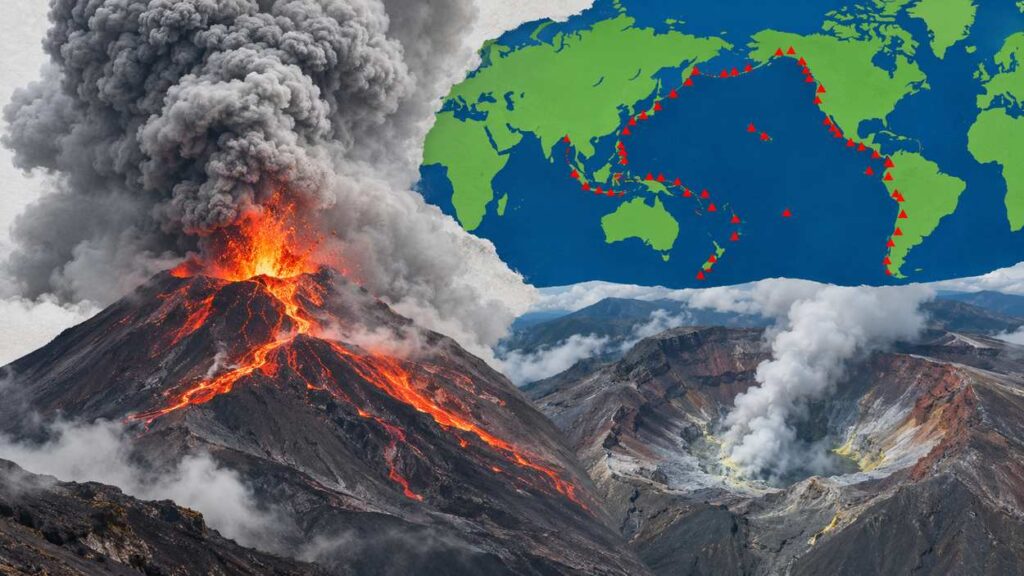
Volcano statistics from the Smithsonian’s Global Volcanism Program (GVP) count 1,214 Holocene volcanoes and 11,089 eruptions in its March 31, 2026 update. The same list held 1,422 Holocene volcanoes in the June 2020 database, and GVP says the numbers will change as new research is published, new age dates are acquired, or new criteria are applied and volcanoes are reviewed.
Continuing eruptions typically number 40 to 50. Of those, generally around 20 are actively erupting on any particular day. In 2025, there were 71 confirmed eruptions from 63 different volcanoes. The U.S. Geological Survey (USGS) counts about 1,350 potentially active volcanoes worldwide, aside from the continuous belts of volcanoes on the ocean floor at spreading centers, a different label from GVP’s Holocene list.
Key Takeaways
- The Holocene list in the Volcanoes of the World database fell from 1,422 in June 2020 to 1,214 in the statistics from the March 31, 2026 update.
- Confirmed eruptions during 2025 totaled 71 from 63 volcanoes, and 29 of them were new eruptions that started during the year.
- Average annual activity from 2000 to 2025 was 78 eruptions from 72 volcanoes, with 36 eruptions started each year.
- According to GVP, 40 volcanoes were in continuing eruption status as of March 31, 2026.
- The list of countries with the most volcanoes starts with the United States at 165 Holocene volcanoes, ahead of Japan at 116, in totals that include overseas territories.
- The 2018 national volcanic threat assessment rates 18 US volcanoes as very high threat, out of a total of 161 volcanoes.
Editor’s Choice
- Potentially active volcanoes worldwide: about 1,350, according to USGS.
- Volcanoes with confirmed eruptions since 1800: 522.
- Indonesian volcanoes active since 1960 CE: 55.
- Santa Maria eruption in Guatemala: 104 years, continuing as of March 18, 2026.
- Noteworthy volcanoes on the GVP list: 140.
- Countries with Holocene volcanoes: 77, plus Antarctica.
Active Volcanoes Worldwide: Holocene and Potentially Active Counts
- Holocene volcanoes total 1,214, with 11,089 eruptions, in the statistics from the March 31, 2026 database update.
- Holocene volcanoes are those that have erupted during the last 12,000 years.
- According to USGS, there are about 1,350 potentially active volcanoes worldwide, and about 500 of those have erupted in historical time.
- Many of those volcanoes are located along the Pacific Rim in what is known as the Ring of Fire.
- GVP writes that “Perhaps the most honest answer to the number question is that we do not really have an accurate count of the world’s volcanoes”.
- There are at least a thousand identified magma systems, on land alone, likely to erupt in the future.
- Dormant intervals between major eruptions at a single volcano may last hundreds to tens of thousands of years, which is why GVP prefers the term “Holocene” volcano to “active volcano”.
- USGS gives about 1,350 potentially active volcanoes, a different label from GVP’s Holocene list of 1,214.
| Holocene statistic | Volcanoes | Eruptions |
|---|---|---|
| All Holocene volcanoes and eruptions | 1,214 | 11,089 |
| Confirmed Holocene eruptions | 853 | 9,916 |
| Confirmed and observed Holocene eruptions | 557 | 6,504 |
Source: Smithsonian GVP, March 2026 update
How many active volcanoes are there?
GVP lists 1,214 Holocene volcanoes as of its March 31, 2026 update, while USGS counts about 1,350 potentially active volcanoes worldwide. About 500 of those have erupted in historical time. The answer depends on whether “active” means activity in the Holocene, potential activity or an eruption in recorded history.
About This Data
- These volcano statistics are compiled from 14 sources: 10 Smithsonian Global Volcanism Program pages, one produced jointly with the U.S. Geological Survey, and 4 U.S. Geological Survey pages.
- Publication dates run from 2018 to November 2026.
- Only government and research-institution data qualified, and figures are updated when those sources publish new editions.
Volcanic Eruptions per Year
- GVP lists 71 confirmed eruptions at some point during 2025.
- There were 74 confirmed eruptions at some point during 2024.
- Of the 2025 eruptions, 29 were new eruptions that started during the year.
- Average annual activity from 2000 to 2025 was 78 eruptions from 72 volcanoes.
- On average, 36 eruptions started and 36 ended each year from 2000 to 2025.
- The 2025 total sits 7 eruptions below the 2000 to 2025 annual average.
- The 2025 figures are reported through the March 31, 2026 data update, so later reviews can still change them.
View the data
How many volcanoes erupt each year?
GVP counted 71 confirmed eruptions from 63 volcanoes during 2025, and the 2000 to 2025 average is 78 eruptions a year from 72 volcanoes. Only 29 of the 2025 eruptions were new eruptions that started during the year. A yearly total therefore includes eruptions that began earlier and kept going.
Recent Developments
- November 6, 2026: Kilauea’s alert level was lowered from WATCH to ADVISORY and its aviation color code from ORANGE to YELLOW, in Hawaiian Volcano Observatory notice 2026/H523.
- November 5, 2026: Episode 56 of the ongoing Halemaʻumaʻu eruption ended at 6:01 p.m. HST at Kilauea.
- November 4, 2026: 27 of the 40 volcanoes on GVP’s March 31, 2026 continuing-eruption list were marked as included in the Smithsonian and USGS Weekly Volcanic Activity Report (WVAR) for the week ending November 4, 2026.
- November 4, 2026: The report for the week of 29 October to 4 November 2026 lists Mayon in the Philippines as New Eruptive Activity, for an eruption that started on 2026 Jan 6.
Volcanoes Erupting Now: Continuing Eruptions in 2026
- 40 volcanoes were in continuing eruption status as of March 31, 2026.
- A continuing eruption indicates at least intermittent eruptive events without a break of 3 months or more, and does not always mean persistent daily activity.
- GVP’s statistics table counts 47 eruptions in its 2026 activity rows, with 41 of them continuing.
- The statistics table and the current-eruptions page give 41 and 40 from the same March 31, 2026 update, and both figures are shown here as published.
- Complete updates are done about every 6 to 8 weeks, and newer eruptions appear in the Weekly Report.
- Indonesia’s currently erupting list for March 31, 2026 named Lewotobi, Lewotolok, Marapi, Merapi, Semeru, Ibu and Dukono.
View the data
How many volcanoes are erupting right now?
40 volcanoes were in continuing eruption status as of March 31, 2026, and generally around 20 are actively erupting on any particular day. 27 of the 40 volcanoes on GVP’s March 31, 2026 continuing-eruption list were marked as included in the weekly report for the week ending November 4, 2026. GVP points readers to the Weekly Report for newer eruptions, though that report is not a comprehensive list of all eruptions in a week.
Countries With the Most Volcanoes
- Holocene volcano counts run 165 for the United States, 116 for Japan and 106 for Russia.
- Holocene volcanoes can be found in 77 different countries, plus Antarctica.
- Indonesia has 101 Holocene volcanoes, with 71 active since 1800 CE and 55 active since 1960 CE.
- Japan has 40 volcanoes active since 1960 CE, against 39 for the United States.
- Ethiopia has 49 Holocene volcanoes, of which 6 have been active since 1960 CE.
- Totals include various categories of overseas territories, and volcanoes along a national boundary are included in the count for each country.
- GVP notes there may be some minor differences from official national agency data due to varying criteria.
| Country | Holocene volcanoes | Active since 1800 CE | Active since 1960 CE |
|---|---|---|---|
| United States | 165 | 63 | 39 |
| Japan | 116 | 61 | 40 |
| Russia | 106 | 46 | 27 |
| Indonesia | 101 | 71 | 55 |
| Chile | 90 | 35 | 19 |
| Ethiopia | 49 | 10 | 6 |
| Papua New Guinea | 39 | 20 | 13 |
| Ecuador | 36 | 17 | 12 |
| Iceland | 35 | 14 | 10 |
| Argentina | 32 | 6 | 3 |
Source: Smithsonian GVP, data as of March 2026
Which country has the most volcanoes?
With 165 Holocene volcanoes as of March 31, 2026, the United States has the most, in a total that includes overseas territories. Japan follows with 116 and Russia with 106. Counted by volcanoes active since 1800 CE, Indonesia has 71 and the United States 63, so the ranking depends on the time window.
Volcano Statistics by Country: Ranks 11 to 20
- Mexico, 11th on the list, has 30 Holocene volcanoes, and Popocatepetl was listed as erupting on March 31, 2026.
- Canada has 24 Holocene volcanoes and 0 active since 1960 CE.
- New Zealand and the Philippines each have 23 Holocene volcanoes.
- Mayon, Kanlaon and Taal were listed as currently erupting in the Philippines on March 31, 2026.
- Kenya has 21 Holocene volcanoes and 0 active since 1960 CE.
- Guatemala has 20 Holocene volcanoes, with Fuego and Santa Maria listed as erupting on March 31, 2026.
- Antarctica has 19 Holocene volcanoes, with Erebus listed as erupting on March 31, 2026.
| Country | Holocene volcanoes | Active since 1800 CE | Active since 1960 CE |
|---|---|---|---|
| Mexico | 30 | 9 | 5 |
| Canada | 24 | 1 | 0 |
| New Zealand | 23 | 9 | 8 |
| Philippines | 23 | 14 | 6 |
| Tonga | 21 | 15 | 9 |
| Kenya | 21 | 5 | 0 |
| Guatemala | 20 | 7 | 5 |
| France | 20 | 11 | 8 |
| Antarctica | 19 | 5 | 2 |
| El Salvador | 17 | 5 | 3 |
Source: Smithsonian GVP, data as of March 2026
Confirmed Eruptions Since 1800 and 1960
- GVP counts 5,413 confirmed eruptions since 1800 from 522 volcanoes.
- 3,155 of the confirmed eruptions since 1800 came before 1960.
- 189 volcanoes with a confirmed eruption since 1800 have none confirmed since 1960.
- The full Holocene record holds 9,916 confirmed eruptions from 853 volcanoes.
- Data about eruptions has been compiled by the Smithsonian since 1968.
- GVP treats the record of large eruptions, whose effects are far reaching and less likely to escape documentation, as a better indicator of the global frequency of eruptions than the improved reporting of smaller eruptions.
| Period | Volcanoes | Confirmed eruptions | Eruptions with known end year |
|---|---|---|---|
| Since 1800 | 522 | 5,413 | 3,783 |
| Since 1960 | 333 | 2,258 | 2,066 |
Source: Smithsonian GVP, March 2026 update
By the numbers: GVP counts 522 volcanoes with confirmed eruptions since 1800 and 333 since 1960, with 5,413 and 2,258 confirmed eruptions in those two periods. Most of the 1,214 volcanoes on the Holocene list have no confirmed eruption since 1800, so the modern record covers under half (522 of 1,214) of the catalogue.
How the Holocene Volcano Count Has Changed
- As of the June 2020 update, version 4.9.0, GVP listed 1,422 volcanoes thought to have erupted or been otherwise volcanically active during the Holocene, and 1,242 on the Pleistocene list.
- By the June 2022 update, version 4.11.0, GVP listed 1,337 Holocene volcanoes and 1,324 on the Pleistocene list.
- Confirmed eruptions totaled 9,874 in the June 2022 version, against 9,926 in the May 2021 version.
- The Holocene list is 208 volcanoes shorter in the March 31, 2026 statistics than in the June 2020 database.
- GVP has tended toward the broader definition of “volcano”, allowing the record of a single large plumbing system to be viewed as a whole.
- Version 5.3.5, dated March 31, 2026, completed a project to provide a name or designation for all previously unnamed volcanoes.
- Version 5.4.0, dated August 7, 2026, completed the review of 2025 eruptions.
View the data
Worth noting: In June 2020, the Volcanoes of the World database listed 1,422 Holocene volcanoes, while the statistics from the March 31, 2026 update count 1,214. GVP says the numbers will change as new age dates are acquired or new criteria are applied, so each count belongs to its date.
US Volcanoes by Threat Level
- The 2018 revised threat assessment includes 18 very high threat volcanoes, out of a total of 161 volcanoes.
- The moderate threat category holds 49 volcanoes.
- 11 of the 18 very high threat volcanoes are located in Washington, Oregon, or California.
- 5 of the 18 very high threat volcanoes are in Alaska near important population centers, economic infrastructure, or below busy air traffic corridors.
- The remaining 2 very high threat volcanoes are on the Island of Hawaiʻi.
- The very low threat category underwent the greatest amount of change, dropping from 32 to 21 volcanoes, owing to better knowledge of the eruptive histories of those volcanoes.
- The total of 161 volcanoes is a decrease of 8 from the total reported by Ewert and others (2005).
- These rankings date from 2018, older than the other figures on this page, and read as that year’s assessment.
View the data
How Many Volcanoes the United States Has
- USGS counts about 170 potentially active volcanoes in the United States and its territories.
- US volcanoes active since 1800 CE number 63, and 39 have been active since 1960 CE.
- Kilauea and Great Sitkin were the US volcanoes listed as currently erupting on March 31, 2026.
- In the United States, volcanoes in the Cascade Range and Alaska (Aleutian volcanic chain) are part of the Ring, while Hawaiian volcanoes form over a hot spot near the center of the Ring.
- The three US counts below use three definitions, so they are not a trend and none of them replaces the others.
| Count | US volcanoes | What is counted |
|---|---|---|
| USGS FAQ | about 170 | Potentially active volcanoes in the US and its territories |
| GVP, March 2026 | 165 | Holocene volcanoes, overseas territories included |
| USGS threat assessment, 2018 | 161 | Volcanoes in the five threat categories |
Source: United States Geological Survey and Smithsonian GVP, 2018 to 2026
Longest Volcanic Eruptions Since 1800
- Santa Maria in Guatemala has been in eruption for 104 years, from 1922 Jun 22, and was continuing as of 2026 Mar 18.
- There have been 163 confirmed eruptions with start dates in 1800 or later that lasted at least 60 consecutive months, from 83 different volcanoes.
- Current continuing eruptions account for 25 of those long eruptions.
- Renewed eruptions after inactivity lasting more than three months count as a new eruption in the Volcanoes of the World database.
- Yasur in Vanuatu is not on the list because there is no clear start date; Captain Cook observed it erupting in 1774.
- Research on Yasur has shown that the same style of activity may have begun around 1270 CE and persisted for over 750 years.
View the data
Key finding: GVP counts 163 confirmed eruptions since 1800 that lasted at least 60 consecutive months, from 83 volcanoes, and current continuing eruptions account for 25 of them. Santa Maria in Guatemala tops the list at 104 years. Many of the longest eruptions are still under way, so their durations keep growing.
Largest Eruptions and the Volcanic Explosivity Index
- The Volcanic Explosivity Index (VEI) is a relative measure of the explosiveness of volcanic eruptions.
- Chris Newhall of the United States Geological Survey and Stephen Self at the University of Hawaii devised the VEI in 1982.
- GVP lists 140 noteworthy volcanoes that meet at least one of its criteria.
- A major eruption, one criterion, is a Holocene eruption with a VEI greater than 5.
- A high fatality eruption is a single eruption that caused at least 100 fatalities.
- A frequently active volcano is one confirmed to have erupted during at least 25 of the past 100 years, since 1925.
- Hayli Gubbi in Ethiopia erupted on 2025 Nov 23, with a Max VEI of 4.
- None of the sources used here ranks the largest eruptions in history, so no all-time ranking is given.
- The table below lists four eruptions that started in late 2025, from November 23 to December 29, 2025, in order of start date rather than size.
| Volcano | Country | Eruption start date | Max VEI |
|---|---|---|---|
| Kikai | Japan | 2025 Dec 29 | 1 |
| Home Reef | Tonga | 2025 Dec 17 | 0 |
| Ambae | Vanuatu | 2025 Nov 24 | 2 |
| Hayli Gubbi | Ethiopia | 2025 Nov 23 | 4 |
Source: Smithsonian GVP, 2025 eruption list (eruptions that started November 23 to December 29, 2025)
Weekly Volcanic Activity Report Coverage
- The Weekly Volcanic Activity Report is a cooperative project between the Smithsonian’s Global Volcanism Program and the US Geological Survey’s Volcano Hazards Program.
- It is updated by 2300 UTC every Thursday and averages 16 reported volcanoes.
- It summarizes activity that meets the report’s criteria and is not a comprehensive list of all eruptions that week.
- Volcanic activity reported there is preliminary and subject to change.
- 27 of the 40 volcanoes on GVP’s March 31, 2026 continuing-eruption list were marked as included in the report for the week ending November 4, 2026.
Is volcanic activity increasing?
The Global Volcanism Program does not see any evidence that volcanic activity is actually increasing. The apparent increase in activity reflects increases in populations living near volcanoes and improvements in communication technologies to report eruptions. That analysis uses data through 2009, and 2024 saw 74 confirmed eruptions, against 71 in 2025.
Conclusion
Volcano statistics from GVP’s March 31, 2026 update count 1,214 Holocene volcanoes, and there were 71 confirmed eruptions during 2025. USGS counts about 1,350 potentially active volcanoes worldwide, a different label from GVP’s Holocene list.
Like asteroid statistics, volcano numbers are catalogue counts that shift when the list is reviewed. Each figure here is best read with the date of the update behind it.
References
- How many active volcanoes are there?
- Current Eruptions
- What was erupting in the year 2025?
- What was erupting in the year 2024?
- Which countries have the most volcanoes? (ranks 1-10)
- Has volcanic activity been increasing?
- What volcanoes have had the longest eruptions?
- Volcanoes of the World (VOTW) Database Information (current version)
- Smithsonian / USGS Weekly Volcanic Activity Report
- What volcanoes are the most noteworthy?
- How many active volcanoes are there on Earth?
- 2018 update to the U.S. Geological Survey national volcanic threat assessment (SIR 2018-5140)
- Kilauea - Volcano Updates
- Volcano Hazards Program Glossary - VEI
