

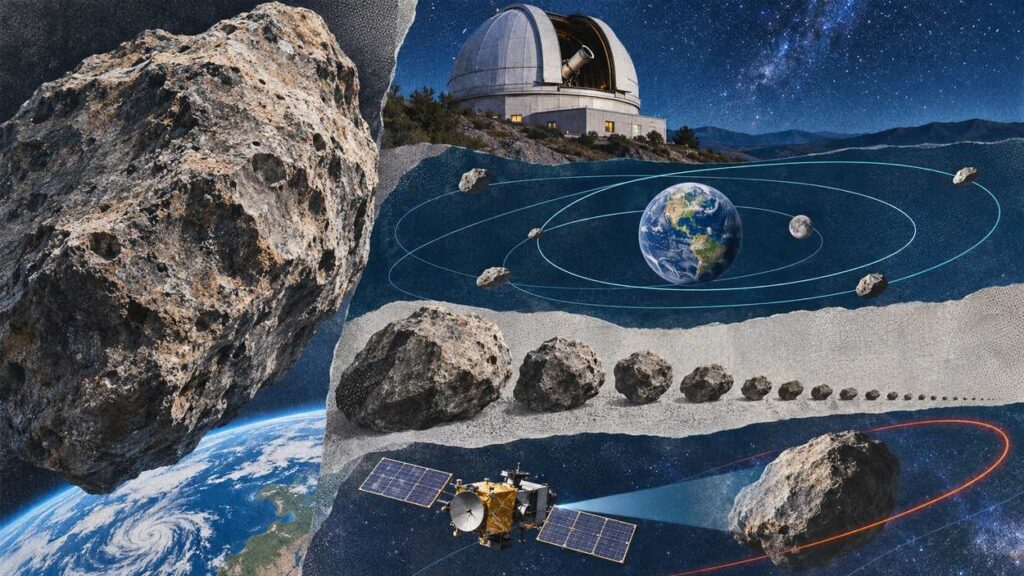
NASA’s Center for Near Earth Object Studies (CNEOS) counts 42,978 known near-Earth asteroids as of its latest discovery date, November 5, 2026. That count anchors the asteroid statistics below. The Minor Planet Center of the International Astronomical Union (IAU) lists 1,583,336 objects in its catalog, 4,644 of them comets.
Of the near-Earth asteroids, 2,533 are potentially hazardous asteroids (PHAs). NASA defines that class by how close an orbit can come to Earth’s and by size. The known near-Earth asteroid count grew by 3,240 during 2025, against 1,586 added in 2015. Counts come from NASA, the European Space Agency (ESA), the IAU and a peer-reviewed survey model, and the catalogs change every week.
Key Takeaways
- CNEOS lists 42,978 near-Earth asteroids, 24,491 of them in the Apollo orbit group, according to NASA.
- The known near-Earth asteroid count grew by 3,240 in 2025, up from 1,586 in 2015.
- 11,699 known near-Earth asteroids measure roughly 140 meters and larger, while a 2023 model put the catalog at about 38% complete for objects larger than 140 meters, per Grav and colleagues.
- 2,533 asteroids are potentially hazardous, and 156 of those are roughly one kilometer and larger.
- NASA’s Sentry system lists 2,241 objects and ESA’s risk list holds 2,208 near-Earth asteroids, both on November 7, 2026, according to NASA and ESA.
- NASA’s close-approach data records 189 approaches within one lunar distance of Earth in 2025.
Editor’s Choice
- Objects in the Minor Planet Center catalog: 1,583,336 in total, per the IAU Minor Planet Center.
- Numbered minor planets: 895,910 in the same catalog.
- Near-Earth objects, asteroids and comets combined: 43,103 in the latest CNEOS count.
- Near-Earth asteroids roughly one kilometer and larger: 884 known to CNEOS.
- Main-belt asteroids larger than one kilometer: an estimated 1.1 to 1.9 million.
- Fireballs in the CNEOS fireball data for 2025: 33 events.
How Many Asteroids Are There
- 1,583,336 objects appear in the Minor Planet Center catalog, a total that includes 4,644 comets, so “objects” is the accurate word for the headline count.
- Its catalog rests on 560,290,134 observations.
- The main asteroid belt between Mars and Jupiter is estimated to contain between 1.1 and 1.9 million asteroids larger than 1 kilometer in diameter, and millions of smaller ones.
- Vesta is the largest asteroid at about 530 kilometers in diameter, while sizes range down to asteroids less than 10 meters across.
- The total mass of all the asteroids combined is less than that of Earth’s Moon.
- More than 150 asteroids are known to have small companion moons, and some have two.
- Near-Earth objects orbit within 30 million miles (48 million kilometers) of Earth’s orbit.
| Catalog count | Figure | Source |
|---|---|---|
| Objects in the Minor Planet Center catalog | 1,583,336 | IAU Minor Planet Center |
| Numbered minor planets | 895,910 | IAU Minor Planet Center |
| Unnumbered minor planets | 682,782 | IAU Minor Planet Center |
| Comets | 4,644 | IAU Minor Planet Center |
| Observations | 560,290,134 | IAU Minor Planet Center |
| Near-Earth objects (November 5, 2026) | 43,103 | NASA CNEOS |
| Near-Earth asteroids (November 5, 2026) | 42,978 | NASA CNEOS |
Source: IAU Minor Planet Center summary page and NASA CNEOS discovery statistics, November 2026
How many asteroids are there?
The IAU Minor Planet Center catalog holds 1,583,336 objects, made up of 895,910 numbered minor planets, 682,782 unnumbered minor planets and 4,644 comets.
How many asteroids are in the asteroid belt?
NASA estimates that the main belt between Mars and Jupiter contains between 1.1 and 1.9 million asteroids larger than 1 kilometer, and millions of smaller ones. Most asteroids orbit the Sun within this belt, generally on orbits that are not very elongated.
About This Data
Compiled from 15 sources: 11 NASA pages, 2 European Space Agency pages, 1 IAU Minor Planet Center summary and 1 peer-reviewed paper. Publication dates run from 2023 to November 2026. Only official agency data and peer-reviewed research qualified. Figures are reviewed on a rolling basis and updated when the catalogs publish new counts.
Near-Earth Asteroids Known Over Time
- CNEOS counted 42,978 known near-Earth asteroids on November 5, 2026.
- 40,642 near-Earth asteroids were known on January 1, 2026, up from 12,137 on January 1, 2015.
- The count grew by 3,240 during 2025, against 1,586 during 2015.
- Another 2,336 were added between January 1 and November 5, 2026.
- On January 1, 2000, CNEOS counted 884 known near-Earth asteroids, and by January 1, 2010 the figure was 6,700.
- Near-Earth objects are asteroids and comets with a perihelion distance of less than 1.3 astronomical units (au), the closest point of their orbit to the Sun.
- The vast majority of near-Earth objects are asteroids, referred to as near-Earth asteroids (NEAs).
View the data
How many near-Earth asteroids are there?
NASA’s CNEOS lists 42,978 known near-Earth asteroids and 43,103 near-Earth objects once comets are added, as of the November 5, 2026 discovery date. CNEOS dates its discovery statistics table by the most recent discovery, not by the day the table was updated, so the totals move as new objects are confirmed.
Recent Developments
- November 7, 2026: ESA’s NEO Coordination Centre counted 2,208 near-Earth asteroids on its risk list, while NASA’s Sentry list held 2,241 objects.
- November 5, 2026: Asteroid 1950 DA was last observed, and Sentry lists one potential impact in the year 2880 with a probability of 3.401e-04.
- November 1, 2026: The CNEOS near-Earth object total reached 43,000.
- October 27, 2026: ESA reported that its Hera spacecraft had resolved Didymos and Dimorphos separately for the very first time, from 1,280 km away.
- October 15, 2026: Asteroid 2026 TP128 made the closest of 44 approaches within one lunar distance recorded in NASA’s close-approach data between August 1 and November 7, 2026.
- September 11, 2026: A fireball released an estimated impact energy of 0.67 kt, one of 8 events in the CNEOS fireball data since the start of August.
Near-Earth Asteroids by Size
- CNEOS lists 11,699 near-Earth asteroids roughly 140 meters and larger on November 5, 2026.
- 11,466 near-Earth asteroids roughly 140 meters and larger were known on January 1, 2026, up from 6,355 on January 1, 2015.
- 884 known near-Earth asteroids are roughly one kilometer and larger.
- 826 near-Earth asteroids were in the one-kilometer class on January 1, 2015, so 58 have been added since.
- On January 1, 2000, the count of near-Earth asteroids roughly one kilometer and larger was 299.
- CNEOS defines its size classes as diameters of roughly 140 meters and larger, and roughly one kilometer and larger.
View the data
How Complete Is the Near-Earth Asteroid Search
- A 2023 model by Grav and colleagues found the near-Earth asteroid population about 38% complete for objects larger than 140 meters.
- Grav and colleagues, citing Mainzer et al. 2023, project that NEO Surveyor will catalog more than two thirds of near-Earth asteroids larger than 140 meters during its nominal survey.
- NASA describes NEO Surveyor as the first space telescope specifically designed to detect asteroids and comets that may be potential hazards to Earth.
- The mission’s launch is set for no earlier than September 2027.
- Its infrared detectors are meant to find dark asteroids that reflect little visible light.
| Measure | Figure | Source |
|---|---|---|
| Known near-Earth asteroids roughly 140 meters and larger (November 5, 2026) | 11,699 | NASA CNEOS |
| Modelled completeness for objects larger than 140 meters | about 38% | Grav et al. 2023 |
| Projected completeness after NEO Surveyor’s 5-year survey | about 76% | Grav et al. 2023, citing Mainzer et al. 2023 |
| NEO Surveyor launch | no earlier than September 2027 | NASA |
Source: NASA CNEOS 2026, Grav and colleagues 2023, NASA NEO Surveyor mission page 2026
Worth noting: Grav and colleagues placed the known catalog at about 38% complete for near-Earth asteroids larger than 140 meters, consistent with estimates by Harris and Chodas from 2021. That model dates from 2023, more than 12 months ago, so its share describes the catalog at that time, not the November 2026 count.
Potentially Hazardous Asteroids
- CNEOS counts 2,533 potentially hazardous asteroids, 156 of them roughly one kilometer and larger.
- 2,501 potentially hazardous asteroids were known on January 1, 2026, up from 1,504 on January 1, 2015.
- The count rose by 896 from the January 1, 2016 figure to 2,501 on January 1, 2026.
- An asteroid is a PHA when its Earth Minimum Orbit Intersection Distance (MOID) is 0.05 au or less and its absolute magnitude is 22.0 or less.
- NASA puts it as an orbit within 4.6 million miles of Earth’s orbit and an estimated diameter of 460 feet (140 meters) or greater.
- “This potential to make a close approach to Earth does not mean a PHA will impact the Earth.”
View the data
How many potentially hazardous asteroids are there?
CNEOS lists 2,533 potentially hazardous asteroids as of the November 5, 2026 discovery date. NASA says the label means only that there is a possibility of such a threat, not that a PHA will impact the Earth. The group is defined by orbit and size, not by any computed impact.
Near-Earth Asteroids by Orbit Group
- 24,491 near-Earth asteroids belong to the Apollo group and 14,922 to the Amor group.
- The four groups add up to 42,978, the full near-Earth asteroid count.
- NASA divides near-Earth asteroids into the Atira, Aten, Apollo and Amor groups by perihelion distance, aphelion distance and semi-major axis.
- 13 asteroids were in the Atira group on January 1, 2015, and the group has gained 28 since.
- CNEOS also tracks 125 near-Earth comets.
View the data
Asteroid Discoveries by Survey
- Pan-STARRS was credited with 1,289 near-Earth asteroid discoveries in 2025, against 880 for Catalina.
- Through the CNEOS data date of November 6, 2026, Catalina had 708 discoveries this year and Pan-STARRS 674.
- Other US surveys rose from 82 discoveries in 2020 to 555 in 2025.
- NEOWISE is credited with 5 discoveries in 2024, the last year in its series.
View the data
By the numbers: NASA’s CNEOS credits Pan-STARRS with 1,289 near-Earth asteroid discoveries in 2025 and Catalina with 880. Surveys grouped as other US programs reached 555 that year, up from 82 in 2020. A growing share of discoveries now comes from surveys other than Catalina and Pan-STARRS.
Catalina and Pan-STARRS Discoveries by Year
- Catalina was credited with 1,520 near-Earth asteroid discoveries in 2020 and 880 in 2025.
- Pan-STARRS went from 1,154 in 2020 to 1,368 in 2024 and 1,289 in 2025.
- In 2023, Pan-STARRS recorded 1,107 discoveries against Catalina’s 1,093.
- ATLAS ranged from 114 to 167 discoveries a year between 2020 and 2025.
View the data
Asteroid Close Approaches Within the Moon’s Distance
- NASA’s close-approach data lists 189 approaches to Earth within one lunar distance in 2025.
- 160 such approaches are listed for 2021, and 114 for 2023.
- The five years from 2021 to 2025 add up to 750 approaches.
- 44 approaches within one lunar distance are recorded between August 1 and November 7, 2026.
- The closest in that window was 2026 TP128 on October 15, 2026.
- These counts reflect approaches by objects known today, so they track discovery as much as traffic, and they are not a measure of impact risk.
View the data
How Often Asteroids Hit Earth by Size
- NASA says asteroids about 10 meters across impact Earth about once a decade, causing a very bright fireball and a strong sonic boom.
- An asteroid of about 140 meters hits Earth about every 20,000 years, creating a crater 1 to 2 kilometers in diameter.
- Asteroids of about 10,000 meters are estimated to hit Earth about every 100 million years.
- A house-sized asteroid exploded over Chelyabinsk, Russia, releasing energy equivalent to about 440,000 tons of TNT on February 15, 2013.
- NASA describes a crater about 1.2 kilometers wide made about 50,000 years ago by an asteroid thought to be 30 to 50 meters in size.
- The CNEOS fireball data lists 33 events for 2025.
| Asteroid size | Average interval between impacts | Effect NASA describes |
|---|---|---|
| 10 meters (30 feet) | about once a decade | very bright fireball and strong sonic boom |
| 50 meters (160 feet) | about every 1,000 years | local devastation |
| 140 meters (500 feet) | about every 20,000 years | crater 1 to 2 km in diameter |
| 1 km (3,000 feet) | about every 700,000 years | global devastation |
| 10 km (6 miles) | about every 100 million years | mass extinctions of life |
Source: NASA Science, Asteroid Facts 2026
Key finding: NASA estimates that an asteroid of about 140 meters hits Earth about every 20,000 years, and one of about 1,000 meters about every 700,000 years. Those are long-run averages, the same way recurrence figures for large volcanic eruptions are read, and say nothing about when the next impact will come.
How often do asteroids hit Earth?
Small asteroids about 10 meters across hit Earth about once a decade, while those of about 1,000 meters arrive about every 700,000 years, per NASA. Larger impacts are rarer still: asteroids of about 10,000 meters are estimated to hit about every 100 million years.
Asteroid Impact Monitoring Lists
- NASA’s Sentry list and ESA’s risk list differed by 33 objects on November 7, 2026, each under its own system and definition.
- Sentry continually scans the most current asteroid catalog for possible impacts with Earth over the next 100 years.
- Objects disappear from the Sentry table once additional observations rule out any potential impact.
- NASA concluded that asteroid 2024 YR4 poses no significant impact risk to Earth in 2032 and beyond, and James Webb Space Telescope data ruled out a lunar impact on December 22, 2032.
| Monitoring list | Objects listed | Last update | What puts an object on the list |
|---|---|---|---|
| NASA JPL Sentry | 2,241 | November 7, 2026 | a possible Earth impact over the next 100 years |
| ESA NEO Coordination Centre risk list | 2,208 | November 7, 2026, 10:51 UTC | a non-zero computed impact probability |
Source: NASA JPL Sentry, ESA NEO Coordination Centre, November 2026
Neither list is a forecast of an impact: both hold objects whose orbits still leave a small computed chance. Objects leave the lists once further observations rule out an impact.
Asteroid Statistics From Planetary Defense Missions
- NASA’s Double Asteroid Redirection Test (DART) impacted the moonlet Dimorphos, 160 meters in diameter, on Sept. 26, 2022.
- The impact shortened Dimorphos’s 12-hour orbit around Didymos by 33 minutes.
- It also changed the binary’s orbital period around the Sun by 0.15 seconds.
- NASA puts the momentum enhancement factor at about two, meaning debris loss doubled the push from the spacecraft alone.
- ESA said on October 27, 2026, that Hera imaged Didymos and Dimorphos on October 18, with the system some 197 million km from Earth.
- ESA plans to unveil the first detailed images of Dimorphos on 25 November.
| Mission fact | Figure | Source |
|---|---|---|
| DART impact on Dimorphos | September 26, 2022 | NASA |
| Dimorphos diameter | 160 meters | NASA |
| Dimorphos diameter | 151 meters | ESA |
| Didymos diameter | 780 meters | NASA and ESA |
| Change in Dimorphos orbit around Didymos | 33 minutes shorter | NASA |
| Change in the pair’s orbit around the Sun | 0.15 seconds | NASA |
| Hera distance at first resolved image | 1,280 km | ESA |
Source: NASA DART mission pages 2026, ESA Hera release 2026
NASA and ESA publish different diameters for Dimorphos, so each figure is shown with the agency that gave it.
Will an asteroid hit Earth?
Scientists at NASA’s CNEOS say it is highly unlikely that an asteroid large enough to cause widespread damage will impact Earth for the next 100 years or more. NASA also concluded that 2024 YR4, once given a very small chance of hitting Earth, poses no significant impact risk in 2032 and beyond.
Conclusion
CNEOS now counts 42,978 known near-Earth asteroids, 2,533 of them potentially hazardous, and the catalog grows by thousands each year. A 2023 peer-reviewed model put the catalog of near-Earth asteroids larger than 140 meters at about 38% complete, so most of the growth to come lies in objects not yet found.
NEO Surveyor, with launch set for no earlier than September 2027, is built to find large numbers of potentially hazardous asteroids and comets. The near-Earth count will keep climbing as it and the ground surveys add objects, and each new count deserves to be read with its date.
References
- CNEOS Discovery Statistics: NEO Totals
- CNEOS Discovery Statistics: NEA Discoveries by Survey
- NEO Basics: NEO Groups
- Asteroid Facts
- MPC Summary: Latest Published Data
- CNEOS Sentry: Earth Impact Monitoring
- Risk List
- CNEOS NEO Earth Close Approaches
- CNEOS Fireballs
- 2024 YR4
- Double Asteroid Redirection Test (DART)
- NASA's DART Mission Changed Orbit of Asteroid Didymos Around Sun
- NEO Surveyor
- The NEO Surveyor Near-Earth Asteroid Known Object Model (Grav et al. 2023, Planetary Science Journal)
- First light: Hera resolves two asteroids instead of one
