

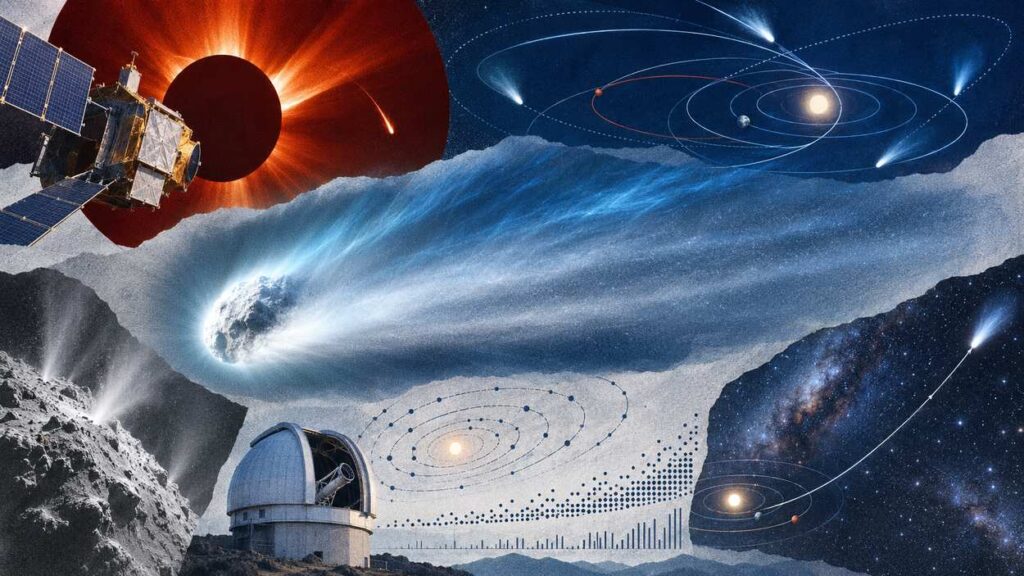
NASA’s Jet Propulsion Laboratory (JPL) Small-Body Database returned 4,087 comets on November 9, 2026, a core figure in comet statistics. The International Astronomical Union’s Minor Planet Center (MPC) gives a second total: 4,644 comets in its catalog, in a batch of Minor Planet Circulars dated 2026-04-14. The two catalogs are counted separately here, each with its date.
SOHO’s discovery count is separate from both catalog totals. Comet number 5,000 discovered using data from the Solar and Heliospheric Observatory (SOHO) was spotted on March 25, 2024. NASA said then that SOHO had discovered more than half of the comets known at the time. Discovery continues every year: the NASA Planetary Data System (PDS) Small Bodies Node counts 37 long-period comet discoveries in 2025 and 10 short-period discoveries in 2025.
Key Takeaways
- NASA’s JPL Small-Body Database returned 4,087 comets in a query on November 9, 2026.
- The Minor Planet Center catalog held 4,644 comets in its batch dated 2026-04-14, a separate count from JPL’s.
- SOHO reached 5,000 comet discoveries in March 2024, which NASA described as more than half of the comets known at the time, according to NASA’s March 2024 release.
- The JPL Small-Body Database places 1,763 comets on parabolic orbits, as of November 9, 2026.
- The NASA PDS Small Bodies Node counts 37 long-period and 10 short-period comet discoveries for 2025.
- According to NASA’s Center for Near Earth Object Studies (CNEOS), 125 near-Earth comets were counted on November 8, 2026.
Editor’s Choice
- Numbered comets in the JPL database: 610, as of November 9, 2026.
- SOHO time in space at its 5,000th comet: over 28 years, according to NASA.
- Jupiter-family comets in the JPL database: 834.
- Halley-type comets in the JPL database: 112.
- SOHO comets in the Marsden group: about 75 of the 5,000.
- Halley’s Comet next return: 2061.
Comet Statistics by Catalog: How Many Comets Are There
- On November 9, 2026, NASA JPL’s Small-Body Database returned 4,087 comets, 610 of them numbered.
- According to the IAU Minor Planet Center, its catalog lists 4,644 comets in the batch dated 2026-04-14. That batch date is about seven months older than the JPL query.
- NASA estimates that there are likely billions of comets orbiting our Sun in the Kuiper Belt and the even more distant Oort Cloud. That figure is an estimate, not a count.
- Comets are leftovers from the dawn of our solar system around 4.6 billion years ago, and consist mostly of ice coated with dark organic material.
- SOHO alone had discovered more than half of the comets known in March 2024.
| Comet count | Total | Date |
|---|---|---|
| JPL Small-Body Database, all comets | 4,087 | November 9, 2026 query |
| JPL Small-Body Database, numbered comets | 610 | November 9, 2026 query |
| Minor Planet Center catalog, comets | 4,644 | Batch dated 2026-04-14 |
| Minor Planet Center catalog, all objects | 1,583,336 | Batch dated 2026-04-14 |
| Comets discovered using SOHO data | 5,000 | March 2024 |
Source: NASA JPL, IAU Minor Planet Center, NASA
About This Data
Compiled from 21 sources: 15 NASA and JPL pages, and 1 NASA PDS Small Bodies Node page. The rest are 3 IAU Minor Planet Center pages and 1 each from the European Space Agency (ESA) and the Naval Research Laboratory. Source dates run from March 2024 to November 2026. Only official agency data and catalogs qualify. Figures are reviewed on a rolling basis and updated when sources publish new data.
Short-Period Comets by Orbit Class
- Jupiter-family comets (JFc) in the JPL database: 834 comets on November 9, 2026.
- Halley-type comets (HTC): 112 in the same query.
- JPL describes its Encke-type class as Encke-type comets, as defined by Levison and Duncan.
- NASA describes short-period comets as taking less than 200 years to orbit the Sun. In many cases their appearance is predictable because they have passed by before.
View the data
Recent Developments
- November 9, 2026: JPL’s Small-Body Database lists C/2026 S1 (Euclid), with orbit class COM (Comet), among its 4,087 comets.
- October 30, 2026: The Minor Planet Center’s newsletter described automating the validation and orbit fitting of newly submitted comet observations.
- October 14, 2026: The Small Bodies Node updated its comet discoveries page, counting 20 long-period and 5 short-period discoveries for 2026 so far.
- October 5, 2026: NASA’s October skywatching post said the Orionid meteor shower would peak on Oct. 21, and viewers may see about 3 to 6 meteors per hour in suburban areas, from debris shed by Halley’s Comet.
Long-Period and Non-Periodic Comets
- Comets on parabolic orbits (PAR) number 1,763 in the JPL database, as of November 9, 2026.
- Parabolic orbits outnumber hyperbolic orbits by 1,243 comets in the same query.
- JPL’s COM class is a comet orbit not matching any defined orbit class.
- NASA says long-period comets are less predictable, and many arrive from a region called the Oort Cloud about 100,000 astronomical units away.
View the data
The seven JPL class counts across this section and the one above do not add up to the database total, so they are shown as separate class counts only.
Numbered Periodic Comets
- The JPL Small-Body Database holds 610 numbered comets on November 9, 2026.
- The assignment of periodic comet numbers is the responsibility of the Minor Planet Center.
- The highest number on the MPC list is 516P PANSTARRS, P/2026 B1, on a list last updated on 2026 May 30.
| Periodic comet numbering | Value |
|---|---|
| Numbered comets, JPL Small-Body Database | 610 |
| Highest periodic comet number, MPC | 516P |
Source: NASA JPL, IAU Minor Planet Center, 2026
How many periodic comets are there?
JPL’s Small-Body Database returns 610 records for numbered comets as of November 9, 2026, and the Minor Planet Center’s list of periodic comet numbers runs to 516P as of its May 30, 2026 update. The two figures count different things, JPL database records and MPC number assignments, so they do not match. Only periodic comets the MPC has numbered appear on that list, so the numbered total is not a count of every periodic comet.
Long-Period Comet Discoveries per Year
- The NASA PDS Small Bodies Node counts 58 long-period comet discoveries in 2020, up from 44 in 2019.
- Long-period discoveries numbered 47 in 2024 and 37 in 2025.
- The page notes that the site is currently under development, and that until a comet receives a number, periodic comets with periods of greater than twenty years may be listed as long-period.
View the data
How many comets are discovered per year?
The Small Bodies Node series counts 37 long-period and 10 short-period discoveries in 2025, or 47 comets combined. Its interstellar series adds 1 object in 2025. These yearly counts are separate from SOHO’s running total.
View the data
Short-Period Comet Discoveries per Year
- Short-period comet discoveries numbered 20 in 2021 in the Small Bodies Node series.
- The count was 18 in both 2019 and 2020, then 14 in 2024 and 10 in 2025.
- The 2026 total stood at 5 in data updated through October 14, 2026.
View the data
SOHO Comet Discoveries
- SOHO, a joint mission of ESA and NASA, launched in December 1995.
- On March 25, 2024, a citizen scientist in the Czech Republic spotted the 5,000th comet discovered using SOHO data.
- SOHO reached that milestone over 28 years in space, even though it was never designed to be a comet hunter.
- Most of the 5,000 comets discovered using SOHO have been found with the help of volunteer comet hunters in the Sungrazer Project.
- The Naval Research Laboratory (NRL) wrote in 2024 that it takes approximately 4 to 5 years for 1,000 comet discoveries, and that the SOHO mission is nominally scheduled to end on December 31, 2025. These SOHO figures date from March 2024, more than 12 months ago.
| SOHO milestone | Value |
|---|---|
| Launch | December 1995 |
| 5,000th comet spotted | March 25, 2024 |
| Time in space at 5,000 | Over 28 years |
| Share of comets known in March 2024 | More than half |
| Pace of discovery | About 4 to 5 years per 1,000 comets |
Source: NASA, Naval Research Laboratory, 2024
Key finding: NASA’s March 2024 release says SOHO had discovered more than half of the comets known at the time. Its 5,000th comet came over 28 years in space, and most of the 5,000 comets discovered using SOHO have been found with the help of volunteer comet hunters.
How many comets has SOHO found?
SOHO reached its 5,000th comet on March 25, 2024, according to NASA. The NRL put the pace at approximately 4 to 5 years for 1,000 comet discoveries. No later SOHO total is in the sources used here.
Sungrazing Comets and the Marsden Group
- Before the launch of SOHO and the Sungrazer Project, according to a quote in NASA’s 2024 release, “there were only a couple dozen sungrazing comets on record.”
- Only about 75 of the 5,000 comets discovered with SOHO belong to the Marsden group.
- ESA says Marsden group comets are thought to be pieces shed by the much bigger Comet 96P/Machholz, which passes close to the Sun every 5.3 years.
| Marsden group statistic | Value |
|---|---|
| SOHO comets in the Marsden group | About 75 |
| Parent comet 96P/Machholz, years between passes near the Sun | 5.3 |
Source: NASA, ESA, 2024
Near-Earth Comets
- NASA’s CNEOS counted 125 near-Earth comets on November 8, 2026.
- Near-Earth asteroids outnumber near-Earth comets by far: the same November 8, 2026 row counts 43,021 asteroids.
- The near-Earth comet count was 110 on January 1, 2016, a rise of 15 to the November 8, 2026 total.
View the data
Notable Comets and Return Dates
- Astronomers have linked Halley’s appearances to observations dating back more than 2,000 years.
- Halley was last seen in Earth’s skies in 1986 and will return in 2061 on its regular 76-year orbit around the Sun.
- Swift-Tuttle last reached perihelion in 1992 and will return again in 2125.
- According to NASA, Comet Encke has the shortest orbital period of any known comet within our solar system, at 3.30 years.
- Hale-Bopp was visible to the naked eye for 18 months in 1996 and 1997.
- Comet 67P/Churyumov-Gerasimenko made history as the first comet to be orbited and landed upon by robotic spacecraft from Earth.
| Comet | Orbital period (years) | Nucleus size | Last seen or perihelion | Next return |
|---|---|---|---|---|
| 1P/Halley | 76 | 1986 | 2061 | |
| 109P/Swift-Tuttle | 133 | 26 km | 1992 | 2125 |
| 2P/Encke | 3.30 | About 4.8 km | ||
| C/1995 O1 (Hale-Bopp) | About 2,534 | About 60 km | Discovered July 23, 1995 | |
| 67P/Churyumov-Gerasimenko | Discovered Oct. 22, 1969 |
Source: NASA Science, 2026
By the numbers: NASA says Halley was last seen in Earth’s skies in 1986 and will return in 2061 on its regular 76-year orbit around the Sun. Comet 109P/Swift-Tuttle takes 133 years to orbit the Sun once and will return again in 2125, while Encke takes 3.30 years to orbit the sun once.
When will Halley’s Comet return?
Halley’s Comet will return in 2061 on its regular 76-year orbit around the Sun, according to NASA. It was last seen in Earth’s skies in 1986, when it was met in space by an international fleet of spacecraft.
Interstellar Comets
- Comet 2I/Borisov is the first confirmed interstellar comet, discovered by Crimean amateur astronomer Gennady Borisov on Aug. 30, 2019.
- Comet 3I/ATLAS is the third known object from outside our solar system to be discovered passing through our celestial neighborhood.
- The ATLAS survey telescope in Chile first reported its sighting of 3I/ATLAS to the Minor Planet Center on July 1, 2025.
- In the Small Bodies Node data, the interstellar series lists 1 object in 2017 and 1 in 2025.
| Interstellar object | Fact | Date |
|---|---|---|
| 2I/Borisov | First confirmed interstellar comet | Discovered Aug. 30, 2019 |
| 3I/ATLAS | Third known object from outside the solar system | First reported July 1, 2025 |
Source: NASA Science, 2025
Worth noting: NASA says Comet 2I/Borisov is the first confirmed interstellar comet, discovered on Aug. 30, 2019, and 3I/ATLAS is the third known object from outside our solar system. In the Small Bodies Node data, the interstellar series lists 1 object in 2017, so Borisov is the first interstellar comet but not the first interstellar object.
How long do comets take to orbit the Sun?
Short-period comets take less than 200 years to orbit the Sun, according to NASA. At the short end, Encke takes 3.30 years to orbit the sun once. For a long-period example, Hale-Bopp takes about 2,534 years to orbit the sun once. Many long-period comets come from the distant Oort Cloud.
Conclusion
NASA JPL’s database returned 4,087 comets in its latest query, and the Minor Planet Center catalog lists 4,644 in an older batch, so any comet total needs its catalog and date. SOHO’s 5,000 discoveries by March 2024 are a separate count from both catalogs.
New discoveries keep arriving at a pace of 47 long-period and short-period comets in 2025, by the Small Bodies Node’s count. Halley’s return in 2061 is its next scheduled appearance, according to NASA.
References
- JPL Small-Body Database Query
- Periodic Comet Numbers
- Comet Facts
- Comets
- ESA, NASA Solar Observatory Discovers Its 5,000th Comet
- SOHO-5000!
- SOHO reaches 5000 comets
- Comet Discoveries by Year (Discovery Years, Comet Statistics)
- CNEOS Discovery Statistics: NEO Totals
- 1P/Halley
- 109P/Swift-Tuttle
- 2P/Encke
- C/1995 O1 (Hale-Bopp)
- 67P/Churyumov-Gerasimenko
- 2I/Borisov
- Comet 3I/ATLAS
- Newsletter - October 2026
- Disappearing Planets, Dragon Fireballs, Hunter’s Moon Fill October’s Spooky Skies
- SBDB Lookup: C/2026 S1 (Euclid)
- MPC Summary: Latest Published Data
- SBDB Filtering: Orbit Classes
