

AI in education is no longer a futuristic concept; it’s a measurable reality reshaping how teachers teach and students learn. Across the U.S. and around the world, AI tools have moved from pilot projects to daily use, helping personalize learning, automate administrative work, and enhance student outcomes. From adaptive tutoring platforms used in classrooms to AI-powered grading systems aiding faculty, the technology is changing education at every level. In this article, we explore the latest statistics, showing how AI adoption is accelerating and what that means for learners and educators alike.
Editor’s Choice
- 86% of students globally use AI tools in their academic work in 2025.
- 92% of university students report using AI, up significantly from 66% in 2024.
- The global AI in education market is valued at $7.57 billion in 2025.
- 60% of U.S. teachers now integrate AI tools into their teaching.
- 57% of higher education institutions prioritize AI in 2025, up from 49% last year.
- Over 47% of education leaders use AI daily in operations and strategy.
- Three in 10 teachers use AI weekly, saving around 6 hours per week.
Recent Developments
- A major education publisher partnered with Google to transform 2 million textbooks into AI tutors.
- The U.S. Department of Education issued new guidance on responsible AI use in schools.
- Nine in 10 higher education professionals use AI tools for research and writing tasks.
- Universities revised their academic integrity policies due to the rise of generative AI.
- AI literacy is increasingly viewed as a key career skill by students.
- Institutions are shifting from AI pilot programs to full infrastructure investments.
- Public AI frameworks now emphasize ethical and practical implementation.
- AI chatbots are widely used for 24/7 admissions and student support services.
Overview of Technology Use in Education With AI Integration
- 86% of students globally use AI tools in their studies.
- 92% of university students reported AI usage, compared to 66% in 2024.
- 60% of U.S. teachers engage with AI tools for instruction and classroom tasks.
- 85% of K–12 teachers use generative AI in classroom settings.
- 38% of educators use AI for lesson planning and 37% for content creation.
- 44% of educators use AI for research purposes.
- Nearly 60% of U.S. principals use AI tools for administrative tasks.
- 57% of higher education institutions prioritize AI adoption institution-wide.
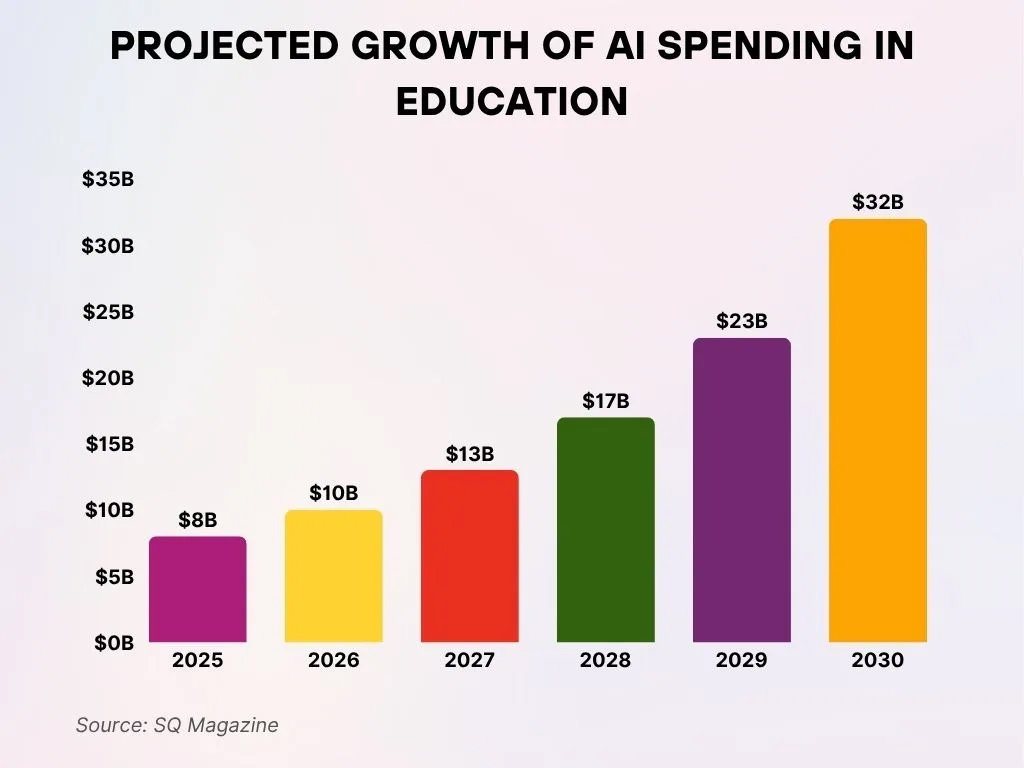
Forecasted Expansion of AI Investment in Education
- In 2025, AI spending in education is anticipated to reach $8 billion, reflecting growing institutional adoption.
- By 2026, the education AI market is projected to expand further, reaching $10 billion in total spending.
- In 2027, overall AI expenditures are expected to climb to $13 billion, continuing the upward growth trend.
- The year 2028 is forecasted to witness a rise to $17 billion, signaling accelerating adoption across the education sector.
- By 2029, AI investments in education are predicted to surge and hit $23 billion globally.
- In 2030, annual AI spending in education is expected to soar to $32 billion, demonstrating a quadruple increase from 2025.

Statistics on The Adoption of AI in Education Systems
- 60% of teachers in the U.S. use AI daily in 2025.
- 32% of teachers use AI at least weekly.
- 86% of students globally use AI, with more than half using it weekly.
- Three in 10 teachers save nearly 6 hours per week using AI tools.
- Over 47% of education leaders rely on AI daily for operations.
- Nearly 60% of principals report AI use across school systems.
- 44% of educators use AI for academic research.
- 85% of K–12 teachers use generative AI, compared with 22% of higher education faculty.
Faculty and Teacher Usage Patterns Involving AI
- 53% of teachers use AI for grading and assessment in 2025.
- 56% of teachers rely on AI analytics to track student progress.
- Educators report reduced administrative workload through AI.
- 58% of university instructors use AI in daily teaching practices.
- AI supports lesson planning, quizzes, and curriculum development.
- Teachers show higher adoption when training and policies are clear.
- AI use extends beyond grading to research and instruction support.
- Professional development programs increase educator confidence with AI.
Ways Students Are Engaging With Generative AI
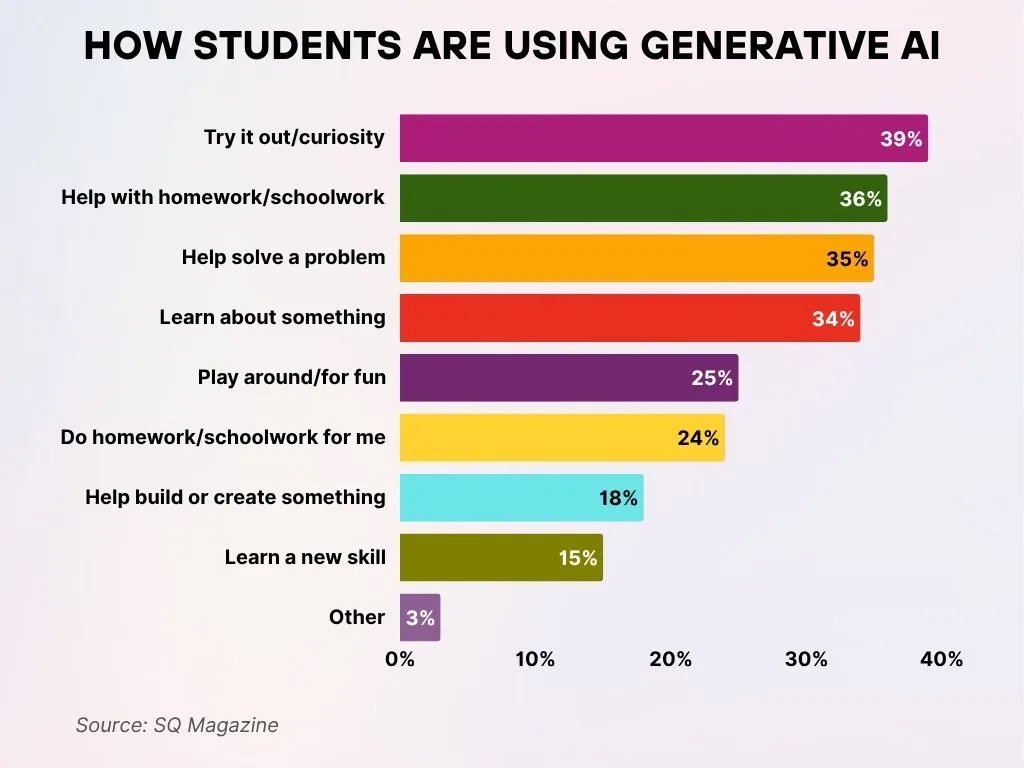
- 39% of students report using AI tools mainly out of curiosity or simply to experiment with them.
- 36% of learners depend on AI to assist with homework or school-related tasks.
- 35% of students say they apply AI to solve problems they face during their studies.
- 34% turn to AI as a resource to learn new topics or find information quickly.
- 25% of students interact with AI purely to play around or use it for entertainment.
- 24% acknowledge that they use AI to complete homework or schoolwork on their behalf.
- 18% utilize AI to build or create projects, including creative or academic content.
- 15% are actively leveraging AI as a tool to learn a new skill.
- Only 3% of students chose “Other” as their method of using AI.
School and University Implementation of AI Technologies
- 92% of UK higher education students use AI tools in academic work, up from 66% in 2024.
- 85% of K-12 teachers report using generative AI for personal or school tasks.
- 57% of higher education institutions now prioritize AI as a strategic focus.
- 54% of institutions leverage AI for curriculum design and support.
- 52% of higher education institutions use AI to automate administrative workflows.
- 21% of suburban K-12 teachers use AI, compared to 17% urban and 16% rural.
- 71% of repetitive tasks in higher education can be handled by AI chatbots.
- 47% of school leaders use AI tools daily for administrative decisions.
Classroom Transformation Through Tools Enabled by AI
- AI adapts content delivery to individual learning pace, boosting learner performance in 59% of studies analyzed from 2012-2024.
- 86% of students now use AI tools for schoolwork, enabling personalized adaptive experiences.
- 60% of U.S. K-12 teachers used AI during the 2024-2025 school year for customized content.
- 49% of classrooms leverage AI for language learning support, with 55% of students using it for foreign languages.
- Interactive AI feedback matches human feedback effectiveness, improving outcomes without significant differences.
- AI-powered simulations in STEM yield 54% higher test scores in active learning programs versus traditional methods.
- Automated attendance tracking saves teachers up to 6 hours weekly, freeing time for instruction.
- Classroom chatbots support over 50% of teachers, providing 24/7 student assistance.
- Real-time dashboards from AI analytics cut college dropout rates by 10-15% through interventions.
Personalized and Adaptive Learning Supported by AI
- AI-driven adaptive learning boosts test scores by 62% in Knewton platforms.
- Schools using adaptive AI see up to 75% improvement in standardized test performance.
- Personalized AI learning increases student motivation to 75% from 30% in traditional classes.
- AI real-time feedback enhances engagement by 30% and academic performance by 25%.
- Adaptive platforms deliver 54% higher test scores across math, science, and language arts.
- AI personalization raises course completion rates by 70% over traditional methods.
- Personalized learning programs cut dropout rates by 15% and boost attendance by 12%.
- AI adaptive tools improve math test scores by 15-30% compared to standard teaching.
- Experimental AI groups achieve 84.47% post-test scores versus 81.72% in controls.
AI in Education Market Growth Outlook
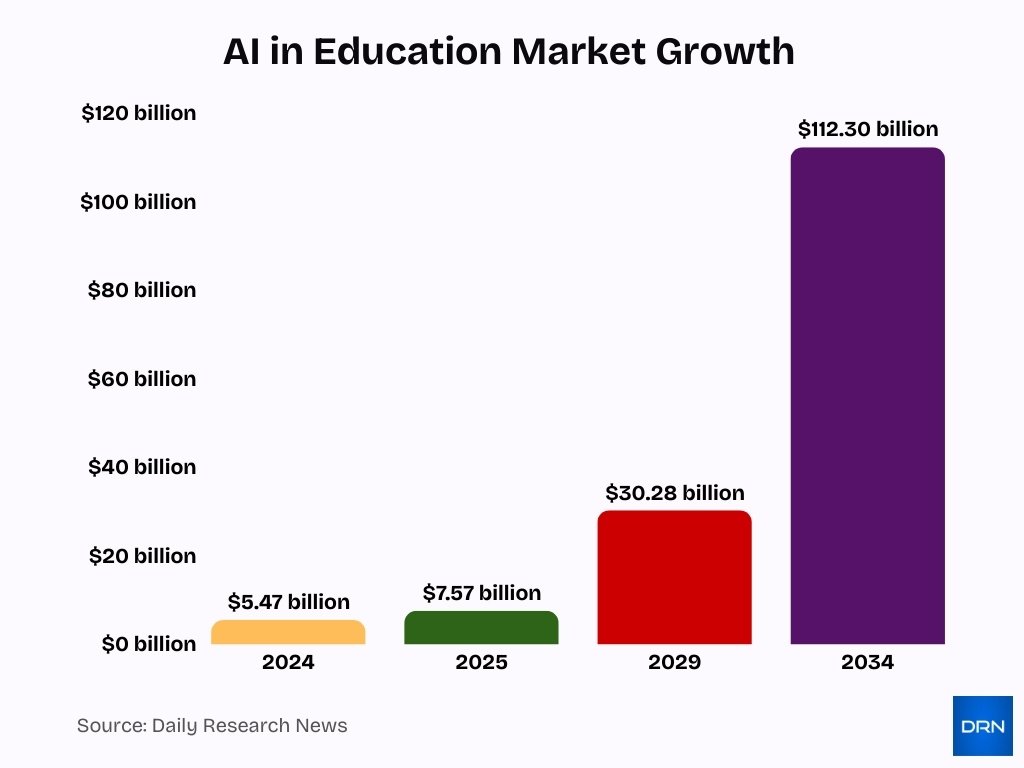
- The AI in education market reached a valuation of $5.47 billion in 2024, reflecting early but accelerating adoption across learning platforms.
- Market size is projected to increase to $7.57 billion in 2025, indicating steady year-over-year growth and rising institutional investment.
- By 2029 (forecast), the market is expected to expand sharply to $30.28 billion, highlighting rapid scaling and broader adoption in global education systems.
- Long-term projections show the market soaring to $112.30 billion by 2034 (forecast), underscoring strong confidence in AI-driven education technologies and sustained demand.
Assessment, Grading, and Feedback Improvements via AI
- 53% of teachers now use AI tools for grading tasks.
- AI grading reduces teacher workload by up to 80%.
- Teachers save an average of 6 hours weekly using AI for assessments.
- AI feedback is delivered 10x faster than manual methods.
- Gradescope AI cuts exam grading time by 90%.
- Essay grading drops from 10 minutes to 30 seconds per paper.
- AI analytics identify learning gaps in 92% of cases early.
- 95% of AI-graded essays match human scores accurately.
- AI tools provide 3x more detailed feedback per assignment.
- Continuous AI feedback boosts student performance by 25%.
K–12 Education Outcomes Shaped by AI
- 85% of K–12 teachers and 86% of students used AI in the 2024-25 school year.
- AI personalization yields up to 30% better student learning outcomes than traditional methods.
- 60% of U.S. K–12 public school teachers used AI tools during the 2024-2025 school year.
- AI adaptive learning boosts student engagement by 50% through personalized paths.
- AI-powered personalized learning achieves 70% higher course completion rates.
- Schools with AI personalization saw 12% increase in student attendance.
- AI interventions improved reading comprehension by 20–40% in government schools.
- AI early alerts enable real-time detection of at-risk students via behavior patterns.
University-Level Transformations Using AI Platforms
- 92% of university students globally use AI tools in their studies, up from 66% last year.
- 86% of students employ AI weekly for academic tasks like summarization and editing.
- 84% of higher education professionals, including faculty, now use AI professionally.
- 61% of faculty integrate AI into teaching, though 88% do so minimally.
- 54% of institutions leverage AI for curriculum design and enhancement.
- 53% of HEIs deploy generative AI for creating learning materials.
- 40% of universities use AI-powered tutoring and chatbots for advising.
- 37% of institutions report higher student satisfaction from AI advising.
- Over 50% of doctoral universities adopt advanced AI for research analysis.
Most Popular AI Tools Used by Students
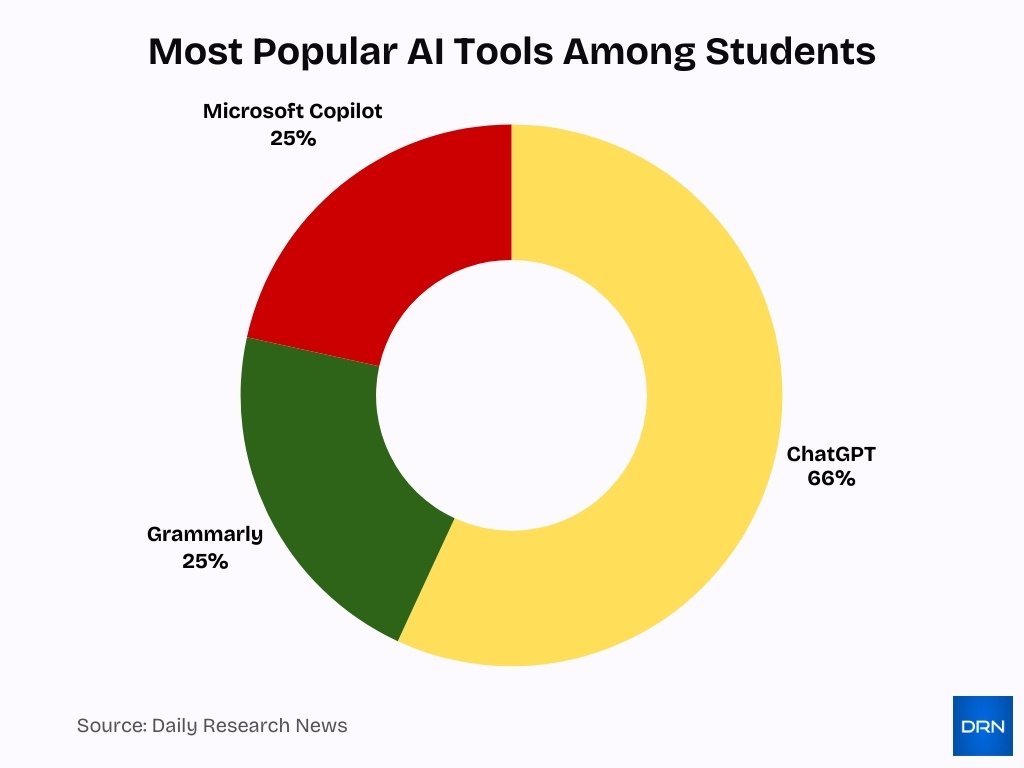
- ChatGPT leads student adoption, with 66% of students identifying it as their primary AI tool, highlighting its dominance in learning, research, and academic support.
- Grammarly is used by 25% of students, showing strong demand for AI-powered writing, grammar, and editing assistance in academic work.
- Microsoft Copilot also reports 25% usage, reflecting its growing role in productivity, coding, and task automation for students.
- The data reveals a significant gap in adoption, with ChatGPT outperforming other AI tools by over 40 percentage points.
- Conversational and generative AI tools dominate student preferences, indicating a shift toward interactive, multi-purpose AI platforms.
- Combined usage of writing and productivity-focused AI tools accounts for 50%, underlining their importance in day-to-day student academic workflows.
Online and E-Learning Developments Enhanced With AI
- AI in the e-learning market reaches $320 billion in 2025 with 14% annual growth.
- 75% of students feel more motivated in AI personalized learning environments vs 30% in traditional classrooms.
- AI tutors boost math proficiency by up to 9 percentage points for lower-rated tutors.
- AI feedback systems reduce grading workloads by 70% while providing real-time analysis.
- Predictive AI analytics enable early identification of at-risk students, cutting dropout rates by 15%.
- 63% of students desire 24/7 AI chat support for academic assistance.
- 34% higher retention rates from AI personalized learning compared to traditional methods.
- AI engagement tracking yields 54% higher test scores in active learning environments.
Perceptions of Students Regarding AI in Education
- 86% of students use AI tools regularly for academic support and convenience in studies.
- 77.9% of students express minimal concerns about AI’s impact on their education.
- Many students report high worries over AI-generated misinformation and deepfakes in education.
- A growing proportion of students fear that unequal access to premium AI tools creates academic inequity.
- Students demand clear AI policies, with only 49% of colleges providing guidance.
- 81% of educators note student anxiety over academic integrity and AI cheating risks.
- 92% of UK students view AI as a helpful study partner for efficiency.
- 66.9% of students see AI skills as critical for career success.
Teacher Viewpoints on Incorporating AI in Teaching
- Educators recognize AI tools like ChatGPT reduce lesson preparation time by up to 31%, freeing around one hour per week.
- 85% of teachers used AI in the 2024-25 school year, with 50% reporting reduced workloads.
- 60.1% of educators rate AI feedback as trustworthy, compared to 90.5% for teacher feedback.
- 23% of teachers express concerns over AI accuracy, amid mixed trust levels.
- 70% of teachers worry that AI weakens critical thinking and reduces human interaction.
- Half of students feel less connected to teachers due to AI use in class.
- 34% of educators use generative AI frequently, while usage varies widely at 58% overall.
- 41% of schools lack agreed AI policies, with many teachers advocating structured guidelines.
- 44% of teachers believe using AI for core tasks feels like cheating, highlighting ethical dilemmas.
- 55% seek hands-on training to boost confidence and AI adoption.
Use of Artificial Intelligence by College Students in Academic Tasks
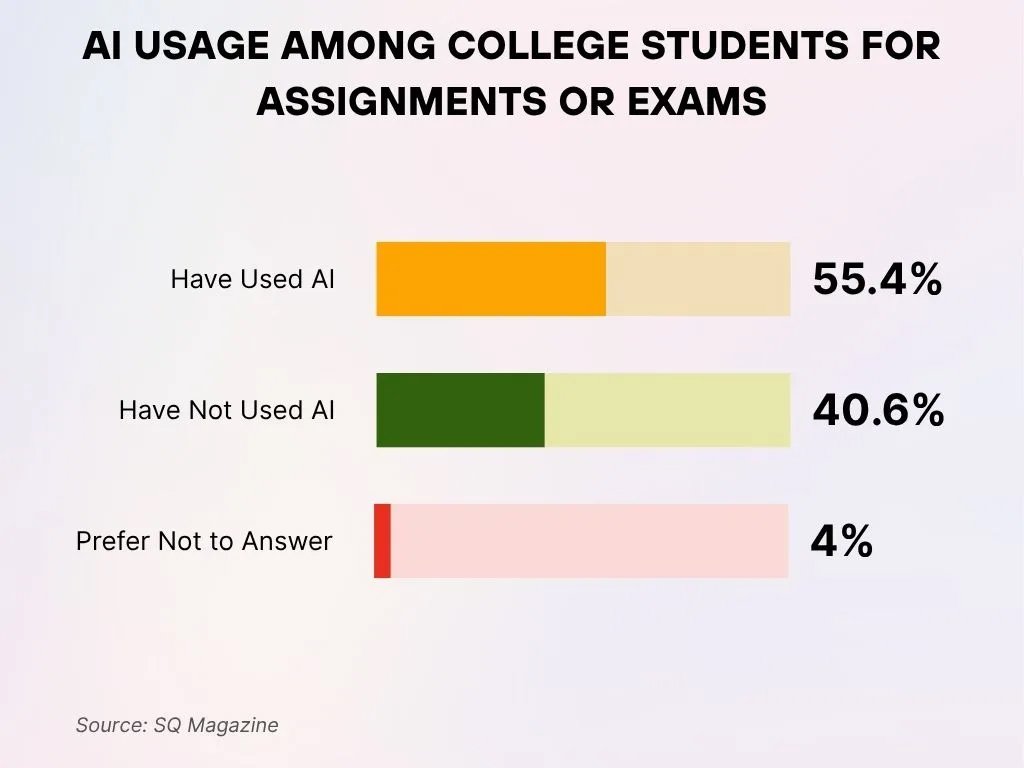
- 55.4% of college students stated that they have used AI tools to support their assignments or exams during their academic work.
- 40.6% of students indicated that they have not used AI for any academic-related activities.
- 4% of respondents chose not to disclose their usage, suggesting potential sensitivity around the subject.
Challenges Faced During the Adoption of AI in Education
- Around 70% of educators view AI use in assignments as plagiarism.
- 92% of students use generative AI tools versus 61% of faculty using minimally.
- 75% of well-funded schools have adequate devices for AI, versus 25% in disadvantaged schools.
- 68% of teachers rely on AI detection tools amid rising plagiarism concerns.
- Over one-third of faculty opt out of generative AI due to resistance barriers.
- Only 43% of educators have received any AI training sessions.
- 57% of higher education institutions have formal AI policies in place.
- 39% of high-poverty districts train teachers on AI versus 67% low-poverty districts.
- Overreliance on AI significantly correlates with reduced critical thinking in students.
Ethical and Privacy Implications Tied to AI Use
- 47% of organizations faced negative consequences from AI bias, up from 44% in early 2024.
- 59% of higher education professionals worry about AI data security and privacy, up 9% year-over-year.
- 49% of educators express concern over bias in AI models, rising 13% from the prior year.
- 40% of AI-using companies encountered unintended bias in models affecting interactions.
- Nearly 38.6% of AI “common-sense facts” in knowledge bases contain bias.
- AI incidents surged 56.4% in 2024, including privacy violations and bias cases.
- 80% single-year jump in organizations defining AI ethical charters.
- Women comprise only <30% of AI professionals worldwide, fueling equity gaps.
- 81% of tech leaders support government regulations to curb AI bias.
Frequently Asked Questions (FAQs)
86% of education organizations report using generative AI, marking one of the highest adoption rates across industries.
The global AI in education market is projected to reach about $32.27 billion by 2030, growing at a CAGR of 31.2% from 2025 to 2030.
As of 2025, 86% of students globally use multiple AI tools, with 54% using them weekly and 25% using them daily.
The AI education tools market is expected to grow from approximately $10.5 billion in 2025 to $223.2 billion by 2034, with a CAGR of 40.4%.
Conclusion
AI’s integration into education is deep and accelerating, affecting universities, online learning, student perceptions, teacher practices, and institutional policy. Students value AI for its personalized support and efficiency, but they also raise concerns about bias, misinformation, and privacy. Teachers appreciate time savings while navigating ethical and assessment challenges.
Schools and universities are developing frameworks to harness AI responsibly while addressing issues of equity, access, and academic integrity. As AI continues to evolve, clear policies, strong training, and inclusive governance will define its long-term impact on education.