

Artificial intelligence (AI) is rapidly reshaping human resources (HR). What was once a support tool for administrative tasks has become a core driver of HR efficiency, predictive insights, and data‑guided decisions. Today’s AI tools help companies hire faster, forecast workforce needs, and tailor employee experiences more precisely than ever before. From enhanced candidate screening to smarter workforce planning, AI’s impact extends across HR functions. Explore the stats below to understand how AI is influencing HR now and where it’s headed.
Editor’s Choice
- 72% of HR professionals report increased AI adoption in HR functions in 2025, up from 58% in 2024.
- Nearly half of organizations use AI tools in HR for recruitment and screening.
- AI adoption in HR departments is projected to be above 80% by 2026, especially for generative and predictive analytics.
- Only about 3% of organizations use generative AI in HR today, showing an opportunity for growth.
- AI in the HR market is growing at 27.6% CAGR through 2029.
- 65% of employees say they’re excited to use AI at work.
- 83% of companies still show low AI maturity despite increased adoption.
Recent Developments
- Early 2026 saw HR tech reorganizations as major firms double down on AI strategies.
- AI job listings soared by 130% since 2020, even as overall hiring slowed.
- Firms are shifting from pilot AI experiments toward measurable business impact in HR.
- HR leaders increasingly link AI with people analytics and workforce strategies.
- Reports highlight agentic AI reshaping HR workflows rather than just assisting with simple tasks.
- Some companies struggle to translate AI deployment into a clear ROI.
- Inconsistent AI policies lead to workforce confusion and varied use cases.
- Employee rework on AI outputs reveals hidden productivity costs.
Global Adoption of AI in HR
- 50% of organizations worldwide reported using AI tools in HR as of 2024.
- North America leads usage at 68%, followed by Europe (54%) and Asia (45%).
- Adoption in HR rose from 26% in 2024 to 43% in 2025.
- 78% of companies use AI in at least one business function, showing broad integration beyond HR.
- 61.6% of HR pros say AI involvement is still low, indicating early or partial usage.
- 38% of organizations plan future AI HR use.
- Only 1% of companies believe AI in HR has reached full maturity.
- AI adoption among HR professionals climbed to 72% in 2025.
Generative AI in HR Market Growth Outlook
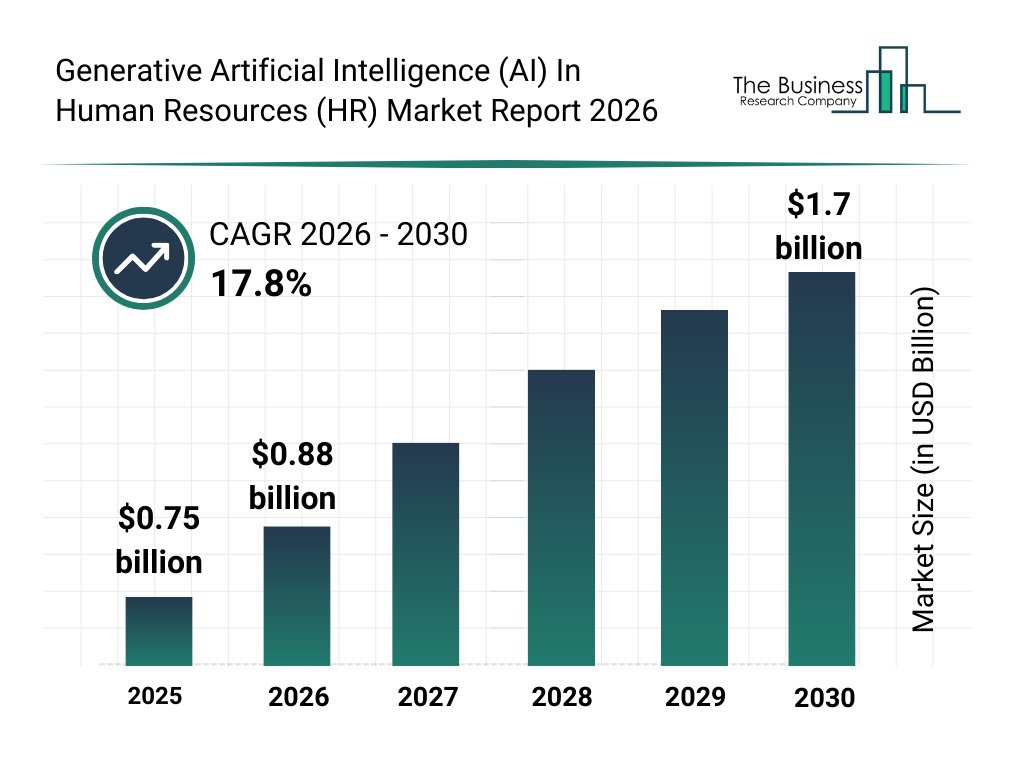
- The Generative AI in HR market is projected to grow from $0.75 billion in 2025 to $1.7 billion by 2030, reflecting strong long-term expansion.
- In 2026, the market is expected to reach $0.88 billion, showing steady year-over-year growth.
- The industry is forecast to expand at a CAGR of 17.8% (2026–2030), highlighting rapid adoption across HR functions.
- Market value is set to more than double in five years, driven by increasing use of AI-powered recruitment, analytics, and automation tools.
- Consistent growth from 2027 to 2029 indicates rising enterprise investment in generative AI solutions for HR operations.
- The upward trend reflects growing demand for data-driven workforce management, talent optimization, and process efficiency.
- By 2030, the market is expected to surpass $1.7 billion, positioning generative AI as a core technology in modern HR ecosystems.

Benefits of AI for HR Teams and Organizations
- 84% of employees eagerly embrace agentic AI to boost productivity and efficiency.
- 75% of recruiters report that AI tools speed up resume screening and candidate matching.
- AI-powered hiring systems cut recruitment costs by about 30%.
- AI-driven learning programs increase employee engagement by 72%.
- AI skill-assessment tools raise training efficiency by 45%.
- Workforce analytics powered by AI improves efficiency by 40%.
- Organizations using AI-driven predictive analytics reduced employee turnover by 25–40%.
- AI reduces bias in performance evaluations by 25–50%.
- AI-based evaluations predict leadership potential with 80% accuracy.
Challenges and Barriers to AI Adoption in HR
- 83% of organizations exhibit low AI and automation maturity despite widespread use.
- Only 35% of HR professionals feel equipped for AI implementation challenges.
- 70% of firms face resistance to change as a key barrier to AI adoption in HR.
- 62% of employees voice job security fears amid AI-driven HR transformations.
- Merely 3% of HR functions deploy generative AI, signaling high caution levels.
- 78% of HR tasks remain manual due to uneven AI integration across functions.
- 85% of HR leaders worry about bias and poor governance in AI models.
- 65% of organizations lack clear AI policies, causing inconsistent tool use.
- A $5.5 trillion global skills gap hampers HR workforce readiness for AI.
Top Objectives for Using Generative AI in HR
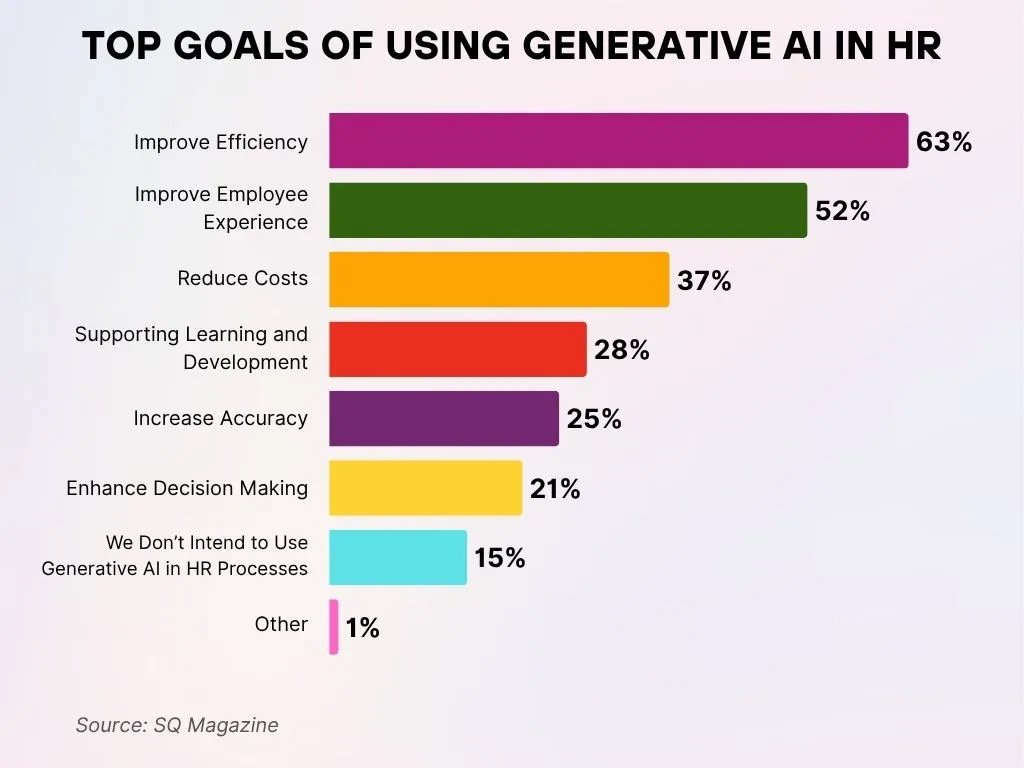
- Improving efficiency remains the leading priority for HR leaders, with 63% identifying it as their primary objective for adopting generative AI in HR operations.
- Enhancing the employee experience is a major focus, as 52% of HR leaders aim to use generative AI to improve workplace satisfaction and engagement.
- Reducing operational costs is another significant driver, with 37% of respondents citing cost optimization as a key reason for adopting AI solutions.
- Supporting learning and development is prioritized by 28%, highlighting generative AI’s role in upskilling, training, and professional growth initiatives.
- Increasing process accuracy is viewed as a major benefit by 25%, emphasizing AI’s ability to minimize errors and improve workflow reliability.
- Strengthening decision-making capabilities is a priority for 21%, as HR leaders leverage AI-driven insights to develop more effective HR strategies.
- Notably, 15% of HR leaders stated that they do not intend to implement generative AI in their HR processes at this time.
- A small minority of 1% mentioned other objectives that fall outside the main predefined categories.
AI in Talent Acquisition and Recruitment
- 87% of companies now use AI tools in recruitment, showing broad adoption across organizations.
- Among AI adopters, 65% use AI to generate job descriptions, and 42% customize job postings using AI.
- 41% of AI‑using companies deploy AI‑powered chatbots to engage with candidates during the hiring process.
- HR screening tools powered by AI automatically filter out unqualified applicants for 64% of HR departments.
- 81% of HR leaders have implemented or are piloting AI in recruitment, significantly increasing efficiency.
- AI recruiting tools can cut time‑to‑hire by up to 75% in some environments.
- 44% of recruiters report AI saves time as the main driver for adoption, helping reduce manual tasks.
- Across 2025 and 2026, AI recruitment usage jumped from about 26% to 43% of organizations.
- Studies find AI can outperform human recruiters in structured interviewing scenarios, increasing successful hires and retention.
- Even with widespread AI use, 93% of hiring managers stress retaining human involvement alongside AI tools.
AI for Candidate Sourcing and Screening
- AI accelerates candidate sourcing by scanning large candidate pools and identifying matches faster than manual search.
- Recruiters using AI report a 50% reduction in time‑to‑screen candidates, speeding up hiring pipelines.
- AI screening analytics can increase hiring accuracy by up to 40%, enhancing the quality of matches.
- AI candidate sourcing tools often integrate with large job boards to automate initial outreach.
- Automated resume parsing helps filter out roles that lack core skills or criteria, saving recruiter hours.
- In 2025 research, 44% of organizations used AI for talent sourcing, reflecting significant penetration.
- By prioritizing candidates based on historical success patterns, AI tools help recruiters focus on high‑potential talent.
- Organizations with AI sourcing systems report faster candidate pipeline building and higher recruiter satisfaction.
- AI screening often incorporates job‑specific keywords and competencies, reducing unfit applicants early.
- Despite this efficiency, human oversight remains crucial to catch context‑based fit issues AI might miss.
HR’s Role in Generative AI Strategy
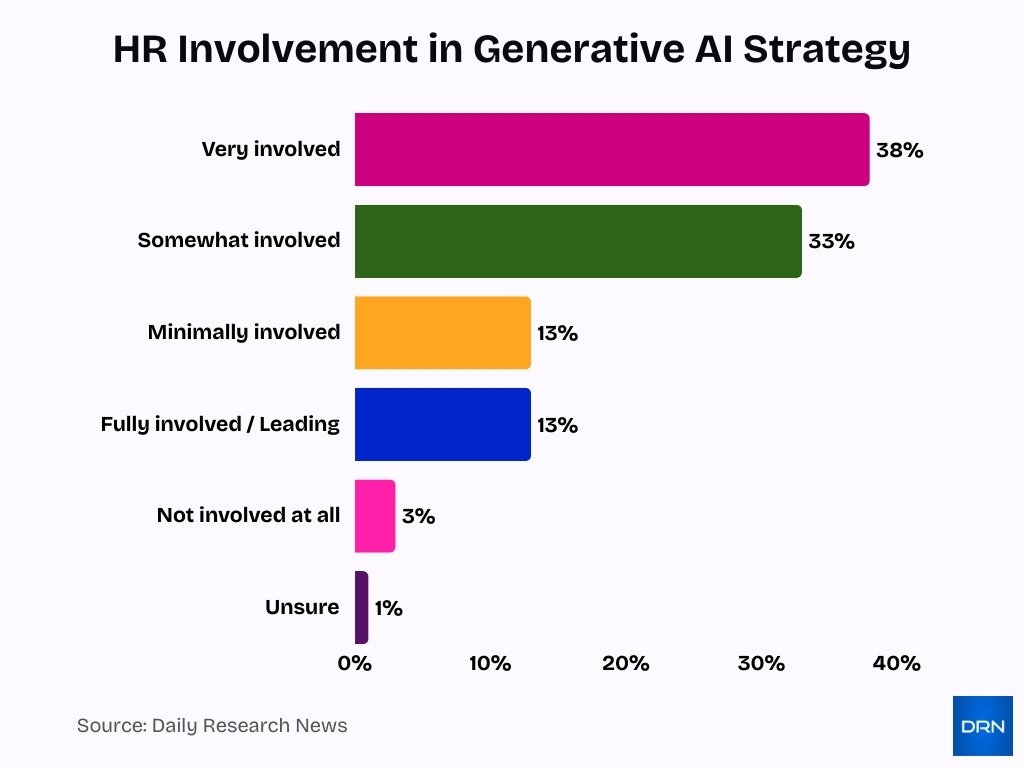
- 38% of respondents say HR is very involved in generative AI–related decisions, showing strong participation in training and job redesign initiatives.
- 33% of organizations report HR is somewhat involved, indicating moderate engagement in shaping AI strategies.
- 13% of respondents state HR is minimally involved, suggesting limited influence on AI implementation.
- Another 13% of companies say HR is fully involved or leading generative AI efforts, reflecting strategic leadership roles.
- Only 3% of respondents report HR is not involved at all, highlighting that most organizations recognize HR’s importance in AI adoption.
- Just 1% remain unsure, indicating high overall clarity about HR’s role in generative AI initiatives.
- Overall, 71% of organizations (38% very involved + 33% somewhat involved) have HR actively engaged in generative AI strategy, reinforcing its growing importance in workforce transformation.
AI in Resume Parsing and Shortlisting
- The global AI resume screening market reached $1.47 billion in 2024.
- AI parsing tools achieve over 90% accuracy in extracting candidate data.
- Automated resume parsing saves up to 75% screening time for recruiters.
- AI reduces time-to-hire by an average of 50% through efficient shortlisting.
- Companies report up to 30% reduction in recruitment costs using AI screening.
- AI hiring tools provide 39% fairer treatment for female candidates.
- Market projected to grow at 18.2% CAGR, reaching $6.41 billion by 2033.
- 43% of HR teams now use AI tools for resume screening.
- AI boosts shortlisting success to 53% from manual 29%.
AI‑Powered Interviews and Assessments
- AI interviewing tools can conduct standardized candidate interviews without human fatigue.
- In a large study, AI interview systems achieved 12% more successful hires and 17% better retention than traditional processes.
- AI assessments often score soft skills, cognitive ability, and job fit based on structured responses.
- 64% of HR professionals leverage automation to pre‑filter unsuitable candidates before interviews.
- Conversational AI assistants can handle 189 million candidate interactions, driving scale in interview scheduling.
- Automated interview tools can shorten feedback loops and improve candidate experience.
- AI assessments help reduce bias by standardizing interview questions and criteria.
- Hiring managers note that AI gives deeper behavioral insights than traditional screening alone.
- Some AI interview solutions draw on real‑time performance data to tune scoring models.
- Human validation remains part of most AI interview workflows to ensure fairness and context.
AI-Driven Cost Savings Across Recruitment Stages
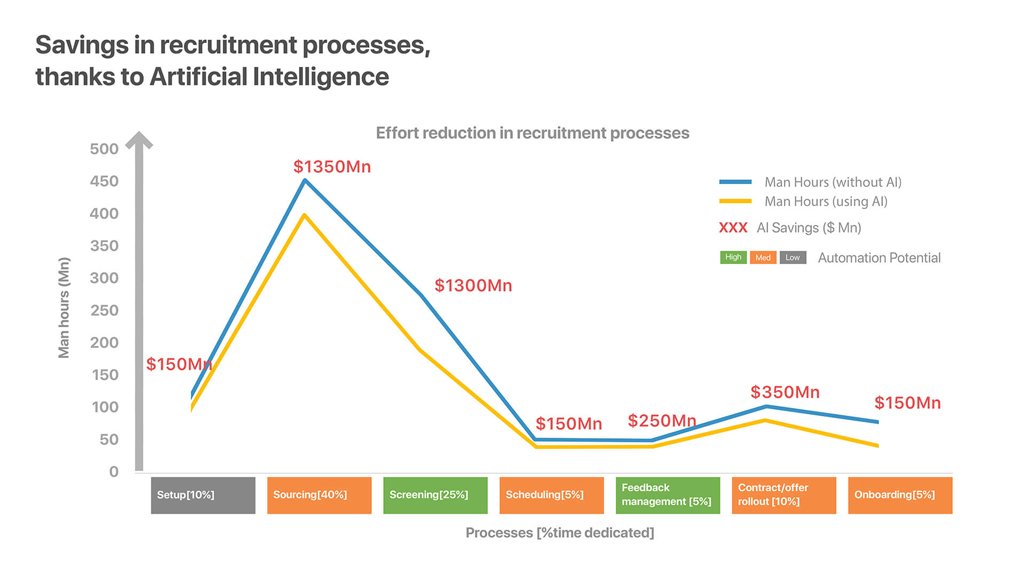
- Sourcing (40% of total time) is the most resource-intensive stage, with effort dropping from 450 Mn man-hours (without AI) to 390 Mn (with AI), generating the highest savings of $1,350 Mn.
- Screening (25%) sees a major efficiency boost, reducing workload from 270 Mn to 180 Mn man-hours, delivering an impressive $1,300 Mn in AI savings with high automation potential.
- Contract/Offer Rollout (10%) improves from 100 Mn to 80 Mn man-hours, contributing $350 Mn in cost savings through AI adoption.
- Feedback Management (5%) decreases slightly from 50 Mn to 45 Mn man-hours, yet still produces $250 Mn in savings, supported by high automation capability.
- Setup (10%) drops from 120 Mn to 100 Mn man-hours, resulting in $150 Mn in AI-driven savings, though automation potential remains low.
- Scheduling (5%) reduces effort from 50 Mn to 40 Mn man-hours, unlocking $150 Mn in savings through moderate automation.
- Onboarding (5%) falls from 80 Mn to 45 Mn man-hours, also delivering $150 Mn in measurable AI savings.
- Overall, AI adoption across recruitment processes indicates multi-billion-dollar savings potential, with the greatest financial impact concentrated in Sourcing and Screening functions.
AI in Onboarding and New Hire Experience
- AI onboarding tools automate administrative tasks like paperwork and training scheduling.
- Employers using HR AI report smoother new hire transitions and faster productivity.
- Chatbots guide new hires through policies, reducing confusion and HR workload.
- Automated onboarding can deliver tailored content based on role and skill profile.
- Employee feedback systems powered by AI help measure onboarding satisfaction.
- AI onboarding analytics reveal early performance indicators for retention risk.
- Personalized training recommendations improve early engagement.
- Onboarding automation reduces HR admin time, letting teams focus on strategic work.
- New hires report higher confidence levels with interactive AI guidance tools.
- Longitudinal data show AI onboarding correlates with higher first‑year retention.
AI in Workforce Planning and Forecasting
- 72% of HR professionals believe AI improves workforce planning.
- AI-powered HR analytics predict workforce trends with 90% accuracy.
- AI-driven predictive scheduling reduces labor costs by 18%.
- AI-driven workforce analytics improve efficiency by 40%.
- 80% of organizations will use AI for workforce planning by 2025.
- AI forecasts skills gaps three years in advance.
- 90% of global enterprises face critical skills shortages by 2026.
- 72% of HR leaders report that AI enhances planning processes.
- AI workforce optimization saves $500 billion globally by 2025.
Top HR Domains Where AI Is Driving the Greatest Transformation
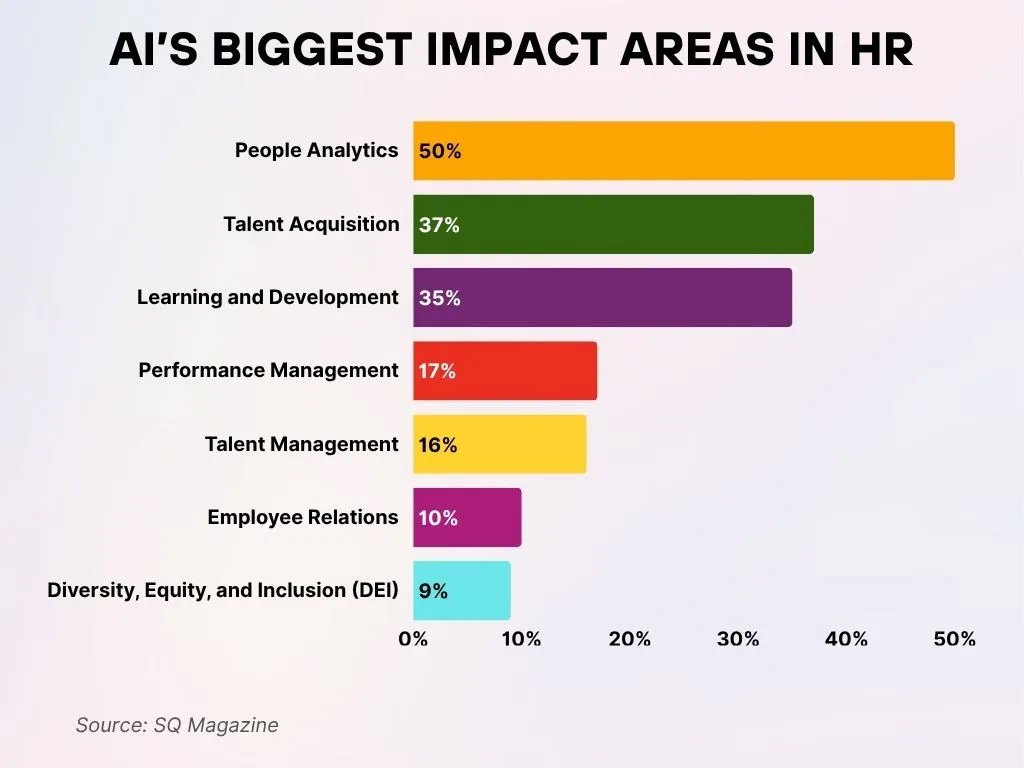
- People Analytics emerges as the leading domain where AI is projected to create the most substantial impact, with 50% of respondents recognizing it as the primary transformation area.
- 37% of HR professionals anticipate that Talent Acquisition will undergo significant change driven by AI-powered tools and automation.
- Learning and Development follows closely, as 35% identify it as a major function set to experience meaningful AI-driven advancement.
- 17% believe AI will enhance Performance Management, particularly in areas such as goal tracking and employee evaluation processes.
- 16% indicate that Talent Management will gain measurable benefits from AI-enabled insights and workflow automation.
- Employee Relations is also expected to see AI integration, although at a lower scale, with 10% highlighting its impact potential.
- Diversity, Equity, and Inclusion (DEI) stands at 9%, reflecting growing yet comparatively limited AI adoption within this strategic HR segment.
AI for Employee Performance Management
- AI enables organizations to set data‑driven performance benchmarks and automate performance feedback loops.
- AI systems track individual productivity patterns and flag performance trends in real time.
- Automated performance evaluations reduce duplication of manual scoring and subjective bias.
- In some firms, AI now contributes core data for manager reviews and appraisal dashboards.
- Predictive models help HR teams identify employees at risk of falling below performance standards.
- AI‑guided recommendations can suggest tailored improvement plans for underperforming employees.
- Early research shows organizational adoption of AI analytics is linked with higher performance visibility and clearer growth pathways.
- Some HR leaders report better alignment between individual goals and company priorities due to AI insights.
- AI performance tools are often integrated with broader HR analytics platforms to support continuous improvement cycles.
AI in Employee Engagement and Experience
- AI platforms monitor engagement signals, with 75% of companies using them for real-time team insights.
- Real-time AI insights help managers address issues, reducing disengagement by 40% before escalation.
- AI eliminates bias in analysis, improving fairness scores by 65% via data patterns.
- AI tools identify unsung performers, boosting morale by 33% in recognition programs.
- Personalized AI platforms tailor experiences, increasing engagement by 60% with custom tips.
- AI chatbots provide instant HR support, cutting response times by 80%.
- AI feedback systems collect continuous data, lifting response rates by 45%.
- Leaders using AI gain better visibility, with 72% reporting improved team satisfaction.
- Advanced AI analytics enable departmental comparisons, driving targeted actions in 92% of firms.
- Integrated AI platforms are central to HR strategies, adopted by 68% of competitive markets.
Key AI Investment Priorities: HR Lags Behind Other Sectors
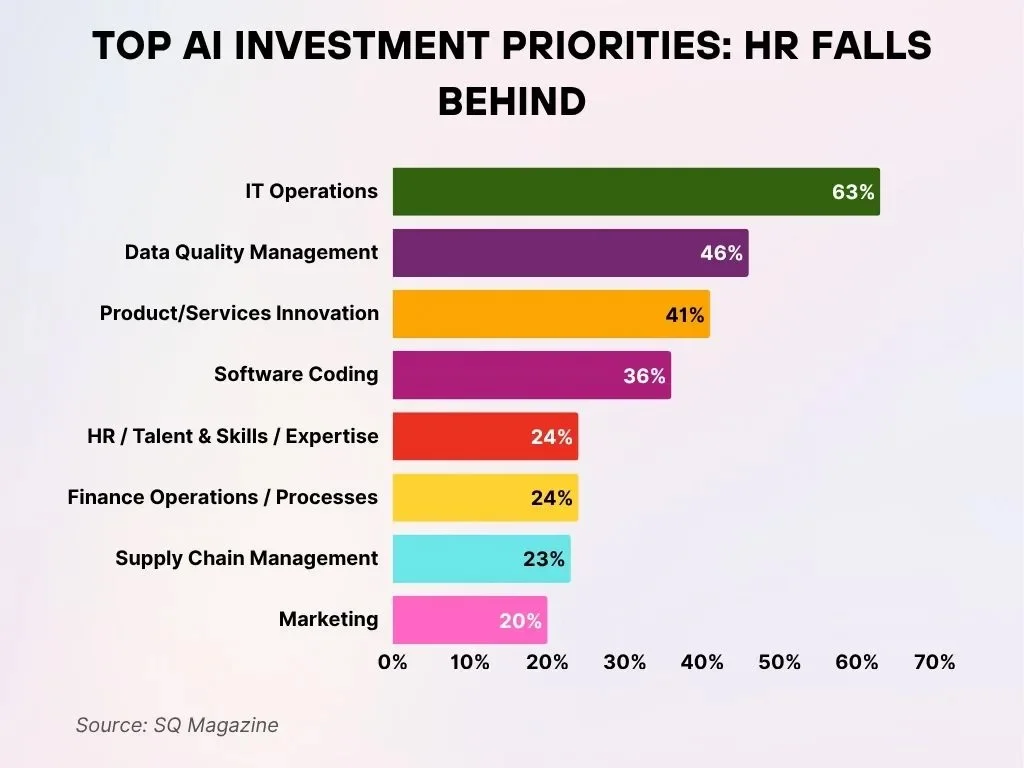
- IT operations continue to dominate AI investment strategies, with 63% of decision-makers prioritizing this critical area for automation and efficiency improvements.
- 46% of organizations are concentrating on data quality management, emphasizing the essential role of clean and reliable data in enhancing AI performance and accuracy.
- Around 41% of companies are investing in product and service innovation by leveraging AI tools and automation to accelerate growth and competitiveness.
- Nearly 36% plan to strengthen software coding processes through AI-driven development support and intelligent programming assistance.
- Only 24% of AI investments are allocated to HR, talent development, and skills/expertise, underscoring a significant adoption gap compared to other business functions.
- Finance operations and processes also received 24%, placing them on par with HR in overall AI investment rankings.
- Supply chain management captured 23% of total AI investment interest, reflecting moderate adoption in logistics and operations optimization.
- Marketing recorded the lowest priority, with just 20% of respondents allocating AI spending to this function.
AI for Employee Retention and Turnover Prediction
- AI analyzes historical turnover data to predict which employees are most likely to leave.
- Models incorporate sentiment, performance ratings, and engagement scores to highlight flight risk.
- HR departments using AI forecasting reduce turnover by targeting at‑risk workers with tailored interventions.
- AI suggestions include personalized career pathing, workload adjustments, and coaching alerts for declining performers.
- Retention analytics help leaders understand root causes like lack of growth, engagement dips, or leadership issues.
- In some industries, AI improves retention rates by identifying conditions that correlate with voluntary exit.
- Insight platforms link retention predictors with strategic HR investment decisions.
- AI enables HR to simulate scenarios with different retention strategies to find the most effective.
Role of AI in Education, Training, and Upskilling
- AI-powered personalized learning market reaches $6.3 billion globally in 2025, growing at 27.7% CAGR through 2034.
- K-12 education captures 40.4% market share in AI personalized learning due to adaptive tools improving engagement.
- AI training yields 27% average productivity improvement, saving 11.4 hours per knowledge worker weekly.
- Organizations using AI-powered skills gap analysis achieve 20–40% faster upskilling in critical roles.
- Customized AI learning paths boost employee engagement by 72% and knowledge retention by 60%.
- AI-driven career pathing increases employee retention by 20% via personalized development plans.
- AI upskilling programs deliver 40% time savings on routine tasks and over 20% cost reductions in training.
- Employees with 81+ hours of annual AI training gain 14 hours of weekly productivity, though 55% more likely to leave.
- Adaptive AI systems improve knowledge retention by 35%, engagement by 40%, and cut training time by 22%.
- AI learning platforms reduce employee training costs by over 20% while enhancing motivation by 80%.
AI in Hiring & Firing: Adoption Split Between HR and Non-HR Professionals
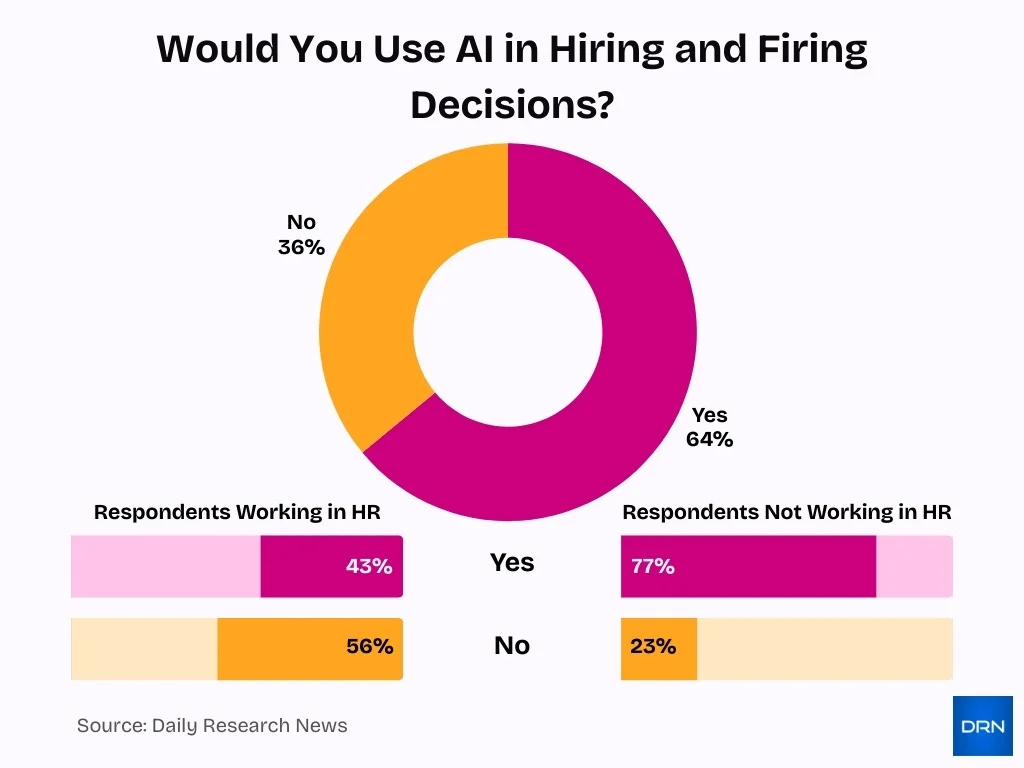
- A majority of respondents (64%) said Yes, they would use AI in hiring and firing decisions, while 36% said No, indicating overall positive sentiment toward AI-driven workforce decisions.
- Among HR professionals, only 43% support using AI for hiring and firing, whereas a higher 56% oppose it, reflecting notable skepticism within the HR community itself.
- In contrast, non-HR respondents show strong acceptance, with 77% saying Yes to AI-based hiring and firing decisions and just 23% saying No.
- The data reveals a significant perception gap of 34 percentage points between HR professionals (43%) and non-HR professionals (77%) in AI adoption for workforce decisions.
- Overall, while AI acceptance is high (64%), resistance remains concentrated within HR roles, highlighting concerns around ethics, bias, and human oversight in employment decisions.
AI Chatbots and Virtual Assistants in HR
- AI chatbots and virtual assistants handle up to 80% of routine HR queries, reducing team workload significantly.
- Over 50% of companies are projected to implement HR chatbots by 2025.
- 38% of HR leaders are actively testing or implementing AI automation in enterprise HR.
- HR chatbots reduce operational costs by up to 30% through task automation.
- Chatbots cut HR response times by up to 80%, enabling instant query resolution.
- 62% of employees prefer virtual assistants for their HR needs.
- 92% of HR teams direct new hires to chatbots for quick information access.
- 66% of HR executives report that chatbots substantially enhance employee engagement.
- AI chatbots achieve 99% immediate response rate to employee questions.
Employee Perceptions and Trust in AI in HR
- 54% of employees trust AI more than human HR professionals for unbiased decisions.
- 55% of employees express concerns over AI surveillance and privacy in HR tracking.
- 57% believe humans are more biased than AI in compensation decisions.
- 54% of UK workers feel uncomfortable with HR using AI, citing trust issues.
- 50% of employees trust AI systems for unbiased feedback in performance reviews.
- 26% of candidates trust AI to evaluate them fairly in hiring processes.
- 55% agree AI improves fairness in recruitment, though transparency doubts persist.
- 87% prefer AI feedback over managers for fairer assessments.
- 38% of workers prefer AI assistants over human HR admins, up 26.7% year-over-year.
Frequently Asked Questions (FAQs)
Approximately 50% of organizations globally have integrated AI tools into HR functions, with North America leading at 68% adoption.
The global AI in HR market is projected to grow from an estimated $3.25 billion in 2023 to about $15.24 billion by 2030, at a 24.8% CAGR.
About 61.6% of HR professionals say they have little to no involvement with AI in their HR processes.
The AI in HR market is anticipated to increase by $16.55 billion from 2025 to 2029, with a 27.6% CAGR over that period.
Conclusion
AI’s influence on HR continues to expand across performance management, engagement, retention, and learning. Companies increasingly rely on AI platforms for predictive insights, automating routine tasks, and delivering personalized employee experiences. Yet employee perceptions and trust remain vital, with transparency and empathy shaping successful adoption.
HR teams that balance technology with human judgment are better positioned to navigate AI‑driven transformation and build a workforce prepared for the future.