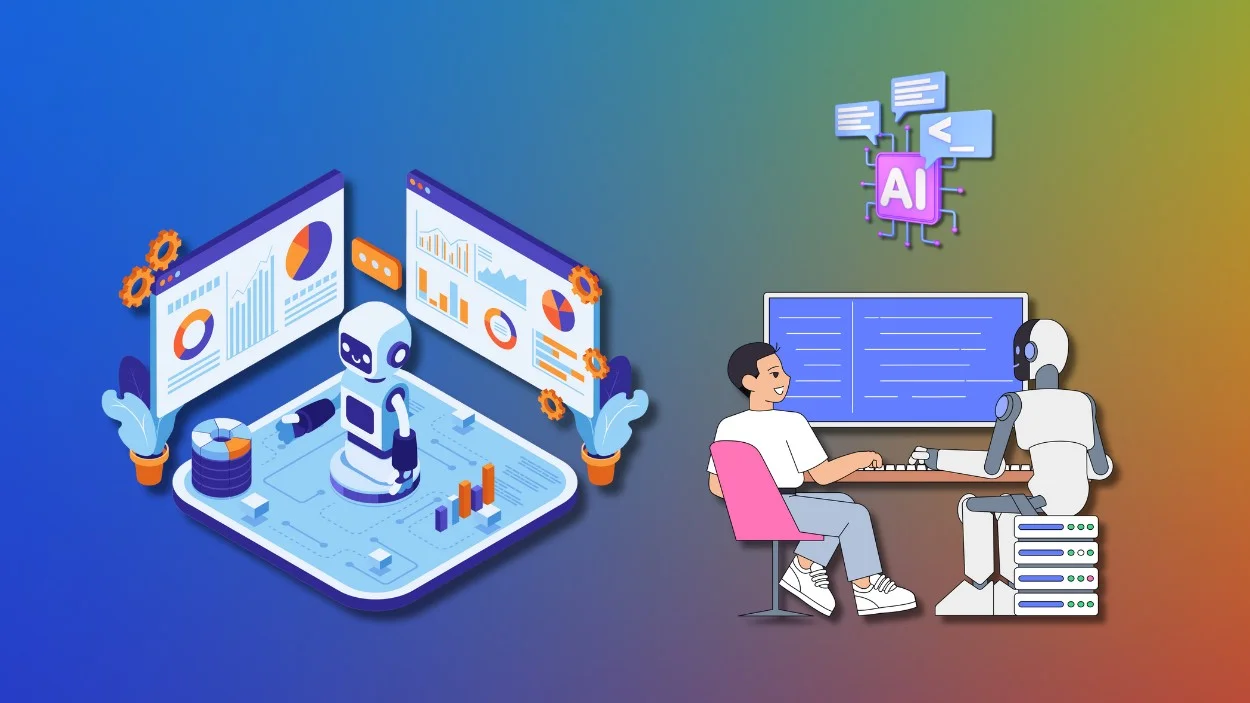


Artificial intelligence (AI) is rapidly reshaping how marketers operate, enabling deeper data analysis, faster content creation, and more personalized customer engagement. From global brands to small businesses, firms increasingly rely on AI tools to optimize campaigns, manage workflows, and unlock new efficiencies. The impact extends beyond internal workflows; many companies have already seen measurable gains in productivity and marketing outcomes. This article delves into the latest data shaping that transformation.
Editor’s Choice Stats
- The global AI marketing industry is valued at $47.32 billion in 2025.
- 88% of marketers use AI daily in their marketing roles.
- 51% of marketing teams now use AI to optimize content, from email to SEO.
- 43% of marketers automate repetitive marketing tasks with AI tools.
- 60% of marketers say AI acts as an assistant for their daily work duties.
- 78% of organizations worldwide now use AI in at least one business function.
- 90% of marketers using AI for content rely on it for text-based tasks such as idea generation, draft creation, or headline writing.
Recent Developments
- 78% of organizations use AI in at least one business function in 2025, up from 55% in 2024.
- 71% of organizations regularly use generative AI in business operations, surging from 33% in 2023.
- 73% of marketing departments use generative AI, mainly for image and text generation.
- 76% of marketers apply GenAI for content creation in 2025.
- 83% of companies prioritize AI in business plans, with 72% implementing it in marketing and sales.
- 78% of growing SMBs plan to increase AI investment in the next year.
- Content curation dominates AI marketing applications with the highest revenue share in 2024-2025.
- North America holds a 39.5% share in the AI for sales & marketing market in 2025.
- The AI marketing market is valued at $47.32 billion in 2025, projected to reach $107.5 billion by 2028.
AI Marketing Overview Statistics
- 88% of marketers say they use AI in their marketing roles in 2025.
- Among those using AI, 51% apply it to content optimization, and 50% to content creation.
- 45% of marketing professionals rely on AI to brainstorm content ideas.
- 43% automate repetitive marketing tasks through AI-powered tools, reducing manual workload.
- 43% consider AI essential to their social media strategy.
- 41% use AI for data analysis and deriving insights.
- 73% of marketers say AI plays a role in creating personalized customer experiences.
- According to a 2025 industry-wide report, 60% of marketers regard AI as an assistant rather than a replacement for their work.
- 90% of marketers leveraging AI for content creation use it for text-based tasks, idea generation, drafting, and headline writing.
Global AI in Marketing Market Size Statistics
- The global AI in Marketing market is anticipated to grow rapidly over the upcoming years, maintaining strong expansion momentum.
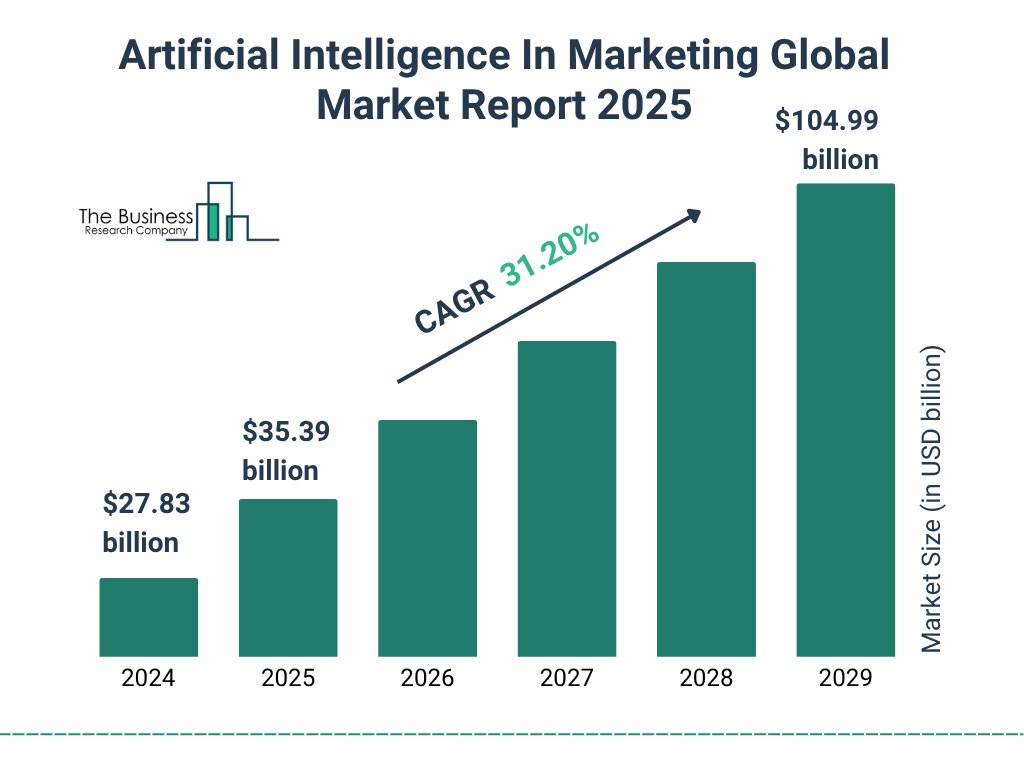
- The market size in 2024 is reported at $27.83 billion, reflecting substantial existing adoption.
- The market size in 2025 is expected to rise to $35.39 billion, demonstrating continued strong demand.
- A notably strong CAGR of 31.20% is emphasized, indicating sustained high-growth potential in the sector.
- Forecasts show continuous market expansion each year through 2029, signaling long-term scalability.
- For 2026, the market is projected to show continued growth, with values higher than 2025, even though the exact figure is not specified.
- In 2027, the market size is expected to experience a noticeable rise, consistent with the strong CAGR trajectory.
- In 2028, projections highlight a substantial increase in the overall global AI marketing market size.
- By 2029, the market is anticipated to reach $104.99 billion, representing nearly a fourfold increase compared to 2024.

AI Adoption in Marketing Statistics
- Among all organizations globally, 78% now use AI in at least one business function, up from 55% just a year earlier.
- For marketing teams specifically, 88% report using AI daily.
- In content-focused marketing teams, 51% use AI for content optimization, and 50% for content creation.
- Roughly 43% of marketers automate routine, repetitive tasks using AI-powered tools.
- 43% consider AI important for their social media strategy.
- 41% analyze data for insights using AI tools, helping guide marketing decisions.
- 60% of marketers say AI functions as an assistant, helping speed up work and reduce manual burden.
- Over 70% of marketers expect AI’s role in marketing to grow further in the next 12 months.
- The shift from experimentation to regular deployment of AI tools has accelerated over 2024,2025, with many companies integrating AI into core marketing workflows.
Generative AI Management Strategies in Business
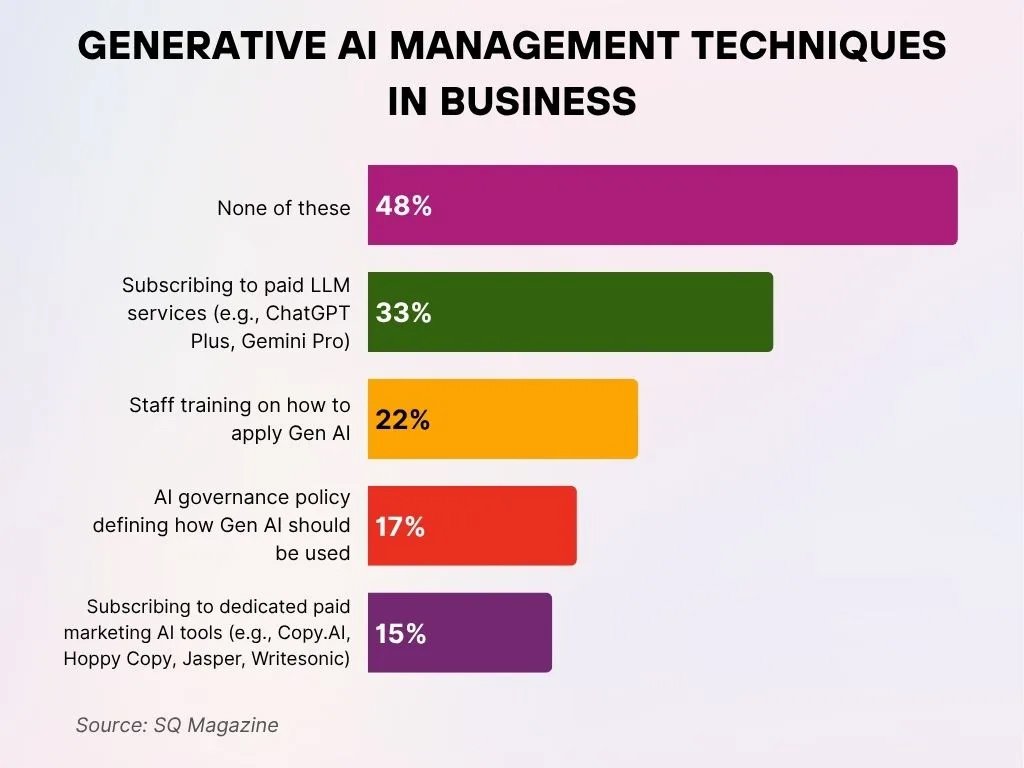
- 48% of businesses indicated that they do not utilize any Generative AI management techniques, maintaining the same lack of structured oversight.
- 33% of organizations are subscribing to paid LLM platforms, including services like ChatGPT Plus and Gemini Pro.
- 22% have begun training their staff on ways to effectively integrate Generative AI into daily workflows.
- 17% have established an AI governance policy that outlines how Generative AI should be properly used within the organization.
- 15% are actively subscribing to specialized paid marketing AI tools such as Copy.AI, Hoppy Copy, Jasper, or Writesonic.
AI Impact on Marketing ROI and Revenue Statistics
- Firms that invest deeply in AI in marketing and sales see sales ROI improve by 10–20% on average.
- Some leading companies report 1.5× higher revenue growth over three years compared to peers, aided in part by AI integration.
- Companies using AI for content marketing saw 68% report improved content marketing ROI.
- Those using AI for SEO and content tasks reported 65% better SEO outcomes, such as improved ranking or organic traffic.
- Enterprise-wide AI adoption has delivered 26–55% productivity gains along with about $3.70 returned per dollar invested.
- Organizations retraining employees for AI projects report a 43% higher success rate in deploying AI.
- Marketing and sales teams using AI are more likely, 83%, to see revenue growth than teams not using AI, 66%.
- Among marketers adopting AI broadly, many indicate AI has shifted from experimental to instrumental, supporting sustainable ROI.
AI Impact on Lead Generation and Conversion Statistics
- Marketers using AI for segmentation report that 74% saw improvements in conversion rates.
- Companies using AI-generated content or AI-enabled personalization note conversion improvements as a key driver of AI value.
- Firms integrating AI into lead scoring saw notable gains in lead qualification and engagement.
- Companies adopting AI across marketing reported up to 37% reduction in customer acquisition costs (CAC).
- 95% of customer interactions in AI-adoption firms are now AI-powered in 2025.
- AI speeds up content generation, letting companies run more campaigns and increase lead volume.
- Marketers say AI helps them scale personalization, vital for higher conversion in large campaigns.
- As AI tools integrate with CRM, improved segmentation and targeting boost lead-to-customer conversion.
AI Impact on Customer Acquisition and Retention Statistics
- Companies deploying AI-powered marketing achieve an average 37% reduction in customer acquisition costs.
- AI-driven personalization boosts conversion rates by up to 25%, lowering acquisition expenses.
- Businesses using AI retention tools reduce churn rates by 10-30%.
- 75% of firms using AI customer service report improved satisfaction, aiding retention.
- AI personalization increases repeat purchase rates by up to 20%.
- Retailers with AI-driven recommendations see 15% higher conversion rates.
- AI chat recovers 35% of abandoned carts, enhancing acquisition and loyalty.
- 64% of AI-powered sales come from first-time shoppers.
- Firms with AI personalization enjoy up to 20% higher retention rates.
- AI loyalty programs boost engagement by 40%.
How Much Do Companies Invest in Marketing Each Month?
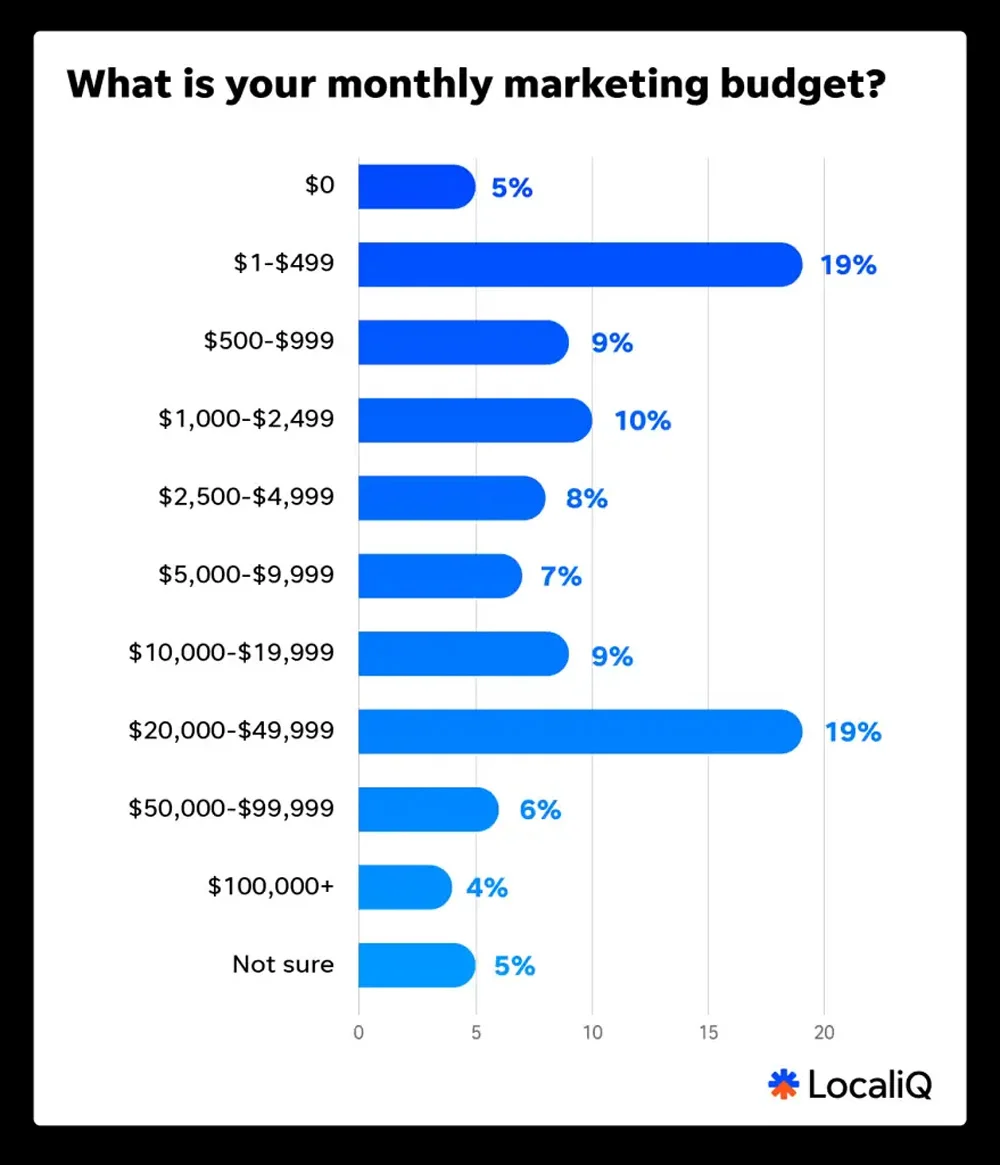
- 19% of businesses put $1–$499 toward their monthly marketing efforts, reflecting a modest spending tier.
- Another 19% direct $20,000–$49,999 each month to marketing, highlighting a wide range of investment levels.
- 10% maintain a marketing budget of $1,000–$2,499 per month.
- 9% of companies fall into both the $500–$999 and $10,000–$19,999 monthly marketing spending brackets.
- 8% indicate they spend $2,500–$4,999 on marketing every month.
- 7% consistently invest $5,000–$9,999 in their monthly marketing activities.
- 6% allocate $50,000–$99,999 to marketing on a monthly basis.
- Only 4% of businesses spend over $100,000 per month on marketing.
- 5% reported having no marketing budget whatsoever.
- Another 5% stated they are unsure about their monthly marketing budget.
AI in Advertising and Paid Media Statistics
- 88% of marketers use AI daily in marketing tasks, boosting efficiency by up to 79%.
- AI-generated ad creatives lift ROAS by 50-72% and CTR by 47% over manual ones.
- Businesses with AI-powered ad strategies cut advertising costs by up to 50% via targeting.
- AI-driven A/B testing delivers 20-28% higher conversion rates across campaigns.
- 37% average reduction in customer acquisition costs reported by AI marketing users.
- Google AI video ads achieve 17% higher ROAS than manual campaigns on YouTube.
- AI personalization boosts conversion rates by 25% and cuts CAC by 10-20%.
- Smart AI bidding improves ROAS and lowers CPA through real-time optimization.
- AI audience targeting increases ROAS by 22% and conversions by 16%.
AI Personalization and Customer Experience Statistics
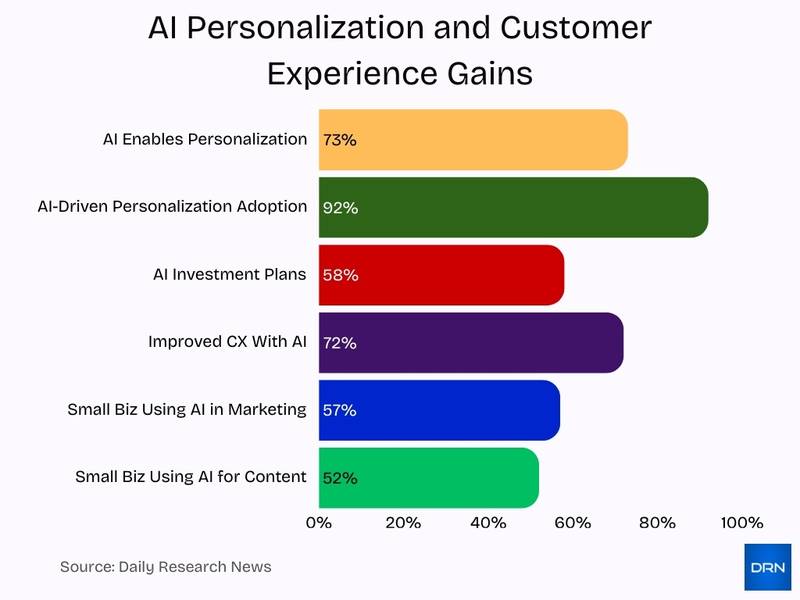
- In 2025, 73% of marketing teams said AI helps them create more personalized experiences.
- 92% of businesses used AI-driven personalization in 2025.
- Tailored CTAs outperformed generic CTAs by 202%.
- 58% of marketers plan to invest more in AI and automation for personalization.
- 72% of marketers reported improved customer experience with AI automation.
- AI-based segmentation strengthens alignment between offers and customer needs.
- 57% of small businesses use AI for marketing, and 52% use it for content and personalization.
- AI-driven improvements in customer engagement are a major reason firms increase AI investment.
AI-Powered Chatbots and Virtual Assistants in Marketing Statistics
- 80% of companies use or plan to use AI-powered chatbots for customer service by 2025.
- 63% of organizations are in the final or complete stages of conversational AI adoption.
- 67% increase in sales reported by businesses using chatbots.
- 70% conversion rates achieved by AI chatbots in retail/eCommerce.
- 80% of sales and marketing teams integrate chatbot systems.
- 64% of CX leaders plan to increase chatbot investments next year.
- 75% of businesses using chatbots report higher customer satisfaction.
- 30% reduction in customer service costs from chatbots.
- 23% overall conversion rate boost from AI chatbots.
- 85% of consumers interacted with an AI agent in the past three months.
Predictive Analytics and Forecasting in Marketing Statistics
- AI-driven firms see a 47% improvement in forecasting accuracy for marketing campaigns.
- 22% higher marketing ROI achieved through AI optimization in media and ads.
- 20-30% increase in campaign ROI for enterprises using AI predictive analytics.
- 93% of marketers use AI for faster content creation and decision-making in forecasting.
- 95% of companies deploy AI-powered predictive analytics in their marketing strategies.
- 80-95% accuracy reached by predictive AI models in marketing consumer behavior forecasts.
- 60% of businesses leverage AI to predict customer lifetime value effectively.
- 87% of marketers view data as under-utilized, boosting AI forecasting adoption.
Generative AI in Marketing Statistics
- The global generative AI market is valued at $62.75 billion in 2025.
- Forecasts project $356.05 billion by 2030, with ~ 41.5% CAGR.
- 63% of marketers report using generative AI in workflows.
- 85% of marketers use AI tools for content creation.
- 25.6% report better success with AI-generated content, rising to 64% including equal-success outcomes.
- Organizations now integrate generative AI into core workflows for content and personalization.
- Generative AI allows faster production with fewer bottlenecks.
- Enterprises say generative AI frees creative teams to focus on strategy.
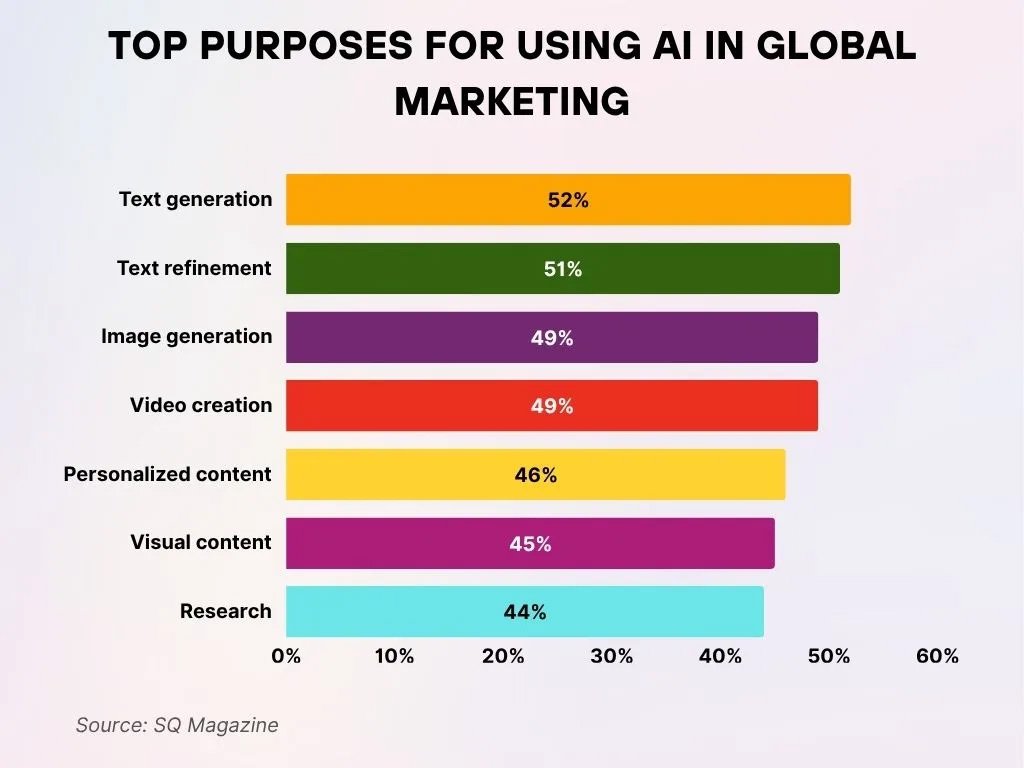
Primary Reasons Marketers Worldwide Use AI
- 52% of marketing professionals depend on AI for generating text, marking it as the most prevalent application.
- 51% make use of AI for refining text to boost clarity and tone.
- 49% of users apply AI for both creating images and producing videos, highlighting the strong need for creative automation.
- 46% count on AI to develop personalized content tailored to distinct audience segments.
- 45% engage AI to craft visual content, reinforcing design-intensive campaigns.
- 44% employ AI for research activities, supporting insight generation and strategic planning.
Challenges and Barriers to AI Adoption in Marketing Statistics
- 44% of companies are waiting for more mature AI solutions before deploying broadly.
- 39% of marketers are unsure how to safely use generative AI.
- 43% say they don’t know how to get the most value from generative AI.
- 55% of PR and marketing professionals lack formal AI use guidelines.
- Lack of internal expertise remains a major barrier.
- Many AI pilots fail to deliver measurable business value.
- Small businesses often struggle to sustain AI investment.
- Data privacy, governance, and bias concerns slow adoption.
Future Trends of AI in Marketing Statistics
- 79% of CMOs see AI as essential for competitive advantage in marketing.
- The AI marketing market is valued at $47.32 billion in 2025, projected to reach $107.5 billion by 2028.
- Global AI marketing is expected to grow at a 36.6% CAGR from 2024 to 2030.
- 88% of marketers use AI daily, with 92% of businesses planning increased investments.
- AI personalization boosts marketing ROI by 25% and sales by 20%.
- SMB AI adoption surged 41% to 55% in 2025, with 76% using AI marketing tools.
- Predictive AI models achieve 80-95% accuracy in marketing forecasts.
- AI governance market to grow at 49.2% CAGR from 2025-2034 amid rising transparency needs.
- 93% of marketers believe AI is essential for goals, with 81% improving efforts via predictive analytics.
Frequently Asked Questions (FAQs)
88% of marketers say they use AI in their everyday marketing work.
51% of marketing teams use AI tools to optimize content such as email campaigns and SEO.
74% of marketers using AI for segmentation saw improvements in conversion rates.
60% of marketing departments worldwide expect to integrate at least one AI technology by the end of 2025.
Conclusion
AI has rapidly shifted from novelty to necessity in marketing. Adoption rates, ROI gains, and expanding use cases, from advertising to personalization to predictive analytics, show that AI is transforming how brands engage customers and optimize spend. Yet, adoption is not without hurdles, skills gaps, governance concerns, and uneven ROI means firms must approach AI with strategy, transparency, and realistic expectations.
As the technology matures, marketers who integrate AI thoughtfully, balancing human creativity with data-driven AI tools, are likely to stay ahead in an increasingly competitive landscape.