

The integration of artificial intelligence (AI) with robotics is no longer a distant vision; it is a defining driver of modern automation. AI-augmented robots power smart factories, enhance logistics efficiency, and support healthcare delivery, reshaping how businesses operate and how people live. For example, AI-driven robotics now optimizes warehouse operations with autonomous mobile robots and enables adaptive surgical assistance systems in hospitals. With foundational advancements across industries, readers will find compelling data and growth insights in the sections that follow.
Editor’s Choice
- In 2024, the global AI in robotics market was valued at approximately $14.45 billion, projected to reach $23.01 billion in 2025.
- The AI robotics market is forecast to grow at a CAGR of 28.6% through 2025.
- By 2030, some analyses project the AI robots market expanding from $6.11 billion in 2025 to $33.39 billion.
- More than 16 million service robots will be deployed worldwide by 2025, with 57% AI-enabled.
- Global industrial robot installations reached 542,000 units in 2024, doubling demand over the past decade.
- Robot density in factories reached 162 units per 10,000 employees in 2023.
- Industrial robots are increasingly key to productivity, with 4.66 million units operating globally in 2025.
Recent Developments
- A robot was trained on 1,000 tasks in a single day, highlighting rapid learning capability improvements.
- NVIDIA’s Jetson Thor AI module offers 7.5× more computing power than its predecessor, boosting robotics capabilities.
- AI robotics startups face intense talent competition, drawing 176,000 applications for a few hundred positions.
- Industry forecasts identify AI, humanoid robotics, and sustainability as leading robotics trends in 2025.
- Mobile and autonomous robots account for 50–60% of total robotics hardware revenue.
- Improvements in machine perception and deep learning continue to enhance robots’ real-world adaptability.
- Increased AI integration enables robots to perform complex decision-making autonomously in unstructured environments.
- Advances in collaborative robot safety and sensor systems are lowering barriers to human-robot collaboration.
AI in Robotics: Key Statistics Overview
- AI in the robotics market value is expected to increase from $14.45 billion in 2024 to $23.01 billion in 2025.
- AI robotics market growth is projected at a CAGR ranging from 28% to 40% through 2030.
- The broader robotics market is estimated to approach $50 billion in 2025.
- More than 16 million service robots are expected to be deployed globally by 2025.
- Industrial robot operational stock is estimated at 4.66 million units in 2025.
- Annual industrial robot installations exceed 500,000 units worldwide.
- Robot adoption density has more than doubled over seven years.
- AI in robotics combines cognitive learning with mechanical precision across applications.
AI Robotics Market Growth Outlook
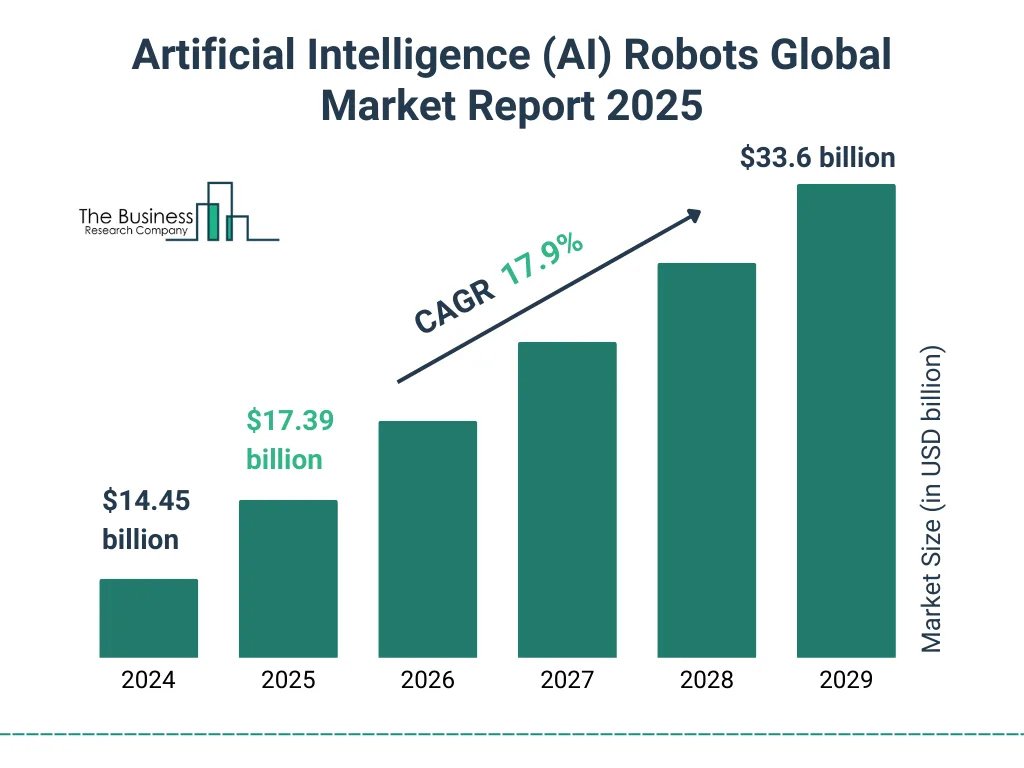
- The AI robots market is projected to expand from $14.45 billion in 2024 to $33.6 billion by 2029, reflecting strong long-term growth momentum.
- In 2025, the market is expected to reach $17.39 billion, indicating rapid early-stage adoption of AI-driven robotic solutions.
- The market is forecast to grow at a CAGR of 17.9%, underscoring robust global investment and rising demand for intelligent automation.
- This near-doubling of market size in five years highlights the expanding role of AI robots across industries such as manufacturing, healthcare, and logistics.

AI-Powered Industrial Robotics Statistics
- Factories installed 542,076 industrial robots in 2024, marking a record year.
- The total number of industrial robots in operation reached 4.66 million units globally.
- The global industrial robotics market is valued at $48.3 billion in 2025.
- Market forecasts project growth to $90.6 billion by 2030.
- AI-driven industrial robotics alone is valued at $8.98 billion in 2025.
- AI-powered industrial robotics could reach $49.11 billion by 2034.
- Asia Pacific accounts for nearly half of global industrial robotics revenue.
- AI robotics are increasingly used for predictive maintenance and adaptive production.
Collaborative Robots (Cobots) and AI Adoption Stats
- The global cobot market is valued at $1.9 billion in 2025.
- Cobot adoption is projected to grow at a 20% CAGR toward 2030.
- Alternative forecasts estimate cobots reaching $3.38 billion by 2030.
- Shipment growth slowed to 13.8% in 2024, with recovery expected in 2025.
- AI-enabled cobots support safe human-robot collaboration without cages.
- Lightweight cobots account for over 50% of unit shipments.
- AI capabilities reduce deployment time by enabling rapid task learning.
- North America and Europe lead SME adoption of AI cobots.
AI Adoption Rates by Industry Sector
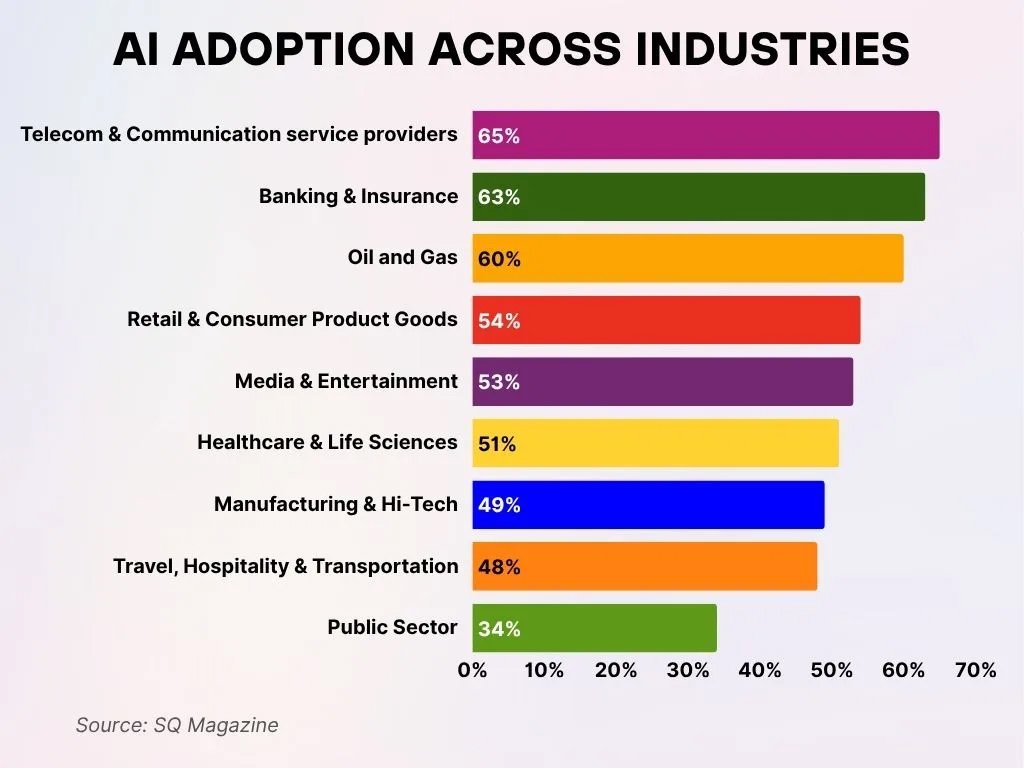
- Telecom & Communication service providers take the lead with 65% AI adoption, highlighting deep integration across automation and customer support operations.
- Banking & Insurance follow closely at 63%, actively leveraging AI for fraud detection, risk assessment, and enhanced customer experience.
- Oil and Gas record 60% adoption, utilizing AI technologies for predictive maintenance and improved resource optimization.
- Retail & Consumer Product Goods reach 54%, implementing AI-driven solutions for personalization, inventory management, and sales forecasting.
- Media & Entertainment achieve 53% adoption, largely driven by content recommendation systems and advanced audience analytics.
- Healthcare & Life Sciences report 51% AI usage, with strong emphasis on diagnostics, drug discovery, and patient care optimization.
- Manufacturing & Hi-Tech register 49% adoption, concentrating on process automation, quality control, and robotics integration.
- Travel, Hospitality & Transportation adopt AI at 48%, applying it to dynamic pricing, route optimization, and customer service enhancements.
- The Public Sector trails with only 34% AI adoption, indicating slower digital transformation across government and public services.
AI in Service and Consumer Robotics Statistics
- AI-integrated service robotics market valued at $33,965.8 million in 2025, growing at a CAGR of 21.4% to $131,723.5 million by 2032.
- The service robotics market reaches $62.85 billion in 2025, projected to hit $233.8 billion by 2035.
- 48% of companies implemented robotic solutions amid labor shortages, with 55% citing availability constraints.
- Hospitals using AI robots for logistics report 15-22% cost reductions and 20-30% higher order fulfillment rates.
- Consumer robotics market to reach $59.5 billion by 2032 at 26.7% CAGR, driven by household applications.
- Europe service robotics market is valued at $7.55 billion in 2025, growing at 18.49% CAGR to $29.34 billion by 2033.
- The autonomous delivery robots market is expected to reach $738.3 million in 2025, surging to $7,579.4 million by 2034 amid the e-commerce boom.
- The household robots market hits $14.54 billion in 2025, expanding to $71.26 billion by 2034.
- Nearly 200,000 professional service robots were sold globally in 2024, up 9% year-over-year.
Healthcare and Medical Robotics AI Statistics
- The healthcare robotics market reaches $13.0 billion in 2025, growing to $43.7 billion by 2035 at a 12.9% CAGR.
- Surgical robots hold 42.7% of the medical robot market revenue in 2025.
- Hospitals command 58.4% share of medical robot revenue in 2025.
- AI-assisted robotic surgeries cut operative time by 25% and complications by 30%.
- Surgical precision surges by 40% with AI-enabled robots.
- AI in the rehabilitation robotics market hits US$3.830 billion in 2025, expanding at 25.04% CAGR.
- The medical telepresence robots market is valued at $80.3 million in 2024, growing at 18.8% CAGR from 2025.
- Disinfection robots in healthcare are projected to reach $4.09 billion by 2031 at 19.6% CAGR.
Logistics, Warehousing, and Supply Chain Robotics Stats
- The logistics robotics market reached $15 billion in 2024.
- Market value is projected to exceed $17.2 billion in 2025.
- Long-term forecasts estimate growth to $72.6 billion by 2034.
- Autonomous mobile robots represent 44.5% of logistics robotics hardware.
- AI robotics improves order fulfillment accuracy and speed.
- E-commerce growth continues to fuel warehouse automation demand.
- AI robots reduce labor costs and error rates in warehouses.
- Adoption is strongest in North America and the Asia Pacific.
Agricultural Robotics Adoption Across Farming Operations
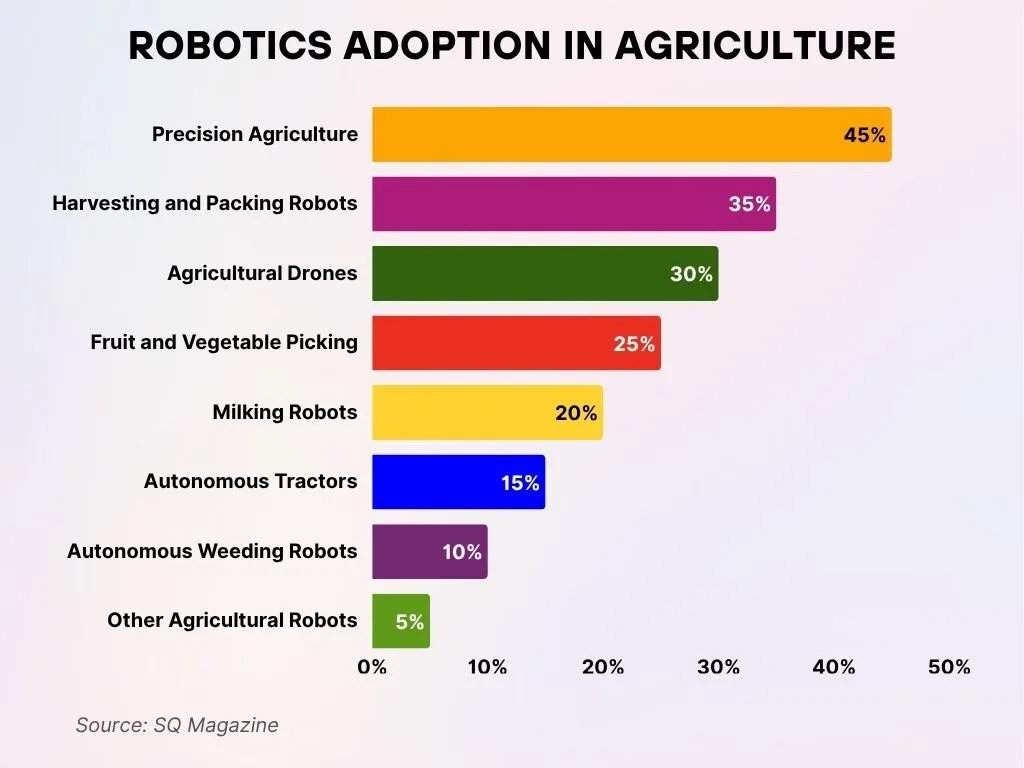
- Precision Agriculture dominates agricultural robotics with an adoption rate of 45%, fueled by data-driven farming methods and sensor-based automation systems.
- Harvesting and Packing Robots are utilized by 35% of farms, significantly enhancing efficiency in labor-intensive post-harvest processes.
- Agricultural Drones closely follow with 30% adoption, enabling crop monitoring, precision spraying, and accurate yield estimation.
- Fruit and Vegetable Picking Robots have achieved 25% adoption, assisting farmers in automating delicate and repetitive harvesting activities.
- Milking Robots are implemented by 20% of agricultural businesses, driving higher operational efficiency in dairy farming operations.
- Autonomous Tractors represent 15% adoption, delivering self-driving technology for plowing, seeding, and fieldwork tasks.
- Autonomous Weeding Robots are adopted by 10%, helping lower herbicide usage through precision-based weed management.
- Other Agricultural Robots account for 5%, encompassing specialized, niche, or emerging robotic applications within farming.
Automotive and Manufacturing AI Robotics Statistics
- China installed 295,000 industrial robots in 2024, over 54% of the global total.
- Global industrial robot installations reached 542,000 units in 2024.
- The EU automotive sector installed 30,650 robots in 2024, down 5% year-on-year.
- Germany saw 25% decline in automotive robot installations in 2024.
- Next-gen robotics in automotive is valued at $10.2 billion in 2024.
- The automotive robotics market hit $12.1 billion in 2024.
- Cobots comprised 12% of 542,000 new robot installations worldwide in 2024.
- The AI quality inspection systems market reached $465.3 million in 2024.
- AI vision achieves 99.97% defect detection accuracy in automotive inspections.
- AI predictive maintenance cuts downtime by 30–50% in manufacturing.
Investment, Funding, and R&D Spending in AI Robotics
- The AI robotics market is valued at $20.82 billion in 2025.
- Market forecasts project growth to $149.34 billion by 2032.
- Major funding rounds include $350 million raised by humanoid robotics firms in 2025.
- Large robotics startups have previously secured over $600 million in funding.
- North America captured nearly $70 billion of global AI venture funding in 2024.
- Robotics and drone startups account for over half of regional AI funding in some hubs.
- Governments are forming national alliances to accelerate robotics R&D.
- Corporate acquisitions highlight consolidation across AI robotics markets.
AI Robotics Impact on Productivity and Efficiency
- AI-driven robotics unlocks $2.9 trillion in annual U.S. economic value by 2030.
- Industry 4.0 robotics boosts production capacity by 10-15% while cutting costs by 5-7%.
- Predictive maintenance with AI robotics reduces downtime by 35-45% and breakdowns by 70-75%.
- Logistics robotics achieves 99%+ inventory accuracy, minimizing errors and lost sales.
- Service robots save 5.5 minutes per room in housekeeping, enhancing efficiency amid staffing shortages.
- AI vision systems improve defect detection by up to 90%, slashing waste and scrap by 30-45%.
- Robotics implementation cuts cycle times by 33%, increasing throughput by 25%.
- Industrial robot density up 1% lifts labor productivity by 0.018% on average.
- AI robotics market grows at 18.4% CAGR from 2023-2032, driving efficiency gains.
Regional and Country-Level AI Robotics Adoption Stats
- Asia accounted for 74% of new industrial robot deployments globally in 2024.
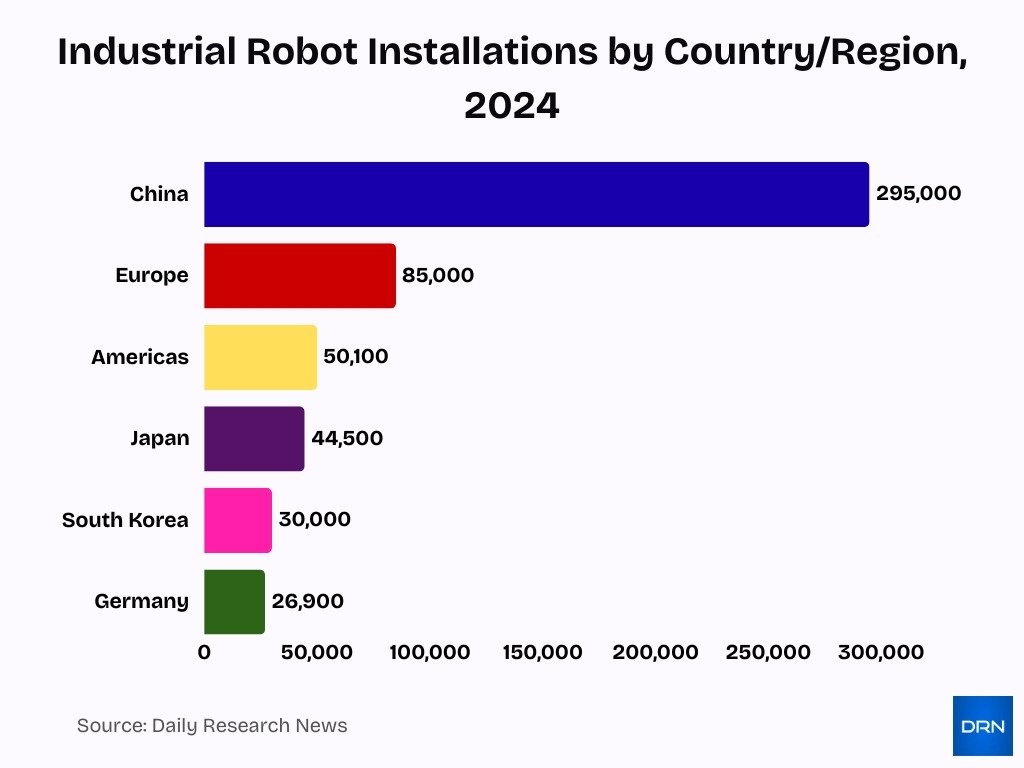
- China installed 295,000 industrial robots in 2024, surpassing all other countries combined.
- Europe saw 85,000 robot installations in 2024, an 8% decline from the prior year.
- The Americas installed 50,100 units in 2024, representing 9% of the global total.
- China‘s robot stock reached 2.03 million units by the end of 2024, over half worldwide.
- North America held 36.9% share of the global embodied AI market revenue in 2024.
- Europe’s automotive sector installed 23,000 robots in 2024, down amid industry pressures.
- Japan deployed 44,500 robots in 2024, the second-largest market after China.
- South Korea installed about 30,000 units in 2024, maintaining high automation density.
- Germany, Europe’s top market, saw 26,900 installations in 2024.
Impact on Labor, Jobs, and Workplace Safety
- AI is projected to replace 16% of jobs globally by 2025.
- New roles equivalent to 9% of jobs are expected to emerge.
- Net job impact reflects a 7% shift in existing roles.
- Demand increases for robot maintenance and system oversight roles.
- Repetitive tasks face the highest automation risk.
- Workplace injuries decline as robots handle hazardous tasks.
- Enhanced AI safety systems support human-robot collaboration.
- Skills in data analysis and robot supervision grow in importance.
AI Algorithms and Techniques Used in Robotics
- Over 70% of industrial robots deployed since 2020 incorporate machine learning.
- Machine learning in the robotics market grows at a CAGR of 44.1% by 2022.
- Intelligent robotics market reaches $50.33 billion by 2030 at 29.2% CAGR.
- CNN-based models achieve up to 97% accuracy in object recognition for robotics.
- Reinforcement learning in the robotics market hits $1.82 billion in 2024.
- NLP enables robots to grasp objects correctly on the first attempt in most cases.
- The hybrid AI market is expected to reach $76.9 billion by 2033, improving diagnostics by 50%.
- The AI-driven industrial robotics market is projected to reach $49.11 billion by 2034.
- The robotic software platforms market is expected to reach $18.98 billion by 2030 at 25.61% CAGR.
Edge AI, Sensors, and Connectivity in Robotics Statistics
- Edge AI market valued at $11.8 billion in 2025, projected to reach $56.8 billion by 2030 with 36.9% CAGR.
- Edge AI cuts robotics latency to under 10 ms versus 100 ms cloud processing.
- Robotic sensors market hits $1,819.4 million in 2024, growing to $3,625.8 million by 2033 at 8.1% CAGR.
- YOLOv8 sensor fusion achieves 92.6% accuracy and 95% mAP for real-time obstacle detection.
- 5G boosts bandwidth from 35-43 Mbps (4G) to 400 Mbps-1.8 Gbps for robotics.
- Sensor fusion market reaches $68.2 billion by 2035 at 19.7% CAGR.
- AI hardware slashes robotic energy use by 12-25% via optimization.
- Cobots show 70% lower injury rate than industrial robots with sensor feedback.
- Edge AI reduces processing latency by up to 40% versus cloud offloading.
China Industrial Robot Installation Trends (2014–2024)
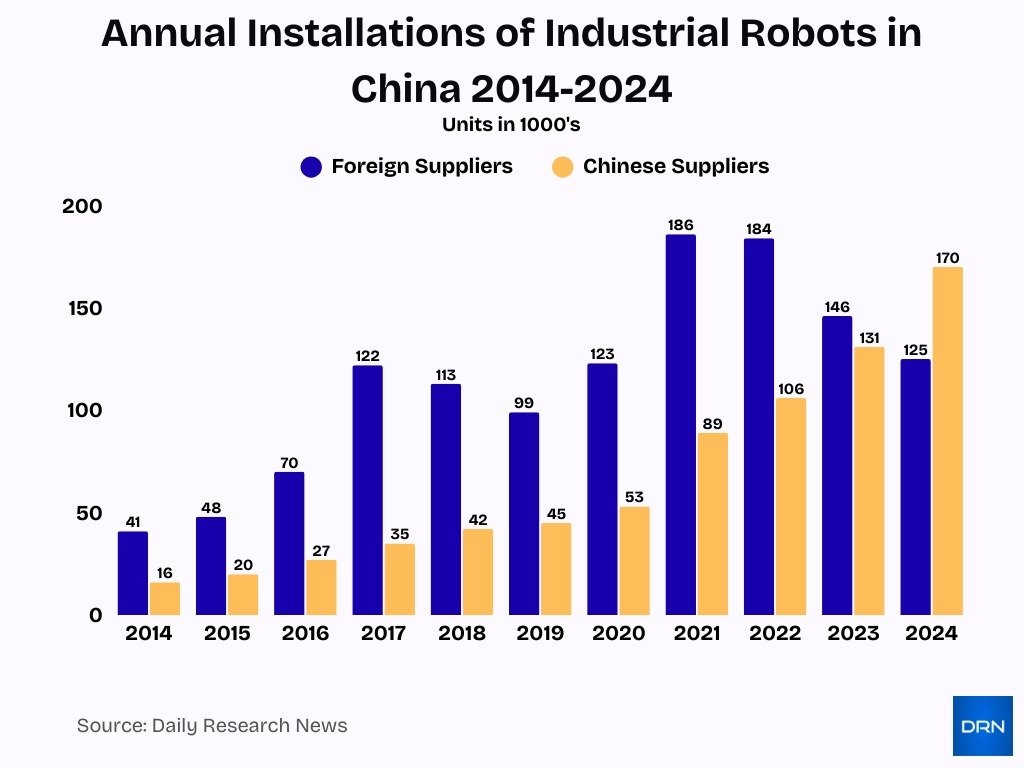
- China’s annual industrial robot installations grew from 57,000 units in 2014 to 295,000 units in 2024, marking an increase of over 5× within a decade.
- Installations supplied by foreign manufacturers peaked at 186,000 units in 2021 before declining to 125,000 units in 2024, indicating a gradual loss of dominance.
- Chinese robot suppliers expanded aggressively, rising from just 16,000 units in 2014 to 170,000 units in 2024, representing more than a 10× growth.
- Domestic suppliers overtook foreign vendors for the first time in 2023, when Chinese installations reached 131,000 units, surpassing 146,000 foreign units.
- In 2024, Chinese suppliers accounted for approximately 58% of total installations, reinforcing China’s push toward robotics self-sufficiency.
- Total robot installations rebounded after the pandemic, jumping from 176,000 units in 2020 to 275,000 units in 2021, a single-year increase of nearly 56%.
- Between 2021 and 2024, overall demand remained strong, consistently exceeding 275,000 units annually, reflecting sustained automation investment.
- The data highlights a structural shift in China’s robotics market, with local manufacturers capturing incremental growth while foreign suppliers face mounting competitive pressure.
Autonomous Mobile Robots and Self-Driving Systems Statistics
- Global AMR market reaches $2.25 billion in 2025, projected to hit $4.56 billion by 2030 at 15.1% CAGR.
- Autonomous forklifts reduce human error in accidents by 90% through advanced sensors.
- Over 35,000 serious injuries annually from forklift incidents per OSHA data.
- AMR picking systems boost operator throughput to 350+ picks per hour.
- Delivery robots grow from 21,000 units in 2024 to 2.1 million by 2034.
- Machine learning route optimization cuts path length by 19.3% vs traditional methods.
- AMR-WES integration improves hit rate by 0.30 on average for better throughput.
- India AMR market hits $153.42 million in 2025, growing at 15.04% CAGR.
- SLAM market valued at $673 million in 2024, expanding to $8.27 billion by 2032.
Future Trends and Forecasts for AI in Robotics
- The AI robotics market could grow from $6.11 billion in 2025 to $33.39 billion by 2030.
- Cognitive robotics may expand from $6.6 billion in 2025 to $19 billion by 2037.
- The overall robotics market could reach $190.8 billion by 2035.
- AI robotics is transitioning from pilots to large-scale deployments.
- Advances will improve robot adaptation and perception.
- Responsible AI frameworks will guide safe robotics adoption.
- Humanoid robots are expected to become more capable over time.
- Human-centered AI will shape future robotics design.
Frequently Asked Questions (FAQs)
The global AI in robotics market is projected to grow from about $6.11 billion in 2025 to $33.39 billion by 2030, at a CAGR of ~40.4%.
The market was estimated at $12.77 billion in 2023 and is projected to reach $124.77 billion by 2030, with a CAGR of ~38.5% from 2024 to 2030.
Asia Pacific dominated the AI in robotics market with approximately 44.6% share of the global revenue in 2023.
The global operational stock of industrial robots is estimated at roughly 4.66 million units in 2025, growing about 9% year‑on‑year.
Conclusion
AI in robotics has moved decisively past theoretical exploration into real-world deployment, with strong investment, measurable productivity benefits, and rapid technological evolution. Funding activity reflects sustained investor confidence, while advances in AI algorithms and edge computing continue to elevate autonomy and performance. Across manufacturing, logistics, healthcare, and service sectors, AI-powered robots are reshaping workflows and redefining job roles.
Looking ahead, market forecasts point to continued rapid expansion, positioning AI robotics as a foundational technology for the next decade of economic and industrial transformation.