

Artificial intelligence (AI) is reshaping how brands, creators, and users interact on social platforms. AI-powered tools are central to content generation, scheduling, analytics, and personalized experiences across networks like Meta, TikTok, and LinkedIn. From automating tasks to enhancing audience targeting, AI is driving measurable performance gains across industries. Healthcare campaigns use AI to tailor outreach, while e‑commerce brands deploy it to optimize ad spend and conversions. Explore the key statistics that define AI’s impact on social media tools.
Editor’s Choice
- AI in the social media market size is projected at $2.96 billion in 2024, rising sharply in the coming years.
- 79% of creators report that AI helps them produce content faster in 2025.
- 60% of marketers now use AI daily, up from 37% in 2024.
- 71% of social media images were AI-generated in 2025.
- Chatbot investments climbed from $2.47 billion in 2021 to $15.57 billion in 2025.
- Over 70% of marketers integrate AI into social workflows.
- 78% of companies use AI in at least one business function.
Recent Developments
- AI adoption globally grew to 16.3% by the end of 2025, reflecting steady uptake.
- DeepSeek’s AI saw traction in developing regions, underscoring varied global adoption trends.
- ChatGPT and similar tools report over 800 million weekly users, emphasizing widespread AI familiarity.
- Platforms prioritize AI labeling, TikTok reports 1.3 billion AI‑labeled videos.
- AI usage in PR tripled since 2023, with 75% of professionals using generative AI.
- Reddit projects higher ad revenue thanks to AI‑powered ads boosting targeting demand.
- AI tools raise moderation debates, with blocks on certain services in multiple countries.
- Gen Z shows high reliance on AI tools, with ~40% using ChatGPT daily for tasks beyond social media.
AI Tools Adoption and Usage Trends
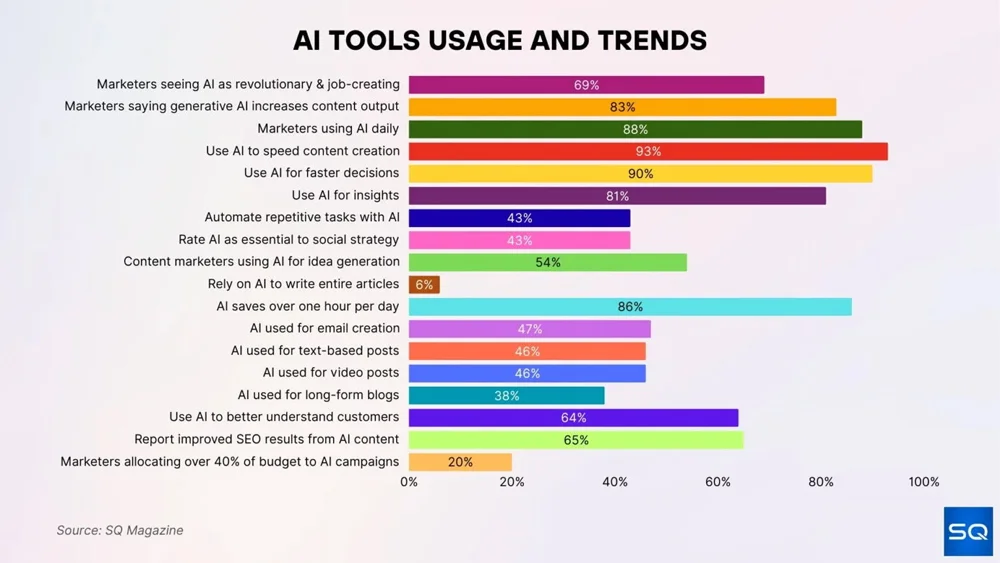
- 69% of marketers now perceive AI as revolutionary and job-creating, rather than a threat to employment.
- A clear majority, 83%, state that generative AI enables them to produce significantly more content than previously possible.
- 88% of marketers use AI daily, with 93% leveraging it to accelerate content creation, 90% for faster decision-making, and 81% to gain actionable insights.
- 43% automate repetitive tasks using AI, while another 43% consider AI essential to their social media strategy.
- Approximately 54% of content marketers use AI for idea generation, yet only 6% depend on it to write full articles end-to-end.
- 86% report that AI saves more than one hour per day while also helping them generate creative ideas.
- AI applications span emails (47%), text-based posts (46%), video posts (46%), and long-form blog content (38%).
- 64% use AI to better understand customers, and 65% report improved SEO performance from AI-generated content.
- Nearly 20% of marketers allocate over 40% of their budget to AI-powered content campaigns.
Adoption Statistics for AI‑Powered Social Media Tools
- 60% of marketers now use AI tools daily for tasks from content to analytics.
- 84% increased AI use over the last year, per industry reports.
- 51% of marketing teams use AI to optimize content workflows.
- 57% of small businesses now use AI for marketing activities.
- 52% of small businesses deploy AI for content creation.
- 62% of businesses plan to invest in conversational AI for real‑time support.
- Over 80% of professionals find AI important to their marketing efforts.
- 38% of organizations cite increased efficiency as a top AI benefit in social media.

Image and Video Generation With AI for Social Media Platforms
- AI tools now produce 71% of social media images, dominating visual content creation.
- 80%+ of social platforms use AI algorithms for content recommendations and user engagement.
- 40% of TikTok and Instagram videos feature AI generation for short-form content.
- 41% of brands adopted AI video tools in 2025, surging 128% year-over-year.
- AI-assisted visuals deliver 15-25% higher engagement rates for businesses.
- 73% of companies report engagement boosts from AI visual production.
- AI-powered posts increase engagement by 30% over manual social content.
- 62% of marketers find AI labels enhance visual performance.
- 55%+ of users favor personalized AI videos in social feeds.
- 62% of marketers save over 50% time with AI video production.
AI in Social Media Global Market Growth
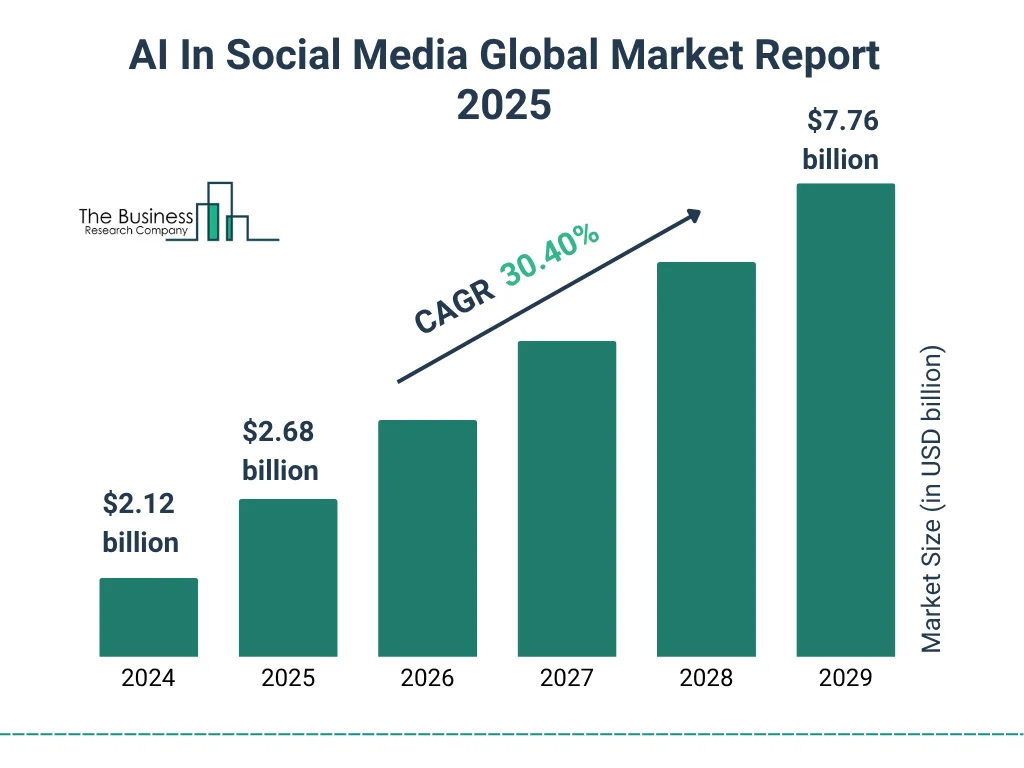
- The AI in the social media market was valued at $2.12 billion in 2024, highlighting the early-stage commercialization of AI-driven social platforms.
- In 2025, the market expanded to $2.68 billion, reflecting growing adoption of AI-powered content creation, analytics, and automation tools.
- By 2026, the market is projected to reach $3.48 billion, driven by increased use of generative AI for social media marketing and engagement.
- The market is expected to grow to $4.55 billion in 2027, supported by rising investments in AI-based audience targeting and personalization.
- In 2028, the global AI in social media market is forecast to hit $5.98 billion, as enterprises scale AI-enabled social commerce and advertising solutions.
- By 2029, the market is projected to reach $7.76 billion, underscoring AI’s transformation of content strategy, influencer marketing, and social analytics.
- Overall, the market is anticipated to grow at a strong CAGR of 30.40% between 2024 and 2029, signaling sustained long-term expansion and innovation in AI-driven social media technologies.
Caption and Copywriting Insights on AI in Social Media
- Over 80% of social media content recommendations rely on AI for better user retention.
- 76% of marketers using generative AI apply it for content creation and copywriting.
- 42% of marketers leverage AI specifically for social media copy generation.
- Businesses see 15-25% higher engagement rates with AI-optimized social content.
- AI slashes content creation time by up to 70% for social media posts.
- Over 40% of social media marketers now use AI to write captions, up 103% from 2023.
- 75% of marketing managers use AI for content generation, boosting engagement by 25-30%.
- AI hashtag strategies increase organic reach by 40-60% on social platforms.
- 71% of marketers report that AI outperforms human content on social media.
Scheduling and Automation Advances Through AI Integration
- AI scheduling tools now optimize post timing based on audience behavior, boosting engagement up to 20% vs manual scheduling.
- Around 43% of marketers automate repetitive social tasks like scheduling with AI tools.
- AI helps teams publish across platforms simultaneously, saving about 2–3 hours weekly per user.
- 18% of social teams use cross‑platform AI scheduling as part of their workflow.
- Automated scheduling reduces manual errors by up to 30%.
- AI tools predict the best post cadence, often outperforming human planners in engagement metrics.
- Many tools now take real‑time trend data to adjust schedules on the fly.
- Scheduling via AI integrates calendar planning with performance data to inform future campaigns.
Content Creation Trends Using AI in Social Media
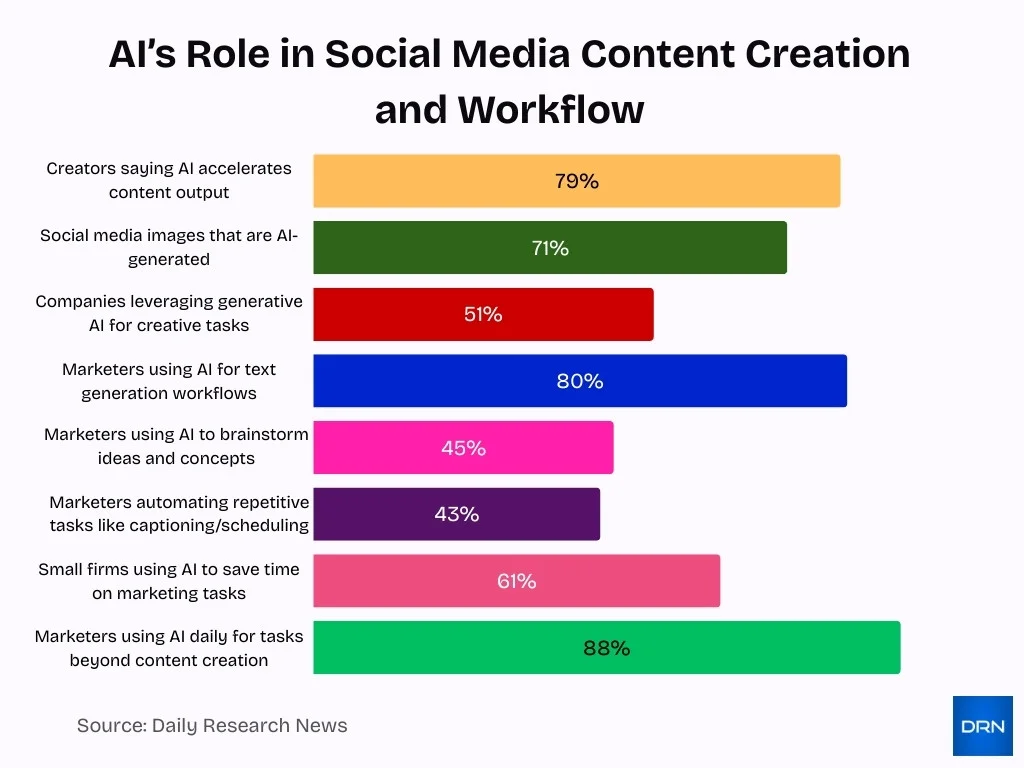
- 79% of creators indicate AI accelerates content output.
- 71% of images shared on social media are now AI‑generated.
- 51% of companies leverage generative AI for creative tasks.
- Over 80% of marketers use AI for text generation workflows.
- 45% of marketers use AI to brainstorm ideas and concepts.
- 43% report automating repetitive tasks like captioning and scheduling.
- 61% of small firms embrace AI to save time on marketing tasks.
- 88% of marketers use AI daily for tasks beyond content creation.
Analytics and Reporting Enhanced by AI in Social Media
- AI analytics provide trend insights faster than traditional reporting, accelerating decision speed.
- Real‑time dashboards alert teams to performance dips or spikes instantly.
- AI detects patterns across engagement, reach, and conversions to suggest optimization steps.
- Predictive analytics forecasts campaign outcomes ahead of time.
- AI identifies peak interaction times with greater accuracy than manual analysis.
- Natural language processing (NLP) helps interpret qualitative feedback from audiences.
- Automated report generation cuts analysis time by 40–60%.
- Many platforms now incorporate AI scorecards that grade post performance and forecast next steps.
Audience Segmentation and Targeting With AI Technologies
- AI creates granular segments analyzing thousands of behavioral signals beyond demographics.
- 78% of brands use AI to reduce ad waste by precise targeting.
- AI-driven behavioral segmentation boosts CTR by 20–40% over static ads.
- Brands see 32% lower CPA and 17% higher ROAS with AI campaign tools.
- AI predictive targeting achieves 2–3x higher conversion rates than demographics.
- AI-optimized creatives deliver up to 2x higher CTRs via personalization.
- 75% of companies use or plan AI-powered segmentation for dynamics.
- AI cuts ad costs by up to 80% through dynamic engagement pricing.
- eBay improved CTR by 42% using AI for audience targeting.
Adoption of Generative AI Management Practices
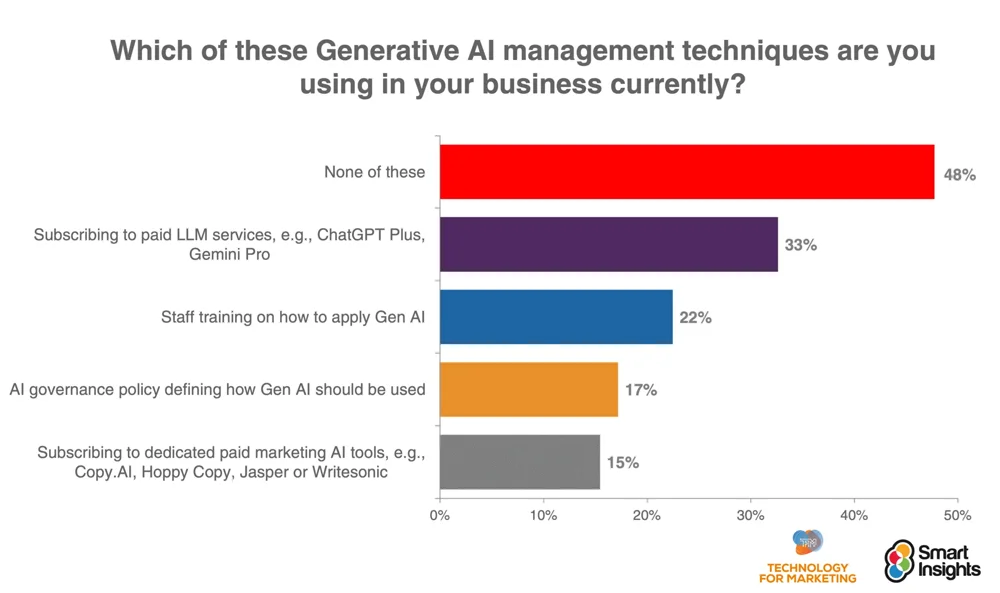
- 48% of businesses state that they are currently using none of the listed Generative AI management techniques across their organizations.
- 33% of companies report subscribing to paid LLM services, including platforms such as ChatGPT Plus and Gemini Pro, to support AI-driven workflows.
- 22% of organizations confirm that they provide staff training focused on how to effectively apply Generative AI in day-to-day operations.
- 17% of firms indicate that they have established a formal AI governance policy that clearly defines how Generative AI should be used internally.
- 15% of businesses say they subscribe to dedicated paid marketing AI tools, such as Copy.AI, Hoppy Copy, Jasper, and Writesonic, to enhance content creation and marketing efficiency.
Advertising Performance and ROI Driven by AI on Social Media
- AI‑driven ad optimization boosts ROI by automatically allocating budgets to high‑performing ads.
- A study shows that over 80% of marketers using GenAI report measurable ROI improvements.
- Platforms like Meta and TikTok increasingly use AI to personalize ads on a per‑user basis.
- AI tools adjust bidding strategies in real time to maximize ad efficiency.
- Dynamic creative optimization tests variants automatically to find top performers.
- Real‑time insights from AI help reduce cost‑per‑click (CPC) and cost‑per‑acquisition (CPA).
- Predictive analytics forecast ad outcomes, reducing campaign risk.
- AI attribution models improve understanding of customer journeys across touchpoints.
Recommendation Algorithms and Feed Personalization via AI
- Personalized recommendation systems influence over 70% of content on major platforms like Amazon.
- Netflix’s AI recommendations drive 75% of user engagement on the platform.
- AI-powered feeds boost user engagement by 66% on average across apps.
- 31.9% of Facebook Feed organic views stem from algorithmic recommendations.
- Amazon generates 35% of sales through its recommendation engine.
- AI personalization achieves 1.7x higher conversion rates in marketing.
- Personalized AI reduces customer churn by 28%, according to Gartner.
- YouTube personalization now weights viewer satisfaction at 35% in rankings.
- Activity feeds increase user retention by 60% via personalization.
Customer Support and Chatbots Powered by AI in Social Media
- Investment in AI chatbots soared from $2.47B in 2021 to $15.57B in 2025.
- AI chatbots now handle vast volumes of routine user queries without human input.
- Use of chatbots increased 42% during major retail seasons, aiding purchases and returns.
- Chatbots accelerate response times to under one hour in many cases.
- Automated support improves satisfaction scores as users get instant help.
- AI agents can route complex requests to human agents when needed.
- Chatbots handle repetitive tasks like order checks, FAQ replies, and scheduling.
- Some brands see AI support cost savings of up to 25% annually.
Primary Professional Use Cases for AI Tools
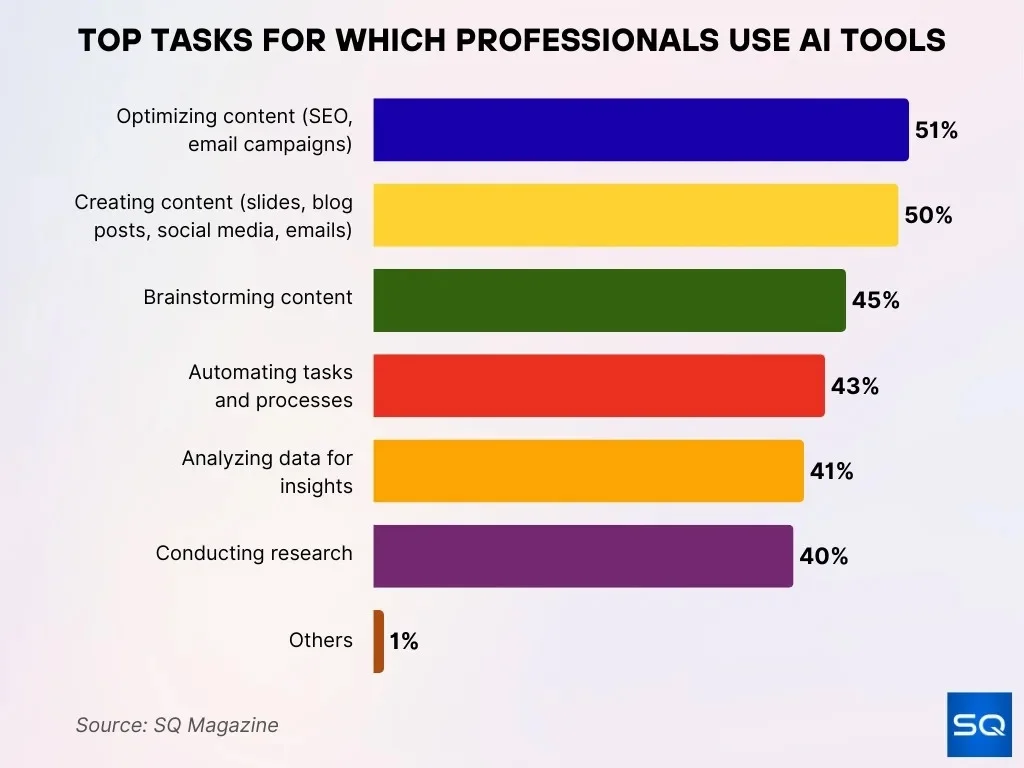
- 51% of professionals use AI tools to optimize content, including SEO strategies and email marketing campaigns.
- 50% of users leverage AI for content creation, such as presentations, blog articles, social media posts, and emails.
- 45% of professionals depend on AI to brainstorm and generate content ideas.
- 43% apply AI technologies to automate routine tasks and operational processes.
- 41% utilize AI-powered analytics to analyze data and extract actionable insights.
- 40% rely on AI tools to support research activities and information gathering.
- Only 1% of professionals report using AI for other unspecified purposes.
Social Listening and Sentiment Analysis Through AI Tools
- 62% of social marketers use social listening tools to understand conversations.
- Social listening ranks as a top priority for many social strategies.
- AI sentiment analysis helps detect emotional trends in brand mentions.
- Deep learning sentiment models score posts for positivity or negativity automatically.
- Real‑time trend identification helps brands react proactively to shifts.
- Listening tools can refine product and marketing decisions based on feedback loops.
- Sentiment analysis aids crisis response by flagging negative spikes early.
- NLP models integrated into dashboards enhance pattern recognition and reporting.
Influencer Discovery and Campaign Management Using AI
- 66.4% of marketers report that AI improved influencer campaign performance.
- 77% of brands achieve higher ROI with AI-driven influencer marketing.
- 60% of marketers use AI for influencer discovery and matching.
- 37% higher engagement from AI-optimized influencer content.
- Global influencer platform market hits $32.55 billion in 2025 via AI tools.
- 63% of professionals adopt AI/ML for campaign management.
- 55% leverage AI analytics for precise influencer-brand alignment.
- 40% faster outreach automated by AI in influencer campaigns.
- Platforms analyze billions of interactions for optimal AI influencer matches.
Impact of AI on Social Media Engagement Metrics
- Businesses using AI for social media content generation report a 15-25% increase in engagement rates.
- Over 80% of social media content recommendations are powered by AI, improving user retention rates.
- AI recommendation systems boost user engagement by 30% through personalized content.
- Brands using AI scheduling tools see engagement lifts of 20–30%.
- AI personalization delivers 5-8 times higher return on marketing spend.
- AI trend forecasting boosts engagement by 37% and conversions by 22%.
- 86% of companies using AI recommendations report major customer retention upticks.
- AI-optimized posts via A/B testing increase shares by up to 150%.
AI-Driven Marketing Tools Marketers Plan to Adopt
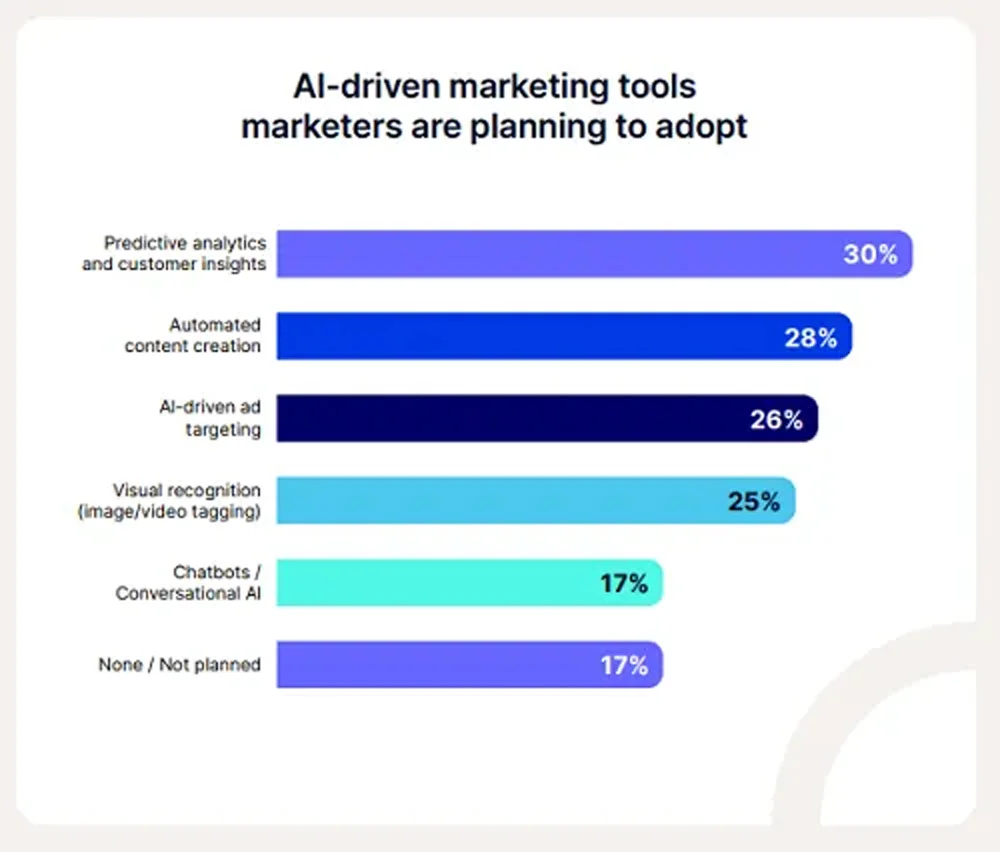
- Predictive analytics and customer insights lead adoption plans, with 30% of marketers aiming to use AI to better understand audiences and forecast behavior.
- Automated content creation ranks second, as 28% of marketers plan to leverage AI to scale blogs, ads, emails, and social media content efficiently.
- AI-driven ad targeting is a priority for 26% of marketers, highlighting growing demand for more precise, data-driven advertising and personalization.
- Visual recognition tools for image and video tagging attract 25% of marketers, reflecting the rising importance of visual content analysis.
- Chatbots and conversational AI are planned by 17% of marketers, supporting automated customer engagement and real-time support.
- No AI adoption plans are reported by 17% of marketers, indicating a segment that remains cautious or unprepared to implement AI-driven marketing tools.
Transparency and Labeling Challenges of AI‑Generated Content
- South Korea mandates clear labeling of all AI-generated ads starting early 2026 to safeguard consumers.
- Humans detect AI-generated content with only 51% accuracy, near random chance.
- AI labels on headlines reduce perceived accuracy and sharing by 0.12–0.20 points on scales.
- 42% of users report less trust in news stories after seeing AI disclosure labels.
- Fifty % of consumers correctly identify AI-written copy, with 52% disengaging from content they suspect is written by AI.
- Social platforms label just 30% of AI-generated posts despite detection promises.
- 61% of users worry that AI images spread fake news, demanding transparent technical details.
- Detailed AI labels boost user confidence in organizations compared to vague disclosures.
- Global legislative mentions of AI surged 21.3% across 75 countries since 2023.
- Labeling AI content significantly cuts belief in claims and the likelihood of sharing online.
Consumer Perceptions of AI Use in Social Media Content
- A 2024 survey found that 62% of consumers are less likely to engage with AI‑generated content than human‑created posts.
- Privacy and personalization remain central to consumer trust in AI on social platforms.
- Some consumers value AI‑driven personalization for convenience and relevance.
- Others express concern over authenticity and data privacy tied to automated interactions.
- Consumer sentiment varies by age, with younger users often more accepting of AI content.
- Transparent labeling tends to increase belief that content is AI‑generated, even as engagement behavior holds steady.
- Trust in brands using AI is higher when coupled with clear communication and human oversight.
- Perceived authenticity remains a key differentiator for consumer preference in social feeds.
Future Trends for AI Integration in Social Media Tools
- AI in the social media market is expected to grow from $4.12 billion in 2025 to $70.53 billion by 2034 at 37.11% CAGR.
- Generative AI in social media is projected to reach $62.72 billion by 2028 with 41.53% CAGR.
- The virtual influencer market is expected to hit $45.88 billion by 2030 at 40.8% CAGR.
- Over 80% of social media content recommendations are powered by AI, boosting user retention.
- 71% of social media images are now AI-generated, transforming visual content creation.
- Businesses using AI for social media report 15-25% higher engagement rates.
- 44% trust AI more than 24% for social media influencers, emphasizing governance value.
- 81% of social marketers say predictive analytics is key for strategy and influencer decisions.
- 85% of marketers view short-form video as the top format boosted by generative AI.
- 18% of teams use cross-platform AI tools for unified social media workflows.
Frequently Asked Questions (FAQs)
About 80% of social media content recommendations are driven by AI algorithms.
The global AI in social media market is forecast to grow from $2.92 billion in 2025 to $20.83 billion by 2032, at a CAGR of 32.4%.
Approximately 60% of marketers use AI tools daily for social media activities, up from 37% in 2024.
Roughly 79% of creators report that AI enables them to produce content faster, with about 65% using it for at least half of their posts.
Conclusion
AI is now an integral force in social media tools, improving influencer campaigns, agency efficiencies, engagement metrics, and personalization across platforms. While adoption continues to grow, challenges in transparency, labeling, and consumer trust shape how these technologies evolve. Marketers who balance data-driven automation with clear ethical practices and human oversight stand to unlock long‑term value and stronger audience connections.