Artificial Intelligence (AI) is reshaping the global labor market, not just as a future possibility, but as a current force. Firms across industries are integrating AI tools into workflows, triggering job displacement even as automation boosts productivity and enables new forms of work. This shift already affects clerical roles, data-heavy jobs, and basic administrative functions. At the same time, sectors such as tech, design, and care are beginning to see increased demand for newly defined roles. The following article delves into the most recent statistics and trends around AI-driven job loss and transformation.
Editor’s Choice
- An estimated 300 million jobs globally could be replaced by AI and automation, reflecting a substantial fraction of worldwide employment.
- By 2030, 30% of U.S. jobs may become fully automatable, while 60% of jobs could undergo significant change in task structure due to AI.
- In 2025, organizations report a sharp increase in AI adoption, 88% say they use AI in at least one business function, up from 78% last year.
- Industries most exposed to AI show wage growth double that of industries with low AI exposure, indicating the rising value of AI skills.
- 92 million roles may be displaced worldwide by 2030, even as 170 million new jobs emerge over the same period.
- A 2025 study found that 76,440 positions have already been eliminated due to AI-related displacement.
- AI-exposed industries report 3× higher growth in revenue per employee compared with less exposed industries.
Recent Developments
- 88% of organizations now report using AI in at least one business function, up from 78% in 2024.
- Only about one-third of companies have begun scaling AI programs across their business units.
- Roughly 50% of companies using AI plan workflow redesigns to accommodate automation.
- Wages in AI-exposed industries grew twice as fast as in low-exposure sectors.
- 66% of AI-exposed jobs saw accelerated skill change in 2025, up from 25% last year.
- Sectors such as agriculture and mining are increasing AI investment.
- Many organizations still report little or no workforce reduction from AI adoption.
- AI-powered roles such as data engineering and machine learning specialization continue to expand.
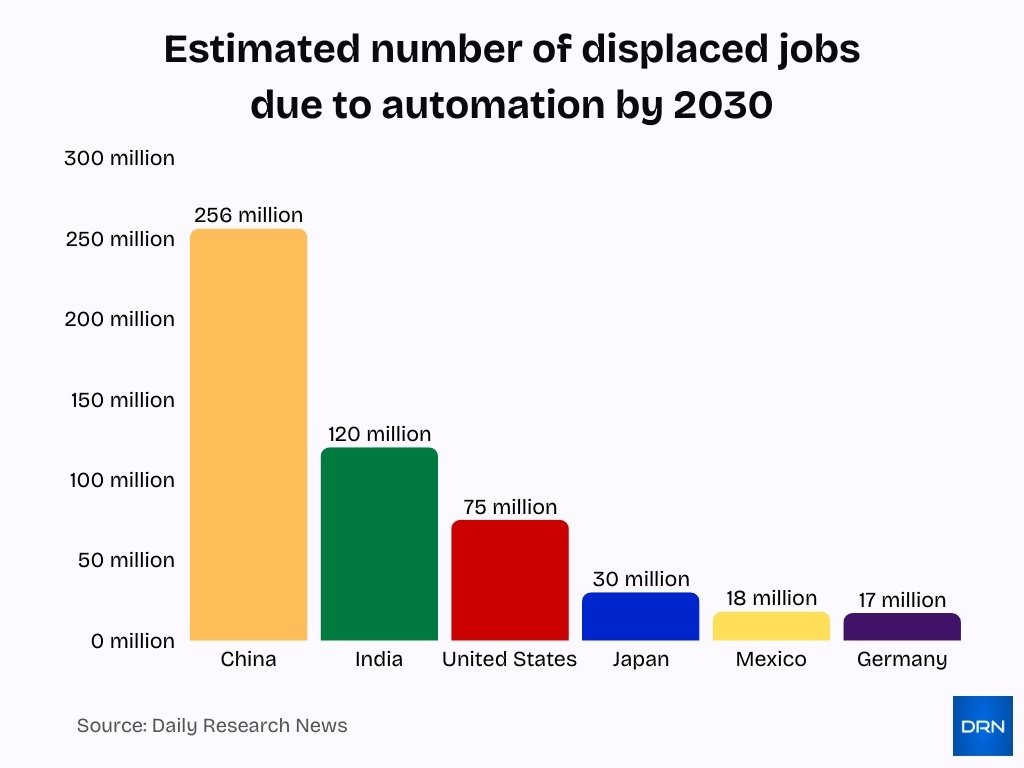
Global Job Displacement Due to Automation by 2030
- China is projected to experience the largest job displacement, with an estimated 256 million jobs affected, a figure significantly higher than any other country in the dataset.
- India follows as the second most impacted nation, expecting around 120 million displaced jobs due to automation-driven changes.
- The United States may see approximately 75 million jobs displaced, highlighting substantial workforce transformation in one of the world’s most advanced economies.
- Japan is projected to lose 30 million jobs, reflecting the country’s rapid adoption of automation in manufacturing and service sectors.
- Mexico could face around 18 million displaced jobs, indicating growing technological shifts within its labor market.
- Germany, despite being a highly industrialized nation, shows an estimated 17 million job displacements, the lowest among the countries listed, possibly due to early automation adaptation and workforce upskilling efforts.
General AI Impact on Jobs
- AI could displace 92 million jobs globally by 2030 while creating 170 million new roles.
- Up to 57% of U.S. work hours are automatable with current AI technologies.
- WEF predicts 39% of skill sets will become outdated between 2025-2030 due to AI.
- Goldman Sachs estimates 300 million full-time jobs could be affected worldwide by generative AI.
- MIT reports that current AI systems cover 12% of U.S. work hours.
- 85 million jobs may be displaced by 2025, but 97 million new roles could emerge.
- McKinsey warns AI agents could automate 44% of U.S. work hours today.
- 41% of employers worldwide plan workforce reductions due to AI over the next five years.
- 20 million U.S. workers need retraining for AI careers in the next three years.

Global Job Loss Projections
- 92 million roles may be displaced globally by 2030 due to AI, automation, and structural change.
- 170 million jobs may be created in the same period, producing a net gain of 78 million jobs.
- Other analyses estimate 400 to 800 million global job displacements by 2030.
- 375 million workers, or 14% of the global workforce, may need to switch occupations by 2030.
- Up to 40% of jobs worldwide may face structural change from AI.
- Forecasts vary significantly based on economic conditions and adoption rates.
- Many displaced workers could transition to other forms of employment, but only with large-scale reskilling.
- Uncertainty remains high due to evolving human AI collaboration models.
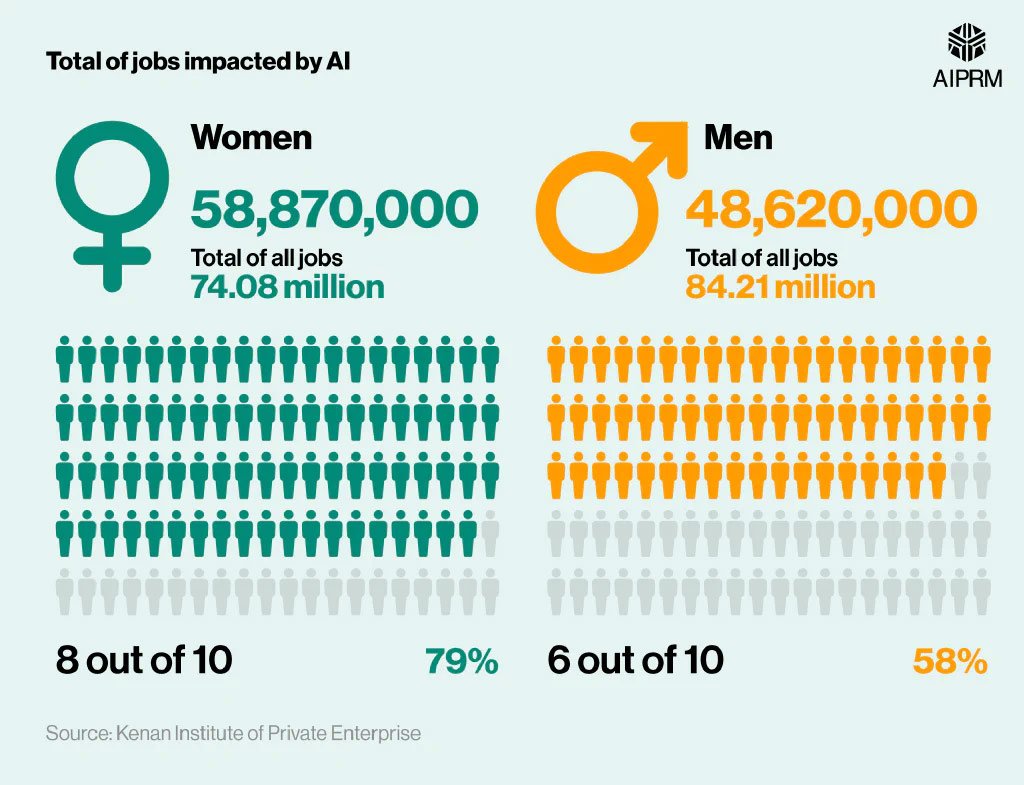
AI’s Impact on Jobs by Gender
- Women face a higher proportion of AI-impacted jobs, with 8 out of 10 roles influenced, equivalent to 79% of all women’s jobs.
- A total of 58,870,000 women’s jobs are projected to be impacted by AI, out of 74.08 million total jobs held by women.
- Men experience a lower relative impact, with 6 out of 10 jobs, about 58%, affected by AI.
- In absolute numbers, 48,620,000 men’s jobs are expected to be impacted out of 84.21 million total jobs held by men.
- Although men hold more total jobs overall, women are disproportionately affected when considering the share of their workforce impacted by AI.
- These findings highlight a gender-skewed vulnerability in job roles likely to be influenced or disrupted by AI technologies.
Current AI Job Losses
- 77,999 tech jobs lost to AI from January to early June 2025.
- 48,414 U.S. job cuts cited AI in 2025, with 31,000 in October alone.
- 85 million jobs will be displaced by AI by 2025, but 97 million new roles will emerge.
- 92 million roles, equivalent to 8% of current jobs, will be displaced by 2030.
- 300 million full-time jobs at risk globally from AI automation.
- 14% of the global workforce may need career changes by 2030 due to AI.
- 41% of employers plan workforce reduction via AI in the next five years.
- Over 112,700 tech jobs were cut across 218 companies in 2025.
- 17,375 job cuts directly attributed to AI January-September 2025.
Jobs Most at Risk
- 25% of global jobs face generative AI exposure, rising to 34% in high-income countries.
- Clerical occupations show the highest generative AI exposure worldwide.
- Data entry clerks are projected to lose 24% of their jobs globally due to automation.
- 7.5 million data entry jobs are at risk of elimination by 2027.
- Telemarketers face 96% AI automation exposure for tasks.
- 46% of accountants and bookkeepers’ work is automatable by generative AI.
- 60% of administrative assistant tasks are expected to be automated by 2028.
- 92 million roles could be displaced globally by AI by 2030.
- 17,375 customer service jobs will be cut due to AI in 2025.
Jobs Least Affected by AI
- Air traffic controllers face a <1% automation risk due to high-stakes human judgment.
- Radiologists and chief executives are among the occupations with the lowest 6-7% US workforce displacement from AI.
- Pharmacists and clergy show minimal vulnerability as AI displaces only 2.5% of current employment.
- Photographers retain resilience with 15% of jobs safe in creative fields per exposure metrics.
- Roles needing empathy or human interaction have only 7.3% automation in the education sector.
- Manual dexterity jobs like nursing assistants face the lowest applicability scores from generative AI.
- Only 15% of US jobs (23 million) are at heightened automation risk, per SHRM analysis.
- 63% of jobs include barriers preventing full AI displacement.
- 60% of employment is exposed to AI changes, but 5% fully automatable globally.
Impact by Industry
- AI-exposed industries report 3× higher revenue per employee compared to low-exposure sectors.
- Wage growth is twice as fast in AI-exposed industries versus less exposed ones.
- AI can replace work equivalent to 11.7% of the U.S. workforce, or $1.2 trillion in wages.
- 92 million global jobs may be displaced by AI by 2030, per WEF forecasts.
- Manufacturing has lost over 1.7 million jobs globally to AI-driven automation.
- Industrial robots now handle 44% of repetitive manufacturing tasks worldwide.
- The technology sector announced 141,159 job cuts in 2025 amid AI integration.
- Customer service faces an 80% automation risk by 2025 from AI chatbots.
- AI skills command a 56% wage premium over similar non-AI roles.
- 86% of employers expect AI to transform businesses by 2030.
Impact by Generation
- Workers aged 22-25 in high AI exposure roles saw a 13% employment decline versus low-exposure peers.
- Early-career software engineers (22-25) experienced a nearly 20% employment drop since late 2022.
- Young workers aged 18-24 are 129% more likely than those over 65 to fear AI job obsolescence.
- 27% of bachelor’s degree holders work in jobs most exposed to AI automation.
- 66% of enterprises reduced entry-level hiring due to generative AI adoption.
- 49% of Gen Z job seekers believe AI diminishes college education value.
- Nearly 50 million U.S. entry-level jobs, held by young workers, face high AI risk.
- Mid/late-career workers in specialized fields show stable or growing employment amid AI rise.
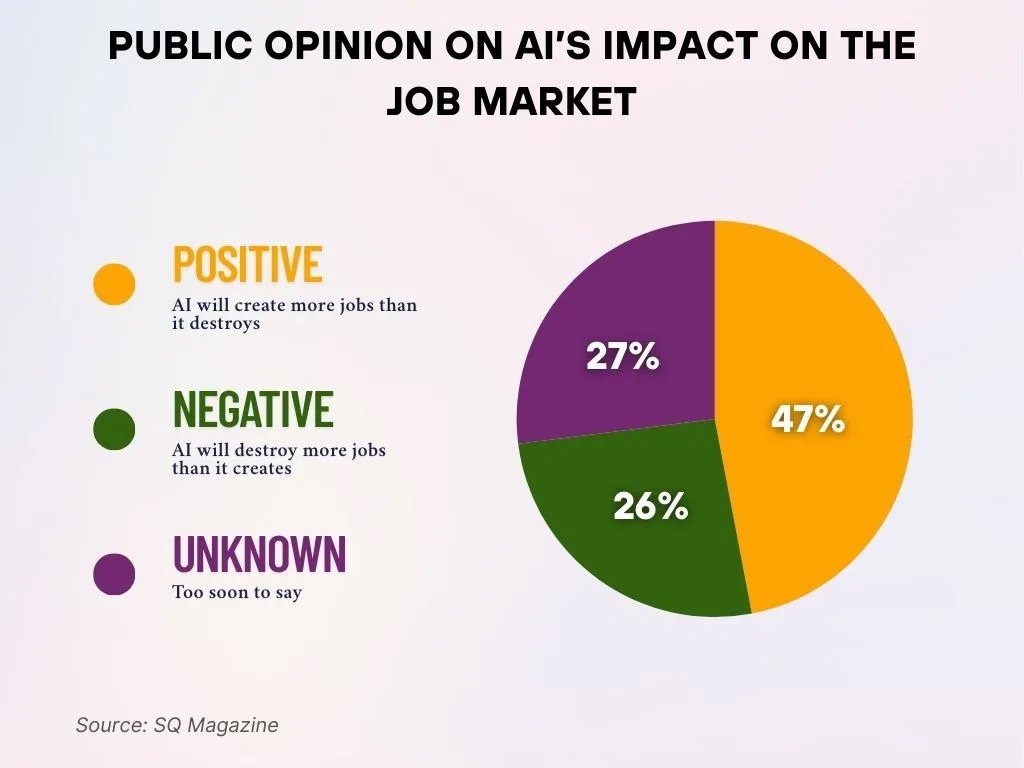
Public Sentiment Regarding AI’s Influence on the Job Market
- 47% of people believe AI will have a positive impact, creating more jobs than it destroys, which demonstrates strong optimism about future employment opportunities.
- 26% think AI will have a negative effect, as it may eliminate more jobs than it generates, underscoring significant concerns about job displacement.
- Another 26% say it is too soon to tell, reflecting ongoing uncertainty about how AI will ultimately reshape overall employment dynamics.
Skills for AI-Resistant Careers
- 39% of core skills will become obsolete by 2030, according to the World Economic Forum.
- Cybersecurity job openings reached 3.5 million globally in 202,5, with sustained demand.
- Data analyst roles are projected to grow 23% by 2032, per the U.S. Bureau of Labor Statistics.
- Information security analysts are expected to expand by 32% from 2022–2032.
- 69% of employees believe AI improves job performance despite concerns.
- Up to 3 million low-skill jobs are at risk of AI displacement by 2035 in the UK.
- AI governance roles like ethics specialists saw 28% growth in 2023 postings.
- Blended technical-soft skills training boosts employment outcomes long-term over a single focus.
- Hiring for AI literacy in non-technical roles surged 323% over eight years.
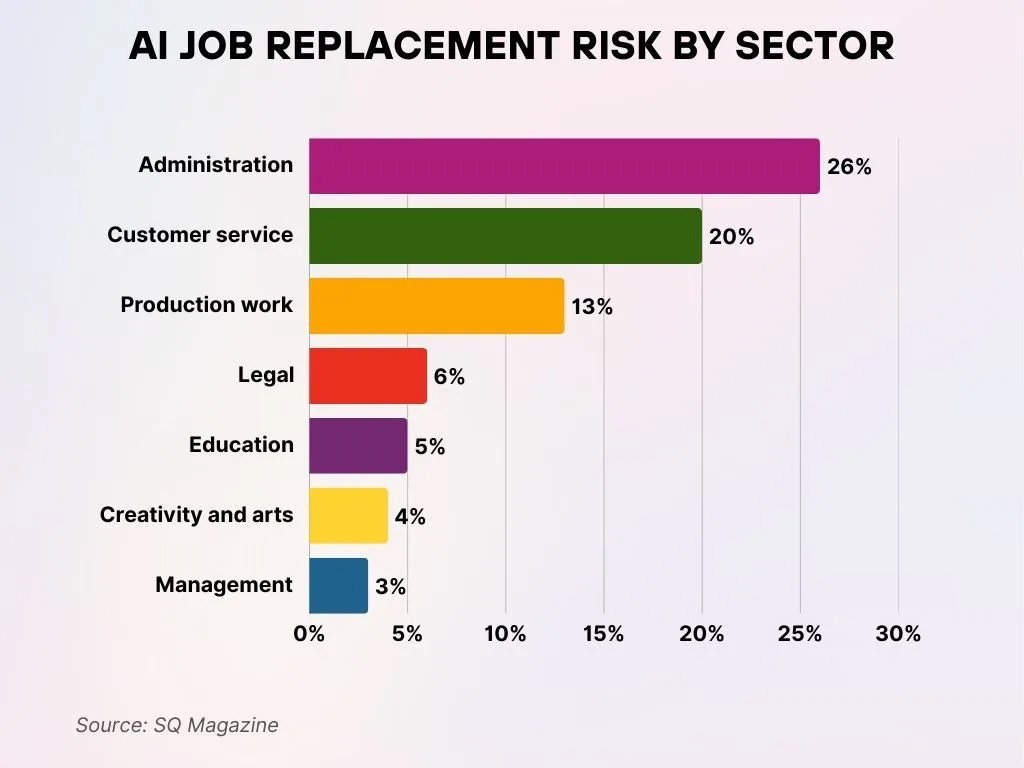
AI Job Replacement Risk Across Sectors
- Administration jobs face the highest risk, with 26% potentially impacted by AI technologies, as these roles include clerical and support functions that are highly automatable.
- Customer service roles remain the next most vulnerable, with 20% of positions at risk as AI chatbots and virtual assistants increasingly replace routine interactions.
- Production work shows a 13% likelihood of replacement, driven largely by automation and robotics within manufacturing environments.
- The legal sector holds a 6% job replacement risk, since AI is used for document review and legal research, though human judgment still plays a major role.
- Education roles carry a 5% risk, as AI can support content delivery, yet human interaction remains essential in teaching.
- Jobs involving creativity and the arts show a 4% risk, with AI assisting in content creation but still limited in producing original creative thought.
- Management positions are the least threatened, with only a 3% risk, as strategic decision-making and leadership continue to rely heavily on human capabilities.
Jobs Created by AI
- 78 million new jobs may be created globally by 2030 due to AI adoption.
- Around 133 million new roles could emerge, while 75 million may be displaced by automation.
- The global AI market could generate $15.7 trillion in economic output by 2030, driving employment growth.
- 97 million jobs requiring human-AI collaboration may arise across major industries by 2025.
- Demand for data scientists and AI experts is projected to grow by 36% annually through 2031.
- The AI sector itself could employ over 10 million professionals worldwide by 2030.
- 58% of companies plan to create new, higher-value roles as AI boosts productivity.
- Jobs involving human skills like creativity and empathy may rise by 20–25% in the next decade.
- The AI ethics and governance job market is expected to expand by 30% annually through 2032.
- AI-related career opportunities in cybersecurity could increase by 32% by 2030.
Unemployment Rate Changes Correlated With AI Exposure
- Occupations with higher AI exposure saw unemployment increases of up to 2.5 percentage points from 2022-2025, with a correlation of 0.47.
- Computer and mathematical occupations, with an AI exposure score of around 80%, faced the steepest unemployment rises.
- Generative AI adoption intensity correlated 0.57 with larger unemployment gains across occupations.
- Low AI exposure sectors, like blue-collar jobs, experienced relatively smaller unemployment increases.
- Most AI-exposed workers’ unemployment rose 0.30 percentage points from 2022 to early 2025.
- The least AI-exposed workers saw unemployment climb 0.94 percentage points over the same period.
- Nationwide unemployment rate reached 4.2% by July 2025, up from 3.7% pre-pandemic average.
- 23% of employed workers will use generative AI weekly by late 2024.
Org-level Adoption of AI and Workforce Reduction Intentions
- 78% of organizations now use AI in at least one business function, up from 55% last year.
- 45% of organizations deploy AI across three or more functions like sales, marketing, and operations.
- Only 12% of companies remain stuck in AI pilot mode in 2025.
- 41% of employers worldwide plan workforce reductions due to AI automation by 2030.
- AI could displace 11.7% of the U.S. workforce, affecting HR, logistics, and finance roles.
- Over 40% of workers need reskilling by 2030 to mitigate AI-driven job loss.
- 80% of business leaders prioritize reskilling employees for AI over layoffs.
- 55% of businesses regret redundancies made during AI adoption without proper planning.
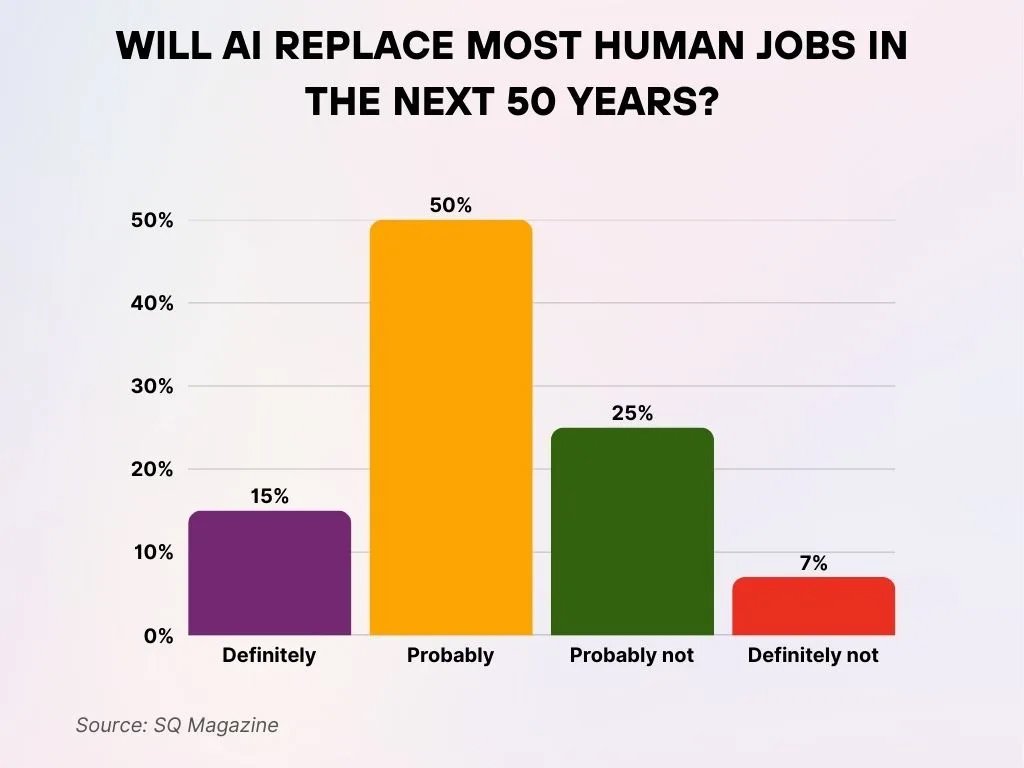
Will AI Take Over Most Human Jobs in the Coming 50 Years?
- 50% of people believe that AI will probably assume a major share of the work now performed by humans within the next 50 years, maintaining the idea of significant technological takeover.
- 15% of respondents think that AI will definitely replace a large portion of human tasks during the same 50-year period, emphasizing strong confidence in automation’s expansion.
- 25% of people answered probably not, showing ongoing uncertainty or skepticism about the long-term influence of AI on human employment.
- Only 7% of participants are certain that AI will definitely not displace substantial human labor over the next five decades, reflecting minimal confidence in large-scale automation avoidance.
Economic Implications of AI
- AI systems are projected to add $19.9 trillion to the global economy by 2030, driving 3.5% of GDP.
- AI boosts productivity by 40% on average for employees who use it daily.
- Industries most exposed to AI saw productivity growth surge to 27% from 7% pre-2022.
- Jobs requiring AI skills command up to a 25% wage premium in the US.
- AI could affect 40% of 40% global jobs, rising to 60% in developed economies.
- Occupations highly exposed to AI face larger unemployment rises, with a 0.47 correlation to rate increases.
- AI adoption reached 78% of enterprises in 2025, yielding $3.70 ROI per dollar invested.
- By 2030, AI is expected to contribute $15.7 trillion to global GDP, a 14% increase.
- AI is projected to boost global trade by 34-37% and GDP by 12-13% by 2040.
Frequently Asked Questions (FAQs)
According to the 2025 report by the World Economic Forum (WEF), about 92 million jobs worldwide could be displaced by 2030.
The same WEF report projects that AI and related changes could create 170 million new jobs by 2030.
Given 170 million new jobs and 92 million displaced, the net projected global job growth is +78 million jobs.
Technologies available today could theoretically automate approximately 57% of current U.S. work hours.
Conclusion
AI is reshaping the world of work in complex, sometimes contradictory ways. In some areas, automation and generative AI are driving displacement, especially in routine, low-skilled jobs, while in others, AI is creating new roles, expanding productivity, and supporting economic growth. The direction of the labor market will depend heavily on how individuals, companies, and governments prepare for change.
Workers who embrace reskilling, cultivate adaptability, and build AI-relevant skills may find new opportunities emerging as AI continues to evolve.