

Artificial intelligence (AI) continues its rapid climb into everyday life and business. People around the world now rely on AI for tasks ranging from smartphone features and search to workplace productivity. In industry, companies in sectors like finance and healthcare are integrating AI to automate processes and deliver insights, while consumers use AI assistants and tools for daily decisions and creativity. These trends show AI’s growing influence on how we work, shop, and solve problems. Explore the full article to see where AI stands.
Editor’s Choice
- The global AI market is projected to reach $390.9 billion in 2025, up from 2025 figures.
- More than 1.8 billion people have used AI tools worldwide, with hundreds of millions engaging daily.
- AI adoption by companies has surged, with up to 78% of businesses using AI in at least one function.
- 66% of people report regular AI usage (at least every few months).
- Workplace AI use continues to grow, with roughly 45% of employees using it at least annually.
- Generative AI tools are now part of 67% of organizational workflows.
- ChatGPT processes 2.5 billion messages per day, illustrating persistent engagement.
Recent Developments
- ChatGPT’s global web traffic share dropped from about 86% to ~64–65% in early 2026, while Google’s Gemini climbed past 20%.
- AI usage at work is rising, with 12% of U.S. workers using AI daily as of late 2025.
- Nearly half of U.S. workers say they use AI at least a few times a year, up from earlier years.
- Technology and finance sectors continue to be leaders in workplace AI adoption.
- Some surveys suggest workplace AI adoption growth may be plateauing in late 2025.
- Companies are increasing strategic investment in AI projects and scaling beyond pilots.
- Generative AI is becoming a central business tool, with many organizations planning more investment.
- AI integration into mobile and consumer apps continues to expand daily interactions.
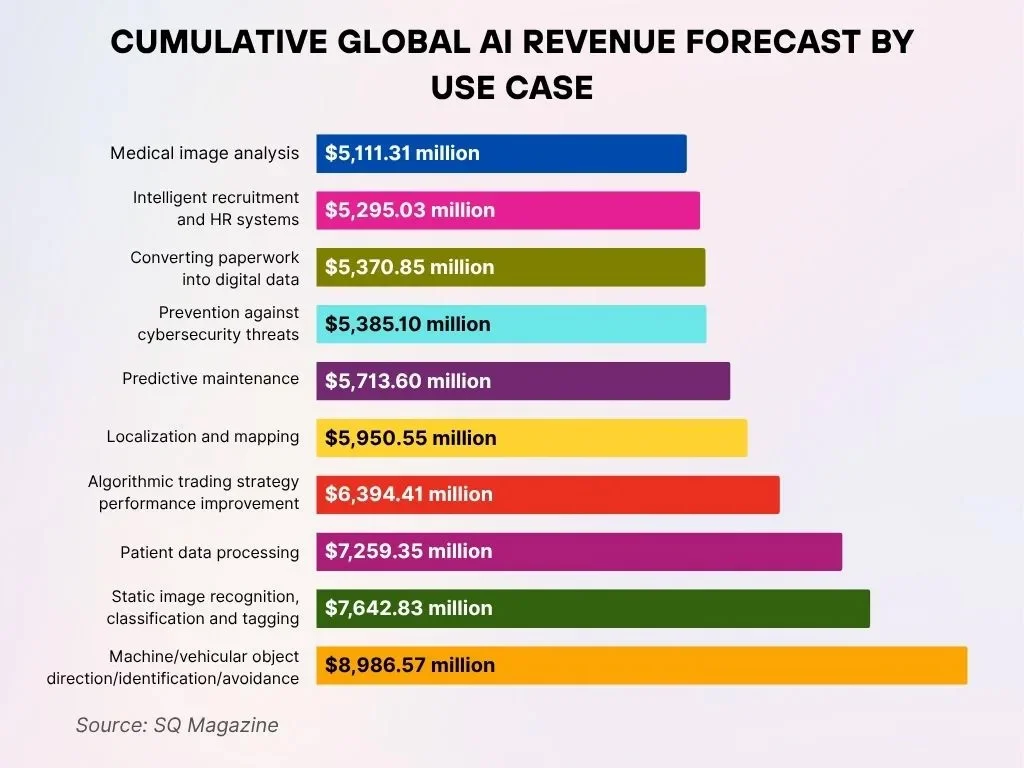
Projected Global AI Revenue by Application Segment
- Machine and vehicular object detection, direction sensing, identification, and collision avoidance dominate the landscape with a forecasted revenue of $8,986.57 million, making it the largest revenue-generating AI use case overall.
- Static image recognition, classification, and tagging technologies are anticipated to generate $7,642.83 million, highlighting robust demand for visual AI solutions across industries.
- AI-driven patient data processing is projected to deliver $7,259.35 million, demonstrating the expanding influence of AI within modern healthcare systems.
- Algorithmic trading strategy performance enhancement is expected to reach $6,394.41 million, emphasizing its critical importance in financial services and capital markets.
- Localization and mapping applications are set to earn $5,950.55 million, fueled by rapid advancements in autonomous navigation and geospatial intelligence.
- Predictive maintenance solutions powered by AI are forecasted at $5,713.60 million, underscoring AI’s role in improving industrial efficiency and reducing operational costs.
- AI-based prevention of cybersecurity threats is estimated to achieve $5,385.10 million, reinforcing the growing reliance on AI for digital security and threat mitigation.
- Automation of paperwork conversion into digital data is expected to contribute $5,370.85 million, illustrating how AI-driven automation significantly boosts organizational productivity.
- Intelligent recruitment platforms and AI-enabled HR systems are projected to generate $5,295.03 million, signaling AI’s increasing role in workforce optimization and talent management.
- Medical image analysis powered by AI completes the forecast with $5,111.31 million, further strengthening AI’s impact on diagnostics and healthcare innovation.
Global Adoption Rates of AI
- In three years, 1.2 billion people have used AI tools globally.
- AI adoption in the working-age population reached 16.1% in late 2025.
- Generative AI usage grew from ~26% to over 30% of the population in 2025.
- North America leads with higher adoption rates compared to some regions.
- Some regions, like the Middle East and Oceania, show adoption varying between ~22% and ~28%.
- Global diffusion of AI is now faster than prior technologies like the PC or smartphone.
- Countries with advanced infrastructure exhibit quicker AI uptake.
- Variations remain significant, with lower adoption in some emerging markets.

Number of Worldwide Users of AI
- Nearly 1.8 billion people worldwide have used AI tools.
- An estimated 500–600 million people engage daily with AI.
- Some platforms alone (e.g., Quark AI) report 150 million monthly active users.
- The individual AI user base grew by 64 million in 2025, totaling 378 million new adopters.
- ChatGPT’s message volume data indicates billions of interactions daily.
- 66% of people now report using AI regularly.
- Estimates suggest an even larger habitual user count as tools become more embedded.
- AI on smartphones reaches up to 90% of U.S. users, though awareness varies.
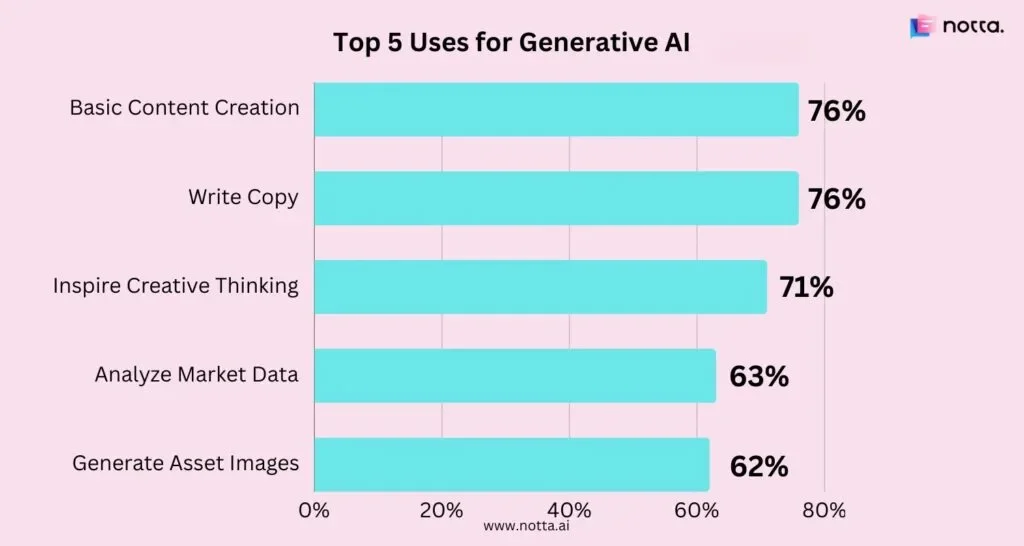
Top 5 Primary Applications of Generative AI
- 76% of users rely on Generative AI for Basic Content Creation, establishing it as the leading use case for productivity enhancement and workflow automation.
- An identical 76% adopt Generative AI to Write Copy, underscoring its strong impact across marketing, blogging, and business communications.
- Around 71% use it to Inspire Creative Thinking, highlighting AI’s expanding influence in brainstorming, ideation, and concept development.
- Nearly 63% depend on Generative AI to Analyze Market Data, supporting data-driven insights, trend identification, and strategic planning.
- About 62% utilize it to Generate Asset Images, emphasizing its growing role in visual content creation and design workflows.
Everyday Applications of AI by Consumers
- 43% of consumers use AI tools daily.
- Trust in AI for research and brand decisions is on the rise.
- AI assists in shopping tasks, like product comparisons and deal hunting.
- Voice assistants and recommendation systems drive daily AI interaction.
- Many users rely on AI without recognizing it, hidden in device features.
- AI supports everyday decisions such as travel planning and news summaries.
- AI is integrated into search, navigation, and entertainment platforms.
- Use of AI in personal finance and health monitoring apps continues to grow rapidly.
Gender Differences in AI Engagement
- Men were historically more likely to use generative AI, though adoption by women has accelerated.
- Early use saw women’s generative AI adoption at about 33% vs. 44% for men.
- Deloitte predicted that women’s use of generative AI would match or exceed men’s by the end of 2025 in the U.S.
- Gendered perceptions of AI’s social and ethical impact explain a significant portion of adoption disparity.
- In some surveys, women make up a slight majority (~52%) of ChatGPT users.
- Usage styles vary: women more often use AI for writing/communication, men more for technical tasks.
- Virtual assistant use shows small differences between genders, but broader AI engagement trends vary by task type.
- Overall, gender gaps in AI use are narrowing as awareness and familiarity grow.
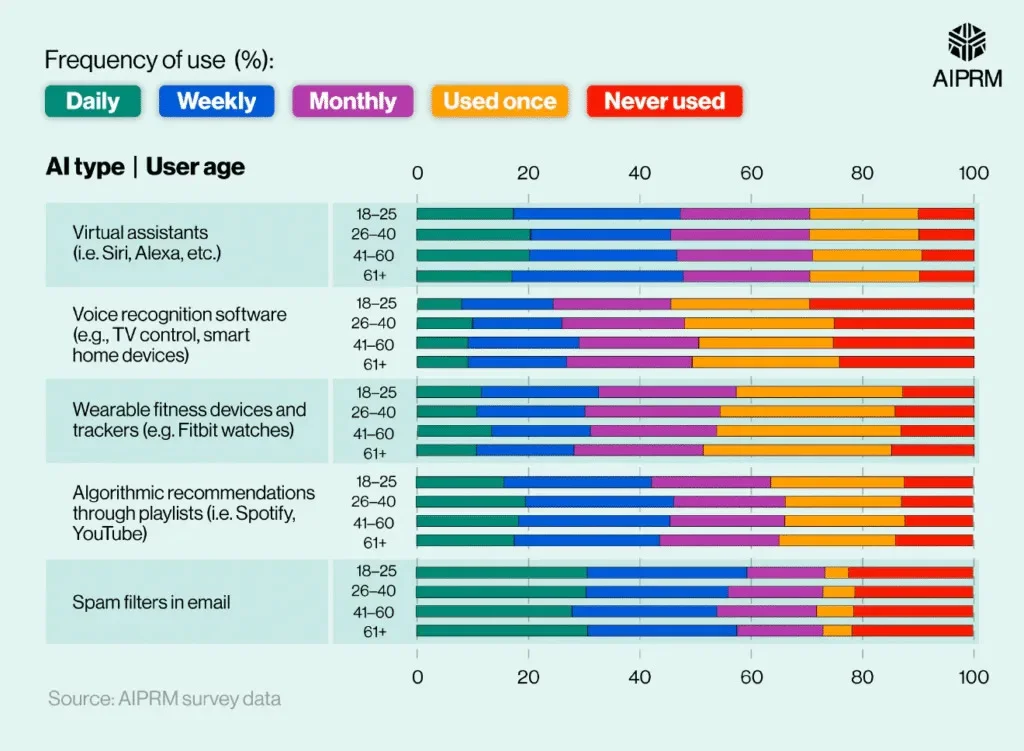
AI Tool Usage Patterns Across Age Groups
- Virtual Assistants are used daily by 30% of users aged 18–25, while 30% of users aged 61+ have never used them, underscoring a pronounced generational divide in adoption.
- Voice Recognition Software records 20% daily usage among users aged 18–25, but 40% of those aged 61+ have never tried it, reflecting significantly lower uptake in older age brackets.
- Wearable Fitness Devices are used daily by 20% of users aged 26–40, yet 42% of individuals aged 61+ report no usage at all, marking the highest non-use rate within this tool category.
- Algorithmic Recommendations (such as Spotify and YouTube) are most favored by users aged 18–25, with 32% daily usage, while 30% of those aged 61+ have never engaged with them.
- Email Spam Filters represent the most widely adopted AI tool, achieving over 40% daily usage across all age groups and maintaining less than 10% non-use, particularly prevalent among users aged 41–60 and 61+.
Healthcare Transformation Through AI
- Nearly 100% of healthcare CIOs plan to implement AI systems by 2026.
- ~79% expect to adopt generative AI for internal workflows.
- AI tools aid in diagnostics, patient data analysis, and administrative tasks.
- Predictive models help anticipate patient outcomes and resource needs.
- AI-driven imaging analysis reduces error rates and improves the identification of conditions.
- Healthcare organizations report reduced operational costs with automation.
- Generative AI is used to draft patient communications and educational materials.
- Concerns remain around data privacy and clinical reliability in AI health tools.
Finance and Banking Integration of AI
- 89% of financial services firms report AI increases annual revenue and decreases annual costs, with 64% seeing over 5% revenue growth.
- 82% of U.S. banks plan to increase their AI budget share in 2026.
- ML-based fraud detection achieves up to 90-94% accuracy in banking transactions.
- Banks using AI chatbots handle 80-90% of customer queries, cutting call center costs by $1.2M/year.
- Generative AI boosts bank productivity by up to 30-46% in operations by 2030.
- AI predictive analytics improves loan approval accuracy by 40% for financial institutions.
- Financial services will spend over $67 billion on AI by 2028, focusing on decisioning and operations.
- 65% of financial firms actively use AI, up from 45% last year, with 73% viewing it as crucial.
Educational Advancements Driven by AI
- 92% of students were using AI tools by 2025, up dramatically from 66% in 2024, reflecting rapid classroom integration.
- In the U.S., 51% of students engage with generative AI for homework and projects.
- 66% of students report using ChatGPT for school-related tasks, making it the top AI education tool.
- About 25% of students use Grammarly and Microsoft Copilot to enhance writing and study support.
- 60% of educators actively use AI in classrooms, with leaders most likely to adopt these tools.
- 43% of teachers purchase AI tools personally to support learning activities.
- 82% of students believe AI literacy will be important for future careers.
- 88% of teachers think generative AI will positively impact student career outcomes.
- The global AI in education market was valued at ~$5.88 billion in 2024 and is projected to reach $32.27 billion by 2030.
Country-Level Statistics on AI Usage
- India is a global AI powerhouse, with high adoption rates of ChatGPT and other tools.
- India also ranks strongly in the usage of Claude.ai, with substantial work-related engagement.
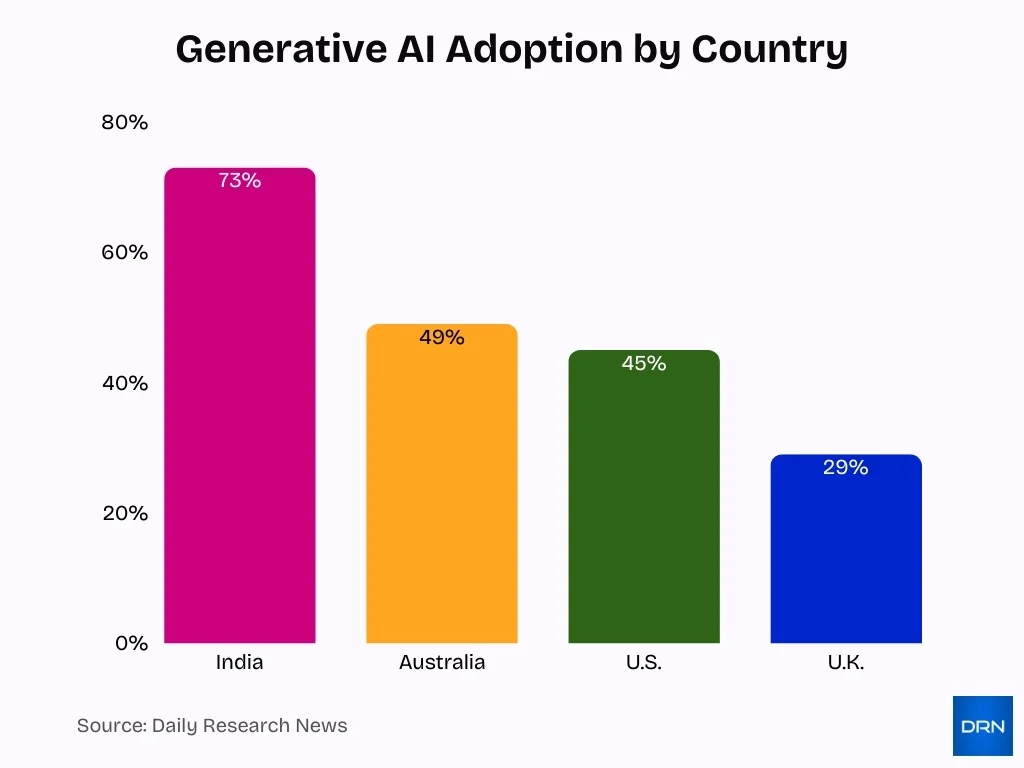
- Generative AI adoption varies widely: 73% in India, 49% in Australia, 45% in the U.S., and 29% in the U.K.
- OECD surveys show AI technology adoption by firms is increasing across developed countries.
- AI integration among Italian firms doubled from 8.2% in 2024 to ~16.4% in 2025.
- Canada’s AI adoption rate among businesses doubled, yet only ~12 % of firms reported active implementation by mid‑2025.
- The U.K.’s AI market exceeds £21 billion in value, with policies to expand its AI capacity.
- Regional differences reflect uneven access, awareness, and policies shaping AI uptake globally.
Trends in Workplace Adoption of AI
- 43% of U.S. knowledge workers now use AI on the job, up from less than 10 % two years ago.
- A survey shows 43% of professionals use AI for work or professional tasks, up from 37% previously.
- 12% of U.S. workers use AI daily, with about 25% using it several times a week.
- 49% of U.S. workers still report never using AI in their job, highlighting uneven adoption.
- Globally, surveys estimate 88%–93% of companies use AI in some form, with 79% adopting GenAI.
- Only 7% of organizations have fully deployed AI across all functions, while 31% are scaling beyond pilots.
- Millennials (35–44) are among the most comfortable and experienced AI users at work.
- A notable skills gap persists; many employees use AI regularly, but a minority receive formal training.
Top Use Cases for AI at Work
- 82% of U.S. employees used AI at work in 2025, with 40% frequent users among remote workers.
- 24% of employees use AI daily for drafting workplace emails.
- 82% of enterprise leaders use generative AI at least weekly for content creation and analysis.
- 70% of project professionals’ organizations deploy AI for project tracking and management.
- 82% of developers use AI tools weekly to generate code snippets.
- 54% of consumers rate AI chatbots as effective for routine customer support inquiries.
- Businesses using AI lead scoring achieve 2.3X higher lead-to-deal conversion rates.
- 92% of Fortune 500 companies adopted AI for forecasting and supply chain planning.
- AI resume screening cuts hiring time by 80% and boosts matching accuracy to 90-95%.
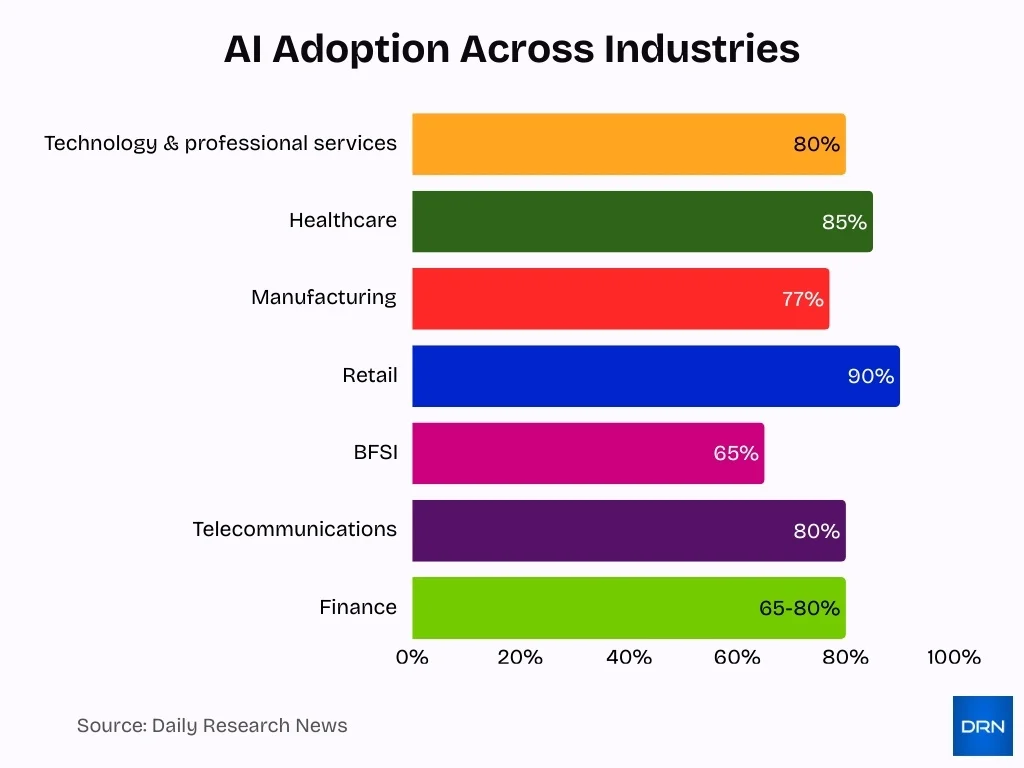
Industry-Wise Adoption of AI
- The technology and professional services sectors lead with AI adoption rates above 80% in 2025.
- Healthcare organizations show 85% AI adoption in 2025, up from 72% prior year.
- Manufacturing firms report 77% AI usage, rising from 70% in 2024.
- Retail businesses achieve 90% AI adoption, focusing on supply chain and customer service.
- The BFSI sector drives 65% AI adoption rate across predictive analytics and chatbots.
- Customer service leads AI agent use at 30–35% of organizations in 2026.
- Telecommunications scales AI tools across departments, with adoption exceeding 80% in tech sectors.
- Finance achieves 65–80% AI usage in high-adoption departments like sales and operations.
AI Tools for Automation and Productivity
- ChatGPT, Gemini, and similar platforms are among the most commonly used workplace AI tools.
- Intelligent assistants are used daily by more than half of active workplace AI users.
- AI integration with productivity suites boosts task automation for reporting and scheduling.
- Specialized AI tools assist with real-time language translation, improving global collaboration.
- Voice-activated AI functions help with hands-free task management.
- AI-based insights help sales teams tailor outreach and identify high‑value prospects.
- Project automation through AI reduces repetitive administrative work, freeing up strategic tasks.
- AI dashboards and analytics tools enable faster decision cycles for managers.
Market Share of Popular AI Tools
- The global AI market is projected to reach approximately $900 billion in 2026, up from $390.9 billion in 2025.
- The generative AI market value is expanding rapidly, with projections exceeding $66 billion by the end of 2025.
- Machine learning markets are expected to grow to $282 billion by 2030.
- Markets like computer vision and natural language processing show sustained multi‑year growth.
- Large AI platforms, such as OpenAI and Google AI, capture a significant share of daily active engagement.
- Workspace AI tools integrated with enterprise software gain widespread usage across departments.
- Adoption of AI agents in business workflows is high, with 79% of organizations using agentic AI at some level.
- Cloud‑based AI deployment continues to dominate the infrastructure share.
Data Privacy and Security Issues in AI
- Data violations linked to generative AI more than doubled year‑over‑year in enterprise settings.
- Organizations report an average of 223 monthly incidents of sensitive data exposure caused by AI.
- Over 50% of violations involve regulated personal, financial, or healthcare data.
- Roughly 47% of AI users still rely on unmanaged personal accounts, heightening risk.
- Weak governance and a lack of oversight for AI agents increase data misuse risks.
- Only ~21% of companies currently report having strong AI oversight and safety protocols.
- Security concerns remain a major barrier to organizational AI expansion.
- AI privacy regulation lags behind usage, prompting calls for stronger governance frameworks.
Frequently Asked Questions (FAQs)
More than one‑third (over 33%) of individuals across OECD countries used generative AI tools in 2025, showing rapid uptake in advanced economies.
About 88% of organizations worldwide now use AI in at least one business function, up from prior years as adoption becomes mainstream.
The global AI market was valued at approximately $638 billion in 2025 and is estimated to grow to around $900 billion by 2026.
In the second half of 2025, 16.1% of the global working‑age population used AI tools, indicating continued expansion from earlier adoption levels.
Conclusion
The momentum behind AI adoption shows no sign of slowing. Across education, workplaces, and business functions, AI enhances productivity, streamlines tasks, and expands market opportunities. Schools are rapidly integrating AI to support learning, while employers increasingly embed AI into daily workflows. Once experimental tools are now mainstream, but challenges related to skills gaps, security, and governance persist. Looking ahead, the balance between innovation and responsible use will shape how AI continues to evolve in society and the global economy.