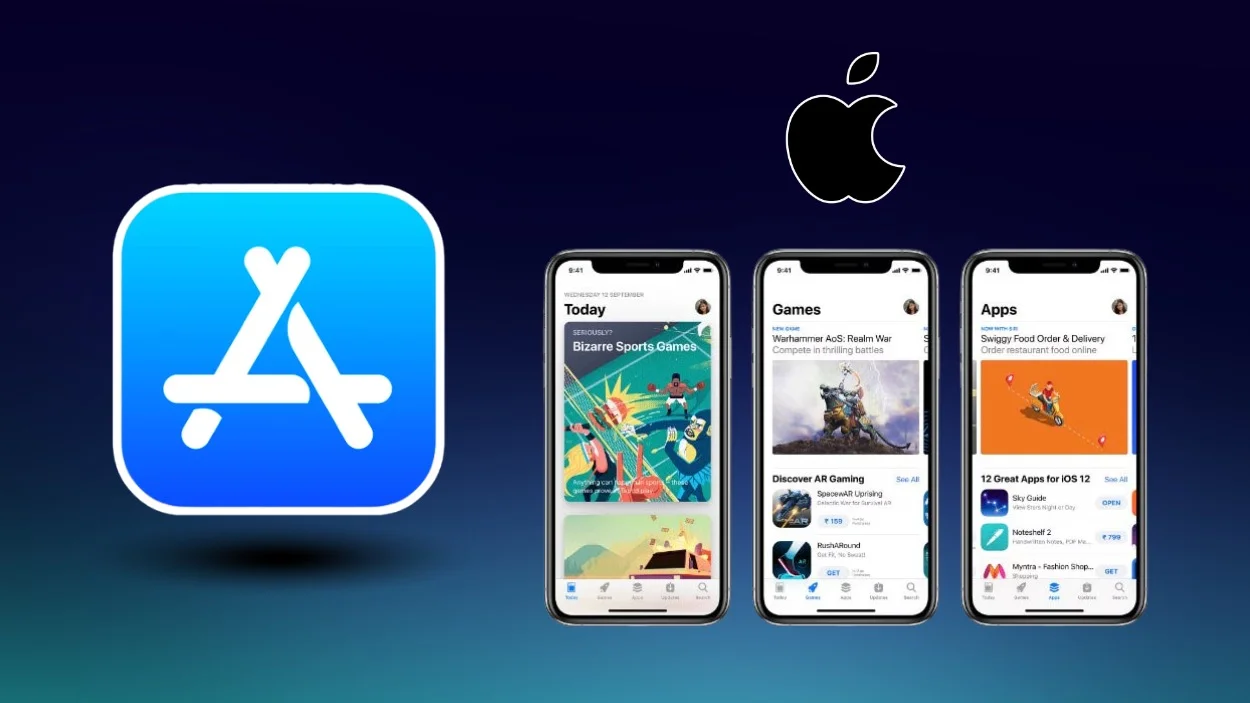


The App Store remains one of the most influential digital marketplaces in the world. It attached new records for user engagement, revenue, and ecosystem impact, shaping how people work, play, and connect through mobile apps. From billions of downloads to trillions in developer billings, the platform fuels economic activity globally. Its reach extends into gaming, productivity, health, and e‑commerce, influencing both consumer behavior and business strategies. These figures set the stage for what’s next. Dive into the App Store Statistics to see how the landscape continues to evolve.
Editor’s Choice
- 850 million weekly active users engaged with the App Store in 2025.
- The App Store ecosystem facilitated over $1.3 trillion in global developer billings and sales in 2024.
- Apple’s App Store is projected to generate $138 billion in revenue in 2025.
- Gaming accounted for 60% of App Store revenue in 2025.
- App Store users are expected to download around 38 billion apps by 2026.
- The App Store hosted nearly 2.1 million apps as of January 2026.
- Users open apps 11+ times per day on average.
Recent Developments
- In 2025, the App Store saw more than 850 million weekly users worldwide, a notable increase year over year.
- Developers have earned over $550 billion from the App Store since its launch in 2008.
- The App Store ecosystem facilitated $1.3 trillion in billings and sales in 2024.
- Apple announced changes to App Store policies to align with global regulatory environments.
- Weekly active user growth indicates rising engagement across key markets like the US, China, and India.
- Apple expanded features supporting transactions and discovery, enhancing developer revenues.
- Average consumer spending per user in the U.S. App Store remains high, reflecting strong monetization.
- Continued growth in subscription‑based models drives recurring value for developers and Apple alike.
- Shifts in regulatory landscapes, e.g., the EU Digital Markets Act, influence App Store operations.
App Store Overview
- The Apple App Store hosts nearly 2.1 million apps as of January 2026.
- App availability grew from previous years, indicating steady developer participation.
- Of these, the vast majority are free or freemium models with in‑app purchases.
- App categories span games, productivity, lifestyle, social, health, finance, and utilities.
- Games represent a significant share of both app count and revenue generation.
- Daily app publishing remains strong, with thousands of apps added weekly.
- The App Store supports distribution in 175+ countries and regions globally.
- High engagement levels continue, and users open apps multiple times per day.
Total Number of Apps on the App Store
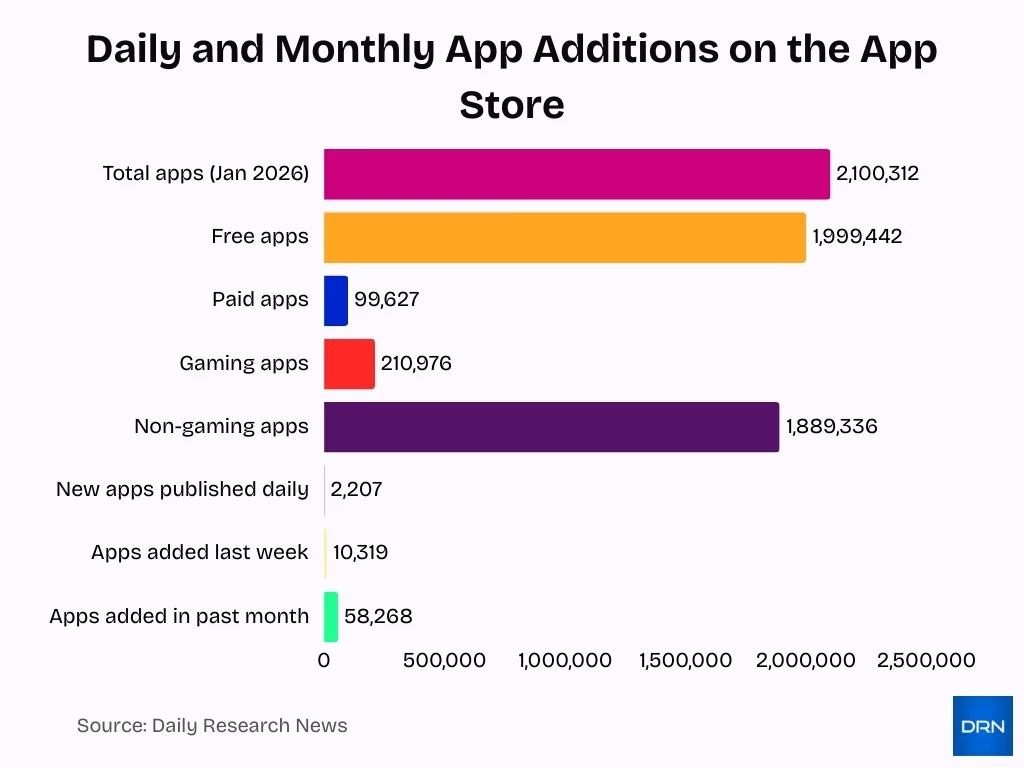
- The App Store currently hosts 2,100,312 total apps as of January 2026.
- 1,999,442 apps are free, dominating with a 95.25% share, while 99,627 are paid.
- Games account for 210,976 apps, representing about 10% of the entire catalog.
- Non-gaming apps total 1,889,336, comprising nearly 90% of available listings.
- An average of 2,207 new apps are published daily on the App Store.
- 10,319 apps were added last week, with 58,268 published in the past month.
- The catalog spans 26 major categories, including the top ones like Utilities and Education.
- 885,412 publishers support the ecosystem, releasing apps across diverse categories.

Key App Store Statistics at a Glance
- 2.1M+ apps available on the App Store as of January 2026.
- 850M+ average weekly active users in 2025.
- Over 38 billion app downloads expected by 2026.
- Projected $138B global revenue in 2025.
- Developer billings exceeded $1.3T globally in 2024.
- Gaming apps generated ~60% of revenue in 2025.
- Subscription apps accounted for ~44% of revenue.
- Users interact with apps an average of 11+ times per day.
App Store User Base and Reach
- Over 850 million people actively use the App Store weekly.
- The platform serves users in 175+ countries and regions.
- Engagement remains high, with daily interactions common across demographics.
- Large markets like the U.S., China, and India contribute significantly to traffic.
- The App Store ecosystem supports billions of devices globally.
- Users download billions of apps annually, reflecting sustained demand.
- Consumer spend per user in the U.S. is among the highest worldwide.
- Engagement trends show users spending increasing time in apps year over year.
Demographic and Regional Breakdown of App Store Users
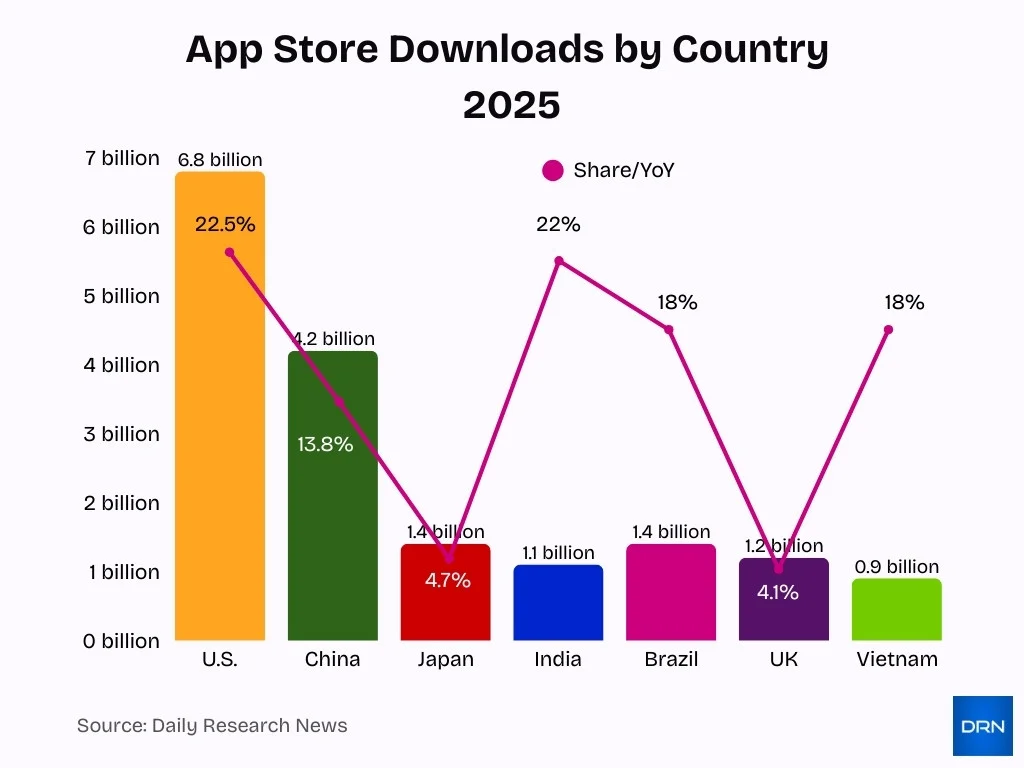
- The App Store leads with 6.8 billion downloads in the U.S., representing 22.5% of global App Store installs in 2025.
- China follows with 4.2 billion App Store downloads, holding a 13.8% market share in 2025.
- Japan accounts for 1.4 billion App Store downloads, or 4.7% of the total in 2025.
- India saw 22% year-over-year growth in App Store downloads, reaching 1.1 billion in 2025.
- North America and Europe generate over 60% of App Store revenue due to high purchasing power.
- iOS market share in the U.S. stands at 58.64% of smartphones in 2025.
- Users aged 18-34 comprise 63% of App Store downloads, led by Gen Z and Millennials.
- Brazil recorded 18% YoY growth in App Store downloads at 1.4 billion in 2025.
- Vietnam achieved 18% growth with 0.9 billion App Store downloads in 2025.
- The UK contributed 1.2 billion downloads, 4.1% share, with 9% YoY growth in 2025.
App Store Revenue and Market Size
- The App Store generated an estimated $138 billion in revenue in 2025, up nearly 17% from the prior year.
- App Store revenue growth outpaces many traditional entertainment sectors globally.
- Apple’s App Store remains the top revenue‑generating app marketplace, despite fewer downloads than Android.
- Developer billings and sales exceeded $1.3 trillion through 2024.
- Consumer spending on mobile apps and games combined across iOS and Android reached roughly $150 billion in 2024.
- Annual app revenue is heavily supported by in‑app purchases and subscriptions rather than paid downloads.
- The U.S. market accounts for over half of App Store revenue, followed by Europe and Asia.
- Growth trends indicate ongoing expansion in spending on services and digital goods through the App Store.
Top App Categories by Revenue
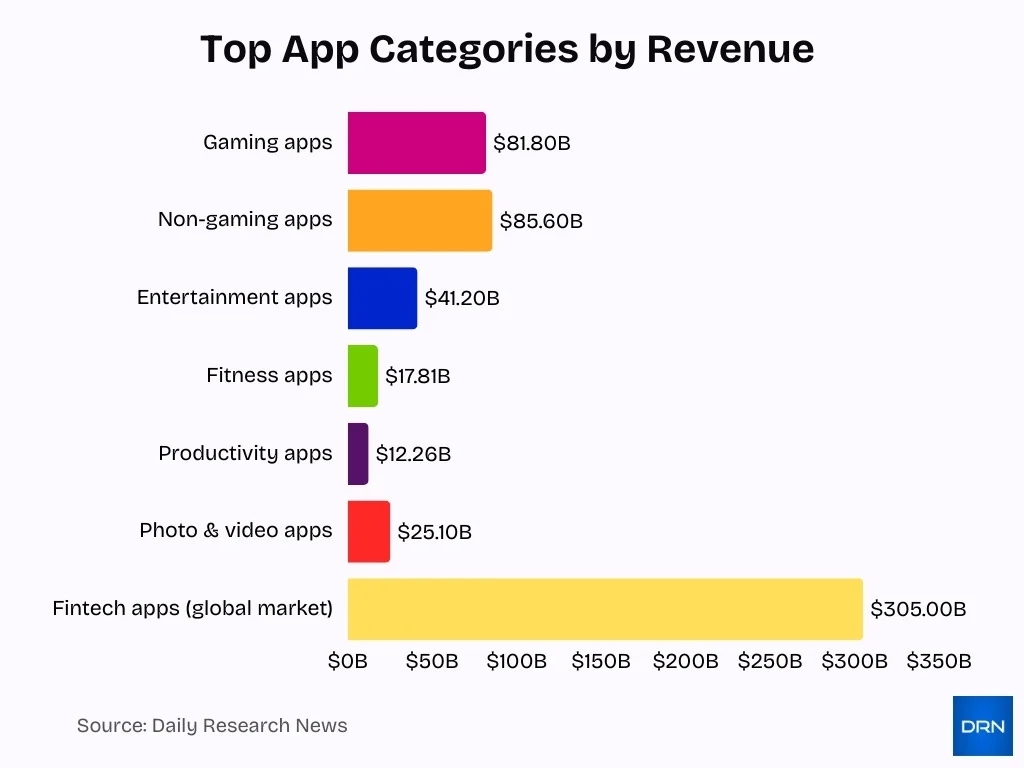
- Gaming apps generated $81.8 billion in revenue in 2025, leading all categories.
- Non-gaming apps surpassed games in 2025 revenue, with $85.6 billion, up 21% YoY.
- Entertainment apps are projected to reach $41.2 billion in revenue by 2025.
- The fitness apps market hit $17.81 billion in 2025, growing at 21.5% CAGR.
- Productivity apps generated $12.26 billion in 2025.
- Fintech apps contributed to the $305 billion global market projection for 2025.
- Photo & video apps expected to earn $25.1 billion by 2025.
- Shopping apps saw 7.4% YoY ecommerce growth during the 2025 holidays.
Gaming Revenue on the App Store
- Games dominate App Store monetization, generating about 60% of total revenue.
- Mobile gaming revenue often exceeds $80 billion annually from iOS alone.
- Top-grossing games globally include titles with multiple billion‑dollar revenue figures.
- Honor of Kings, Roblox, and PUBG Mobile consistently appear among the highest‑earning titles.
- Many top games employ in‑app purchases and microtransactions as primary monetization methods.
- Free‑to‑play models dominate, yet high spending per active gamer boosts revenue totals.
- Seasonal updates, events, and esports influence revenue spikes in key markets.
- Regional gaming preferences vary widely, with certain genres performing better in Asia versus the U.S./Europe.
Subscription Revenue on the App Store
- Subscription apps account for roughly 44% of App Store total revenue.
- Streaming services like video and music subscriptions contribute major recurring revenue.
- Productivity and business subscriptions continue to grow with remote and hybrid work trends.
- Fitness and wellness subscription apps saw notable engagement increases in 2025.
- Subscription pricing tiers often range from monthly to annual plans, increasing lifetime value.
- Subscription revenues benefit from automatic renewals, boosting long‑term monetization.
- App analytics suggest higher retention rates for subscription apps than one‑time purchase apps.
- Developers increasingly use tiered subscription models to balance pricing and user acquisition.
Worldwide App Ecosystem and Smartphone Adoption
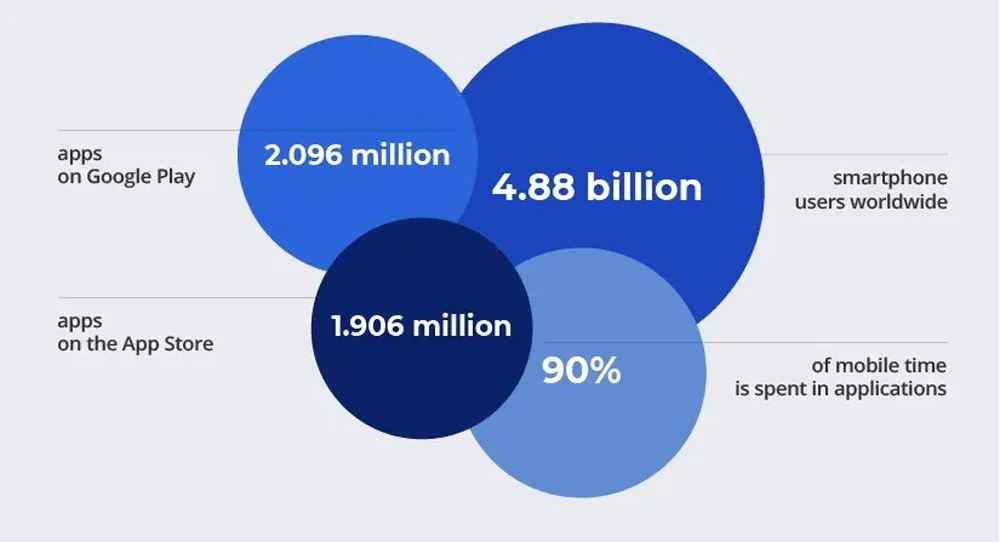
- There are 4.88 billion smartphone users worldwide, highlighting near-universal adoption of mobile devices across global markets.
- Google Play hosts 2.096 million apps, positioning it as the largest app marketplace in the global mobile ecosystem.
- The Apple App Store offers 1.906 million apps, ensuring a strong and competitive ecosystem for iOS users worldwide.
- Mobile users spend 90% of their total smartphone time in applications, emphasizing the overwhelming dominance of apps in everyday mobile usage.
In‑App Purchases and Microtransactions Statistics
- In-app purchases generated $150 billion in revenue across iOS and Google Play in 2024, up 12.5% year-over-year.
- Gaming accounted for $82 billion in mobile IAP revenue in 2024, rising 4% YoY with 3.5 trillion player hours.
- In-app purchases represent 48.2% of total mobile app revenue, surpassing 37.8% from paid downloads.
- Top 1% of App Store publishers with IAP generated 94% of all U.S. store revenue.
- Candy Crush Saga derives 95% of its revenue from in-app purchases, exceeding $20 billion in lifetime revenue.
- Microtransactions made up 58% of PC gaming revenue at $24.4 billion in 2024.
- Only 1.83% of mobile gamers make in-app purchases, but microtransactions form 76% of online gaming revenue.
- Global online microtransaction market hit $57.89 billion in 2024, projected to reach $115.06 billion by 2034.
- The gaming sector led microtransaction revenue on mobile platforms in 2024.
- Hybrid strategies combining IAP, subscriptions, and ads drove 37% IAP growth for mobile games in 2024.
App Categories and Genre Distribution
- App Store apps span over 20+ major categories covering diverse user needs.
- Games represent roughly 10–12% of all apps, yet contribute a disproportionate amount of revenue.
- Free apps constitute the vast majority of the catalog, typically over 95%.
- Non‑gaming categories include tools, productivity, social, entertainment, and lifestyle.
- Photo & video apps maintain strong popularity due to social media and content creation trends.
- Finance and fintech categories grow with increasing mobile banking and investment usage.
- Health & fitness, education, and business apps have notable niche user bases.
- App release rates exceed 2,200 new apps per day, showing ongoing category expansion.
Top App Categories by Downloads
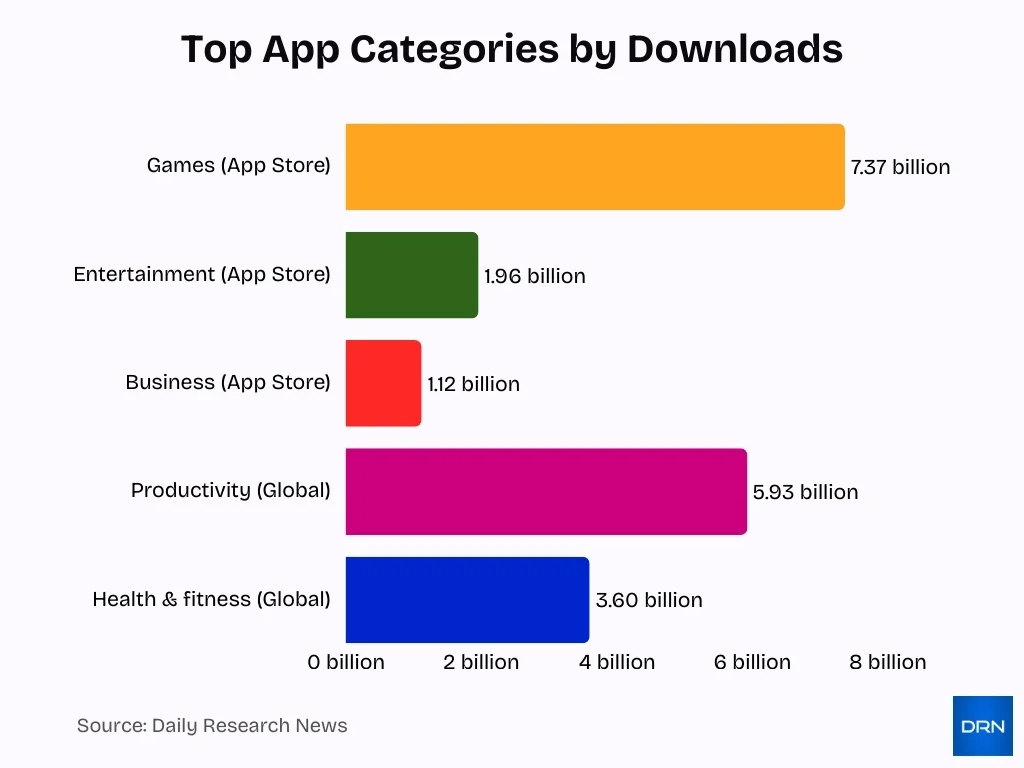
- Games captured 7.37 billion downloads on the App Store in 2025, leading all categories.
- Entertainment apps recorded 1.96 billion downloads on the App Store in 2025.
- Business category saw 1.12 billion downloads on the App Store in 2025.
- Social apps like TikTok achieved 495 million downloads on the App Store lifetime.
- Shopping apps like Temu hit 36 million global downloads in October 2025.
- Productivity tools amassed 5.93 billion global downloads in 2025.
- Health & fitness apps reached 3.6 billion global downloads in 2024.
- Games dominated with over 40% share of worldwide app downloads in 2024.
- App Store hit 34.3 billion total downloads in 2025.
App Store Downloads and Install Trends
- The App Store is expected to hit 38 billion downloads by 2026.
- This total shows an increase from roughly 35.4 billion downloads in 2024.
- Most downloads, over 90%, are free app installs, emphasizing discoverability.
- Redownloads account for a large portion of install figures, indicating user re‑engagement.
- Search‑driven installs represent over half of total downloads, highlighting search optimization value.
- Daily and weekly install rates continue to climb, tracking with increased smartphone penetration globally.
- Global mobile app downloads overall, across stores, are projected to reach 299 billion.
- iOS download growth lags Android in volume but outpaces in monetization value.
- Install patterns spike seasonally around holidays and major product launches.
U.S. Apple Pay Adoption Rate Trends
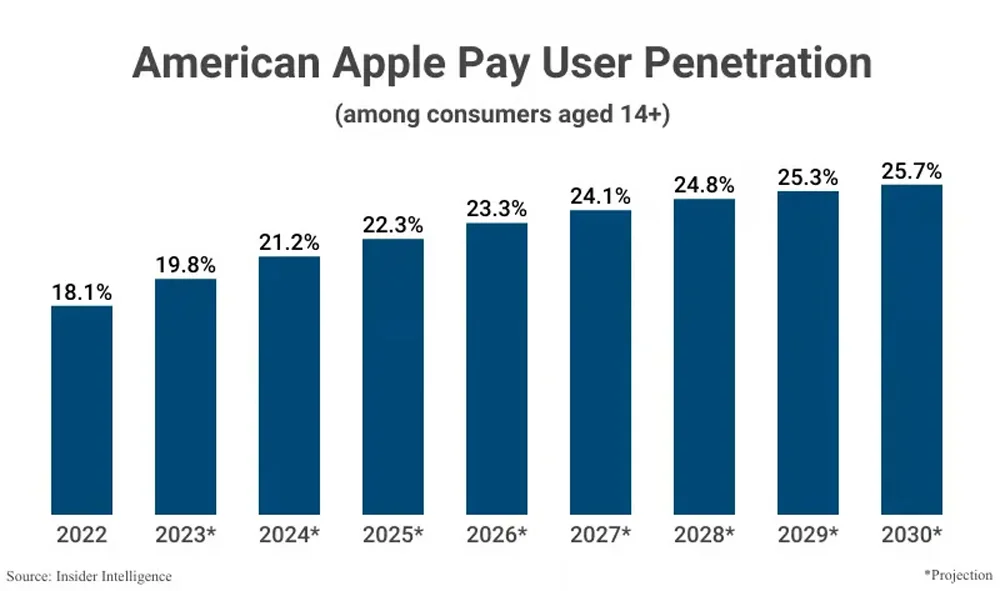
- Apple Pay user penetration in the U.S. is expected to reach 22.3% in 2025, reflecting steady year-over-year growth.
- By 2026, Apple Pay usage is projected to account for 23.3% of eligible users, continuing the upward adoption trend.
- In 2027, the penetration rate is forecast to increase to 24.1%, signaling consistent expansion.
- During 2028, Apple Pay adoption could climb to 24.8%, bringing usage close to one-quarter of the population.
- Forecasts for 2029 estimate 25.3% penetration, maintaining the incremental growth trajectory.
- By 2030, Apple Pay user penetration is expected to reach 25.7%, marking a continued rise in long-term adoption.
User Engagement and Retention in App Stores
- iOS users spend an average of 4.2 hours daily on mobile apps, up 5% year-over-year in 2025.
- 813 million weekly visitors engaged with the App Store in 2024, rising to 850 million weekly users in 2025.
- 69.3% of App Store downloads are redownloads, dominating overall activity.
- Productivity apps achieve 32.86% Day 1 and 24.23% Day 7 retention rates.
- Subscription apps account for nearly 44% of total App Store revenue.
- Push notifications boost retention by 3x for users receiving them in the first 90 days.
- Gaming apps see sessions surge up to 152% during events like New Year’s Eve.
- Personalized content lifts 28-day retention to 61-74% versus 49% for generic.
- News apps lead with 11.3% 30-day retention among top categories.
App Store vs Google Play Store Overview
- Apple’s App Store consistently generates more revenue than Google Play despite fewer downloads.
- In 2024, the App Store brought in $103.4 billion vs Google Play’s $46.7 billion.
- Google Play accounts for roughly half of all worldwide downloads, far more than iOS.
- By 2025, Google Play is projected to hit 143 billion installs compared to iOS’s 38 billion.
- App availability on Google Play is larger; however, App Store monetization per user remains stronger.
- Apple App Store’s revenue‑per‑download ratio significantly exceeds that of Google Play.
- Android OS holds a larger global market share, while iOS leads in high‑spend markets like the U.S.
- App quality initiatives on both platforms evolve differently, with Google recently cleaning up its catalog.
Highest-Revenue Mobile Apps in History
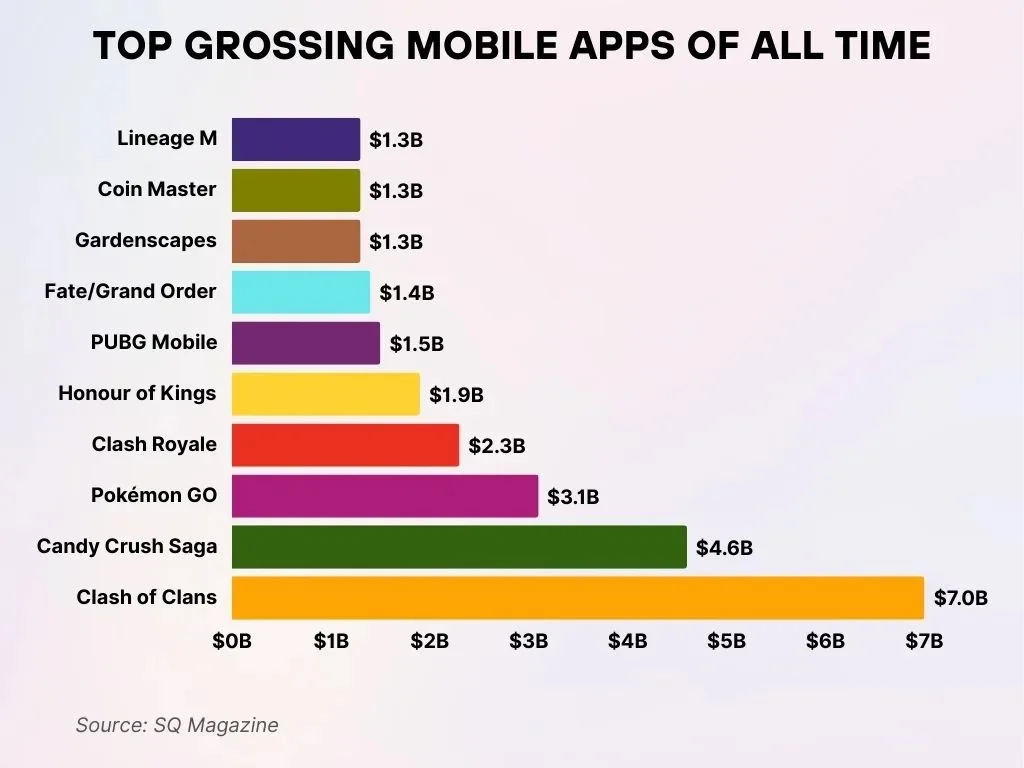
- Clash of Clans dominates all mobile apps with an impressive $7 billion in lifetime revenue, setting the benchmark for long-term monetization success.
- Candy Crush Saga secures the second position, generating $4.6 billion, largely fueled by the sustained popularity of casual gaming worldwide.
- Pokémon GO has accumulated $3.1 billion in total revenue, driven by its global appeal and innovative augmented reality gameplay.
- Clash Royale recorded $2.3 billion in earnings, reflecting strong engagement among dedicated strategy game players.
- Honour of Kings has earned $1.9 billion, firmly dominating mobile eSports markets across Asia.
- PUBG Mobile reached $1.5 billion in lifetime revenue, underscoring robust demand for mobile shooter experiences.
- Fate/Grand Order closely follows with $1.4 billion in revenue, supported by a loyal anime RPG fanbase.
- Lineage M, Coin Master, and Gardenscapes each generated $1.3 billion, collectively rounding out the list of top-grossing mobile titles.
App Store Optimization and Discovery Trends
- Search drives 65% of App Store downloads, a dominant discovery channel.
- Re-downloads account for up to 75% of installs in key niches, signaling strong brand recall.
- ASO software market reaches USD 38.1 billion in 2025, growing at 16.7% CAGR through 2035.
- iOS user acquisition spend surges 35% globally amid intensifying competition.
- App Store browsing now drives 15% of downloads, up from 10% pre-iOS 11.
- Average App Store conversion rate hits 25%, top categories exceed 40-50%.
- Page-to-install rate stands at 33.38% on Google Play, 66.61% on App Store.
- Ratings boost conversions by 60% from 3.6 to 4.2 stars.
- 75% of top apps localize metadata, enhancing global visibility.
Frequently Asked Questions (FAQs)
The App Store offered about 2.0 million–2.1 million apps by late 2025, growing to roughly 2.1 million by January 2026.
The App Store reached about 34.3 billion downloads in 2025, with installs projected to approach 38 billion by 2026.
The App Store is expected to generate about $138 billion in revenue globally in 2025.
About 69.3% of downloads on the App Store are redownloads rather than first‑time installs.
Conclusion
The App Store continues to be a dominant force in the app economy, driving billions of downloads, tens of billions in revenue, and intense competition with other platforms like Google Play. Engagement and retention trends show users are deeply integrated into app ecosystems, especially in gaming, streaming, and productivity. High‑monetization markets like the U.S. and Europe keep the App Store ahead on spend, even as Android leads in sheer global install volume.
With search‑driven discovery and optimization increasingly critical to success, developers focusing on data‑driven ASO and retention strategies will gain a competitive edge. Overall, the App Store’s evolving trends reflect a mature yet expanding digital marketplace shaping how users interact with mobile technology every day.