

Apple Music has become one of the leading players in global music streaming since its 2015 launch, blending a premium listening experience with deep integration into Apple’s hardware and software ecosystem. It boasts over 108 million paying subscribers worldwide, reflecting consistent growth in a highly competitive market. Its influence extends far beyond casual listening; artists, record labels, and advertisers all shape strategies around streaming data and user engagement.
From powering global chart-topping tracks to redefining how listeners engage with audio quality and curated content, Apple Music’s impact touches artists and fans alike. Dive into the full article to explore key statistics shaping Apple Music’s position.
Editor’s Choice
- 108 million paid subscribers globally in 2026, marking ongoing expansion.
- Apple Music estimated revenue of around $10.5 billion in 2026.
- Holds approximately 30.7% of the U.S. music streaming market.
- Available in 167 countries worldwide.
- Offers a library with 100+ million songs.
- Curates 30,000+ playlists across genres and moods.
- Pays artists an average of $0.01 per stream, among the highest in the industry.
- Strong user engagement is reflected in Replay and personalized listening insights.
Recent Developments
- Apple Music played a central role in the 2026 Super Bowl halftime show listening surge, with multiple songs dominating global charts.
- Expanded Replay features allow listeners to track detailed annual listening behaviour.
- Apple continues to integrate music streaming with Shazam and other discovery platforms, driving engagement.
- Partnerships with music production tools and DJ software expanded Apple Music’s footprint among creators.
- Ongoing enhancements to Spatial Audio and Dolby Atmos enrich immersive listening experiences.
- New curated station releases and genre-specific channels broaden content diversity.
- Apple services overall, including Apple Music, marked record‑breaking engagement in 2025.
- Emerging focus on personalized playlists and algorithmic recommendations to increase retention.
Overview Statistics on Apple Music
- 108 million paid subscribers worldwide (2026), with steady annual growth.
- Operates in 167 countries across major global markets.
- Revenue projected at $10.5 billion in 2026.
- The library includes 100+ million songs and growing content partnerships.
- Over 30,000 curated playlists for diverse listener tastes.
- The average artist payout is roughly $0.01 per stream.
- Dominates high-fidelity audio options with Lossless and Spatial Audio.
- Enhanced social sharing and Replay insights deepen user engagement.
Subscriber Count by Year for Apple Music
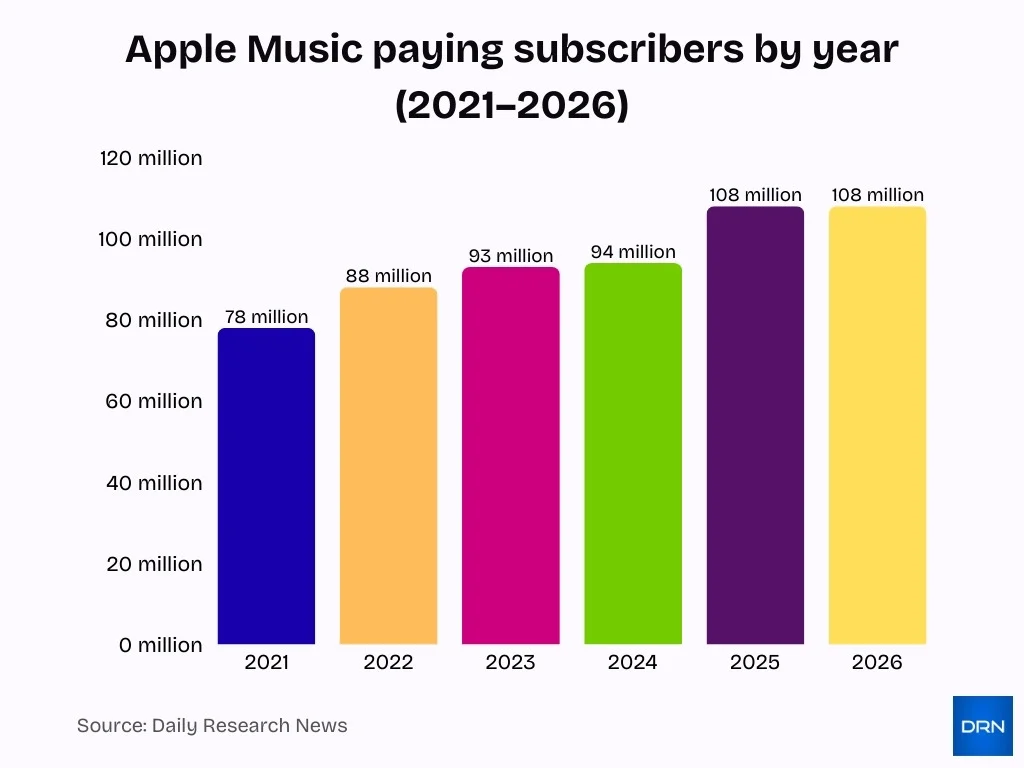
- 2026: ~108 million paying subscribers.
- 2025: ~108 million.
- 2024: ~94 million subscribers recorded.
- 2023: ~93 million subscribers.
- 2022: ~88 million subscribers.
- 2021: ~78 million subscribers.
- Growth has averaged double‑digit percentages in recent years, with some slowdown in larger markets.
- Apple’s ecosystem strategy, bundling with Apple One, has helped sustain subscriber growth.

Revenue and Financial Performance of Apple Music
- An estimated $10.5 billion in revenue in 2026 from subscriptions.
- Apple Music revenue grew from $9.2 billion in 2023.
- Revenue has increased consistently year over year, reflecting strong monetization.
- Contributes an estimated ~6.4% of Apple’s services revenue, underpinning its strategic value.
- Premium-only model ensures predictable income without ad‑supported tiers.
- Revenue growth outpaces wider industry streaming revenue trends in several regions.
- Higher per‑user revenue is a competitive differentiator versus freemium rivals.
- Continued investments in exclusive content and audio formats support premium pricing.
Market Share in Music Streaming for Apple Music
- Holds roughly 30.7% market share among U.S. subscribers.
- Second only to Spotify’s ~36% share in the U.S. streaming market.
- In the U.S., estimated 45.9 million subscribers with ~31.5% share.
- Apple Music competes directly with Spotify, Amazon Music, and YouTube Music.
- Globally, Apple Music is consistently the second‑largest paid streaming service by subscribers.
- Market leadership varies by region, with Spotify stronger in Europe and Latin America.
- Apple’s integration across iOS devices helps sustain its share in key markets.
- Music streaming overall accounted for a majority of global music revenue in 2024, underpinning Apple Music’s business context.
Global Apple Music Users by Country & Regional Trends
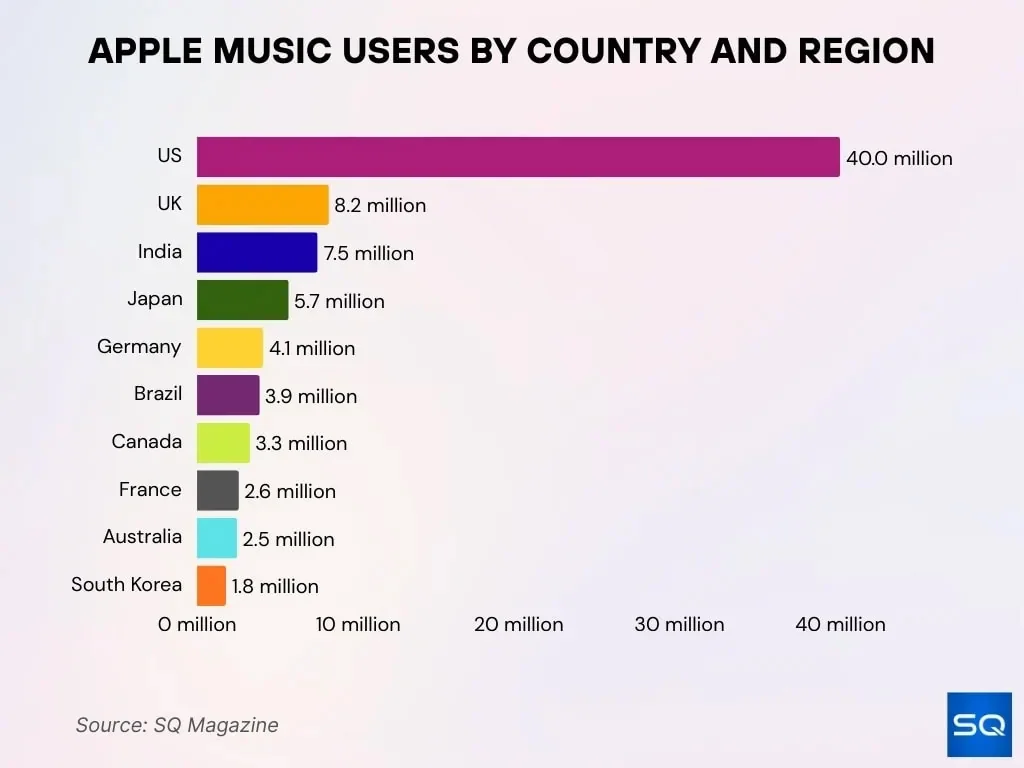
- United States: Approximately 40 million subscribers, representing nearly 37% of the global total, making it the largest and most dominant Apple Music market worldwide.
- United Kingdom: Around 8.2 million subscribers, reflecting strong and consistent adoption across major metropolitan and suburban regions.
- India: Nearly 7.5 million subscribers supported by rapid double-digit growth, highlighting accelerating digital music consumption and expanding smartphone penetration.
- Japan: Close to 5.7 million subscribers, driven by strong domestic music demand and high streaming service loyalty.
- Germany: About 4.1 million subscribers, supported by a well-established digital infrastructure and stable subscription culture.
- Canada: Roughly 3.3 million subscribers, benefiting from high broadband penetration and strong integration with Apple’s ecosystem.
- Australia: Nearly 2.5 million subscribers, reflecting steady adoption among young and urban user segments.
- Brazil: Around 3.9 million subscribers, supported by growing mobile internet access and rising interest in international and regional music content.
- France: Approximately 2.6 million subscribers, driven by strong local content curation and government-backed digital media initiatives.
- South Korea: Close to 1.8 million subscribers, shaped by intense competition from domestic streaming platforms and strong K-pop consumption trends.
- Regional adoption rates indicate that Western markets are becoming increasingly mature, while emerging markets continue to accelerate at a faster pace.
- Localized editorial playlists have increased overall user interaction by 26% in non-English-speaking countries, improving content discovery and listener retention.
- Apple’s student subscription plan, priced competitively, contributes to 12% of all new sign-ups across major global university towns, reinforcing youth market penetration and long-term user acquisition strategies.
Listening Time and Engagement on Apple Music
- Apple Music users average around 28 hours of listening per week, illustrating deep engagement.
- Daily app opens increased 11% year over year, showing rising habitual usage.
- 70% of users utilize the offline download feature at least weekly.
- Personalized playlists account for about 40% of listening sessions.
- Search‑driven plays form roughly 14% of streams, suggesting strong reliance on curated content.
- Spatial Audio adoption has grown, with 38% of users enabling the feature.
- Users listening with Spatial Audio spend ≈19% more time in the app weekly than those who don’t.
- Apple Music shows a robust 79% three‑month retention rate among new subscribers.
Device and Platform Usage for Apple Music
- Over 95% of Apple Music subscribers use the service on an iPhone, reflecting strong iOS alignment.
- Apple CarPlay accounts for 24%+ of listening sessions in North America.
- Apple Music comes pre‑installed on 1.5 billion+ Apple devices worldwide, boosting accessibility.
- Apple Watch users spend an average of 6.5 hours/week listening via the Music app.
- Cross‑platform support spans iOS, macOS, iPadOS, tvOS, Android, and web, with usage rising on non‑Apple devices.
- Siri integration for voice control fuels hands‑free engagement in vehicles and smart devices.
- HomePod streaming activity rose roughly 30% year over year, thanks to Spatial Audio improvements.
- Handoff and iCloud sync features boost seamless listening across devices.
Demographics by Age and Gender on Apple Music
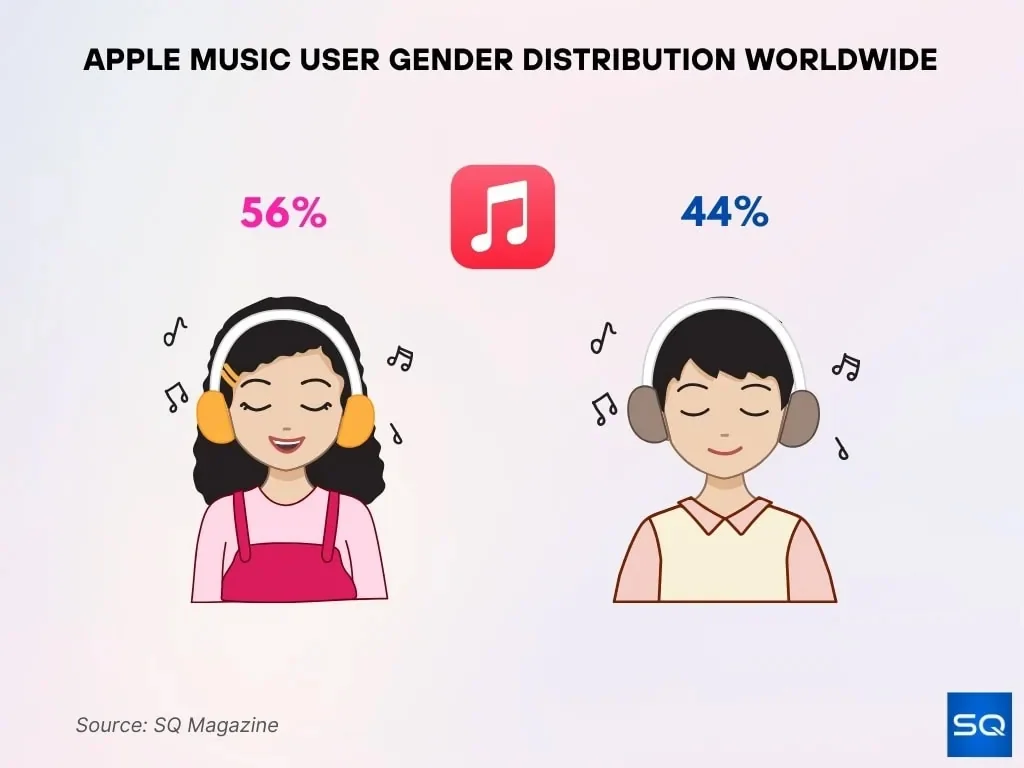
- 56% of Apple Music users identify as female, while 44% identify as male, showing a clear tilt toward female listeners.
- Users aged 25–34 form the largest single age band at 23% of subscribers, making them Apple Music’s core adult audience.
- Listeners aged 35–44 account for about 22% of the user base, highlighting strong adoption among older millennials and early Gen X.
- The 18–24 age group represents roughly 17% of Apple Music users, underscoring meaningful but not dominant youth engagement.
- The 55+ segment also holds about 23% of users, matching or exceeding younger adult groups and signaling notable multi‑generational appeal.
- Combined, users aged 25–44 represent around 45% of Apple Music’s audience, forming the platform’s primary working‑age cohort.
- Only about 15% of Apple Music users are aged 45–54, making this the smallest major age segment on the service.
- Over 50% of Apple Music’s user base is 35+, indicating comparatively stronger penetration among older listeners than some rival streaming platforms.
Library Size and Content Catalog in Apple Music
- Apple Music’s library contains a catalog of over 100 million tracks, covering a global range of genres and time periods.
- The service offers more than 30,000 curated playlists, organized by mood, genre, activity, and occasion.
- Millions of tracks, roughly 75 million songs, are available in Lossless Audio at no extra cost to subscribers.
- At launch, thousands of songs featured Spatial Audio with Dolby Atmos, with the collection expanding continuously.
- Apple Music’s catalog supports over 160 countries and regions, enabling wide regional and language‑specific content discovery.
- The platform hosts hundreds of radio stations and live shows, including flagship stations such as Apple Music 1 and Apple Music Hits.
- Apple Music Originals and exclusive interviews span thousands of releases across major artists and emerging creators.
- Podcast content integrated into iTunes and Apple Music has grown by over 30% year‑on‑year in total catalog size.
- Users can download up to 100,000 songs to a single iCloud Music Library for offline listening without stream count limits.
- The service supports over 20 lossless resolution tiers, including resolutions up to 24‑bit/192 kHz, for high‑fidelity streaming and download.
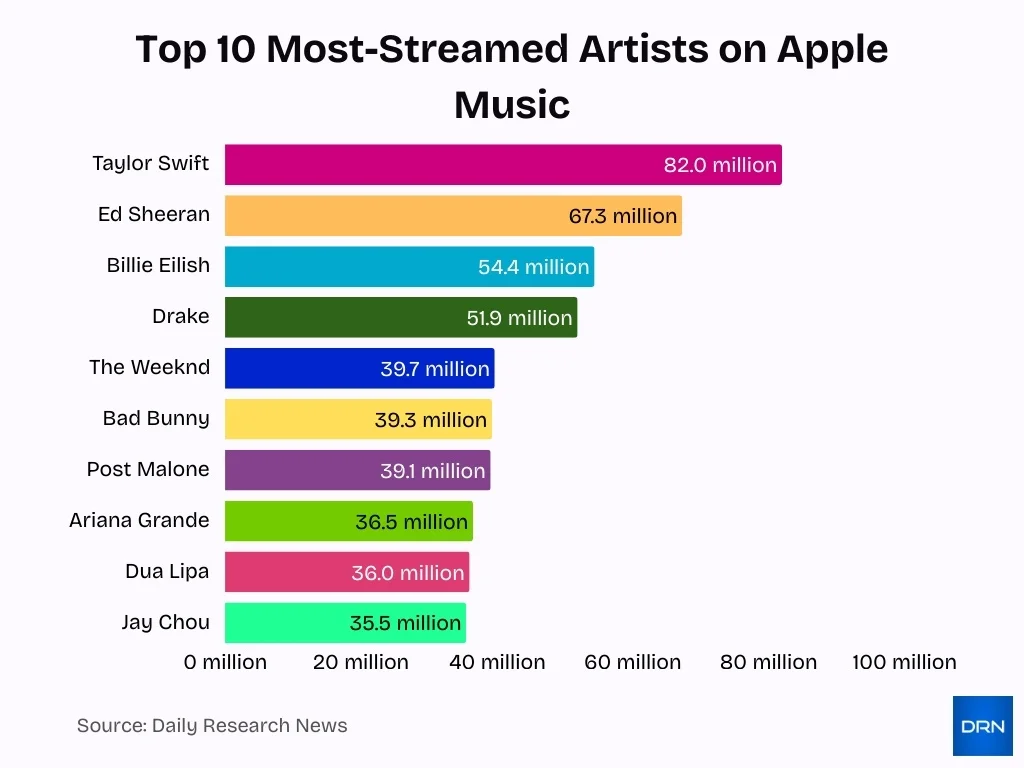
Top 10 Most-Streamed Artists on Apple Music
- Taylor Swift leads the ranking with 82.0 million streams, making her the most-streamed artist on Apple Music.
- Ed Sheeran secures second place with 67.3 million streams, reflecting his strong global fanbase.
- Billie Eilish ranks third after recording 54.4 million streams, driven by her high youth engagement.
- Drake follows closely with 51.9 million streams, showing his consistent streaming dominance.
- The Weeknd enters the top five with 39.7 million streams, highlighting his long-term popularity.
- Bad Bunny records 39.3 million streams, proving the rising influence of Latin music on Apple Music.
- Post Malone attracts 39.1 million streams, maintaining his status as a top mainstream artist.
- Ariana Grande reaches 36.5 million streams, supported by her loyal global audience.
- Dua Lipa achieves 36.0 million streams, fueled by her chart-topping pop hits.
- Jay Chou closes the top 10 with 35.5 million streams, representing strong Asian market demand.
Playlists, Radio, and Live Shows on Apple Music
- Apple Music has more than 30,000 playlists, spanning editorial and algorithmic curation.
- Playlists drive about 40% of listening activity across global users.
- Apple Music 1, Hits, Country, Música Uno, and Club stream 24/7 live radio.
- Radio shows with hosts like Zane Lowe attract millions of monthly listeners.
- Live concert broadcasts and exclusive premieres increase real‑time engagement.
- Apple Music SharePlay usage grew by ≈43% YoY, enhancing social listening.
- Genre‑specific radio stations diversify user experiences.
- Integration with Shazam improves music discovery in radio and playlists.
Spatial Audio and Lossless Streaming in Apple Music
- Apple Music offers Spatial Audio with Dolby Atmos on millions of tracks, providing immersive 3D sound quality.
- The service also includes Lossless Audio streaming for millions of songs at no extra cost.
- Hi‑Res Lossless extends up to 24‑bit/192 kHz for supported tracks.
- Users can enable lossless or Hi‑Res Lossless in audio settings across devices.
- Spatial Audio adoption continues to grow as listeners seek richer audio experiences.
- Apple Music’s audio formats often register higher satisfaction ratings among audiophiles than standard streams.
- Many major releases now include Atmos mixes, increasing immersive catalog presence.
- Apple Music’s superior quality formats are often highlighted in comparisons with rivals.
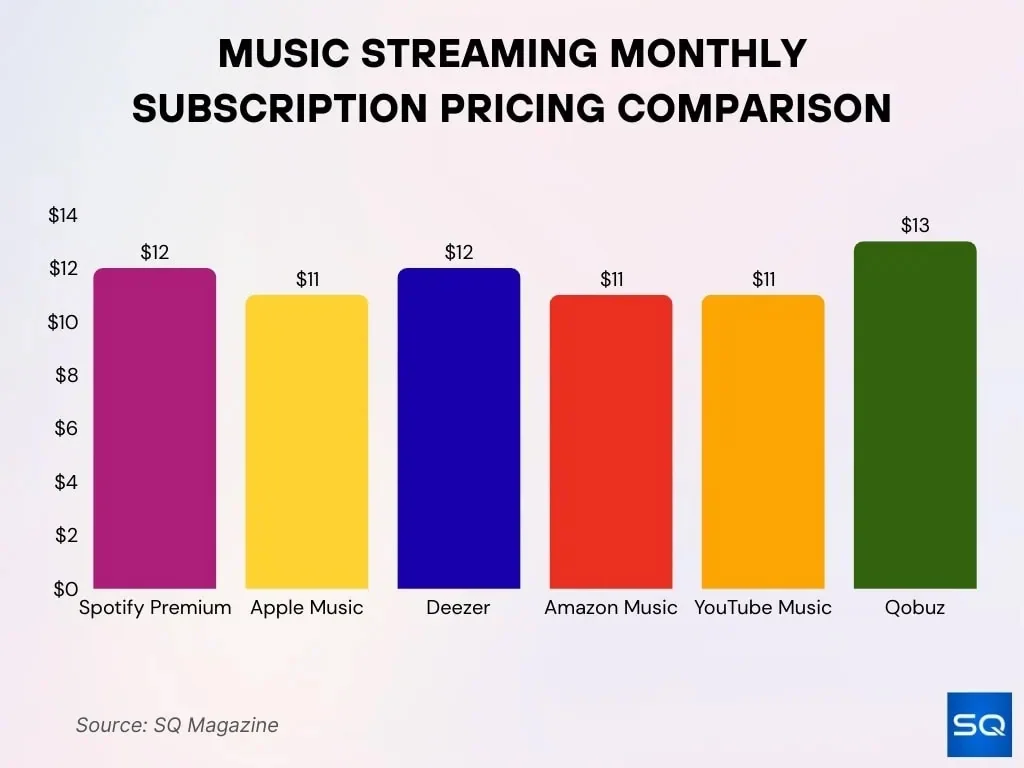
Music Streaming Monthly Subscription Pricing Comparison (Cost & Value Analysis)
- Qobuz stands as the most expensive major streaming service at $13 per month, positioning itself as a premium, audiophile-focused platform for high-quality music listeners.
- Spotify Premium and Deezer are priced at $12 per month, placing them in the upper mid-range segment of the music streaming market.
- Apple Music, Amazon Music Unlimited, and YouTube Music provide more cost-efficient plans at $11 per month, appealing to price-conscious subscribers.
- The price gap between the cheapest and most expensive services is only $2 per month, highlighting strong pricing convergence across the global music streaming industry.
- Mainstream platforms cluster closely within the $11–$12 range, reinforcing price parity as a key competitive strategy among leading services.
- Despite similar pricing structures, platforms continue to differentiate through exclusive content, audio quality, ecosystem integration, and bundled benefits rather than relying on cost alone.
Pricing and Subscription Plans for Apple Music
- Apple Music’s Individual plan typically costs $10.99/month in the U.S. for standard subscribers.
- The Family plan covering up to six users is around $16.99/month.
- Student pricing is generally reduced to about $5.99/month with eligible proof.
- Apple’s site also mentions introductory free trial periods for new subscribers.
- No long‑term commitment, users can cancel any time without penalty.
- Pricing remains competitive with major rivals like Spotify and Amazon Music.
- Regional pricing varies (e.g., India and other markets often have localized plans).
- Apple Music promotional bundles (e.g., Apple One) can offer broader services at bundled rates.
Free Trials and Discounts on Apple Music
- Apple Music’s 1-month free trial converts 0.5% of users to paid subscribers monthly.
- 60% of the initial 3-month trial users from 11 million signups became paying subscribers in 2015.
- Student plan offers 50% discount at $5.99/month versus the $10.99 standard rate.
- Family plans account for 34.7% of music streaming subscriptions per the 2018 survey.
- The 2026 promotional deal provides 6 months for $2.99, saving $62.95 off the regular price.
- Trial-to-paid conversion rate stands at 42% with 3.2% monthly churn.
- 108 million paying subscribers globally in 2026, up 16.1% from 2025.
- 79% retention rate among early free-trial users, reported by Apple.
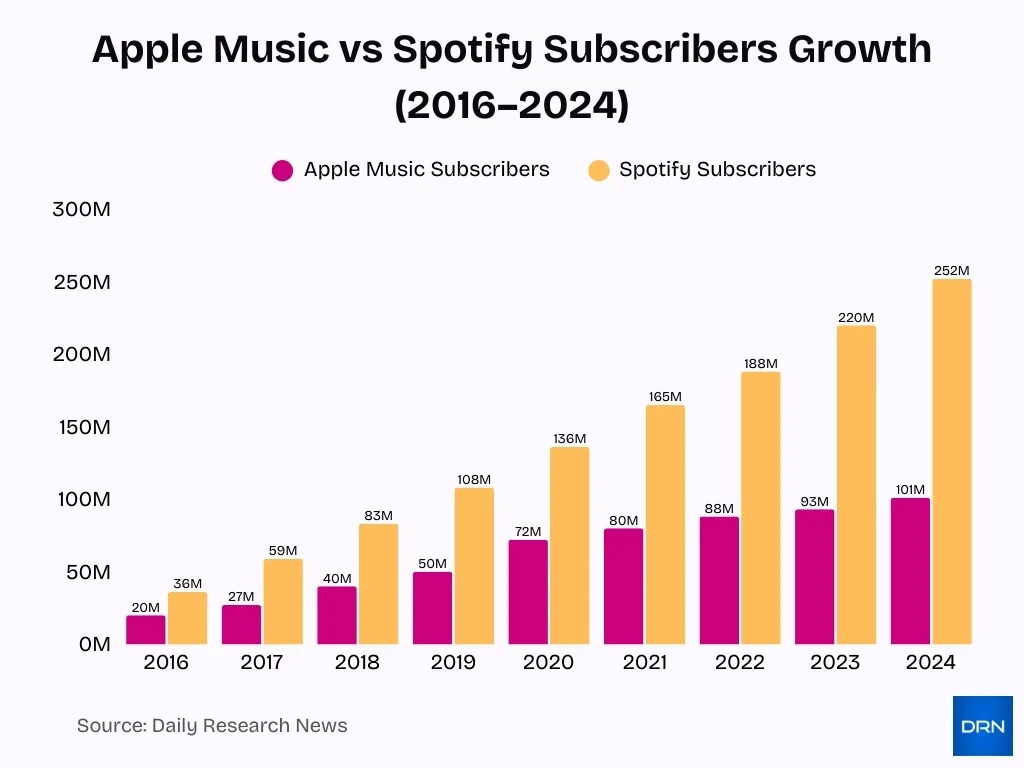
Apple Music vs Spotify Subscriber Growth
- Spotify’s subscribers increased from 36 million (2016) to 252 million (2024), reflecting a massive long-term expansion in its global user base.
- Apple Music’s user base grew steadily from 20 million (2016) to 101 million (2024), showing consistent but comparatively slower growth.
- In 2016, Spotify led Apple Music by 16 million subscribers, establishing its early dominance in the streaming market.
- By 2019, Spotify reached 108 million users, more than double Apple Music’s 50 million subscribers.
- During 2020, Spotify climbed to 136 million users, while Apple Music surged to 72 million, driven by increased home entertainment demand.
- In 2021, Spotify crossed 165 million subscribers, compared to Apple Music’s 80 million, widening the competitive gap.
- By 2022, Spotify expanded to 188 million users, maintaining a strong lead over Apple Music’s 88 million.
- In 2023, Spotify hit 220 million subscribers, while Apple Music reached 93 million, highlighting sustained platform loyalty.
- In 2024, Spotify peaked at 252 million users, surpassing Apple Music by 151 million subscribers.
- Over the 2016–2024 period, Spotify added 216 million users, whereas Apple Music gained 81 million, underlining Spotify’s superior growth momentum.
- The data shows that Spotify consistently outperformed Apple Music every year in total subscribers throughout the nine years.
Comparison of Apple Music vs Amazon Music
- In the U.S., Apple Music holds a 30.7% subscriber market share vs Amazon Music’s 23.8%, together accounting for 54.5% of paid streaming users.
- Both Apple Music and Amazon Music Unlimited offer lossless streaming up to 24‑bit/192kHz on supported devices, with spatial audio available on select catalogs.
- Standard individual pricing is $10.99/month for Apple Music vs. $9.99/month for Amazon Music Unlimited with Prime, and $10.99 without Prime.
- Apple Music has no perpetual free tier, while Amazon offers a limited free ad‑supported option with restricted skips and catalogs.
- Apple Music’s library exceeds 100 million songs and 30,000 curated playlists, compared with Amazon Music’s catalog of over 100 million tracks but with less editorial emphasis.
- Amazon’s deep integration with Echo and Alexa drives a high share of in‑home voice playback, with Amazon devices in over 100 million households globally.
- Both platforms allow offline downloads on multiple devices, typically supporting at least 10,000+ tracks per account for listening without a connection.
- Apple Music’s Family Plan is priced at $16.99/month for up to 6 users, while Amazon Music’s Family Plan costs $16.99–$17.99/month for 6 accounts.
Most‑Streamed Songs and Albums on Apple Music
- “DtMF” by Bad Bunny hit No. 1 on Apple Music’s Daily Top 100 Global with 23 tracks simultaneously in the Top 100 after his Super Bowl halftime show performance.
- Following the event, Bad Bunny placed 9 songs in the global Top 25 and 5 tracks in the Top 10 on Apple Music’s Daily Top 100 Global chart.
- Six of Bad Bunny’s 23 charting tracks were re-entries to Apple Music’s Daily Top 100 Global, underscoring sustained catalog streaming months after prior peaks.
- Bad Bunny’s album cuts appeared on Apple Music album charts in 155 countries, reaching the Top 10 in 128 and hitting No. 1 in 46 markets worldwide.
- Apple Music Replay’s 2024 data named Kendrick Lamar’s “Not Like Us” the most‑played track of the year on the platform globally.
- Taylor Swift’s “The Tortured Poets Department: The Anthology” was Apple Music’s most‑streamed album of 2024, while she ranked as the platform’s top‑streamed artist.
- Apple Music reported that 39 of the year’s top global songs in 2024 were by female-identifying artists, marking the biggest year for women in its global songs chart history.
- Curated playlists like “Hits in Spatial Audio” and “Made for Spatial Audio” highlight that top tracks in Dolby Atmos now span major genres from pop to Afrobeats and rock.
- Apple Music’s year-end Replay charts combine streams, Shazam tags, and lyric reads to rank the biggest global songs and albums annually.
Frequently Asked Questions (FAQs)
Apple Music has over 93 million paying subscribers worldwide.
Apple Music generated an estimated $9.2 billion in annual revenue.
Apple Music accounts for 30.7% of the music‑streaming subscriber market in the United States.
Around 56% of Apple Music users are female, and 44% are male.
Conclusion
Apple Music remains a dominant premium streaming service, supported by its expansive library, immersive audio formats, and deep integration across Apple devices. With robust adoption of Spatial Audio and Lossless streams, Apple continues to appeal to users seeking high‑quality audio. Its pricing and trial options keep it competitive with Spotify and Amazon Music, while unique statistical features, such as Replay, deepen user engagement.
Top artists and global hit songs reflect shifting listener tastes throughout the year, underlining Apple Music’s role as both a cultural and commercial force in music streaming.