

Augmented Reality (AR) continues gaining traction as a technology that merges digital content with the physical world. Businesses across retail, healthcare, and manufacturing are using AR to enhance shopping experiences, guide training, and streamline workflows, all while increasing engagement and efficiency. For example, retailers use AR for virtual product try-ons, while healthcare institutions adopt AR for surgical visualization and training simulations.
The numbers behind these trends tell a story of rapid growth and widespread adoption across both consumer and enterprise sectors. Read on to explore the most pivotal AR statistics shaping.
Editor’s Choice
- The global AR market is projected to reach between $83.65 billion and $140.34 billion in 2025, showcasing strong growth momentum.
- AR revenue is expected to expand at CAGRs exceeding 30% across multiple forecasts from 2025 to 2034.
- By 2030, the AR market may surpass $500 billion to $600 billion, depending on the analyst firm.
- A rising share of U.S. internet users, estimated at 35 to 40%, will engage with AR regularly by 2025.
- Combined shipments of AR and VR headsets and smart glasses are expected to grow around 39% in 2025, representing rising hardware demand.
- Mobile AR users and devices continue to increase rapidly, with billions of users expected globally.
- AR integration in retail and e-commerce is driving significant user engagement and online shopping enhancements.
Recent Developments
- AR technology is increasingly used beyond gaming, extending into enterprise applications like training and remote support.
- By 2025, upgrades in smart glasses and mobile AR are accelerating user adoption and new use cases.
- Major technology companies are launching new AR hardware and features to expand real-world applications.
- Developers are pushing AR for location-based and navigation scenarios using embedded sensors and mapping.
- Research highlights AR usage in online shopping and product interaction, improving consumer engagement.
- Wearable AR is moving closer to daily use with expanded content and interaction beyond controlled environments.
- Early studies suggest AR will influence knowledge work, potentially reducing reliance on traditional displays.
- AR adoption insights emphasize enhanced training and educational acceptance worldwide.
Global Market Size for Augmented Reality
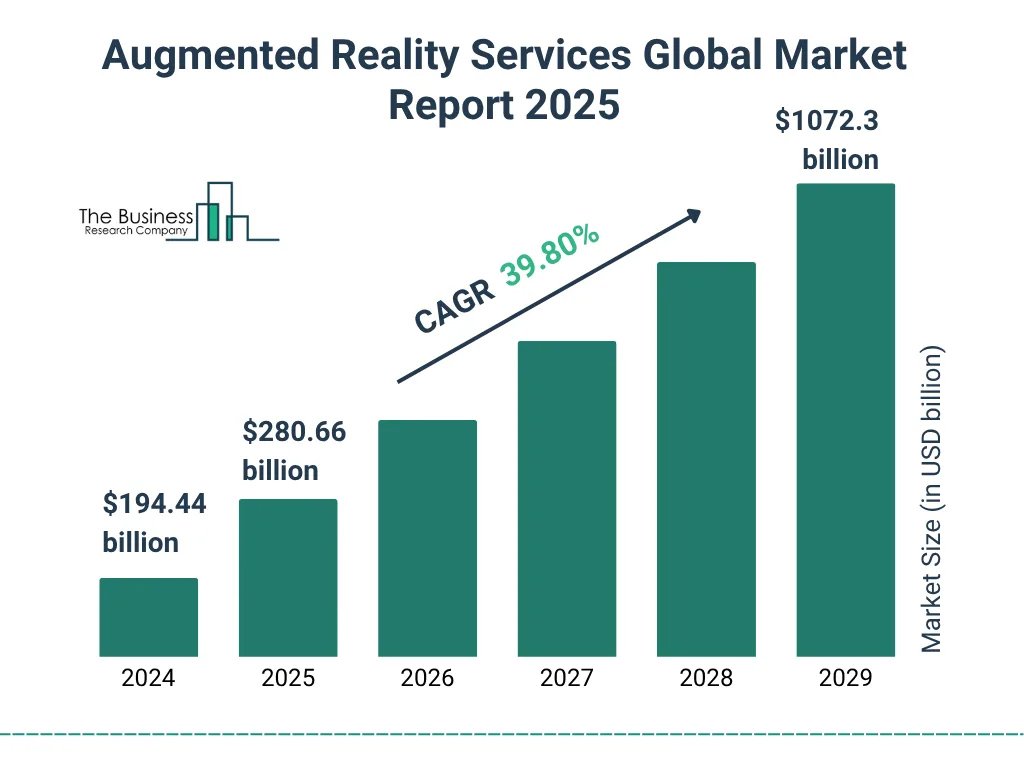
- The global augmented reality services market was valued at $194.44 billion in 2024, highlighting its rapidly expanding commercial footprint.
- In 2025, the AR services market is projected to grow significantly to $280.66 billion, reflecting accelerating adoption across industries.
- By 2029, the augmented reality services market is expected to surge dramatically to $1,072.3 billion, signaling large-scale market maturation.
- This robust expansion represents a strong CAGR of 39.8% between 2024 and 2029, underscoring sustained long-term growth momentum.
Growth Projections in the Augmented Reality Sector
- The AR market is forecast to grow at around 31% CAGR from 2025 to 2035.
- Other analysts project growth rates approaching 38% CAGR through the mid-2030s.
- Mobile AR is expected to maintain CAGR levels above 30% over the next decade.
- Some industry models show the AR market could add hundreds of billions of dollars in value by the late 2020s.
- By 2030, AR revenues may be nearly ten times larger than 2025 levels.
- Asia-Pacific is expected to be one of the fastest-growing AR regions, driven by mobile adoption.
- Hardware segments such as smart glasses are projected to grow faster than traditional headsets.
- Enterprise software and services are expected to compound overall market growth.

Adoption and Usage Rates of Augmented Reality
- 35 to 40% of U.S. internet users are expected to use AR regularly by 2025.
- Estimates suggest up to three-quarters of the global population could engage with AR in some form.
- Social filters, navigation tools, and mobile games have normalized AR in everyday digital interactions.
- Mobile AR device users reached around 1.7 billion globally by 2024.
- Smartphone-based AR engagement has increased steadily over the past decade.
- Brands using AR features report higher engagement and conversion rates than non-AR experiences.
- Headset and wearable AR shipments continue to rise year over year.
- Consumer familiarity with AR strongly correlates with adoption in retail and social platforms.
Devices and Hardware Trends in Augmented Reality
- The global AR and VR headset market grew over 18% year over year in early 2025.
- Smartphones remain the dominant AR device, with around 1.7 billion mobile AR users expected by 2025.
- The mobile AR hardware market is projected to grow from tens of billions in 2025 to over $100 billion by 2030.
- Major technology companies continue investing heavily in smart glasses and mixed-reality headsets.
- High-end AR headsets now enter the market at price points above $1,500, targeting enterprise users.
- Wearable AR still trails smartphones due to cost and ecosystem limitations, but continues improving.
- Developers increasingly support cross-platform AR across mobile devices, headsets, and future smart glasses.
- Hardware advances in sensors, displays, and battery life are improving AR usability.
User Demographics in Augmented Reality Applications
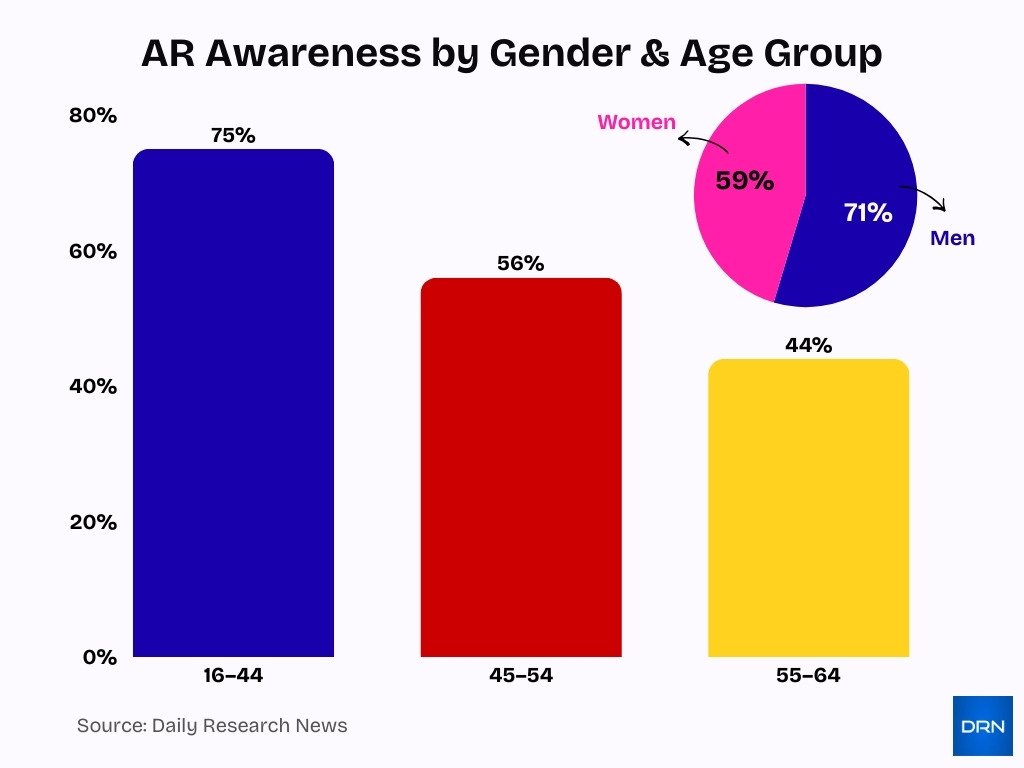
- 75% of people aged 16-44 show high AR awareness, dropping to 56% for 45-54 and 44% for 55-64.
- 71% of men versus 59% of women demonstrate AR awareness across demographics.
- North America commands 36% of the global AR market share in 2024, ahead of Europe at 27%.
- Asia-Pacific drives mobile AR with robust infrastructure and high smartphone penetration.
- 91.75% of Gen Z express a strong interest in AR shopping experiences.
- 30% of Americans actively use AR, with 20% engaging monthly or more.
- Over 85% of AR users, especially Gen Z and Millennials, participate in social shopping.
- 98% of AR shoppers find it enhances their shopping experience significantly.
- Hospitals and clinics hold 47.9% share of AR in healthcare for professionals.
Software and App Statistics Related to Augmented Reality
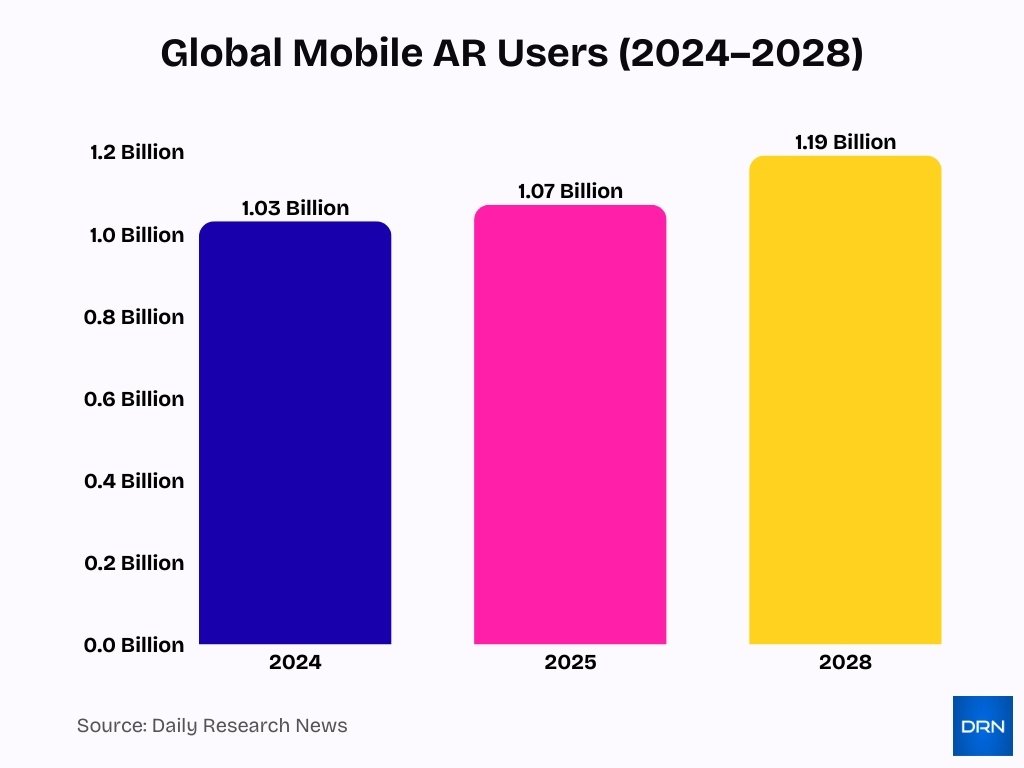
- 1.07 billion mobile AR users worldwide in 2025, growing to 1.19 billion by 2028.
- Global AR market valued at $83.65 billion in 2024, with 37.9% CAGR through 2030.
- Over 200 million people use AR daily on Snapchat alone in 2025.
- AR retail market projected to reach $54.7 billion by 2033, with 29.9% CAGR.
- 71% of shoppers would buy more often from retailers offering AR apps.
- The AR SDK software market is valued at $2.8 billion in 2024, reaching $18.5 billion soon.
- 61% of consumers prefer retailers with AR experiences for enhanced engagement.
- 39% of enterprises use AR/VR for training and remote assistance.
- AR users engaging with features are 66% more likely to convert in retail.
AR Market Industry-Wise Revenue Distribution
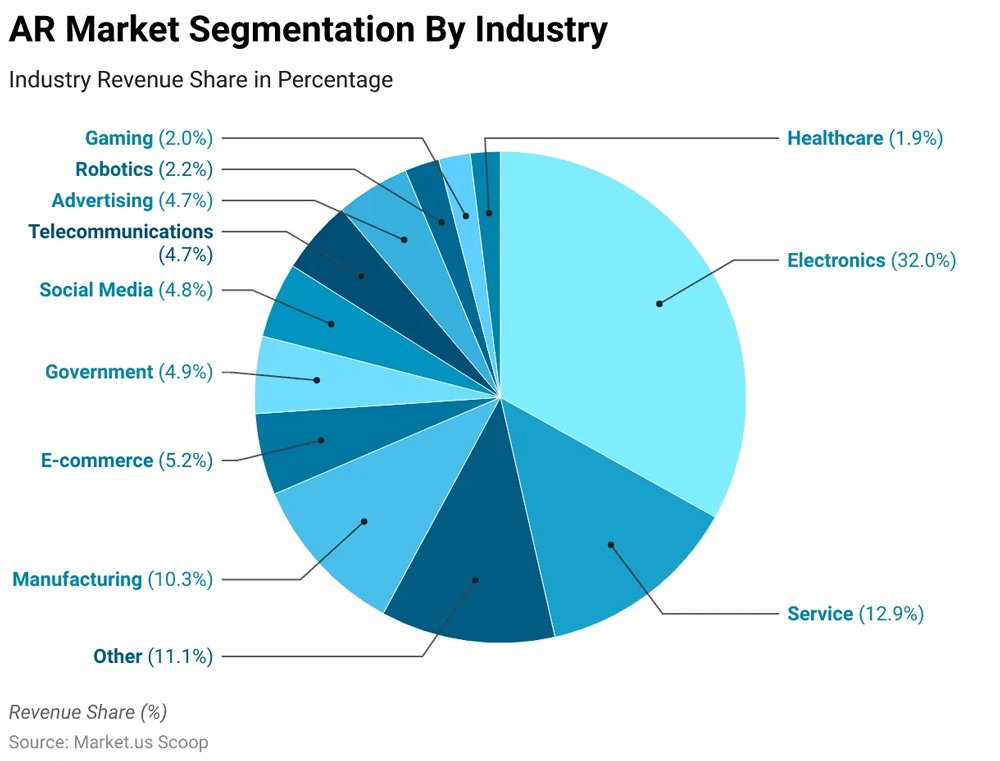
- Electronics dominate the AR market, leading with a 32.0% revenue share across global industries.
- Service industries make up a significant portion of the AR market, accounting for 12.9% of total revenue.
- Other sectors together contribute a combined 11.1% share to overall AR industry revenues.
- Manufacturing maintains a solid position in the AR market, holding a 10.3% share.
- E-commerce represents a growing segment, making up 5.2% of the total AR market.
- Government applications account for 4.9% of overall augmented reality usage and revenue.
- Social media platforms contribute 4.8% to the global AR market share.
- Telecommunications also play a notable role, accounting for 4.7% of AR industry revenue.
- Advertising captures an equal 4.7% share of total AR revenue worldwide.
- Robotics holds a smaller yet emerging portion of the AR market, with a 2.2% share.
- Gaming represents 2.0% of the overall augmented reality industry revenue.
- Healthcare records the smallest contribution within the AR market, with a 1.9% share.
Gaming and Entertainment Driven by Augmented Reality
- The global AR gaming market reached $11.84 billion in 2025.
- Pokémon GO amassed over 1 billion downloads worldwide since its launch.
- Social media AR filters achieve 75 seconds average engagement time.
- TikTok AR content boosts watch time by 1.7x versus regular videos.
- AR sports broadcasts yield 15% higher viewer engagement.
- AR in sports viewing increases retention by 20% during events.
- Cross-platform AR games retain users 1.4x longer.
- AR experiences elevate app time spent with 3-minute lens sessions on Snapchat.
Retail and E-commerce Integration with Augmented Reality
- AR can increase purchase intent by around 17% in retail environments.
- Over 60% of consumers prefer retailers offering AR experiences.
- More than 70% of shoppers say AR would encourage them to shop more often.
- AR-enabled retail is projected to reach double-digit billions in market value.
- A significant share of consumers is willing to pay more for AR-enhanced products.
- More than half of retailers plan new AR or VR investments.
- Most major retail brands intend to use AR for customer engagement.
- AR-driven e-commerce continues growing at strong compound rates.
Advertising and Marketing Innovations Using Augmented Reality
- 61% of consumers say augmented reality (AR) increases their likelihood of purchasing from a brand.
- AR campaigns can achieve up to 200% higher engagement than traditional advertising formats.
- Around 70% of shoppers claim AR helps them make quicker, more confident purchase decisions.
- Virtual try-before-you-buy tools reduce product return rates by over 22% on average.
- Nearly 54% of marketers currently use or plan to invest more in AR experiences within the next year.
- 48% of media agencies now include AR integrations in their digital campaign strategies.
- Consumers are 2.7x more likely to remember AR ads compared to standard static ads.
- Products featuring AR visuals show an average 40% higher conversion rate than non-AR listings.
- Experiential marketing using AR drives 30% greater event engagement than traditional methods.
- The global AR advertising market is projected to surpass $50 billion by 2030.
Mobile Trends Shaping Augmented Reality Usage
- 1.03 billion mobile AR users worldwide in 2024, projected to reach 1.07 billion in 2025.
- Mobile devices drive 59.7% of global website traffic as of April 2025.
- The global mobile AR market is valued at $37.73 billion in 2024, forecasted to hit $49.59 billion in 2025.
- ARCore is available on 1.4 billion Android devices, expanding to iOS compatibility.
- Retail AR experiences boost conversion rates by up to 189%, with 85–112% lifts in eyewear and cosmetics.
- Consumer segment captures 51% of mobile AR revenue through gaming and social media apps.
- Flutter is used by 46% of mobile developers for cross-platform AR frameworks on Android and iOS.
- 72% of wearable users rate gesture controls in AR as highly intuitive.
- Gaming accounts for 40% of total AR usage across industries.
- Mobile AR revenue projected to reach $110.68 billion by 2029 at 31.6% CAGR.
Education and Training Enhanced by Augmented Reality
- AR boosts student post-test scores by 5% in science education through immersive experiences.
- 75% retention rate achieved with AR/VR learning versus 5% for lectures.
- 70% of students understand concepts faster using AR tools.
- AR immersive experiences improve academic performance by up to 30%.
- AR in the training market is expected to grow from $51.34B in 2025 to $249.42B by 2029 at 48.5% CAGR.
- 34% of companies use simulation-based AR training, with 15% planning adoption.
- AR/VR education market projected at $116.6B by 2035 with 15.7% CAGR.
- 90% immediate retention from AR simulation training in medical education.
Healthcare and Medical Applications of Augmented Reality
- Global AR healthcare market to reach $16.44 billion by 2033, growing at a 26.3% CAGR from 2025.
- AR navigation boosts surgical screw accuracy to 97.1% in spine procedures with no complications.
- 68% of U.S. medical schools adopted AR/VR for training curricula.
- AR models increased patient knowledge substantially in a study of 67 participants over four months.
- The virtual rehabilitation market (including AR) is projected at $2.3 billion by 2030, with 24.4% CAGR.
- AR telemedicine enabled the successful remote re-diagnosis of cardiac arrhythmia and tuberculosis cases.
- AR assistive tech aids 20% of students with reading difficulties and 5-8% with dyslexia.
- AR in surgery reduced pinpointing errors from 15.9 mm to 6.5 mm for engineering groups.
Manufacturing and Industrial Advancements Through Augmented Reality
- AR boosts manufacturing assembly efficiency by 60% through visual instructions.
- Remote AR maintenance cuts task time by 25% and errors by 90%.
- AR overlays in manufacturing reduce errors by up to 80% during assembly.
- AR virtual simulations enable 10x faster design iterations before physical production.
- AR shortens onboarding time by 40-60% for new manufacturing workers.
- Digital twin AR integration cuts inspection times by 30% in quality assurance.
- AR safety training simulates hazards, boosting productivity by 40%, like Boeing’s results.
- Falling AR hardware costs, down to under $5,000/unit, drive 45% CAGR adoption.
Key Barriers Slowing Augmented Reality Adoption
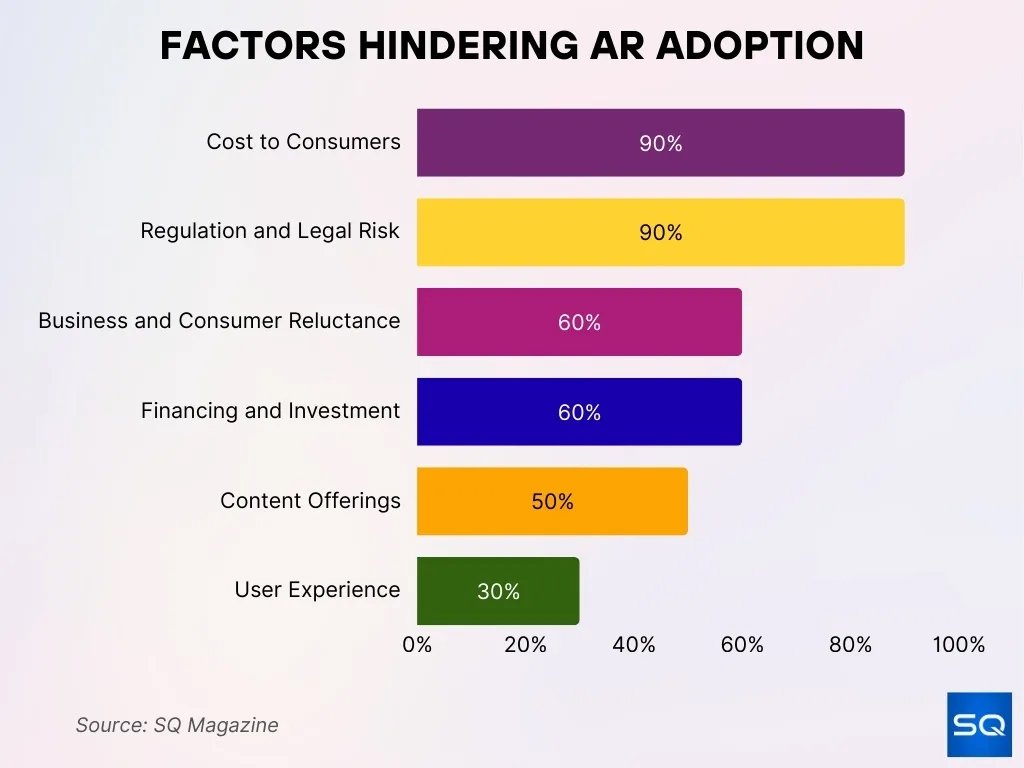
- 90% of respondents identify cost to consumers as a major barrier to AR adoption.
- 90% also point to regulation and legal risk as a key hurdle limiting wider adoption.
- 60% express concern over business and consumer reluctance toward adopting AR technology.
- 60% highlight financing and investment availability as a significant challenge for AR growth.
- 50% believe content offerings within the AR ecosystem are still insufficient.
- 30% report that user experience limitations continue to restrict adoption levels.
Real Estate and Architecture Utilizing Augmented Reality
- Global AR market valued at $93.67 billion in 2024, projected to reach $1,716.37 billion by 2032 with 43% CAGR.
- 86% of potential new-build buyers are eager to use AR for visualizing future homes.
- AR engagement rose 20% since 2020, boosting conversion rates by 90%.
- 61% of consumers prefer retailers offering AR experiences.
- Rework costs nearly 10% of construction; AR reduces it by up to 25%.
- Listings with AR close 20–30% faster than traditional ones.
- AR marketing generates 45% higher engagement on property portals.
- AR agencies see conversion rates jump up to 40%.
- 83% adoption rate of AR/AI in large architecture firms (50+ staff).
Enterprise Adoption Trends of Augmented Reality
- 75% of Fortune 500 companies have adopted XR for training and education.
- North America holds 35% share of the global AR in the enterprise market.
- The Enterprise AR market is expected to grow from $112.91 billion in 2025 to $422.61 billion by 2030.
- VR training completes 4x faster than classroom instruction.
- Boeing achieved 75% reduction in training time using AR-guided assembly.
- 22% of large enterprises use VR for training vs 7% overall organizations.
- AR enables 25% faster maintenance tasks at Airbus.
- Global AR market projected at $140.34 billion in 2025, reaching $1,716 billion by 2032.
- Enterprise to drive 60% of total VR revenue by 2030.
Frequently Asked Questions (FAQs)
The global Augmented Reality market is estimated to be around $72.5 billion in 2025, according to recent market forecasts.
The Augmented Reality market is forecast to grow at a 31.5% compound annual growth rate (CAGR) from 2025 to 2035.
The global mobile AR market is projected to reach approximately $113.6 billion by 2030 from around $30.6 billion in 2025.
The global AR market was valued at around $83.65 billion in 2024 and is expected to grow to about $599.6 billion by 2030.
Conclusion
Augmented Reality stands at a crossroads of rapid advancement and strategic adoption across industries. From marketing innovation and retail engagement to enterprise training and healthcare visualization, AR’s statistical footprint shows expanding real-world use and compelling business value. Major barriers such as cost, infrastructure limitations, and technical skill gaps remain, but forecasts point to steady investment and growth through the next decade, especially as mobile AR and enterprise tools mature.
Whether enhancing customer experiences, streamlining workflows, or redefining design and education, AR is shaping how organizations compete in a tech-enabled world. These figures underscore a larger trend: Augmented Reality is not just experimental; it is integral to future business and consumer experiences.