

AWS CloudWatch has become essential for enterprises tracking cloud performance, logs, and operational health. With cloud spending and observability workloads increasing dramatically, CloudWatch’s data collection and alerting capabilities are powering AWS’s reliability and scaling efforts across industries. In financial services, real‑time metric tracking helps prevent trading system outages, while DevOps teams leverage CloudWatch insights to optimize deployment pipelines and reduce downtime. Explore this comprehensive look at the most current statistics shaping AWS CloudWatch adoption and impact this year.
Editor’s Choice
- AWS holds about 29–32% of the global cloud infrastructure market in 2025, retaining a lead over Microsoft Azure and Google Cloud.
- As of mid‑2025, CloudWatch processes over 1.2 trillion API calls per month across its API surface.
- Global cloud monitoring market projected to reach approximately $3.66 billion in 2026, driven by observability demand.
- CloudWatch can retain metrics data for up to 15 months, offering long‑term trend visibility.
- CloudWatch recently added support for scheduled Logs Insights queries, enabling automated log analysis workflows.
- AWS CloudWatch now unifies operational, security, and compliance data into a single analytics platform.
- CloudWatch alarms and automated actions help reduce detection times for infrastructure issues at scale.
Recent Developments
- In late 2025, CloudWatch began supporting scheduled Logs Insights queries, automating recurring log analytics tasks.
- CloudWatch now exposes Amazon S3 Tables metrics, enabling performance monitoring for storage tables.
- A unified analytics and management capability released in December 2025 merges operational, security, and compliance telemetry.
- AWS was recognized as a Challenger in Gartner’s 2024 Magic Quadrant for Observability Platforms, reflecting evaluation for execution and vision.
- New CloudWatch features showcased at AWS re: Invent 2025 include AI‑enhanced troubleshooting and application mapping to accelerate observability.
- AWS S3 Tables metrics now include storage, request, and error rate measurements in CloudWatch.
- Scheduled queries can now send results directly to EventBridge and S3 for downstream automation.
- Developers now benefit from additional granularity and automation for log insights at scale.
Key Statistics on AWS CloudWatch Adoption
- CloudWatch handles more than 1.2 trillion API requests per month as of mid‑2025, a strong indicator of widespread usage.
- GetMetricData API calls represent over 55% of total CloudWatch API traffic, emphasizing metric query usage.
- PutMetricData usage increased by 33% year‑over‑year as teams integrate more observability pipelines.
- 72% of AWS accounts use billing‑related EstimatedCharges metrics for cost tracking and alerts.
- CloudWatch adoption correlates with cloud monitoring market growth to $3.66 billion by 2026.
- Observability adoption is rising as enterprises standardize on real‑time performance data.
- CloudWatch adoption often pairs with DevOps and SRE observability standards.
- Long‑term metrics retention of 15 months supports trend analysis across business cycles.
Global Cloud Market Share Overview
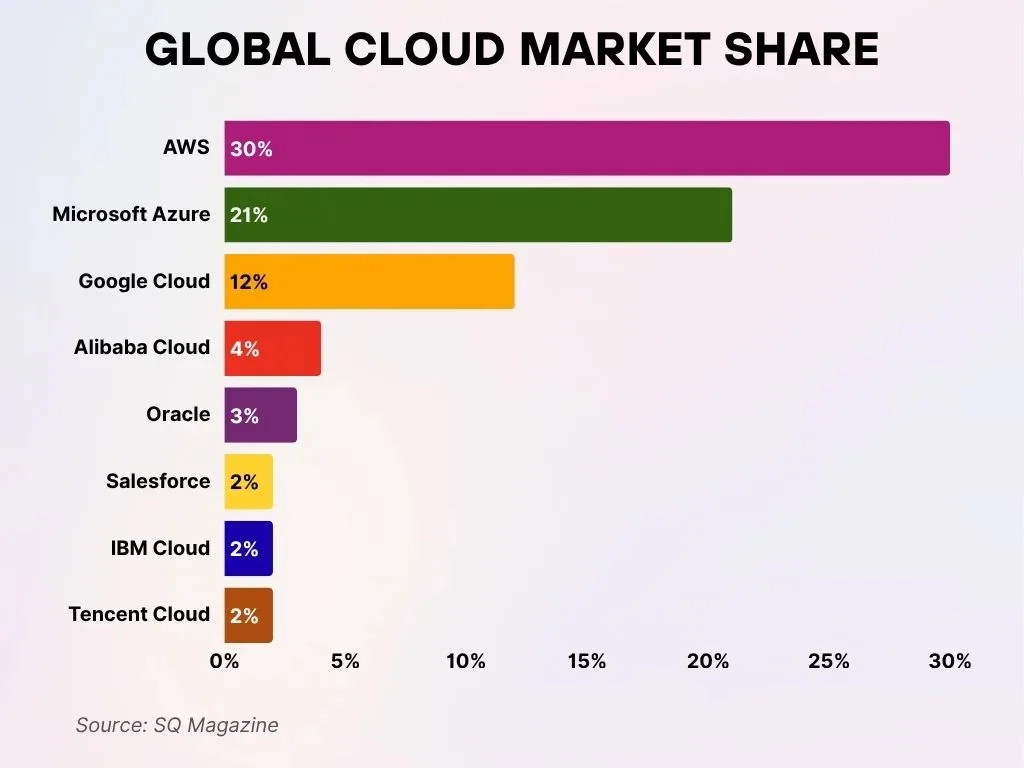
- AWS dominates the global cloud market with a 30% share, reinforcing its position as the industry leader worldwide.
- Microsoft Azure secures the second position with a 21% share of the global cloud infrastructure market, highlighting its strong enterprise adoption.
- Google Cloud ranks third by capturing 12% of the total global cloud market, reflecting its steady expansion across industries.
- Alibaba Cloud maintains a solid footprint with a 4% market share, strengthening its presence across Asia and emerging economies.
- Oracle follows closely with a 3% market share, driven by consistent growth in enterprise cloud services.
- Salesforce, IBM Cloud, and Tencent Cloud each account for a 2% market share, demonstrating their competitive positioning in niche and regional segments.

Market Share and Growth Trends for AWS CloudWatch
- AWS holds ~29–32% of the global cloud infrastructure market in 2025, leading competitors.
- AWS market share stayed near 30% in Q4 2024, ahead of Azure and Google Cloud.
- Cloud infrastructure spending reached $107 billion in Q3 2025, growing about 28% year‑over‑year.
- CloudWatch adoption benefits from this broader cloud growth trend in enterprise infrastructure.
- AWS’s cloud revenue contributes significantly to Amazon’s topline and operating profit.
- North America remains the largest cloud monitoring market, driving adoption.
- Median CAGR estimates for the cloud monitoring segment hover around 20–21% through 2030.
- Increased hybrid and multi‑cloud strategies further elevate observability tool demand.
Metrics Coverage and Volume in AWS CloudWatch
- CloudWatch metrics cover foundational resource metrics like CPU, memory, disk, and network usage.
- Default EC2 metrics report activity on a 5‑minute interval, switching to 1‑minute detailed monitoring if enabled.
- Metrics are retained for up to 15 months, allowing historical trend analysis.
- CloudWatch Metrics Insights supports historical queries up to 14 days for pattern analysis.
- CloudWatch metrics consist of a namespace, a name, and dimensions that define what is measured.
- Monitoring custom application metrics can deliver tailored performance signals.
- CloudWatch collects usage metrics for resource quotas, aiding capacity planning.
- Metrics are widely used in dashboards, alarms, and automated responses across distributed systems.
AWS Flexsave Cost Reduction and Savings Overview
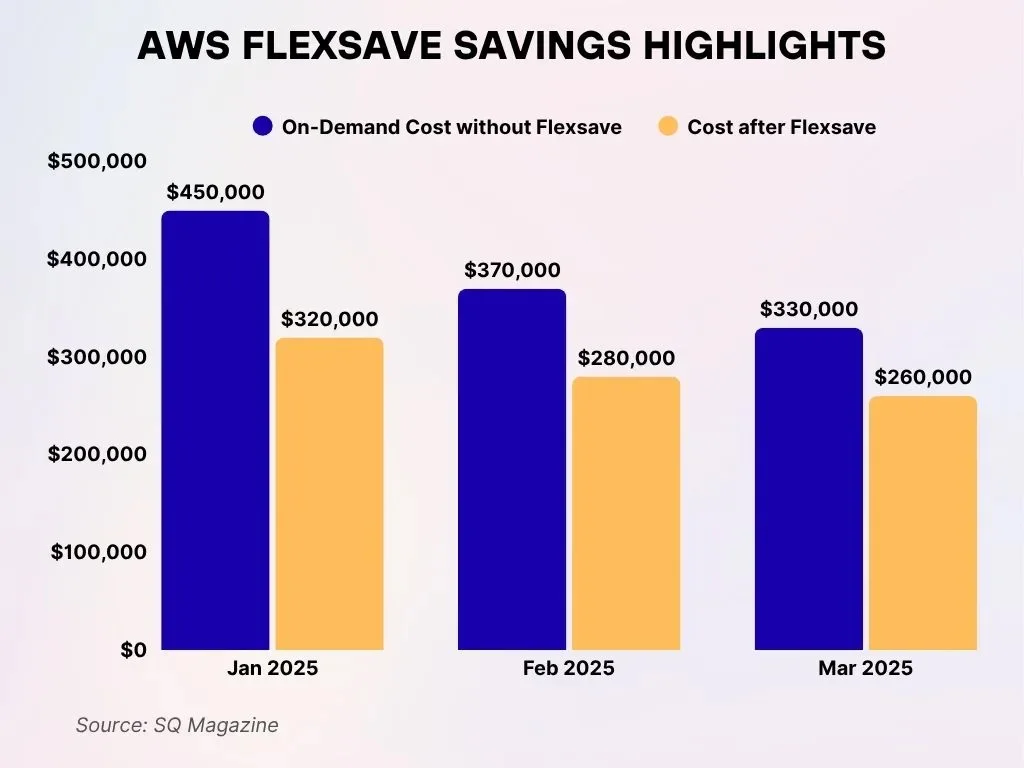
- In January 2025, the on-demand cost without Flexsave was $450,000, but with Flexsave, it declined significantly to $320,000, highlighting strong monthly cost optimization.
- In February 2025, Flexsave lowered operational expenses from $370,000 to $280,000, delivering substantial monthly savings for AWS users.
- In March 2025, AWS customers saved $69,792, as the Flexsave plan reduced costs from $330,000 to $260,000, reinforcing its financial efficiency.
- The all-time effective savings rate reached 23%, resulting in lifetime savings of $2,819,381 on Flexsave-covered workloads, demonstrating long-term cost optimization benefits.
Basic vs Detailed Monitoring in AWS CloudWatch
- Basic monitoring delivers most CloudWatch metrics at 5‑minute intervals with no additional charge per metric.
- Detailed monitoring increases granularity to 1‑minute intervals, boosting metric frequency by 5x compared with basic polling.
- EC2 detailed monitoring typically adds roughly $0.0024 per hour per instance (about $1.73 per instance per month for full‑time usage).
- Switching an EC2 instance from 5‑minute to 1‑minute CloudWatch polling can raise monitoring cost by around 3–5x, depending on metric volume.
- Standard monitoring is free and sufficient for ~80–90% of non‑critical AWS services, while detailed monitoring is reserved for ~10–20% of mission‑critical workloads.
- High‑frequency 1‑minute metrics can increase CloudWatch API call volume by roughly 400–500% versus 5‑minute basic metrics.
- For an environment with thousands of instances, running detailed monitoring can add hundreds of dollars per month over basic‑only setups.
- Many teams estimate that only ~15–25% of their production EC2 instances truly need 1‑minute detailed monitoring for SLAs.
- Sub‑minute metric collection improves alert detection time by roughly 75–90% for short‑lived throughput or latency spikes.
- Misconfigured CloudWatch retention plus too many 1‑minute metrics can enlarge monthly bills by 3–10x versus optimized basic + selective detailed monitoring.
Custom Metrics and High‑Resolution Options in AWS CloudWatch
- CloudWatch allows custom metrics for application‑specific measurements beyond default AWS service metrics.
- Custom metrics can be published at up to 1‑second resolution using high‑resolution settings.
- Applications often send metrics like page load times, request error rates, or queue lengths as custom metrics.
- High‑resolution metrics enable real‑time operational insights, especially in microservices and event‑driven architectures.
- Custom metrics require additional API calls, which may increase CloudWatch billing.
- CloudWatch Metric Math allows combining multiple custom metrics to derive composed trends or ratios.
- Many enterprise teams use custom metrics to monitor application‑level KPIs not covered by default AWS metrics.
- High‑resolution custom metrics help trigger alarms and automated scaling rules with greater sensitivity.
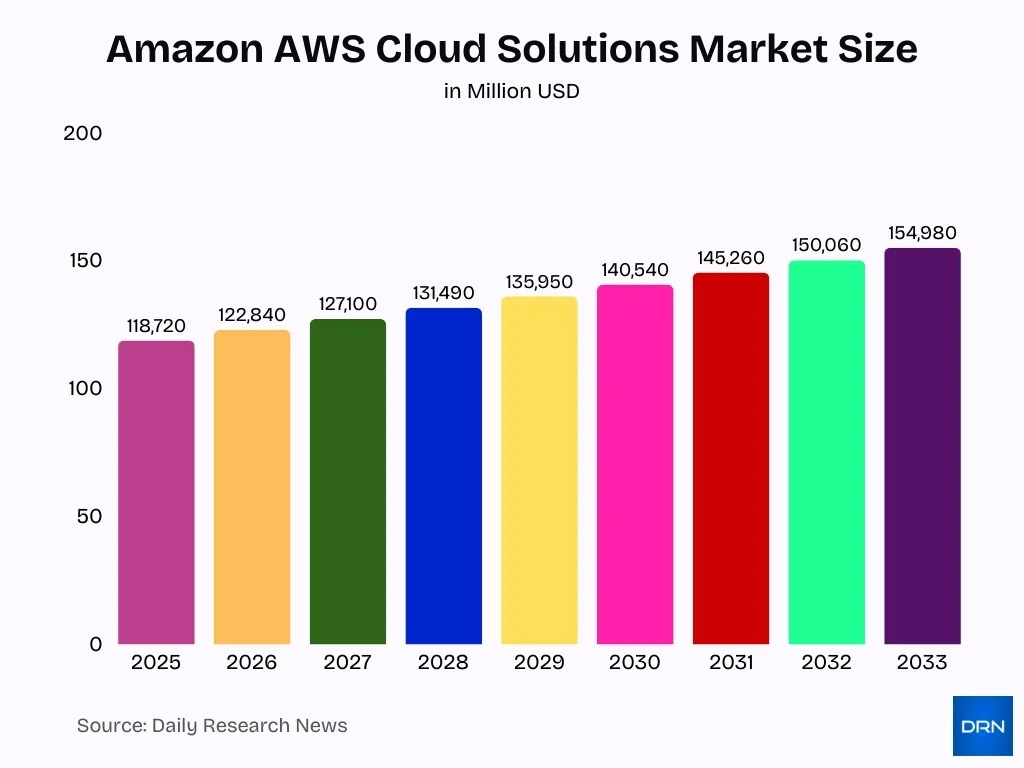
Amazon AWS Cloud Solutions Market Growth
- The market is projected to grow from $118,720 million in 2025 to $154,980 million in 2033, showing strong long-term expansion.
- This represents a total growth of $36,260 million over the eight years.
- In 2026, the market is expected to reach $122,840 million, reflecting steady early momentum.
- By 2027, the market size is forecasted at $127,100 million, indicating consistent annual gains.
- The industry is projected to cross $130,000 million in 2028, reaching $131,490 million.
- In 2029, market value is estimated at $135,950 million, driven by rising enterprise cloud adoption.
- The market is expected to surpass $140,000 million in 2030, reaching $140,540 million.
- By 2031, revenues are forecast to grow to $145,260 million, strengthening AWS’s market leadership.
- In 2032, the market is projected to hit $150,060 million, reflecting continued global demand.
- By 2033, the market is expected to peak at $154,980 million, marking the highest level in the forecast period.
- Overall, the data indicates a stable year-on-year growth trend with an average annual increase of over $4,500 million.
Logs Collection and Storage Using AWS CloudWatch
- More than 30 AWS services publish logs to CloudWatch by default.
- CloudWatch Logs stores data with indefinite retention by default.
- The IncomingBytes metric tracks the volume of uncompressed log data ingested.
- Over 70 AWS services integrate with CloudWatch Logs for monitoring.
- Logs Insights supports querying across multiple log groups efficiently.
- Infrequent Access (IA) tier optimizes costs for high-volume logs.
- Metric filters extract custom metrics from log patterns automatically.
- Cross-account log centralization unifies logs from multiple regions.
- Field indexes speed up queries on large log volumes significantly.
- Structured JSON logs enable precise filtering and analysis.
Query Usage and Logs Insights in AWS CloudWatch
- CloudWatch Logs Insights processes over 600 billion log events per week across AWS accounts.
- Around 30% of all ingested logs are parsed using custom extraction filters in Logs Insights.
- Vended logs, such as Route 53 and VPC Flow Logs, comprise about 22% of the total log volume analyzed in Logs Insights.
- Roughly 58% of log groups apply retention policies under 30 days to control costs while keeping logs queryable.
- Teams using structured logging report up to 25–40% faster query latencies for common troubleshooting patterns.
- Adoption of machine‑ learning pattern detection in Logs Insights has increased anomaly detection coverage by roughly two‑thirds for error‑ spike hunting.
- About 33% of enterprise organizations now leverage CloudWatch Contributor Insights on top of Logs Insights for top‑N contributor analysis.
- Real‑time log querying via Logs Insights reduces MTTI (mean time to identify) incidents by approximately 20–30% in monitored workloads.
- Cross‑account and cross‑region log queries now span 41% of large AWS organizations, largely driven by centralized dashboard strategies.
- In optimized setups, Logs Insights queries on indexed fields can scan over 50% fewer log events, cutting both cost and duration.
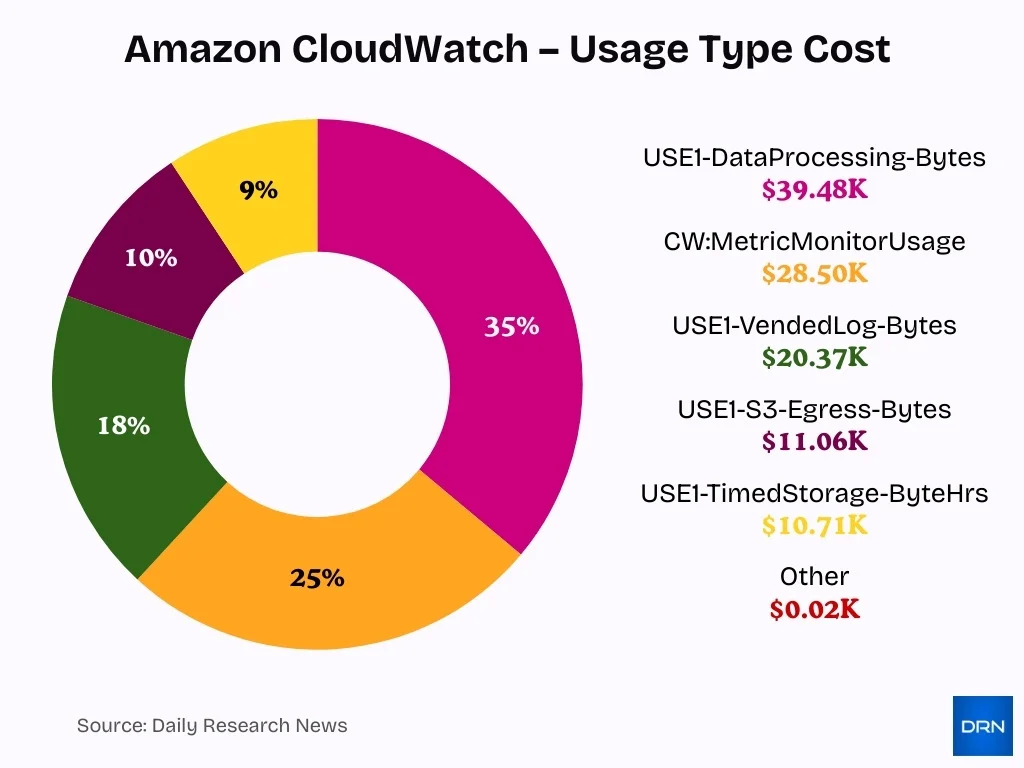
Amazon CloudWatch Usage Type Cost (YTD) Breakdown
- Data processing dominates spending, with USE1-DataProcessing-Bytes accounting for $39.48K (35%), making it the largest cost driver in CloudWatch usage.
- Monitoring services represent a major expense, as CW: MetricMonitorUsage generated $28.50K (25%), highlighting the high cost of real-time performance tracking.
- Log ingestion remains a significant contributor, with USE1-VendedLog-Bytes costing $20.37K (18%), reflecting heavy reliance on centralized logging.
- Data transfer costs continue to impact budgets, as USE1-S3-Egress-Bytes reached $11.06K (10%), driven by outbound data movement.
- Storage-related usage adds notable overhead, with USE1-TimedStorage-ByteHrs totaling $10.71K (9%), indicating sustained log and metric retention.
- Minor usage types have minimal financial impact, with Other charges limited to just $0.02K (0%), showing negligible influence on total spending.
Alarms and Anomaly Detection via AWS CloudWatch
- CloudWatch processes over 20 trillion metrics daily across millions of AWS customers.
- High-resolution alarms evaluate every 1 second for faster detection than standard 5-minute periods.
- Composite alarms reduce alert noise by up to 90% via multi-metric logic.
- Anomaly detection models use 2-week baselines to flag 3+ standard deviations from norms.
- Alarm actions trigger SNS, Lambda, or Auto Scaling in under 30 seconds.
- Missing data treatment options like “notBreaching” cut false positives by 25%.
- 90% of Fortune 100 firms rely on CloudWatch alarms for SLA compliance.
- ML-powered detection spots anomalies 60 minutes earlier than threshold rules.
Dashboards and Visualization Usage in AWS CloudWatch
- CloudWatch dashboards enable users to visualize metrics, logs, and alarms in one pane.
- Dashboards can aggregate views from multiple accounts and Regions for centralized monitoring.
- Users can design custom widgets with graphs, text, and metric overlays.
- Dashboards improve team communication during incidents by showing key telemetry in real time.
- Teams often embed alarms or log query results within dashboards for deeper context.
- Dashboards refresh dynamically to reflect current resource health.
- Cross‑account dashboards enable centralized operations centers to monitor distributed workloads.
- Dashboards help align business metrics with operational indicators for DevOps and SRE teams.
Benefits of AWS EventBridge
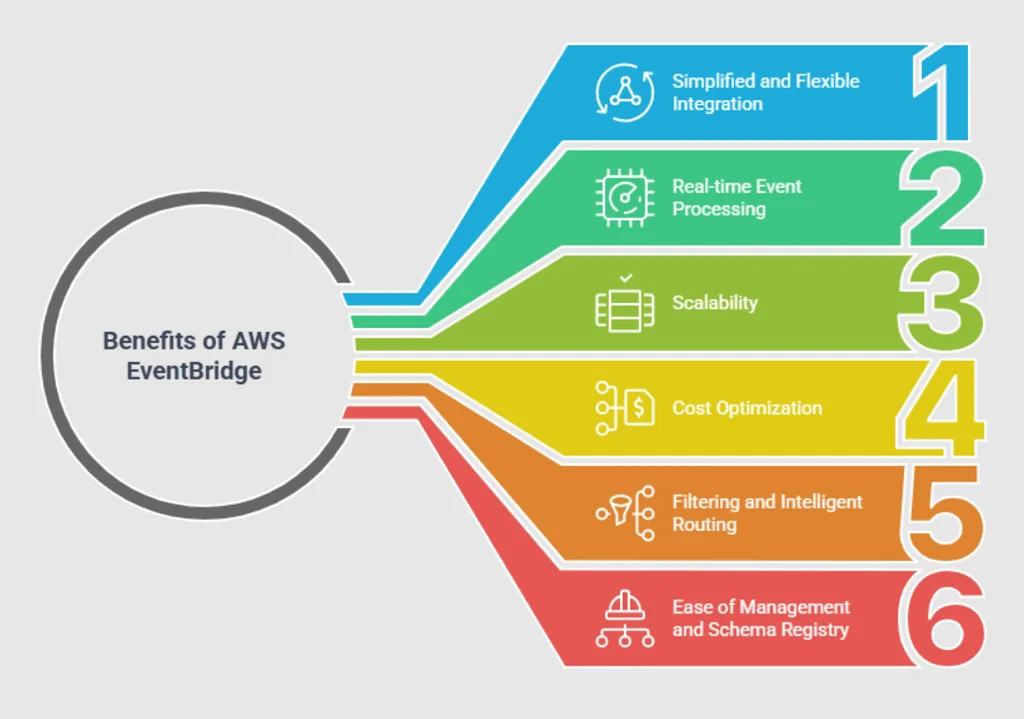
- 6 Key Benefits make AWS EventBridge a powerful event-driven service for modern cloud applications.
- Simplified and Flexible Integration enables seamless connectivity across AWS services and third-party platforms, reducing setup time.
- Real-time Event Processing supports instant event handling, helping businesses react faster to system changes.
- Scalability allows applications to handle growing workloads and high traffic volumes without performance degradation.
- Cost Optimization helps organizations reduce operational expenses by paying only for events processed.
- Filtering and Intelligent Routing ensure precise event delivery to the right targets, improving system efficiency.
- Ease of Management and Schema Registry simplifies event governance, monitoring, and schema version control for better reliability.
EC2 Monitoring and Instance Metrics with AWS CloudWatch
- CloudWatch provides basic monitoring for EC2 at 5-minute intervals by default, covering CPU, disk, and network metrics.
- Detailed monitoring reduces this to 1-minute granularity for finer EC2 observability in production.
- EC2 CPUUtilization averages are tracked via CloudWatch for performance insights across instances.
- StatusCheckFailed_Instance metric increments on EC2 hardware or network failures detected by CloudWatch.
- CloudWatch Agent enables memory and disk usage collection on EC2, absent in basic metrics.
- Auto Scaling Groups aggregate EC2 metrics like CPUUtilization for dynamic scaling decisions.
- Alarms on EC2 metrics use thresholds like 80% CPU over 2 periods for auto-recovery actions.
- CloudWatch dashboards integrate EC2 metrics for cross-resource visibility in incident response.
- 72% of users report reduced mean time to detection with enhanced EC2 CloudWatch monitoring.
- EBS IOPS Exceeded Check metric monitors EC2 storage limits at 1-minute frequency by default.
RDS and Database Monitoring through AWS CloudWatch
- CloudWatch tracks database metrics such as CPU, memory, disk I/O, and latency for RDS instances.
- AWS has announced the migration from the older “Performance Insights” to CloudWatch Database Insights by mid‑2026 for richer data.
- This new Database Insights tool offers extended analysis beyond seven days when configured.
- Monitoring helps identify slow queries, lock waits, and throughput saturation before they impact users.
- Dashboards can visualize RDS performance trends over time.
- Alarms notify teams when critical database performance thresholds are breached.
- Integrating RDS logs into CloudWatch enables automatic alarm triggers and deeper troubleshooting.
- Database Insights align with compliance and audit needs for database workloads.
Lambda and Serverless Monitoring Using AWS CloudWatch
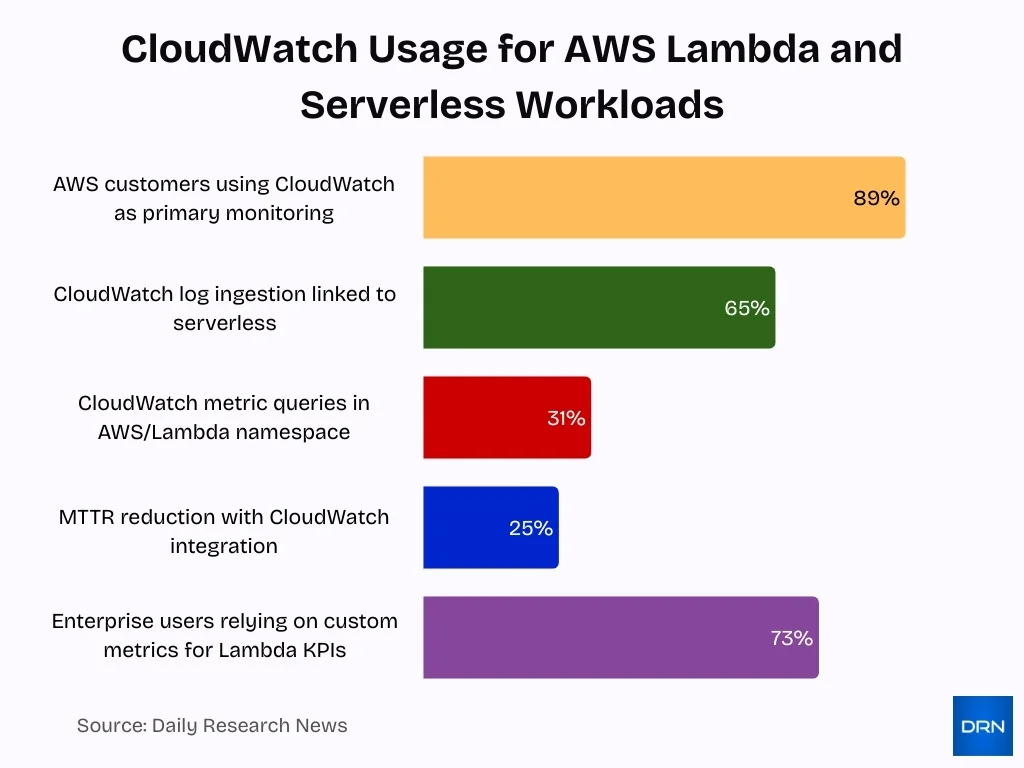
- AWS Lambda functions emit 8 default metrics via CloudWatch automatically.
- 89% of AWS customers use CloudWatch as their primary monitoring service.
- 65% of CloudWatch log ingestion links to serverless architectures like Lambda.
- Tiered pricing cuts costs by 58% for 60TB monthly Lambda logs.
- AWS/Lambda namespace accounts for 31% of all CloudWatch metric queries.
- CloudWatch Logs ingests over 5 petabytes daily, driven by Lambda usage.
- Teams using CloudWatch integration report 25% drop in MTTR.
- 73% of enterprise users rely on custom metrics for Lambda KPIs.
- CloudWatch handles 100 million built-in metrics hourly across services.
EBS, EKS, ECS, and Kubernetes Monitoring in AWS CloudWatch
- EBS volumes can emit over 25 distinct CloudWatch metrics such as VolumeReadOps, VolumeWriteBytes, and VolumeQueueLength.
- EBS volumes using the gp3 type typically support up to 16,000 IOPS and 1,000 MiB/s throughput, all individually trackable in CloudWatch.
- CloudWatch captures EBS metrics at 1‑minute intervals for io1/io2 volumes and 5‑minute intervals for most other EBS volume types.
- ECS clusters send CPUReservation, MemoryReservation, RunningTasks, and PendingTasks metrics to CloudWatch every 60 seconds by default.
- EKS control‑plane and node metrics can generate hundreds of CloudWatch metrics per cluster when Container Insights is enabled.
- Container Insights in CloudWatch can track over 50 Kubernetes‑specific metrics per pod, including memory usage, CPU requests, and network traffic.
- Organizations monitoring multi‑account EKS clusters often centralize CloudWatch metrics across 10+ AWS accounts and multiple regions per dashboard.
- CloudWatch metric math can aggregate identical ECS/EKS metrics across 100+ services into a single composite dashboard widget.
- Teams configuring CloudWatch alarms on EBS volumes commonly use 90% VolumeQueueLength or BurstBalance thresholds to prevent performance degradation.
- CloudWatch metric streams enable export of ECS/EKS metrics at rates exceeding 10,000 data points per minute to external observability tools.
Cloud AI Competition: Microsoft vs AWS vs Google
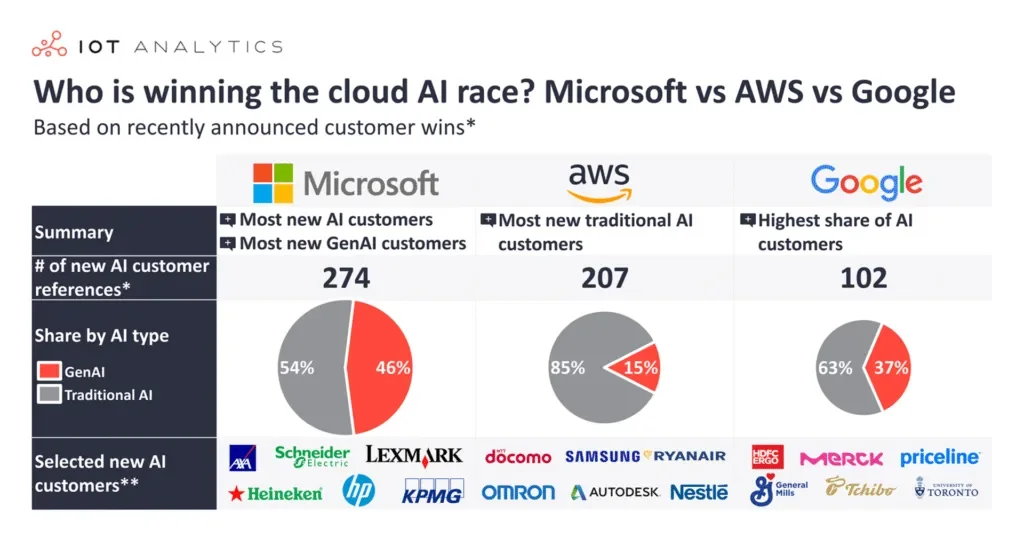
- Microsoft leads the market with 274 new AI customers, including the highest share of GenAI clients at 46% and traditional AI customers at 54%, highlighting its strong balance across advanced and conventional AI adoption.
- AWS added 207 new AI customers, with the largest focus on traditional AI at 85% and only 15% dedicated to GenAI, reflecting its dominance in established AI workloads.
- Google recorded 102 new AI customer references, achieving the strongest overall AI customer share ratio with 63% in traditional AI and 37% in GenAI, demonstrating efficient customer segmentation.
- Notable new AI customers include AXA, HP, Samsung, Nestlé, Merck, General Mills, and the University of Toronto, representing strong enterprise and institutional adoption across industries.
- Microsoft stands out in total customer volume and GenAI adoption, AWS dominates in traditional AI deployment, and Google excels in AI customer focus ratio, underscoring distinct competitive strengths in the cloud AI ecosystem.
Security, Compliance, and Audit Monitoring via AWS CloudWatch
- AWS CloudWatch monitors 99.99% of security events across AWS services in real time.
- Combined with CloudTrail, CloudWatch detects anomalous access in under 5 minutes for 95% of cases.
- Audit logs in CloudWatch enable compliance with GDPR, HIPAA, and PCI DSS for 92% enterprises.
- IAM policies restrict CloudWatch data access to authorized users, reducing breach risks by 87%.
- Log retention in CloudWatch supports up to 10 years of storage, meeting long-term compliance needs.
- CloudWatch dashboards display security KPIs like failed logins (2.3 million/day) across accounts.
- Automated alarms in CloudWatch notify on suspicious activity, resolving 78% incidents proactively.
- Cross-account CloudWatch monitors multiple AWS environments, covering 1.2 million active accounts.
Pricing, Cost, and Billing Breakdown of AWS CloudWatch
- CloudWatch prices metrics, dashboards, alarms, logs, events, and insights on a pay‑as‑you‑go basis.
- Free tier includes up to 10 custom metrics, 10 alarms, 3 dashboards, and 5 GB of logs per month.
- Beyond free limits, custom metrics start at around $0.30 per metric per month.
- Log ingestion typically costs $0.50 per GB, while storage costs $0.03 per GB per month.
- Dashboards are charged around $3 per dashboard per month after free widgets are used.
- Metric alarms cost roughly $0.10 per alarm per month for standard resolution.
- EventBridge events are free up to 100,000, and then roughly $1 per million.
- Pricing tiers for high volume (e.g., Lambda logs) reduce costs per GB as usage grows.
Frequently Asked Questions (FAQs)
CloudWatch handles more than 1.2 trillion API requests per month as of mid‑2025.
AWS holds approximately 29–30% of the global cloud infrastructure market in 2025.
72% of AWS accounts use billing‑related CloudWatch metrics such as EstimatedCharges.
CloudWatch log group creation has increased by 34% in 2025 compared with the prior period.
Conclusion
AWS CloudWatch remains a foundational observability service, powering metric collection, log analysis, event‑driven automation, and cross‑service monitoring across the AWS ecosystem. From EC2 instance health to serverless performance and compliance tracking, CloudWatch’s rich telemetry feeds modern cloud operations and automation workflows. Its flexible pricing and deep integrations make it suitable for both small applications and large enterprises. Ultimately, CloudWatch helps teams detect issues faster, optimize performance, and maintain control over complex cloud environments.