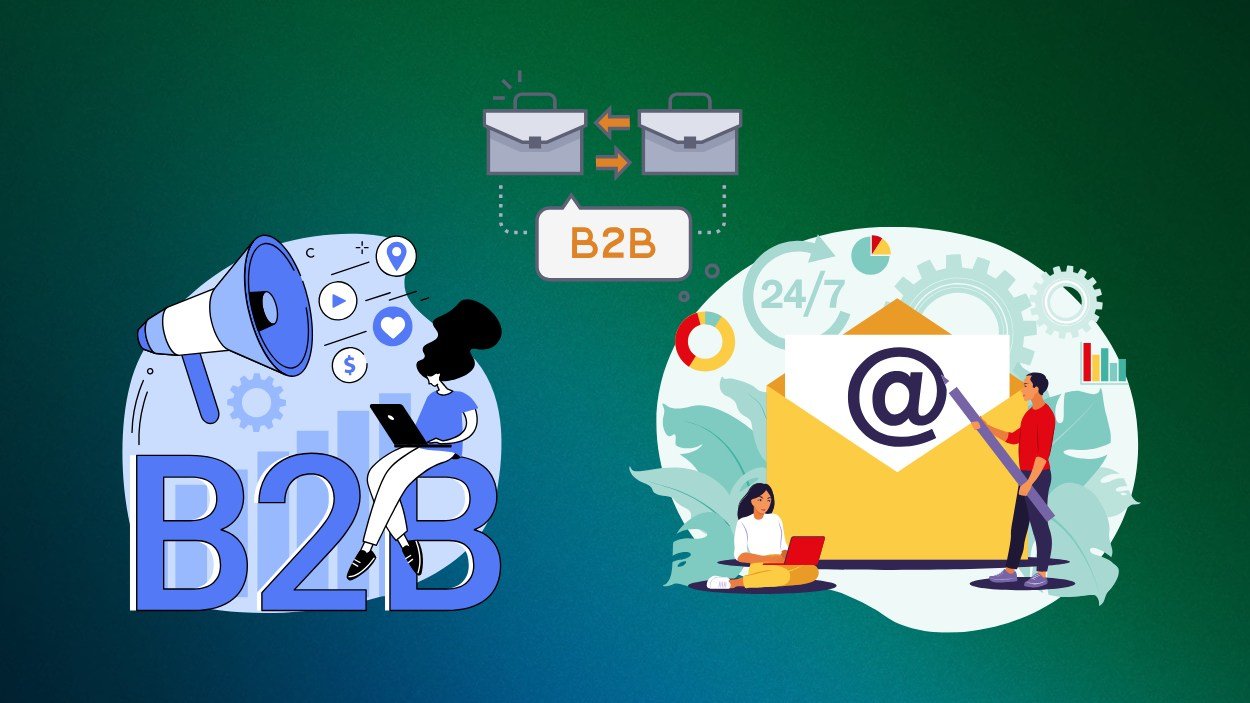


B2B email marketing remains one of the most reliable channels for reaching decision makers and driving measurable business outcomes. As inboxes become more crowded, marketers are refining strategies to boost engagement, nurture leads, and support complex sales cycles. Email plays a key role in demand generation programs and buyer education across industries like SaaS and professional services, helping generate qualified leads and influence multi-touch revenue paths. With every business vying for attention in cluttered inboxes, it’s vital to understand how benchmarks are shifting and where opportunities lie. Explore the data below to see what’s happening in B2B email marketing now.
Editor’s Choice
- By 2025, there will be nearly 5 billion email users worldwide, increasing global reach.
- B2B email average open rate benchmarks are around 20.8% in 2025.
- The average B2B click-through rate is about 3.2% in 2025.
- The average B2B email unsubscribe rate sits at ~0.24%, signaling strong relevance.
- Segmented email campaigns can generate up to 30% more opens.
- Segmentation and personalization help generate 50% more clicks.
- Email remains a top channel for engagement, often outperforming social media and paid ads.
Recent Developments
- Global email usage continues to grow, with 4.6 billion users projected in 2025.
- Daily email volume is expected to surpass 370 billion messages worldwide.
- AI-driven personalization is boosting click-through rates and revenue.
- More marketers now report segmentation as a critical success factor.
- Email automation and lifecycle flows rank as top priorities for 2025.
- Enhanced segmentation improves cross-channel collaboration across teams.
- Email marketing is increasingly integrated with CRM and analytics stacks.
- More B2B teams are focusing on data health and consent management to improve deliverability.
B2B Email Marketing Overview
- B2B email marketing achieves an average open rate of 20.8%.
- Personalized B2B emails yield 30% higher open rates and 50% higher CTRs.
- Average B2B email CTR stands at 3.2% across industries.
- Email marketing ROI delivers $36 return per $1 spent in B2B.
- 90% of B2B marketers prioritize email engagement as a top focus.
- Nurtured B2B leads convert at 1.8% on average.
- Lead nurturing emails generate 8% CTR versus 3% for standard sends.
- 86% of B2B companies now use personalization in email marketing.
- 42% of B2B marketers rank email as the top-performing channel.
B2B Email Marketing Adoption and Usage
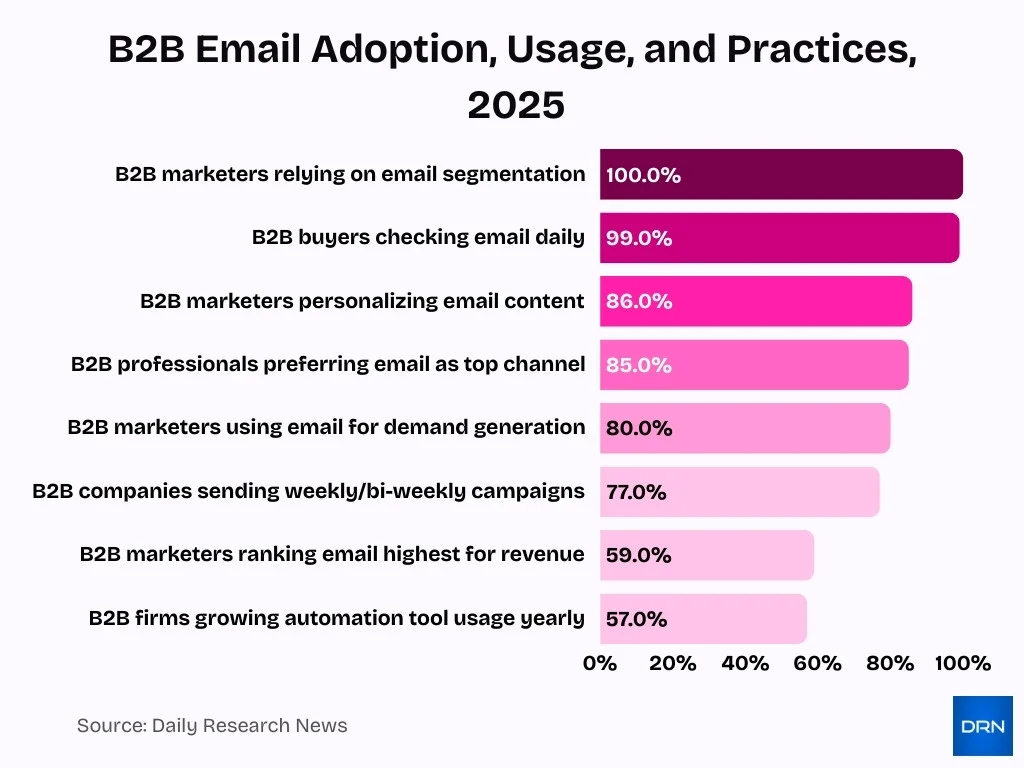
- 85% of B2B professionals prefer email as a top communication channel.
- 99% of B2B buyers check email daily, up to 20 times.
- 80% of B2B marketers use email as a core demand generation tactic.
- 77% of B2B companies send weekly or bi-weekly email campaigns.
- 59% of B2B marketers rank email highest for revenue generation.
- 57% of B2B firms report growing automation tool usage yearly.
- 86% of B2B marketers regularly personalize email content.
- Nearly 100% of B2B marketers rely on email segmentation for precision.

ROI and Revenue Impact
- Email marketing delivers $36 revenue per $1 spent, a 3600% ROI.
- B2B companies average a $40 return for every $1 on email campaigns.
- 42% of B2B firms fail to hit $36 in revenue per $1 in email returns.
- Automated emails generate 320% more revenue than non-automated sends.
- Email ROI reaches $70 per $1 for top-performing B2B programs.
- Personalized emails yield 5–6x higher transaction rates than batch blasts.
- Email MQLs convert 11.3% higher than the blended marketing average.
- B2B email contributes 2.24% of total marketing revenue.
B2B Email List Growth and Database Health
- Strong list hygiene correlates with a 98.16% average B2B deliverability rate.
- Regular cleaning keeps B2B bounce rates at healthy 2-2.48% averages.
- 38% of B2B marketers prioritize list growth by increasing email budgets in 2025.
- Detailed segmentation boosts B2B opens by 30% and clicks by 50%.
- Personalized opt-ins yield 30.4% open rates versus 5.9% for non-opted lists.
- Preference centers target <0.3% spam complaints to protect sender reputation.
- Double opt-in reduces B2B spam complaints and ensures higher quality leads.
- List hygiene removes 22.5% annual data decay for <2% bounces.
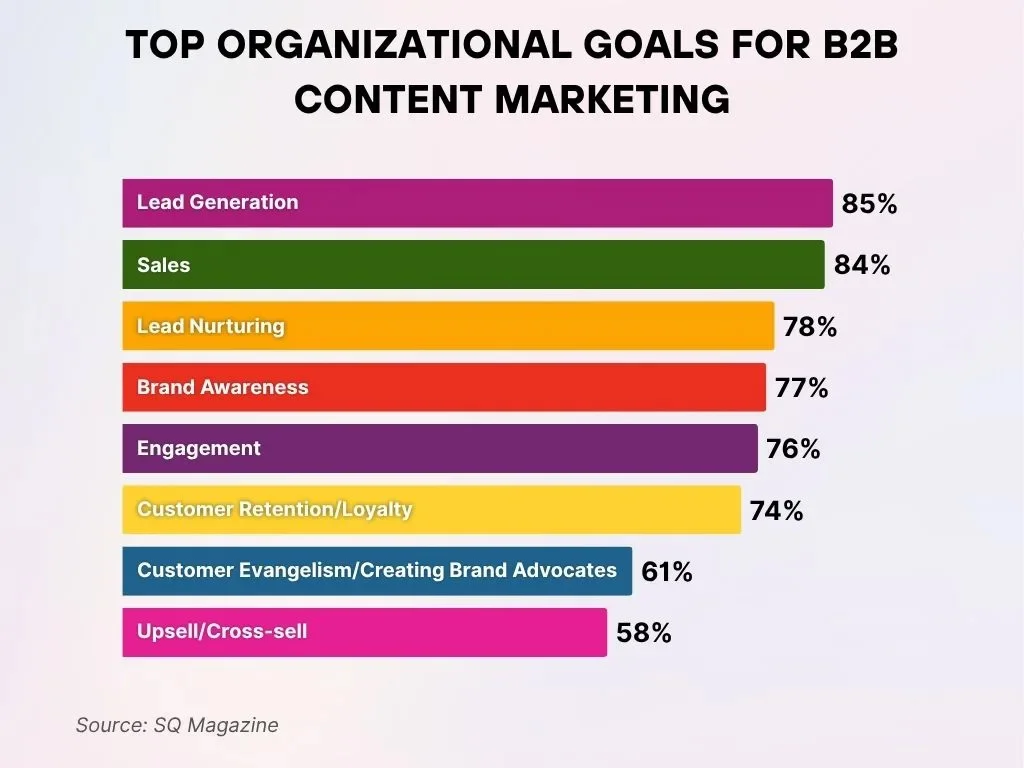
Top Organizational Goals for B2B Content Marketing
- Lead Generation remains the top priority for B2B marketers, with 85% identifying it as a critical goal for driving business growth.
- Sales Enablement ranks closely behind, with 84% of organizations citing it as a primary objective to support revenue teams.
- Lead Nurturing is emphasized by 78% of businesses, underscoring the importance of building long-term relationships with prospects.
- Brand Awareness is considered essential by 77% of B2B marketers seeking to increase visibility within their target markets.
- Audience Engagement is a key goal for 76%, reflecting a strong focus on meaningful connections with audiences.
- Customer Retention and Loyalty are priorities for 74%, highlighting the value of sustaining existing customer relationships.
- Customer Evangelism and Brand Advocacy are targeted by 61% to transform customers into active promoters.
- Upsell and Cross-sell Strategies are pursued by 58% of marketers to maximize customer lifetime value and revenue potential.
B2B Email Deliverability and Bounce Rates
- B2B emails achieve a 98.16% delivery rate in 2025.
- Average B2B bounce rate stands at 2.0% across benchmarks.
- Fully authenticated senders (SPF+DKIM+DMARC) secure 83.75% inbox placement.
- Only 7.6% of domains enforce DMARC policies for better deliverability.
- 2.7x higher inbox likelihood with full SPF, DKIM, and DMARC implementation.
- 60% of B2B senders clean lists regularly to reduce bounce rates.
- 23.6% verify lists pre-campaign, targeting under 2% bounces.
- Removing inactives after 6-12 months boosts sender reputation significantly.
- High-volume senders (1M+/mo) face 27.63% inbox placement due to poor hygiene.
B2B Email Open Rate Statistics
- 2025 B2B email open rates average around 20.8% across benchmarks.
- B2B open rates trail B2C averages, with B2B at 15.1% versus B2C at 19.7%.
- Investment firms achieve top B2B open rates of 45.47% in cold emails.
- Segmentation boosts B2B open rates to 40–50%, doubling generic campaigns.
- Personalized subject lines lift B2B open rates by 26% on average.
- Question-based subject lines drive 46% B2B email open rates.
- Apple privacy changes inflate B2B open rates via pre-loading emails.
- Clean, healthy B2B lists sustain 25–40% open rates consistently.
Click Through and Click to Open Rates
- Average B2B click-through rates typically range between 2% and 4%.
- Specific B2B benchmarks show CTRs near 3.2%.
- Overall, email marketing CTR averages hover around 2.66%.
- Click to open rates generally fall between 10% and 15%.
- Regional CTOR benchmarks show variation, including ~6.7% in North America.
- Higher CTOR signals stronger alignment between content and audience intent.
- Mobile-optimized emails improve CTR by roughly 14%.
- Certain B2B niches report CTRs above 6%.
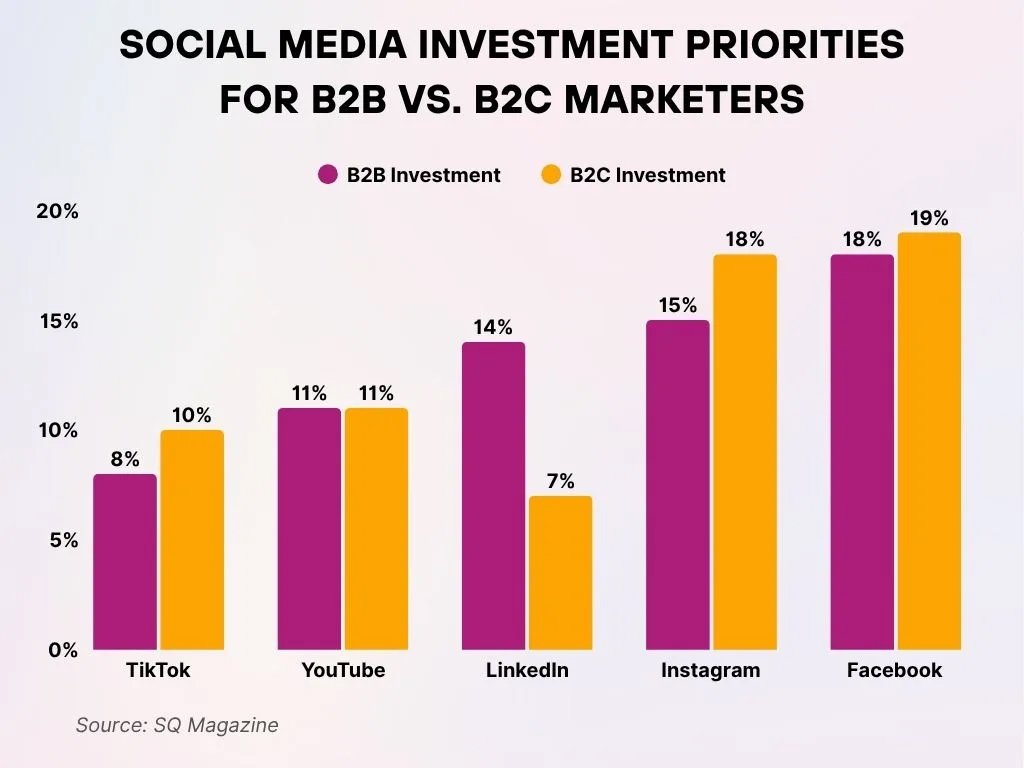
Social Media Investment Focus: Differences Between B2B and B2C Marketers
- Facebook remains the top investment priority across both segments, with 18% of B2B marketers and 19% of B2C marketers planning to allocate their highest level of spending to this platform.
- Instagram continues to be a key strategic focus, drawing 15% of B2B marketers’ investment alongside a higher 18% share from B2C marketers.
- LinkedIn stands out as a strong B2B-preferred platform, with 14% of B2B marketers prioritizing it compared to only 7% of B2C marketers.
- YouTube receives balanced investment attention, as 11% of both B2B and B2C marketers plan to make significant investments in the platform.
- TikTok shows greater appeal among consumer-focused marketers, capturing 10% of B2C marketers’ investment, slightly higher than the 8% allocated by B2B marketers.
B2B Unsubscribe and Spam Complaint Rates
- Average unsubscribe rates typically range from 0.1% to 0.5%.
- Median unsubscribe benchmarks often sit near 0.22% to 0.24%.
- Some industries experience unsubscribe rates approaching 0.40%.
- Lower unsubscribe rates signal stronger list relevance.
- Spam complaint rates usually remain below 0.1%.
- Irrelevant or overly frequent emails increase spam flags.
- One-click unsubscribe options reduce complaint risk.
- Healthy unsubscribe levels support long-term list engagement.
B2B Sales Pipeline and Revenue Attribution from Email
- Email contributes 1.3% of total MQLs and 2.24% of revenue in B2B SaaS.
- Nurtured leads make 47% larger purchases and shorten sales cycles by 23%.
- 81% of B2B marketers use email as a core channel for professional outreach.
- Email MQLs convert 11.3% higher than average and progress 7% faster.
- Personalized emails boost revenue by 10-15% overall in B2B campaigns.
- B2B teams see $36 revenue per $1 spent on email marketing on average.
- Multi-touch attribution assigns email credit across 40% first/last and middle touches.
- CRM integration enables precise tracking of email leads to closed deals and ROI.
- 80% of B2B sales require 5+ follow-ups using email engagement signals.
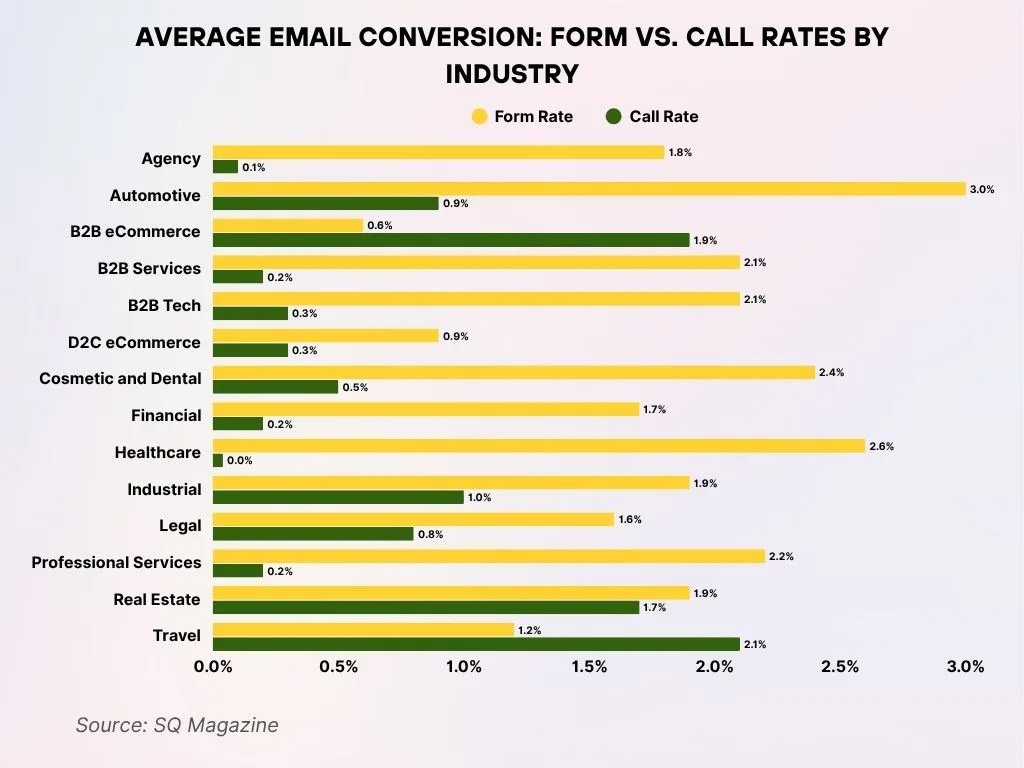
Industry-Wise Comparison of Average Email Conversion Performance: Form vs. Call Rates
- Automotive leads across both metrics with a 3.0% form rate and a 0.9% call rate, clearly positioning it as the top-performing industry.
- Healthcare demonstrates a strong 2.6% form rate, but records the lowest call rate at just 0.04%, highlighting a major channel imbalance.
- Cosmetic and Dental achieves a 2.4% form rate alongside a moderate 0.5% call rate, reflecting balanced conversion performance.
- Professional Services maintains a healthy 2.2% form rate paired with a 0.2% call rate, indicating steady engagement through forms.
- B2B Tech and B2B Services are tied with identical 2.1% form rates, while their call rates stand at 0.3% and 0.2%, respectively.
- Travel records the highest call rate at 2.1%, but simultaneously posts a lower form rate of 1.2%, suggesting call-driven conversions.
- Real Estate follows closely with a 1.9% form rate and a 1.7% call rate, signaling strong engagement across both channels.
- B2B eCommerce stands out with a notable 1.9% call rate, but lags in forms with only a 0.6% form rate.
- Industrial shows a 1.9% form rate and a 1.0% call rate, effectively balancing both conversion channels.
- Agency reports a modest 1.8% form rate and a low 0.1% call rate, placing it among the lower-performing industries.
- Legal records a 1.6% form rate and a 0.8% call rate, reflecting relatively even conversion results.
- D2C eCommerce trails behind with a 0.9% form rate and a 0.3% call rate, making it one of the lowest-performing sectors overall.
B2B Email Campaign Frequency and Send Time Benchmarks
- 54% of B2B clients send emails 2-4 times per month, aligning with weekly or bi-weekly cadences.
- B2B companies typically opt for 1-3 emails monthly, favoring lower frequencies over daily sends.
- 73% of unsubscribes stem from excessive frequency, linking higher sends to increased opt-outs.
- B2B unsubscribe rates average 0.1-0.31%, rising above 0.5% with frequent campaigns.
- Tuesday-Thursday at 10 AM-3 PM yield peak B2B open rates during mid-week business hours.
- Thursday 9-11 AM sends achieve 44.0% open rates, outperforming other weekdays.
- B2B evening sends like 8 PM hit 59% open rates for select audiences.
- Consistent cadences such as weekly nurture sequences boost long-term B2B engagement by 47.9% mid-morning.
- B2B open rates average 42.35% overall, prioritizing timing over send volume.
B2B Email Subject Line Performance Statistics
- Strong subject lines boost B2B email open rates by 22% through urgency and exclusivity.
- The average B2B cold email open rate stands at 39% across industries.
- Personalized subject lines like “Hi {{first_name}}” achieve 45.36% open rates in B2B.
- Personalization lifts B2B email open rates by up to 26%.
- A/B testing subject lines is used by 47% of marketers to optimize performance.
- Emojis in B2B subject lines yield mixed results, with some studies showing 56% higher opens.
- Question-based subject lines drive 46% open rates by sparking curiosity in B2B.
- Urgent subject lines increase B2B open rates by 22%.
- Short subject lines (6-10 words) deliver the highest B2B open rates at 21%.
Personalization and Segmentation in B2B Email Campaigns
- 59% of marketers say personalization is critical for engagement.
- Segmented campaigns drive 30% more opens and 50% more clicks.
- Personalized subject lines increase open rates by ~26%.
- Behavior-based personalization significantly improves conversions.
- 54% of email marketers personalize based on user behavior.
- Segmented campaigns outperform broad sends across metrics.
- Firmographic segmentation improves relevance in B2B messaging.
- Personalization helps reduce unsubscribes and spam complaints.
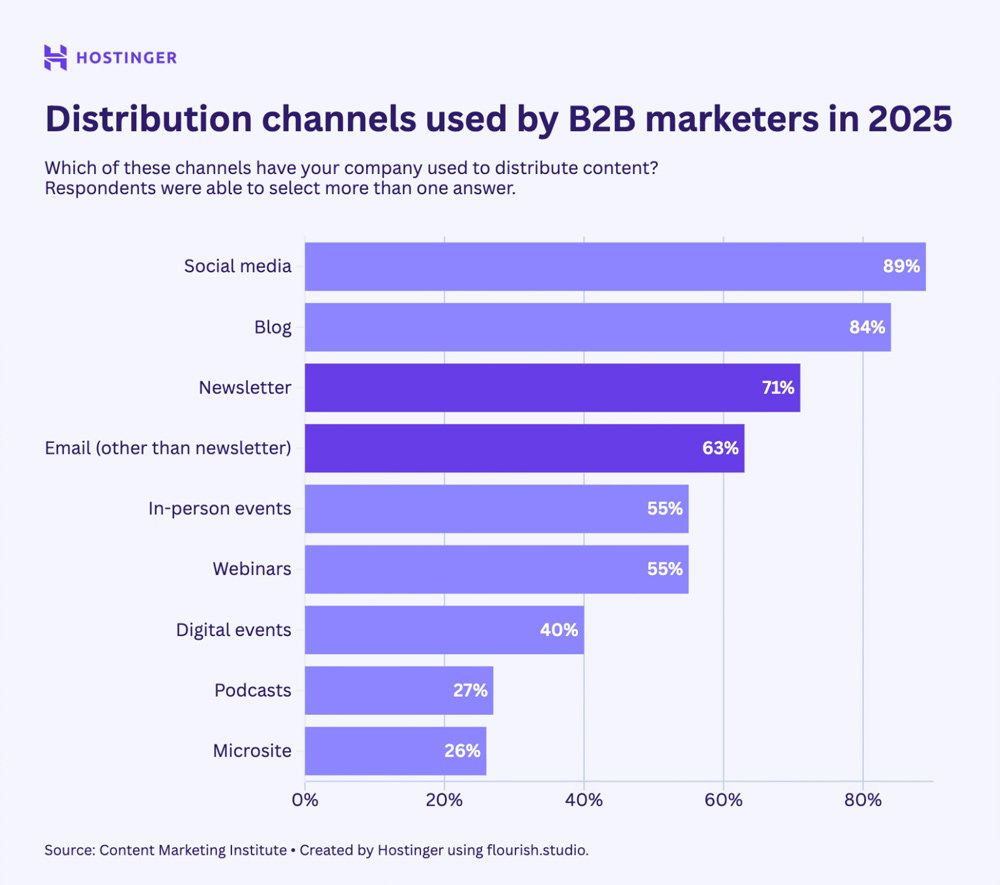
Distribution Channels Used by B2B Marketers in 2025
- Social media is the most widely used channel, with 89% of B2B marketers relying on it to distribute content, highlighting its dominance in reach and engagement.
- Blogs remain a core pillar of B2B content strategies, used by 84% of marketers to drive organic traffic and thought leadership.
- Newsletters continue to be highly effective, with 71% adoption, showing the importance of owned audiences and direct communication.
- Email beyond newsletters is used by 63% of marketers, reinforcing email’s role in lead nurturing and personalized outreach.
- In-person events are used by 55% of B2B marketers, signaling a strong return to face-to-face engagement.
- Webinars match in-person events at 55%, demonstrating the continued value of educational, scalable digital formats.
- Digital events are leveraged by 40% of marketers, indicating selective but strategic use in broader content ecosystems.
- Podcasts are used by 27% of B2B marketers, reflecting a growing but still niche role in long-form, on-the-go content.
- Microsites are the least used channel at 26%, typically reserved for campaign-specific or high-intent initiatives.
Automation and Drip Campaign Performance in B2B Email
- Automated emails generate 52% higher open rates.
- Automation delivers 332% higher click rates than batch sends.
- Automated emails can produce 2,361% higher conversion rates.
- Journey-based triggers improve nurture effectiveness.
- Automation frees teams to focus on strategy and creativity.
- Welcome sequences outperform standard promotional emails.
- Lifecycle automation increases long-term engagement.
- Drip campaigns accelerate lead qualification across touchpoints.
Mobile vs Desktop B2B Email Engagement
- Nearly 42% of all emails are opened on mobile devices.
- Desktop and webmail accounts for 58% of total email opens combined.
- 42% of recipients delete non-optimized emails on mobile.
- Responsive design boosts mobile clicks by 15%.
- Mobile opens peak during weekends when webmail and desktop rates rise on weekdays.
- Mobile click-to-open rates exceed desktop by 30%.
- Desktop handles long-form content better with 75.55% average open rates.
- B2B mobile engagement at 38% of opens lags behind general trends.
Future Outlook and Trends in B2B Email Marketing
- AI-powered personalization boosts B2B email open rates by 41% through optimized send times.
- Interactive email elements increase click-to-open rates by up to 73% in B2B campaigns.
- Privacy regulations drive the adoption of double opt-in processes as standard for B2B email consent management.
- Predictive analytics achieves 94% accuracy in forecasting B2B email campaign performance.
- CRM integration with email analytics enables precise revenue attribution across customer journeys.
- Mobile-first designs see 15% higher clicks, with 75% of B2B emails opened on mobile devices.
- Preference centers reduce unsubscribes by empowering recipients to customize content preferences.
- Real-time dynamic content delivers 76% higher click-through rates in personalized B2B sequences.
- AI personalization in B2B emails yields 40% revenue increases via hyper-targeted campaigns.
Frequently Asked Questions (FAQs)
The 2025 B2B benchmark open rate is 20.8%.
The 2025 B2B benchmark click-through rate is 3.2%.
A commonly cited 2025 B2B unsubscribe benchmark is 0.24%.
There are 4.59 billion email users worldwide in 2025, about 56% of the global population.
Conclusion
B2B email marketing continues to be a highly effective channel, driven by segmentation, personalization, automation, and mobile optimization. Email remains central to nurturing complex buyer journeys and delivering measurable revenue impact across industries. As technology evolves, marketers who embrace AI, device-aware design, and data-driven strategies will stand out by delivering relevant, engaging experiences directly in business inboxes.
Understanding current benchmarks and applying them strategically helps B2B teams sharpen performance and prepare for the next phase of email marketing innovation.