

The battle between Google and Bing continues to define how billions of people find information online. Google remains the undisputed leader in search, while Bing holds the position of the closest challenger in the marketplace. This comparison matters to marketers, advertisers, and everyday users because the choice of search engine influences advertising reach, search behavior insights, and how companies prioritize visibility.
From AI-enhanced query results to differing desktop and mobile usage patterns, these platforms shape the digital experience in distinct ways. Explore the key statistics below to understand how Google and Bing compare in today’s search landscape.
Editor’s Choice
- Google’s global search engine market share exceeded ~90% in 2026, showing its continued dominance.
- Bing holds around ~4–4.3% of the global search market share, making it the second most used search engine worldwide.
- Google processes over 8.5 billion searches each day.
- Bing reaches over 5.2 billion monthly visitors globally.
- Bing records about 100 million daily active users, partly driven by AI integration.
- Google’s desktop search share is around 82–83% worldwide as of late 2025.
- Bing’s desktop search share worldwide is at roughly 10–12%, significantly higher than its mobile presence.
Recent Developments
- Google’s search market share has held steady above 90% into early 2026, reflecting minimal fluctuation year over year.
- Bing has gradually increased its share, now accounting for about 4.3% globally in 2026.
- AI-powered enhancements, like Bing’s integration with Copilot and Google’s AI Mode, are reshaping how search results are delivered.
- Bing’s AI updates contributed to user growth and doubled engagement in some segments over recent years.
- Google’s investment in generative AI aims to maintain relevance amid rising alternatives.
- Integration of AI summaries into search results has influenced how users interact with search outputs.
- Google has faced regulatory scrutiny regarding its dominance in search markets.
- Bing’s focus on console and Windows integration has helped capture specific user niches.
Overview of Bing vs Google
- Google leads international web search with about 90% of queries globally.
- Bing trails as the runner-up, holding around 4% or slightly more of total searches.
- Other engines, including Yahoo!, DuckDuckGo, and Yandex, have combined share under 8%.
- Bing’s advantage lies in integration with Microsoft products like Windows and Xbox.
- Google’s ecosystem extends across Android, Chrome, YouTube, and Maps.
- Google’s extensive data infrastructure helps it refine search relevance continuously.
- Bing stands out in console and Windows environments due to the default settings.
- Both companies are investing heavily in AI search features to stay competitive.
Global Search Engine Market Share Distribution Worldwide
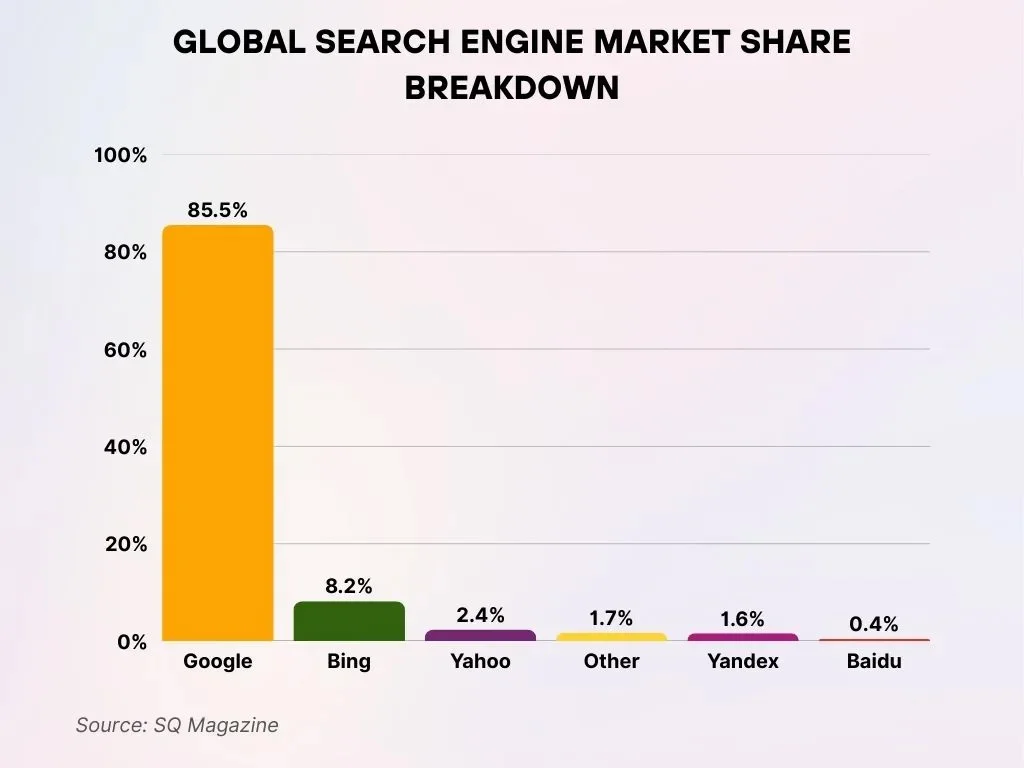
- Google continues to dominate the global search engine market with a massive 85.5% share, further reinforcing its position as the top choice worldwide.
- Bing secures 8.2% of the market, establishing itself as the second-largest search engine by overall traffic volume.
- Yahoo captures 2.4%, allowing it to maintain a modest global presence despite increasing competition.
- Other search engines collectively account for 1.7%, reflecting a diverse mix of smaller platforms operating worldwide.
- Yandex, which is popular in Russia and surrounding regions, holds 1.6% of the global search market.
- Baidu, China’s major search engine, commands only 0.4% of global traffic.

Bing vs Google Market Share Trend Over Time
- Google held 88-92% global search market share consistently from 2015 to 2024.
- Bing‘s global share rose from 2.82% in 2018 to 3.43% in 2024.
- In 2025, Bing achieved 4.09% global market share, up from prior years.
- Google‘s share stood at 89.62% globally in January 2025.
- On desktop, Bing captured 12.23% worldwide in January 2025.
- Google dominated the desktop with 78.83% share in early 2025.
- Bing grew from 3.43% in 2024 to 4.45% global in January 2026.
- Google maintained 89.82% worldwide market share in January 2026.
Search Engine Usage by Device Type
- As of early 2026, Google holds over 93% of the global mobile search market share, reflecting Android’s global footprint.
- Bing’s mobile market share remains below 1% globally, showing limited traction outside default desktop environments.
- On desktop devices worldwide, Google controls roughly 82–84% of search traffic.
- Bing captures between 10–12% of global desktop search share, significantly stronger than its mobile position.
- In the U.S. desktop market, Bing’s share climbs closer to 14–16%, higher than its global desktop average.
- Over 60% of global searches occur on mobile devices, reinforcing Google’s strength in smartphone ecosystems.
- Tablet search patterns mirror desktop behavior, where Bing’s share approaches 8–10% in certain regions.
- Console search traffic remains a niche segment, but Bing dominates Xbox-based search activity due to default integration.
Google vs. Bing User Age Distribution
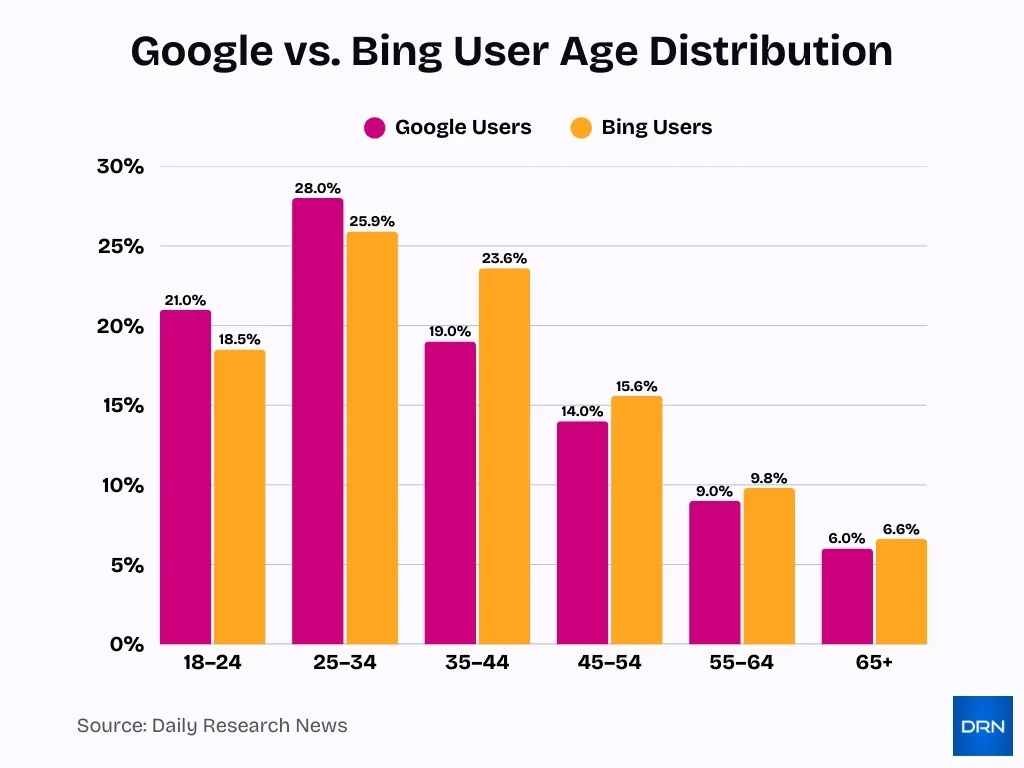
- Users aged 18–24 represent 21% on Google and 18.5% on Bing, showing that Google has a stronger presence among younger users.
- The 25–34 age group is the largest segment on both platforms, accounting for 28% of Google users and 25.9% of Bing users, highlighting high engagement from young professionals.
- Middle-aged users (35–44 years) make up 19% on Google and 23.6% on Bing, indicating that Bing attracts a relatively older working audience.
- The 45–54 age segment contributes 14% of Google users and 15.6% of Bing users, reflecting steady usage among experienced professionals.
- Users aged 55–64 account for 9% on Google and 9.8% on Bing, showing similar adoption levels among pre-retirement users.
- The 65+ age group represents 6% on Google and 6.6% on Bing, suggesting slightly higher senior user engagement on Bing.
- Overall, Google dominates younger demographics (18–34) with a combined 49% share, while Bing shows stronger traction among users aged 35+ with a combined 55.6% share, reflecting different audience profiles for advertisers and marketers.
Daily and Monthly Active Users (Bing vs Google)
- Google processes approximately 8.5–9 billion searches per day, translating to over 3 trillion searches annually.
- Google’s search engine reaches more than 4.3 billion active users worldwide, covering over half the global population.
- Bing generates an estimated 450+ million searches per day (around 13–14 billion per month), which equates to roughly 160+ billion searches each year.
- Bing surpassed 100 million daily active users after integrating AI features such as Copilot.
- Bing receives over 3 billion monthly visits.
- Google.com remains the most visited website globally, averaging 80–90 billion monthly visits.
- Bing.com averages between 1.2–1.5 billion monthly visits, a fraction of Google’s traffic but still substantial.
- In the U.S., Bing reaches roughly 18–20% of desktop search users, due to Microsoft Edge and Windows defaults.
Search Query Volume Comparison (Bing vs Google)
- Google handles over 8.5 billion search queries daily, making it the largest query processor globally.
- That equates to roughly 99,000 searches per second on Google.
- Bing processes an estimated 900 million daily queries, about one-tenth of Google’s volume.
- Google’s annual query volume exceeds 3 trillion searches, maintaining long-term growth year over year.
- Bing’s annual search volume surpasses 330 billion searches, based on daily estimates.
- In the U.S., Google accounts for approximately 86–88% of total search queries, while Bing contributes around 7–8%.
- Long-tail and conversational queries have increased due to AI-powered search features on both platforms.
- Voice search queries primarily route through Google because of Android dominance and Google Assistant integration.
Bing vs Google Market Share by Region
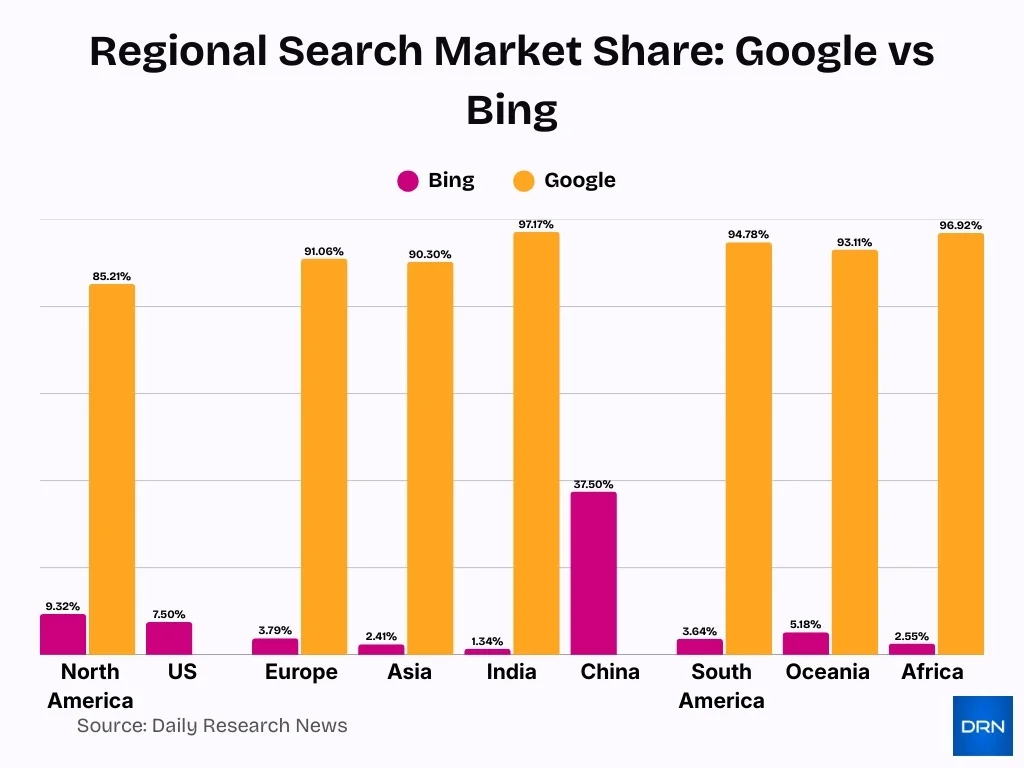
- In North America, Google commands an 85.21% market share while Bing holds 9.32%.
- In the US, Bing‘s all-device share reaches 7.5% as of April 2025, higher than the global average.
- Europe sees Google at 91.06% dominance with Bing at 3.79%.
- Asia maintains Google‘s ~90.3% lead, Bing trailing at 2.41%.
- In India, Google captures 97.17%, Bing just 1.34%.
- China‘s desktop market favors Bing at 37.5%, Baidu at 30.9%.
- South America has Google at 94.78%, Bing 3.64%.
- Oceania reflects Google 93.11%, Bing 5.18%.
- Africa shows Google‘s peak 96.92%, Bing 2.55%.
Website Traffic and Unique Visitors (Bing vs Google)
- Google.com records 94.76 billion monthly visits in January 2026.
- Bing.com attracts over 500 million monthly unique visitors globally.
- Google holds 89.7% of the global search engine market share.
- Bing commands 4% of the worldwide search market share.
- In the US, Bing captures ~18% of the desktop search market.
- Google drives ~90% of total US search engine traffic.
- Bing has 12.21% share of the global desktop search market.
- Google accounts for over 10% of all global internet traffic.
- Bing sees 100 million daily active search users.
- The US contributes 27% of Bing‘s total global traffic.
Organic vs Paid Search Share (Bing vs Google)
- Google Ads accounts for roughly 28–30% of global digital advertising spend, making it the largest paid search platform.
- Google drives more than 90% of the global organic search traffic share.
- Microsoft Advertising represents about 6–7% of the U.S. paid search market.
- Organic click share on Google declines in certain SERPs due to ads and AI-generated summaries.
- Bing tends to show slightly fewer paid ad placements per page compared to Google.
- In the U.S., paid search accounts for nearly 39% of total digital ad spend, with Google capturing the majority.
- Bing’s paid search competition is lower, resulting in less crowded auction environments.
- Organic SEO visibility remains critical, as over 50% of website traffic still originates from organic search across industries.
Bing vs. Google: Average Click-Through Rate (CTR) Performance Comparison
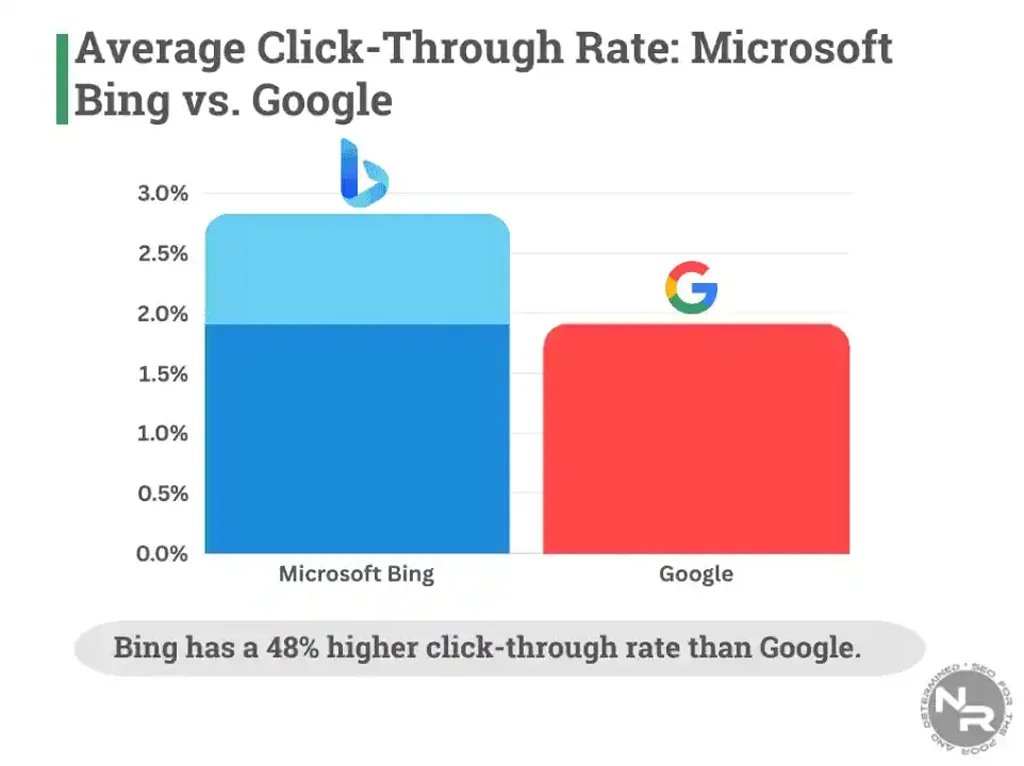
- Microsoft Bing records an average click-through rate (CTR) of approximately 2.9%, clearly outperforming Google in terms of user engagement and ad interaction.
- Google’s average CTR stands at around 1.96%, reflecting lower engagement per impression compared to Bing’s advertising performance.
- Bing’s CTR is 48% higher than Google’s, positioning it as a more efficient platform for ad visibility, user clicks, and marketing effectiveness.
Cost-Per-Click and Cost-Per-Acquisition Comparison
- The average Google Ads search CPC across industries is approximately $2.69.
- In high-competition industries like legal services, Google Ads CPC can exceed $6–$9 per click, with some keywords reaching $50+.
- Microsoft Advertising’s average CPC is typically 20–35% lower than Google Ads in comparable industries.
- Average Bing Ads CPC across industries ranges between $1.50–$2.00, depending on vertical.
- Google Ads average CPA across industries is approximately $48–$60 on search campaigns.
- Microsoft Advertising’s average CPA often trends 10–30% lower than Google Ads, particularly in B2B and finance sectors.
- In the U.S., paid search remains one of the highest ROI digital channels, generating $2 for every $1 spent on Google Ads.
- Lower competition on Bing contributes to reduced CPC inflation compared to Google’s highly competitive auction environment.
Search Advertising Revenue and Market Share
- Google generated over $237 billion in advertising revenue in 2025, with the majority coming from search ads.
- Search advertising accounts for more than 55% of Google’s total revenue, highlighting its core business model.
- Microsoft reported over $12–$14 billion in search and news advertising revenue, driven by Bing and Microsoft Advertising.
- Google controls approximately 28–30% of the global digital advertising market share, leading all platforms.
- Microsoft Advertising holds roughly 6–7% of the U.S. paid search market, trailing Google but maintaining steady growth.
- Paid search accounts for nearly 40% of total U.S. digital ad spend, underscoring its strategic importance.
- Google’s advertising revenue grew year over year by high single digits entering 2026, despite macroeconomic headwinds.
- Microsoft’s AI integration into Bing has contributed to incremental ad revenue gains since 2023.
Google vs Bing Ads Performance: Key Insights
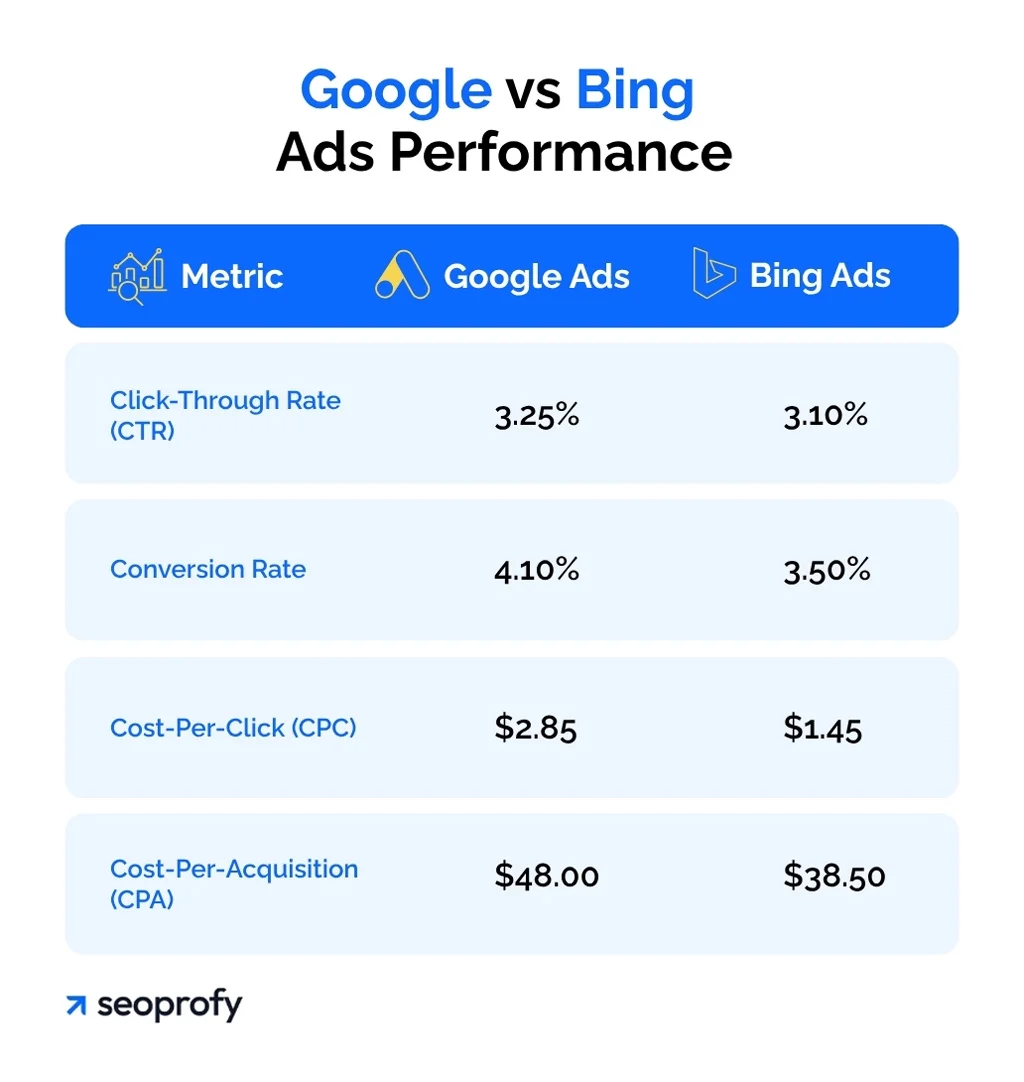
- Google Ads records a higher Click-Through Rate (CTR) of 3.25% compared to Bing Ads at 3.10%, indicating slightly stronger ad engagement on Google’s platform.
- The Conversion Rate on Google Ads stands at 4.10%, outperforming Bing Ads’ 3.50%, which shows better lead and sales generation efficiency.
- Bing Ads offers a significantly lower Cost-Per-Click (CPC) of $1.45 versus Google Ads’ $2.85, making it a more budget-friendly option for advertisers.
- The Cost-Per-Acquisition (CPA) on Bing Ads is lower at $38.50 compared to Google Ads’ $48.00, helping businesses achieve conversions at reduced costs.
- While Google Ads delivers higher engagement and conversion rates, Bing Ads provides better cost efficiency with lower CPC and CPA.
AI Search and Generative Answer Adoption (Google vs Bing Copilot)
- Google’s AI Overviews reached 2 billion monthly users across 200 countries by Q2 2025.
- Microsoft Bing reported 140 million daily active users after Copilot integration in 2025.
- 52% of U.S. adults have used AI LLMs like search engines by March 2025.
- Google holds ~89.6% global search market share in early 2025.
- AI Overviews cause 34.5% drop in organic CTR for top pages.
- Bing’s desktop market share rose to 11-12% post-Copilot by early 2025.
- 90% of Fortune 500 companies use Microsoft Copilot as of 2025.
- 40% of 18-34-year-olds actively use AI tools, leading to adoption.
- Over 60% of U.S. consumers have used conversational AI for shopping searches.
- Microsoft 365 Copilot has 15 million paid seats, up 160% year-over-year.
Integration with Product Ecosystems (Android, Chrome vs Windows, Edge, Xbox)
- Google’s Android powers over 70% of global mobile operating systems, strengthening its mobile search dominance.
- Chrome controls approximately 63–65% of the global browser market share, reinforcing Google as the default search engine.
- Google Search remains the default engine on Chrome and Android devices, driving billions of daily queries.
- Microsoft Windows powers around 70% of global desktop operating systems, supporting Bing’s desktop penetration.
- Microsoft Edge holds approximately 5–7% of global browser share, with Bing as the default search provider.
- Xbox console users rely on Bing for built-in web search functionality.
- Institutional agreements in education and enterprise environments often set Bing as the default on managed Windows devices.
- Google’s ecosystem integration across Gmail, YouTube, Maps, and Drive increases cross-platform user retention and search frequency.
Search Engine Market Share Comparison: Overall vs Mobile Usage
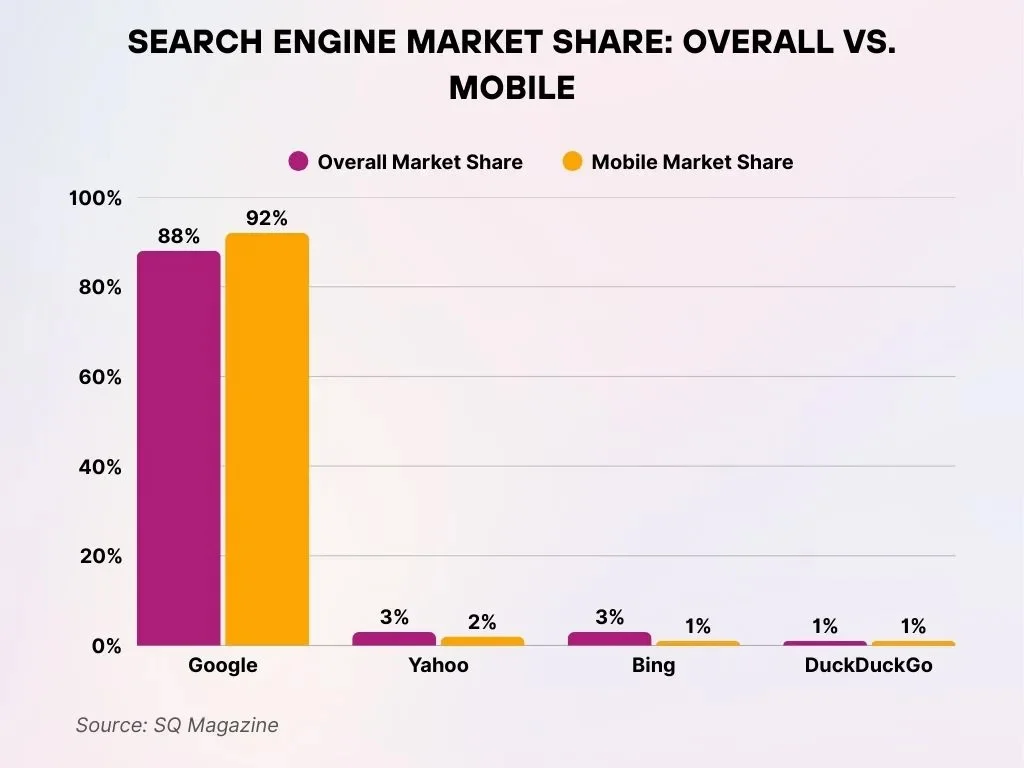
- Google clearly dominates both segments with 88% overall market share and an even stronger 92% on mobile, reinforcing its position as the global leader in search engines.
- Yahoo maintains a minor yet stable presence by holding 3% overall market share and 2% on mobile, reflecting consistent but limited user adoption.
- Bing captures 3% overall market share but drops to only 1% on mobile, highlighting its weaker performance and lower usage on smartphones.
- DuckDuckGo represents 1% in both overall and mobile markets, demonstrating steady niche adoption driven by its strong privacy-focused positioning.
Future Outlook for Bing vs Google Market Share and Usage
- Google maintains 89–91% global search share through 2027.
- Bing reaches 4.5% worldwide market share by 2026 with AI growth.
- Mobile search favors Google at 92% share due to Android dominance.
- Desktop Bing usage grows 15% YoY to 12–14% enterprise share.
- Paid search revenue projected to rise 8–10% annually to $400B by 2027.
- AI search interfaces are expected to handle 30% queries by 2028.
- Voice search diversifies a 5–7% market, minimally impacting Google’s lead.
- Regulatory actions may cut Google defaults by 10–15% in the EU/US.
- Bing AI drives 20% faster adoption in enterprise segments.
Frequently Asked Questions (FAQs)
Google’s global search engine market share is approximately 90% of total searches worldwide in 2026.
In the United States, Bing holds about 8.78% of the overall search engine market in 2026.
Bing retains around 10–12% of the global desktop search engine market as of early 2026.
In 2025, Google Search ad revenue was over $252 billion, compared to Bing’s estimated $14+ billion in search ad revenue.
Conclusion
Google continues to command the global search market with over 90% share, trillions of annual queries, and more than $200 billion in advertising revenue. Its ecosystem integration across Android, Chrome, and YouTube reinforces unmatched scale and user reach. Meanwhile, Bing maintains a steady second-place position, benefiting from Windows integration, lower advertising costs, and AI-powered enhancements through Copilot.
For advertisers, the choice between Google and Microsoft Advertising often comes down to scale versus efficiency. Google offers reach and volume, while Bing frequently provides lower CPC and competitive conversion rates in desktop-heavy sectors. Looking ahead, AI search experiences will shape how users interact with both platforms, but current data suggests Google’s leadership remains firmly intact.