

Canva has rapidly evolved from a simple online design tool into a global creative platform used by millions of individuals, teams, and enterprises. It continues to drive visual communication with powerful tools, simple workflows, and wide-ranging applications, from social media content and marketing campaigns to classroom projects and enterprise branding. Real-world impact is clear: educators use Canva to boost visual literacy, while Fortune 500 companies rely on it for consistent, scalable design output. Dive into the current data shaping Canva’s growth and influence across industries.
Editor’s Choice
- 260 million people use Canva every month in 2025, reflecting immense global traction.
- Canva’s annual revenue reached $3.5 billion in 2025.
- The platform now serves customers in 190 countries.
- Canva supports 100+ languages, expanding accessibility worldwide.
- Over 30 billion designs have been created on Canva since launch.
- Canva’s subscriber base includes 24 million+ paying users.
- 85% of Fortune 500 companies use Canva for business design needs.
Recent Developments
- In 2025, Canva unveiled its Creative Operating System, integrating AI throughout its tools.
- The Creative OS features the Canva Design Model, an AI that understands layout and brand logic.
- Canva expanded its Visual Suite 2.0 to include productivity features like spreadsheets and code generation.
- AI enhancements now power tools such as Canva Sheets and Canva Code.
- The platform continues to streamline cross-team workflows with tighter integration of design and data tools.
- Multiple acquisitions, including Leonardo.ai, bolster Canva’s AI image and video capabilities.
- Canva’s expansion reflects a strategy to rival traditional design and productivity platforms.
- Canva deepened enterprise offerings with tailored solutions for large teams.
Key facts about Canva as a design platform
- Canva was founded in 2013 by Melanie Perkins, Cliff Obrecht, and Cameron Adams.
- The platform offers tools for presentations, social media graphics, video editing, and web content.
- Canva supports 100+ languages, serving a truly global audience.
- Users have created more than 30 billion designs since inception.
- Canva supports educational, professional, and personal design workflows.
- The interface combines drag-and-drop simplicity with powerful AI features.
- Canva’s mobile apps extend design access beyond desktops.
- The platform continues to add new templates and media assets.
User growth and statistics on Canva
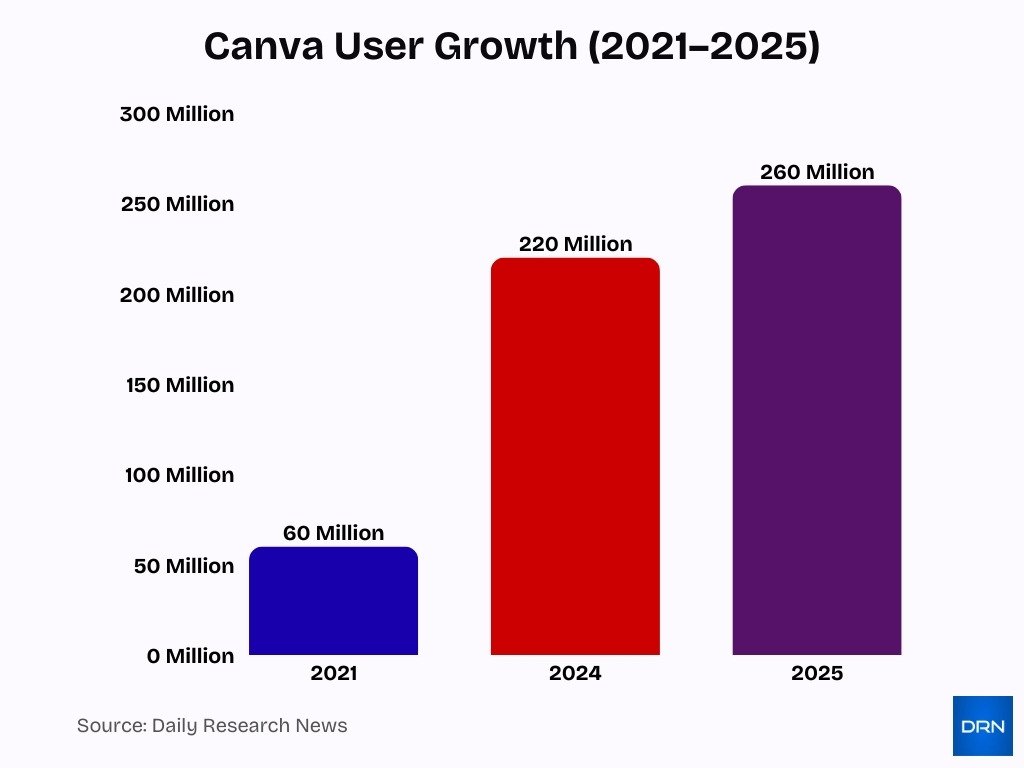
- Canva reached 260 million monthly users in 2025.
- Monthly active users grew from 220 million in late 2024 to their current figure.
- Over 24 million+ paying subscribers are on Canva’s paid tiers.
- Paying users include Pro, Teams, and Enterprise customers.
- The user base expanded from 60 million in 2021 to 260 million by 2025.
- Daily onboarding averages tens of thousands of new users.
- Gen Z and Millennials remain among the fastest-growing segments.
- User stickiness remains high with over 80% returning monthly.

Revenue and financial performance of Canva
- Canva’s annual revenue in 2025 is $3.5 billion.
- Revenue reflects continued growth year-over-year.
- Annual revenue had previously surpassed $2.7 billion in 2024.
- Other estimates place annualized revenue near $3 billion.
- Revenue contributions increasingly come from enterprise and subscription plans.
- Pro subscription growth remained strong in 2024.
- User upgrades to paid plans correlate with demand for advanced features.
- Revenue diversification includes templates, assets, and business licenses.
Valuation and funding rounds of Canva
- Canva raised a total of $589 million across 18 funding rounds.
- Secondary share sale in mid-2025 valued Canva at $42 billion.
- Blackbird Ventures led early investments with $3 million across five rounds.
- Sequoia Capital participated in the $40 million Series C round in 2018, valuing Canva at $1 billion.
- Valuation reached $15 billion after a $71 million Series E in 2021.
- The company secured a $560 million Series D extension in 2025, led by Franklin Templeton.
- $200 million Series F round in 2021 pushed total funding past $500 million.
- Peak 2021 valuation hit $40 billion before stabilizing at $26 billion by 2022.
- Employee tender allowed sales up to $3 million per Canvanaut at $42 billion valuation.
Leading Industries Leveraging Canva for Design Needs
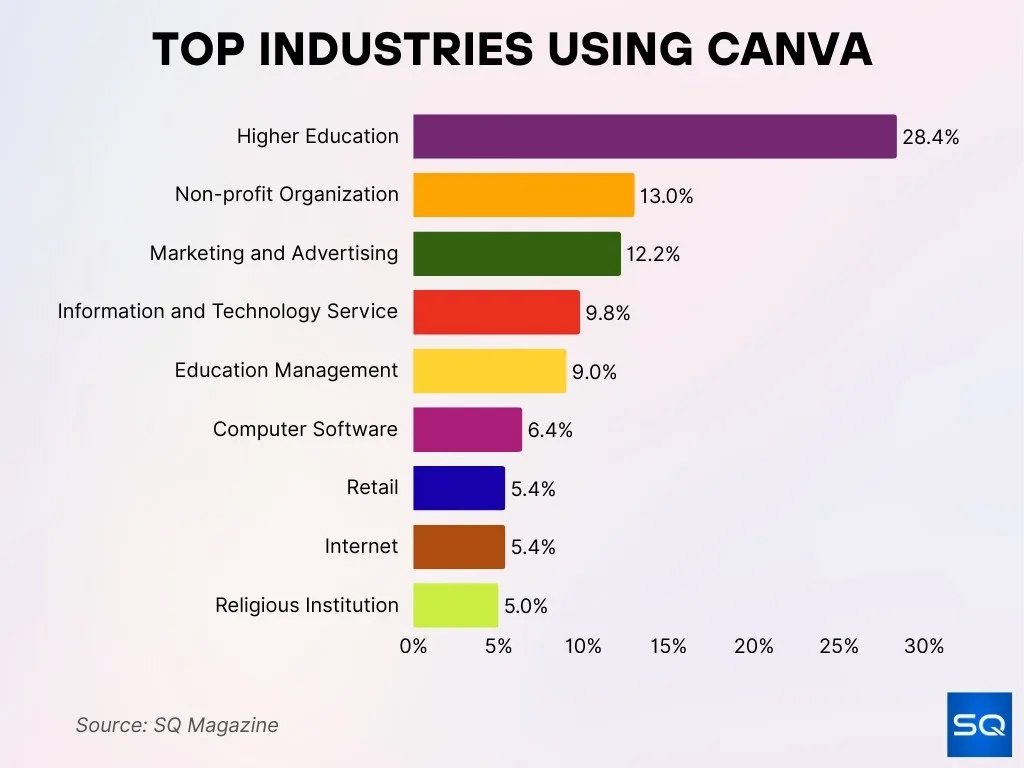
- Higher Education dominates Canva adoption, accounting for 28.4% of overall industry usage across the platform.
- Non-profit organizations come next with 13%, demonstrating a strong dependence on Canva for advocacy and outreach designs.
- Marketing and Advertising represent 12.2%, underscoring Canva’s significant role in branding and promotional activities.
- Information and Technology Services comprise 9.8% of Canva users, reflecting steady adoption in tech-driven sectors.
- Education Management contributes 9% to total Canva industry usage, supporting administrative and academic content creation.
- The Computer Software industry accounts for 6.4% of users, showing moderate but consistent usage.
- Both the Retail and Internet industries capture 5.4%, indicating equal adoption levels across these sectors.
- Religious Institutions also adopt Canva, making up 5% of overall usage across industries.
Device and platform trends for accessing Canva
- Canva Android app exceeds500 million downloads globally.
- Over 200 million total mobile downloads across iOS and Android platforms.
- 40% of Canva access comes from mobile devices worldwide.
- Desktop accounts for 60% of platform usage, ideal for complex designs.
- 81.14% of canva.com traffic originates from desktop browsers.
- Cross-platform syncing enables seamless design continuity across devices.
- Triple-digit mobile growth in Indonesia, the Philippines, and Brazil.
- 5 million daily smartphone users drive significant Canva mobile activity.
Plan type distribution across Canva users
- The free plan remains the most widely used tier globally.
- Paid plans, including Pro and Enterprise, now account for millions of subscribers.
- As of 2025, approximately 24 million+ paid users are on premium plans.
- Pro accounts make up around 11% of total users.
- Enterprise licenses represent 40% of paid subscribers.
- Canva for Education remains free for verified teachers and students, representing ~25% of the community.
- Conversion from free to paid averages 4% globally, rising to ~8% in North America.
- Brand Kits and Magic Resize are cited as top reasons for upgrading.
Canva Design Creation and Output Metrics
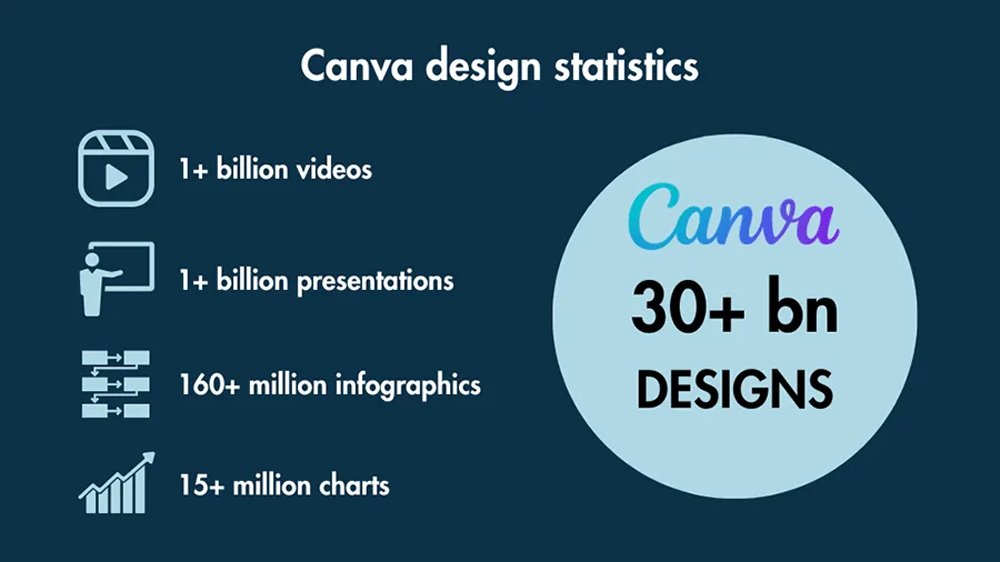
- Canva users have collectively created 30+ billion total designs across the platform, highlighting massive global adoption.
- Over 1 billion videos have been designed using Canva, reflecting strong growth in visual video content creation.
- More than 1 billion presentations have been produced on Canva, underscoring its popularity for professional and educational use.
- Canva hosts 160+ million infographics, making data visualization widely accessible to users worldwide.
- Users have also generated 15+ million charts, supporting advanced analytics and reporting needs across industries.
Export and creation trends using Canva tools
- Users create tens of millions of designs daily, with Canva reporting about 38.5 million designs per day by late 2024.
- On average, more than 23 designs are created every second on iPhone and iPad apps.
- Canva has surpassed 30 billion total designs created since launch.
- Designs export in formats including PDF, PNG, JPG, SVG, MP4, and PPT.
- Downloadable templates exceed 4.5 million options.
- Exports increasingly support e-commerce, social campaigns, and print products.
- Exports to external tools remain common for collaborative workflows.
- High-resolution exports support professional client deliverables.
Presentation and whiteboard usage on Canva
- Over 1 billion presentations have been created using Canva.
- Presentations support meetings, pitches, webinars, and virtual learning.
- Whiteboards enable collaborative brainstorming and planning.
- Templates simplify data-rich and visual storytelling.
- Educational users rely on whiteboards for interactive classes.
- Business teams use whiteboards for strategy sessions and workshops.
- Presentations frequently export to PPT and PDF formats.
- Animated and video-enhanced presentations continue to grow year-over-year.
Video and social content production via Canva
- Canva users have created over 1.2 billion videos using its editor since launch, supported by 1.5 million stock audio tracks for social content production.
- Canva hosts around 16,868 video templates, contributing to a library of 4.5M+ templates that power short-form social video output at scale.
- Organizations report up to a 60% increase in overall content creation in one month when using Canva’s built-in tools for video and social creatives.
- Canva’s community has produced over 30 billion designs, with more than 38.5 million designs per day, many optimized for platform-specific vertical and square formats.
- Canva serves 260M+ monthly active users in 190+ countries, giving teams and creators a large shared ecosystem for ad and campaign video workflows.
- A featured brand saw social media engagement rise by roughly 1,115% when using Canva visuals in posts compared with non-Canva content.
- During the pandemic, users created over 4 million Zoom video backgrounds in Canva, showing strong adoption of quick, export-ready MP4 visual assets.
- Canva’s social media solution supports fast publishing of graphics and short-form videos across major channels like Instagram, TikTok, Facebook, and YouTube from one interface.
Demographic insights of Canva’s customer base
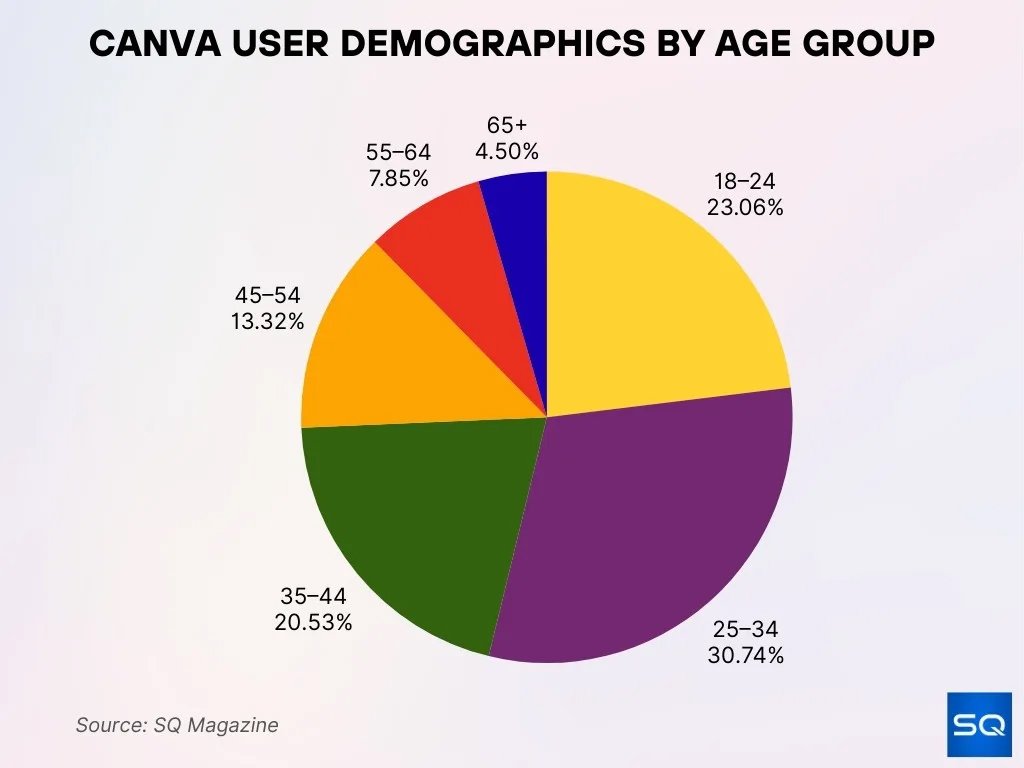
- 25–34-year-olds represent the largest user segment, accounting for approximately 30.74% of the total user base.
- The 18–24 age group comes next with 23.06%, while 35–44-year-olds contribute a significant 20.53% share.
- Users aged 45–54 comprise 13.32%, those 55–64 make up nearly 7.85%, and the 65+ age group accounts for around 4.50% of users.
- The female user share increased notably from 55% in 2022 to 60% in 2023, reflecting rising adoption among women.
- Overall gender distribution remains slightly female-skewed, with about 58% female users compared to 42% male users.
AI tools and Magic Studio usage in Canva
- In Canva’s 2024 Visual Economy survey, 82% of professionals said they used AI-powered tools like Magic Studio to produce visual content in the past year.
- Canva’s community created over 30 billion designs by 2024, with AI tools such as Magic Studio helping drive 38.5 million designs per day on average.
- In 2024, Canva’s new Visual Suite features, including AI tools, boosted overall user engagement by 22% year over year.
- Organizations using Canva’s analytics and AI-assisted features, such as Magic Chart, have reported up to 20% improvements in business performance.
- The Canva Visual Economy research found that 77% of respondents said communicating visually, often with AI-enhanced content, has increased in their workplace.
- Globally, more than 260 million monthly users rely on Canva’s platform, where AI tools are embedded across photo, video, and document workflows.
- Report data shows that 69% of marketers feel there are too many generative AI tools, but still turn to integrated suites like Canva’s Magic Studio for streamlined workflows.
- Surveys of business users indicated that 70%+ see AI features such as background removal and layout suggestions as key to faster content production in Canva’s ecosystem.
- Visual communication leaders report that teams using AI-generated layouts and copy in Canva experience “hours-to-minutes” reductions in design time for campaigns.
- Enterprise case studies highlight that Canva’s Magic Studio at Scale cuts manual design steps and helps teams deliver more personalized campaigns with consistent branding across channels.
Sheets and data visualization activity on Canva
- Canva Sheets lets users create spreadsheets natively, with over 400+ functions for analysis and modeling in a familiar grid interface.
- Magic Charts can convert Sheet ranges into animated charts in seconds, updating in real time whenever underlying data changes.
- Canva offers a library of 20+ chart types that link directly to Sheets, including bar, line, pie, scatter, and combo visuals.
- Data Connectors allow importing from Google Sheets, Google Analytics, Salesforce, HubSpot, and World Bank, syncing millions of rows of external data into Canva Sheets.
- Data connectors and bulk import are limited to Canva Pro, Teams, and Enterprise, excluding most Free users from live third‑party integrations.
- Canva highlights Sheets use cases like financial reports, KPI dashboards, and project tracking, positioning Sheets as a lightweight BI-style workspace for teams.
- Canva Sheets can power dashboards where a single KPI tile or chart can surface one key metric while staying linked to underlying row-level data.
- Designs using charts and visuals sourced from Sheets help audiences understand trends up to 3x faster than raw tables, improving clarity of insights.
- Teams can collaborate in real time in Canva, with multiple editors updating Sheets, comments, and visuals simultaneously in one shared design.
- Charts and dashboards built from Sheets data can be exported as PDF, PNG, or MP4, supporting static reports and animated presentations for sharing.
Regional and country-level usage of Canva
- Canva is used across 190+ countries, covering nearly 97.4% of the world’s nations.
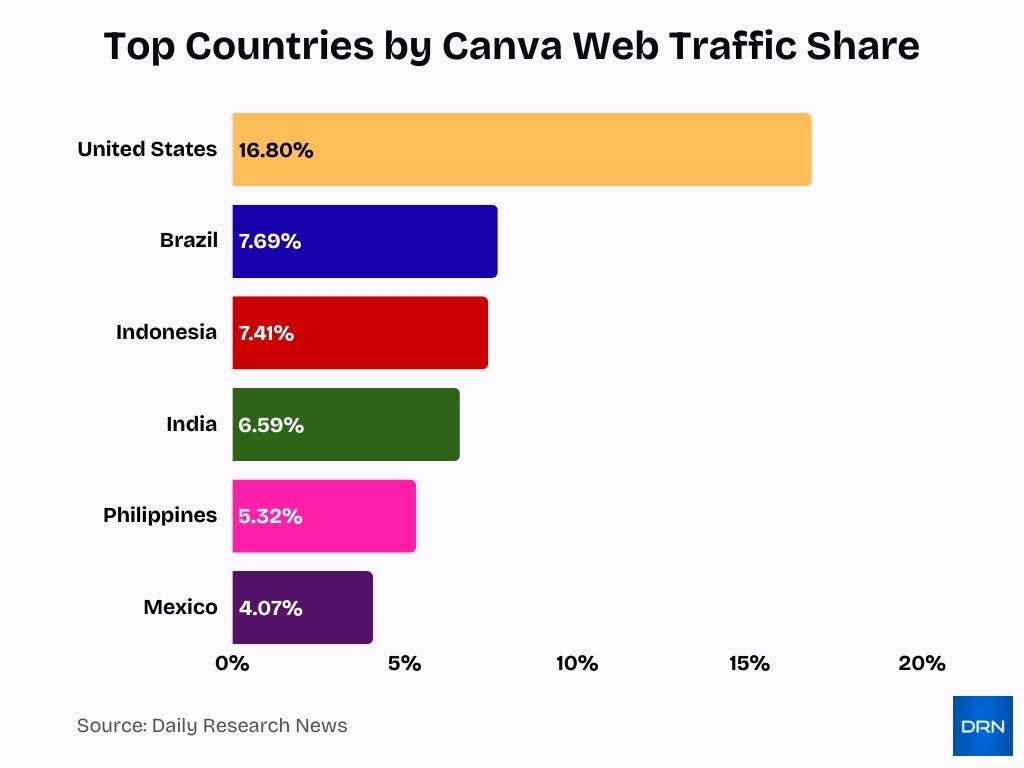
- The United States contributes ~16.8% of global web traffic to Canva.
- Brazil accounts for around 7.69% of global traffic.
- India represents about 6.59% of total Canva platform visits.
- Indonesia accounts for roughly 7.41% of global access.
- The Philippines and Mexico follow with 5.32% and 4.07%, respectively.
- Canva adoption is strong across Europe, including France, Spain, and the UK.
- Usage in Latin America continues to grow, especially in Colombia and Peru.
Integrations and app ecosystem around Canva
- Canva’s Apps Marketplace hosts over 300 apps from developers in 122 countries.
- Canva apps have been used over 1 billion times since the Developer Program launch in 2023.
- The platform recently introduced 12 new APIs, including Design Editing and Data Connectors.
- Canva Connect APIs enable integrations with CRM, spreadsheets, and ad platforms like Google and Meta.
- Developer community spans 122 countries, powering a growing ecosystem of custom apps.
- Apps SDK supports automation, AI extensions, and real-time data for 190 million users.
- 540 apps listed in the Canva Apps Marketplace across 311 vendors.
- Premium Apps Program and $50M Innovation Fund boost app monetization and growth.
- Ecosystem includes hundreds of productivity tools for brand management and reporting.
Competitor comparison featuring Canva and others
- Canva commands 12.47% of the global graphics software market.
- Adobe dominates with over 70% share in creative software.
- Figma captures 40.65% of the design software industry.
- Figma grew from 7% to 90% market share in UI design tools by 2023.
- Canva surged 35% in the design software market share over the past year.
- 85% of Fortune 500 companies use Canva.
- CapCut seized 42% revenue share in the top video editing apps.
- Visme holds 0.1% market share in web content management.
- Canva leads the presentation category with 46% share.
Frequently Asked Questions (FAQs)
Canva has approximately 240–260 million monthly active users in 2025, according to the most recent platform data.
In 2025, Canva’s annual revenue is reported to be about $3.3–$3.5 billion across various financial highlights.
Canva’s subscriber base has grown to more than 24–27 million paid users in 2025.
Canva’s valuation has reached about $42 billion through internal share sale transactions.
Conclusion
Canva stands as a central platform for modern visual communication. Its AI-powered tools, collaborative features, and expanding ecosystem support creators, educators, and enterprises alike. With billions of designs created and strong global adoption, Canva continues to redefine how ideas are shared visually at scale.