

The live chat era has accelerated beyond simple FAQs and support bots to become a central channel for business-to-customer interaction. Companies across industries use live chat and AI-powered conversational tools not only to resolve queries but also to increase conversions, improve customer engagement, and streamline service operations. Retailers rely on live chat to support high-volume purchasing moments, while healthcare and financial institutions use it to scale support without sacrificing responsiveness. The statistics below break down how live chat and chatbot adoption continue to shape digital communication across industries.
Editor’s Choice
- The global chatbot market is estimated at around $7–9 billion in 2025.
- Projected growth to over $27 billion by 2030 indicates strong long-term expansion.
- Nearly 987 million people use AI chatbots worldwide today.
- ChatGPT processes around 2.5 billion messages per day in 2025.
- 78% of organizations are using AI in at least one business function.
- 51% of consumers prefer bots over humans for immediate service.
- 95% of customer interactions are expected to be AI-powered by the end of 2025.
Recent Developments
- AI chatbots are increasingly used for emotionally supportive interactions and social engagement, beyond transactional tasks.
- Advanced conversational systems now assist with post-operative care and complex healthcare interactions.
- Some firms are scaling back full reliance on AI, reintroducing human support where customer preference for human contact is strong.
- Major general-purpose AI assistants like ChatGPT dominate market presence and usage volumes.
- Retailers reported a 42% increase in AI chat usage during peak shopping seasons, aiding purchases and returns.
- Companies are focusing on customizing AI solutions rather than one-size-fits-all models to improve ROI.
- Chatbot integrations are expanding into voice and omnichannel interfaces for richer engagement.
- Privacy, personalization, and transparency have become central themes in ongoing chatbot deployments.
What Is a Chatbot?
- A chatbot is an automated conversational agent that responds to user queries in real time via text or voice.
- Chatbots range from rule-based FAQ responders to AI-driven conversational assistants.
- They operate on websites, mobile apps, messaging platforms, and social channels.
- Advanced chatbots use natural language processing and machine learning to improve accuracy.
- In business, chatbots serve both customer support and proactive engagement roles.
- Chatbots can escalate conversations to human agents when needed.
- Modern chatbots support multilingual and multimodal interactions.
- They often integrate with CRM, ticketing, and knowledge base systems.
- Some chatbots leverage large language models for context-aware dialogue.
- Continuous learning and analytics help refine performance over time.
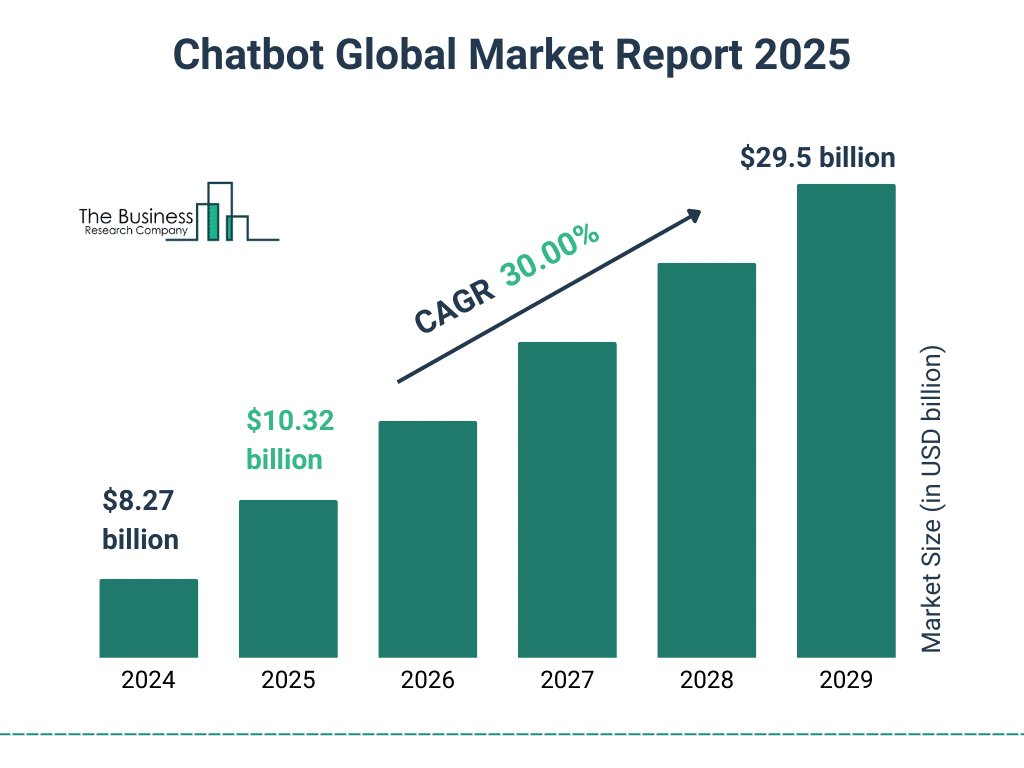
Chatbot Global Market Growth Overview (2024–2029)
- The global chatbot market is experiencing rapid expansion, driven by increased adoption across customer service, e-commerce, healthcare, and enterprise automation.
- Market size reached $8.27 billion in 2024, establishing a strong baseline for accelerated growth.
- In 2025, the market increased to $10.32 billion, reflecting rising enterprise and AI-driven chatbot deployments.
- The market is projected to grow at a robust compound annual growth rate (CAGR) of 30.0% over the forecast period.
- By 2026, the market value is estimated to reach approximately $13.4 billion, supported by advancements in natural language processing and generative AI.
- Continued momentum is expected in 2027, with the market expanding to around $17.4 billion as chatbot adoption scales globally.
- In 2028, the market is forecast to achieve nearly $22.6 billion, driven by omnichannel customer engagement and automation initiatives.
- By 2029, the global chatbot market is projected to reach $29.5 billion, more than tripling its 2024 size.

Key Chatbot Statistics Overview
- 97% of companies expect new teams to adopt generative AI tools soon.
- Nearly 96% of consumers know what chatbots are and recognize their utility.
- 88% of customers have used a chatbot, with usage continuing to rise in 2025.
- 29% of users expect 24/7 chatbot availability.
- 51% of consumers prefer chatbot interactions for immediate service.
- 78% of organizations deploy AI in at least one function, including chat interactions.
- Customer satisfaction improves where chatbots enable efficient self-service.
- Chatbot adoption has doubled since the early 2020s.
- Chatbots handle a significant portion of initial customer engagements.
- AI assistants increasingly embed sentiment and context analysis.
Chatbot Adoption by Businesses
- 78% of organizations use AI tools in at least one business function.
- In 2025, 46% of SaaS companies plan to adopt chatbots.
- 58% of chatbot use cases focus on B2B applications.
- Large enterprises show 60% plus adoption rates.
- Chatbots are now mission-critical tools rather than experiments.
- Businesses use chatbots to streamline workflows and reduce support overhead.
- Sustained investment signals long-term integration.
- Companies build internal teams to manage chatbot ecosystems.
- Chatbots support pre-sales and post-sales engagement.
- Adoption aligns closely with digital transformation strategies.
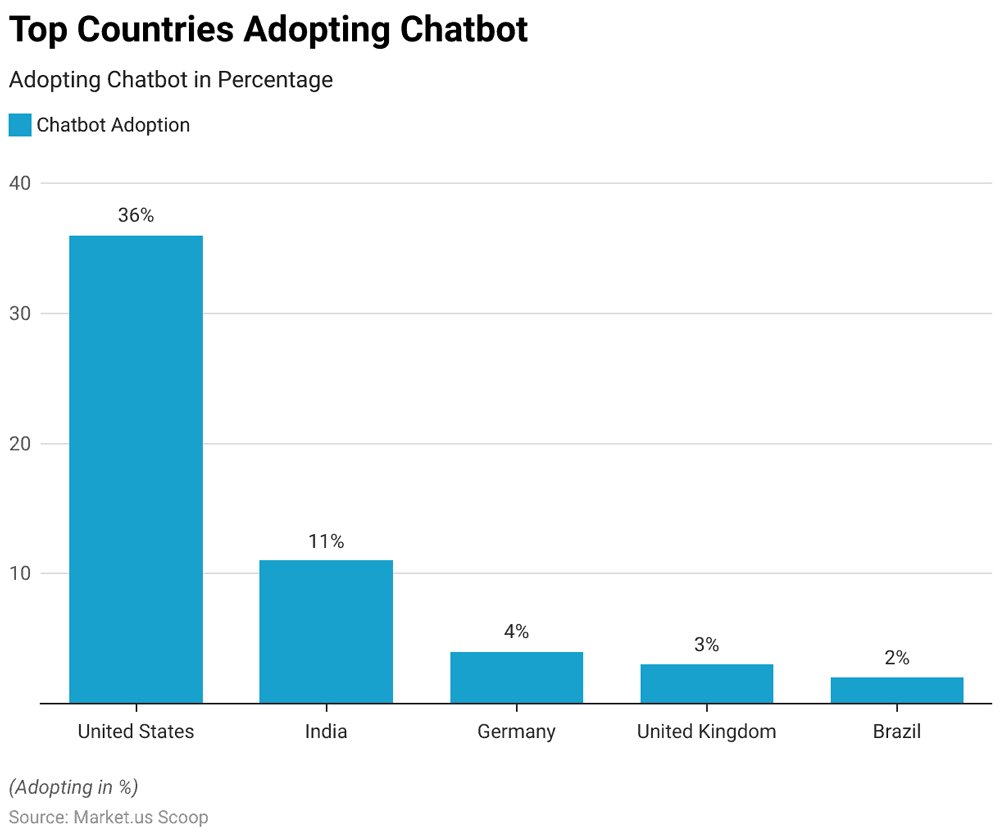
Chatbot Adoption by Country
- The United States leads global chatbot adoption, accounting for 36%, indicating strong enterprise and consumer integration of AI-driven conversational tools.
- India ranks second with 11% adoption, reflecting rapid digital transformation and increasing use of chatbots in customer service and e-commerce.
- Germany shows moderate adoption at 4%, suggesting steady but cautious implementation within regulated and industrial sectors.
- The United Kingdom follows closely with 3%, highlighting growing interest but comparatively slower large-scale deployment.
- Brazil records 2% adoption, signaling early-stage growth potential in emerging markets.
Chatbot Usage by Business Size
- Two-thirds of large enterprises have implemented chatbots by 2025.
- Small and medium businesses represent roughly 34% of adopters.
- 58% of B2B firms use chatbots, compared to 42% of B2C firms.
- Large firms deploy chatbots across multiple channels and functions.
- SMBs use chatbots to scale support without major hiring.
- Mid-sized firms use chatbots for lead qualification and workflows.
- 79% of organizations prioritize AI in software strategies.
- Businesses blend chatbot automation with live agents.
- Advanced generative AI tools appear more often in larger firms.
- Chatbot first service models are expanding across all sizes.
Chatbot Usage by Generation
- 64% of U.S. teens (ages 13-17) report using AI chatbots.
- 30% of U.S. teens use AI chatbots daily, including 16% multiple times per day.
- 68% of teens ages 15-17 use chatbots, vs. 57% of those ages 13-14.
- 70% of Black and Hispanic teens use chatbots, higher than 58% of White teens.
- 58% of U.S. adults under 30 have used ChatGPT, vs. 10% of those 65+.
- 42% of millennials use ChatGPT for business or productivity tasks.
- 82% of Gen Z adults report using AI chatbots like ChatGPT or Gemini.
- 70% of ChatGPT usage is non-work-related, dominating among younger users.
- 20% of Gen Z shoppers always prefer chatbots over human agents, vs. 4% boomers.
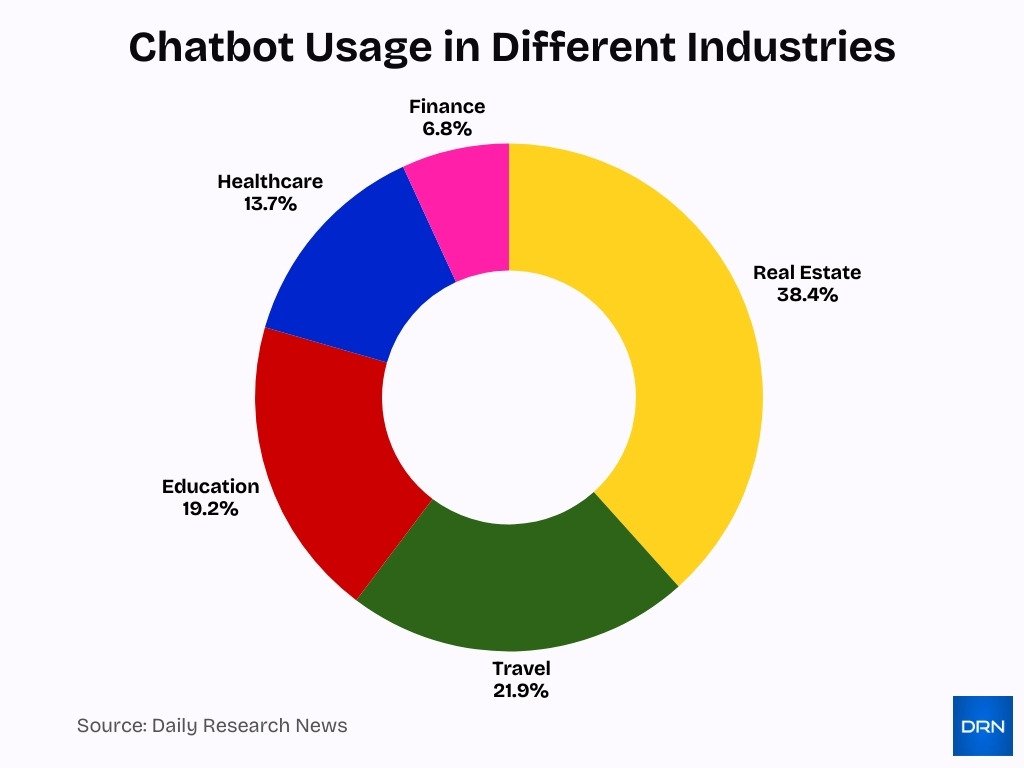
Chatbot Usage Across Key Industries
- Real Estate leads chatbot adoption with 28% usage, indicating strong reliance on automated assistants for property inquiries, lead qualification, and customer engagement.
- The Travel industry ranks second at 16%, where chatbots are widely used for bookings, itinerary management, and customer support.
- Education accounts for 14% of chatbot usage, reflecting growing adoption for student assistance, admissions support, and e-learning platforms.
- Healthcare represents 10%, leveraging chatbots for appointment scheduling, patient queries, and preliminary health guidance.
- Finance shows the lowest adoption among the listed sectors at 5%, suggesting more cautious implementation due to regulatory, security, and compliance concerns.
- Overall, the data highlights that customer-facing and service-driven industries are adopting chatbots more rapidly than highly regulated sectors.
Chatbot Usage by Channel (Web, Mobile, Social, Messaging)
- Over300,000 chatbots operate on Facebook Messenger, leading social platform usage.
- 1.4 billion people use messaging apps supporting chatbots globally.
- 79% of chatbot engagements happen on Facebook Messenger versus other platforms.
- 65% of users interact with chatbots on messaging apps daily or weekly.
- 58% of B2B companies deploy chatbots on their websites.
- 73% of buyers expect chatbots on websites for easy interactions.
- 39% of customer-business chats in eCommerce are handled by chatbots on web/mobile.
- 54% of consumers prefer chatbots via messaging apps over other channels.
- 62% of consumers choose chatbots over waiting for human agents across channels.
Chatbot Use Cases in Customer Service
- Chatbots handle 75% of customer inquiries in 2025.
- 37% of businesses deploy chatbots for customer support.
- Chatbots cut response times by over 40% for companies like Bank of America.
- 67% of consumers have used chatbots for support in the past year.
- 90% of businesses report faster complaint resolutions with chatbots.
- Hybrid models boost customer satisfaction by 12-20%.
- 80% of firms see increased call volume capacity via chatbots.
- 85% of interactions will be bot-handled without agents by 2025.
- Chatbots achieve 97% CSAT and 96% positive feedback.
Chatbot Use Cases in Ecommerce and Retail
- 80% of retail and ecommerce businesses use AI chatbots or plan to use them soon.
- Shoppers using AI chatbots convert at 12.3% vs 3.1% without, a fourfold increase.
- 47% of ecommerce customers use chatbots to place orders or handle returns.
- 49% of US retail professionals already use AI chatbots and virtual agents.
- AI-assisted shoppers spend 25% more on average through personalized recommendations.
- Chatbots reduce cart abandonment by 20-30% with timely reminders and incentives.
- E-shops with chatbots handle 89.2% of inquiries vs 71.2% without.
- Retailers using chatbots report up to 67% sales increase from better personalization.
Chatbot Use Cases in Healthcare
- 31% of healthcare organizations adopt chatbots for customer service.
- 68% of health organizations incorporate AI chatbots.
- 52% of US patients access health data via chatbots.
- 40% improvement in appointment adherence with chatbot reminders.
- 25% reduction in hospital readmissions using AI chatbots.
- 30% boost in patient engagement from healthcare chatbots.
- 78% of professionals see chatbots as ideal for appointment booking.
- 44.7% of studies highlight chatbots for mental health support.
Chatbot Use Cases in Banking and Finance
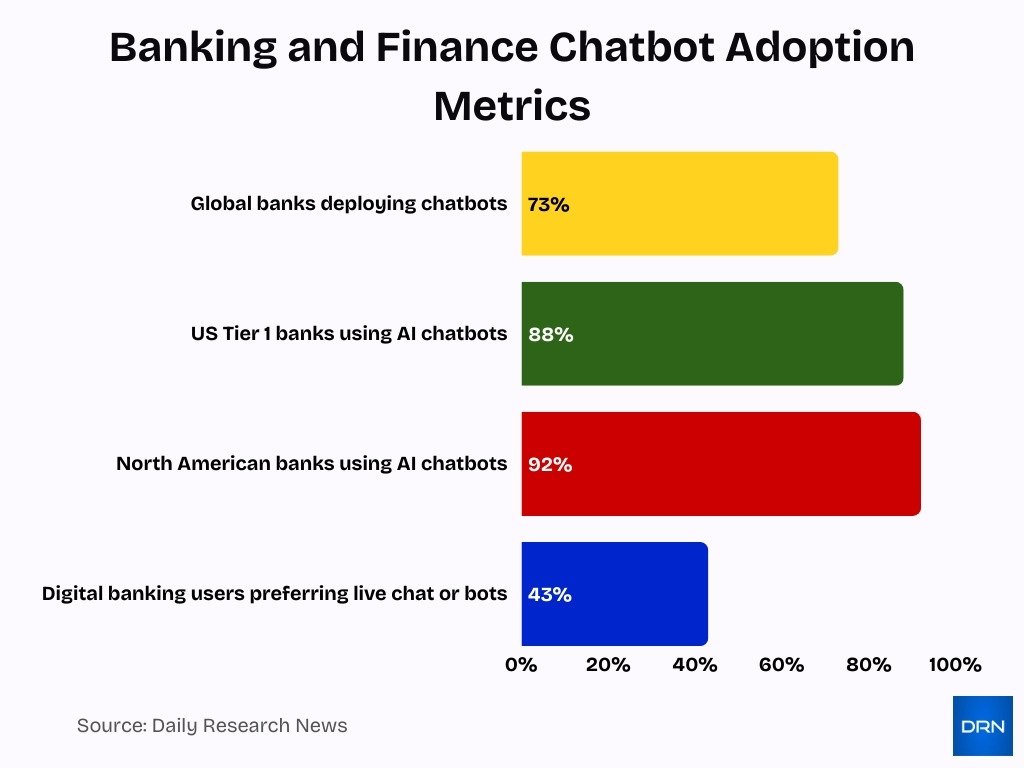
- 73% of global banks deploy chatbots.
- 88% of US Tier 1 banks use AI chatbots.
- Banking chatbots handle 3.1 billion interactions per month.
- Customer satisfaction with banking chatbots reached 84%.
- 92% of North American banks use AI chatbots.
- 43% of digital banking users prefer live chat or bots.
- Chatbots support transfers, balance checks, and fraud alerts.
- Generative AI enhances fraud detection.
- Internal bots support compliance and operations.
- Multi-language support expands accessibility.
Chatbot Performance and Efficiency Stats
- Chatbots automate up to30%of contact center tasks, saving $23 billion in the U.S.
- Chatbots respond3 times faster than traditional channels.
- Adoption yields47% faster responses and 22% drop in times.
- Bots resolve80% of routine inquiries independently.
- 87% resolution rate achieved without human handoff.
- Issue triage saves533 agent hours monthly per 10,000 queries.
- Analytics cut escalations from 22% to 9% in 90 days.
- 24/7 availability boosts satisfaction by 24%.
- Resolution cycles drop33-45% with fewer escalations.
- Backend integration enables82% resolution time reduction.
Cost Savings and ROI from Chatbots
- AI chatbots delivered $11 billion in savings and 2.5 billion hours saved.
- Chatbots generate around 30% customer support cost savings.
- 83% of businesses report positive ROI from AI use.
- Health insurance AI solutions saved $22 million.
- Chatbots can boost revenue by up to 67%.
- Time savings improve operational efficiency.
- SMBs control costs while expanding service.
- Reduced training costs improve ROI.
- Lower repeat contact rates cut expenses.
- CRM integration increases lifetime value.
Customer Satisfaction with Chatbots
- 87.2% of users rate chatbot experiences as neutral or positive.
- 62% of customers prefer chatbots over waiting for human agents.
- 51% choose bots for immediate assistance rather than live chat.
- 24/7 availability increases satisfaction levels by 48%.
- Easy escalation to humans boosts user trust by 33%.
- 42% of users are concerned about chatbot accuracy and tone.
- 68% of younger users (18–34) prefer chatbots to contact forms.
- Reducing wait times by half raises overall sentiment scores by 37%.
- Hybrid chatbot models achieve 29% higher satisfaction than bot-only systems.
- Regular AI refinement improves user trust and retention by 21%.
Top Ten AI Chatbots by Active Users
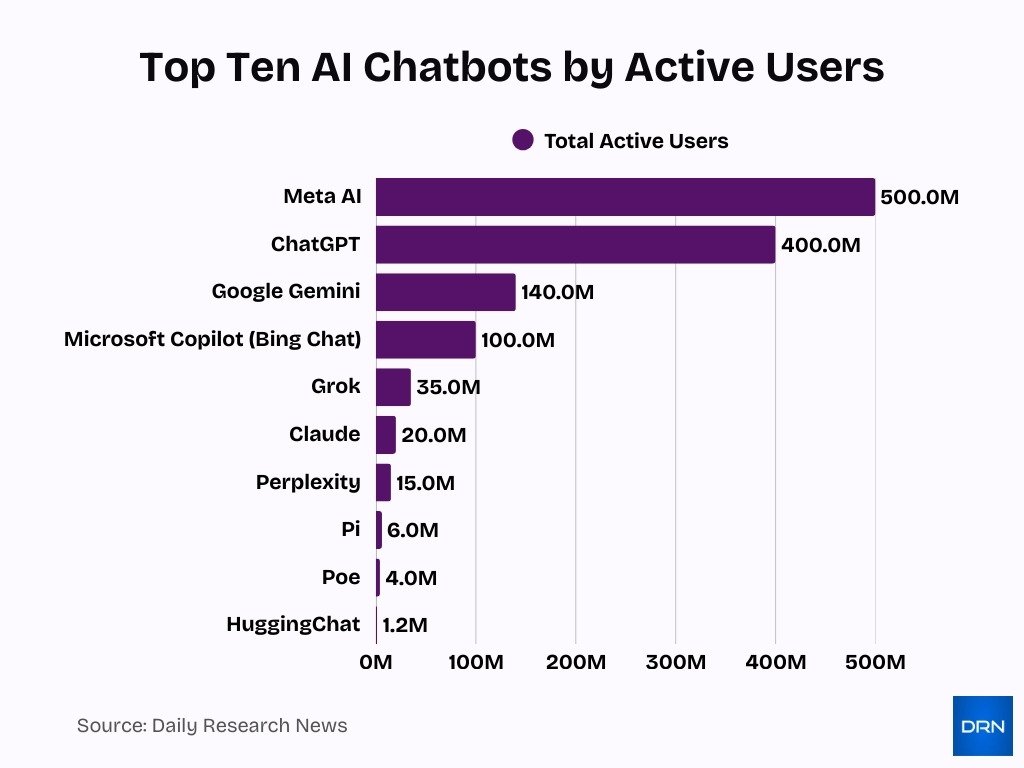
- Meta AI leads the market with 500 million active users, making it the most widely adopted AI chatbot globally.
- ChatGPT ranks second with 400 million active users, reflecting strong consumer and enterprise adoption.
- Google Gemini holds the third position, reaching 140 million active users, driven by deep integration with Google’s ecosystem.
- Microsoft Copilot (Bing Chat) follows closely with 100 million active users, benefiting from Microsoft’s productivity and search platforms.
- Grok has achieved notable traction, attracting 35 million active users in a relatively short time frame.
- Claude reports 20 million active users, indicating steady growth in the conversational AI and enterprise assistance segment.
- Perplexity has gained 15 million active users, highlighting demand for AI-powered search and research tools.
- Pi maintains a niche but growing user base with 6 million active users, focused on personal AI interactions.
- Poe records 4 million active users, serving as a multi-model AI access platform.
- HuggingChat, with 1.2 million active users, primarily caters to developers and open-source AI enthusiasts.
Generative AI and LLM Chatbot Statistics
- 78% of enterprises adopted generative AI across business functions in 2025, up from 55% prior year.
- 71% of organizations now deploy LLMs in enterprise chatbots for core operations.
- 88% of enterprise LLM API usage comes from top providers like OpenAI, Anthropic, and Google.
- Banks using LLMs achieved 30% fraud reduction through real-time pattern detection.
- Generative AI personalization boosts conversion rates by 25% and engagement 2.5x.
- 70% of CX leaders view generative chatbots as architects of personalized journeys.
- Generative AI slashes task completion times by over 60% across all work tasks.
- 75% of customer interactions are resolved by generative AI chatbots autonomously.
- Enterprises spent $37 billion on generative AI in 2025, a 3.2x YoY increase.
- CX firms report 18% consumer satisfaction growth from generative AI deployment.
Future Trends and Forecasts for Chatbots and Conversational AI
- By 2027, 25% of enterprises will use digital assistants as primary service channels.
- Chatbots may handle up to 95% of customer service interactions.
- Markets are forecast to grow at 23.3% CAGR.
- Generative AI drives next-generation capabilities.
- Voice-enabled chatbot investment is rising.
- Internal operations use cases will expand.
- Predictive analytics will improve effectiveness.
- Hybrid human AI models gain momentum.
- Ethical AI and privacy become priorities.
- Cross-platform conversational continuity emerges.
Conclusion
Chatbots and conversational AI have proven their value across customer service, healthcare, banking, and business operations. Data shows organizations gaining efficiency, cost savings, and higher customer satisfaction at scale. From handling routine inquiries to enabling advanced generative AI interactions, chatbots continue to redefine digital engagement.
Looking ahead, success will depend on balancing automation with thoughtful design, ethical practices, and seamless human collaboration.