

Conversion Rate Optimization (CRO) continues to be a vital performance metric for digital marketers and online businesses. Across industries, average conversion rates show both challenges and opportunities as companies strive to turn more website visitors into customers or leads. In ecommerce, SaaS, and service sectors, conversion performance strongly influences revenue growth and customer acquisition costs. Retail teams use CRO insights to refine checkout funnels, while B2B marketers deploy optimized forms to boost lead generation and pipeline velocity. Explore the latest trends and benchmarks shaping CRO below.
Editor’s Choice
- 2.9% average conversion rate across industries in 2025.
- 7.04% average conversion rate for Google Ads campaigns.
- 223% typical ROI from using CRO tools, underlining big returns.
- 2.89% average mobile ecommerce conversion rate as of mid-2024.
- 2.96% average ecommerce conversion rate per industry benchmarks.
- 79% share of visitors who do not convert into customers.
- 77% proportion of businesses run A/B tests to improve conversions.
Recent Developments
- The average conversion rate benchmark of 2.9% in 2025 highlights modest growth despite economic pressures.
- PPC and paid search strategies are delivering solid conversion performance, with paid search often in the 3.2% range.
- Google Ads continues to be a strong channel, with an average conversion rate above 7% in recent data.
- CRO investments are increasing, with many firms allocating up to 30% of marketing budgets toward optimization tools.
- CRO tools yield a median ROI of more than 200%, encouraging broader adoption.
- Mobile optimization remains a focus, as mobile devices account for 79% of landing page visits yet often lag in conversion rates.
- A/B testing adoption is now common practice, with 77% of companies conducting experiments to refine user journeys.
- Faster page load times correlate with higher conversions, reinforcing performance optimization best practices.
Overview of Statistics in Conversion Rate Optimization
- Conversion rates across industries average between 2% and 3%, illustrating broad performance standards.
- Ecommerce sites range closer to 2.7%–2.96% for total conversions.
- Desktop conversion rates typically outperform mobile, with desktops often above 3%.
- Across paid channels, average conversion rates vary by platform and format.
- Email and referral traffic often outperform organic and social in conversion percentages.
- Businesses without dedicated CRO roles lag in performance measurement and testing.
- Most visitors, 79%, fail to convert, underscoring optimization needs.
- CRO adoption correlates with increased experimentation and user personalization efforts.
Channel-Wise Conversion Rate Performance
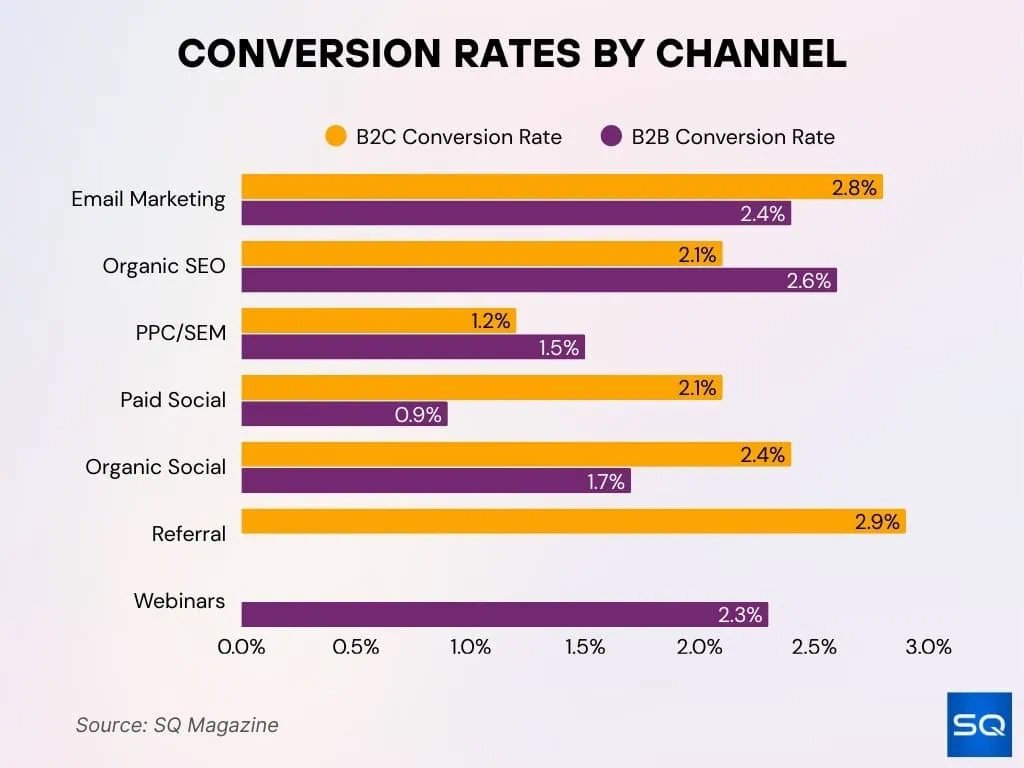
- In B2C, email marketing records around 2.8%, organic SEO delivers nearly 2.1%, while PPC/SEM averages close to 1.2%.
- In B2B, SEO achieves approximately 2.6%, email marketing follows at 2.4%, webinars convert at about 2.3%, and PPC performs near 1.5%.
- Paid social channels in B2C typically converge around 2.1%, compared with B2B, where rates fall near 0.9% across many reports.
- Organic social traffic shows roughly 2.4% conversion in B2C, while B2B averages lower at about 1.7%.
- Referral traffic posts an average conversion rate of nearly 2.9% across multiple industries.
- Webinars consistently demonstrate a B2B conversion rate of around 2.3% in numerous analyses.
- Across paid channels, SEM/PPC converts at roughly 1.5% in B2B, compared with about 1.2% in the B2C context.

Website Performance and Average Conversion Rates
- Across the US and global benchmarks, 2.9% is cited as the average overall conversion rate in 2025.
- Ecommerce sites average 2.7% to 2.96% for conversion performance.
- Desktop conversion rates often land near 3.2%, significantly higher than mobile.
- Mobile ecommerce conversion rates around 2.89% reflect growing mobile traffic with conversion gaps.
- Conversion rate drops sharply with page load delays; even a 1-second delay can reduce conversions noticeably.
- Average landing page conversions across industries can exceed 9–10% for top performers.
- Traffic source conversion variation shows that email often outperforms organic in ecommerce contexts.
- Benchmarks vary widely by niche, underscoring the importance of segment-specific performance goals.
Business Type Impact on Conversion Rates (B2B, B2C, SaaS)
- B2B SaaS conversion benchmarks vary, but high-performing SaaS sites often exceed 9%.
- B2B service industries see conversion rates near 4.9% on average.
- B2B conversion rates can be lower for tech or longer sales cycle services, often around 1–2%.
- B2C ecommerce conversion rates typically fall in the 2%–3% range.
- Retail and consumer electronics conversion rates often sit above general ecommerce averages.
- SaaS form fill and free trial conversions present unique metrics distinct from ecommerce purchases.
- Longer B2B purchase journeys reflect lower raw conversion percentages but higher revenue impact per conversion.
- CRO strategies tailored to business type can significantly uplift effectiveness and lead to quality.
Industry Benchmarks for Conversion Rate Metrics
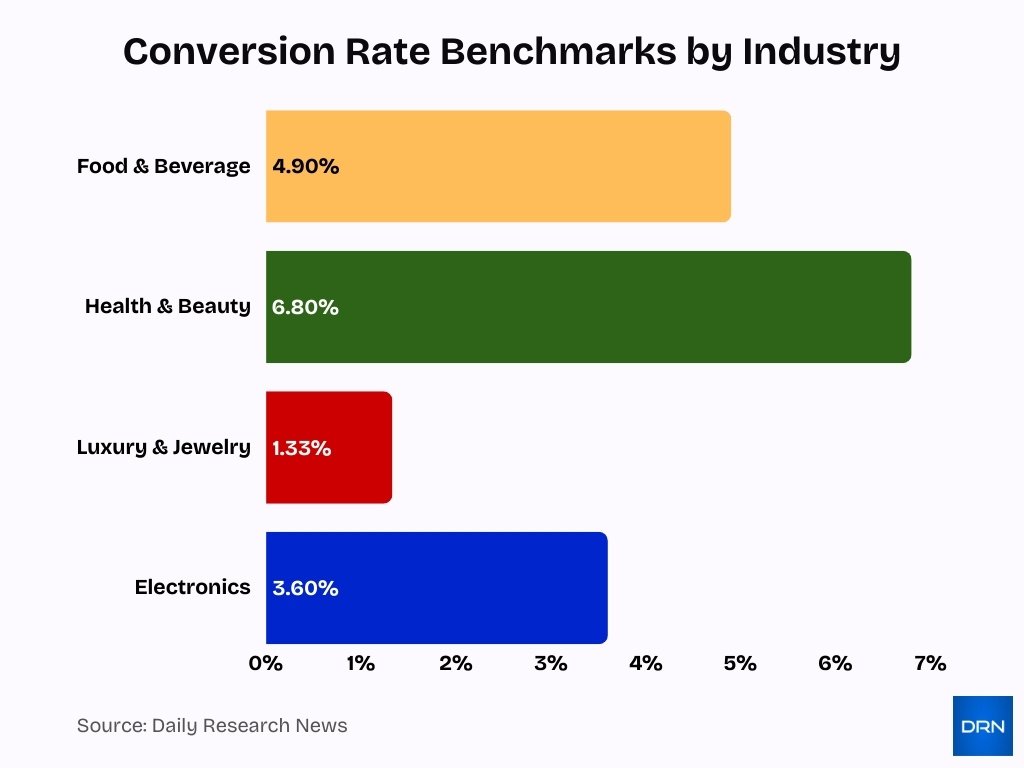
- Food & beverage ecommerce achieves 4.9% average conversion rate, among the highest benchmarks.
- Health & beauty sectors reach up to 6.8% conversion, outperforming broad ecommerce averages.
- Luxury & jewelry categories average 1.33% conversion rate, below overall industry norms.
- Electronics ecommerce records 3.6% conversion rate, strong in paid search contexts.
- Automotive parts show 2.1%–3.6% conversion rates across benchmarks.
- Global ecommerce averages sit at 1.9%–3%, with top niches exceeding 4%.
- Referral traffic converts at 5.4%, the highest among channels like direct at 2.2%.
- Desktop yields 3.9% conversion versus 1.8%–2.9% on mobile devices.
- The American region leads with 3.14% ecommerce conversion benchmark.
Funnel Performance Metrics in Conversion Rate Optimization
- Top-of-funnel engagement varies widely, with high bounce rates reducing conversion opportunities.
- Middle-of-funnel nurturing with email and retargeting shows 3× higher engagement than basic ad paths.
- Bottom-of-funnel conversion rates often sit at ecommerce averages of 2.5%–3%.
- Lead magnet landing pages frequently outperform product pages, sometimes exceeding 10% conversion rates.
- Multi-step funnels produce higher quality leads but lower overall completion due to friction.
- Personalized funnels deliver significantly higher conversion rates versus generic flows.
- Abandoned cart recovery flows convert at 10–12% or more when optimized.
- Email retargeting increases mid-funnel engagement more effectively than many paid efforts.
Landing Pages and Their Conversion Rate Effectiveness
- The average landing page conversion rate across sites is around 2.35%.
- Top 25% of landing pages convert at 5.31% or higher.
- Top 10% performers often exceed 11.45%, highlighting optimization impact.
- B2B landing pages with optimized forms see higher submissions than generic homepages.
- Tailored calls to action can increase landing page conversions by double-digit percentages.
- Reducing form fields correlates with higher completion rates.
- Visual trust signals, such as reviews and guarantees, improve confidence and conversions.
- Faster-loading landing pages consistently outperform slower competitors.
Ecommerce Performance Based on Conversion Rates
- Average ecommerce conversion rates in 2025 hover between 2% and 4% globally.
- Many benchmarks show a 2.9% average for general ecommerce performance.
- High-performing ecommerce stores convert at 5–7% or more.
- Referral traffic in ecommerce can yield 5.4% conversion rates, outperforming paid and organic.
- Email-driven ecommerce conversions often reach 5% or higher.
- Cart abandonment remains high, near 70%, underscoring optimization opportunities.
- Free shipping offers can increase conversion rates by 28%.
- Adding product videos boosts conversions by around 21%.
Device-Based Trends in Conversion Rates (Desktop, Mobile, Tablet)
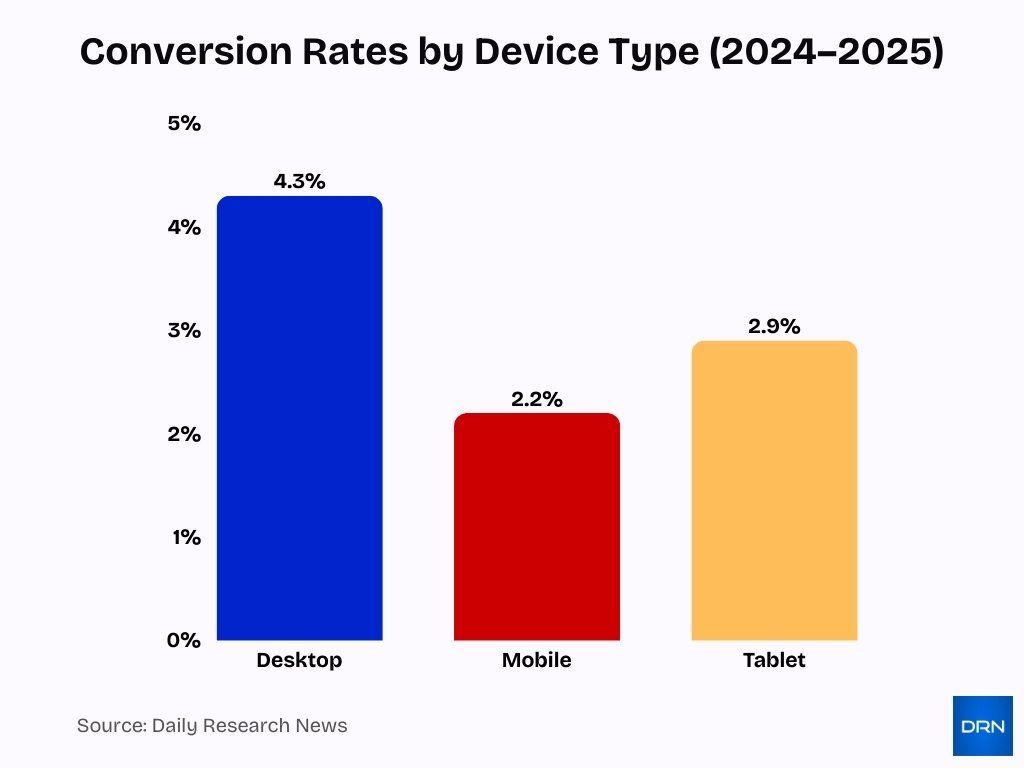
- Desktop conversion rates average 4.3% in 2025, outperforming mobile across most verticals.
- Mobile devices account for 59.6% of global web traffic, yet convert at just 2.2%.
- Tablet e-commerce conversion rates reached 2.9% as of December 2024, the highest among devices.
- Desktop rates stand at 3.9% versus 1.8% for mobile in typical e-commerce benchmarks.
- Every second of mobile page delay can drop conversions by up to 20%.
- Simplified mobile checkout flows boost conversions by 35.26% for large sites.
- Bounce rates on mobile exceed desktop by 12% in the 2025 data.
- Desktop outperforms mobile by 1.9x on average across e-commerce traffic.
- Optimized brands narrow the desktop-mobile gap, with some mobile rates matching 3%+.
Lead Generation and Its Influence on Conversion Rates
- 48% of marketers cite email marketing as their top lead generation tactic.
- Landing pages remain a strong lead source for 44% of businesses.
- Content marketing attracts leads for 43% of marketers.
- Organic SEO and retargeting offer some of the lowest cost per leads, at around $31 on average.
- Lead generation costs vary widely by industry, with healthcare exceeding $400 per lead.
- Smaller companies often see a lower cost per lead, around $47.
- Ecommerce cost per lead averages near $91, reflecting competitive markets.
- About 49% of B2B marketers identify lead generation as their biggest challenge.
Email Campaigns Driving Conversion Rate Success
- Average email campaign conversion rates fall between 2% and 5% across industries.
- Some benchmarks show 15.22% overall email performance for specific conversion goals.
- B2C email conversion rates hover near 2.8%.
- B2B email campaigns often convert at about 2.4%.
- Grocery email campaigns may reach 7.9% conversion rates, while outdoor gear averages below 1%.
- Personalization consistently boosts email conversion performance.
- Automated nurture sequences often double standard campaign results.
- Segment-specific emails deliver higher engagement and conversions than generic sends.
Social Media Contributions to Conversion Rate Growth
- 1.5% average conversion rate from social media traffic highlights a lower direct sales impact.
- Short-form video formats generate the highest ROI among social content types.
- 79% of consumers say user-generated content influences purchase decisions.
- 54% of users research products on social platforms before buying.
- 64% of consumers want deeper brand connections through social communities.
- 48% of consumers prefer buying on brand websites, while 37% would use social commerce options.
- Social media conversion uplift varies heavily by platform and targeting precision.
- Influencer partnerships continue to grow, with a projected $24B industry size.
CRO Adoption and Optimization Insights
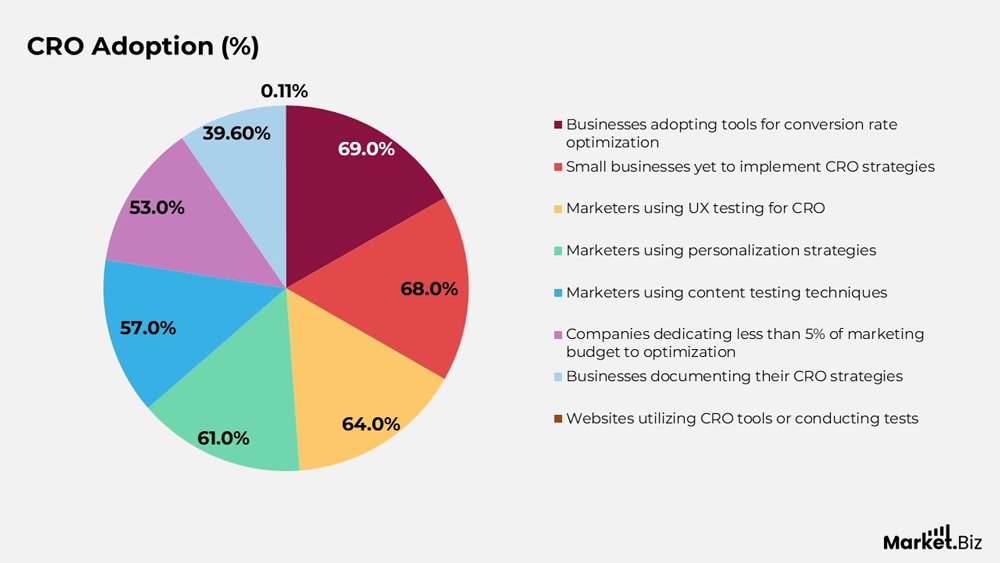
- 69.0% of businesses actively adopt conversion rate optimization tools, highlighting a strong interest in improving website performance.
- 68.0% of small businesses have yet to implement CRO strategies, indicating a major opportunity for growth and education.
- 64.0% of marketers use UX testing as a core CRO technique to enhance user experience and conversions.
- 61.0% of marketers rely on personalization strategies to deliver more relevant and high-converting user journeys.
- 57.0% of marketers apply content testing techniques, emphasizing data-driven optimization efforts.
- 53.0% of companies dedicate less than 5% of their marketing budget to optimization, limiting potential CRO impact.
- Only 39.6% of businesses formally document their CRO strategies, suggesting weak long-term planning.
- A mere 0.11% of websites actively use CRO tools or conduct testing, revealing a significant execution gap despite high awareness.
Paid Media and PPC Impact on Conversion Rate Outcomes
- Google Ads conversion rates around 7.04% remain strong in 2025.
- Paid search often outperforms other paid channels when user intent is high.
- Paid social campaigns typically convert under 2%–3%, despite broad reach.
- Optimized landing pages significantly improve paid media conversion outcomes.
- Refined audience targeting can lift conversion rates by 10–25% or more.
- Dynamic remarketing ads outperform static paid campaigns in re-engagement.
- Combining paid media with CRO reduces cost per acquisition.
- Search intent paired with personalized landing content drives higher efficiency.
Testing Strategies and Their Role in Conversion Rate Optimization
- Only 42% of businesses perform CRO experiments at least quarterly.
- Companies that test regularly see approximately 1.8× higher annual revenue.
- A/B testing can lift conversions by an average of 18% over six months.
- Structured experimentation improves insight quality over ad-hoc design changes.
- Personalized experiences from test data outperform generic variants.
- Live chat testing can produce up to 45% conversion uplifts.
- Video content tests may increase conversions by roughly 86%.
- Optimized CTA testing can boost conversion rates by 17–20%.
Conversion Rates Across Different Traffic Channels
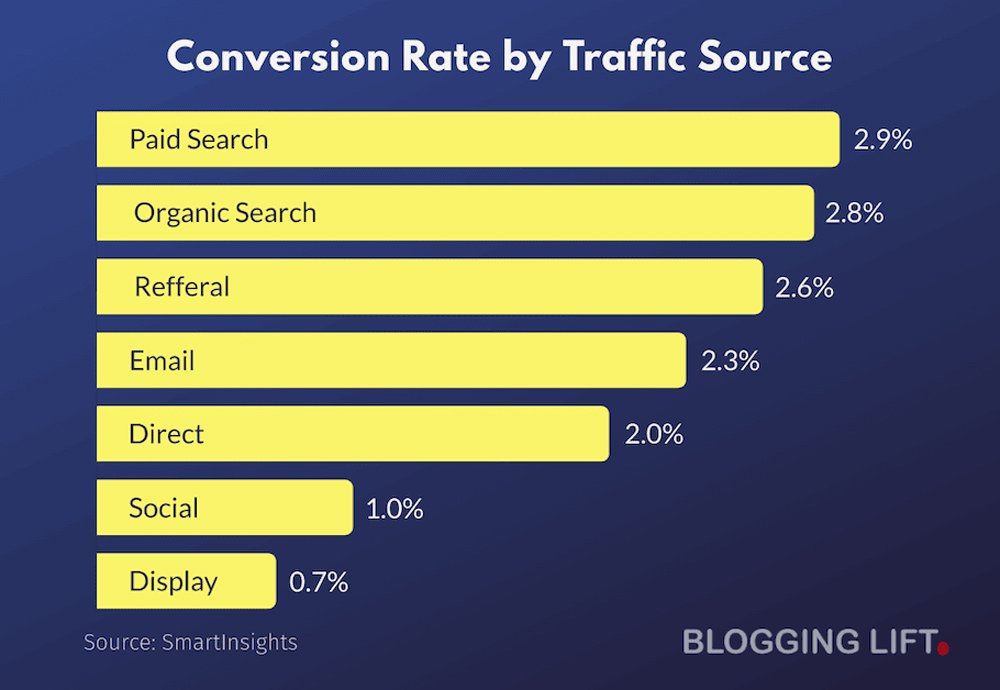
- Paid Search generates the highest conversion performance at 2.9%, making it the most effective traffic source overall.
- Organic Search comes in a close second, delivering a strong 2.8% conversion rate across user visits.
- Referral traffic maintains a competitive position, achieving a respectable 2.6% conversion rate consistently.
- Email campaigns continue to perform reliably, converting users at approximately 2.3% on average.
- Direct traffic shows moderate effectiveness, recording a 2.0% conversion rate from direct visits.
- Social media demonstrates a comparatively lower influence, converting users at only 1.0% overall.
- Display ads exhibit the weakest results among channels, with conversions reaching just 0.7%.
UX Design Factors Affecting Conversion Rate Results
- Websites with superior UX achieve 4.5% average conversion rates vs 2.6% for poor UX.
- Clear prominent CTAs boost conversion rates by up to 161%.
- Streamlined checkout flows yield 47% average completion rates, top sites hit 60%+.
- Trust signals like badges increase conversions by 42%.
- Simplified navigation cuts bounce rates by 10-15%.
- Intent-aligned content lowers bounce rates and lifts conversions significantly.
- Consistent UX across journeys boosts retention by 1.8x.
- 10% UX budget increase drives 83% higher conversions.
- Mobile UX improvements yield 28% conversion uplift.
Site Speed and Its Relationship with Conversion Rate Performance
- Each second of delay in page load time reduces conversions by 7%.
- Sites loading in 1 second have 2.5x higher e-commerce conversion rates than those taking 5 seconds.
- Walmart saw 2% conversion increase for every 1-second page load improvement.
- Every second delay in mobile page load drops conversions by up to 20%.
- Bounce rates rise 32% when the load time goes from 1 to 3 seconds.
- Pages loading in 5 seconds, see bounce rates soar to 38%.
- Core Web Vitals optimization boosted Rakuten 24’s conversion rate by 33%.
- 0.1-second mobile speed improvement lifts retail conversions by 8.4%.
- 70% of consumers say page speed impacts purchase willingness.
-
Most Popular Conversion Rate Optimization (CRO) Techniques
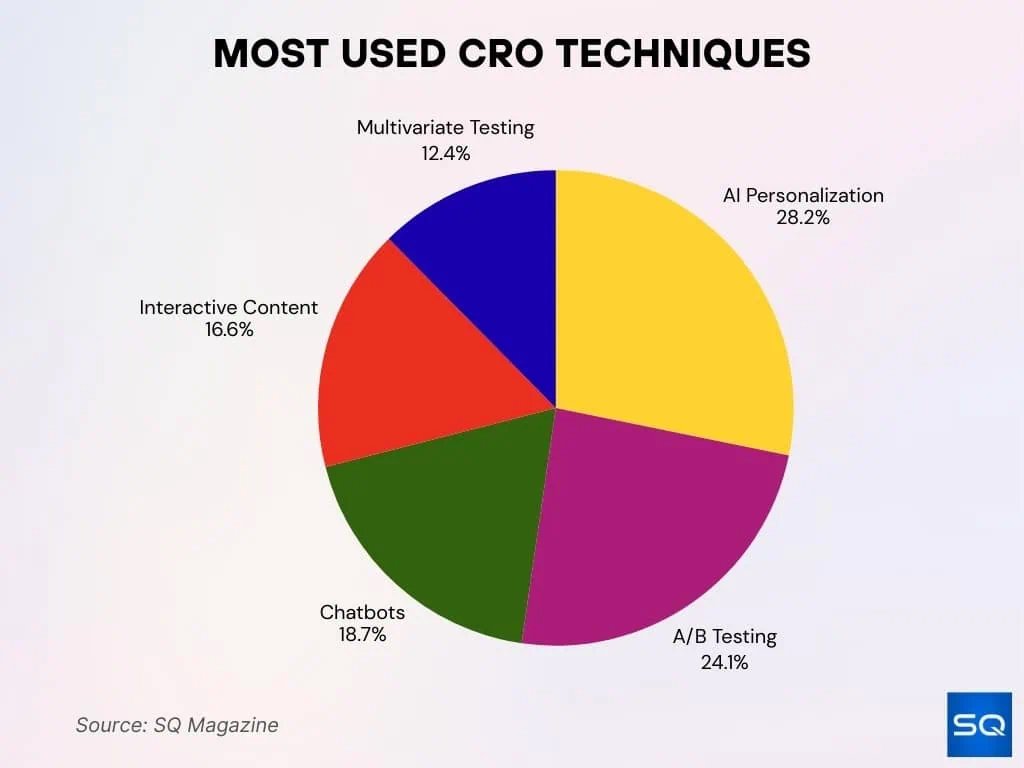
- AI Personalization stands out as the most widely used CRO technique, with 28.2% of marketers actively leveraging it to enhance user experiences and conversions.
- A/B Testing ranks as the second most adopted method, with 24.1% of professionals using it to optimize performance through controlled experimentation.
- Chatbots continue to gain traction in CRO strategies, being implemented by 18.7% of businesses to improve engagement and customer support.
- Interactive Content is increasingly embraced as a CRO tactic, with 16.6% of companies utilizing it to drive higher user involvement.
- Multivariate Testing remains the least commonly used among the leading techniques, with 12.4% adoption, despite its advanced optimization potential.
Personalization Strategies Enhancing Conversion Rates
- Personalized websites average around 19% conversion rates, significantly higher than generic experiences.
- Personalization engines boost relevance and engagement.
- AI-driven personalization delivers a 10–15% revenue uplift, with some cases reaching 25%.
- Tailored product recommendations increase cross-sell conversions.
- Dynamic content improves relevance throughout the user journey.
- Personalized CTAs outperform generic calls to action.
- Segmented messaging boosts conversions across email and landing pages.
- User intent signals enable experiences aligned with conversion goals.
Business Returns and Revenue Gains from Conversion Rate Optimization
- Structured CRO programs generate an average 223% ROI.
- Brands investing more than 5% of marketing budgets in CRO see 4× higher conversion lifts.
- Data-driven CRO teams are 3.5× more likely to report revenue growth.
- Monthly experimentation outperforms sporadic testing in revenue outcomes.
- Higher conversion rates reduce acquisition costs and raise lifetime value.
- CRO enables more efficient budget allocation across channels.
- Strong CRO execution builds competitive advantage in crowded markets.
- Conversion gains compound over time, driving sustainable growth.
Forecasts and Future Directions in Conversion Rate Statistics
- AI-driven personalization boosts conversion rates by 25% through micro-moment optimization.
- Businesses using first-party data strategies see 2x higher conversion rates amid third-party cookie decline.
- Predictive analytics in CRO is projected to grow with the market reaching $95 billion by 2032 at 23% CAGR.
- Voice AI search improves e-commerce conversion rates by 15–35%, especially on mobile.
- UGC integration lifts conversion rates to 79% by enhancing trust signals.
- AI personalization at scale increases revenues 5–15% and marketing ROI 10–30%.
- Frictionless experiences from 0.1-second site speed gains yield over 10% conversion uplift.
- The CRO market expands from $3.01 billion in 2019 to $5.07 billion by 2025, with AI trends.
- Voice-based mobile searches at 20% demand CRO optimization for future paths.
Frequently Asked Questions (FAQs)
The average conversion rate across all industries in 2025 is approximately 2.9%.
Companies that use conversion rate optimization tools typically see an average 223% return on investment.
About 69% of businesses have adopted tools and techniques to enhance conversion rates and measure user experiences.
Mobile ecommerce conversion rates are around 2.3%, tablets 3.1%, and desktops 2.8% in 2025.
Conclusion
Conversion Rate Optimization remains a cornerstone of digital success and beyond. Data shows that personalization, structured testing, UX improvements, and site speed deliver measurable gains. Mobile performance, paid media efficiency, and social engagement continue to shape outcomes. As CRO strategies evolve toward AI-driven insights and seamless cross-channel experiences, businesses that adapt early position themselves for stronger growth, deeper customer relationships, and sustained revenue performance.