

Cyber insurance has become a core financial safeguard as digital threats grow more frequent and costly. Businesses face a cyber risk landscape shaped by rising ransomware losses, broader claim categories like business email compromise, and shifting premium dynamics. Two real-world indicators show its impact: healthcare organizations are paying millions in breach-related expenses, and many small‑to‑mid‑sized firms struggle with claim denials despite coverage purchases.
These trends highlight why leaders in risk management and finance are closely tracking cyber insurance data. Explore the full article to see the latest statistics shaping this evolving market.
Editor’s Choice
- Global cyber insurance market projected at ~$20.7 billion in 2025, up from about $15.2 billion in 2024, reflecting continued demand.
- Average global data breach cost in 2025: ~$4.44 million.
- Average cost of a U.S. data breach in 2025: over $10 million.
- Ransomware losses are rising, with individual attacks costing insurers over $1 million on average in 2025.
- Cyber claims dropped ~53% in H1 2025, even as severity increased.
- 70%+ of cyber claims linked to ransomware or business compromise in recent reports.
- Premium growth remains solid, with projections of annual increases of 15–20%.
Recent Developments
- Global ransomware payouts declined sharply in 2024, dropping by more than one‑third, according to Chainalysis.
- Aflac disclosed a major cyberattack affecting ~22.65 million individuals in 2025.
- More insurers tighten underwriting norms following higher denial rates in cyber claims.
- Business email compromise continues to drive loss trends, especially among companies still delaying multi‑factor authentication adoption.
- Cyber attack volumes and sophistication remain elevated, prompting stronger policy wordings and exclusions.
- Ransomware remains central to loss severity, with resilience data showing average claims costs jumping year‑over‑year.
- Small and medium enterprises increasingly adopt cyber insurance, yet penetration rates lag.
- Regulators globalize breach reporting standards, influencing insurer loss estimation and pricing.
Global Cyber Insurance Market Growth Statistics
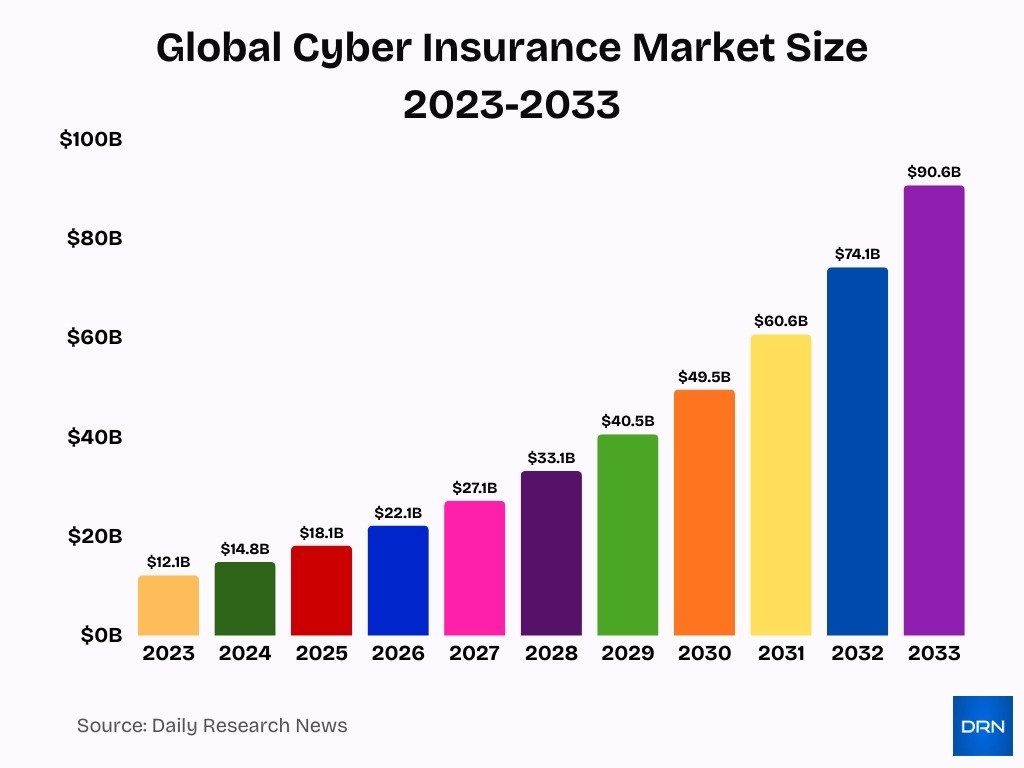
- The global cyber insurance market is valued at $12.1 billion in 2023, reflecting rising awareness of cyber risk coverage.
- Market size increases to $14.8 billion in 2024, showing steady year-over-year growth.
- By 2025, the market will reach $18.1 billion, driven by expanding digital adoption and threat exposure.
- The market crosses $22.1 billion in 2026, highlighting accelerating enterprise demand.
- In 2027, the total market value climbs to $27.1 billion, fueled by higher ransomware and breach claims.
- Market size grows to $33.1 billion in 2028, reflecting broader adoption of cyber insurance policies.
- By 2029, the market will expand to $40.5 billion, indicating strong underwriting and pricing momentum.
- The market reaches $49.5 billion in 2030, nearly quadrupling its 2023 size.
- In 2031, the cyber insurance market value jumps to $60.6 billion, crossing the $50 billion milestone.
- The market continues its rapid rise to $74.1 billion in 2032, supported by regulatory pressure and cyber resilience efforts.
- By 2033, the global cyber insurance market is forecast to hit $90.6 billion, marking a dramatic long-term expansion.
- Overall market growth is projected at a robust 22.3% CAGR, underlining cyber insurance as one of the fastest-growing segments in the global insurance industry.
Premium Trends
- Annual premiums projected to grow 15–20% per year through 2026.
- North America accounts for roughly 66% of global premiums.
- Competitive pressures have softened rate increases in some markets.
- Premium growth varies significantly by industry class and risk quality.
- Higher loss severity from ransomware contributes to selective underwriting.
- Increased regulatory requirements drive demand for broader coverage, lifting premium volume.
- SMEs often incur a higher relative cost due to a lack of baseline security controls.
- Cyber insurance pricing trends remain more volatile than other commercial lines.

Claims Frequency Statistics
- In H1 2025, cyber claims notifications fell 53% compared to H1 2024.
- Ransomware accounted for 76% of incurred losses in cyber insurance claims during H1 2025.
- BEC and FTF comprised ~60% of all submitted cyber insurance claims.
- Cyber claims frequency dropped 7% due to active risk management practices in 2025.
- Vendor-related claims made up 26% of notifications in H1 2025, down from 37% in 2024.
- Ransomware severity rose 17% year-over-year, averaging over $1.18 million per claim in H1 2025.
- Claim denials reached 37% for failures to maintain multi-factor authentication.
- Small businesses saw 8% higher claim frequency, while medium firms faced 32% increase.
- Canadian claims showed BEC at 28.6% and FTF at 24.5%, exceeding half of the total claims.
Average Data Breach Costs Across Industries
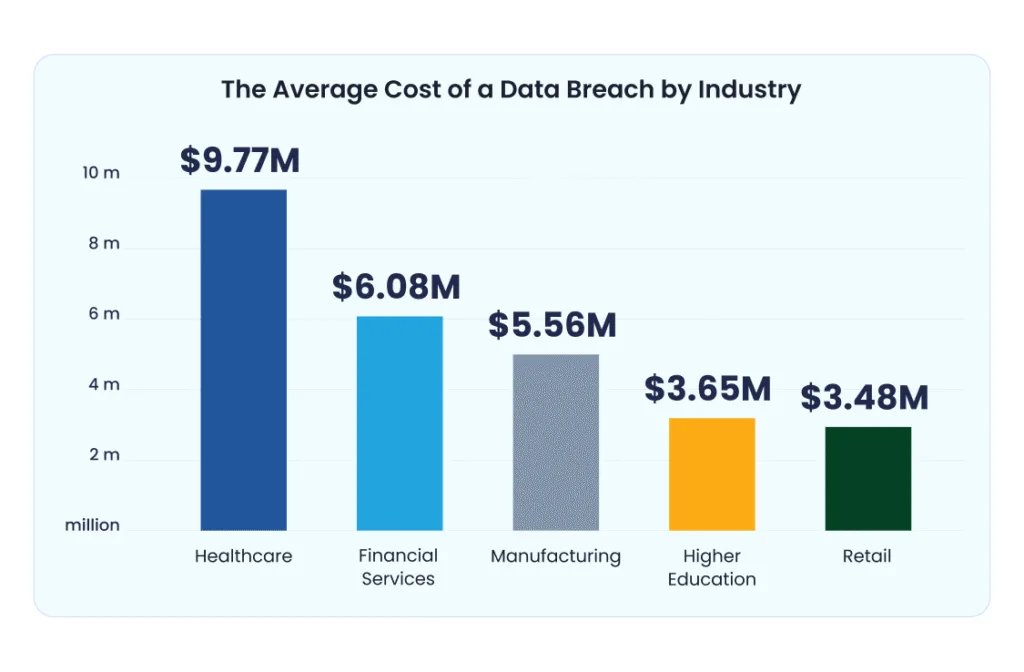
- Healthcare experiences the highest data breach costs, averaging $9.77 million, making it the most expensive industry when it comes to data breach incidents.
- Financial Services ranks second, with an average breach cost of $6.08 million, highlighting the high risk and value of compromised financial data.
- Manufacturing incurs average breach costs of $5.56 million, demonstrating that industrial systems remain high-value and attractive targets for cyberattacks.
- Higher Education reports average data breach costs of $3.65 million, largely driven by exposure of sensitive student and institutional information.
- Retail records the lowest average breach cost at $3.48 million, yet it still results in substantial financial losses and reputational harm.
Average Claim Costs
- The global average cyber insurance claim payout in 2025 is around $115,000 across all claim types, reflecting diverse incident severity.
- Ransomware claims tend to be costlier, averaging approximately $292,000 per claim in 2025, highlighting threat impact differences.
- Coalition data shows the average cyber insurance payout has remained close to $115,000, similar to 2024 levels.
- Healthcare ransomware incidents show even higher costs, with some providers facing average losses near $1.3 million in 2025.
- Resilience analysis indicates that when ransomware claims incur losses, the average claim cost exceeds $1.18 million in H1 2025.
- Small incidents like business email compromise often range between $35,000 to $185,000 per incident for insurers.
- Costs vary widely by region and industry, with U.S. data breaches averaging $10.22 million, more than double the global average.
- Direct and indirect breach costs, such as legal fees and restoration, affect overall claim values.
Ransomware Claims Data
- Ransomware remains a dominant loss driver, accounting for roughly 60–76% of claim value in 2025 portfolios.
- In the first half of 2025, ransomware accounted for 91% of incurred losses in some insurer portfolios.
- The average ransomware insurance loss reached $1.18 million in H1 2025, up from prior years.
- Deloitte and others report a 17% year-over-year increase in overall ransomware costs.
- Some studies project that ransomware costs, including ransom and recovery, could exceed $5.5M–$6M per incident in 2025.
- Ransomware victims appear at a rate of over 500 new victims per month by mid-2025 globally.
- Traditional ransom payments are only part of the insured loss; costs include recovery, legal support, and business interruption.
- Attackers increasingly use complex extortion tactics that boost claim severity.
Business Email Compromise Stats
- BEC and funds transfer fraud accounted for 60% of all cyber insurance claims in 2024.
- Average BEC loss reached $35,000 per claim, up 23% year-over-year.
- 29% of BEC incidents involved funds transfer fraud with average losses of $106,000.
- FTF events from BEC averaged $185,000 in losses, down 46% from the 2023 peak.
- BEC claims frequency held steady at 0.44% of policies in 2024.
- 10,402 total cyber claims analyzed in 2025 study, with BEC among top causes.
- 44% of ransomware victims paid ransoms, but BEC drove most insurance payouts.
- The UK saw BEC at 46.4% of event types, the highest among regions.
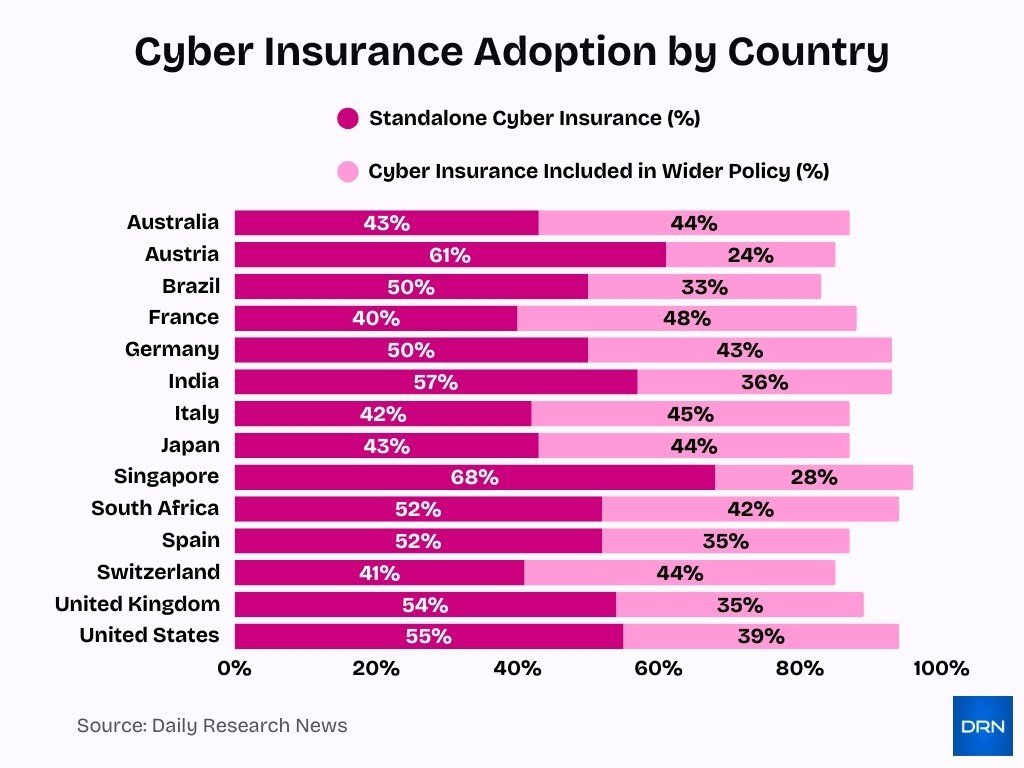
Cyber Insurance Adoption Trends by Country
- Singapore leads globally, with a 68% standalone cyber insurance adoption rate, making it the most mature market among surveyed countries.
- The United States follows closely, where 55% of businesses hold standalone cyber insurance, reflecting strong awareness of cyber risk exposure.
- In Austria, 61% of companies rely on standalone cyber policies, while only 24% include cyber coverage within broader insurance, signaling a preference for dedicated protection.
- India reports a high 57% standalone adoption rate, showing rapid cyber insurance uptake in emerging digital economies.
- The United Kingdom shows balanced growth, with 54% standalone coverage and 35% bundled within wider business insurance policies.
- Germany and Brazil each record 50% standalone adoption, indicating that half of businesses in these markets prioritize direct cyber risk coverage.
- France stands out for bundled coverage, where 48% of businesses include cyber insurance within broader policies, exceeding its 40% standalone usage.
- Italy and Japan display nearly identical patterns, with 42–43% standalone adoption and 44–45% bundled coverage, suggesting diversified insurance strategies.
- In South Africa and Spain, 52% of businesses use standalone cyber insurance, while 42% and 35%, respectively, rely on bundled protection.
- Switzerland shows lower standalone penetration at 41%, but a relatively strong 44% adoption through wider business insurance policies.
- Australia reflects a near-even split, with 43% standalone cyber insurance and 44% bundled coverage, indicating no dominant preference.
Claims by Industry
- Healthcare reports the highest average data breach cost at $10.22 million in the U.S. for 2025.
- Financial services face the highest average cyber insurance claim cost of $1.2 million per claim.
- Retail industry experiences average breach costs of $3.48 million, up 18% year-over-year.
- Manufacturing sees cyber claims 1.6 times more frequent and 1.2 times more severe than average.
- Tech supply chain events account for 15% of large cyber claims over €1 million in 2025.
- Data-rich industries report ransomware in 44% of breaches, averaging $5.08 million in costs.
- The education sector had 79% ransomware attack rate, with 56% of organizations paying ransoms.
- Public sector tech providers suffer major breaches, including 19GB of stolen sensitive data.
- Niche SMEs face average cyber incident costs of $175,000, with 254 claims over $1 million.
Claims by Business Size
- Large corporations average $228,000 per cyber claim, far exceeding smaller peers due to complex legal costs.
- Medium businesses face $139,000 average claims with 3.99% frequency from rising ransomware threats.
- Small enterprises incur $79,000-$120,000 breaches, equating to high costs per revenue dollar.
- Large firms see 5.97% claim frequency, boosted by compliance and regulatory components.
- Smaller firms absorb 98% of claims volume but suffer proportional impacts up to $1.24M.
- Industry data shows small business breaches yield insurance claims at rates exceeding reported attacks by 43%.
- Global multinationals report varied costs, like $226,000 in Canada versus $35,000 in the UK, due to regional regulations.
- Micro/startups focus on data loss claims, with 40% losing critical data and facing productivity halts.
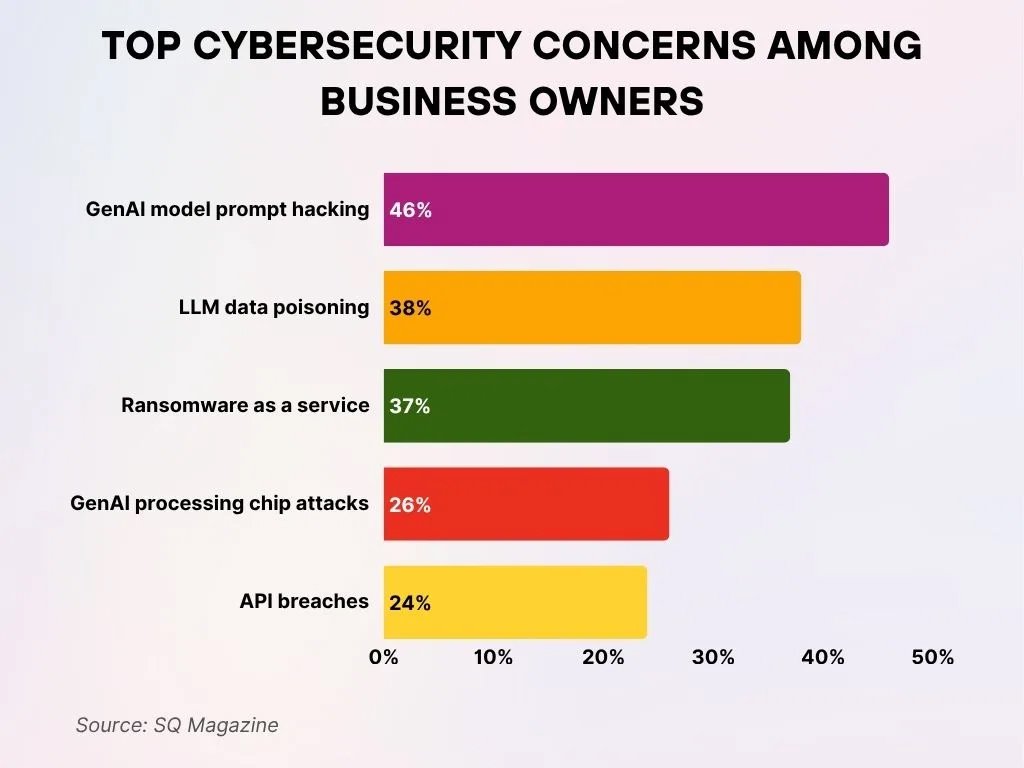
Leading Cybersecurity Worries Reported by Business Owners
- 46% of business owners reported GenAI model prompt hacking as their primary cybersecurity concern, underscoring growing anxieties about the misuse and manipulation of AI systems.
- 38% indicated they are concerned about LLM (Large Language Model) data poisoning, highlighting the serious risks posed by compromised or tainted AI training datasets.
- 37% pointed to Ransomware as a Service (RaaS) as a significant threat, drawing attention to the increasing ease of access to sophisticated cybercrime tools.
- 26% said they are worried about GenAI processing chip attacks, reflecting fears surrounding hardware-level weaknesses within advanced AI infrastructures.
- 24% of survey respondents expressed alarm over API breaches, stressing the critical importance of protecting digital integrations and interface security.
Adoption Rates by Company Size
- Large enterprises are the most likely to carry cyber insurance, with 70–80% penetration among Fortune 1000 firms.
- SMEs lag significantly, with adoption rates estimated below 30% globally, leaving many exposed to digital threats.
- Research shows awareness of cyber risk is high, around 72% of companies report increased threat levels, but only a fraction secure coverage.
- Among mid‑sized firms (100–999 employees), roughly 40–50% report having some form of cyber coverage in 2025.
- In smaller businesses (<100 employees), adoption drops to 15–25%, often due to perceived costs and complexity.
- Tech firms adopt coverage more readily, exceeding 60% adoption, reflecting heavy digital dependency.
- Heavily regulated sectors like finance and healthcare show adoption rates >75% due to compliance pressures.
- Firms with prior cyber incidents are 2× more likely to purchase or renew coverage than those without.
Coverage Penetration Statistics
- Cyber insurance still represents less than 1% of overall commercial insurance premiums worldwide, revealing a protection gap.
- In the U.S., penetration among mid‑to‑large businesses exceeds 50%, whereas in emerging markets it often stays below 20%.
- Coverage for SMEs in developed economies increased by ~8% year‑over‑year as insurers tailor products to smaller firms.
- Only about 15–25% of insured policies include full business interruption coverage, a key component for operational resilience.
- More than 40% of policies now include ransom and extortion protections, reflecting ransomware’s dominance.
- Social engineering coverage remains limited, with only ~15% of policies explicitly covering this vector in 2025.
- Insurers increasingly require baseline cybersecurity controls (MFA, training), with 80%+ of policies mandating at least one control.
- Cloud‑native and third‑party incident coverage options are growing, reflecting supply chain risk awareness.
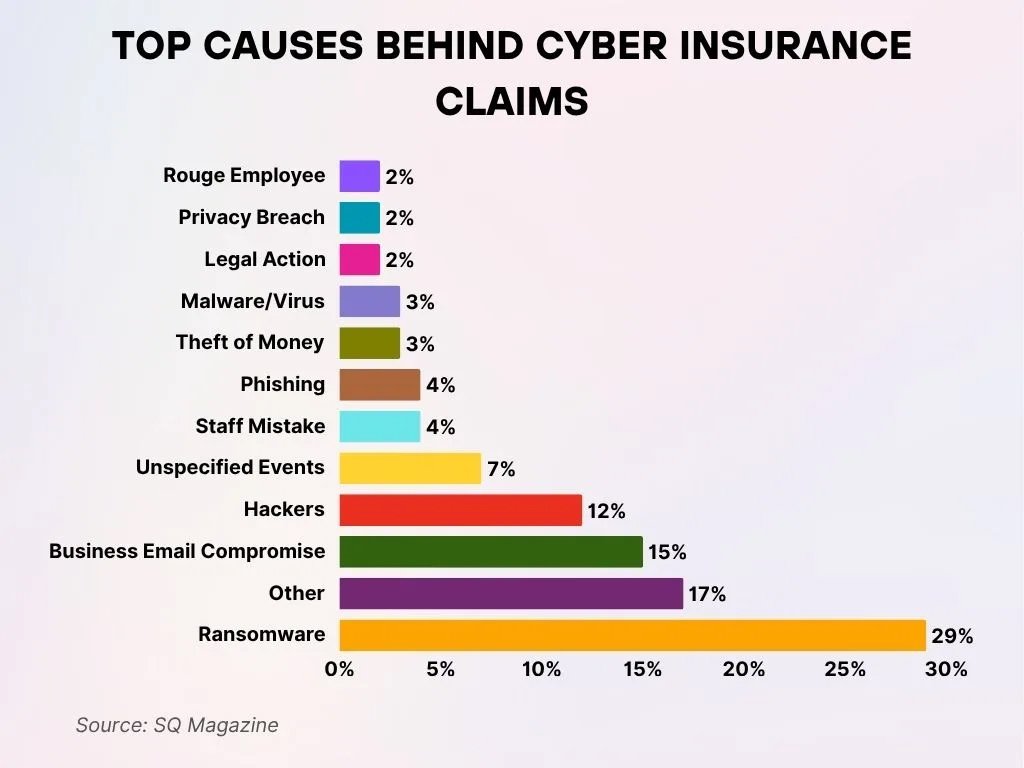
Top Causes Behind Cyber Insurance Claims
- Ransomware leads all causes, accounting for 29% of total cyber insurance claims, making it the most expensive and damaging cyber threat.
- Other causes make up 17%, reflecting a broad mix of miscellaneous or unclassified cyber incidents.
- Business Email Compromise (BEC) is responsible for 15% of claims, emphasizing the significant financial risks tied to compromised communications.
- Hackers account for 12% of reported claims, underscoring the ongoing and persistent threat from external cyber attackers.
- Unspecified events comprise 7%, indicating that many cyber incidents still have unclear or unidentified origins.
- Phishing and staff mistakes each contribute 4%, highlighting the impact of human error and deceptive social engineering tactics.
- Malware or virus attacks and theft of money drive 3% of claims each, showing continued exposure to software-based threats and direct financial loss.
- Privacy breach, legal action, and rogue employee incidents each account for 2%, representing the lowest share but still serious internal and legal risk factors.
Supply Chain Risks
- Third-party vulnerabilities caused 35.5% of all breaches in 2024, up 6.5% from 2023.
- Supply chain attacks surged with a 179% year-on-year increase in weekly cyber-attacks in 2024.
- 59% of breaches impacting the top 150 insurance companies involved third-party attack vectors.
- Nearly one-third of procurement leaders reported increased cyberattacks on supply chains in recent months.
- Each supply chain disruption costs companies an average of $680,000 in direct financial losses.
- Vulnerability exploitation accounted for 90% of supply chain interconnection breaches in 2024.
- 84.6% of organizations faced increased working costs as the top consequence of supply chain disruptions.
- 54% of large organizations identified supply chain challenges as the biggest barrier to cyber resilience.
- 47% of firms suffered from vendor and supply-chain attacks in 2024.
Social Engineering Threats
- Human error caused 68% of data breaches in 2024.
- 89% of social engineering attacks were financially motivated.
- 65% of social engineering attacks involved phishing.
- AI-powered phishing has a 42% higher success rate than traditional scams.
- Phishing initiated 36% of all data breaches.
- BEC scams caused $55.5 billion in global losses.
- 60% of cyber insurance claims stemmed from BEC or funds transfer fraud.
- 66% of social engineering attacks targeted privileged accounts.
Future Market Outlook
- Global cyber insurance market to reach $32.19 billion by 2030, growing at a 14.2% CAGR from $16.54 billion in 2025.
- Cyber premiums are projected to hit $27 billion by 2030 from $15.1 billion in 2024.
- Munich Re forecasts the market at $16.3 billion in 2025, doubling by 2030 with 10%+ annual growth.
- Beazley predicts cyber market expansion to $40 billion by 2030 from $15 billion in 2024.
- SME cyber adoption to surge, with only 10% currently covered versus 80% large enterprises.
- AI in insurance underwriting to grow at 41.6% CAGR, enhancing cyber risk pricing accuracy.
- Cyber reinsurance market expected to rise from $5.5 billion to $9.5 billion by 2030.
- Bundled cyber offerings with risk services becoming standard, aiding SMBs in resilience.
- 62% of businesses now hold cyber insurance, up from prior years, with 15-20% premium growth annually.
Frequently Asked Questions (FAQs)
The global cyber insurance market is estimated to be between about $16.3 billion and $20.56 billion in 2025 based on multiple industry forecasts.
Projections indicate a CAGR of around 14.2% to 21.5% for the cyber insurance market from 2025 into the early 2030s.
In 2025, the global average cost of a data breach is approximately $4.44 million.
About 72% of organizations report an increase in cyber risk in 2025.
Conclusion
The cyber insurance landscape reflects both remarkable growth and persistent challenges. Adoption continues to rise, especially among larger enterprises, yet a significant protection gap remains for many small and medium‑sized businesses. Evolving threat vectors, involving phishing, social engineering, and supply chain points of failure, underscore the need for comprehensive coverage and stronger cybersecurity measures.
As insurers refine risk models and expand offerings, companies that proactively embrace coverage and risk mitigation will be better positioned to weather digital threats. The coming years will likely bring broader penetration, deeper integrations between insurance and security practices, and greater emphasis on resilience across industries.