

Cyber warfare is no longer a fringe threat; it has become central to national security, economic stability, and the protection of critical infrastructure worldwide. Hostile cyber operations range from sophisticated nation-state campaigns to AI-assisted intrusion tools, reshaping how governments and industries prepare and respond. For example, AI-generated attacks doubled year over year, and critical infrastructure hacks disrupted utilities in Europe this year. With stakes rising, cyber warfare trends matter to every decision-maker and security professional. Explore the latest data on this evolving digital battlefield below.
Editor’s Choice
- Cybercrime costs are projected to hit $10.5 trillion globally in 2025, making it one of the largest wealth transfers in economic history.
- The average global cost of a data breach in 2025 reached $4.45 million.
- 70% of organizations reported experiencing at least one significant cyber attack in 2024.
- Ransomware incidents surged 60% in the first half of 2025 compared with the prior period.
- Asia-Pacific attacks increased by 13% in 2024.
- 72% of security leaders see cyber risks rising year over year.
- Nation-state AI-assisted attacks on U.S. targets more than doubled in 2025 vs 2024.
Recent Developments
- AI-assisted cyber operations reported more than 200 AI-generated deception incidents between July 2024 and July 2025.
- Denmark accused Russia of destructive cyber-attacks on water utilities and election sites in Europe.
- A U.S. federal advisory warned that a Chinese hacking campaign now affects 200 organizations and 80 countries.
- Global ransomware attacks jumped 60% in H1 2025 compared with H2 2024.
- 1,055 cyber incidents were globally recorded in the past year, reflecting broad attack surface expansion.
- India documented 265 million cyber attacks in 2025 alone.
- High-profile breaches involving major technology and telecommunications providers highlighted ongoing large-scale adversarial priorities.
- Security leaders reported cyber risk levels significantly higher than the prior year.
What Is Cyber Warfare?
- Cyber warfare refers to state or proxy-sponsored digital attacks intended to disrupt, degrade, or manipulate essential systems.
- It encompasses espionage, infrastructure sabotage, information operations, and digital coercion.
- Nation-state actors often exploit zero-day vulnerabilities and bespoke malware.
- Unlike traditional conflict, cyber warfare rarely leaves physical footprints yet can paralyze services.
- It spans offensive operations, defensive postures, and psychological influence campaigns.
- Critical targets include government, utilities, military networks, and financial systems.
- Adversaries leverage AI, automation, and anonymous networks to obscure attribution.
- The scope includes critical infrastructure sabotage, espionage, disinformation, and data destruction.
Key Drivers Shaping Modern Cybersecurity
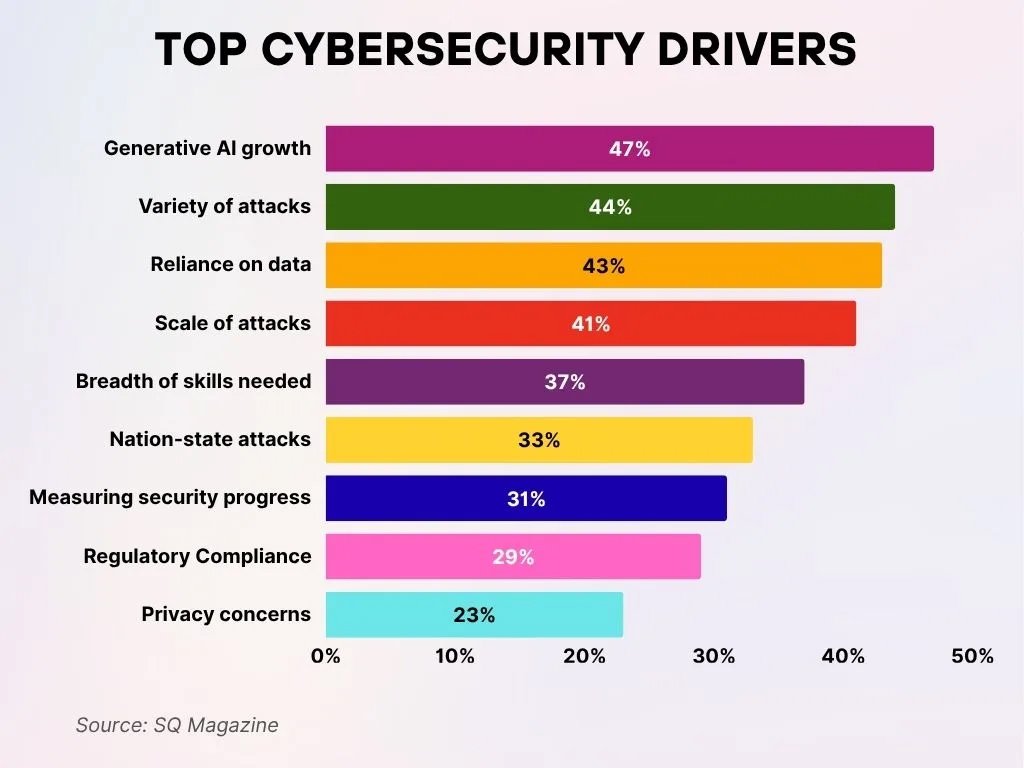
- 47% of respondents identify Generative AI growth as the leading cybersecurity driver, underlining its dual impact on rapid innovation and emerging security threats.
- 44% point to the wide variety of attacks, emphasizing the growing complexity and sophistication of today’s cyber threat landscape.
- 43% are driven by an increased reliance on data, illustrating the high stakes involved in data protection and information security.
- 41% recognize the expanding scale of attacks as a critical concern that demands stronger and more resilient defenses.
- 37% highlight the breadth of skills required, underscoring persistent talent shortages and skills gaps in cybersecurity roles.
- 33% express concern over nation-state attacks, signaling rising geopolitical tensions within the global cyber domain.
- 31% focus on measuring security progress, reflecting the growing need for improved metrics and performance tracking.
- 29% view regulatory compliance as a major motivator driving increased cybersecurity investments.
- 23% mention ongoing privacy concerns, highlighting sustained public pressure to better protect personal data.

Key Global Cyber Warfare Statistics
- $10.5 trillion is the projected global cost of cybercrime in 2025.
- The average cost of a data breach reached $4.45 million globally in 2025.
- 70% of organizations faced at least one significant cyber attack in 2024.
- Ransomware incidents increased 60% in the first half of 2025.
- Asia-Pacific experienced a 13% rise in cyber attacks during 2024.
- 72% of surveyed organizations reported rising cyber risk year over year.
- Cybercrime losses equate to roughly $333,000 lost every minute worldwide.
- India recorded 265 million cyberattack attempts in 2025.
- AI-driven attack incidents more than doubled from 2024 to 2025.
- Global telecom hacking campaigns now span 80 countries.
Cyber Warfare Market Growth Statistics
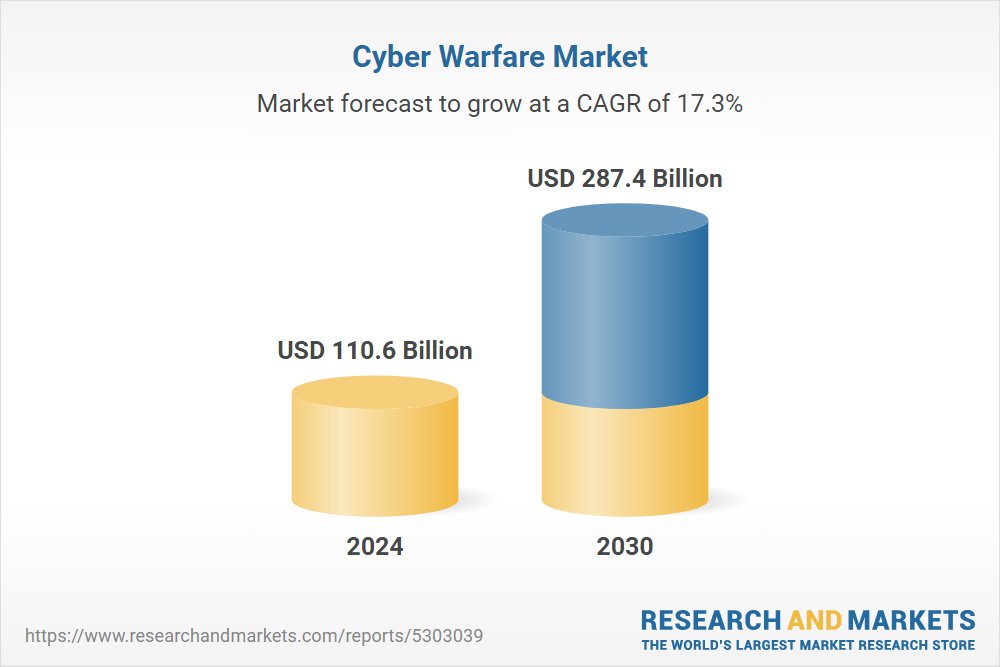
- The global Cyber Warfare Market is projected to expand at a strong CAGR of 17.3%, highlighting rapid acceleration in digital defense investments worldwide.
- In 2024, the Cyber Warfare Market is valued at approximately $110.6 billion, reflecting rising government and military cybersecurity spending.
- By 2030, the market size is forecast to reach around $287.4 billion, indicating more than 2.5× growth over the forecast period.
- The sharp increase in market value between 2024 and 2030 underscores escalating nation-state cyber threats, geopolitical tensions, and the modernization of cyber defense capabilities.
- Sustained double-digit growth in the Cyber Warfare Market signals long-term strategic importance for defense agencies, intelligence units, and cybersecurity vendors globally.
Nation-State Cyber Warfare Activity
- Russia, China, Iran, and North Korea remain among the most active cyber adversaries.
- Russian cyber operations against NATO-aligned states increased 25% year over year.
- AI-assisted attacks targeting U.S. systems more than doubled in 2025.
- Chinese cyber campaigns now affect 80 countries and 200 organizations.
- Nation-state espionage operations targeting finance and industry surged by up to 150%.
- Critical infrastructure continues to be a prime focus of state-linked cyber activity.
- North Korean cyber groups remain active in covert digital operations.
- Iranian cyber campaigns increasingly combine cyber attacks with influence operations.
Most Targeted Countries and Regions
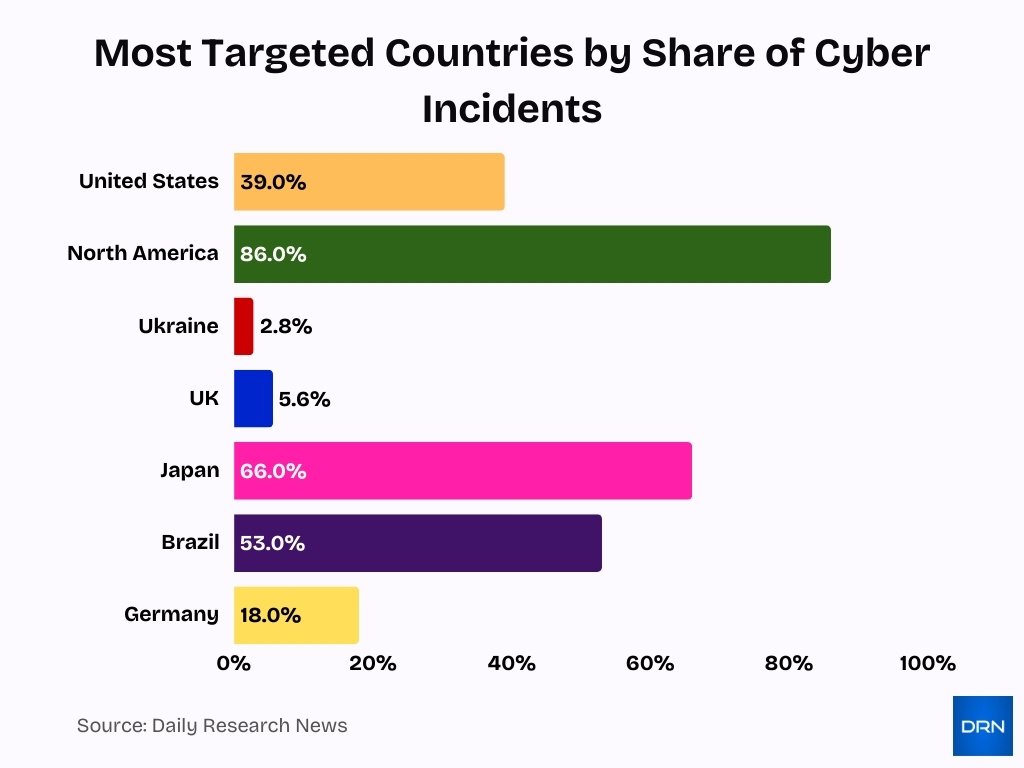
- The United States leads with 39% of global cyberattacks in 2025.
- 86% of North American cyber incidents targeted U.S.-based assets.
- Ukraine ranks fifth globally, absorbing 2.8% of worldwide cyberattacks.
- Israel faced 1,345 cyberattacks amid regional conflicts in 2025.
- India recorded 265 million malware detections across 8 million endpoints.
- Japan accounted for 66% of APAC cyber incidents in 2025.
- The UK captured 5.6% of global cyberattack volume per Microsoft data.
- Brazil led LATAM with 53% of regional cyber incidents.
- Germany represented 18% of Europe’s cyber incidents in 2025.
- Poland endures 20-50 daily cyberattacks from Russian actors.
Cyber Warfare in the Russia–Ukraine Conflict
- Russian cyber operations against Ukraine surged by nearly 70% in 2024, reaching 4,315 incidents from 2,541 in 2023.
- Over 4,300 cyber incidents targeted Ukrainian government, energy, and defense systems in 2024.
- Phishing and malware accounted for the majority of attacks, with Ukraine facing ~60% of Russian phishing campaigns.
- CERT-UA handled 4,315 incidents in 2024, confirming over 1,000 as direct cyberthreats.
- Gamaredon (UAC-0010) conducted over 270 documented attacks on government and military targets in 2024.
- Sandworm executed destructive ops like ZEROLOT wiper against Ukrainian energy infrastructure.
- Malware dominated with 58% of incidents involving ransomware and spyware for data theft.
- Government agencies faced 90% of reported cyber incidents in Ukraine during 2024.
- Allied support from the US, EU, and NATO bolstered Ukraine’s cyber defenses amid 800+ early war attacks.
Use of Cyber Warfare in Other Ongoing Conflicts
- anian hackers unleashed a****700% surge in attacks on Israeli infrastructure since June 2025.
- Extremist-aligned groups claimed****876 DDoS attacks against Middle Eastern organizations in 2024.
- Pakistan-linked actors launched over****650 cyber attacks on India’s critical infrastructure amid border tensions.
- Pro-Russian NoName057(16) targeted****3,776 unique hosts in Europe, including defense-related entities since 2024.
- Over 130 deepfakes have been identified in elections worldwide since September 2023, with AI interference rising.
- DDoS attacks comprised 65% of incidents on EU public administration sites in 2025.
- Pro-Russian hackers disrupted France’s La Poste postal services with a major DDoS attack in December 2025.
- False-flag tactics were detected in****15% of cyber operations, complicating attribution in 2025.
Most Targeted Industries and Sectors
- The education sector endured the highest cyber attack volume in Q1 2025, averaging 4,484 attacks per organization weekly.
- Government institutions faced 2,678 weekly cyber attacks per organization in early 2025.
- Telecommunications recorded a sharp 94% year-over-year surge in attacks, hitting 2,664 weekly per organization.
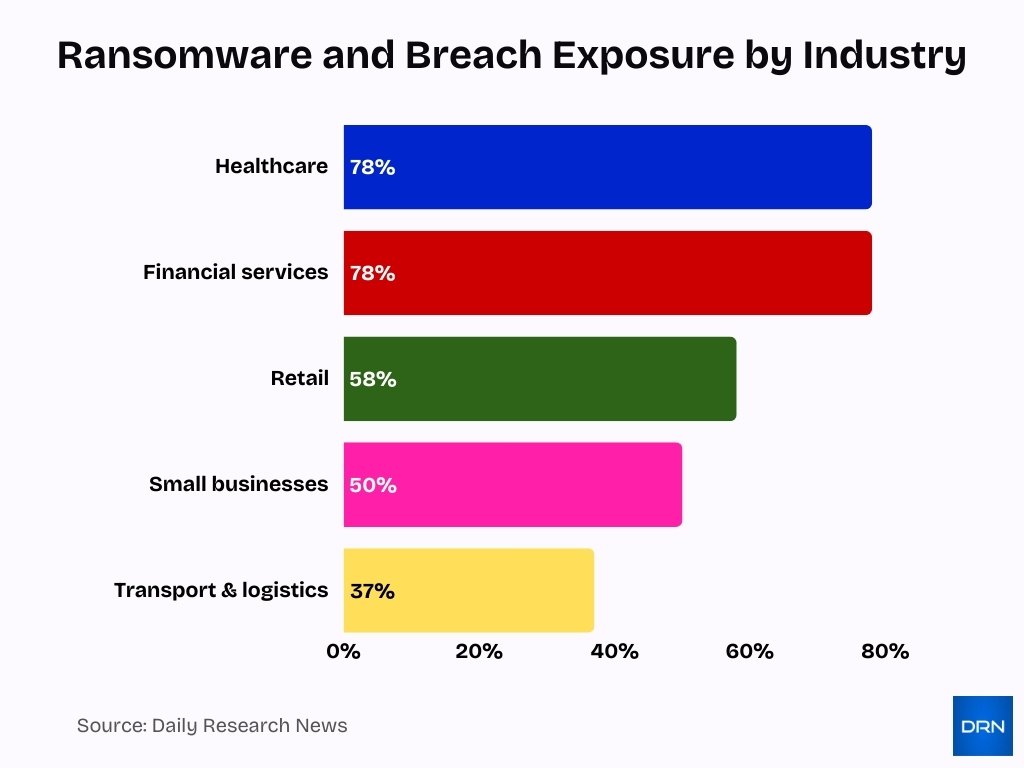
- The healthcare sector saw ransomware attempts in 78% of organizations due to sensitive patient data vulnerabilities.
- Financial services experienced ransomware in 78% of firms amid rising cyber threats.
- Retail incidents stemmed from phishing in 58% of cases during 2025 breaches.
- Small businesses comprised 50% of all global cyberattacks in recent reports.
- Transportation and logistics noted heightened reconnaissance activity with 37% growth in breaches.
- Utilities ranked among the top breached sectors, facing 126% ransomware surge in Q1 2025.
Cyber Espionage and Intelligence Gathering
- Approximately 79% of nation-state cyberattacks targeted governments, NGOs, and research institutions.
- China and Russia remained the leading sources of sophisticated cyber espionage.
- Expanded campaigns impacted 200 U.S. organizations and 80 countries.
- AI-generated decoy documents increasingly bypass traditional security controls.
- Intellectual property theft remained a primary objective of espionage campaigns.
- Phishing and credential harvesting served as common initial access points.
- Covert cyber operations overlapped with financial crime and sanctions evasion.
- Stolen data increasingly funded broader state objectives.
Cyber Terrorism and Political Influence Operations
- AI-driven influence campaigns generated over 100 fake political personas using Claude AI across Facebook and X in 2025.
- Claude AI-powered 100+ fake personas in global influence operations mimicking human behavior.
- 12.8 million+ synthetic identities fueled influence ops with $35B in fraud losses in 2025.
- The generative AI market hit $71.36 billion, driving digital influence ops expansion.
- Social engineering initiated 36% of cybersecurity incidents via human manipulation in 2025.
- DDoS attacks on Moldova’s elections blocked 14 million attempts in one night.
- Moldova’s Central Election Commission faced 898 million malicious requests in a 12-hour DDoS.
- Extremist groups received $20 million+ in North America via cryptocurrency funding.
- Hacktivist DDoS campaigns targeted U.S. government sites by groups like RipperSec in Q1 2025.
- Attribution failed in 31% of major cyber incidents due to proxy obfuscation.
Most Severe and High-Risk Cybersecurity Threats
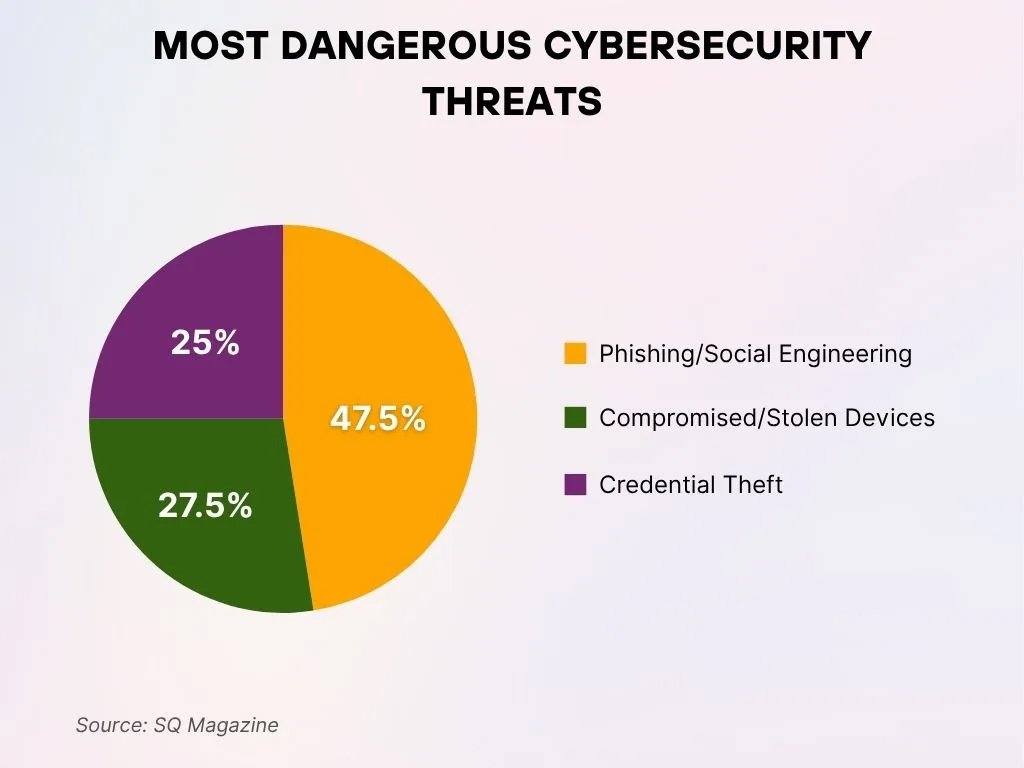
- 47.5% of cyber incidents originate from phishing and social engineering attacks, positioning them as the most prevalent and most dangerous threat vectors today.
- 27.5% of attacks result from compromised or stolen devices, highlighting the growing importance of securing both physical and remote access points.
- 25% of security breaches involve credential theft, reinforcing the critical need for robust authentication systems across organizations.
Malware, Ransomware, and Wiper Attacks in Warfare
- A ransomware attack occurred roughly every 19 seconds worldwide in 2025.
- Ransomware incidents rose 34% globally in the first nine months of 2025 versus 2024.
- Malware and ransomware comprised 37% of all cybersecurity breaches in 2025.
- Organizations faced an average of 181 days to detect malware persistence in 2025.
- Ransomware groups targeted critical sectors in 50% of 4,701 attacks through September 2025.
- Wiper malware strains like PathWiper surged in cyber warfare campaigns in 2025.
- Ransomware attacks hit 727 in November 2025, up 22% year-over-year.
- Reused malware infrastructure from RaaS platforms complicated attribution in 2025.
- Automated toolkits drove 1,984 attacks per week per organization in Q2 2025.
DDoS and Infrastructure Disruption Attacks
- Cloudflare blocked 20.5 million DDoS attacks in Q1 2025, a 358% YoY spike.
- DDoS volume grew exponentially to over six terabits in early 2025, up 350%.
- The government sector accounted for 28% of all DDoS traffic in H1 2025.
- Iran faced over 15,000 DDoS attacks during the Iran-Israel conflict, vs 279 on Israel.
- Multi-vector attacks made up 7.5% of all DDoS incidents in Q3 2025.
- IoT botnets in DDoS attacks jumped fivefold to 1 million devices.
- Azure endured a record 15.7 Tbps DDoS from the Aisuru IoT botnet in 2025.
- Cloudflare mitigated 8.3 million DDoS attacks in Q3 2025, up 40% YoY.
- The US led targets with 14.3% of global DDoS attacks in H1 2025.
Attacks on Critical Infrastructure and Utilities
- Cyber attacks on critical infrastructure surged 30% in one year, targeting energy, transportation, and utilities.
- Ransomware disabled ~1,000 computers at Romanian water utility Apele Române in 2025.
- Half of 4,701 ransomware incidents in 2025 hit critical sectors like energy and transportation, up 34% YoY.
- US utilities faced 70% jump in cyberattacks in 2024 compared to 2023.
- The energy sector saw 459% YoY increase in IoT malware attacks from 2024-2025.
- Transportation accounted for 37% of OT cyber attacks with physical consequences in 2024.
- Utilities experienced 42% surge in ransomware attacks from 2023-2024.
- Power grids saw vulnerable points grow by ~60 per day in the US.
- IoT devices faced 820,000 daily hacking attempts globally in 2025.
-
Business Logic Attacks: Risks, Awareness, and Readiness
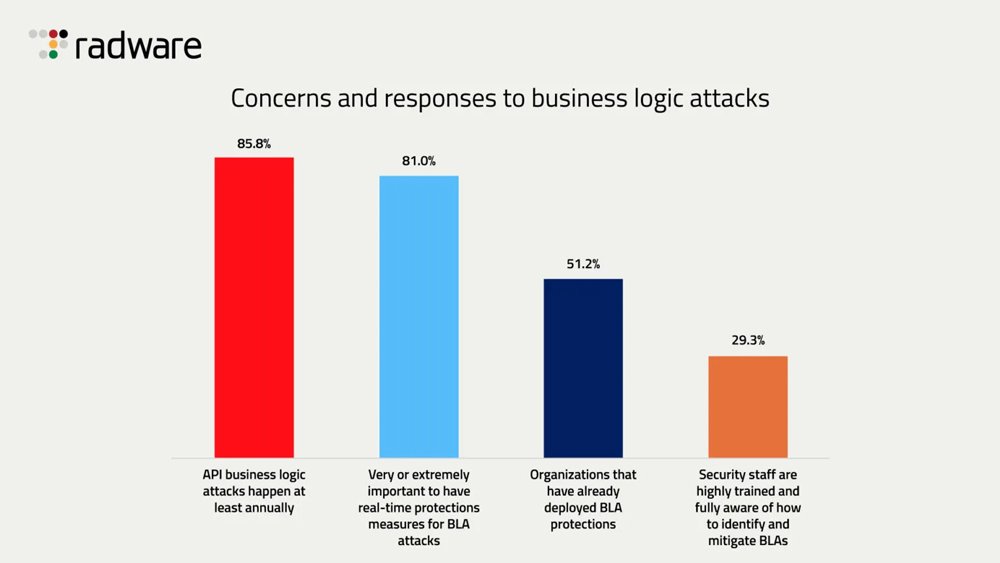
- 85.8% of organizations state that API business logic attacks take place at least once a year, highlighting their high frequency and persistent threat level.
- 81.0% of respondents consider it very or extremely important to deploy real-time protection measures to defend against business logic attacks (BLAs).
- Only 51.2% of organizations have already implemented BLA protection, indicating that many remain insufficiently prepared.
- Merely 29.3% of security teams are highly trained and fully aware of how to detect and mitigate business logic attacks effectively.
Government and Military Network Breaches
- Government cyberattacks rose 138% in India from 85,797 incidents in 2019 to 204,844 in 2023.
- US federal agencies reported 32,211 information security incidents in fiscal year 2023.
- Stolen credentials enabled 49% of all analyzed breaches per Verizon’s 2023 report.
- The Minnesota National Guard deployed for 17 days to aid St. Paul after a July 2025 cyberattack.
- AI-enabled operations comprised 34% of nation-state cyber incidents in 2025.
- Government organizations faced 24% of all reported cyberattacks in 2025.
- States activated the National Guard for cyber assistance at least 41 times since 2018.
- 88% of certain breach patterns involved stolen credentials in the 2025 DBIR.
- Russian group stole 4TB of UK MoD contractor data, including RAF base files, in October 2025.
Economic Costs of Cyber Warfare
- Global cybercrime costs reached $10.5 trillion in 2025.
- The average global data breach cost is measured at $4.45 million.
- Incident response, fines, and downtime drove financial impact.
- Manufacturing, healthcare, and utilities faced the highest remediation costs.
- Many small businesses failed within six months after major breaches.
- Reputational damage caused long-term revenue loss.
- Governments increased cybersecurity spending to counter threats.
- Widespread cyber conflict reduced investor confidence.
Cyber Warfare Readiness by Region
- North America generated $86.9 billion in cybersecurity revenue in 2024, leading global markets.
- The United States and Western Europe accounted for over 70% of worldwide security spending in 2025.
- East Asian nations like Thailand, Vietnam, and Singapore faced 68% of regional cyberattacks in 2024.
- Asia-Pacific recorded over 57,000 ransomware attacks in early 2024 amid state threats.
- Latin America confronts a 515,000–701,000 cybersecurity workforce shortage.
- Africa holds many nations in Tier 4–5 of the Global Cybersecurity Index with low maturity scores.
- 19 of 32 NATO members established dedicated military cyber defense units, according to recent counts.
- 105 countries, mostly developing, are ranked in Tier 3–4, lacking mature cyber strategies globally.
- Public-private partnerships control 85% of critical infrastructure, central to cyber readiness.
- The global cybersecurity workforce gap hit 4.8 million vacancies, slowing defense growth.
Frequently Asked Questions (FAQs)
Global cybercrime damage is projected to total about $10.5 trillion annually by 2025.
The average cost of a data breach in 2025 reached approximately $4.45 million globally.
The U.S. endured an estimated 227 major state‑sponsored cyber incidents in 2025, the highest worldwide.
India experienced more than 265 million cyberattack incidents in 2025.
Conclusion
Cyber warfare represents a sustained and escalating global threat. Statistical trends show rapid growth in ransomware, AI-enabled attacks, and targeted campaigns against governments, militaries, and critical infrastructure. Economic losses continue to mount, while readiness varies significantly by region. As digital systems become more interconnected, the data underscores the urgency for stronger defenses, international cooperation, and long-term resilience strategies to manage the realities of modern cyber conflict.