

Cybersecurity risks continue to sharpen as digital transformation accelerates across industries. Businesses face increasingly sophisticated threats that exploit cloud systems, AI tools, and human vulnerabilities. For example, global regulators processed an average of 443 breach reports per day in 2025, a 22% increase from the prior year. Real-world impacts are visible in breaches like the Under Armour incident that exposed 72.2 million accounts and a ransomware attack at Ingram Micro affecting over 42,000 individuals.
These events ripple across sectors, influencing risk strategies, insurance costs, and security investments. Explore the latest data below to understand how cybersecurity threats and defenses are evolving.
Editor’s Choice
- Global cybercrime costs are projected to reach approximately $10.5 trillion annually by 2025, marking an ongoing rise.
- The average global cost of a data breach in 2025 was about $4.44 million.
- In the U.S., breach costs often exceed $10 million per incident in heavily regulated sectors.
- Ransomware was involved in 44% of breaches in 2025, up from roughly 32% in 2024.
- 443 daily breach reports were filed with EU regulators in 2025, the highest since GDPR took effect.
- Phishing emails surged by more than 17% in late 2024 through 2025 and are increasingly sent from compromised trusted accounts.
- AI‑linked techniques appeared in an estimated 16% of breaches in 2025, reflecting emerging threat vectors.
Recent Developments
- 72% of organizations believe cyber risk increased over the past year.
- Breach reporting increased sharply in 2025 thanks to new regulations and attack volume.
- AI‑driven attacks and automation tactics are emerging as notable trends in threat reports.
- Over €1.2 billion in GDPR fines were issued in 2025, underscoring enforcement focus.
- High‑profile ransomware and data breaches continue to hit global brands into late 2025.
- Cybercrime actors are refining social engineering methods, exploiting credential theft and phishing.
- Increased global collaboration among cybersecurity agencies is shaping deterrence strategies.
- Small business cyberattack rates remain elevated, attracting growing policy attention.
Key Cybersecurity Drivers
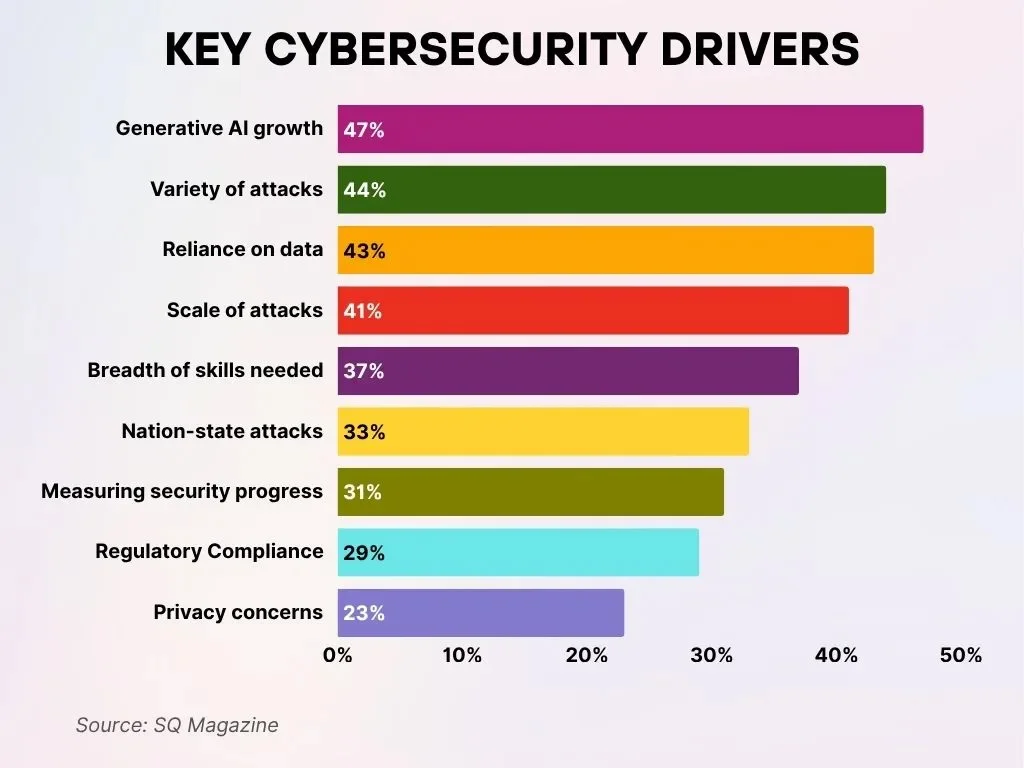
- Generative AI expansion is the leading cybersecurity catalyst, with 47% of respondents citing it as a major factor shaping their overall security strategies.
- A wide spectrum of cyberattacks is forcing organizations to evolve their defenses, as 44% highlight the growing variety of attacks as a key concern.
- 43% of cybersecurity professionals are influenced by the rising dependence on data, reinforcing data protection as a critical organizational priority.
- The increasing scale of cyberattacks continues to intensify pressure on security teams, with 41% identifying it as a significant operational challenge.
- A persistent skills shortage remains a major obstacle, as 37% point to the expanding breadth of expertise required to counter modern cyber threats.
- Nation-state cyber activity is becoming a growing concern, shaping the cybersecurity agenda for 33% of respondents.
- 31% of organizations face difficulties in measuring security effectiveness, emphasizing the need for improved metrics and visibility.
- Regulatory compliance continues to act as a strong cybersecurity driver, with 29% stressing its influence on security planning and execution.
- Privacy-related risks, although still relevant, rank lower overall, with 23% citing them as a primary driver behind cybersecurity initiatives.
Cost of Cybercrime
- Global cybercrime losses are projected at $10.5 trillion in 2025.
- Cost estimates represent year‑over‑year increases as threats grow more complex.
- Average data breach costs globally sat at $4.44 million in 2025.
- In the U.S., data breach costs often exceed $10 million per incident in many sectors.
- Ransomware‑related disruption and recovery costs average several million dollars per incident.
- Small businesses collectively lose billions annually due to cybercrime impacts.
- Global enforcement fines like GDPR penalties add billions in financial consequences.
- Reduced ransomware payments due to refusal and enforcement may shift overall cost profiles.

Cyber Attack Frequency
- Ransomware is involved in 44% of breaches in 2025, a marked increase over prior years.
- Phishing emails and complaints remain among the highest‑frequency attack types.
- Daily breach reports in Europe averaged 443 per day in 2025.
- An estimated 3.4 billion phishing emails are sent daily.
- SMBs are targeted in 61% of cyberattacks globally.
- Credential compromise vectors, including business email compromise, remain prevalent.
- Data breach disclosures include millions of exposed records in major incidents.
Data Breach Statistics
- Major breaches in late 2025 affected millions of records across sectors.
- December 2025 breaches included approximately 3.5 million University of Phoenix records stolen.
- The average global breach cost was $4.44 million in 2025.
- There was a 22% increase in breach notifications in the EU in 2025.
- Ransomware‑linked breaches comprised nearly 44% of total incidents in 2025.
- Regulatory pressure for disclosure continues to increase globally.
- Breach volumes and impacts vary widely across industries and regions.
- The healthcare and education sectors saw elevated breach counts in recent reporting.
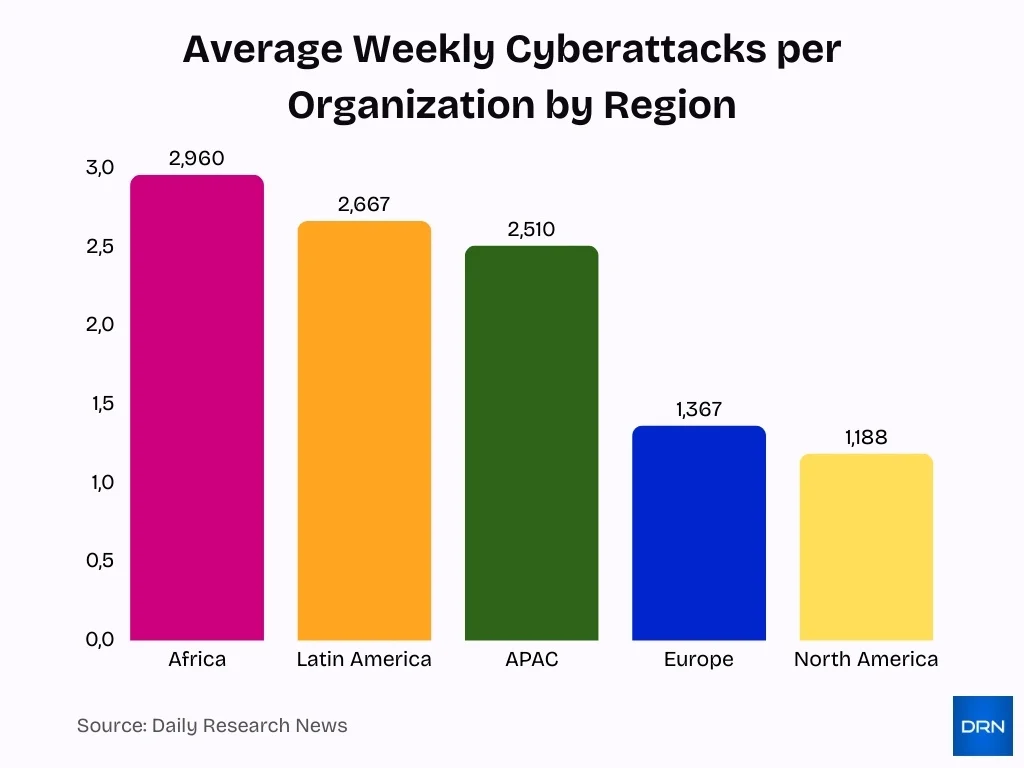
Rising Cyberattack Pressure Across Global Regions
- Africa recorded the highest average weekly cyberattacks per organization at 2,960, reflecting a sharp +37% YoY increase, signaling rapidly growing threat exposure.
- Latin America saw the fastest year-over-year growth, with attacks rising +53% to an average of 2,667 weekly attacks per organization.
- The APAC region experienced 2,510 attacks per organization per week, alongside a +23% YoY increase, highlighting expanding digital risk across emerging and mature markets alike.
- Europe reported 1,367 weekly attacks per organization, with a notable +35% annual increase, indicating intensifying threat activity despite stronger regulatory frameworks.
- North America had the lowest attack volume among the listed regions at 1,188 weekly attacks per organization, yet still faced a +17% YoY rise, showing that no region is immune.
Ransomware Statistics
- Ransomware was present in about 44% of breaches in 2025, up from roughly 32% in 2024.
- The median ransom demand was around $115,000, yet 64% of victim organizations refused to pay attackers in 2025.
- Global ransomware attacks rose by 32% in 2025, with reported incidents increasing from 5,631 in 2024 to 7,419.
- Ransomware activity climbed by 34% year‑over‑year in the first three quarters of 2025.
- U.S. ransomware incidents were up 50% in the first 10 months of 2025 compared to 2024.
- Up to 85% of ransomware attacks go unreported, suggesting a much larger underground footprint.
- SMBs were targeted in around 70% of ransomware cases.
- 60% surge in ransomware attacks was observed in early to mid-2025 in certain sectors.
Phishing and Social Engineering Statistics
- Phishing remains a dominant attack vector globally, with billions of phishing emails sent daily.
- Phishing emails increased by 17.3% between late 2024 and early 2025.
- Attacks from previously compromised accounts rose by 57.9% in the same period.
- Phishing is frequently the primary initial access vector for ransomware.
- AI‑assisted phishing campaigns are generating highly convincing messages at scale.
- Adversary‑in‑the‑middle phishing attacks are rising in critical sectors like energy.
- Phishing constitutes a major share of social engineering attacks.
- The human factor contributes to ~60% of cybersecurity breaches.
Malware and Virus Statistics
- Malware continues to be a pervasive threat through payloads like infostealers, loaders, and trojans.
- Infostealers were tied to over 2.1 billion compromised credentials in 2024.
- Malware remains a key factor in ransomware distribution.
- Malware families and malicious URLs are increasingly used for credential theft.
- 3.7 billion URL‑based threats were documented over six months.
- Smishing and mobile-based social engineering surged by 2,500%.
- Malicious URLs outpaced traditional attachments as malware delivery methods.
- Fileless execution and in‑memory malware techniques are increasing in use.
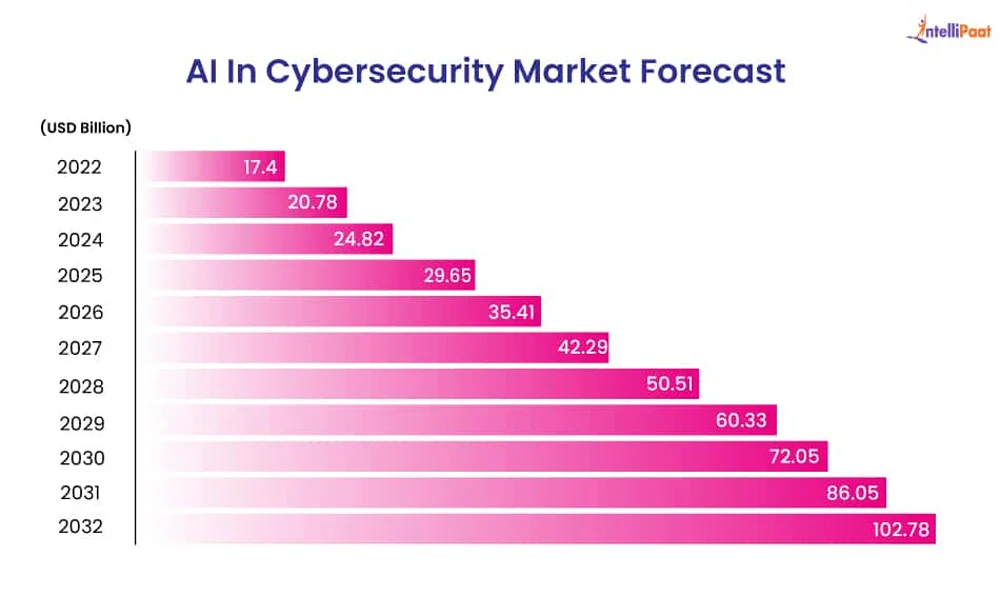
AI in Cybersecurity Market Growth
- The AI in cybersecurity market was valued at $17.40 billion in 2022, marking the early phase of large-scale AI adoption in security solutions.
- Market size increased to $20.78 billion in 2023, reflecting rising demand for automated threat detection and response.
- In 2024, the market reached $24.82 billion, driven by wider enterprise adoption of AI-powered security platforms.
- The market is projected to grow to $29.65 billion in 2025, supported by increased investments in machine learning-based cyber defense.
- By 2026, AI cybersecurity spending is expected to hit $35.41 billion, highlighting strong momentum across industries.
- The market is forecasted to reach $42.29 billion in 2027, fueled by the growing need for real-time threat intelligence.
- In 2028, the market size is estimated at $50.51 billion, signaling accelerated deployment of AI-driven security automation.
- AI in cybersecurity revenue is projected to rise to $60.33 billion in 2029, as cyberattack sophistication continues to increase.
- By 2030, the market is expected to reach $72.05 billion, reflecting widespread adoption across cloud and enterprise environments.
- The market is forecasted to grow to $86.05 billion in 2031, driven by regulatory pressure and zero-trust security models.
- By 2032, the global AI in cybersecurity market is projected to surpass $102.78 billion, underscoring AI’s critical role in future cyber defense strategies.
Business Email Compromise Statistics
- Business Email Compromise (BEC) attacks accounted for 73% of all cyber incidents in 2024.
- Organizations targeted by BEC face average losses of $4.67 million per attack.
- BEC was responsible for 8.5% of all data breaches.
- BEC attacks have cost businesses more than $55 billion over the past decade.
- BEC remains a major vector tied to financial fraud and invoice manipulation.
- Credential theft surged 160% in 2025, contributing to BEC risk.
- Rising email security failures impact healthcare and other sectors.
- Pretexting and BEC have overtaken classic phishing in some incidents.
Cloud Security Statistics
- 61% of companies experience at least one cloud attack per year.
- 21% of cloud security incidents result in data breaches.
- 27% of organizations report public cloud security issues.
- Over half of cloud breaches are linked to human error.
- Cloud misconfiguration accounts for 23% of incidents.
- Phishing often targets cloud credentials for deeper compromise.
- Identity and credential abuse drive unauthorized cloud access.
- Cloud infrastructure remains a top target across industries.
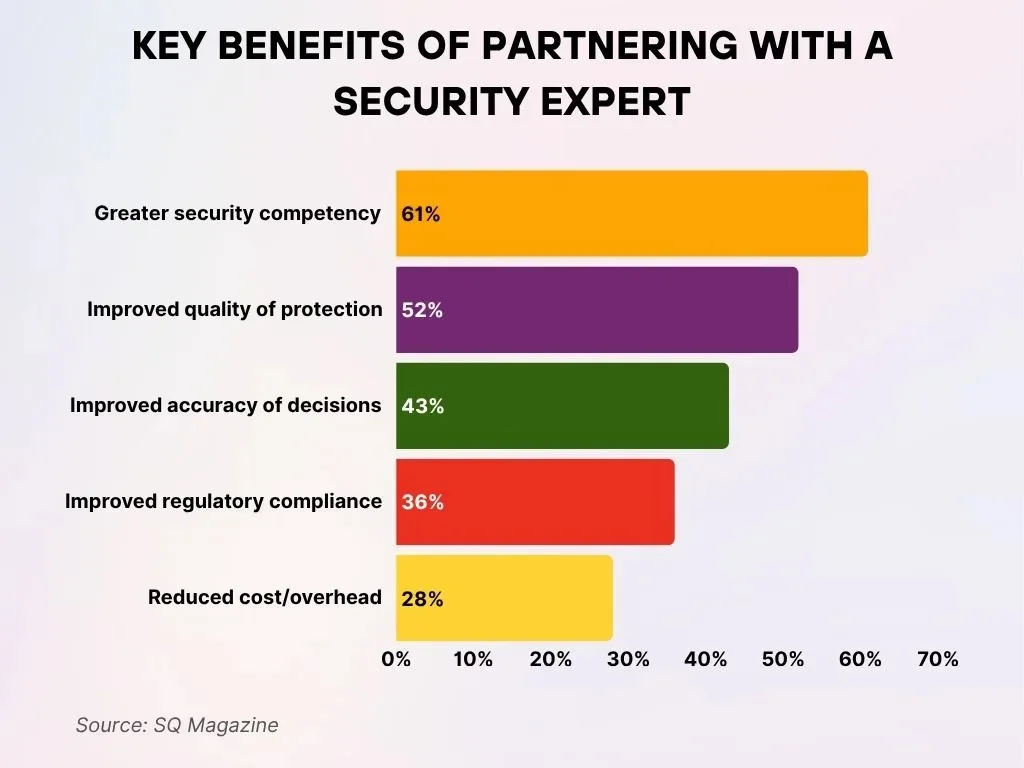
Key Advantages of Collaborating with a Security Specialist
- 61% of organizations identified stronger security expertise as the leading benefit of collaborating with a security expert, highlighting improved internal capabilities and knowledge depth.
- 52% reported enhanced quality of protection, emphasizing more robust defense systems, stronger safeguards, and improved threat prevention mechanisms.
- 43% experienced greater decision-making accuracy, reflecting more data-driven, well-informed cybersecurity strategies across the organization.
- 36% observed improved regulatory compliance, enabling organizations to better align with evolving industry regulations and standards.
- 28% achieved lower costs and reduced overhead, demonstrating that expert partnerships can also drive operational efficiency and cost optimization.
Identity and Access Management Statistics
- Credential access accounted for 75% of malicious activity in 2025.
- Account compromise surged 389% year-over-year, comprising 55% of all attacks.
- 63% of account compromises used PhaaS kits to bypass MFA.
- 44% of valid cloud security alerts stemmed from identity weaknesses.
- 99% of cloud identities are over-privileged, enabling escalation.
- 91% of organizations faced an identity-related breach recently.
- 54% of ransomware victims had credentials in infostealer logs prior.
- 160% increase in compromised credentials detected in 2025.
- 33% of all cloud alerts are related to identity issues.
- The IAM market reached $21.8 billion by 2025.
Endpoint and Network Security Statistics
- Endpoint threats remain a frontline concern across sectors.
- Infostealers harvest credentials from endpoints at scale.
- Malicious URL attacks and remote access tools are frequent threats.
- Credential stuffing and botnets drive lateral movement in networks.
- Legacy protocols and unpatched systems are common intrusion paths.
- Zero‑day and fileless malware are used to evade endpoint defenses.
- Segmentation failures often lead to broader compromise.
- Strong EDR capabilities correlate with faster incident containment.
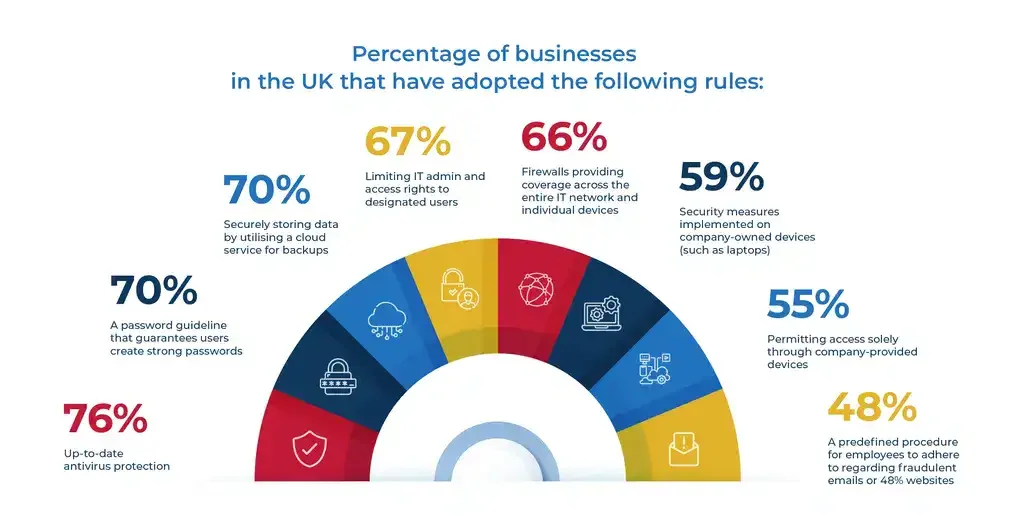
UK Business Adoption of Cybersecurity Measures
- 76% of UK businesses confirm they maintain up-to-date antivirus protection, making it the most widely adopted cybersecurity measure.
- 70% of organizations rely on cloud services for secure data backups while enforcing strong password guidelines across systems.
- 67% of companies restrict IT administrator privileges and access rights to designated users to minimize internal security risks.
- 66% implement firewalls across entire networks as well as individual devices to ensure broader protection coverage.
- 59% apply cybersecurity controls specifically on company-owned devices, including employee laptops.
- 55% allow system access only through company-provided devices, strengthening endpoint security and operational control.
- 48% have a predefined employee procedure in place for handling fraudulent emails and malicious websites.
Third‑Party and Supply Chain Risk Statistics
- 54% of organizations experienced a breach via third parties in the past two years.
- Supply chain attacks rose by more than 40% in 2025.
- Enterprises work with over 3,000 third‑party vendors.
- Only 17% of companies rate their third‑party risk programs as effective.
- Software supply chain attacks made up nearly 20% of major breaches.
- Continuous vendor monitoring rose to 46% in 2025.
- Third‑party breaches take 28% longer to detect than internal ones.
- Regulatory scrutiny of vendor risk is increasing.
Insider Threat Statistics
- 83% of organizations reported at least one insider incident in 2025.
- Negligent insiders account for over 55% of incidents.
- Insider breaches cost $15.4 million annually per organization.
- Credential misuse is the leading insider threat vector.
- Remote work increased insider risk by approximately 20%.
- 34% of insider incidents involved former employees with access.
- User behavior analytics adoption rose to 41% in 2025.
- Financial and healthcare sectors face the most insider threats.
Cybersecurity Concerns Around Generative AI
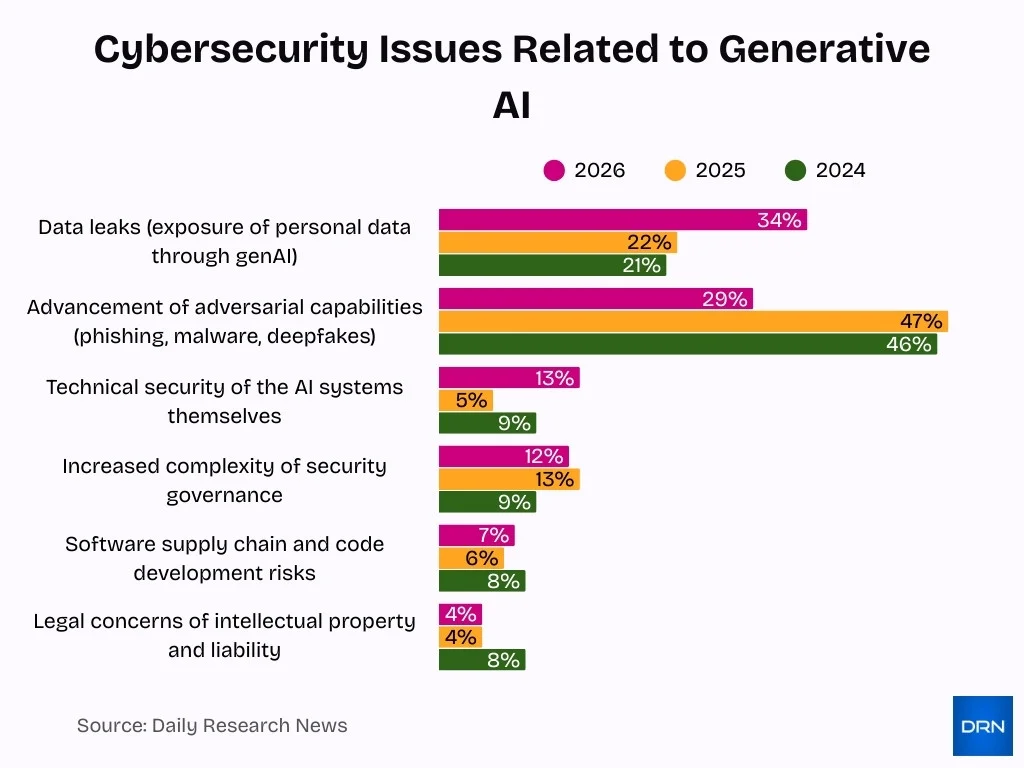
- Adversarial AI threats such as phishing malware and deepfakes remain the top concern, affecting 46% in 2024 and peaking at 47% in 2025, before easing to 29% in 2026.
- Data leaks and personal data exposure via generative AI rise sharply to become the leading concern in 2026 at 34%, up from 21% in 2024 and 22% in 2025.
- Technical security of AI systems themselves gains urgency in 2026 (13%), more than doubling from 5% in 2025, reflecting growing focus on model and infrastructure security.
- Security governance complexity remains a moderate but persistent issue, cited by 9% in 2024, 13% in 2025, and 12% in 2026.
- Software supply chain and code development risks, including potential backdoors, stay comparatively lower at 8% in 2024, 6% in 2025, and 7% in 2026.
- Legal and intellectual property concerns decline over time, dropping from 8% in 2024 to 4% in both 2025 and 2026, indicating reduced perceived risk.
IoT and OT Security Statistics
- Connected IoT devices surpassed 17 billion globally in 2025.
- Over 50% of IoT devices lack basic security controls.
- 23% increase in OT‑focused incidents was reported in manufacturing and energy.
- 75% of organizations say IoT is harder to secure than IT assets.
- OT vulnerabilities take nearly twice as long to patch.
- IoT botnets drove DDoS attacks up over 30% year over year.
- Critical infrastructure cybersecurity is under increased regulation.
- Asset visibility is the top OT security challenge.
Cybersecurity Skills Gap and Workforce Statistics
- The global cybersecurity workforce gap hit approximately 4 million in 2025.
- The U.S. has over 500,000 open cyber roles.
- 70% of organizations say talent shortages increase risk.
- Entry‑level salaries rose by 8% year over year.
- Only 18% of organizations feel adequately staffed.
- Automation and AI are used to offset staffing gaps.
- Women make up less than 25% of the cyber workforce.
- The biggest skill shortages are in cloud, identity, and threat intel.
Average Cost of a Data Breach by Industry
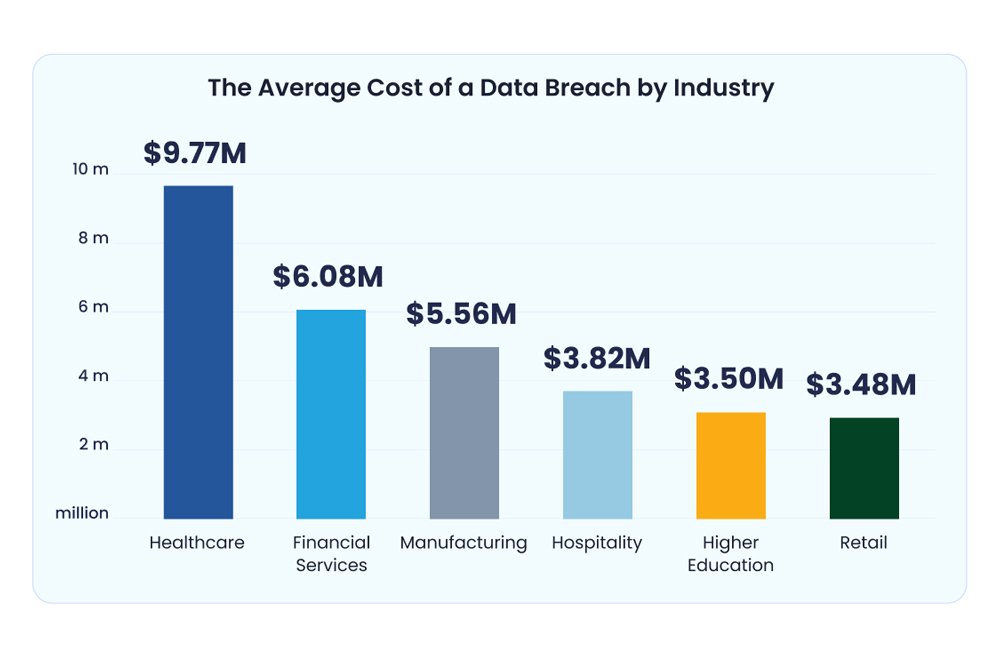
- Healthcare faces the highest average data breach cost at $9.77 million, highlighting its extreme exposure due to sensitive patient data and strict compliance requirements.
- Financial Services ranks second, with an average breach cost of $6.08 million, driven by high-value financial data and regulatory penalties.
- Manufacturing organizations incur an average breach cost of $5.56 million, reflecting rising risks tied to intellectual property and operational disruption.
- Hospitality reports a comparatively lower but still significant average breach cost of $3.82 million, often linked to customer payment and loyalty data.
- Higher Education institutions experience an average data breach cost of $3.50 million, largely due to decentralized IT environments and open networks.
- Retail records the lowest average breach cost at $3.48 million, though frequent attacks and large customer volumes still pose substantial risk.
Cybersecurity Market Size and Spending Statistics
- Cybersecurity spending reached $215 billion in 2025.
- Forecasts project over $240 billion in 2026.
- The U.S. accounts for about 40% of global cybersecurity spending.
- Cloud security spending rose by over 25% year over year.
- Identity and access management is the fastest‑growing segment.
- SMB cybersecurity budgets grew by an average of 12%.
- Cyber insurance premiums continue to rise.
- Government cybersecurity spending increased across sectors.
Future Cybersecurity Trends and Forecast Statistics
- AI‑driven cyberattacks are expected to rise significantly through 2026.
- By 2027, over 50% of enterprises will adopt Zero Trust as a core strategy.
- Compliance costs are forecast to grow double‑digit rate annually.
- Ransomware will remain dominant, but payment rates are falling.
- Quantum‑resistant cryptography adoption will rise by 2026–2027.
- Cyber resilience is becoming a top boardroom priority.
- Automation will handle up to 40% of SOC tasks by 2027.
- Supply chain security remains a top priority.
Frequently Asked Questions (FAQs)
The global cybersecurity market is estimated to be $264.43 billion in 2026, up from $235.5 billion in 2025, growing at around 12.28% CAGR through 2031.
Global cybercrime damages are projected to reach approximately $10.5 trillion annually by the end of 2025.
Ransomware was involved in 44% of breaches in 2025, up from roughly 32% in 2024.
The average global cost of a data breach in 2025 was about $4.4 million, with U.S. incidents often exceeding $10 million.
Conclusion
Cybersecurity reflects a landscape defined by scale, complexity, and urgency. From rising ransomware and supply chain threats to widening workforce gaps and accelerating Zero Trust adoption, the data shows organizations must balance technology, people, and process more carefully than ever. While global spending continues to grow, the most effective strategies increasingly focus on identity security, resilience, and risk visibility rather than perimeter defense alone.
For U.S. organizations operating in a globally connected environment, these statistics provide a clear signal that proactive investment and informed decision‑making will define who stays secure in the year ahead.