


Digital marketing has become the backbone of brand strategy across industries, from retail chains deploying mobile-first campaigns to B2B software providers leveraging SEO to drive lead generation. For example, a fast-moving consumer goods (FMCG) firm can use short-form video ads to boost seasonal sales, while an enterprise SaaS company might optimise organic search rankings to reduce cost per acquisition. Below is a detailed dive into the most current numeric data behind these shifts.
Editor’s Choice
Here are seven standout statistics that offer a snapshot of the digital marketing landscape today:
- The global digital marketing and advertising market is estimated at $683.5billion in 2025.
- On average, businesses earn $5 for every $1 spent on digital marketing.
- The SEO services market alone is projected to $72.31 billion in 2025.
- Approximately 58% of small businesses now rely on digital channels to connect with customers.
- By 2026, 69% of total ad spending is expected to come via mobile devices.
- 83% of marketing leaders list demonstrating ROI as a top priority, but only 36% say they can confidently measure it.
- The content marketing industry worldwide is estimated to be at $524.7 billion globally in 2025.
Recent Developments
- About 59% of marketers plan to increase their partnerships with influencers in 2025 compared to 2024.
- 76% of social-media users say social content influenced a purchase decision, and for Gen Z users, it jumps to 90%.
- Programmatic advertising is expected to account for 87% of digital-ad revenue by 2026.
- The shift to mobile continues, as of 2023, smartphones held 61% of ad-spend share, projected to reach 69% by 2026.
- Marketers cite organic search as having the best ROI, 49%.
- Global digital ad sales are projected to total $786 billion in 2025, up about 8% from 2024.
- 63% of marketers say generative AI is already a part of their toolkit.
- The U.S. digital-advertising market is projected at roughly $404.7 billion in 2025.
Forecasted Global Market Size of Digital Marketing
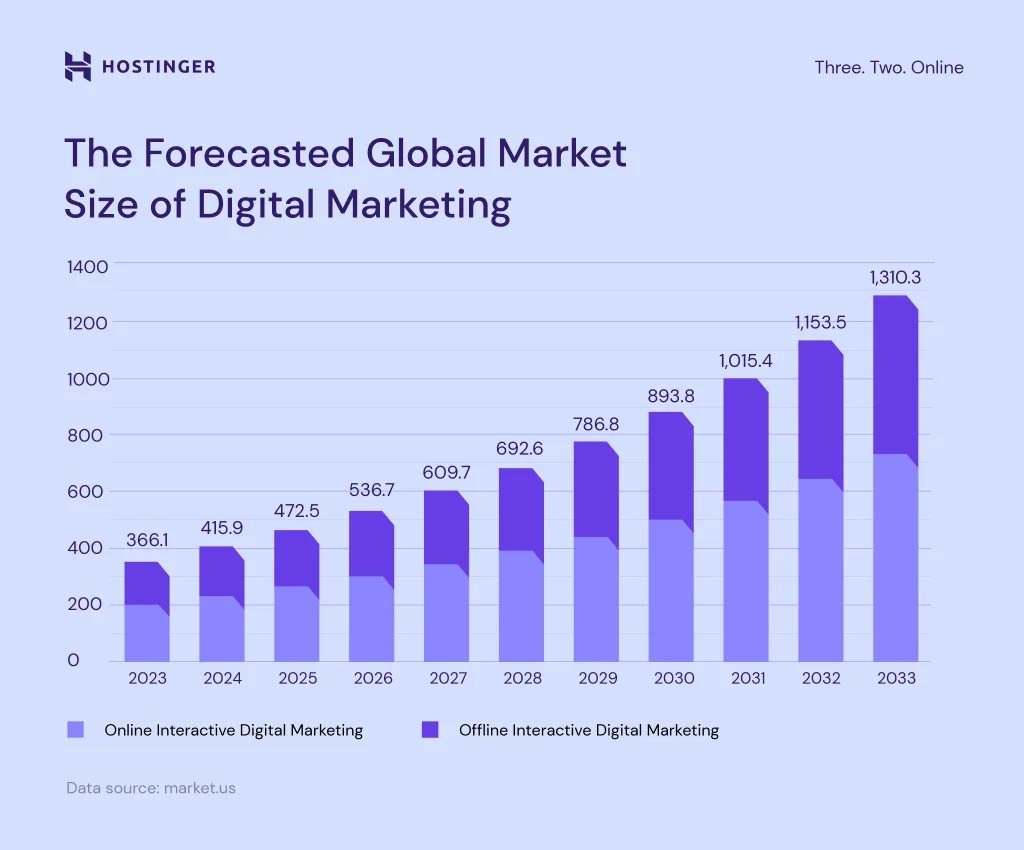
- The forecasted global market size of digital marketing is projected to reach $1,310.3 billion by 2033, as digital marketing continues its strong growth trajectory.
- In 2023, the market was valued at $366.1 billion, marking the starting point of a decade-long surge.
- By 2025, it is expected to hit $472.5 billion, showing how rapidly the sector is gaining momentum.
- In 2028, forecasts place the value at $692.6 billion, which is nearly double the 2023 figure in just five years.
- By 2030, the market could reach $893.8 billion, with growth fueled by widespread digital transformation across sectors.
- The 2031 estimate stands at $1,015.4 billion, marking the first time the market surpasses the $1 trillion threshold.
- Both offline and online segments are growing, but online marketing leads as investment trends shift toward digital-first strategies.
- The market climbs steadily year over year, reflecting the growing global reliance on digital channels.
Search Engine Optimization (SEO) Statistics
- The global SEO market is estimated at $72.31 billion in 2025 and projected to reach $106.15 billion by 2030, at a CAGR of 7.98%.
- More than 49% of marketers say organic search offers the best ROI.
- Approximately 93% of website traffic originates from search engines in some reports.
- For businesses that blog regularly, 82% report positive ROI from inbound marketing efforts.
- The top obstacle for SEO in 2025 is algorithm updates and evolving search-intent dynamics.
- 61% of marketers say improving SEO and growing organic presence is their top inbound priority.
- The cost of content marketing is 62% less than traditional methods, according to some sources.
- Nearly 70% of marketers plan to increase their content-marketing budget to support SEO.
- In U.S. monthly budgets for SEO services, many companies are spending over $500 and report higher satisfaction when doing so.

Content Marketing Statistics
- The global content marketing industry is estimated at $524.7 billion globally in 2025, growing about 10.4% in 2026.
- 72% of marketers believe their content strategy has increased engagement and traffic.
- 91% of brands now use video as a marketing tool.
- 90% of marketers say video content has generated a measurable ROI.
- 87% of marketers believe video content directly impacts sales.
- 49% of Gen Z TikTok users report purchasing via the platform after seeing brand content.
- More than 90% of brands are using social media as part of their content-marketing mix.
- Short-form video is the fastest-growing format, with more than 54% of consumers preferring brands that use video.
- Blogging, social media posts, and case studies remain in the top 3 content tactics according to recent surveys.
Social Media Marketing Statistics
- 91% of businesses use social media for marketing purposes.
- 76% of social-media users say that social content influenced a purchase decision.
- For Gen Z users on social platforms, that figure rises to 90%.
- The global social-media advertising market is expected to grow by 12% in 2025.
- The average social-media ad spend per user is about $45.11 in 2025.
- Up to 83% of marketing leaders consider ROI demonstration a key challenge in social campaigns.
- More than 59% of marketers plan to increase influencer partnerships in 2025.
- Short-form video dominates, with more than 54% of consumers preferring brand content in video format on social platforms.
- Over 70% of marketers say generating traffic and leads through social content remains a top challenge.
Effectiveness of Stories in Social Media Strategy
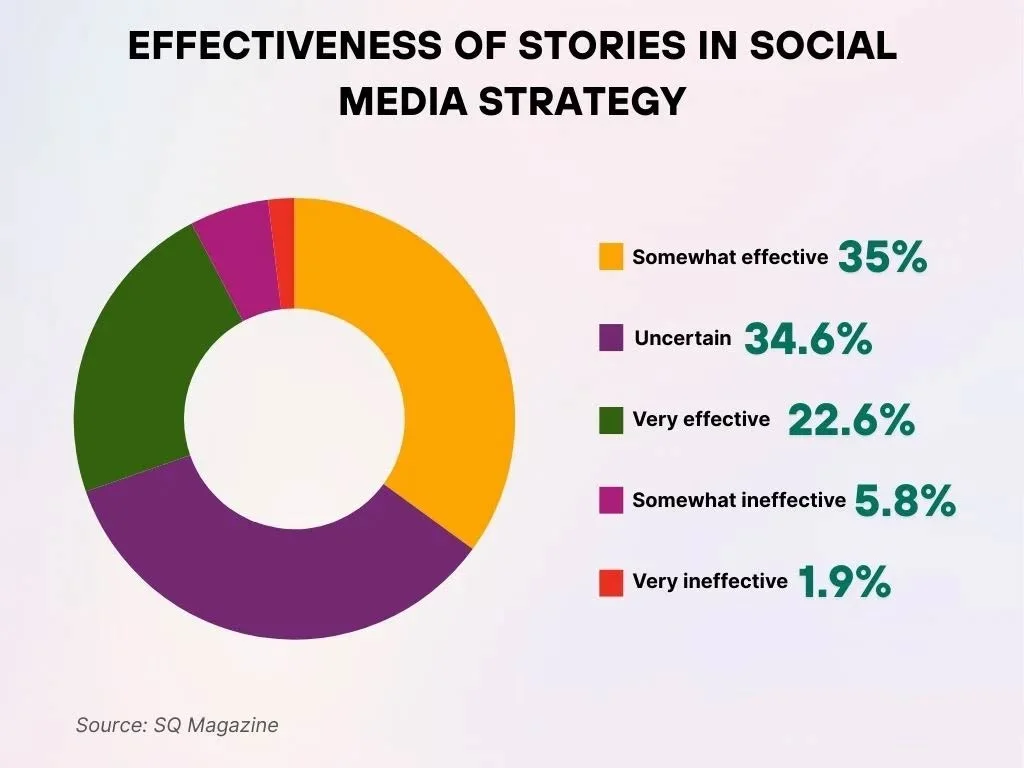
- 35% of respondents report that stories are somewhat effective in contributing to their overall social media strategy, maintaining the same level of effectiveness indicated in the original statement.
- 34.6% of participants state that they are uncertain regarding the effectiveness of incorporating stories into their social media strategy, preserving the full meaning of the initial data point.
- 22.6% express that stories are very effective for achieving meaningful engagement and delivering strong results, fully reflecting the sentiment of the original wording.
- Only 5.8% of respondents feel that stories are somewhat ineffective within their broader social media strategy, retaining all original details and emphasis.
- A minimal 1.9% consider stories to be very ineffective in terms of contributing positively to their strategy, accurately mirroring the intent of the initial sentence.
Email Marketing Statistics
- There are about 4.48 billion email users worldwide in 2025, up from 4.37 billion in 2023.
- Email marketing campaigns deliver an average ROI of roughly 3,600%, $36 return per $1 spent in 2025.
- 99% of email users check their inbox daily.
- 59% of consumers say marketing emails have influenced their purchase decisions.
- Email remains the top channel; 79% of B2B marketers say it’s their most successful content-distribution channel.
- About 44% of marketing professionals say email is their most effective marketing channel.
- Segmenting email lists drives around 30% more opens and 50% more click-throughs.
- 66% of all email opens occur on mobile devices.
- The average marketing email budget for businesses is about 7.8% of total marketing spend.
- For e-commerce, email drives about $40 in revenue for every $1 spent.
Video Marketing Statistics
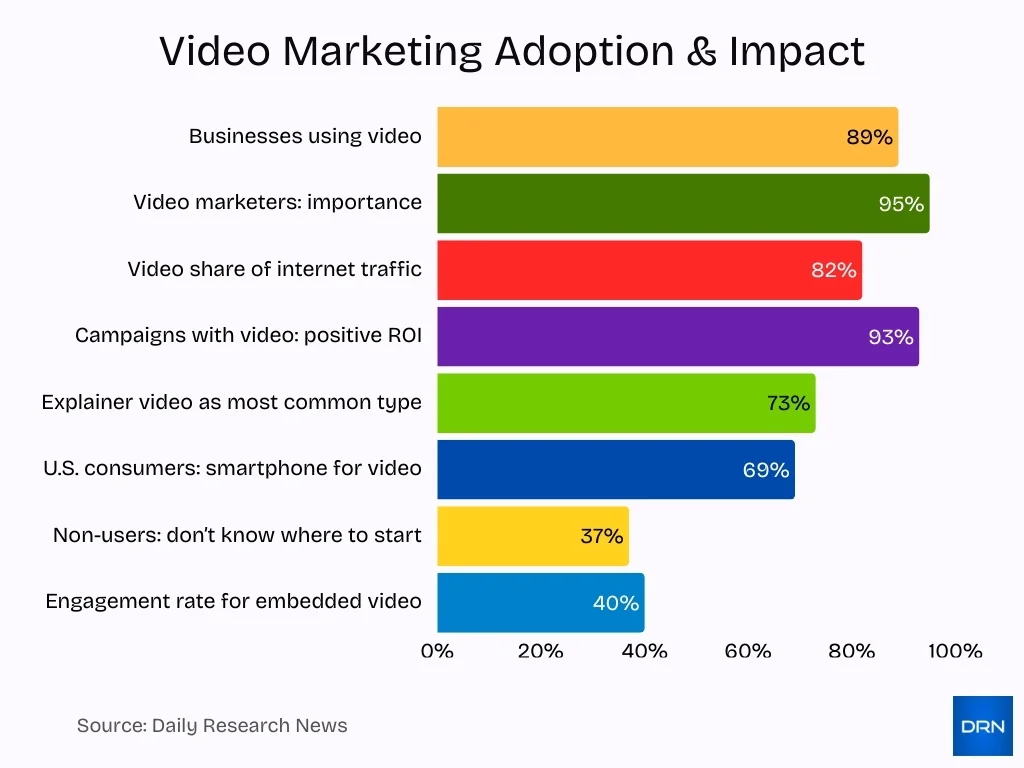
- 89% of businesses use video as a marketing tool in 2025.
- 95% of video marketers say video is important in their overall strategy in 2025.
- Video content is expected to make up around 82% of all internet traffic by 2025.
- Video marketing campaigns deliver positive ROI in 93% of cases in early 2025.
- Websites using video content see average conversion rates of about 4.8%, versus 2.9% for those without video.
- Short-form video spending globally is projected at around $111 billion in 2025, approximately 12% year-over-year growth.
- In marketing use-cases, 73% of businesses say they use explainer videos, making it the most common video type.
- 69% of U.S. consumers say smartphones are their most-used device for watching videos.
- Among the businesses not using video in 2025, 37% say the main reason is that they don’t know where to start.
- The average engagement rate for videos embedded in blogs or landing pages exceeds 40%.
Mobile Marketing Statistics
- Global mobile ad spending is projected to exceed $228 billion in 2025.
- 63% of U.S. Google searches happen on mobile devices.
- Mobile devices account for more than half of annual website traffic for most marketers.
- 66% of email marketing opens happen on mobile devices.
- Nearly 98.5% of Facebook users access it via mobile devices.
- Smartphones are projected to account for approximately 59% of global e-commerce retail sales in 2025.
- More than 50% of digital ad spend is now focused on mobile ads.
- Over 75% of retail website visits occur on smartphones worldwide.
Ecommerce Marketing Statistics
- Mobile commerce is expected to account for around 59% of global online retail sales in 2025.
- The global e-commerce sector continues to grow as online retail expands.
- Among the top 1,000 online retailers, 96% say email marketing delivers the best ROI.
- Automated and personalised emails drive higher conversion and repeat-purchase rates.
- The average e-commerce website conversion rate remains under 2% globally.
- For U.S. shoppers, smartphone visits dominate; over 77% of retail website visits originate from mobile.
- Short-form video is increasingly used in e-commerce marketing; 78% of consumers prefer to learn about a product via short video.
- More than 70% of consumers say they’ve purchased after seeing a brand’s social-video content.
Advertising and Paid Media Statistics
- For every $1 spent on digital marketing, businesses typically earn about $5 in return.
- Programmatic advertising is projected to represent 87% of digital ad revenue by 2026.
- Social-media ad spend per user is estimated at $45.11 in 2025.
- Mobile ads dominate, and more than 50% of overall digital ad spending is mobile-focused.
- Social media advertising is growing faster than paid search in many markets.
- The U.S. digital advertising market is expected to surpass $400 billion in 2025.
- Ad spend on mobile social media advertising alone exceeded $140 billion in recent measurement years.
Lead Generation Statistics
- 70% of marketers rate their leads as being “high quality”.
- Lead generation is the 3rd-most important metric content marketers track.
- 61% of marketers identify lead generation as their top challenge in 2025.
- Automation tools improve lead generation and conversions according to 80% of marketers.
- 19.65% of marketers plan to use AI agents for marketing automation in 2025.
- About 47.18% of marketers say they understand how to integrate AI into strategies.
- Only 44% of marketers say the data they have about their target audience is high quality.
Digital Marketing Budget Distribution
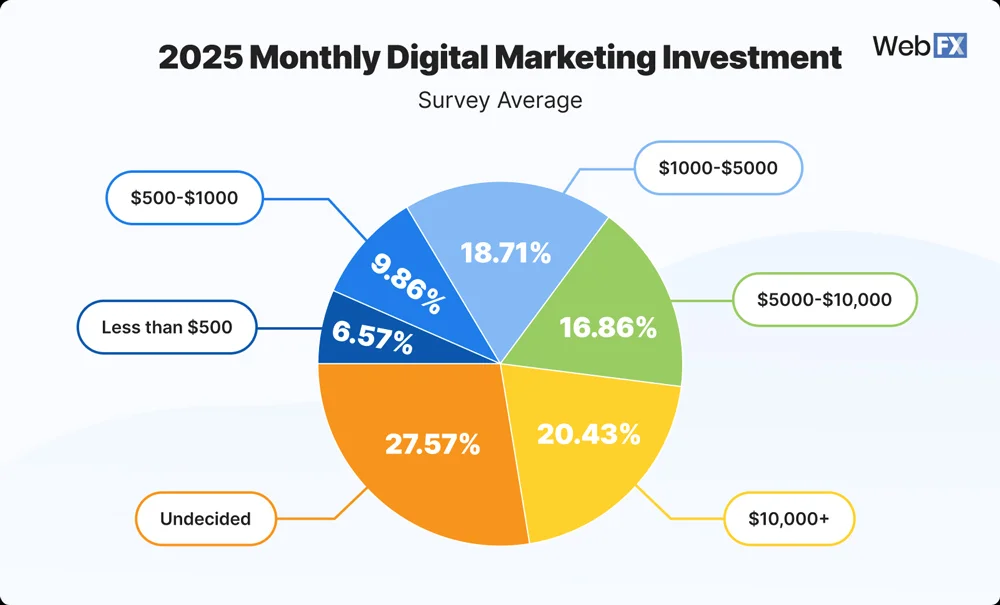
- The largest share of respondents, 27.57% are undecided about their monthly digital marketing budget, maintaining the same indication of uncertainty across the survey.
- 20.43% plan to invest $10,000+ per month, showing a strong commitment among higher-budget businesses to sustained marketing efforts.
- 18.71% expect to spend $1,000–$5,000 monthly, signaling a stable mid-range investment level across respondents.
- 16.86% are budgeting $5,000–$10,000, reflecting a solid mid-tier investment range comparable to more growth-oriented strategies.
- 9.86% anticipate spending $500–$1,000 per month, pointing to a lower-tier but still active digital marketing allocation.
- 6.57% plan to invest less than $500, representing the smallest budget group identified within the survey data.
Conversion Rate Optimization (CRO) Statistics
- The global average website conversion rate in 2025 is around 2.9%, with a broader global average of 3.68% across all websites.
- In e-commerce, the average conversion rate is approximately 2.96%.
- For the SaaS industry, the average conversion rate is around 9.5%.
- The B2B services sector shows an average conversion rate of 4.94%.
- Each additional second of page-load time reduces conversion rates significantly.
- A seamless user experience can boost conversions by up to 400%.
- Sites not actively optimising their conversion flows often see landing-page conversion rates under 10%.
- Mobile devices consistently show lower conversion rates than desktops.
- The CRO software market is projected to reach about $5 billion by 2025.
Affiliate Marketing Statistics
- The global affiliate marketing industry was valued at over $18.5 billion in 2024.
- U.S. affiliate marketing spending is projected to reach nearly $12 billion in 2025.
- Brands using affiliate marketing achieve about $15 return for every $1 spent.
- Approximately 81% of brands utilise affiliate marketing programs in 2025.
- More than 50% of affiliate traffic comes from mobile devices.
- Affiliate marketing contributes 5–25% of overall online sales for many major brands.
- About 58% of brands say affiliate marketing helps increase brand awareness.
- Sectors such as education, beauty, skincare, and travel show strong affiliate performance.
- Tracking and attribution challenges are rising as third-party cookies diminish.
Influencer Marketing Statistics
- The global influencer marketing market is projected to $32.55 billion in 2025.
- 86% of U.S. marketers plan to partner with influencers in 2025.
- 80% of brands maintained or increased influencer budgets in 2025, and 47% increased budgets by 11% or more.
- Approximately 73% of brands prefer micro and mid-tier creators for better cost-effectiveness.
- Influencer campaigns report an average ROI of about 5.78×.
- More than 6,939 influencer-marketing service providers are active globally.
- 92% of brands are using or open to using AI tools in influencer workflows.
- Authenticity and measurement remain key concerns in influencer campaigns.
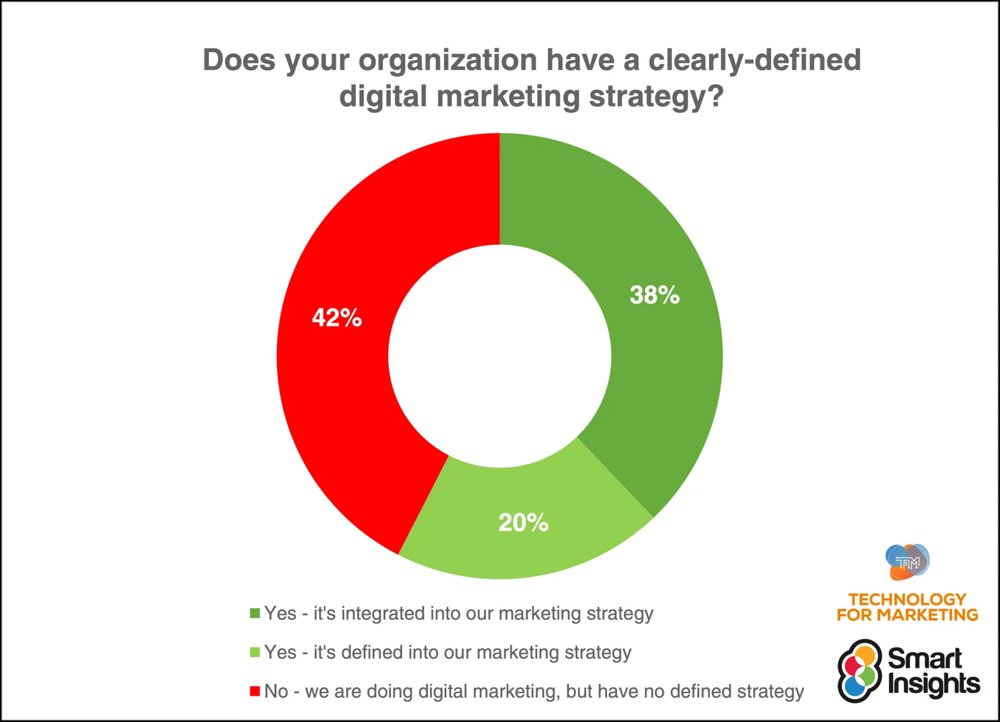
Clearly-Defined Digital Marketing Strategy Adoption
- 38% of organizations report that digital marketing is fully integrated into their overall marketing strategy, indicating a strong level of strategic maturity.
- 20% state that they have a defined digital marketing strategy, though it is not yet fully integrated, reflecting partial strategic alignment.
- 42% are engaging in digital marketing without a clearly defined strategy, exposing a significant strategic gap in planning and execution.
- These findings suggest that although nearly 60% possess some form of digital marketing strategy, a substantial portion still lacks structured and clearly defined planning.
B2B Digital Marketing Statistics
- The global B2B e-commerce market is valued at around $32.11 trillion in 2025 and expected to grow at about a 14.5% CAGR.
- 54% of companies using strong marketing analytics report above-average profits.
- B2B website conversion rates average between 2–5%.
- The average B2B cost per lead is roughly $200 or more.
- 73% of B2B marketers use social media advertising in 2025.
- 83% say content marketing achieved brand-awareness goals, 77% say it improved credibility.
- Email remains a key ROI channel for B2B.
- More than 81% of B2B marketers use video and continue increasing investment.
B2C Digital Marketing Statistics
- The most effective ROI channels for B2C are email marketing, paid social media, and content marketing.
- The average B2C website conversion rate is under 2% globally.
- 68% of small businesses report improved ROI in content marketing due to AI in 2025.
- Nearly 67% of small businesses use AI for content marketing or SEO.
- B2C brands continue increasing budgets for mobile-first and social-driven campaigns.
- B2C email campaign conversion rates average 2.8%, compared to 2.4% for B2B.
- Personalised experiences and customer-journey optimisation are now strategic priorities.
- Over 70% of consumers expect personalised digital experiences.
Digital Marketing ROI and Performance Metrics
- Companies earn about $5 for every $1 spent on digital marketing.
- Account-based marketing in B2B yields 81% higher ROI.
- 54% of companies relying on marketing analytics see above-average profits.
- In B2B, marketing contributes 30–50% of the sales pipeline for high-performers.
- Email marketing drives $30–40 return for every $1 invested.
- The average website bounce rate is around 37%.
- Organisations using data-driven decision-making generally outperform competitors.
- Over 70% of global ad budgets are shifting into digital channels in 2025.
Trends and Future of Digital Marketing
- Generative AI and personalisation lead 2025 marketing trends, enabling real-time consumer insight and tailored experiences.
- Around 75% of CMOs say digital marketing is their main growth lever, and 57% allocate over half their budgets to it.
- Integrated customer experience is central; about 37.5% of marketers prioritise brand experience.
- The digital marketing market is projected to reach $1.18 trillion by 2033.
- First-party data strategies are still maturing; only ~52% of B2B marketers have established governance.
- Mobile and omnichannel experiences dominate as consumers expect seamless transitions across devices.
- Sustainability, privacy, and authenticity increasingly shape campaigns.
- AI-driven search and zero-click journeys are reshaping attribution and visibility.
Frequently Asked Questions (FAQs)
It is projected to reach $786.2 billion by 2026.
The market is expected to grow at a CAGR of 11.22% from 2025-2033.
About 73% of total ad spending is forecast to be digital by 2025.
83% of marketing leaders say demonstrating ROI is a top priority, yet only 36% say they can accurately measure it.
Conclusion
The data clearly shows that digital marketing is not just about more channels, it’s about smarter investments, deeper personalisation, and higher accountability. Whether you are optimising conversion rates, building affiliate and influencer networks, orchestrating B2B or B2C strategies, or measuring ROI at scale, the trends point to data-driven, experience-centred, and AI-enabled marketing.
As budgets shift and technologies evolve, marketers who stay agile, benchmark effectively, and focus on outcomes will lead. Dive into the full article to explore how each discipline plays out in real-world strategies and sector-specific benchmarks.