

Email remains a core pillar of digital communication and marketing. From personal inboxes to global business campaigns, email’s footprint continues to grow, reaching billions of users and driving measurable engagement. In everyday life, professionals check email multiple times per day, and consumers often make purchases directly from messages they receive, showing email’s practical impact. In the business world, marketers rely on email to nurture leads and boost sales with measurable ROI. Below, we dive into the latest data that defines email usage today.
Editor’s Choice
- 5.02 billion people are expected to use email globally by the end of 2026.
- An estimated 392 billion emails will be sent daily worldwide in 2026.
- Email marketing delivers roughly $36 for every $1 spent in ROI.
- 93% of people use email every day.
- 60% of consumers prefer to be contacted by brands via email.
- 88% of email users check their inbox multiple times daily.
- Email open rates for automated workflows average 42.1% in 2026.
Recent Developments
- Global email use continues expanding despite emerging apps. Statista projects 4.7–4.8B users by 2026.
- Daily email volume is rising toward ~392B messages in 2026.
- Email marketing ROI remains strong, with an average of ~$36 per $1 spent.
- Automated email workflows produce up to 10× more revenue than non-automated campaigns.
- Brands increasingly use advanced segmentation and personalization to improve engagement.
- Privacy features like Apple’s Mail Privacy Protection continue to change how engagement is measured.
- More marketers report integrating AI tools into email creation and optimization workflows.
- Customer engagement emails now account for a majority of sends compared to promotional emails.
Global Email Usage and Growth Trends
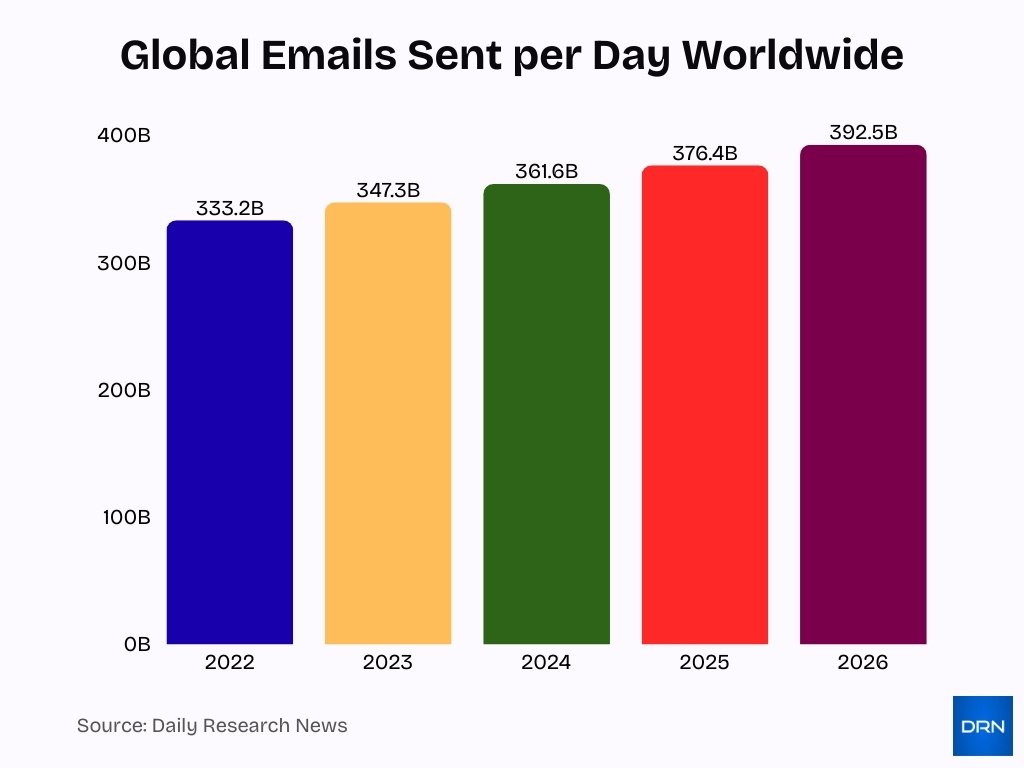
- Global email traffic reached approximately 333.2 billion emails per day in 2022, highlighting the massive scale of worldwide digital communication.
- In 2023, the total number of emails sent daily increased to 347.3 billion, reflecting a 4.3% year-over-year growth compared to the previous year.
- Daily global email volume is projected to climb to 361.6 billion emails in 2024, showing continued expansion in personal and business email usage.
- By 2025, the number of emails sent worldwide each day is forecasted to reach 376.4 billion, driven by growing digital adoption and enterprise communication needs.
- The global email ecosystem is expected to surpass 392.5 billion emails per day in 2026, underscoring email’s role as a dominant and resilient communication channel.
- Overall, global email activity is experiencing steady annual growth, reinforcing its importance in marketing, business operations, and consumer communication across industries.
Conversion Rate Performance in Email Campaigns
- Email campaigns average a 2.6% conversion rate across industries.
- Automated flows achieve 1.42% average conversion, outperforming campaigns.
- Triggered emails deliver 624% higher conversions than batch sends.
- B2B SaaS email benchmarks reach 2.9% conversion rates.
- Personalized emails boost transaction rates by 6x over generic ones.
- Personalized CTAs yield 202% higher conversion rates.
- Food & Beverage leads with 1.72% automated flow conversions.
- Overall, email marketing averages 2.4% conversion in 2025.
- SaaS sites target over 10% free account sign-up conversions.

Number of Users Using Email Globally
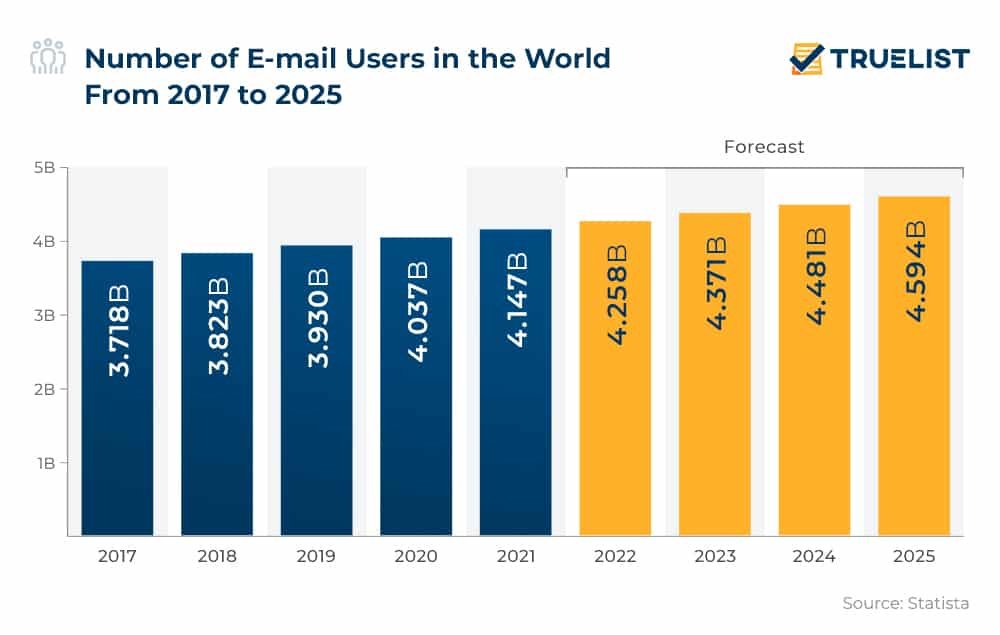
- The number of global email users stood at 3.71 billion in 2017, highlighting email’s already massive worldwide adoption.
- In 2018, email usage increased to 3.82 billion users, reflecting steady year-over-year digital communication growth.
- By 2019, the global email user base reached 3.93 billion, reinforcing email’s role as a core internet service.
- Email users surpassed the 4 billion mark in 2020, totaling 4.03 billion users worldwide.
- In 2021, global email adoption expanded further to 4.14 billion users, driven by remote work and online services.
- The number of email users grew to 4.25 billion in 2022, marking continued expansion despite market maturity.
- In 2023, global email users reached 4.37 billion, showing sustained relevance in personal and business communication.
- Email adoption rose to 4.48 billion users in 2024, reflecting ongoing internet penetration and mobile usage.
- By 2025, the global email user base is projected to hit 4.59 billion users, underscoring email’s long-term dominance as a digital communication channel.
Engagement Metrics in Email Campaigns
- The average email open rate across industries is about 42.35% in 2025, signaling strong interest in email content.
- Average click-through rates (CTR) hover around 2–2.09%, showing engagement beyond just opens.
- Click-to‑open rates (CTOR) reached ~6.81% in 2025, indicating more recipients who open also click links.
- Automation boosts engagement; automated workflows see an average 42.1% open rate and 5.4% CTR.
- Interactive content like videos and surveys can increase click rates by more than 300% versus static email content.
- B2C brands see typical conversion rates from email engagement around 2.8%, while B2B averages 2.4%.
- Opening patterns still matter; emails sent mid‑week (Tuesday–Thursday) generally perform better.
- Privacy changes have made traditional open‑rate measures less reliable, pushing marketers to rely on CTR and CTOR more.
Device and Platform Preferences for Email
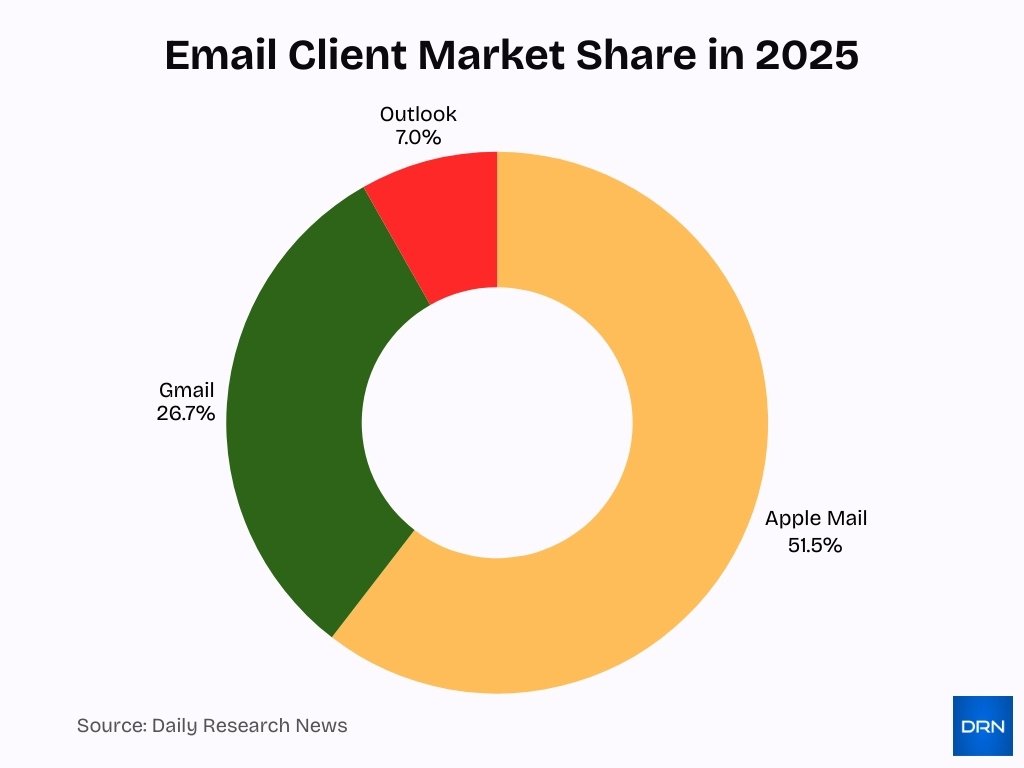
- Apple Mail holds ~51.5% of the email client market share in 2025.
- Gmail follows at ~26.7%, with Outlook at around 7%.
- ~60% of Millennials predominantly check email on mobile devices.
- Mobile optimization increases clicks by roughly 15%.
- Nearly 61% of people read email primarily on phones.
- PC users still account for a large share of clicks despite mobile opens.
- Popular platforms adapt interfaces for both desktop and mobile experiences.
- Device preferences influence how marketers design and time email sends.
Effectiveness of Email Marketing
- Email marketing delivers an average of $36 in revenue for every $1 spent.
- For many companies, ROI ranges from 10:1 up to 36:1 or more.
- Around 41% of marketers rate email as their most effective channel for ROI compared to social and paid search.
- Nearly 20% of firms achieve email ROI beyond $70 per $1 spent.
- Email automation can generate 30× higher returns than one‑off campaign blasts.
- Over half of consumers make a purchase directly from an email.
- Effective segmentation and personalization significantly improve engagement and campaign performance.
- Email’s ROI remains higher than most digital channels year over year.
ROI Achieved Through Email Marketing
- On average, 3600–3800% ROI (or $36–$38 per $1 spent) is common for email campaigns.
- 18% of companies see more than 7000% ROI.
- ROI is higher for companies that dedicate a larger portion of their budget to email.
- Ecommerce email ROI can reach 7200% ($72 per $1) in high‑performing segments.
- Customer engagement emails typically outperform other formats in ROI.
- ROI benchmarks often increase year over year with improved segmentation and automation.
- Email continues to outpace many other marketing channels in profitability.
- Companies investing more heavily in email often see more stable ROI results.
Benchmarks by Industry for Email Marketing
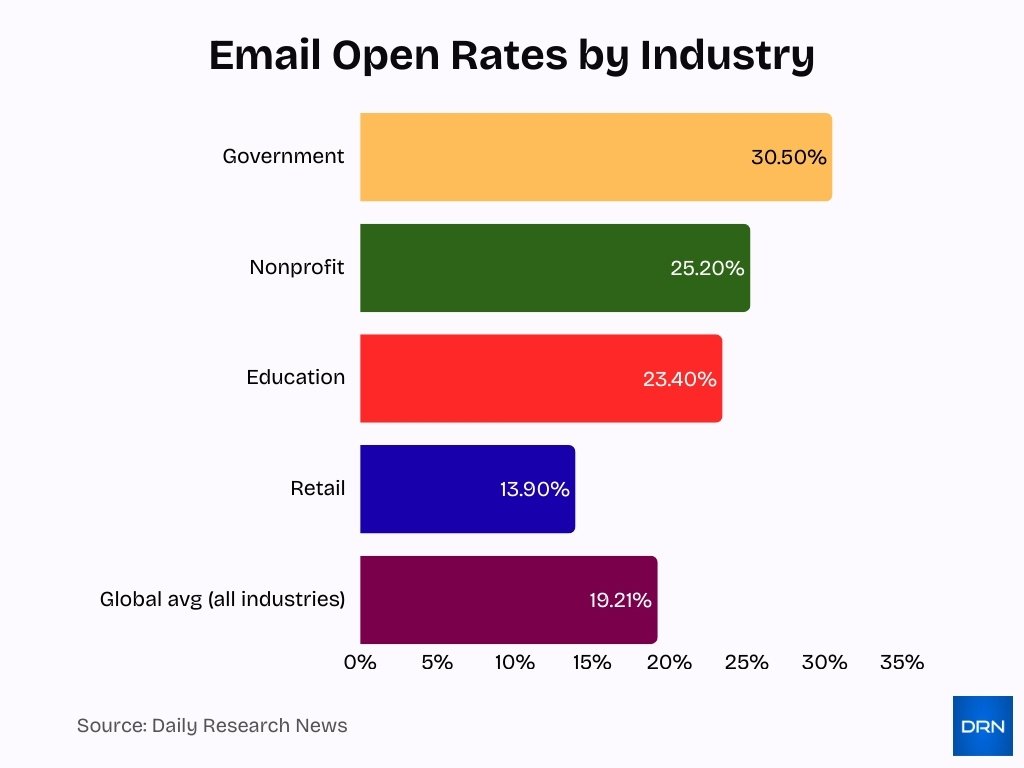
- Government emails achieve the highest average open rate of 30.5%.
- The nonprofit sector records an average open rate of 25.2%.
- The education industry sees 23.4% average open rates.
- Retail emails average 13.9%open rate with 2.1%CTR.
- Global average email open rate stands at 19.21% across industries.
- Average CTR for emails is 2.44%, with the government at 4.1%.
- Healthy unsubscribe rates remain under 0.5%, averaging 0.89% overall.
- Bounce rates typically range from 2-2.5%, averaging 2.48%.
- Education boasts 3.0%CTR, higher than retail‘s 2.1%.
Spam Complaints and Deliverability Issues in Email
- A good deliverability rate is generally 95–99% in 2025.
- Spam complaint rates should ideally remain below 0.1%.
- Rates over 0.3% can damage sender reputation and inbox placement.
- Maintaining DKIM, SPF, and DMARC authentication improves delivery success.
- High engagement signals boost deliverability.
- Poor list hygiene increases bounces and spam flags.
- Deliverability benchmarks vary by email service provider and region.
- Brands increasingly focus on quality content to reduce complaints.
Best Time and Day for Sending Email
- Midweek (Tuesday–Thursday) consistently yields higher open and click rates for B2B audiences, especially between 9 a.m. and 11 a.m. local time.
- Around 12 p.m.–1 p.m. (lunch hours) can be effective for professionals who check emails during breaks.
- Evenings and weekends often perform better for B2C sends, capturing attention when people are off work.
- Sending on Friday afternoons may increase engagement for leisure-related offers or weekend sales.
- Monday mornings are generally less optimal due to inbox overload from weekend catch‑ups.
- Saturday engagement tends to be lower than on weekdays, especially for professional audiences.
- Timing emails based on individual past engagement patterns can outperform static schedules.
- Seasonal and holiday timing often drives higher open and conversion rates.
Email Sending Frequency Among Marketers
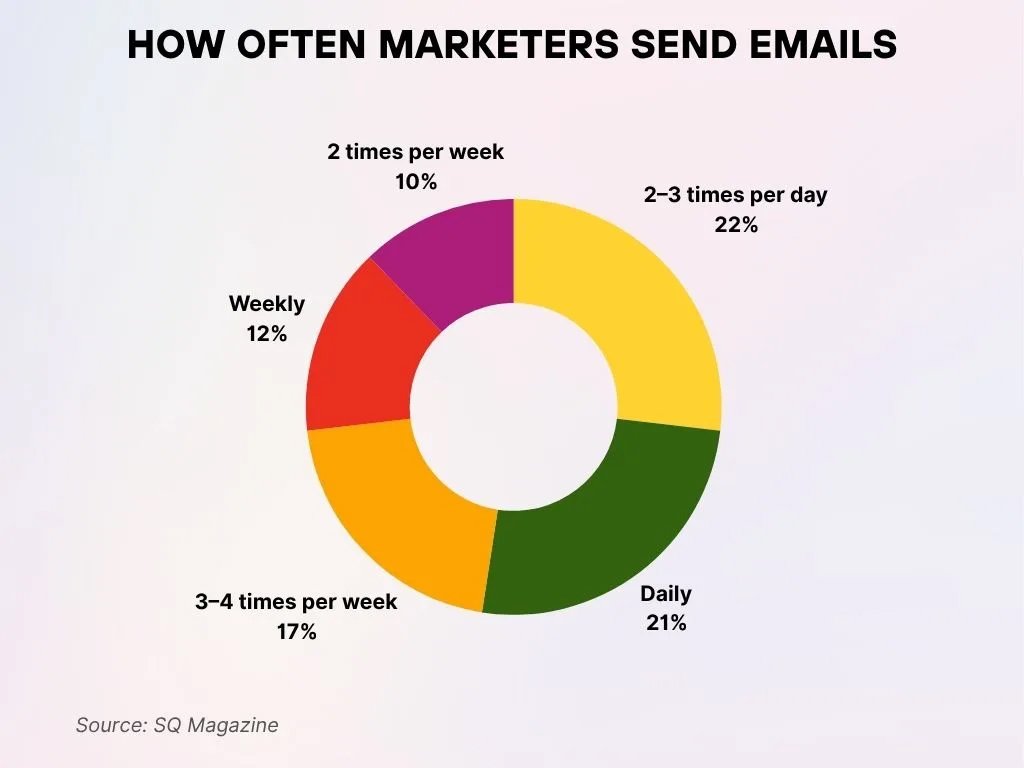
- 22% of professionals distribute marketing emails 2–3 times per day, making this cadence the most commonly used frequency.
- 21% of marketers send marketing emails daily, highlighting a strong inclination toward consistent and regular outreach.
- 17% choose to send emails 3–4 times per week, aiming to balance sending frequency with audience engagement.
- Only 12% of professionals send marketing emails weekly, reflecting a more spaced-out and conservative email strategy.
- Just 10% send marketing emails 2 times per week, representing the least preferred email-sending cadence among marketers.
Personalization and Segmentation Tactics in Email
- ~42% of marketers personalize emails using past interaction data, boosting relevance.
- ~46.5% add subscriber names directly in email copy, 36.5% include names in subject lines.
- Marketers increasingly use multiple versions of the same email to target distinct segments.
- Personalized emails show higher open rates (~30.3%) than non‑personalized (26.6%).
- Segmentation based on purchase history (46.7%) and engagement level (40.7%) remains common.
- 59% of marketers prioritize expanding automation to support personalization.
- Emails tailored with behavioral or demographic data typically reduce bounce rates.
- Personalization improves relevance and reduces user frustration with generic content.
Responsive Design Trends in Mobile Email
- Mobile devices drive 81% of email opens worldwide.
- 62% of recipients delete non-responsive emails instantly.
- Responsive designs lift click-through rates by 20-30% on mobile.
- Poor mobile rendering causes 70% of users to abandon emails.
- Interactive elements boost engagement by 40% in mobile inboxes.
- Dark mode emails see 82% of opens among iOS users.
- Touch-friendly buttons increase taps by 25% versus small links.
- Mobile-first emails cut unsubscribe rates by 15%.
- B2B responsive campaigns achieve 35% higher open rates.
- Accessibility-optimized emails improve conversions by 17%.
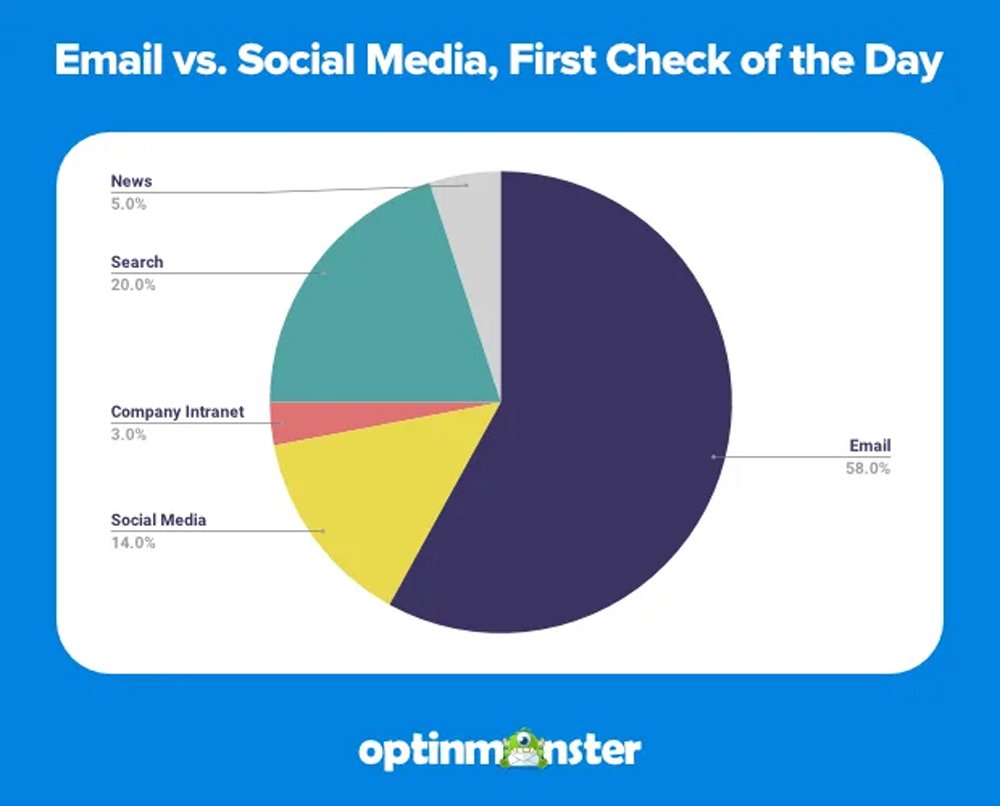
Initial Online Activity of the Day: Email vs. Social Platforms
- 58% of people check their email first when they go online at the start of the day.
- 20% begin their day with search engines as their first digital action.
- 14% open social media first before engaging with any other online activity.
- 5% start their online day by reading news content.
- Only 3% check their company intranet first when they go online.
Performance of Transactional and Automated Email
- Automated emails can generate up to 10× more conversions than bulk broadcasts.
- Welcome emails often see 50–60% open rates, higher than regular campaigns.
- Transactional messages like order confirmations often achieve 70–90% open rates.
- Automated flows can contribute around 37% of total email revenue.
- Abandoned cart email sequences convert approximately 3–4% of recipients.
- Automated sends usually deliver higher revenue per message than standard promotional sends.
- Behavioral triggers improve engagement and retention.
- Automation reduces manual workload while increasing personalization at scale.
Growth and Hygiene Practices for Email Lists
- Nearly 40% of marketers report declining deliverability due to list hygiene issues.
- 39.5% remove inactive subscribers periodically to keep lists fresh.
- 36.8% use double opt‑in, and 33.2% rely on verification services to clean lists.
- Bounce and spam complaints remain top challenges for ~36% of email marketers.
- Regular list maintenance reduces spam flags and improves engagement.
- Segmentation helps isolate inactive contacts and prevents list decay.
- Quality lists show better deliverability and sender reputation over time.
- Integrating list hygiene into workflow is increasingly seen as essential for performance.
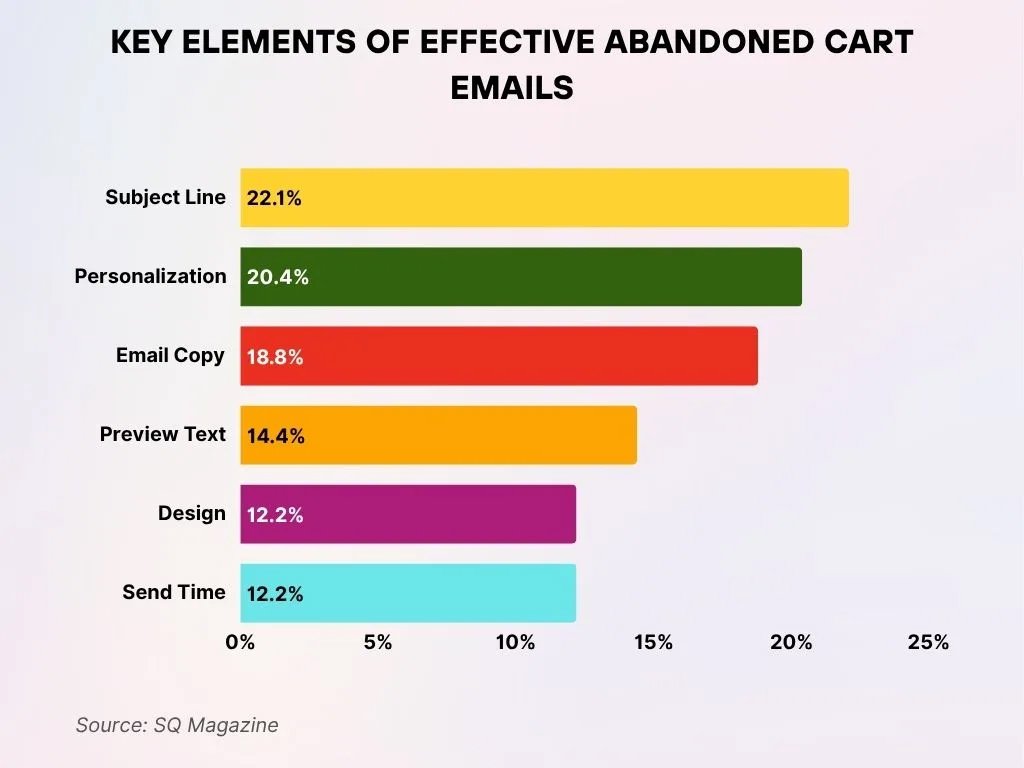
Core Factors Driving High-Performing Abandoned Cart Emails
- 22.1% of marketers state that the subject line is the most important element in abandoned cart emails for driving engagement.
- 20.4% believe personalization delivers the biggest impact when it comes to recovering lost sales through abandoned cart emails.
- 18.8% prioritize the email copy as a crucial component influencing the success of abandoned cart email campaigns.
- 14.4% point to the importance of preview text in grabbing attention and encouraging users to open abandoned cart emails.
- 12.2% value the overall design of the email as a key factor in abandoned cart email effectiveness.
- 12.2% also consider send time a critical factor that directly affects the effectiveness of abandoned cart emails.
Security and Authentication in Email Communication
- Email authentication technologies like SPF, DKIM, and DMARC help ensure messages reach inboxes.
- Only ~36% of email marketers report using DKIM authentication.
- Around 35.6% have implemented DMARC, while 22.9% use SPF protocols.
- Authentication increases trust signals to mailbox providers and reduces spoofing risk.
- Verified email addresses and privacy‑first identity are becoming core deliverability drivers.
- Security best practices support customer confidence and protect against phishing.
- Ongoing monitoring of sender reputation reduces email filtering issues.
- Email authentication aligns with broader data protection and privacy trends.
Future Trends Shaping the Email Landscape
- AI-driven personalization boosts email CTR by 13.44% through hyper-personalized content.
- 74% of marketers using AI personalization tools report higher engagement metrics.
- Interactive emails increase click-to-open rates by up to 73%.
- Inbox placement rates average 86% for major providers like Gmail with proper authentication.
- Zero-party data personalization yields 217% higher click-through rates on recommendations.
- Omnichannel strategies feature email as the top channel at 82.4% usage among B2C marketers.
- Predictive send-time optimization improves open rates by 10-15%.
- DMARC adoption doubled to over 2.3 million domains post-2024 bulk sender rules.
- Privacy regulations cover 82% of the global population, boosting loyalty for compliant brands.
Frequently Asked Questions (FAQs)
~4.6–4.83 billion individuals globally use email in 2025.
Around 376–378 billion emails are sent and received each day in 2025.
Email marketing delivers roughly $36–$42 in revenue for every $1 spent.
About 88–99% of email users check their inbox daily.
Conclusion
Email continues to evolve as a foundational communication and marketing channel, balancing personalization, automation, and data‑driven insights. As open rates, engagement benchmarks, and ROI remain strong, brands are optimizing send times, responsive designs, and list hygiene to improve performance.
Looking ahead, AI and privacy‑first approaches will reshape best practices, requiring marketers to innovate with both trust and relevance at the forefront. By understanding these trends and statistics, businesses can refine email strategies that resonate with audiences today and tomorrow.