

Generative AI is not just a buzzword; it has become a measurable force shaping business models, consumer behavior, and global technology markets. From creative content generation to advanced enterprise automation, companies and individuals are adopting AI tools at unprecedented rates. Whether it’s boosting workforce productivity or creating new revenue streams, generative AI’s impact spans industries. For example, enterprises are embedding AI into core operations to accelerate workflows, while startups secure billion-dollar valuations for AI-driven innovation. Explore forward-looking insights and key metrics that define this dynamic landscape in the full article below.
Editor’s Choice
- The generative AI market value is projected at about $37.89 billion in 2025, with exponential long-term growth on the horizon.
- AI adoption in business has more than doubled in recent years, marking a leap from early experimentation to core strategic investment.
- Enterprise spending on generative AI jumped to $37 billion in 2025, over three times 2024 levels.
- Generative AI adoption in organizations reached 71% by late 2024.
- Generative AI models such as GPT-5.2 compete with other major offerings, reflecting rapid innovation.
- Anthropic reached ~$3billionin in annualized revenue in 2025, spotlighting business demand.
- SMBs report revenue boosts from AI usage and improved scaling outcomes.
Recent Developments
- In 2025, Adobe reported a record $23.77 billion in revenue, attributing much of the growth to AI integration across creative products.
- A major AI startup, Serval, achieved a $1billionvaluation after a $75 M funding round, reflecting investor confidence in AI automation platforms.
- OpenAI appointed a Chief Revenue Officer to drive profitability as usage expands.
- Disney committed $1billionto to OpenAI for AI-driven content creation, signaling a crossover between entertainment and AI.
- Cognizant, Infosys, TCS, and Wipro announced over 200,000 Microsoft Copilot license deployments, underscoring enterprise uptake.
- A MIT study suggests 95% of generative AI business projects are not delivering expected outcomes, highlighting implementation challenges.
- 90% of organizations plan increases in AI spending in 2026, per CIO surveys.
- Anthropic’s annual revenue hit roughly $3 B, growing rapidly as businesses demand generative AI model services.
Generative AI Overview Statistics
- The global generative AI market is estimated at $37.89 billion in 2025, rising from about $25.9billionin in 2024.
- The generative AI market value is projected to reach over $1,000 billion by 2034.
- Adoption of generative AI tools jumped from 33% in 2023 to 71% in 2024 among organizations.
- 65% of companies reported using generative AI workflows in early 2024, reflecting rapid integration.
- Worldwide AI adoption, including GenAI, reached 78% of enterprises in 2025, delivering notable productivity gains.
- Businesses doubled generative AI adoption between 2023 and 2024.
- North America continues to dominate global market share, holding ~41% of total revenue in 2024.
- Generative AI adoption is anticipated to climb further as enterprises and SMBs scale usage through 2027 and beyond.
Generative AI Market Size and Growth
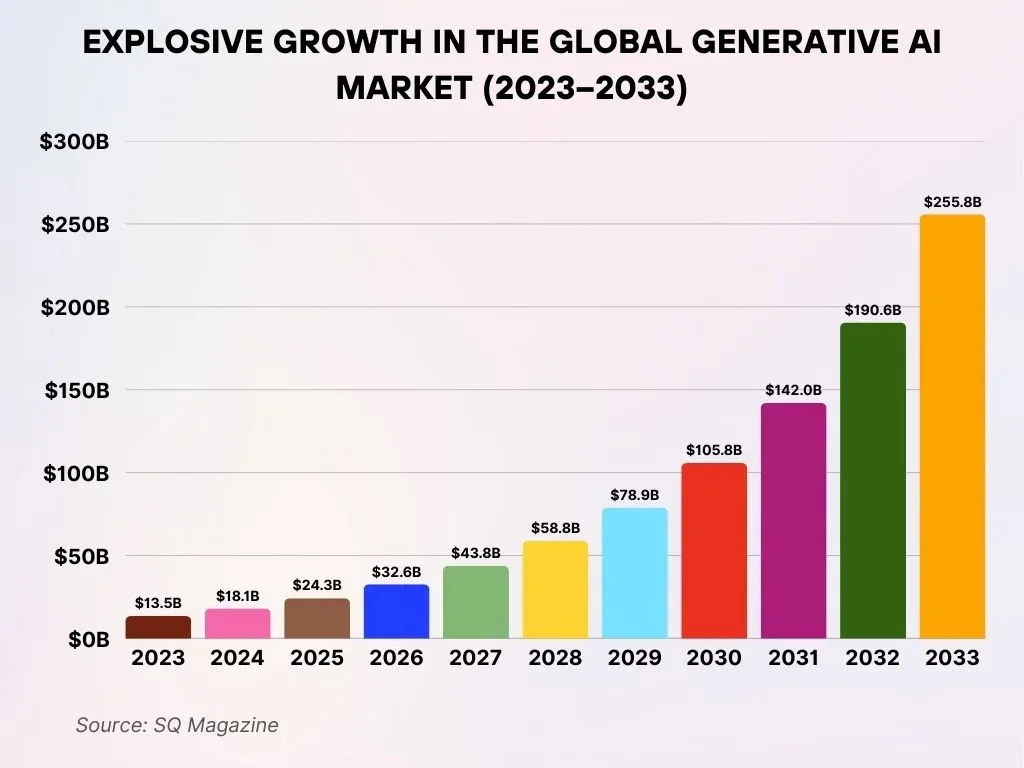
- The Generative AI market is projected to climb to $255.8 billion by 2033, highlighting exceptionally strong long-term growth prospects and sustained market momentum.
- Starting from $13.5 billion in 2023, the market is expected to almost double every few years, reaching approximately $58.8 billion by 2028.
- By 2030, the market is anticipated to expand more than fourfold compared to 2023, achieving a valuation of $105.8 billion.
- Growth is set to intensify significantly in the early 2030s, with the market forecasted to rise to $190.6 billion by 2032.
- The compound annual growth rate (CAGR) throughout the forecast period stands at a robust 34.2%, reflecting rapid adoption, escalating investment, and accelerating innovation.

Investment and Funding Statistics
- Private investment in generative AI reached $33.9billionin in 2024, a significant jump year-over-year.
- Startup valuations reflect strong investor interest, with companies reaching billion-dollar valuations rapidly.
- OpenAI’s valuation reached $300billionafter after a $40 billion funding deal, highlighting investor confidence.
- Funding growth in generative AI startups was over 8 times larger in 2024 compared to 2022.
- Investments increasingly target automation and agent-based AI systems.
- Corporate budgets for AI initiatives are rising, with 90% of firms boosting spend.
- Venture funding is diversifying beyond core models into specialized solutions like IT automation.
- Disney’s $1billioninvestment in OpenAI bridges media IP with AI content creation.
Generative AI Revenue and Economic Impact
- Anthropic projects $9 billion in annualized revenue by the end of 2025 from enterprise AI services.
- Adobe achieved $23.77 billion in total revenue in fiscal 2025, driven by AI integration.
- OpenAI targets over $20 billion annualized revenue in 2025 via subscriptions and enterprise deals.
- Generative AI software market reaches $37B in 2025, capturing 6% of global SaaS spend.
- GenAI delivers an average $3.7 ROI per $1 invested, boosting productivity metrics.
- Top GenAI adopters see $10.3 returned per dollar spent on AI initiatives.
- Enterprise AI spending hits $37 billion in 2025, expanding economic impact across sectors.
- North America leads with $34.4 billion in GenAI revenue in 2025, and APAC is growing rapidly.
Regional Distribution of the Global Generative AI Market
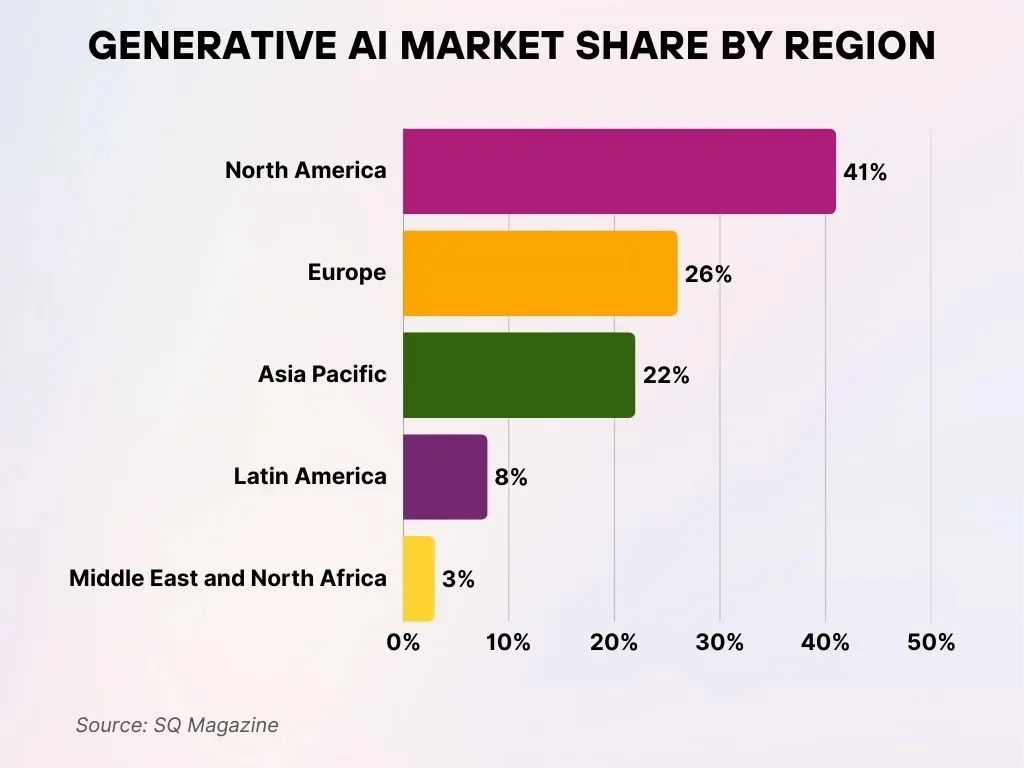
- North America dominates the global generative AI market with a commanding 41% share, underscoring significant technology investments, advanced infrastructure, and continuous innovation leadership.
- Europe secures the second-largest share at 26%, demonstrating robust adoption levels and widespread implementation of generative AI across multiple industries and sectors.
- Asia Pacific represents 22% of the market, emphasizing rapid technological growth, accelerated AI integration, and strong momentum in emerging economies.
- Latin America contributes 8% to the global market share, indicating consistent progress while reflecting comparatively moderate growth rates in adoption.
- The Middle East and North Africa region holds the smallest share at 3%, highlighting early-stage adoption, limited investment, and a still-developing AI ecosystem.
Enterprise Generative AI Adoption Statistics
- 78% of organizations now use AI in at least one business function in 2025, up from 55% in 2024.
- Generative AI adoption within enterprises jumped significantly, with tools integrated across IT, marketing, and operations.
- Companies spent $37billionon on generative AI in 2025, more than triple the $11.5billionin in 2024.
- Nearly 23% of companies are scaling agentic AI systems enterprise-wide.
- Cloud-based AI platforms dominate at 82% usage among enterprise AI solutions.
- 67% of jobs in enterprises now require some AI-related skills.
- Operational efficiency gains average about 34% for enterprises using AI broadly.
- 89% of enterprises plan to adopt generative AI by 2027.
- Major firms are deploying over 200,000 Microsoft Copilot licenses, signaling serious enterprise uptake.
SM billion Generative AI Adoption Statistics
- 58% of U.S. small businesses use generative AI in 2025, up from 40% in 2024.
- Nearly all small businesses now use at least one tech platform, with many integrating AI.
- 82% of small businesses using AI increased their workforce over the past year.
- 35% of SMBs slightly accelerated tech investments, while 27% accelerated significantly due to AI.
- About 53% of SMBs already use AI, and another 29% plan to adopt within a year.
- 75% of SMBs are experimenting with AI tools, especially growth-oriented firms.
- Nearly 96% of SM billion owners plan to adopt emerging technologies, including AI.
- SMBs commonly use AI for automation, customer service, and operational efficiency.
Artificial Intelligence Adoption by College Students in Academic Activities
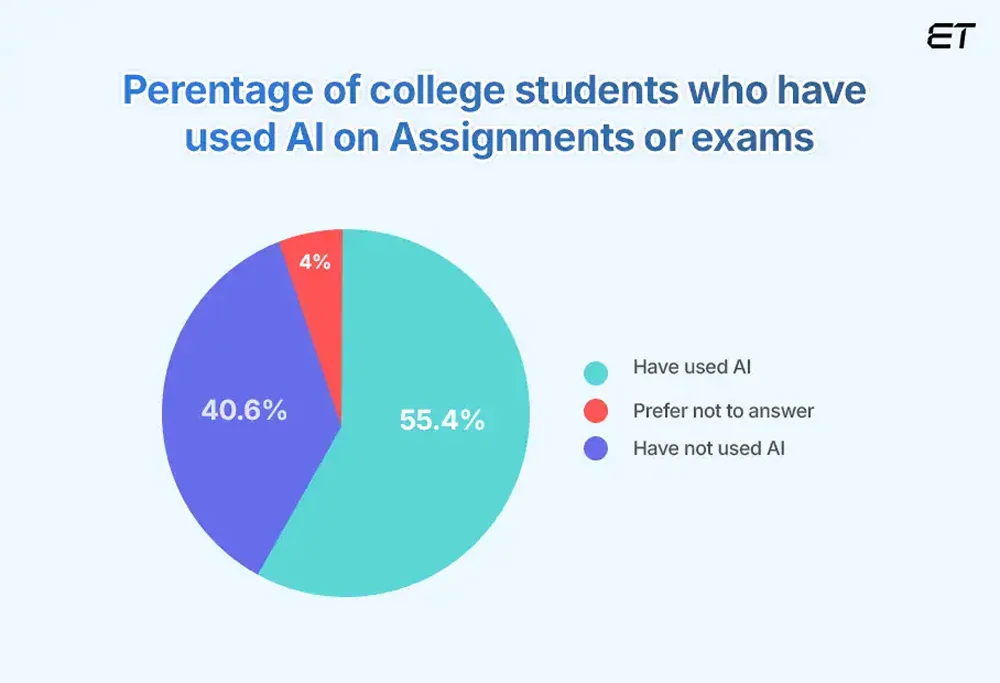
- Approximately 55.4% of college students reported using AI tools for assignments or examinations, emphasizing the extensive integration of AI technology within higher education.
- Around 40.6% indicated they have not used AI, demonstrating that a substantial segment of students continues to complete academic tasks independently without AI support.
- Nearly 4% preferred not to respond, which may reflect underlying concerns related to academic integrity, ethical considerations, or data privacy issues.
Consumer Generative AI Usage Statistics
- 54.6% of adults used generative AI by August 2025, up roughly 10 percentage points from 2024.
- Nearly 70% of Americans have used AI tools.
- 66% of people worldwide use AI regularly, with hundreds of millions engaging daily.
- Daily AI usage among consumers rose from 14% to 29.2% between 2024 and 2025.
- 115 M to 180 M people use generative AI globally every day.
- Younger populations show the highest usage rates.
- Tools like ChatGPT, Gemini, Perplexity, and Claude lead consumer engagement.
- Consumer reliance on AI varies globally, with especially high usage in emerging markets.
Generative AI User Demographics Statistics
- Nearly 54.6% of U.S. adults aged 18-64 have adopted generative AI as of August 2025.
- 65% of generative AI users are Millennials or Gen Z, with 72% employed.
- 70% of Gen Z report using generative AI tools.
- 62% of millennials (aged 35-44) show high expertise in generative AI.
- 73% of the Indian population surveyed uses generative AI, the highest among emerging markets.
- Men are more than twice as likely as women to use generative AI tools.
- Only 10% of Americans aged 65+ have used ChatGPT by mid-2025.
- 84% of high school students use generative AI for schoolwork.
Generative AI Tool Popularity and Usage Share
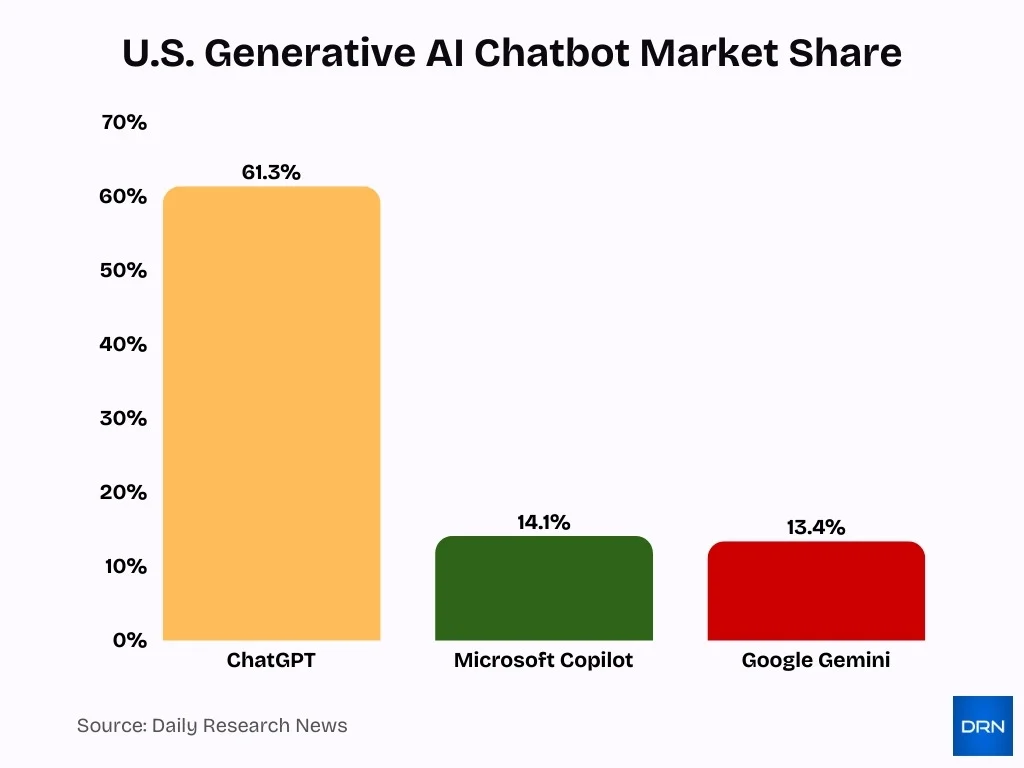
- ChatGPT holds roughly 61.3% of the U.S. generative AI chatbot market.
- Microsoft Copilot follows with 14.1% market share.
- Google Gemini accounts for about 13.4%.
- Generative AI app downloads surged over 319% year over year in 2025.
- AI referral traffic to transactional sites grew over 350%.
- Consumers increasingly use AI for content creation and personalization.
- Market share continues to diversify as specialized assistants gain traction.
- Generative engines are reshaping how users search and discover information.
Productivity and Efficiency Gains from Generative AI
- U.S. banks reported AI boosted productivity from 3% to 6%.
- Workers using AI save 40–60 minutes per day on average.
- 47% of U.S. executives report productivity gains from generative AI.
- 62% of global employees expect AI to improve work efficiency.
- 90% of AI users say it helps save time at work.
- Enterprise AI projects deliver ~26% to 55% productivity gains.
- Efficiency gains are strongest in data-intensive and repetitive roles.
- Developers see 10–30% productivity improvements using AI tools.
Cost Savings and ROI from Generative AI
- Companies report an average $3.70 return for every $1 invested in generative AI.
- Financial services firms achieve ~4.2x ROI, among the highest returns.
- Media and telecom companies see ~3.9x ROI.
- 67% of organizations increased AI budgets in 2025.
- Generative AI enables ~15.2% cost savings through automation.
- Only ~30% of AI experiments reach full production, limiting ROI.
- Less than half of initiatives are fully prepared to capture value responsibly.
- Only ~10% of mid-sized firms are fully integrated with GenAI.
Impact of Generative AI on Jobs and Workforce
- 300 million jobs globally could be affected by generative AI, impacting nearly 18% of total employment.
- Around 80% of executives foresee significant shifts in job skills and responsibilities due to AI adoption.
- Nearly 1.4 billion workers worldwide will need reskilling to adapt to AI-driven workflows.
- About 60% of occupations may see partial automation, focusing on task redistribution rather than full job loss.
- Workers in AI-exposed roles could experience wage increases up to 20% due to skill scarcity.
- Job reductions are estimated at 4% within one year and around 11% in three years in high-automation industries.
- Approximately 36.7% of U.S. employees now use AI tools at work, a sharp rise from 28% in 2024.
- 72% of companies plan to retrain workers for AI-related roles instead of layoffs.
- Generative AI may boost global labor productivity by 7%, equivalent to adding $7 trillion to the economy.
- By 2030, about 30% of work hours could be automated, transforming the future of workforce structures.
Generative AI Bias, Fairness, and Ethics Statistics
- 59% of workers worry about biased AI outputs.
- 72% cite data privacy as a top concern.
- 73% believe generative AI introduces new security risks.
- 54% report concerns about AI output accuracy.
- Only ~13% of companies employ AI ethics specialists.
- 60% of organizations lack formal AI ethics policies.
- Bias-mitigation techniques can improve fairness by ~31%.
- Ethical and trust concerns remain key adoption barriers.
Generative AI Use Cases by Industry
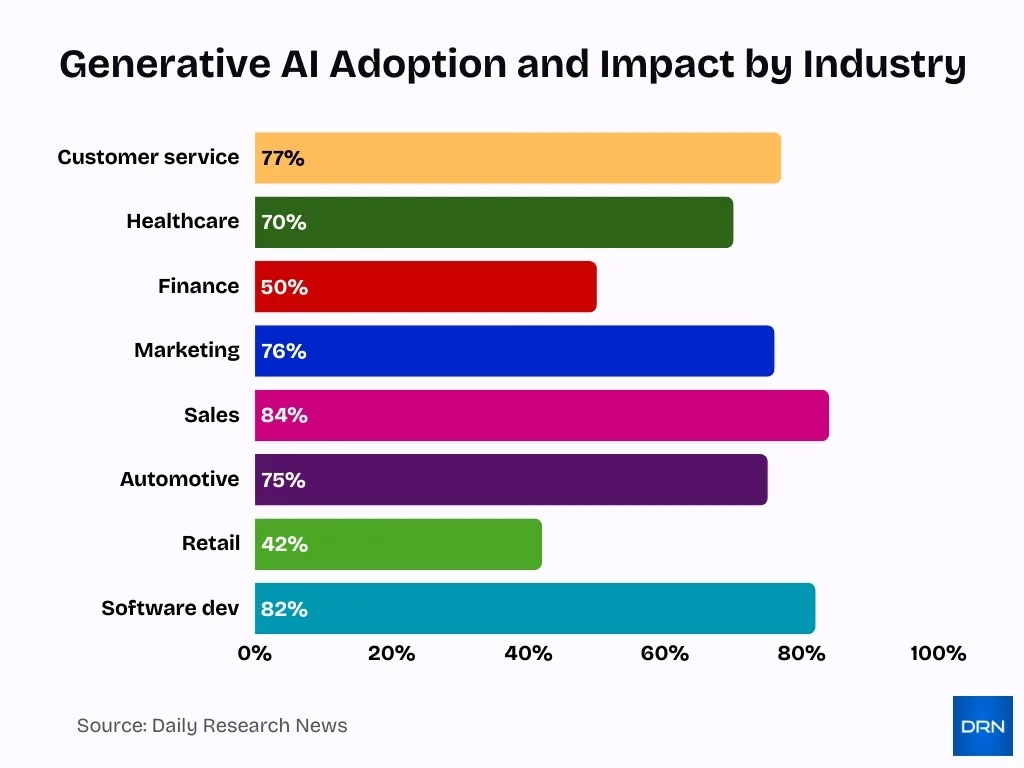
- Customer service leads with 77% of leaders planning greater generative AI integration for chatbots.
- Healthcare adoption hits 70%, focusing on personalized diagnostics and patient data analysis.
- Finance sees 50% uptake for risk assessment and fraud detection via AI models.
- Marketing uses genAI by 76% for content creation and audience targeting.
- Sales professionals report 84% improved performance with AI-driven personalization.
- Automotive leads at 75% for design prototyping and supply chain forecasting.
- Retail applies AI in 42% of firms for demand prediction and recommendations.
- Software development accelerates coding by 82% through AI code generation tools.
Security, Risk, and Compliance Statistics
- 75% of people believe generative AI introduces new security risks.
- Many organizations invest in specialized AI security tools.
- 55% of businesses cite governance challenges as major hurdles.
- Deepfake-related fraud surged 1,200% in the U.S. and 4,500% in Canada.
- ~50% of organizations do not fully trust AI outputs.
- Compliance challenges are especially acute in regulated industries.
- Risk management spending continues to rise with AI adoption.
Regulation and Policy Trends for Generative AI
- U.S. federal agencies introduced 59 AI-related regulations in 2024, more than double 2023’s count.
- 75 countries saw legislative mentions of AI rise 21.3% in 2024, a ninefold increase since 2016.
- The United States leads with 82 national AI policies and strategies as of March 2024.
- The European Union ranks second with 63 AI policies, nearly half focused on governance.
- 67% of OECD countries use AI in public service design and delivery.
- Only 26% of public sector organizations have integrated AI across operations despite 64% seeing cost savings potential.
- China issued as many national AI requirements in early 2025 as in the prior three years combined.
- 94% of government agencies already use generative AI applications for productivity and efficiency.
- Only two in five employees report organizational policies on generative AI use amid widespread adoption.
- Over 5 million people worldwide signed up for AI-related courses in 2023 to address workforce skill gaps.
Future Outlook and Forecasts for Generative AI
- By 2030, AI could generate ~$19.9 T in global economic impact, about 3.5% of world GDP.
- The generative AI market may grow at ~46% CAGR through 2030, reaching ~$356 B.
- 15% of new applications may be autonomously created by AI by 2027.
- Up to 90% of online content could be AI-generated by 2026.
- Adoption depends on technical maturity and strong governance.
- Hybrid human-AI roles are expected to expand across industries.
- AI is forecast to reshape global value chains and productivity.
- Policymakers and leaders emphasize inclusive benefit distribution.
Frequently Asked Questions (FAQs)
$644 billion (up 76.4% from 2024).
$37 billion in 2025 vs $11.5 billion in 2024 (about 3.2x YoY).
$33.9 billion globally (up 18.7% from 2023, and 8.5x 2022 levels).
43.4% CAGR (2025–2032).
Conclusion
Generative AI stands at the crossroads of innovation and responsibility. Statistical insights show clear economic impact, cost savings, and productivity gains, while also revealing challenges in workforce adaptation, ethical fairness, and security risk management. As organizations and governments navigate this fast-moving landscape, effective governance and policy design will shape how value is realized.
The data makes one thing clear: generative AI will continue to redefine how work gets done, and the decisions made now will influence its long-term impact.