

The email platform Gmail continues to shape how billions of people communicate, collaborate, and stay informed each day. In enterprise settings, it underpins business workflows, and in personal use, it anchors our digital lives. From marketing campaigns to customer support, its reach influences countless industries. Read on to explore the full article and understand Gmail’s scale, trends, and key data.
Editor’s Choice
Here are seven standout stats about Gmail in 2025:
- Gmail processes over 131 billion emails daily, representing roughly 35% of all global email traffic.
- Gmail supports an estimated 2.5 billion active users worldwide, about 30% of the global population.
- The worldwide email user base is forecast to reach 4.6 billion by 2025.
- Gmail’s global email client market share is around 27%–31% as of 2025.
- In India and Indonesia, Gmail penetration exceeds 82% of the population.
- The average Gmail user spends about 28 minutes per day handling their inbox.
- Mobile use dominates, with approximately 75%–90% of Gmail users accessing via smartphone.
Recent Developments
- Over 60% of Gmail users adopted the new “Manage subscriptions” feature within the first 3 months of its 2025 launch.
- Gemini assistant’s AI reply suggestions improved response accuracy by 27% in Gmail personalization tests.
- The free Gmail storage tier remains at 15 GB, shared among Gmail, Drive, and Photos for over 2.5 billion users.
- Gmail’s spam filters block 99.9% of spam and phishing emails daily using advanced machine learning.
- More than 9 million organizations actively use Google Workspace’s integrated Gmail business features.
- Gmail adoption in India and Indonesia exceeds 82% of their internet populations, leading global growth.
- The average session duration on Gmail is 28 minutes, with about 12 inbox checks per day per user.
- Around 75%–90% of Gmail users access email via mobile devices, highlighting mobile engagement.
- Gmail handles over 131 billion emails sent and received daily worldwide.
- Users unsubscribe at a rate increase of 15% after using the Manage subscriptions tool, showing improved inbox control.
Global Gmail User Base
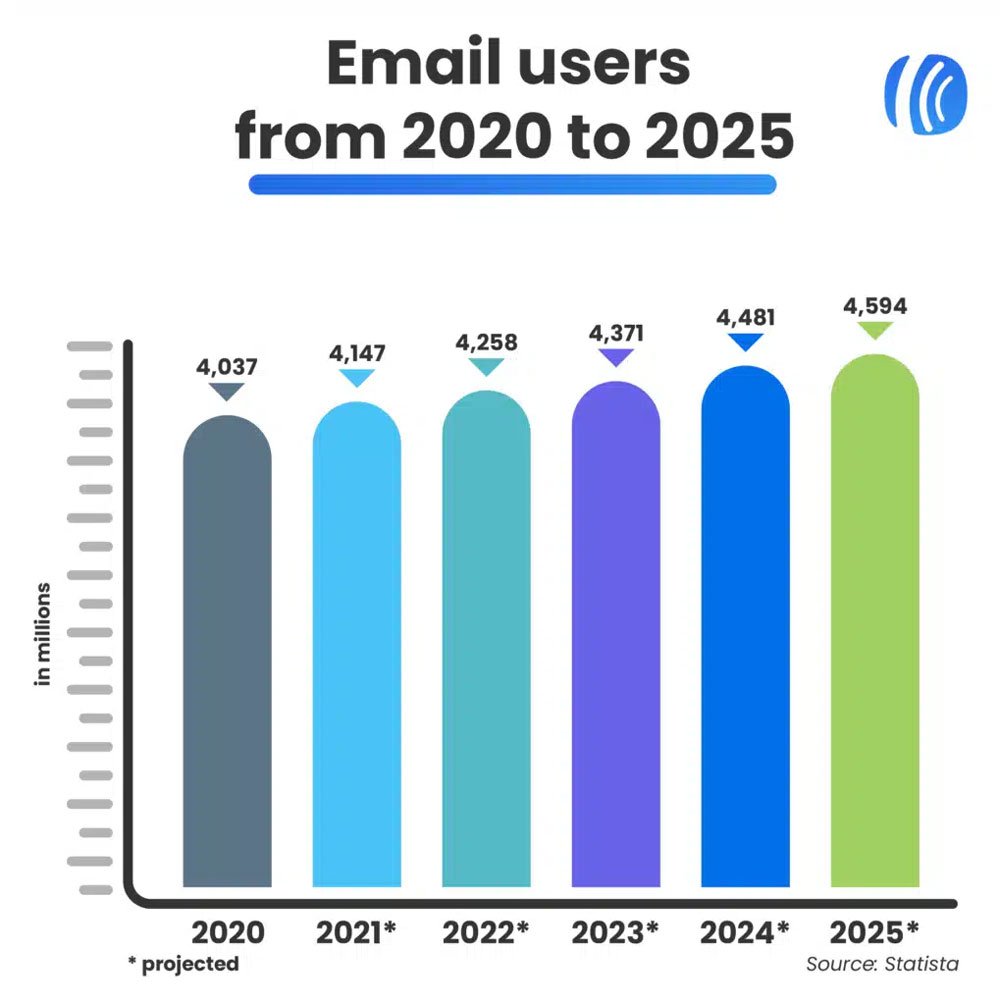
- In 2020, the worldwide count of email users stood at 4,037 million, marking the baseline for subsequent growth.
- Email usage expands yearly, climbing to 4,147 million in 2021 as part of this ongoing upward movement.
- The global user base advances further to 4,258 million in 2022, reflecting sustained adoption.
- By 2023, email users will reach 4,371 million, maintaining the steady expansion pattern.
- The increase continues into 2024, with the user total rising to 4,481 million across the globe.
- Global email users are projected to hit 4,594 million in 2025, reinforcing the long-term growth trend.
- This overall progression represents a rise of more than 557 million users between 2020 and 2025, underscoring significant expansion.
Gmail Market Share and Growth
- Gmail is responsible for about 30% of all global email traffic.
- Some sources estimate Gmail’s email client share at roughly 25.9% in 2025.
- The global email market, in terms of users, is projected to grow to 4.6 billion by 2025.
- If Gmail were to capture 35% of that traffic, it would process 131 billion emails daily.
- Between 2020 and 2025, the email service market saw annual growth of 4–5%.
- Gmail’s user growth has slowed somewhat since 2022, suggesting a shift from rapid expansion to retention and engagement.
- In enterprise segments, Gmail through Google Workspace continues to pull market share from older email platforms.

Daily Email Volume and Traffic
- Worldwide, approximately 361.6 billion emails were exchanged daily in 2024.
- The forecast for 2025 is about 376 billion emails per day globally.
- Gmail alone handled 131 billion+ emails per day.
- That means Gmail processes about 30% of daily global email volume.
- Users spend, on average, 28 minutes per day on Gmail.
- The global email sending rate in 2024 was 4.2 million emails every second.
- Industry-wide spam volume remains high; 2023 estimates show around 160 billion spam emails daily.
- The average business worker receives about 120 emails per day via Gmail.
Gmail Users by Age Group
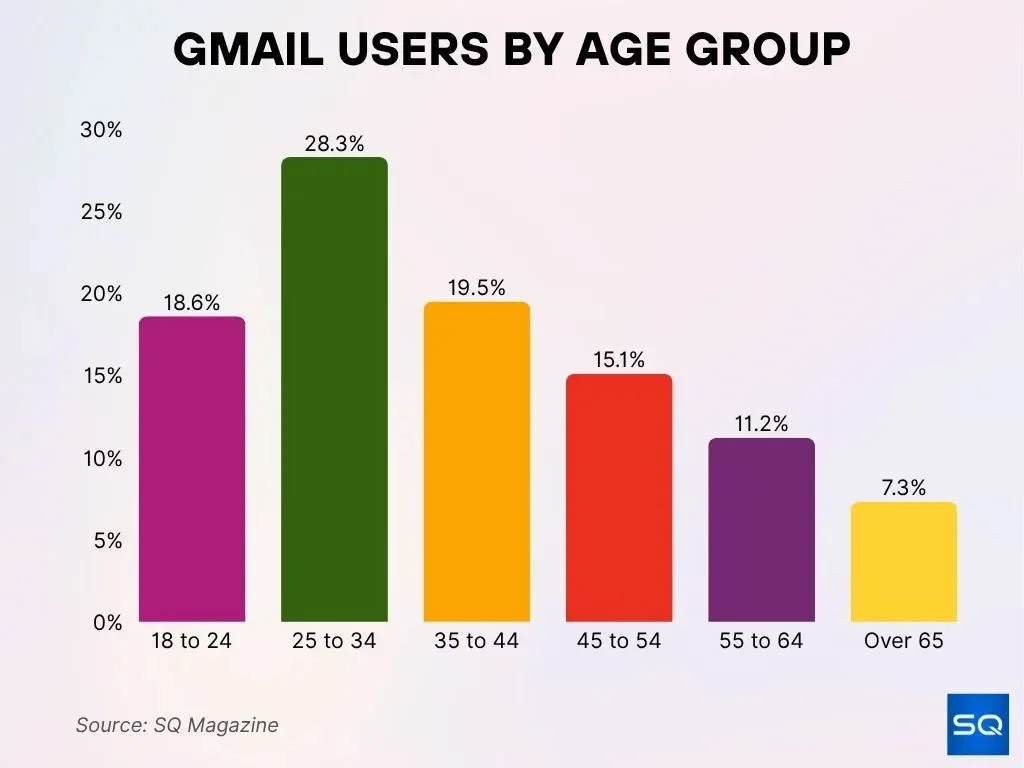
- 25 to 34-year-olds comprise the biggest portion of Gmail users at 28.3%, emphasizing robust usage among rising young professionals.
- 35 to 44-year-olds constitute 19.5% of all users, signaling notable engagement among mid-career individuals.
- 18 to 24-year-olds make up 18.6% of the platform’s audience, illustrating Gmail’s appeal to students and emerging young adults.
- 45 to 54-year-olds represent 15.1%, demonstrating ongoing adoption among established working professionals.
- 55 to 64-year-olds account for 11.2%, underscoring consistent utilization within the pre-retirement demographic.
- Users over 65 years old form the smallest group at 7.3%, reflecting modest yet meaningful participation among senior users.
Mobile vs. Desktop Usage
- Over 75% of Gmail users accessed their email via mobile devices in 2025.
- Gmail’s mobile app accounts for between 75% and 85% of all Gmail opens.
- One study shows Gmail mobile usage at 35.35% and desktop at 64.65%, indicating measurement differences.
- Desktop sessions average around 12 minutes 42 seconds for Gmail users.
- Mobile users tend to check emails more frequently, while desktop users spend longer reading or clicking through emails.
- Email marketers report higher conversion rates from desktop opens compared to mobile.
- In emerging markets, smartphone-first email access is the default mode.
- Responsive and mobile-friendly email design is critical due to Gmail’s mobile dominance.
- US adults spend on average 4 hours 39 minutes per day on mobile devices versus 2 hours 20 minutes on desktops/laptops.
- Globally, 58.3% of web traffic comes from mobile devices, while desktop accounts for 39.8% (2024–25 data).
Geographic Distribution of Users
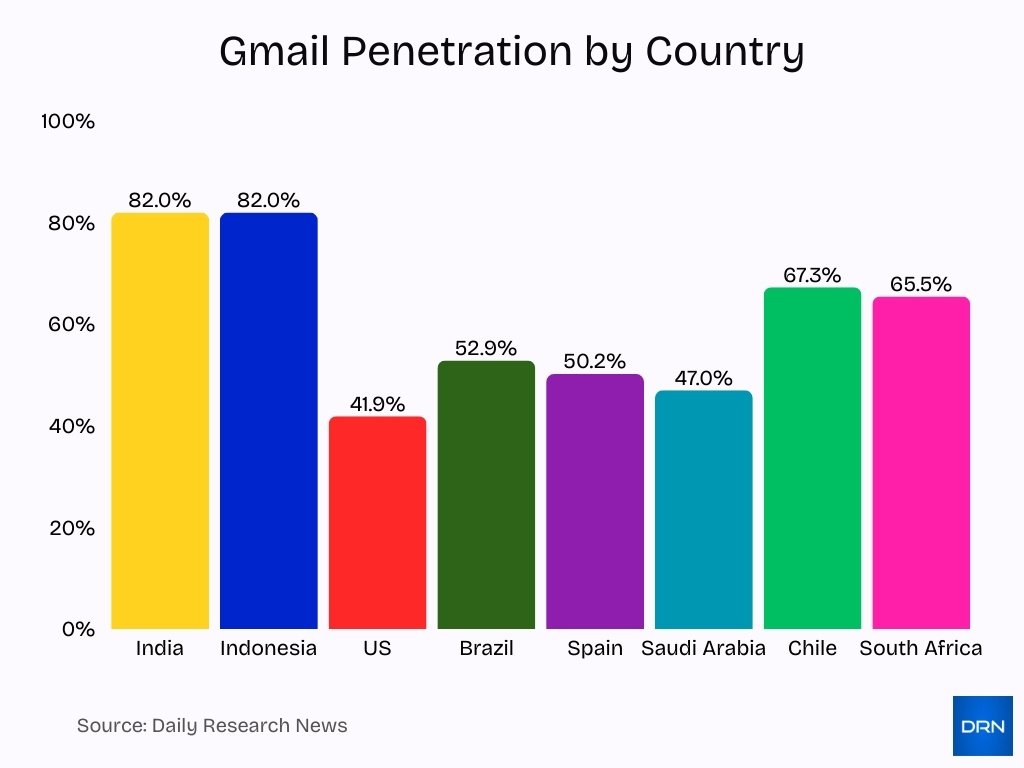
- Indonesia and India both show Gmail penetration above 82%.
- In the United States, Gmail usage stands at around 41.9% of the population.
- Brazil shows Gmail adoption of approximately 52.9%, Spain 50.2%, and Saudi Arabia about 47%.
- Chile (67.3%) and South Africa (65.5%) are high penetration markets.
- Gmail supports over 133 languages globally.
- Asia and Africa continue to drive new Gmail user growth due to rising internet access.
- Developed markets are saturated, while underserved regions still show high growth potential.
- Device usage patterns vary by region, influencing marketing strategies.
Gmail Account and Inbox Statistics
- Many users maintain more than one Gmail account, average of 1.7 accounts per user.
- Total Gmail accounts globally approach 3 billion, including duplicates.
- Gmail’s free tier offers 15 GB of shared storage.
- The average Gmail user checks their inbox 12 times per day and spends 28 minutes managing it.
- Business users typically have higher email volumes and longer management times.
- Gmail supports attachments up to 25 MB; larger files are shared via Drive.
- Gmail processes 131 billion+ emails each day.
- Contacts, labels, and automation usage continue to rise among Gmail users.
Gmail Usage Patterns and Engagement
- The average Gmail user spends 28 minutes per day in the inbox.
- Most Gmail users check their inbox around 12 times daily.
- Adults aged 25-34 years represent 28-33% of total users.
- Mobile interactions involve quick checks, while desktop sessions involve deeper engagement.
- Google Workspace users see 35% productivity improvement and 40% less email clutter.
- Time per message is decreasing, showing increased email efficiency.
- Gmail marketing open rates average 19.2%.
- Gmail now functions as a productivity hub, integrating scheduling, file sharing, and meetings.
Gmail Business and Enterprise Adoption
- Gmail via Workspace has over 6 million paying business customers.
- Up to 90% of U.S. startups use Gmail as their primary email solution.
- About 60% of mid-sized companies use Gmail for their email and collaboration needs.
- Large enterprises, including Fortune 500 companies, show adoption above 40%.
- Gmail business users report 35% productivity gains and 40% reductions in clutter.
- Integration with Drive, Docs, Calendar, Meet, and Chat boosts Gmail’s enterprise value.
- Security features make Gmail attractive for regulated industries.
- Gmail offers cost-effective, scalable alternatives to legacy systems.
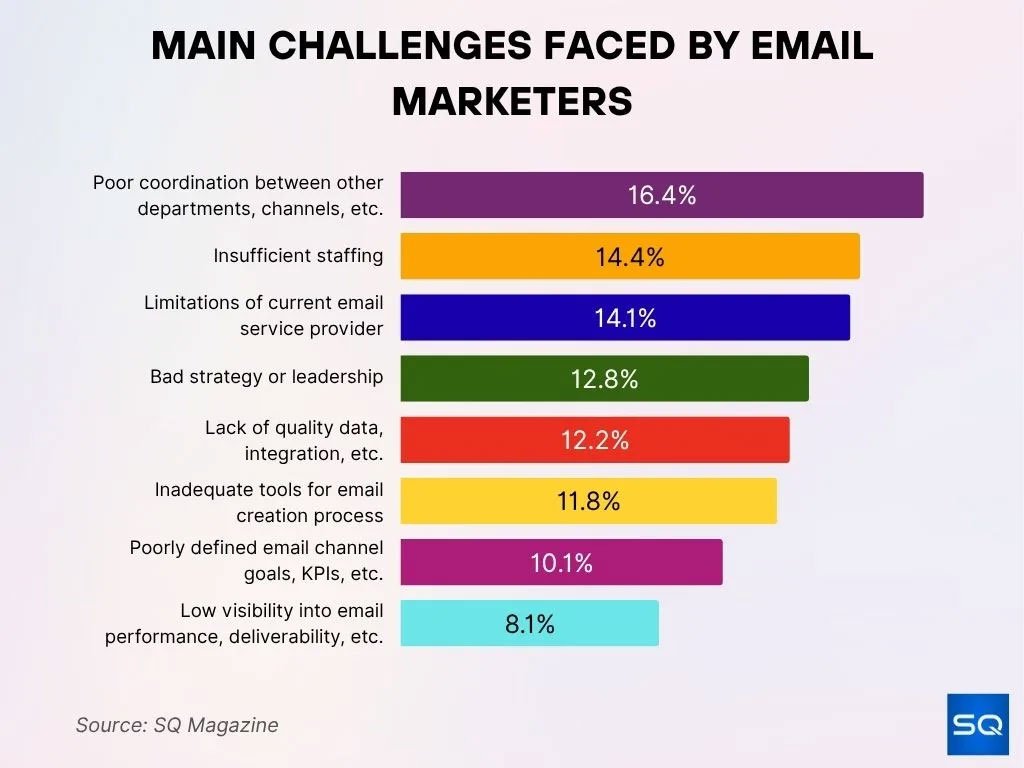
Main Challenges Faced by Email Marketers
- Poor coordination across departments and channels remains the leading obstacle, affecting 16.4% of marketers while disrupting workflow and cohesion.
- Insufficient staffing continues to restrict campaign execution capabilities for 14.4% of email teams, limiting overall output.
- A significant 14.1% of marketers encounter challenges due to the limitations of their email service provider, hindering flexibility.
- Weak strategy or leadership issues obstruct advancement for 12.8% of professionals, slowing strategic development.
- Problems with data quality and integration impact 12.2% of marketers, reducing the effectiveness of segmentation and targeting.
- Inadequate tools for email creation impede progress for 11.8% of marketers, extending production timelines.
- Poorly defined KPIs and channel goals affect 10.1%, diminishing clarity and overall focus.
- Limited visibility into performance presents difficulties for 8.1%, making optimization efforts more challenging.
Security, Spam Filtering, and Phishing Protection
- Gmail blocks more than 99.9% of spam, phishing, and malware before inbox delivery.
- Gmail’s spam filter accuracy sits at about 99.9%.
- Global phishing success rates are projected to drop from 0.12% in 2025 to 0.03% by 2030.
- Global email spam rates hover around 48% in 2025.
- MFA adoption through Gmail significantly reduces breach risk.
- AI-powered detection in Gmail recognizes sophisticated phishing attempts.
- Gmail’s enterprise tier includes S/MIME, audit logs, and enforced TLS encryption.
- Individual users benefit from 2-step verification and passkeys.
Gmail App Downloads and Platform Integration
- The Gmail app has surpassed 10 billion downloads on the Google Play Store.
- Over 0.9 billion downloads are on the Android platform alone.
- Gmail is ranked among the top 5 Android apps in the U.S. by installs.
- The app maintains a high average rating of about 4.4 stars across major app stores.
- Gmail integrates seamlessly with Google Workspace, providing cross-device continuity.
- The app is accessible on Android, iOS, web, and Wear OS platforms.
- Over 75% of Gmail users access their email primarily through mobile devices.
- Gmail APIs enable integration with services like Salesforce, Slack, and automation tools.
- Gmail supports over 72 languages and is used by more than 2.5 billion users globally.
- Mobile-first email growth has reinforced Gmail’s cross-device usage, boosting daily email handling to hundreds of billions worldwide.
Productivity and User Behavior Patterns
- Gmail users spend approximately 28 minutes per day managing email.
- Users check Gmail around 12 times daily.
- Workspace users see 35% productivity gains and 40% clutter reduction.
- The Average daily email load exceeds 120 messages.
- The average user maintains 1.7 accounts.
- Mobile devices dominate short burst checking, while desktop is preferred for longer tasks.
- Gmail usage extends beyond email to scheduling, chat, and file tasks.
- AI-powered features reduce repetitive actions, improving efficiency.
Email Categories and Filters
- Gmail sorts emails into Primary, Social, Promotions, and Updates.
- Approximately 84.5% of emails are categorized as Promotions.
- Social category messages account for 87.2% in some inbox analyses.
- Promotions open rate averages 19.2%.
- Gmail’s “Manage subscriptions” improves user control over mailing lists.
- Advanced users create custom filters to manage high messaging volume.
- Primary tab placement improves visibility compared to Promotions or Updates.
- Marketers must optimize for Gmail’s classification rules.
Open and Read Rates
- Some metrics report Gmail open rates as high as 75%.
- Industry-wide average open rate is around 32.6%.
- Gmail-specific campaigns often average 19.2% opens.
- Transactional emails see 50–80% open rates.
- Gmail promotional CTR averages 3%.
- Unsubscribe rates across campaigns average 0.15%.
- About 24% of Gmail-delivered emails are opened within one hour.
- Engagement is shifting toward actionable metrics such as clicks and replies.
Gmail AI Features and Innovations
- Gmail’s Smart Compose feature was used over 118 billion times in 2022, and usage is expected to multiply in the coming years.
- AI-powered spam filters catch 99.9% of phishing emails, spam, and malware before they reach users’ inboxes.
- Gmail’s AI reduces email handling time by up to 33% daily for repetitive inbox tasks.
- Gmail users save typing more than 1 billion characters weekly thanks to Smart Compose.
- The “Manage subscriptions” feature helps users reduce mailing list overload with easy one-click unsubscribes.
- AI-driven spam detection improvements led to a 38% increase in spam caught and a 19.4% drop in false positives.
- Workspace users benefit from proactive threat detection, analyzing over 40 million security signals globally.
- AI-driven categorization sorts inbox emails automatically, improving user productivity by 20-30%.
- Gmail’s Smart Reply feature accelerates response times, helping users reply 75% faster.
- Future Gmail AI may enable advanced voice commands and workflow automation, increasing task efficiency by up to 50%.
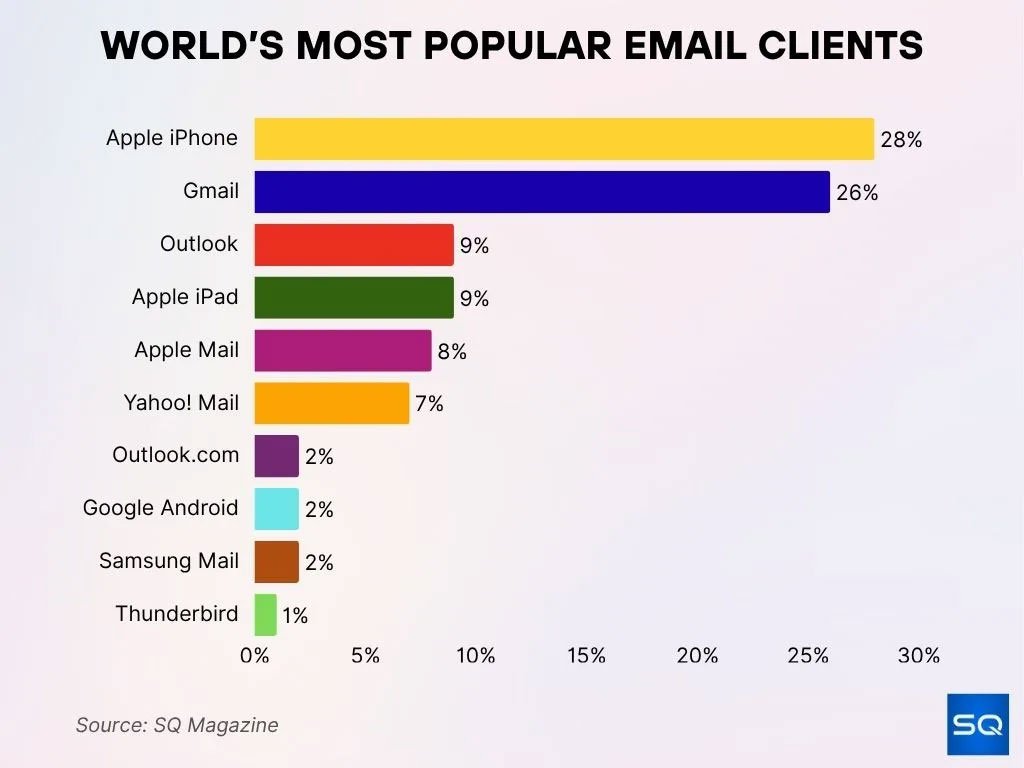
World’s Most Popular Email Clients
- Apple iPhone stands at 28% of all email opens worldwide, underscoring its strong dominance in mobile-based email engagement.
- Gmail comes next with 26%, demonstrating its vast user base and robust cross-platform performance.
- Outlook and Apple iPad each represent 9% of email opens, indicating steady adoption among professional users and tablet audiences.
- Apple Mail accounts for 8%, emphasizing its ongoing popularity among macOS users.
- Yahoo! Mail secures 7%, showing it remains relevant even amid stronger competitors.
- Outlook.com, Google Android, and Samsung Mail each hold 2%, reflecting their niche yet consistently active user segments.
- Thunderbird records the lowest share at 1%, serving a dedicated but smaller user base.
Trends and Future Projections
- Global daily email volume is projected to reach 376.4 billion in 2025.
- Gmail is expected to process over 130 billion emails daily by 2025.
- The Asia Pacific and Africa regions are leading with over 20% CAGR in Gmail adoption growth.
- About 75% of Gmail users access it via mobile devices, driving mobile-first innovation.
- AI-powered features like Smart Compose and Smart Reply are used by over 1 billion Gmail users.
- Gmail is evolving into a digital communication hub, integrating AI for inbox automation.
- Email deliverability challenges are increasing due to strict categorization and privacy changes.
- Approximately 22% of the global population actively uses Gmail, emphasizing its enterprise role.
- Regulations like GDPR and CCPA impact Gmail’s enterprise compliance and global use.
- Gmail mobile app has surpassed 10 billion downloads, reflecting its growing mobile dominance.
Frequently Asked Questions (FAQs)
Gmail serves approximately 2.5 billion active users globally.
Gmail holds about 24.17% of email-client opens worldwide, ranking second.
In Indonesia, Gmail usage reaches around 82.6% of the population.
Globally, around 361.6 billion emails are exchanged daily, and Gmail handles nearly 30% of that volume.
Conclusion
The data shows that Gmail remains a central player in the global communication infrastructure. With more than 2.5 billion active users, billions of daily emails, extensive mobile usage, and deep productivity integrations, Gmail’s footprint spans both personal and enterprise contexts. From AI-powered features to evolving engagement metrics and international growth potential, the trends point to continued significance and change.
Whether you’re an individual user, email marketer, or business leader, the insights presented here help frame how Gmail is being used and where its future trajectory leads. Dive into the full article to explore each section and shape your approach to email in the year ahead.