


Websites and apps need clarity on how users behave. Google Analytics (GA) delivers that clarity, across traffic, engagement, conversion, and user journeys. GA remains central to web measurement worldwide, helping marketers, content creators, and businesses shape data-driven strategies. Below, we highlight key statistics and recent shifts that illustrate GA’s reach and influence.
Editor’s Choice
- Over 14.8 million websites use the latest version, Google Analytics 4 (GA4).
- GA4 accounts for roughly 43% of the global web analytics market share.
- Worldwide, around 37.9 million websites rely on Google Analytics (all versions combined).
- On the websites we know have a traffic analysis tool, Google Analytics is used by about 79.3%.
- Among the top 10,000 global websites by rank, 43.35% now use GA4.
- For the top million websites by traffic, 33.65% have GA4 installed.
- In the United States alone, there are ≈ 3.2 million GA4-enabled sites.
Recent Developments
- As of 2025, Google Analytics is used by 55.49% of all websites globally, or about 37.9 million sites.
- Roughly 14.8 million websites now use GA4, giving it about a 43% share among Google Analytics installations in early 2025.
- GA4 adoption jumped from around 3.5 million sites in late 2024 to over 14.2 million by mid‑2025, a 4x increase in under a year.
- Google technologies dominate web analytics with a combined market share of over 70% in 2024, including Google Analytics and Universal Analytics.
- The global web analytics market reached about $7.98 billion in 2025 and is projected to grow at a roughly 15.44% CAGR to 2030.
- Cloud-based web analytics platforms held about 78.23% deployment share in 2024, far ahead of on‑premise solutions.
- Google Analytics is used by about 79.3% of the websites that use any traffic analysis tool, representing 45.1% of all websites as of mid‑2025.
- GA4 is implemented on roughly 33.65% of the top 1 million websites and 43.35% of the top 10,000 sites by traffic, highlighting strong enterprise adoption.
Overview of Google Analytics Statistics
- Roughly 37.9 million websites globally use Google Analytics in some form.
- Among known analytics tool users, GA has a penetration of 79.3%.
- In the subset of elite sites, the top 10,000 by rank, 43.35% have GA4 installed as of 2025.
- The top 100,000 sites show comparable numbers, around 42.23% use Google Analytics.
- For the top 1 million by traffic volume, GA4’s adoption sits at 33.65%.
- Overall, GA4 (and predecessor versions) cover an estimated 55.49% of all live websites globally, equal to roughly 37.9 million sites in 2025.
- Among websites that use any traffic‑analysis tool, about 79.3% rely on Google Analytics as their primary platform.
- GA4 supports over 200 dimensions and metrics, enabling detailed visitor behavior analysis.
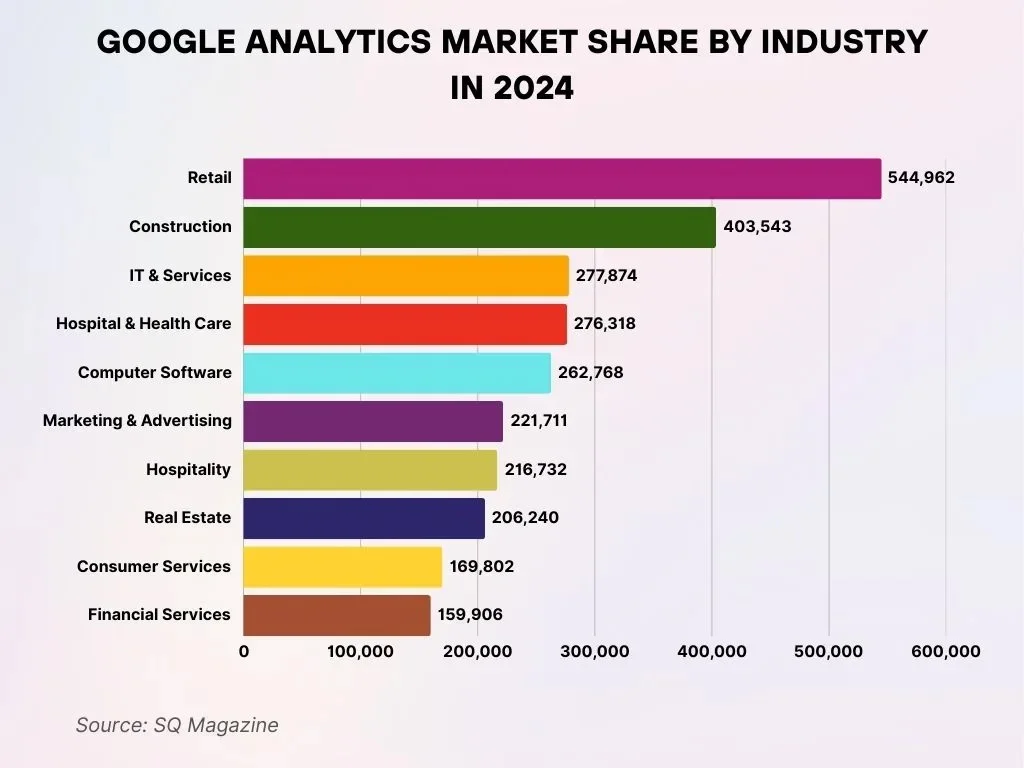
Google Analytics Market Share by Industry in 2024
- Financial Services comes in with 159,906 users, demonstrating a growing reliance on data to optimize digital strategies.
- Retail leads the pack with 544,962 businesses using Google Analytics, making it the top industry adopter.
- Construction follows closely with 403,543 users, showing strong digital tracking integration in a traditionally offline sector.
- IT & Services ranks third, with 277,874 businesses using the platform to monitor digital performance.
- Hospital & Health Care is not far behind, with 276,318 users, reflecting the sector’s growing emphasis on digital presence.
- Computer Software firms contribute 262,768 users, highlighting the tech-savvy nature of this industry.
- Marketing & Advertising accounts for 221,711 users, emphasizing data-driven strategies in the sector.
- Hospitality sees 216,732 users, indicating widespread adoption to enhance guest engagement and track conversions.
- Real Estate features 206,240 users, leveraging analytics to understand customer behavior and improve property visibility.
- Consumer Services has 169,802 users, underlining the importance of analytics in customer experience management.

Adoption Levels of Google Analytics
- GA4’s user base reached 14.8 million websites worldwide by early 2025.
- The U.S. accounts for roughly 3.2 million of those sites, leading globally by a substantial margin.
- That U.S. share represents around 22% of the global GA4 user base.
- Among small businesses (under 50 employees), about 71% report using Google Analytics.
- Companies with 1–10 employees constitute the majority of GA users worldwide.
- Medium-sized businesses (50–1,000 employees) account for a smaller but significant portion, while large enterprises make up less than 10%.
- Adoption continues even among enterprise-level users; GA4’s integration capabilities encourage larger organizations to retain or add GA alongside other analytics tools.
- Small and medium businesses find GA4 especially appealing due to its free tier and low technical barrier, making analytics accessible even to those without a dedicated analytics staff.
GA4 vs Universal Analytics Usage
- GA4 has effectively replaced older versions. Since July 1, 2023, standard Universal Analytics properties have stopped processing new data.
- As of 2025, GA4 is the de facto version for new analytics deployments.
- Many websites migrated to GA4 to benefit from event-based tracking, which handles both mobile apps and web events, rather than session-based measurements used in Universal Analytics.
- GA4 adoption among the top 10,000 sites stands at 43.35%, signaling widespread transition at the high end of the web ecosystem.
- For the top 1 million websites, 33.65% have GA4, suggesting a more gradual shift among high-traffic but lower-ranked sites.
- GA4’s architecture aligns with privacy and compliance demands, a key factor in replacing older versions.
- Analysts note that by late 2024, GA4’s global adoption surged, reflecting deferred migrations from Universal Analytics.
- GA4’s continued growth suggests its usage will likely surpass previous versions across all segments by 2026.
Google Analytics Market Share
- GA4 currently holds about 43% of the global web analytics market as of 2025.
- When considering all versions, Google Analytics is used by approximately 55–56% of global live websites.
- Among websites using any traffic analysis tool, GA commands 79.3% share, making it the dominant single analytics tool globally.
- For the top 10,000 websites by rank, 43.35% run GA4, confirming its reach among high-profile sites.
- Among the top 100,000 sites, nearly 42.23% use Google Analytics.
- For the top million sites, GA4 adoption sits at 33.65%, lower but substantial in absolute terms.
- Many small and mid-sized businesses rely on GA because of its free tier and ease of use, factors that have helped maintain its market dominance even as privacy concerns grow.
- In 2024, cloud-based analytics solutions captured 78.23% of the broader web analytics infrastructure market, a trend supporting GA4’s advantage, as it is cloud-delivered.
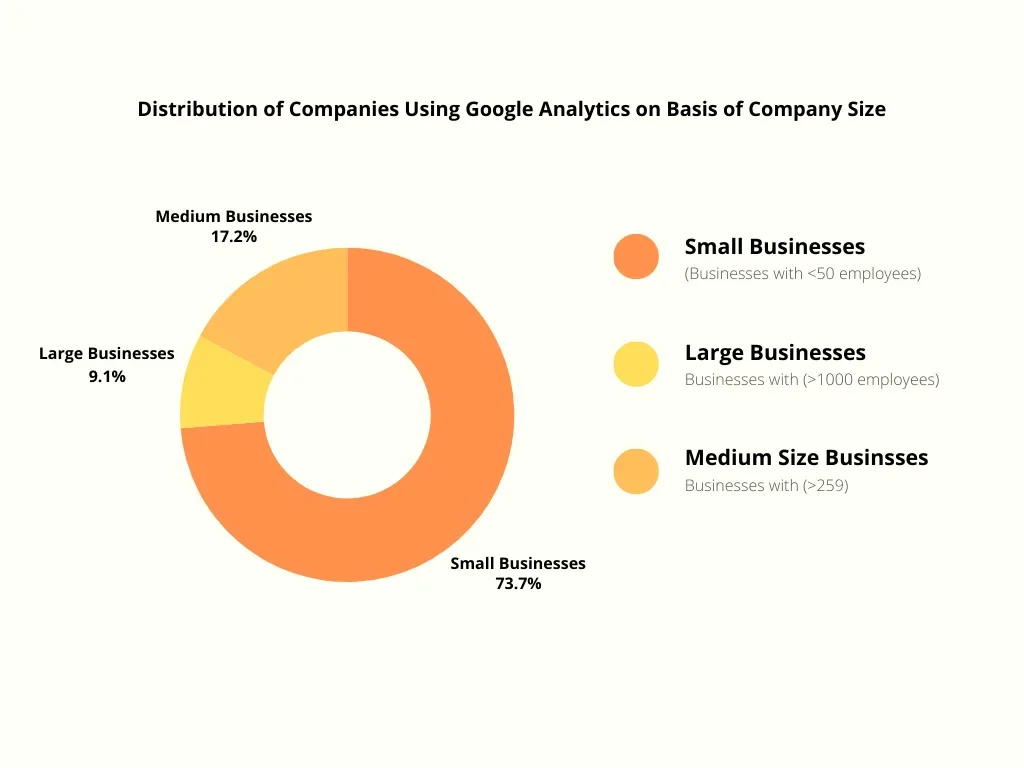
Google Analytics Adoption by Business Size
- Large businesses (those with more than 1,000 employees) constitute only 9.1%, indicating comparatively lower usage among enterprise-level organizations.
- Small businesses dominate the use of Google Analytics, representing 73.7% of total users and referring to companies with fewer than 50 employees.
- Medium-sized businesses (firms with over 259 employees) account for 17.2% of users, demonstrating a moderate level of adoption.
Google Analytics Usage on Top Websites
- Among the top 10,000 highest-ranked websites globally, 43.35% have GA4 implemented.
- For the top 100,000 most-visited sites, 42.23% use Google Analytics (GA4).
- Within the top 1 million websites by traffic, 33.65% have GA4 installed.
- Overall, around 55.49% of all websites rely on Google Analytics as their primary analytics platform.
- Google Analytics (Universal + GA4) is used by roughly 87.2% of the top 10,000 websites, far ahead of competing analytics tools.
- Google Analytics holds about 43% global market share in the web analytics space, underlining its continued dominance.
- Approximately 14–15 million websites worldwide use GA4, including about 3.2 million in the United States.
- More than 2 million WordPress and over 520,000 Shopify websites are integrated with Google Analytics/GA4.
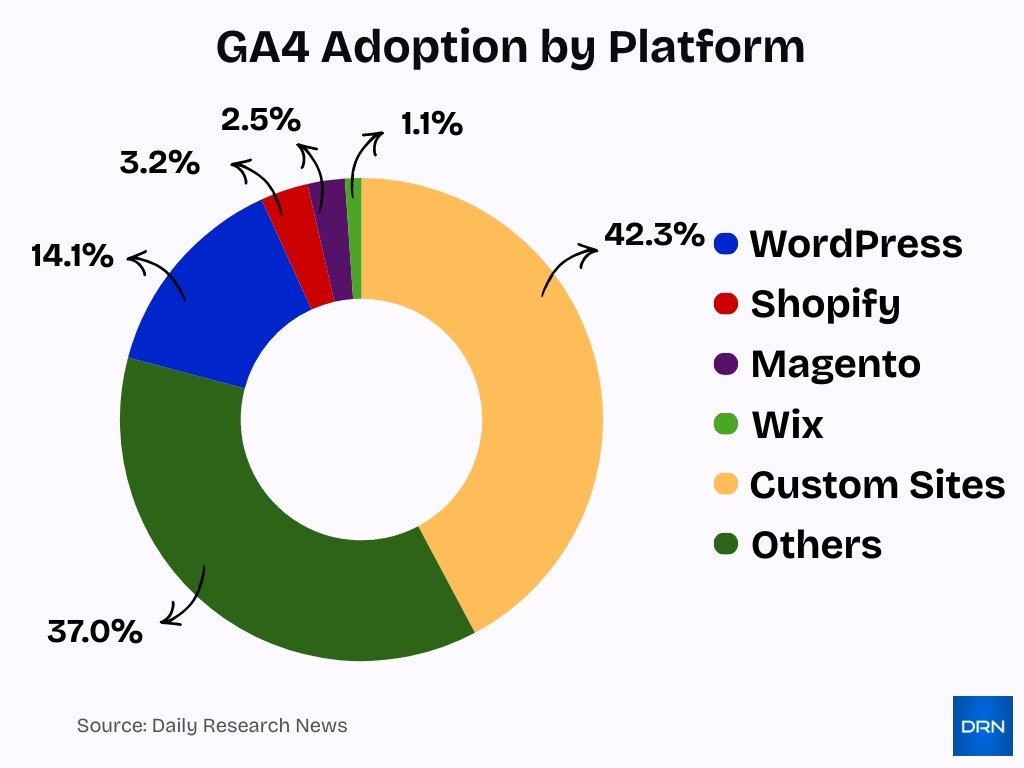
GA4 Adoption by Platform Type
- Custom-built websites lead GA4 adoption, representing 42.3% of all implementations, highlighting that organizations with tailored solutions are quickest to migrate.
- “Other” platforms collectively account for 37.0%, showing that a wide range of smaller or niche systems together make up a large portion of GA4 users.
- WordPress holds 14.1%, making it the most widely adopted mainstream CMS for GA4 among major off-the-shelf platforms.
- Shopify represents 3.2% of GA4 adoption, indicating moderate uptake among e-commerce sites.
- Magento contributes 2.5%, reflecting slower migration within enterprise-level e-commerce platforms.
- Wix shows the lowest adoption at just 1.1%, suggesting limited GA4 usage among small-business or beginner-friendly website builders.
Google Analytics for E-commerce Sites
- Nearly 520,000 GA4 websites operate on Shopify platforms.
- Over 450,000 Shopify stores actively use GA4 for analytics.
- 70% of eCommerce websites have adopted GA4 since its 2023 launch.
- 14.8 million websites globally utilize GA4, holding 43% market share.
- GA4 reports 97% alignment with Shopify session data on average.
- 237,000 Shopify sites leverage GA4 alongside 1.2 million WordPress implementations.
- Event-driven tracking in GA4 enables detailed purchase and cart analysis without data sampling.
- GA4 improves funnel accuracy by avoiding backfill issues present in older Universal Analytics models.
Google Analytics for Mobile Apps and Web
- Over 14.2 million websites globally use GA4 for unified web and app analytics.
- 3.2 million U.S. websites have adopted GA4 cross-platform tracking capabilities.
- GA4 holds a 43% market share among analytics platforms for mobile and web data.
- 5.78 billion people, or 70.5% of the world population, use mobile phones, driving GA4 demand.
- Global monthly mobile data usage reaches 200 exabytes in 2025, emphasizing cross-platform needs.
- 87% of mobile handsets are smartphones, boosting GA4’s app-web integration value.
- GA4 event-based model captures every user interaction across platforms for precise measurement.
- Businesses gain consolidated views with GA4 tracking acquisition, engagement, and conversions seamlessly.
- Mobile technologies contribute 5.8% to global GDP at $6.5 trillion, highlighting GA4’s essential role.
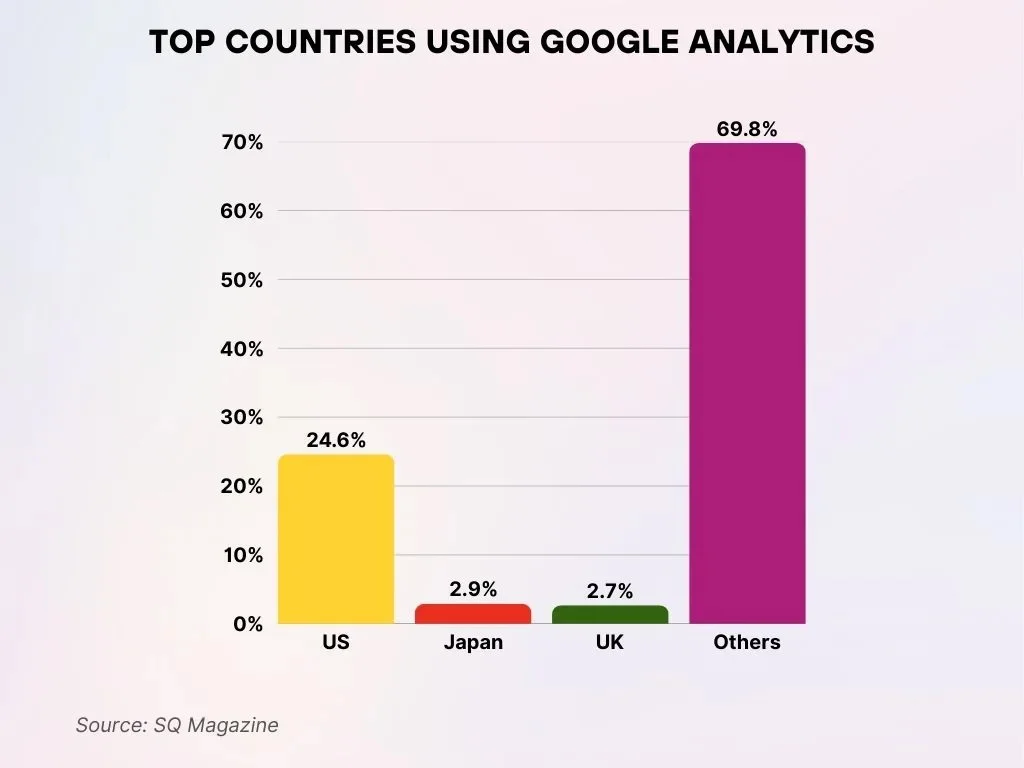
Top Countries Using Google Analytics
- Other countries combined represent the largest portion at 69.8%, highlighting the tool’s broad global distribution beyond the top three.
- The United States stands as the global leader, making up 24.6% of all Google Analytics users.
- Japan accounts for 2.9%, indicating a moderate adoption within the Asian market.
- The United Kingdom contributes 2.7%, demonstrating its consistent presence in digital analytics usage.
Conversion and Goal Tracking Statistics
- GA4 was used by over 14.2 million websites globally in 2025.
- Businesses linking GA4 to Google Ads see 23% higher conversions.
- GA4 holds a 43% share among analytics tools worldwide.
- Over 2 million WordPress sites use GA4 tracking.
- August 2025 GA4 update prevents conversion under-reporting in multi-account setups.
- Ecommerce cart abandonment averages 70% before checkout in GA4 funnels.
- SMBs achieve 27% higher conversion rates with optimized GA4 tracking.
- GA4 supports up to 30 conversion events and 300 custom events.
Engagement and Behavior Metrics in Google Analytics
- Users view an average of 5.53 pages per session in GA4.
- The average session duration is 6 minutes 25 seconds.
- The average bounce rate across GA4 sites is 32.53%.
- GA4 tracks over 200 dimensions and metrics for analysis.
- Around 25–45% of users access content from multiple devices.
- Engaged sessions make up about 40–60% of total visits.
- Only 35–50% of users reach 50% page scroll depth.
- Returning users generate 50–70% of total conversions.
- 20–30% of pages drive 70–80% of total engagement.
- GA4 engagement tracking improves ROI by up to 2.5×.
Attribution and Marketing Channel Statistics
- Brands implementing GA4 Enhanced Conversions report 15–30% more accurate conversion attribution across channels in complex setups.
- After linking GA4 with Google Ads, around 68% of digital marketers say campaign performance improved due to better attribution and bidding signals.
- Data‑driven attribution in GA4 can reassign up to 20–30% of conversions away from last‑click channels to earlier touchpoints in the journey.
- Cross‑platform GA4 properties that track both web and app sessions see, on average, 10–20% more conversions attributed compared with web‑only setups.
- Enhanced conversions using first‑party data can increase match rates by 5–10 percentage points, improving attribution across multiple accounts and devices.
- Multi‑touch attribution models typically reveal that 30–50% of revenue is influenced by mid‑funnel channels that last‑click reporting under‑values.
- Marketers using GA4 event‑based tracking for channel reports note up to 25% budget reallocation toward higher‑ROI channels once true performance is visible.
- Organizations that standardize custom events for offline and non‑standard channels see 10–15% more total conversions captured in their attribution models.
Privacy, Consent, and GDPR Compliance Stats
- A 2024 analysis of over 35,000 EU websites found 49% of cookie banners in violation of GDPR requirements.
- A broader study of 254,148 websites across 31 countries reported that only 15% of cookie banners met minimum GDPR compliance standards.
- Research on 20 million consent interactions showed that over 50% of websites set cookies before any user choice, breaching basic consent rules.
- By mid‑2025, at least 6 national DPAs in Europe had issued enforcement actions against Google Analytics 4 over unlawful cross‑border data transfers.
- Authorities in countries including France, Austria, Sweden, the Netherlands, and Norway have publicly stated that Google Analytics processing can breach GDPR without additional safeguards.
- A cookie‑banner behavior study found that the share of users ignoring banners fell from 76% in 2018 to 33.6% in 2023, reflecting rising awareness of privacy and consent.
- An international compliance review concluded that on many sites, more than 80% of cookie banners still fail at least one core GDPR consent requirement, such as explicit opt‑in, equal choice, or prior blocking.
- Privacy‑first and self‑hosted analytics platforms are increasingly chosen in Germany, France, Italy, and the Netherlands, where regulators and markets now treat privacy‑centric analytics as the default expectation.
- Organizations implementing modern consent solutions report conversion modeling accuracy above 80% when sufficient users grant consent under consent‑mode frameworks.
- Self‑hosted analytics is promoted as a way to meet GDPR, HIPAA, and other regulations, with vendors positioning it as a key response to tightening privacy rules and cross‑border data risks.
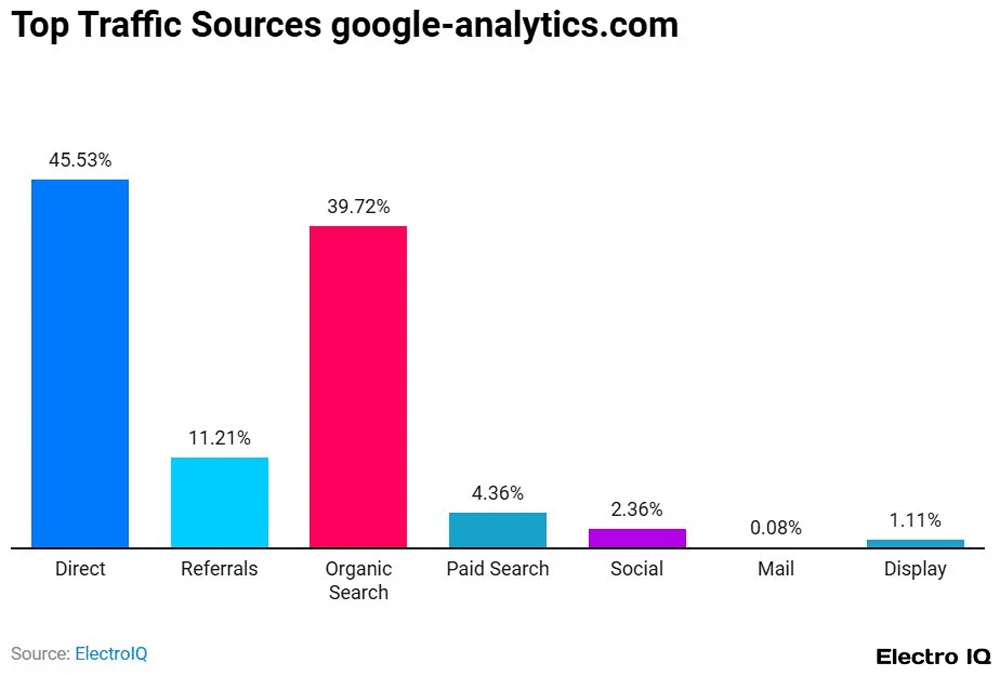
Top Traffic Sources (google-analytics.com)
- Direct traffic is the largest contributor, making up 45.53% of total visits, indicating strong brand recognition and users navigating directly to the site.
- Organic Search accounts for a significant 39.72%, highlighting effective SEO efforts and strong search engine visibility.
- Referrals contribute 11.21%, showing that partnerships, backlinks, or mentions on other sites play a meaningful role in driving traffic.
- Paid Search represents 4.36% of the total, suggesting limited reliance on paid advertising for traffic generation.
- Social media brings in 2.36%, indicating that while present, social platforms are not a major traffic driver.
- Email (Mail) is minimal at 0.08%, implying email campaigns have little impact or are not a primary strategy.
- Display ads contribute 1.11%, showing a modest but measurable effect from display advertising efforts.
Reference: ElectroIQ
Google Analytics Alternatives and Competitor Share
- Matomo remains a leading privacy-focused alternative used by organizations prioritizing data ownership.
- The web analytics market was valued at $7.98 billion in 2025 and may reach $16.36 billion by 2030.
- Cloud-based analytics held 78.23% of the market in 2024.
- Privacy-focused tools like Plausible attract small publishers and EU-facing brands.
- Open source analytics gain traction where strict governance policies apply.
- Many companies use GA alongside secondary analytics tools for complementary insights.
Future Trends in Google Analytics Usage
- Web analytics market reaches $7.98 billion in 2025, growing at 15.44% CAGR to $16.36 billion by 2030.
- Google Analytics powers 55.49% of global websites, totaling 37.9 million sites in 2025.
- GA4 adoption hits 14.8 million websites worldwide, claiming 43% market share by 2025.
- Consent Mode v2 has been adopted by over 90% of EEA advertisers, enabling cookieless conversion modeling.
- Privacy management software market surges from $5.07 billion in 2025 at 23.55% CAGR.
- Cross-platform analytics cuts enterprise reporting time by 40%, boosting customer satisfaction by 25%.
- Data privacy software grows from $5.37 billion in 2025 to $45.13 billion by 2032.
- GDPR fines total €5.88 billion by 2025, driving cookieless tracking adoption.
Frequently Asked Questions (FAQs)
About 55.49% of all websites globally use Google Analytics in 2025.
Roughly 79.6% of websites with a known traffic-analysis tool use Google Analytics.
More than 14.2 million websites globally are using GA4 as of 2025.
Approximately 43.35% of the top 10,000 highest-ranking websites use Google Analytics.
Conclusion
Google Analytics continues to anchor web analytics worldwide. GA4’s improvements in conversion tracking, cross-platform data unification, and compliance features reinforce its role as a core analytics tool, whether for small blogs, e-commerce stores, or global enterprises. At the same time, rising privacy concerns and regulations are fueling interest in alternatives such as Matomo or Plausible Analytics, especially among sites targeting privacy-conscious audiences.
As the web analytics market expands rapidly toward 2030, businesses face a growing choice: stick with GA’s power and breadth, or adopt lighter, privacy-first systems. Either way, the need for accurate, compliant, and actionable data has never been clearer.