


Google Maps has evolved from a simple mapping service into a critical platform for navigation, business listings and spatial intelligence. Today, it supports everything from ride-hailing logistics in major U.S. cities to outdoor adventure routing for global travellers. Two clear use cases: a delivery company optimizing driver routes in New York and a tourism operator in Europe using Maps data to guide visitors to offbeat locations. Dive in to explore the latest statistics and trends behind this indispensable tool.
Editor’s Choice
Here are seven standout metrics that illustrate Google Maps’ scale and significance in 2025:
- Over 2 billion users actively engage with Google Maps globally.
- Approximately 2.2 billion monthly users as of early 2025.
- The platform covers more than 250 countries and territories worldwide.
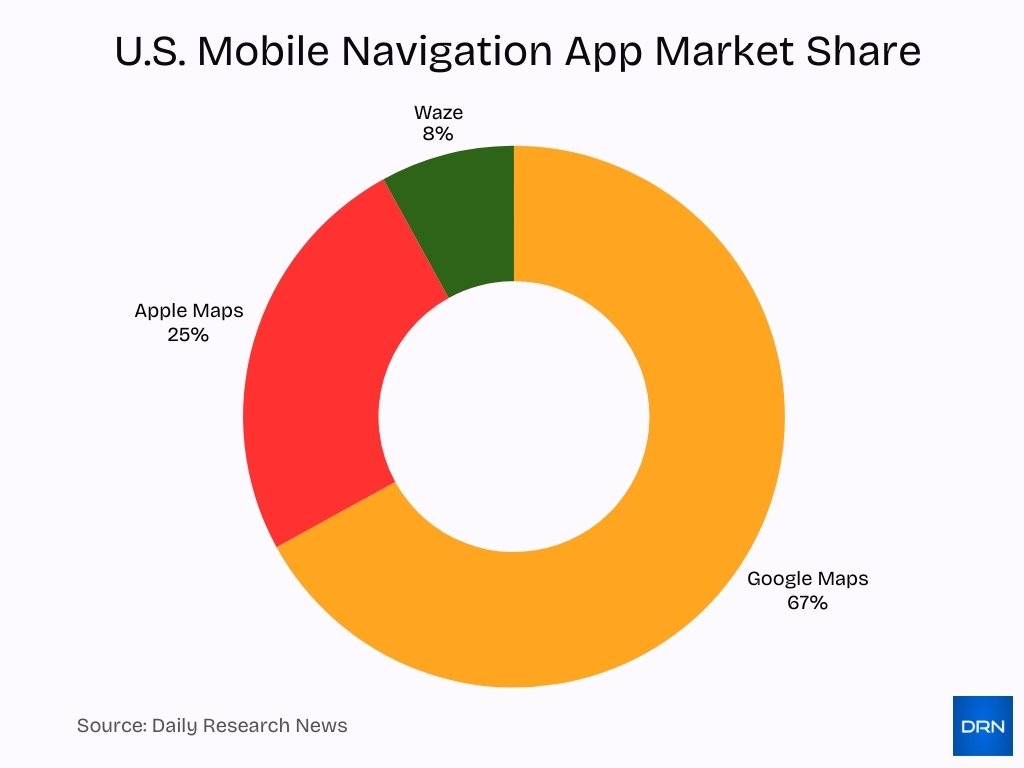
- Google Maps holds an estimated 67% share of the map app market.
- There are over 40 million businesses listed on Google Maps in 2025, out of a total of 200 million places.
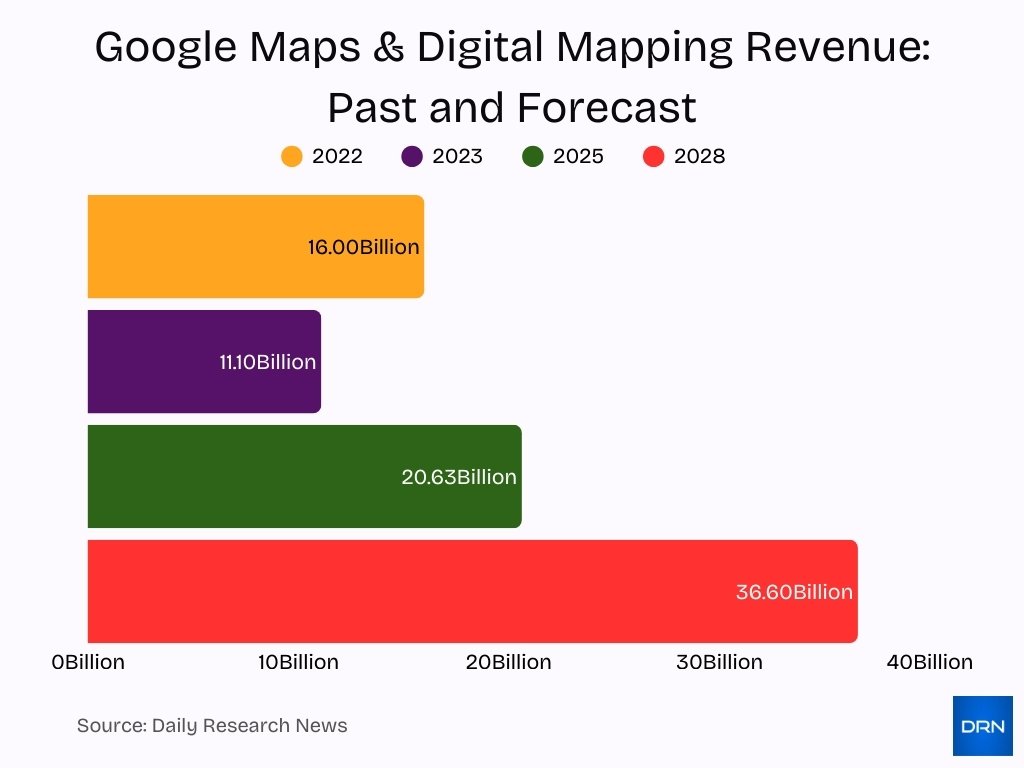
- In the navigation app sector, industry revenue was $16.2 billion in 2022 and is forecast to reach $36.6 billion by 2028.
Recent Developments
Here are eight key recent developments shaping Google Maps:
- In November 2025, Google published holiday traffic and shopping peak insights through Google Maps, showing states’ shopping timing trends.
- Google is increasingly integrating AI and generative features into Maps, for example, conversational directions.
- The staggered deletion of older location history data, three-month default, was announced in 2024- 25 as a privacy initiative.
- Maps expanded high-resolution imagery coverage, 36 million square miles of Earth’s surface mapped in a detailed format.
- The API and integration ecosystem continues to grow; more than 5 million apps use Google Maps integrations.
- Google Maps extended its business listing and promoted listing features to support commerce and local search.
- The platform’s demographic analytics improved, showing more granular age and gender distribution data, for example, 54% male, 46% female.
- More focus on route efficiency and environmental impact studies, signalling a push beyond just “find the way” toward “optimize the way”.
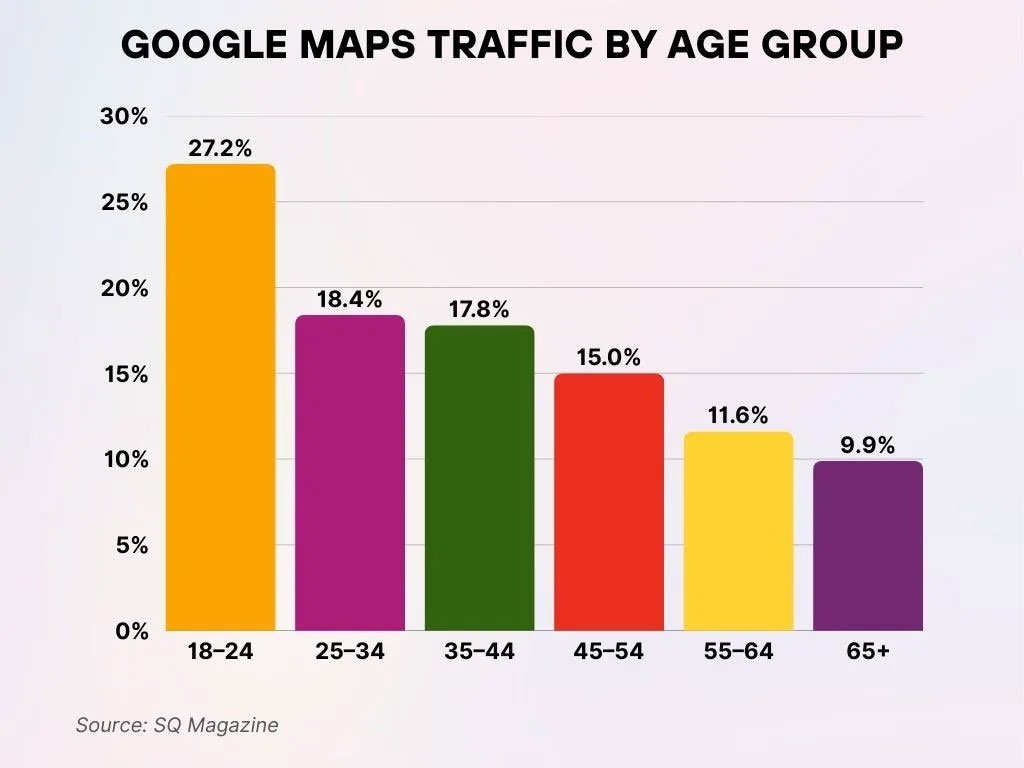
Google Maps Traffic by Age Group
- Users aged 18–24 constitute the largest proportion of Google Maps traffic at 27.2%, emphasizing substantial usage among Gen Z.
- The 25–34 age bracket provides 18.4% of total traffic, illustrating strong participation from younger millennials.
- Close behind, individuals aged 35–44 account for 17.8%, demonstrating steady usage continuing into early middle age.
- The 45–54 demographic represents 15.0%, indicating a moderate decline in activity among older users.
- Users aged 55–64 contribute 11.6% of traffic, reflecting a lower yet still meaningful level of engagement.
- The 65+ age group forms the smallest share at 9.9%, suggesting limited adoption among senior users.
Usage Statistics
- Google Maps accounts for about 67% of the map app market share.
- More than 200 million businesses are listed in Google Maps in 2024-2025.
- “Open now near me” searches increased by 400% in recent years.
- Over 5 million apps integrate Google Maps data and features.
- Users average 50 sessions per month, each lasting roughly 3 minutes.
- Google Maps is used by 88% of consumers for mapping in one survey.
- In the U.S., Google Maps downloads in 2021 reached 25 million despite its pre-installation status.
- Daily contributions from users exceed 20 million items, 200 contributions every second.

Google Maps Street View Statistics
- The Google Street View component reached more than 10 million miles of road imagery in 83 countries by its 10-year mark.
- A study found that Street View imagery covered 62.4% of buildings in a sampled major city.
- Coverage spans 100+ countries and more than 220 billion images.
- 2025 additions included Namibia, Nepal, and Bosnia and Herzegovina.
- The imagery capture fleet uses cars, backpacks, tricycles and on-foot equipment.
- Research shows Street View tends to overrepresent non-residential buildings, creating bias.
- The app uses approximately 0.73 MB every 20 minutes during active map use.
- More than 95 languages and a wide array of landmarks are accessible through Street View.
Navigational Statistics
- Every day, users drive over 1 billion kilometres using Google Maps routing.
- The navigation app industry generated $16.2 billion in 2022.
- The projected industry revenue by 2028 is $36.6 billion.
- Routing research found a 6.5% travel time reduction and related emissions reduction.
- The app is available in 250+ countries and territories for navigation.
- Google Maps consumes about 0.73 MB every 20 minutes on average.
- Users engage in about 50 sessions per month, indicating frequent route checks.
- Google Maps holds the largest global usage share for navigation apps compared to Apple Maps and Waze.
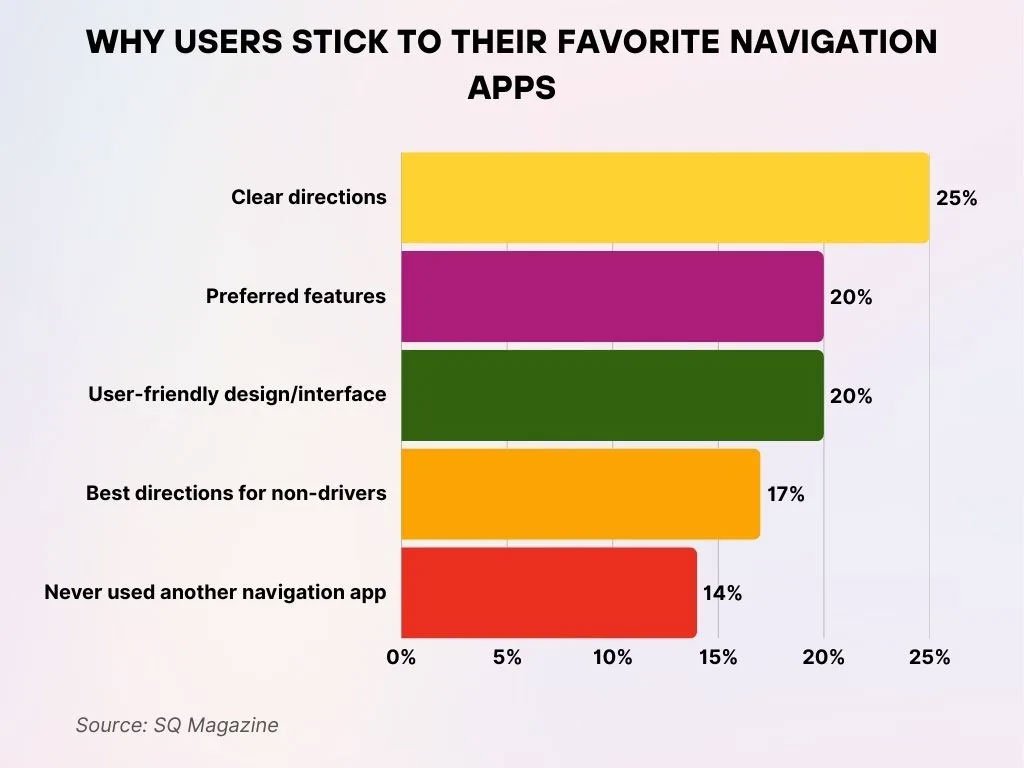
Why Users Stick to Their Favourite Navigation Apps
- 25% of users report that they stick with their preferred navigation app because it delivers clear guidance, emphasizing that turn-by-turn accuracy remains their highest priority.
- 20% say they favour apps that include particular features tailored to their needs, underscoring how customization and functionality strongly influence their choices.
- Another 20% appreciate a navigation app with an intuitive interface, highlighting that simplicity and ease of use are essential for keeping users engaged.
- 17% select their app because it provides the most effective directions for non-drivers, revealing increasing demand among pedestrians, cyclists, and public transit riders.
- 14% of users have never tested a different navigation app, implying deep brand loyalty or complete satisfaction with the first one they adopted.
Google Maps Business Statistics
- The platform lists over 200 million businesses and places worldwide.
- More than 30 million domains use Google Maps integrations.
- 74% of business profiles are small businesses, 17% medium, 8% large.
- Monthly business profile edits exceed 15 million.
- 48% of U.S. local intent searches lead to interaction within 24 hours.
- Profiles with 15+ photos see stronger engagement signals.
- 64% of businesses have verified their profile.
- Typical U.S. business profiles receive 200 clicks per month on average.
Google Maps Revenue Statistics
- Google Maps revenue reached $11.1 billion in 2023.
- Most revenue comes from local ads and API usage.
- The global navigation app market is projected to reach $36.6 billion by 2028.
- The digital map market size is forecasted to hit $20.63 billion in 2025.
- Over 73% of U.S. websites integrate mapping or location features.
- Business listing monetization continues growing as a revenue component.
- Free tier API credits encourage adoption and subsequent platform spending.
Google Maps Worldwide Coverage
- Google Maps is available in 250+ countries and territories.
- The app supports 95+ languages.
- More than 5 million websites and apps use Google Maps Platform products.
- 85% of U.S. smartphone owners have Google Maps installed.
- Coverage continues expanding into rural and remote regions.
- API features have near-global coverage according to the platform documentation.
- Over 70% of Android users worldwide have the app installed.
Features and Innovations
- Google Maps features over 10,000 indoor maps of large venues worldwide.
- “Live View” AR navigation is available in 100+ major cities globally.
- Eco routing options help reduce CO2 emissions by up to 12% on selected routes.
- Google Maps supports multimodal travel options, including driving, cycling, walking, transit, and micromobility.
- Integrations with rideshare services cover 500+ cities, facilitating over 60 million trip bookings quarterly.
- AI-powered tools on Google Maps are used by millions of developers for custom overlays and route optimization.
- Advanced Google Maps features often debut first in the U.S. market.
- Over 154 million daily active users engage with Google Maps worldwide.
- The Live View AR feature usage rose by 38% year-over-year due to wider adoption.
- Google Maps’ multimodal trip features are used in 30% of urban travel plans to combine transit, walking, and rideshare legs.
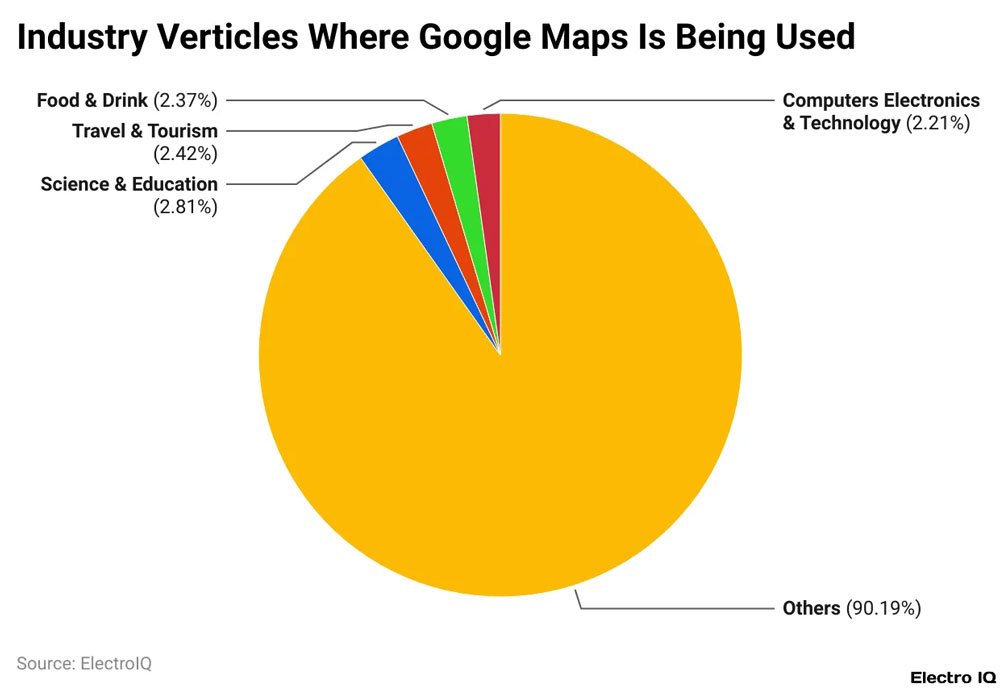
Industries Using Google Maps the Most
- 90.19% of Google Maps usage is attributed to a broad category of “Others,” which represents an overwhelming majority spanning numerous miscellaneous industries.
- Science & Education accounts for 2.81% of overall industry usage on Google Maps, reflecting a meaningful footprint within academic and research-focused sectors.
- Travel & Tourism represents 2.42% of Google Maps activity, underscoring its strong dependence on mapping services for navigation and customer interaction.
- Food & Drink contributes 2.37% to Google Maps usage, indicating consistent reliance among restaurants, cafes, and related establishments for location-based services.
- Computers, Electronics & Technology holds 2.21% of Google Maps usage, showing a modest yet steady application across technology-oriented services and support operations.
Data Collection and Updates
- Users contribute 20 million items daily to Google Maps.
- Core map and imagery layers receive tens of millions of updates per day.
- Real-time routing and traffic data can cut travel time and emissions.
- Data usage averages about 2.2 MB per hour of active map use.
- Crowdsourced edits via Local Guides enhance accuracy.
- Developer dashboards support quota and usage monitoring.
- Some cities show low façade coverage, for example, 12.4% in a sample study.
Google Maps Accuracy Statistics
- Google Maps data is refreshed 100 million times daily across 250+ regions.
- Routing studies show 6.5% average travel time savings and 1.7% CO₂ reduction.
- In alternate route cases, 12.5% time savings and 3.4% CO₂ savings.
- Google Maps receives 50 million map updates daily.
- The app uses 0.73 MB per 20 minutes, indicating highly efficient routing.
- Google Maps holds over 67% navigation market share in the U.S.
- Imagery covers 36 million square miles of Earth’s surface.
Google Maps Competitors Comparison
- Google Maps holds 67% of the U.S. navigation market, Apple Maps 25%, Waze 8%.
- Google Maps captures 80% of the global mobile maps market.
- Uses less data than competitors, for example, 0.73 MB per 20 min.
- In 2023, Google Maps hit 21.1 million U.S. downloads.
- Over 5 million apps and websites use Google Maps APIs, more than competitors.
- Google Maps maintains a feature lead in traffic, transit and indoor mapping.
- Regional alternatives grow but remain far below Google’s user volume.
Environmental Impact
- Routing saves 1.7% CO₂ on average, and 3.4% in special route cases.
- Travel time savings of 6.5% on average and 12.5% in alternative routing scenarios.
- Eco routing helped reduce more than 500,000 metric tons of emissions in some regions.
- Support for multimodal travel allows for reduced vehicle use.
- Geospatial analytics support sustainability and urban infrastructure planning.
- Route optimization reduces idle time and fuel use.
- Environmental impact remains undermeasured globally, but research shows meaningful benefits.
Integration in Smart Cities
- Google Maps Platform covers 250+ territories with 100 million+ daily data updates.
- In 2025, Google Maps added geospatial analytics, generative AI overlays, and weather APIs for smart cities.
- Over 60% of smart city projects use Google Maps for logistics and mobility planning.
- Indoor mapping now supports 1000+ airports and 500+ major malls worldwide.
- Real-time traffic data reduces congestion by up to 30% in cities using Google Maps.
- Localized APIs for India power smart city apps in 75+ Indian cities.
- Digital twin ecosystems integrating Google Maps have grown by 40% year-over-year since 2023.
- Public transit planning enhanced by Google Maps improves route efficiency by 25% on average.
- Google Maps allows millions of daily routing adjustments for smart city mobility systems.
- Weather API integration helps reduce weather-related disruptions in city services by 15% annually.
Local Guides Statistics
- There are over 150 million active Local Guides worldwide as of 2025.
- Local Guides contribute to improving map accuracy in more than 24,000 global locations.
- 300 million Local Guides’ reviews and photos help keep Google Maps up to date.
- Local Guides’ reviews receive 73% more visibility than standard reviews due to detail and media inclusion.
- Businesses with Local Guides engagement see an average 23% rise in Google Maps visibility.
- 89% of Local Guide reviews include photos or videos, enhancing content quality.
- The program spans contributors from all continents with varied contribution levels.
- Local Guides engagement has been critical to maintaining the freshness of location content on Google Maps.
- Research shows review sentiment trends from Local Guides vary by region and population density.
- Google’s Local Guides program is over a decade old and widely recognized as critical in business information accuracy globally.
Security and Trust
- Google Maps’ GPS accuracy averages about 4.38 meters with a 72% recognition rate globally.
- 52% of Google Maps location hits rely on GPS signals, delivering the highest accuracy compared to Wi-Fi or cellular data.
- Google Maps enforces driver distraction guidelines, limiting on-screen interactions to reduce accident risks.
- The U.S. Department of Justice and German regulators are actively scrutinizing Google Maps for antitrust and data handling concerns.
- Approximately 73% of U.S. websites utilize the Google Maps API, underscoring its trusted platform status.
- Google Maps privacy tools, like incognito mode, affect user data view but do not completely stop location data collection.
- Certain governments restrict features such as mapping APIs or location data access for security reasons.
- Regional user trust varies; dense urban areas show higher review engagement but also more skepticism.
- Privacy-enhanced features like anonymized reviews and location opt-outs influence over 60% of user trust decisions.
- Google Maps transparency reports include data on location accuracy and content updates to bolster user confidence.
Frequently Asked Questions (FAQs)
Google Maps has over 1 billion monthly active users.
Google Maps generated approximately US $11.1 billion in revenue in 2023.
There are over 200 million businesses and places listed on Google Maps worldwide.
Users drive over 1 billion kilometres per day using Google Maps routing.
Conclusion
Google Maps remains a pillar platform in navigation, location services and spatial intelligence. From compelling user demographics to global coverage, from smart city integrations to robust Local Guides contributions, the data paints a picture of a tool deeply embedded in daily life and commerce alike. At the same time, accuracy, environmental impact and competitive context show both strengths and areas to watch.
Whether you’re a business owner leveraging location listings, a developer building routing services, or an everyday user planning a route, Map statistics offer valuable insights into how Google Maps continues to evolve. Explore the full article to understand the breadth and depth of Google Maps in today’s world.