

Understanding how people use Google SEO and the broader search ecosystem is essential for businesses, marketers, and site owners aiming to attract organic traffic. SEO trends increasingly influence visibility, revenue, and how audiences discover information online. Companies across industries, from e‑commerce sites optimizing product pages to publishers relying on search referrals, depend on search behavior insights to shape strategy.
Real‑world examples include retail brands optimizing content for mobile users and B2B firms tailoring keywords to capture targeted leads. Explore the latest data below to see how SEO is evolving and why it remains critical.
Editor’s Choice
- Google processes an estimated 16.4 billion searches per day in 2026, roughly 190,000 per second.
- Google’s global search engine market share is about 90% as of 2025‑26.
- The average user conducts 3–4 Google searches daily, reflecting persistent engagement.
- About 58.5% of U.S. searches return zero clicks to external sites, driven by rich results and AI summaries.
- Organic search drives roughly 53% of website traffic, highlighting SEO’s central role.
- The top organic result CTR is near 39.8%, emphasizing the value of high rankings.
- Google uses over 200 ranking factors to evaluate content relevance and quality.
Recent Developments
- AI summaries now appear in ~10% of U.S. Google search results, altering click behavior.
- Publishers report a ~33% global decline in Google search referrals, reshaping content strategies.
- Ongoing AI integration raises concerns about zero‑click growth and reduced organic traffic.
- Some top news and media sites have seen up to 40% traffic declines post AI overviews rollout.
- Despite AI fear, Google search volume exceeded 5 trillion annual queries, showing resilience.
- Changes in algorithm features like AI Overviews and rich snippets continue to impact CTRs and referral patterns across sectors.
- Emerging search formats (e.g., conversational AI responses) are influencing SEO approaches and metrics.
Search Engine Market Share & Usage Statistics
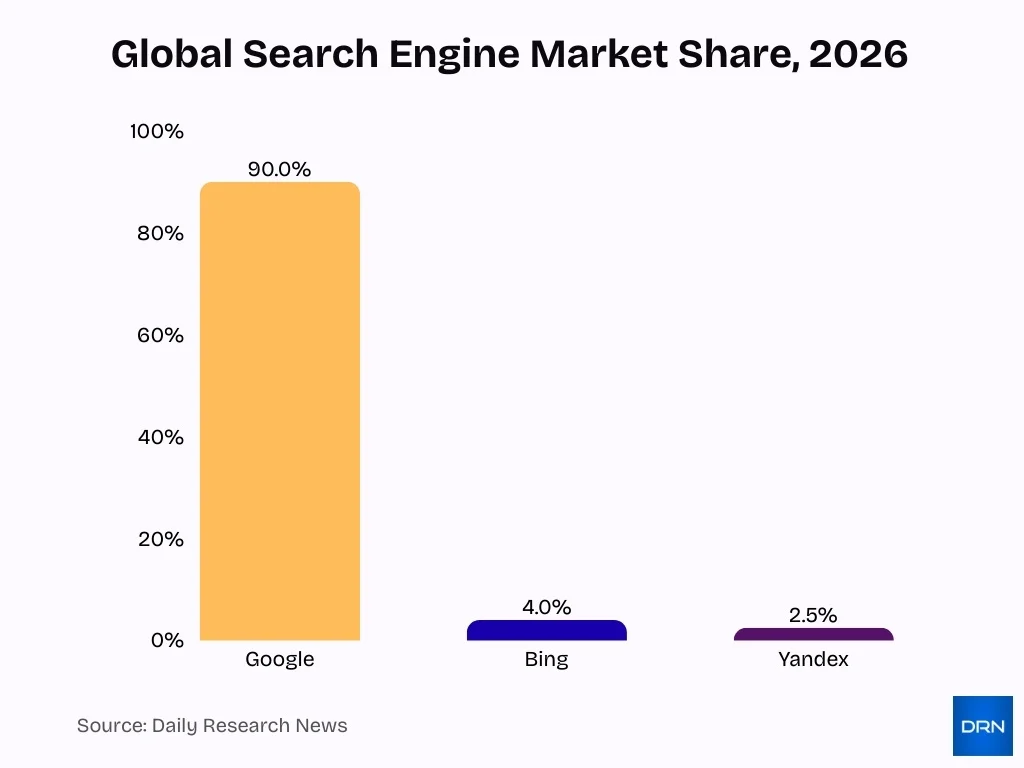
- Google holds around 90% of the global search market in 2026.
- Bing accounts for roughly ~4%, followed by Yandex at ~2.5%.
- Mobile search share on Google exceeds 93% of mobile queries.
- Approximately 79% of internet users regularly use search engines.
- Around 68% of all online experiences start with a search query.
- Google processes over 8.5 billion searches daily (traditional count) and may exceed 16.4 billion in broader estimates.
- Search engine usage continues to grow globally, steadily increasing year‑over‑year.
- Search remains the gateway to online discovery for most users, underlining its strategic value.
Daily Google Searches Statistics
- Google handled ~16.4 billion queries per day in 2026 estimates.
- That translates to roughly 190,000 searches per second.
- Daily searches have nearly doubled since 2020, when 7 billion was typical.
- Monthly search volume is an estimated 498.8 billion+.
- Yearly Google searches have surpassed 5.99 trillion globally in recent estimates.
- Average users perform 3–4 searches daily, cementing search’s role in daily digital life.
- Search frequency trends continue upward as mobile and voice query usage expands.
- An increase in zero‑click queries has influenced how users interact with search results pages.

Organic CTR by Position Statistics
- The #1 organic position’s CTR approaches ~39.8% per some sources.
- CTR for position 2 is ~18.7%, showing a sharp drop from the top spot.
- Position 3 CTR averages ~10.2%.
- Pages ranked #10 are about 10x less likely to receive a click than #1.
- Studies show ~58.5% of U.S. Google searches result in zero clicks to sites.
- Others report 40.9% organic mobile search clicks and 57.1% no clicks in certain samples.
- Over two‑thirds of all clicks go to the top 3 results.
- CTR behavior differs substantially by query type, device, and rich result prevalence.
Core Factors Influencing Google’s Search Ranking Algorithm
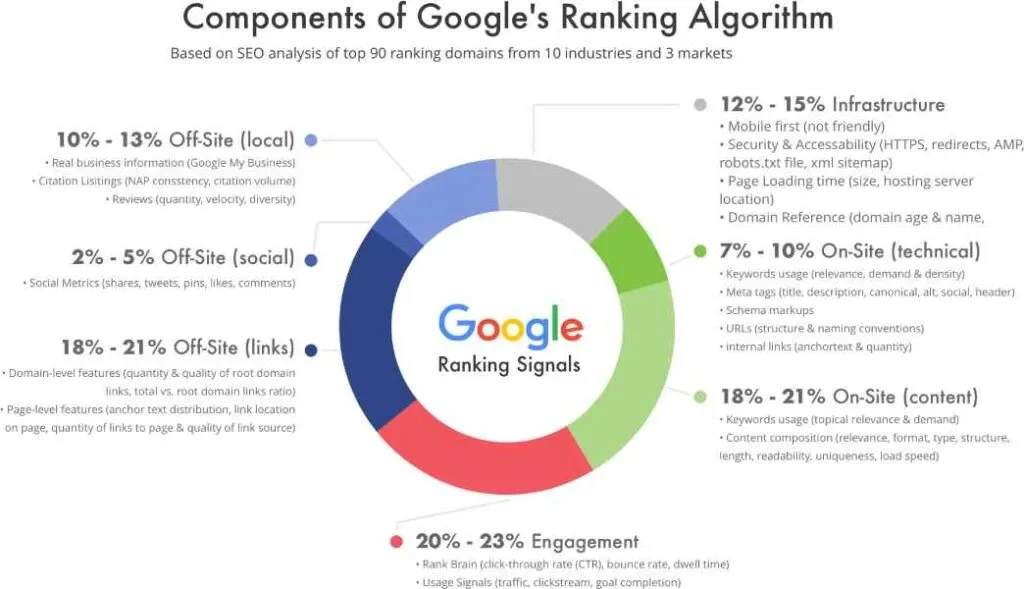
- Off-Site Social ( 2% – 5% ): Social proof generated through shares, likes, comments, and tweets contributes modestly to overall SEO value and visibility.
- Engagement ( 20% – 23% ): Click-through rate (CTR), bounce rate, and dwell time are the most influential signals, as Google leverages RankBrain along with usage metrics such as traffic and goal completions.
- Off-Site Links ( 18% – 21% ): High-quality and high-volume backlinks at the domain level play a major role, while anchor text, link placement, and link sources further impact search rankings.
- On-Site Content ( 18% – 21% ): Topical relevance, content structure, readability, and uniqueness are essential, with page speed and content length also influencing search visibility.
- Infrastructure ( 12% – 15% ): Mobile friendliness, HTTPS security, loading speed, domain age, and technical foundations such as sitemaps and redirects all contribute directly to ranking performance.
- Off-Site Local ( 10% – 13% ): Google My Business optimization, NAP consistency, citations, and review signals are critical drivers of local SEO rankings.
- On-Site Technical ( 7% – 10% ): Schema markup, meta tags, URL structure, and internal linking are important, while proper keyword placement significantly boosts content discoverability.
SEO Ranking Factors Statistics
- Google uses over 200 ranking factors in its algorithm.
- Backlinks rank as a top-3 factor, with #1 results averaging 3.8x more than positions 2-10.
- Sites with strong backlink diversity see higher rankings, per analysis of 1000+ studies.
- Mobile-optimized sites are 67% more likely to rank on Google’s first page.
- Core Web Vitals passing pages at #1 are 10% more likely than at #9.
- Google implements 500-600 algorithm changes annually, about one per day.
- Consistent content publication weighs 23% in the 2025 ranking factors study.
- Searcher engagement accounts for 12% of ranking weight.
- Keywords in the meta title influences 14% of rankings.
- 66% of pages have zero backlinks, limiting their SEO potential.
Content Length and Rankings Statistics
- Top‑ranking pages on Google average around 1,447–2,400 words, significantly higher than lower‑ranking content.
- Content that exceeds 3,000 words generates about 3× more traffic and 4× more social shares compared to shorter articles.
- Long‑form content also earns 3.5× more backlinks than average‑length pages, boosting domain authority.
- Studies show 75% of users never go past page one of search results, making thorough content essential for ranking.
- Pages with in‑depth coverage often cover multiple related keywords and user intents, increasing relevance signals.
- Quality content that satisfies user intent correlates with stronger engagement and lower bounce rates, indirectly helping rankings.
- Sites with structured, well‑organized content tend to perform better on SERPs due to improved readability and semantic clarity.
- Content length correlates with rich result opportunities (e.g., FAQs, tables), which can lift visibility and CTR.
Backlinks Impact on SEO Statistics
- Backlinks remain a core ranking signal, with about 30% of Google’s page authority score attributed to link factors.
- 89% of link builders believe nofollow links still influence rankings, indicating broader value beyond direct SEO impact.
- 41% of SEO professionals identify link building as the most challenging SEO tactic.
- Pages ranking #1 in search results typically attract 3.8× more backlinks than lower‑position pages.
- 42% of SEO experts spend equal time on building internal and external links, underlining balanced link strategies.
- Quality backlinks from authoritative, relevant sites help signal domain trust to algorithms and improve rankings.
- Link-building impacts are often observable within ~3.1 months after acquisition.
- External link strategies continue to evolve as search features like AI summaries and featured snippets shift click behavior.
Most Effective SEO Strategies for Ranking on SERPs
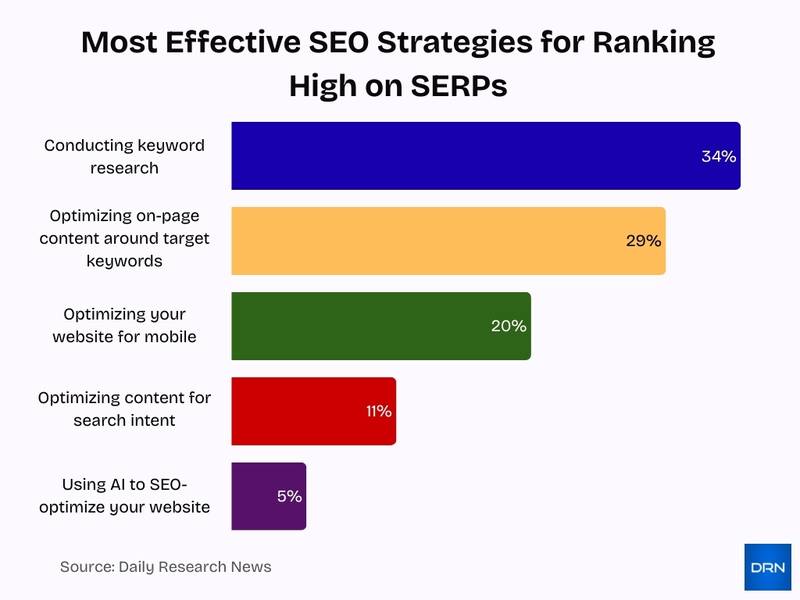
- Conducting keyword research ranks as the most effective SEO strategy, with 34% of marketers identifying it as the top factor for achieving higher positions on SERPs.
- Optimizing on-page content around target keywords follows closely, as 29% of professionals emphasize its importance in improving search visibility and relevance.
- Optimizing websites for mobile remains critical, with 20% of respondents highlighting mobile optimization as a key driver of stronger search rankings.
- Optimizing content for search intent is cited by 11% of marketers, showing the growing focus on aligning content with user needs and query intent.
- Using AI to SEO-optimize websites is still emerging, with only 5% adoption, indicating significant future growth potential in AI-driven SEO strategies.
Mobile SEO Performance Statistics
- ~58–63% of organic search traffic comes from mobile devices, showing the dominance of mobile search.
- 87% of smartphone owners use a search engine daily to find information or services.
- Mobile searches generate significantly more impressions than desktop results, up to ~85% higher in some studies.
- Mobile ranking factors like site speed, core web vitals, and responsiveness directly influence mobile visibility.
- Mobile‑first indexing means Google predominantly uses mobile versions of content for ranking and indexing.
- Voice search on mobile accounts for around 20% of queries, intersecting with mobile behavior.
- Local intent searches are especially common on mobile, often leading to near‑me results and conversions.
- Delay in mobile page load times (over 2 seconds) can lead to significant increases in bounce rates, hurting SEO.
Local SEO Statistics
- Local SEO makes up roughly 46% of all Google searches, highlighting user intent to find nearby businesses.
- 80% of local searches result in conversions, showing high intent and value for local businesses.
- Nearly 76% of smartphone users who perform a local search visit a business within 24 hours.
- 28% of local searches conducted on mobile result in a purchase.
- 79% of marketers consider local SEO an effective marketing strategy for local visibility.
- Local optimization correlates with higher engagement and foot traffic for brick‑and‑mortar companies.
- Businesses leveraging local listings (e.g., Google Business Profile) often see improved local pack placement.
- Local SEO is increasingly critical for industries like hospitality, services, and retail, where proximity drives decision‑making.
Voice Search SEO Statistics
- Voice search accounts for 20% of all mobile queries.
- Over 8.4 billion voice assistants were in use worldwide in 2024.
- 35% of U.S. households own at least one smart speaker.
- 56% of voice searches occur on smartphones.
- 40.7% of voice answers come from featured snippets.
- Voice queries average 4.2 words, longer than typed 3.2 words.
- Over 80% of Google Voice answers are from the top 3 search results.
- 65% of 25–49-year-olds use voice devices daily.
- 32% of consumers use voice daily for typed searches.
Percentage of Voice Search Questions That Go Unanswered
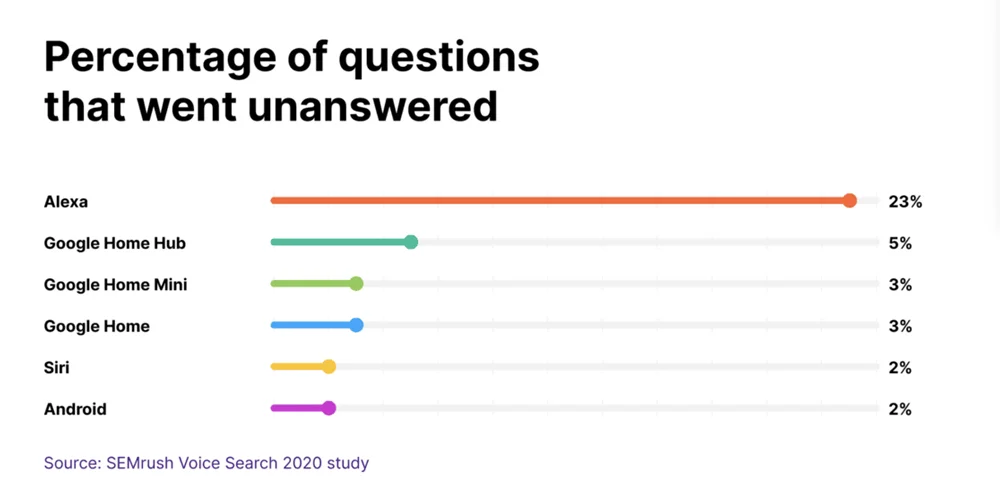
- Amazon Alexa has the highest failure rate, leaving 23% of voice search questions unanswered, significantly higher than any competing assistant.
- Google Home Hub performs notably better, with only 5% of user queries going unanswered, highlighting stronger response accuracy.
- Google Home Mini records a low 3% unanswered query rate, indicating reliable voice search performance for everyday queries.
- Google Home matches similar efficiency, with just 3% of voice questions failing to receive an answer.
- Apple Siri demonstrates high accuracy, as only 2% of voice search questions remain unanswered.
- Android voice assistants also perform strongly, with an equally low 2% unanswered query rate, making them among the most responsive platforms.
Video SEO Statistics
- Videos are up to 50× more likely to rank in search results compared with plain text.
- Search results that include video yield up to 41% higher CTR than text‑only results.
- Websites featuring video content may see ~41% more organic traffic than those that don’t.
- Video thumbnails and rich results increase visibility on SERPs, particularly for how‑to and product queries.
- YouTube is the second-largest search engine globally, driving massive video search demand.
- Video content optimization correlates with longer session durations and lower bounce rates.
- Businesses that use video for SEO often report higher user engagement and conversions.
- Structured video metadata (titles, tags, transcripts) helps search engines index and rank video content.
Technical SEO Statistics
- A technical SEO campaign focusing on performance fixes and optimization reported a ~117% ROI, showing measurable business impact from technical improvements.
- URLs that include close keyword variations see ~45% higher CTR compared with URLs that don’t include relevant terms.
- Nearly 60% of B2B marketers view their blog as their most valuable SEO channel, underlining the intersection of technical readiness and content value.
- Technical SEO emphasizes site speed, structured data, secure HTTPS, and clean crawl paths as foundational ranking prerequisites.
- Mobile‑first indexing remains standard practice, meaning Google prioritizes the mobile version of a site for indexing and ranking.
- Structured data markup supports featured snippets and rich results, increasing visibility on SERPs.
- Websites with optimized sitemaps and robots.txt files report smoother crawl behavior and fewer indexing issues.
- Technical SEO errors like broken links, slow server response times, or poor mobile adaptation continue to negatively affect organic rankings and user engagement.
Core Web Vitals Statistics
- Only 21.98% of origins meet all Core Web Vitals (LCP, FID, CLS) thresholds.
- 53.77% of sites achieve good LCP scores under 2.5s.
- 65.13% of websites pass optimal CLS scores below 0.1.
- Only 42.7% of 1M+ sites have good mobile LCP performance.
- Sites failing CWV see 3-5 position ranking drops.
- Bounce rates drop 21% after CWV optimizations.
- 73% of users abandon sites with poor LCP within 3s.
- Conversion rates rise 33% with improved Core Web Vitals.
- Mobile good INP at 64.9% vs 96.8% desktop.
- Poor CWV correlates with double-bounce rates.
Key Challenges Encountered by SEO Professionals
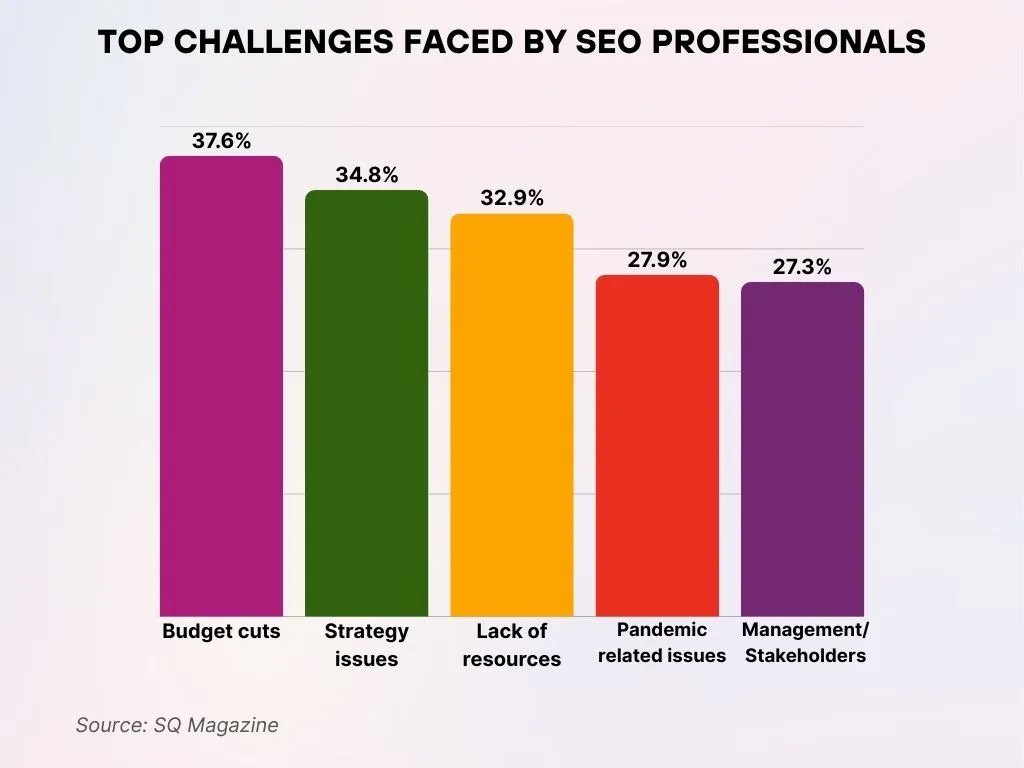
- Management or stakeholder challenges impact 27.3% of SEO professionals, where misalignment or limited understanding from leadership can significantly delay or derail SEO progress.
- Budget cuts represent the largest obstacle, reported by 37.6% of SEO professionals, as restricted funding limits tool access, campaign scalability, and hiring capacity.
- Strategy-related issues affect 34.8% of professionals, with many teams struggling to align SEO strategies with broader marketing or business objectives.
- 32.9% cite a lack of resources as a major barrier, including limited time, insufficient personnel, and reduced access to essential SEO tools and technologies.
- Pandemic-related challenges continue to impact 27.9% of respondents, as shifting consumer behavior and disrupted workflows still create lingering effects on SEO execution.
AI in SEO Statistics
- AI search traffic surged 527% year‑over‑year, highlighting AI’s growing role in discovery and SEO strategy impact.
- Google AI Overviews now reach an estimated 2 billion monthly users across formats.
- Nearly 60% of searches produce no clicks to traditional result links, driven by AI summaries and rich interfaces.
- Close to 70% of businesses report higher ROI after integrating AI into SEO workflows, demonstrating tangible value.
- AI search visitors are often worth about 4.4× more than traditional organic search visitors by conversion value.
- According to industry reports, the adoption of AI SEO tools has accelerated content planning, auditing, and optimization.
- AI use supports multilingual content generation, conversational keyword discovery, and predictive intent modeling.
- Continued AI integration is shaping Search Generative Experience (SGE) and conversational search formats, influencing where traffic is earned and measured.
SEO ROI and Conversion Statistics
- SEO continues to deliver high ROI, often outpacing traditional paid channels over time.
- Average long‑term SEO ROI across industries can exceed 825% over 3 years, showing strong revenue impact.
- B2B SaaS companies see an average of ~702% ROI and ~7 months to break even on SEO investment.
- SEO leads convert at ~14.6%, compared with just ~1.7% for outbound leads, revealing acquisition quality differences.
- 70% of marketers say SEO outperforms PPC for generating sales, emphasizing organic’s effectiveness.
- Thought leadership‑focused SEO campaigns show higher ROI and strategic value than basic content alone.
- SEO ROI generally improves with time, with many campaigns reaching positive net impact after 6–12 months.
- Higher ROI correlates with integrated strategies combining technical SEO, content depth, and AI optimization.
Google Organic Click-Through Rate (CTR) by Ranking Position
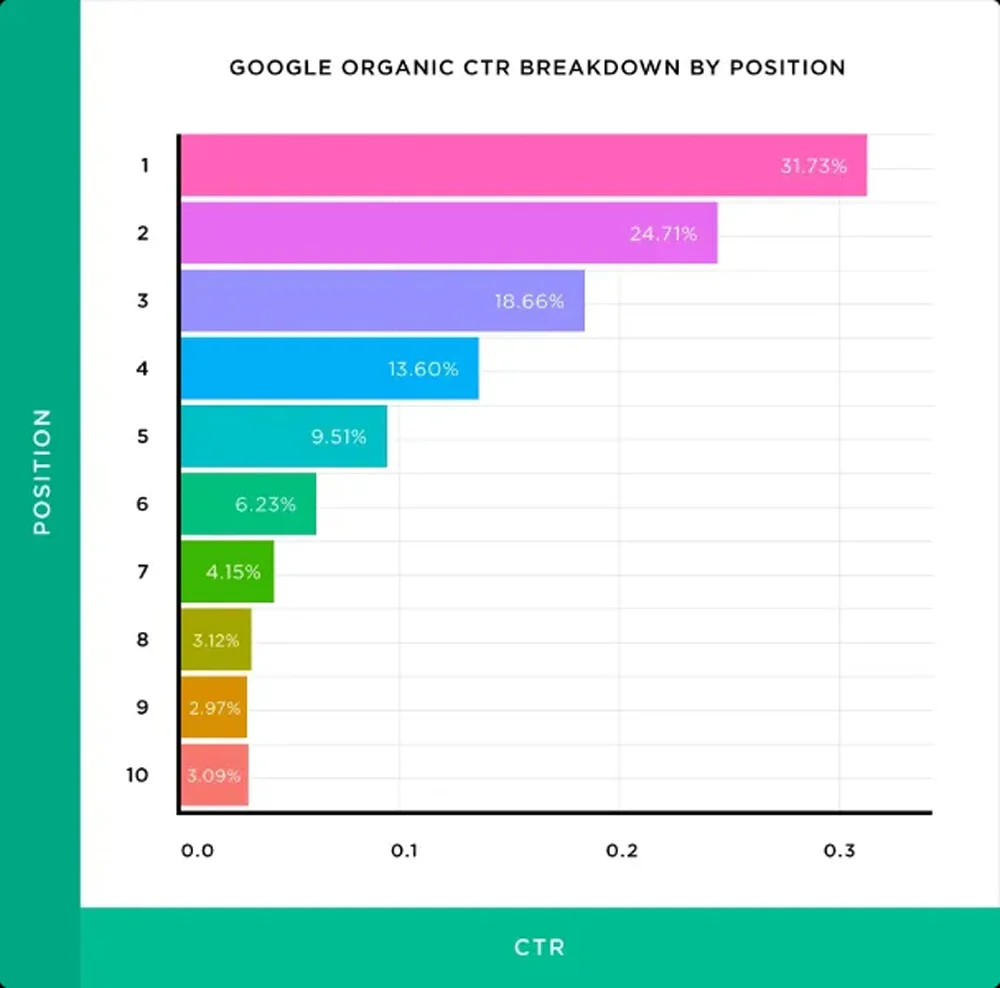
- Position 10 attracts only 3.09% CTR, clearly underscoring the importance of higher rankings to capture meaningful organic traffic.
- Position 1 achieves the highest CTR at 31.73%, making it the most valuable spot for maximizing organic clicks.
- This clearly highlights the massive advantage of ranking first on Google, as it drives maximum organic click potential.
- Position 2 captures 24.71% CTR, representing a significant drop from the top position, yet it still maintains strong visibility and click potential.
- Position 3 earns 18.66% CTR, indicating decent user engagement but noticeably less than the top two results.
- Position 4 records a CTR of 13.60%, placing it within mid-tier visibility on the search results page.
- Position 5 receives 9.51% CTR, which is nearly one-third of the click share captured by the first position.
- Position 6 declines further to 6.23% CTR, demonstrating a continued drop in user attention as rankings move down the SERP.
- Position 7 logs just 4.15% CTR, reflecting limited engagement beyond the top half of the page.
- Position 8 secures 3.12% CTR, positioning it near the bottom of the page with reduced click activity.
- Position 9 registers a 2.97% CTR, highlighting minimal traffic potential as users rarely scroll this far.
Keyword Research Statistics
- ~35% of U.S. queries contain four or more words, indicating a tilt toward long‑tail and conversational search patterns.
- Pages with keywords in their URLs see ~45% higher click‑through rates compared with those without.
- Titles using question‑based keywords can influence CTR, though patterns vary by query type.
- 34.71% of queries include four or more words, showing complexity in user intent and opportunity for specific targeting.
- Keyword research increasingly includes intent analysis, semantic variation, and topic clusters to match user behavior.
- Optimizing for conversational and AI‑driven patterns improves relevance for both traditional and generative search.
- Voice and AI search trends push keyword strategies toward questions, phrasing, and natural language.
- Strategic keyword research also supports better ranking in featured snippets and AI answer formats.
On‑Page SEO Elements Statistics
- Google rewrites 76% of meta titles in search results.
- ~25% of top-ranking pages lack meta descriptions, creating optimization opportunities.
- Title tags between 40-60 characters achieve 33% higher CTR than others.
- 88.5% of top results feature partial keyword matches in H1 tags.
- Schema markup boosts organic traffic by an average of 30% for implemented sites.
- The FAQ schema can increase CTR by up to 25-35% through expanded SERP visibility.
- Optimal keyword density of 1-2% balances relevance without stuffing penalties.
- Well-structured internal linking ( 5-10 links per 2,000 words) lifts organic traffic by 20%.
- Featured snippets from optimized on-page elements deliver 42.9% CTR, the highest in SERPs.
Frequently Asked Questions (FAQs)
Organic search drives about 53.3% of all website traffic across sites worldwide.
Google accounts for over 93.9% of the global mobile search market share.
Google handles over 8.5 billion searches per day, roughly 99,000 searches per second.
The average CTR for the #1 organic search result on Google is about 39.8%.
Conclusion
The SEO landscape continues to evolve rapidly as AI integration, user experience, and technical readiness reshape how visibility is earned. Data shows that technical foundations, Core Web Vitals, and adaptable keyword strategies remain crucial, while AI‑driven search behaviors and long‑term ROI underscore the value of holistic optimization.
As search engines prioritize trust, intent, and seamless interaction, marketers must balance classic SEO fundamentals with innovation to maintain competitive performance and meaningful conversions.