

Google Sheets has become one of the most widely used cloud-based spreadsheet tools in the world. As part of the Google Workspace ecosystem, it enables individuals and teams to create, edit, and share spreadsheets in real time from virtually any device. With businesses and remote workers increasingly relying on cloud-native tools, Sheets is now a staple in many workflows, from basic budgeting to collaborative reporting.
In real-world business settings, companies use Google Sheets to automate workflows, track sales data, and centralize cross-team reporting. In education, teachers and students depend on Sheets for assignments, grade tracking, and collaborative projects. Explore the key statistics below that show Sheets’ growth, usage patterns, and emerging trends.
Editor’s Choice
- 900+ million monthly active users are using Google Sheets in 2025.
- Google Workspace, which includes Sheets, boasts more than 3 billion active monthly users.
- 63% of businesses with under 500 employees used Google Sheets in 2025.
- Enterprise adoption of Google Sheets grew to roughly 42% by 2025.
- Sheets usage in healthcare and biotech organizations increased by 29% year‑over‑year.
- Around 75% of remote‑first companies standardized Sheets for internal data work.
- 68% of freelancers rely on Google Sheets as their primary data tool.
Recent Developments
- In 2025, Google Sheets introduced performance enhancements that improved formula speeds and loading times for large datasets.
- Up to 100% faster calculations and up to 50% quicker copy‑paste actions for data between spreadsheets were reported after updates.
- Real‑time collaboration features continue to be enhanced, with built‑in commenting and revision tracking.
- Sheets now integrates AI‑assisted suggestions for formatting and analysis through Google Workspace tools.
- Offline support was expanded via Drive integrations, though full offline editing is still limited compared to desktop tools.
- Template libraries were updated to include more business and reporting templates in 2025.
- Google improved mobile app responsiveness for Sheets across Android and iOS devices.
- Better integration with CRM and third‑party platforms, such as Salesforce, continued to grow in adoption.
Global Growth of Google Sheets
- Sheets recorded 900+ million monthly users globally in 2025.
- Google Workspace overall, which includes Sheets, hit 3+ billion active users each month.
- Roughly 50.34% market share of the broader productivity software sector was held by Google Workspace in 2025.
- Google Drive, the platform housing Sheets files, reached 2+ billion monthly users.
- Google Docs reported 1 billion monthly active users, underpinning Sheets’ growth.
- Sheets adoption continued to rise fastest in small and medium enterprises (SMEs) compared with large enterprises.
- The United States remains a leading market for Workspace adoption, driving Sheets usage upward.
- Growth in Asia and Europe accelerated in 2025 as remote work remained common.
Usage Distribution Across Google Workspace Applications
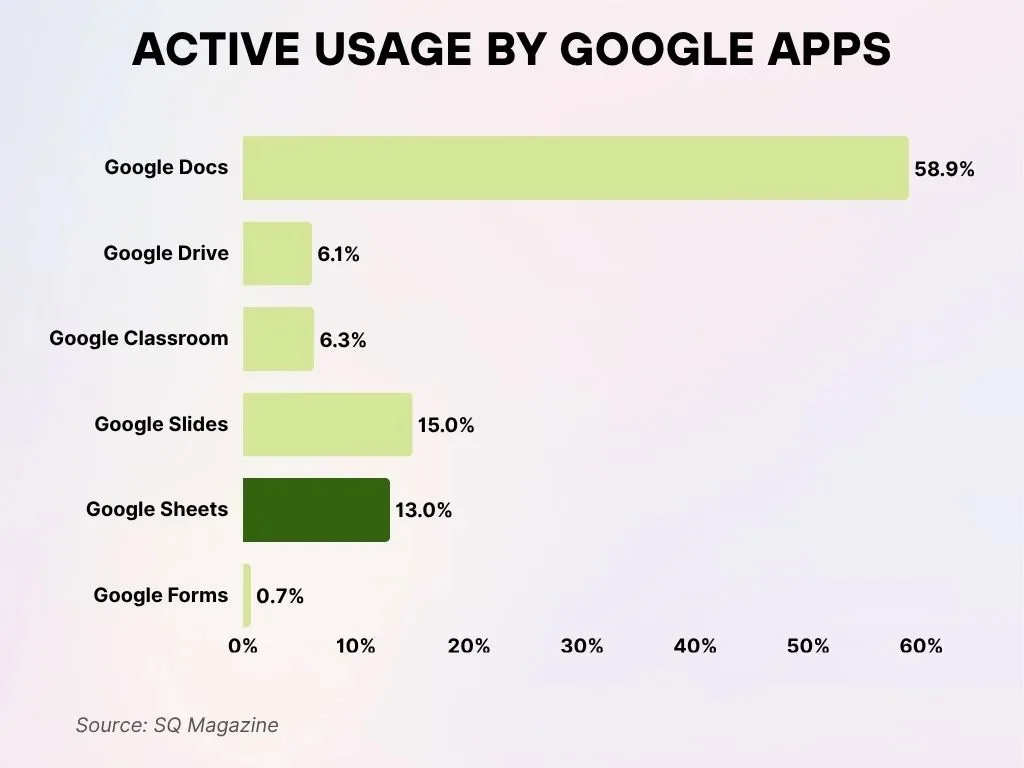
- Google Docs leads overall adoption with 58.9%, clearly establishing it as the most relied-upon tool across all Google Workspace apps.
- Google Slides comes next at 15%, underlining its strong adoption for presentations and visual learning use cases.
- Google Sheets secures the third position with 13%, reflecting its frequent usage for data entry, analysis, and calculations.
- Google Classroom records 6.3% usage, emphasizing its importance in managing assignments, classroom workflows, and student organization.
- Google Drive represents 6.1% of activity, demonstrating its active role in file storage, collaboration, and content sharing.
- Google Forms shows the lowest adoption at 0.7%, indicating limited usage for form creation, data collection, and survey activities.

User Demographics for Google Sheets
- Individuals aged 25–34 make up the largest user group of Sheets.
- Intermediate or advanced spreadsheet users account for 61% of the Sheets user base.
- Technology and IT sectors represent about 27% of Sheets usage.
- Education users are roughly 22% of total Sheets activity.
- Freelancers, especially in digital services, show strong reliance on Sheets tools.
- Remote workers and distributed teams are among the fastest‑growing Sheets users.
- Mobile‑first demographics, including younger professionals, increasingly choose Sheets on the go.
- A growing share of enterprise users use Sheets as part of cross‑organizational workflows.
Device-Based Access to Google Sheets
- In 2025, desktop devices accounted for about 70% of Google Sheets activity.
- Mobile usage made up around 30% of Sheets sessions, an increase from prior years.
- Android devices represented roughly 19% of mobile access compared to ~9% on iOS.
- Users spend 2.4x more time on Sheets on desktop than on mobile.
- Tablet usage remains modest (~3.5%) despite Sheets’ availability.
- Offline editing usage on mobile rose by ~21% in 2025.
- Voice input and smart fill features appear in around 13% of mobile Sheets interactions.
- Mobile‑based sharing grew ~31% in 2025.
Adoption Rates across Regions and Countries
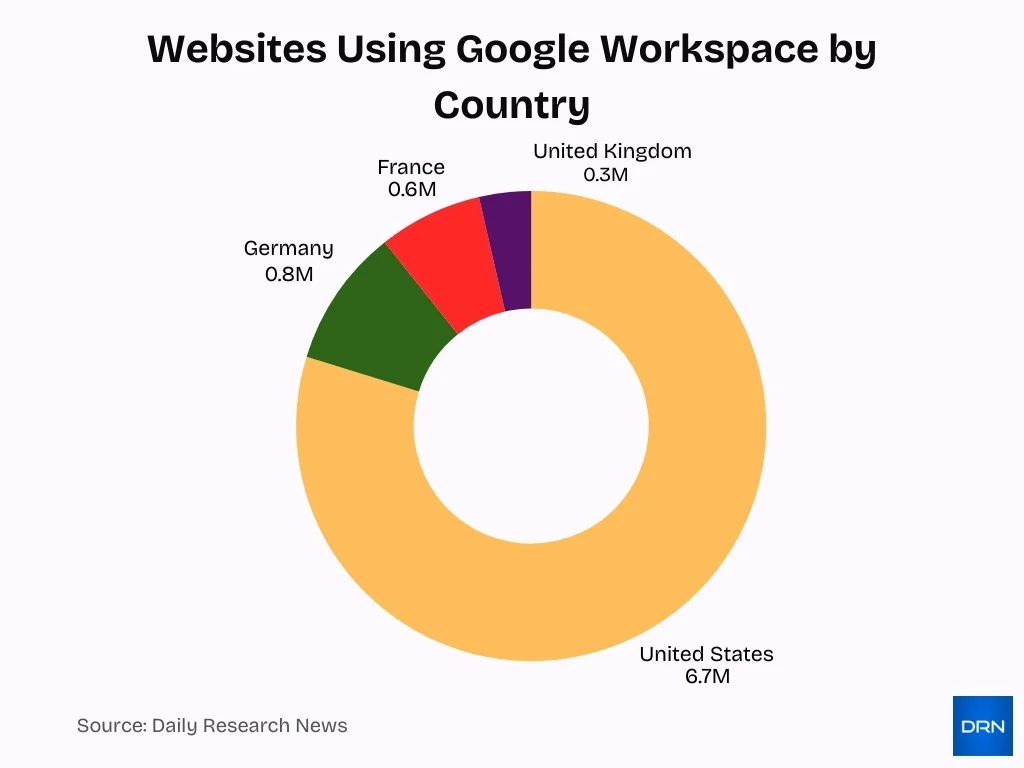
- The United States deploys Google Workspace on ~6.7 million websites, leading global adoption.
- Germany records ~0.8 million websites using Google Workspace.
- France has ~0.6 million websites with Google Workspace deployment.
- The United Kingdom shows ~0.3 million websites adopting the suite.
- Asia Pacific region grows at a >20% CAGR for Google Workspace in 2025.
- Latin America sees rising adoption driven by 75% internet penetration.
- 70% of Google Workspace users access via mobile devices in emerging markets.
- Asia Pacific adoption surges with 30% projected global market share by 2032.
- Cloud spreadsheet usage rises with 900 million monthly Google Sheets users globally.
- Google supports functions in 21+ languages, boosting international Workspace adoption.
Business Size Trends in Google Sheets Adoption
- SMEs lead the adoption of Sheets due to cost savings and collaboration.
- Larger enterprises use Sheets for cross‑functional reporting.
- Freelancers use Sheets as their primary data tool.
- Startups standardize Sheets as a real‑time spreadsheet solution.
- Microbusinesses adopt Sheets when remote workflows grow.
- Hybrid work policies encourage cloud‑first tools like Sheets.
- Budget‑constrained businesses avoid paid tools in favor of Sheets.
- Larger firms may pair Sheets with enterprise dashboards.
Academic and Educational Applications of Google Sheets
- Over 55% of U.S. public schools actively use Google Sheets via Google Workspace for Education.
- 66% of middle and high school instructors use Sheets for gradebooks.
- University research teams employ Google Sheets for collaborative data collection in over 70% of group studies.
- 82% of educators in 300+ U.S. school pilots rated Sheets as “very effective” for student engagement.
- Teachers save an average of 3.4 hours per week using Sheets for grading and attendance tracking.
- Students using Sheets for group projects showed a 19% improvement in collaboration scores.
- 80% of students in the pilot program felt more confident using spreadsheets for STEM tasks.
- Over 80% of the top 100 U.S. universities have adopted Google Workspace for Education, including Sheets.
- Data visualization projects using Sheets in high schools grew by 34% in 2025.
- Real-time progress dashboards in Sheets improved student performance visibility by 47%.
Industry and Sector Use of Google Sheets
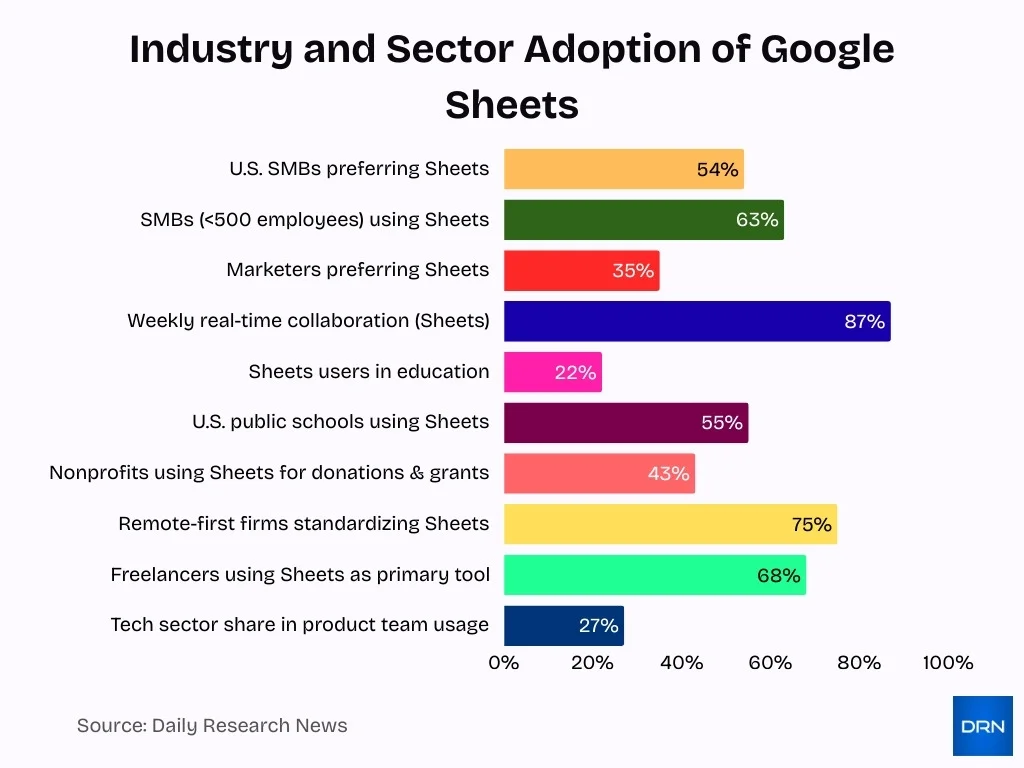
- 54% of U.S. small businesses prefer Google Sheets over Excel for data management.
- 63% of businesses with fewer than 500 employees use Google Sheets.
- 35% of marketing professionals prefer Sheets over Excel for collaboration.
- 87% of Google Sheets users leverage real-time collaboration weekly for KPIs and budgets.
- Sheets integration with CRM platforms like Salesforce rose by 21% in 2025.
- 22% of Google Sheets users are from education, with 55% of U.S. public schools actively using it.
- 43% of nonprofits use Google Sheets for donation tracking and grant reporting.
- 75% of remote-first companies standardize Google Sheets for field data and operations.
- 68% of freelancers use Sheets as their primary tool for invoicing and pricing.
- 27% of the technology sectors represent the largest product team usage for planning and Gantt charts.
Freelancer and Remote Team Use of Google Sheets
- Freelancers and remote teams increasingly rely on Google Sheets for collaborative tools.
- 70% of Google Workspace users actively use Google Sheets weekly.
- 42 million users rely on Google Sheets for daily collaborative tasks.
- Over 900 million individuals utilize Google Sheets for remote work.
- 75% of remote-first companies standardize Google Sheets for data handling.
- 87% of users leverage real-time collaboration features in Google Sheets weekly.
- 70% of Google Sheets usage occurs on desktop for freelancers and teams.
- 35% productivity boost reported by businesses using Google Workspace, including Sheets.
- 63% of businesses with under 500 employees use Google Sheets for operations.
- 30% of Google Sheets access is via mobile, enhancing remote flexibility.
Market Share of Office Productivity Software Platforms
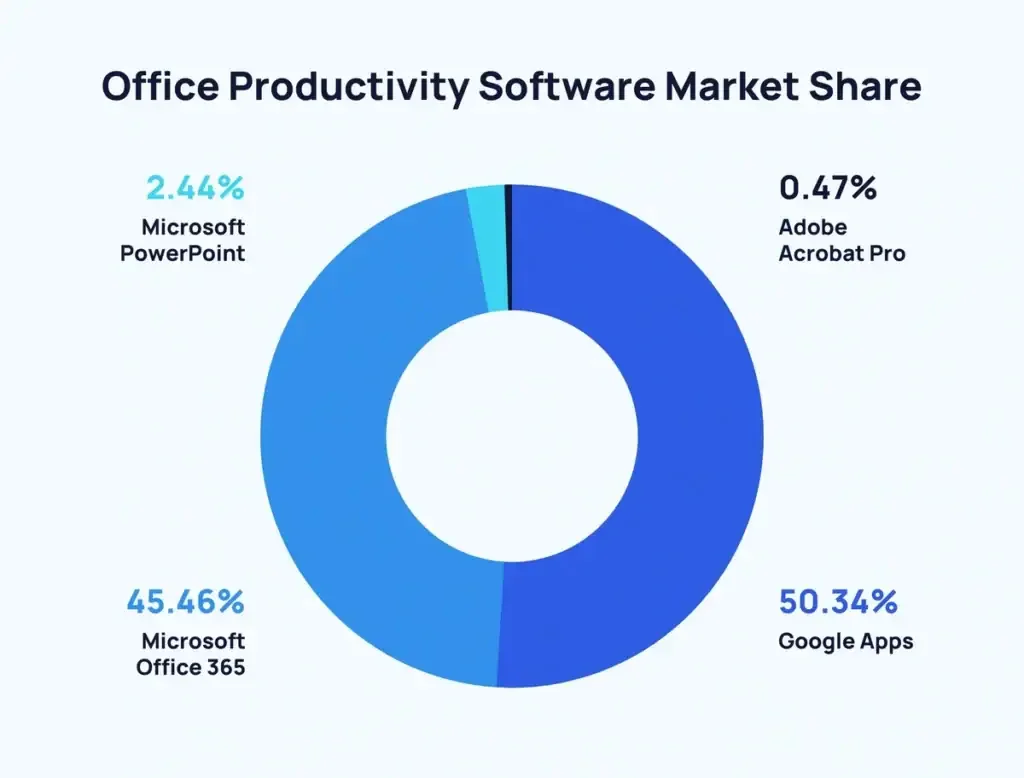
- Google Apps dominates the market with a commanding 50.34% share, highlighting its widespread adoption across both educational and professional environments.
- Microsoft Office 365 secures a strong 45.46% market share, underscoring its continued popularity and deep penetration within corporate settings.
- Microsoft PowerPoint accounts for 2.44%, reflecting its niche yet stable usage primarily for presentation-focused needs.
- Adobe Acrobat Pro represents just 0.47% of the market, indicating a minimal presence among mainstream office productivity solutions.
Collaboration and Sharing in Google Sheets
- 87% of Sheets users use real‑time collaboration features weekly.
- Sheets supports automatic version history with 100% of changes tracked.
- Shared files are used by teams in 75% of remote‑first companies.
- Suggestion mode sees active use in 68% of review workflows.
- 42 million users worldwide rely on Sheets for task tracking.
- Shared links with expiration are common in enterprise settings.
- Collaboration ties into Workspace chat and Gmail in over 50% of workflows.
- Cloud‑based sharing propagates changes instantly.
Template Popularity and Common Use Cases in Google Sheets
- Budgeting and project planning templates are among the top 10 most downloaded.
- Over 14 million dashboards are created monthly from templates.
- Expense logs and inventory tracking templates are used by over 60% of small businesses.
- Marketing calendar templates appear in 45% of team workflows.
- Goal trackers drive 33% of consumer Sheets activity.
- Education templates are used in 66% of middle and high schools.
- CRM tracking templates are used by 42% of mid‑sized sales teams.
- Weekly reporting templates save users 2–3 hours per week.
Google Sheets Jobs in the United States: Key Employment Insights
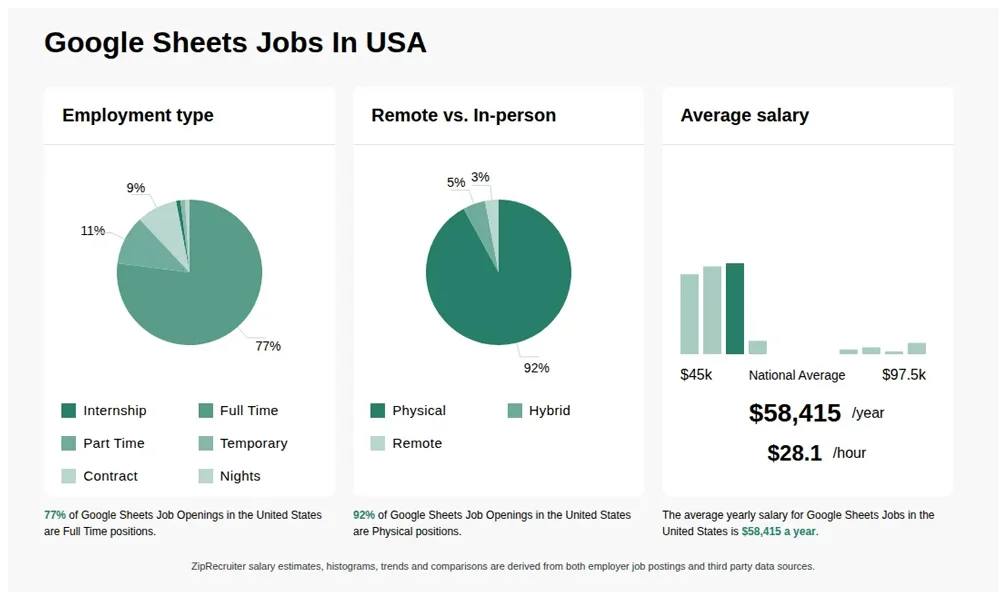
- 77% of Google Sheets job openings in the United States are full-time positions, highlighting strong demand for long-term roles.
- Part-time roles account for 11%, while temporary positions represent 9%, indicating limited short-term or flexible employment options.
- Internship, contract, and night roles together make up only about 3%, showing these job types remain niche within the market.
- 92% of Google Sheets jobs are physical (in-person), demonstrating that most roles still require on-site presence.
- Hybrid work models account for 5%, while fully remote roles represent just 3%, reflecting limited remote availability.
- The average annual salary for Google Sheets jobs is $58,415, aligning closely with the national average.
- On an hourly basis, professionals earn an average of $28.10 per hour, indicating competitive compensation for spreadsheet-focused roles.
- Salary listings range from $45,000 at the lower end to $97,500 at the high end, showing significant earning potential based on experience and role complexity.
Dashboard Creation and Reporting with Google Sheets
- AI‑assisted dashboards in Sheets were generated 27 million times in 2025.
- 84% of auto‑suggested charts align with user intent.
- Pivot tables complete in under 7 seconds for mid‑sized datasets.
- Sales teams use dashboards in 31% of workflows.
- Marketers use dashboards in ~60% of weekly reports.
- Looker Studio dashboards are used in ~39% of analytics reports.
- Real‑time data connections appear in over half of executive dashboards.
- Trend lines and formatting are featured in 52% of dashboards.
AI and Automation Features in Google Sheets
- Smart Canvas delivers 92% accurate auto‑dashboards.
- Duet AI is used by ~44% of U.S. business teams.
- Natural‑language queries grew ~38% in enterprise use.
- AI formatting is used in 21% of new sheet templates.
- Trend summaries appear in 31% of sales dashboards.
- Chart suggestions save analysts ~2.6 hours weekly.
- Auto‑generated formulas help 57% of users.
- AI pattern insights help ~19% of quality teams.
Google Sheets and Microsoft Excel Feature Performance Comparison
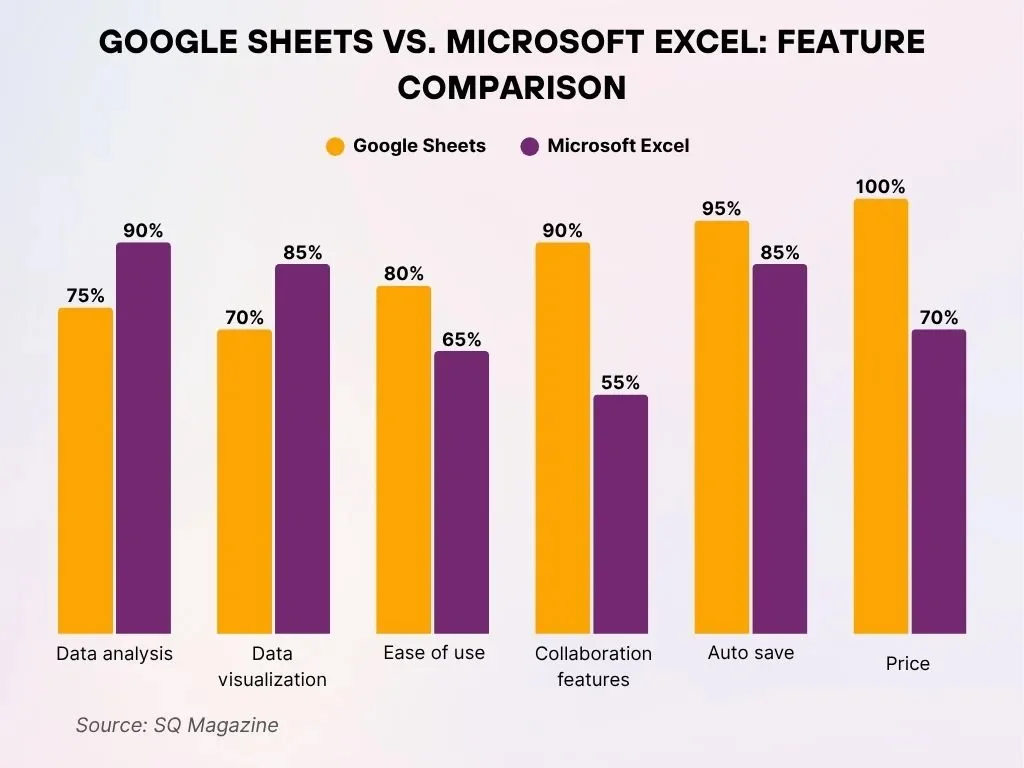
- Microsoft Excel maintains a strong advantage in data analysis, with 90%, clearly outperforming Google Sheets, which records 75% in this capability.
- Excel also demonstrates superior data visualization performance at 85%, compared to Google Sheets’ 70% score in the same area.
- Google Sheets leads in ease of use with 80%, while Excel follows behind at 65%, reflecting a usability gap.
- In terms of collaboration features, Google Sheets dominates with an impressive 90%, significantly ahead of Excel’s 55% rating.
- Auto save functionality performs better in Google Sheets at 95%, compared to Excel’s 85%, highlighting stronger real-time saving.
- Regarding pricing value, Google Sheets achieves a perfect 100%, while Excel scores 70%, making Sheets the more cost-effective option.
Add‑ons, Integrations, and Extensions in Google Sheets
- Over 520 certified add‑ons are available.
- Marketing add‑ons see 61% weekly usage.
- Finance tools make up 33% of integrations.
- Forecasting tools are used in 28% of workflows.
- Machine learning integrations grew 31% YoY.
- CRM sync tools increased 23% in adoption.
- A/B testing add‑ons appear in 40% of projects.
- Reporting tools saw a 29% lift in use.
Forecasts and Future Trends for Google Sheets
- By 2030, the global cloud collaboration market is expected to reach around $120–130 billion, growing at a ~16% CAGR, driven largely by remote work adoption.
- Remote working tools/software are projected to grow at a 21.8% CAGR from 2025–2034, indicating strong long‑term demand for cloud platforms like Google Sheets.
- Surveys show that 78% of businesses report enhanced productivity after adopting AI tools for spreadsheet automation in platforms such as Google Sheets.
- Companies leveraging AI for spreadsheet automation report up to a 30% increase in productivity, underscoring the impact of AI‑driven analysis automation.
- AI‑enhanced spreadsheet workflows using tools like SheetAI and Formula Bot can improve efficiency in data‑heavy tasks by up to 40%, reducing manual reporting time.
- Remote teams using collaboration software experience about an 18% improvement in project completion rates and a 30% reduction in project downtime, reflecting the value of integrated analytics and collaboration.
- The global cloud collaboration market, closely tied to tools like Google Sheets, is expanding as private cloud deployments account for over 55% of revenue, emphasizing secure enterprise collaboration needs.
- Hybrid cloud collaboration solutions, which often include spreadsheet and analytics tools, are forecast to post the highest CAGR from 2025 to 2030, supporting more complex enterprise collaboration trends.
- Recent stats indicate that AI‑powered automation in Google Sheets and similar tools is now used by a majority of data‑driven teams, with over three‑quarters (≈78%) reporting measurable workflow improvements.
Frequently Asked Questions (FAQs)
Google Sheets has more than 900 million monthly active users as of 2025.
About 87% of Google Sheets users utilize real‑time collaboration features at least weekly.
Approximately 54% of U.S. small businesses prefer Google Sheets for data management compared with Microsoft Excel.
There are over 1.1 billion active Google Sheets files stored globally in 2025.
Conclusion
Google Sheets stands at the intersection of cloud collaboration, AI‑assisted productivity, and broad business adoption. Its growth is powered by deep integrations, rapid automation tools, and an ever‑expanding add‑on ecosystem, steering it far beyond basic spreadsheets into a flexible data platform. While Microsoft Excel remains dominant for heavy analytics and legacy enterprise use, Sheets excels where real‑time collaboration and accessible workflows matter most.
The future will continue blending cloud‑native features with AI enhancements as organizations worldwide leverage Sheets for reporting, dashboards, and cross‑team insights.