

The workforce size of Airtable offers a clear window into its operational capacity and growth trajectory. As Airtable evolves its product and expands globally, the number of employees and hiring dynamics reflect both market demand and internal strategy. In high-growth sectors such as SaaS and no-code platforms, headcount trends influence innovation, support, and scalability, from engineering firepower to customer success bandwidth. Explore below to understand how many people work at Airtable today and what that tells us about where the company stands.
Editor’s Choice
- As of mid-2025, one reliable source estimates Airtable has 833 employees globally.
- That 833-employee figure represents about 7.2% growth over the previous year.
- Another source estimates Airtable’s headcount at 971 employees, though this may reflect a different snapshot or methodology.
- On LinkedIn, Airtable is listed in the “501–1,000 employees” range.
- Some sources present lower estimates, for example, around 900 employees.
- Discrepancies aside, most data points suggest Airtable remains a mid-sized company, rather than a large enterprise.
- Estimates vary across sources, highlighting the challenge of pinpointing the exact headcount for private tech firms.
Recent Developments
- A 2025 headcount report shows Airtable at 833 employees.
- That figure includes 172 new hires year-to-date, amounting to about 5% of the workforce.
- Departures stood at 77 employees, meaning net growth was modest.
- The company has gone through workforce shifts in recent years, including a 27% reduction of 237 jobs in 2023.
- Some sources suggest the post-restructuring workforce might be as low as ≈ 600 employees, though that appears to be a conservative estimate.
- In 2024, Airtable reportedly launched new AI-powered tools and increased enterprise-oriented staffing, indicating a strategic hiring focus, especially in product and engineering teams.
- The company’s classification as having 500–1000 employees remains consistent across multiple public profiles.
- These developments suggest Airtable is stabilising after prior downsizing, with steady, but cautious, growth in key functions.
Employee Count by Year
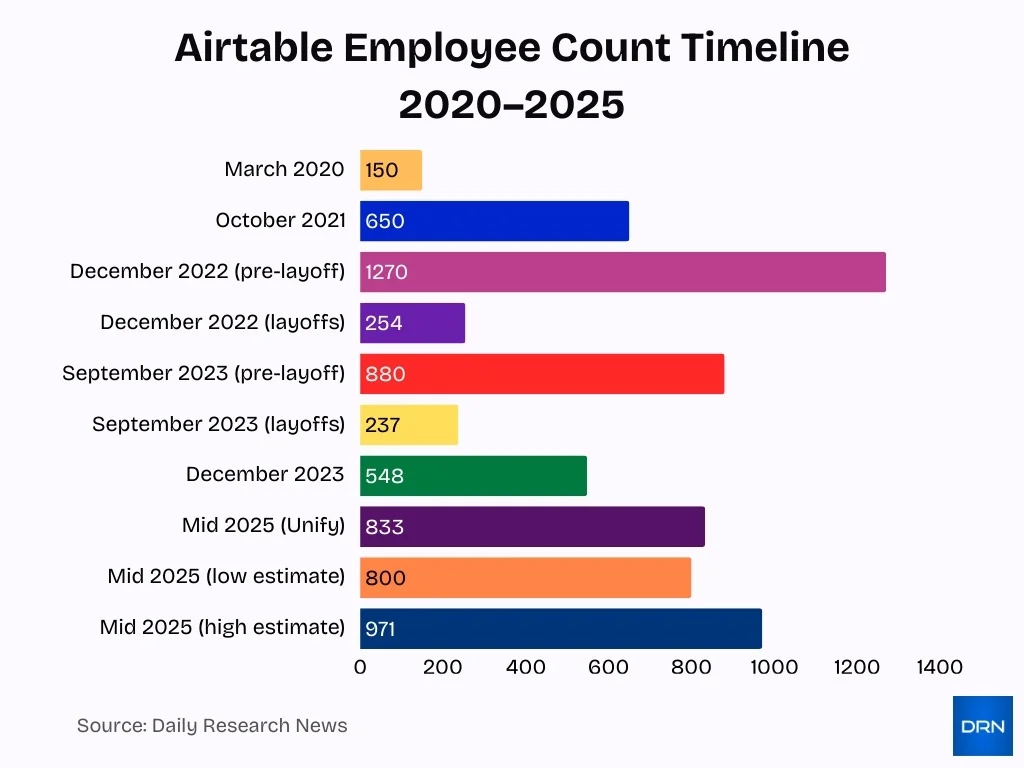
- Airtable had 150 employees in March 2020.
- Headcount reached 650 employees by October 2021.
- The company grew its workforce 8x from the end of 2019 to 2022.
- 254 employees were laid off (20% of staff) in December 2022.
- 237 employees cut (27% reduction) in September 2023.
- 548 employees reported as of December 2023.
- Workforce estimated at 800–971 employees by mid-2025.
- Unify reported 833 employees with 7.2% growth in 2025.
Core Workforce Size
- A detailed workforce analysis report (Aug 2025) lists Airtable with 833 employees worldwide.
- That number reflects a 7.2% increase compared with the previous year.
- According to that same report, the company hired 172 new employees during the year.
- Departures totalled 77 employees, so net headcount growth was positive but moderate.
- Another data provider estimates up to 971 employees, though without detailed verification.
- On LinkedIn, Airtable falls in the broad category of 501–1,000 employees.
- Some industry-wide directories estimate around 900 employees.
- The variation among 833, 900, and 971 highlights how different datasets, timing, and assumptions lead to diverging counts.

Workforce Growth Over Time
- In mid-2025, the 833-employee headcount marks a 7.2% increase year-over-year.
- The 172 new hires in 2025 represent roughly 5% of the total workforce, indicating continued, though cautious, expansion.
- Departures of 77 employees in the same period represent nearly 9.2% of hires, suggesting modest turnover.
- The earlier 2023 layoffs eliminated about 237 jobs, roughly 27% of the workforce at that time.
- That shows the company significantly reduced headcount during restructuring, but has since embarked on controlled rebuilding.
- Some sources note a negative growth rate of –12% in one year, reflecting perhaps pre-2025 volatility.
- The variation across sources suggests that Airtable’s reinstatement of growth varies depending on which departments and geographies get prioritised.
- Overall, the data points to a company shifting from contraction to measured growth, calibrating its workforce as business strategy evolves.
Gender Diversity at Airtable
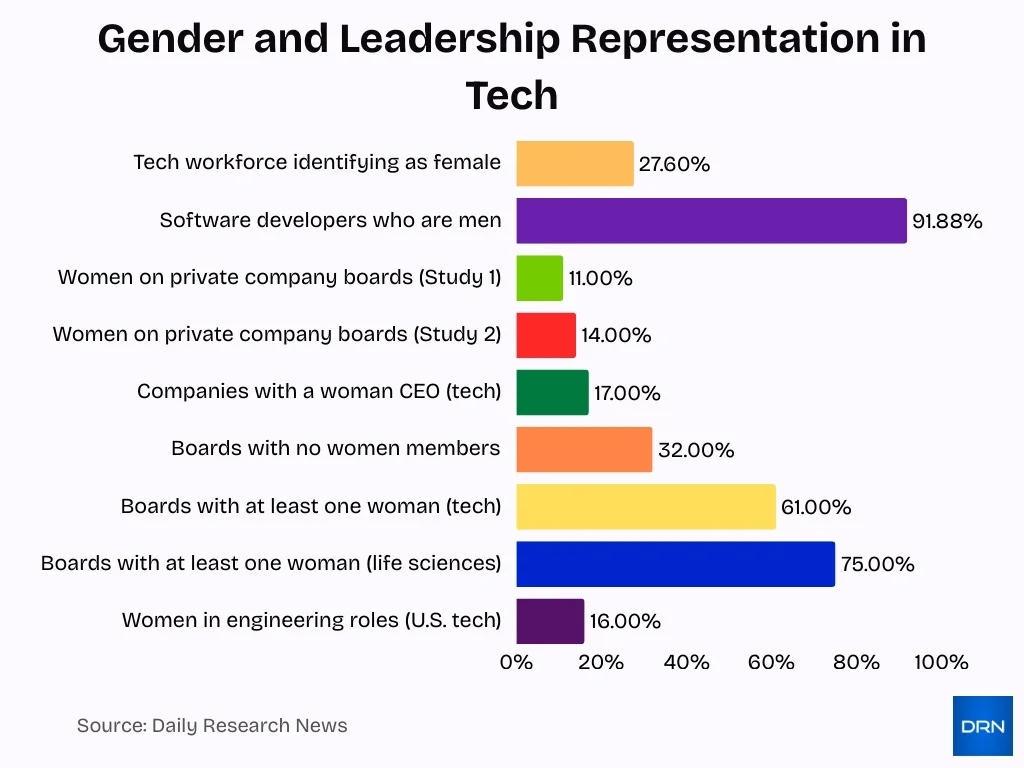
Airtable lacks public gender diversity data, aligning with trends in private tech firms.
- 27.6% of the technology workforce identifies as female in the latest data.
- 91.88% of software developers are men per the 2022 survey.
- Private company boards show 11% women in seats, a 9-to-1 male ratio.
- 14% of private company board seats were held by women in a 2021 study.
- 17% of technology companies have a woman CEO currently.
- 32% of surveyed private company boards have no women members.
- 61% of tech boards have at least one woman, versus 75% in life sciences.
- Women comprise 16% of engineering roles across US tech companies.
- Tech sector gender diversity yields 19% higher revenue per research.
Employee Estimates from Different Sources
- As of 2025, one widely cited tracker lists Airtable at about 833 employees globally.
- Another source estimates the headcount at 900 employees, reflecting a somewhat more generous snapshot.
- Some data aggregators mention around 800 employees, though they rarely provide departmental breakdowns or a date for the snapshot.
- A different platform lists 971 employees, possibly capturing an earlier hiring wave or including contractors or temporary staff.
- Despite variations, most estimates converge within the 800–950 range, indicating a mid-sized workforce rather than a large enterprise.
- Official public profiles classify Airtable under the “501–1,000 employees” banner, in line with these estimates.
- The variance between sources reflects differences in methodology; some include only full-time staff, others may count contractors, and the timing of data collection also matters.
Headcount by Department
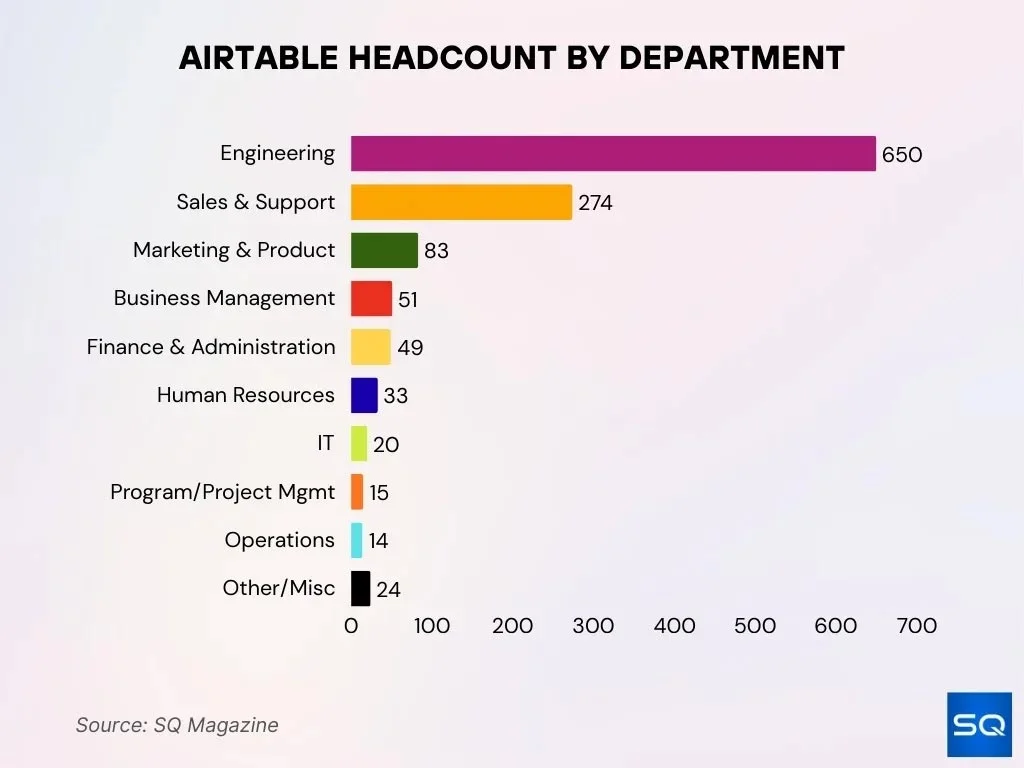
- The Engineering department is reported to include 270–650 employees, with Unify specifically estimating ~650 in Engineering, while still indicating the total range varies by source.
- The Sales & Support organisation remains one of the largest teams, employing ~274 employees across its combined functions.
- The merged Marketing and Product groups collectively account for approximately 83 employees, representing a notable portion of the organisation.
- The Business Management division contains around 51 employees, the Finance & Administration division includes about 49 employees, and Human Resources maintains a workforce of roughly 33 employees.
- Smaller departments such as Information Technology with ~20 employees, Program & Project Management with ~15 employees, and Operations with ~14 employees contribute modest but essential headcount.
- Roles categorised as “Other” or mixed/unspecified collectively amount to ~24 employees, capturing positions that do not align strictly with the main departments.
Largest Teams at Airtable
- Sales & Support leads the largest team with 274 employees.
- Engineering follows closely with 270 employees, nearly matching the sales size.
- Marketing + Product totals 83 employees for promotion and features.
- Business Management employs 51 staff in mid-sized operations.
- Finance & Administration has 49 employees supporting core functions.
- Human Resources maintains 33 employees for workforce needs.
- Information Technology operates with 20 employees for infrastructure.
- Program & Project Management includes 15 employees for coordination.
- Operations runs on 14 employees for daily logistics.
- The other category covers 24 employees in hybrid roles.
Technical vs Non-Technical Employees
- Engineering comprises 270 employees, forming Airtable’s primary technical staff.
- Sales & Support totals 274 employees, the largest non-technical department.
- Airtable’s total workforce stands at 833 employees as of mid-2025.
- Non-engineering roles account for 563 employees, roughly 68% of the total staff.
- Technical staff represents 32% of Airtable’s 833-employee workforce.
- Marketing & Product combined hold 83 employees in non-technical functions.
- Business Management employs 51 staff, emphasising operational non-tech roles.
- Finance & Administration has 49 employees, supporting business overhead.
- Airtable maintains 17 departments, with non-engineering dominating the split.
Remote vs On-Site Employees
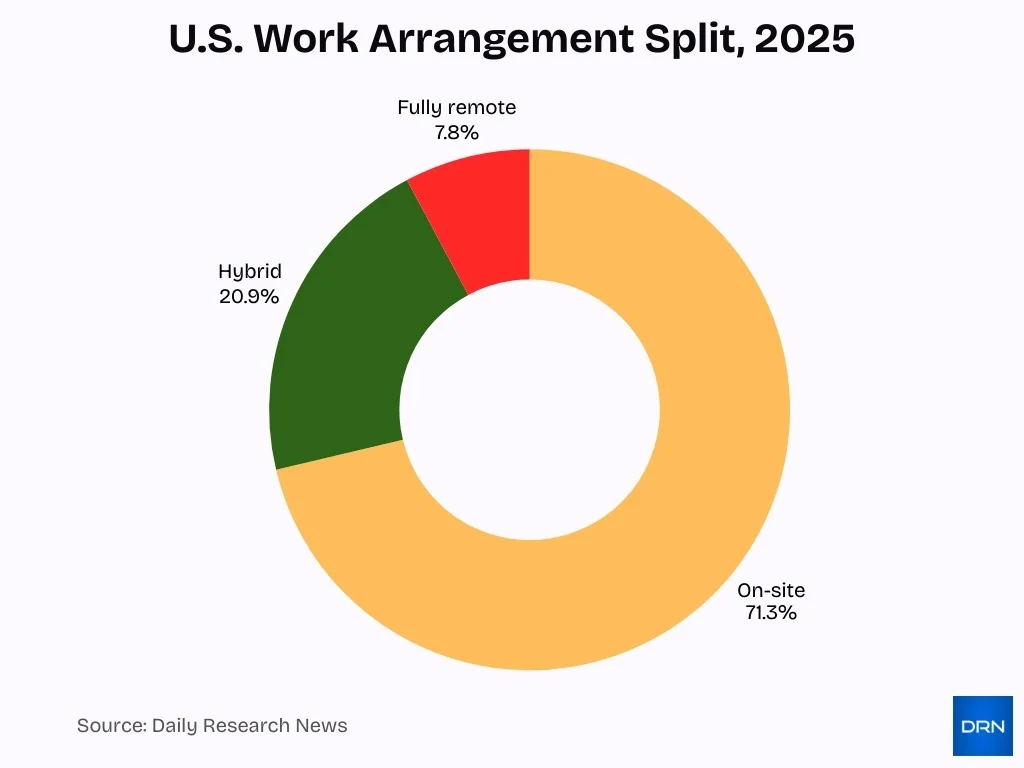
- 22.8% of U.S. employees worked remotely at least partially in March 2025, totalling 36 million people.
- In 2025, 71.3% of full-time U.S. employees work on-site, 20.9% hybrid, and 7.8% fully remote.
- 64% of companies operate on a hybrid model, preferred by most employees over fully remote or on-site.
- Hybrid workforce professionals show the highest engagement at 35%, surpassing remote (33%) and on-site (27%).
- Remote work boosted productivity by 47% since March 2020 compared to pre-pandemic levels.
- SaaS firms with “work from anywhere” policies hire 60%+ outside top U.S. tech hubs post-2021.
- 48% of the global workforce was remote in 2025, up from 20% in 2020.
- 90% of employees report equal or higher productivity in hybrid/remote vs. on-site settings.
- 85% of businesses note increased productivity from remote work flexibility.
Leadership and Executive Team Size
- Airtable employs 833 total employees globally as of mid-2025.
- The company maintains 15 executives, including the CEO and C-suite leaders.
- Typical SaaS firms with 800–900 employees expect 20–40 executives and senior managers.
- Airtable’s 2022 layoffs impacted 254 employees or 20% of the workforce, including 3 C-level exits.
- The founding team comprises 3 key members: Howie Liu (CEO), Andrew Ofstad, and Emmett Nicholas.
- 17 distinct departments reported, suggesting coordinated leadership oversight across functions.
- The Sales & Support team has 274 employees, likely led by VP-level executives.
- The engineering department ranges from 270–650 employees, requiring dedicated director-level management.
- Post-layoff restructuring in 2023 reduced headcount by 27% from the prior peak.
Employees by Country
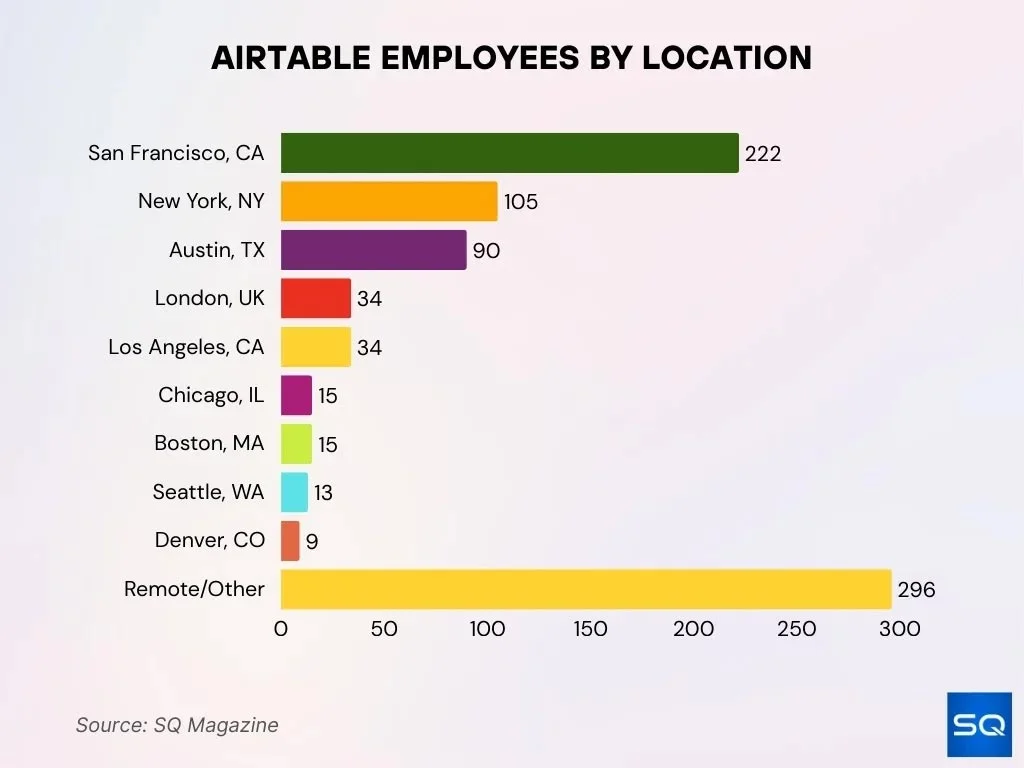
- San Francisco hosts 222 employees, over 25% of Airtable’s total workforce.
- New York employs ≈105 employees as a key U.S. hub.
- Austin has ≈90 employees in its Texas office.
- The London office maintains 34 employees in the UK.
- Los Angeles supports 34 employees as a mid-sized hub.
- Chicago and Boston each have 15 employees.
- Seattle employs 13 employees.
- Denver has 9 employees.
- Remote/Other staff totals 296 employees, reflecting the distributed model.
Layoffs by Year
- In December 2022, Airtable laid off roughly 254 employees, representing about 20% of its workforce at that time.
- The December 2022 cuts also included departures among senior leadership, including its Chief Revenue Officer, Chief People Officer, and Chief Product Officer.
- In September 2023, Airtable announced another round of layoffs, cutting 237 employees, which amounted to about 27% of its staff.
- Combined over the two years, the layoffs removed a substantial portion of Airtable’s workforce, underscoring a strategic retrenchment.
- Reports noted that the 2023 layoffs spanned multiple offices and departments worldwide, from business development to engineering.
- For those laid off, Airtable reportedly provided at least 16 weeks of severance pay, accelerated equity vesting, and legal support for visa-holders.
- Observers noted that the cuts were part of a strategic shift; Airtable moved from targeting broad SMB clients toward focusing on larger enterprise customers.
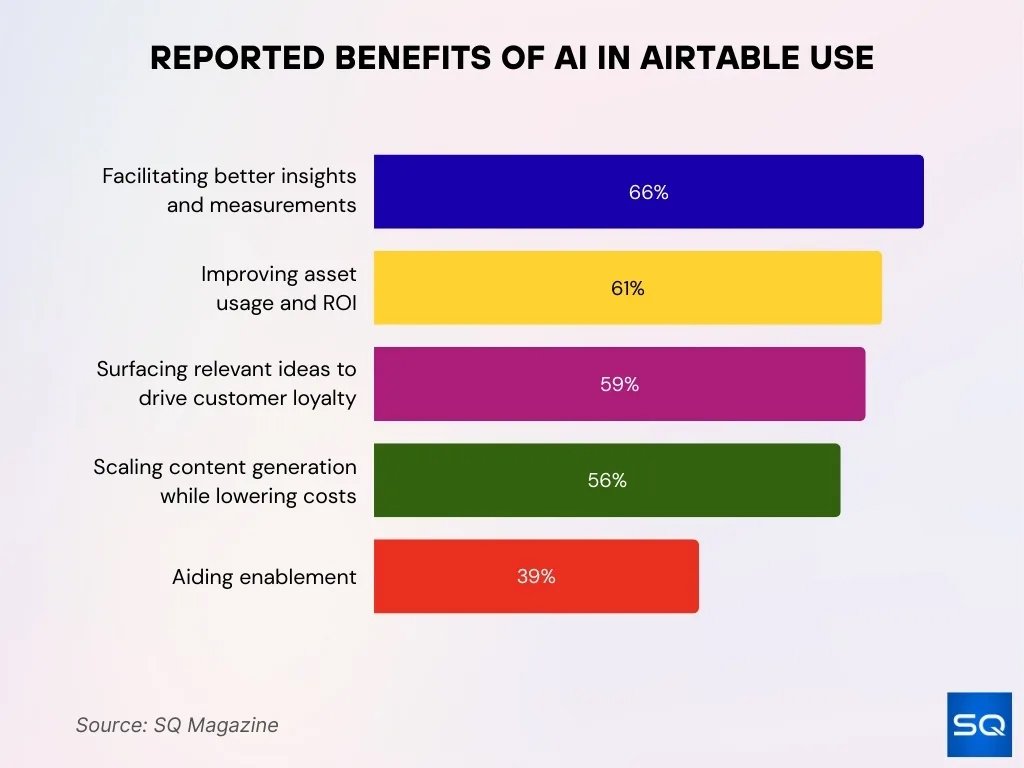
Reported Advantages of AI in Airtable Usage
- 66% of respondents state that AI in Airtable enables stronger insights and enhanced measurement capabilities.
- 61% indicate that AI drives better asset utilisation and improved return on investment (ROI).
- 59% emphasize AI’s contribution to revealing relevant ideas that strengthen customer loyalty.
- 56% report that AI supports scaling content generation while lowering operational costs.
- 39% note that AI is valuable for supporting enablement across various workflows and teams.
Percentage of Workforce Laid Off
- 2022 layoffs cut 20% of Airtable’s workforce, eliminating 254 employees.
- 2023 layoffs reduced 27% of the workforce, impacting 237 employees company-wide.
- Pre-2022 layoff, Airtable had roughly 1,270 employees based on 20% reduction math.
- Pre-2023 layoff, the workforce stood at about 880 employees, per 27% cut calculations.
- Combined 2022–2023 cuts eliminated 491 staff, nearly halving peak headcount.
- Post-layoffs, Airtable reported 548 employees by December 2023.
- The tech sector saw 164,744 layoffs in 2022, surging to 226,000 in 2023 (40% increase).
- Airtable’s cuts hit product and sales teams hardest, targeting a smaller client focus.
- Severance offered 16 weeks’ pay plus accelerated equity vesting to affected staff.
Post-Layoff Workforce Size
- After the 2023 layoffs, external trackers estimate Airtable had 833 employees globally by mid-2025.
- That number accounts for subsequent hires, implying that Airtable repositioned itself and rebuilt some capacity after cuts.
- Some sources give a higher estimate, for instance, 900 employees.
- The reduction-then-rebuild pattern indicates Airtable used layoffs as a reset, then hired selectively, likely in strategic teams.
- Given the 2023 cut of 237 people from perhaps 870–900 (pre-cut) and rebuilding to 833–900, the net workforce change since 2022 appears negative but mitigated over time.
Revenue per Employee
- Airtable’s estimated revenue per employee stands at about $200,200.
- Using a reported 2024 annual revenue of $204.7 million and a headcount of 833–900, this yields a rough revenue-per-employee range of ≈ $227,000–$246,000.
- This indicates operational efficiency in line with many mid-sized SaaS firms.
- The metric likely improved as headcount reduction outpaced revenue decline following layoffs.
- Revenue-per-employee estimates remain approximate due to variability in revenue reporting and staffing counts.
Employee Count vs Competitors
- Airtable employs 833 workers, achieving $204.7M revenue for $246K per employee.
- Notion has 800 employees, generating $540M revenue at $207K per employee.
- Asana maintains 1,819 staff with $773M revenue, yielding $425K per employee.
- Monday.com operates with 2,867 employees and $1.22B projected 2025 revenue for $427K per employee.
- ClickUp supports 1,989 workers, hitting $300M ARR at $200K revenue per employee.
- Airtable’s 833–900 headcount trails Asana (1,819) and monday.com (2,867) by 2–3x.
- Post-layoffs, Airtable cut 27% (237) from 1,070, boosting efficiency vs peers.
- Private SaaS median hits $129K ARR per employee; Airtable exceeds at $246K.
- Notion grew 12% net (144) YTD to 800, slower than Airtable’s 7.2%.
Frequently Asked Questions (FAQs)
Airtable reportedly has ≈ 833 employees globally as of mid-2025.
On LinkedIn, Airtable is classified in the “501-1,000 employees” range.
One aggregator estimates Airtable’s headcount at 971 employees.
Airtable is reported to have grown by 7.2% year-over-year.
Conclusion
Airtable’s journey reflects a company that weathered substantial workforce adjustments, then reoriented itself with a leaner and potentially more efficient staff base. The sharp layoffs, about 20% in 2022 and 27% in 2023, cut deeply into the organisation. The company shows signs of stabilisation with a global team estimated at around 833–900 employees. With a revenue-per-employee metric in the ballpark of $227,000–$246,000, Airtable appears to be operating at a level of efficiency not always common among mid-sized SaaS companies.
At the same time, the lack of public gender-diversity data leaves an important dimension of workforce composition unexamined. For those evaluating Airtable, whether as potential clients, talent, or industry watchers, the company’s trajectory demonstrates both the turbulence faced by many tech firms in recent years and how strategic refocusing may yield a more stable core.
As Airtable continues evolving its enterprise-facing offerings and global presence, its headcount and organisational composition may shift further, making updated tracking essential for an accurate understanding of the company’s direction.