

Microsoft’s search engine Bing remains a notable part of the global search landscape, even as it trails the industry leader. While much of the public discussion focuses on usage trends and market share, understanding the actual workforce powering Bing offers a clearer picture of its scale and strategic relevance within Microsoft. In industries from advertising to cloud computing, the personnel behind search technologies influence everything from product innovation to ad revenue.
For example, advertisers tailor campaigns based on search team insights, and AI engineers on Bing shape how billions of users get answers online. Explore the full article to understand how many people work at Bing, how that workforce has changed, and what it means for technology and business.
Editor’s Choice
- Microsoft’s global workforce totals ~228,000 employees in 2025, stable from 2024.
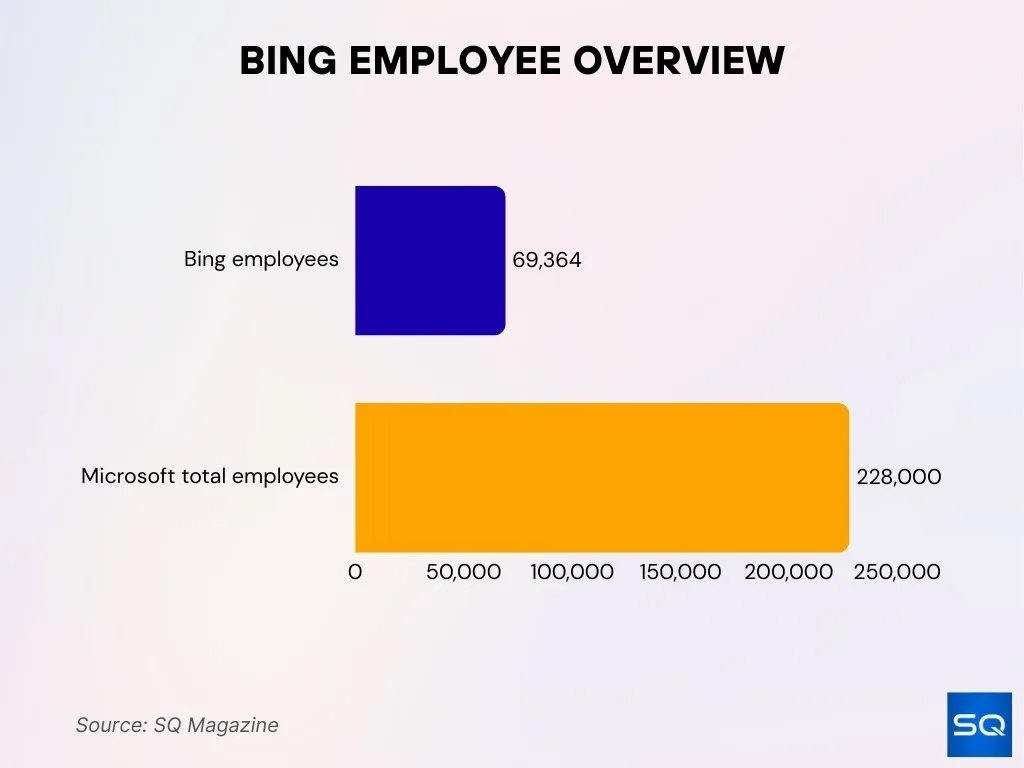
- Bing teams comprise 69,364 employees per 2025 estimates.
- Bing holds ~4% global search market share in 2025.
- Search ad revenue rose 21% to $13.9B in fiscal 2025.
- ~15,000 layoffs hit Microsoft in 2025, sparing AI/search growth.
- ~407 open Bing roles signal ongoing hiring demand.
- 78% of leaders prioritize AI hiring despite sector cuts.
- Bing handles 1.2B daily searches as an engine.
Recent Developments
- In 2025, Microsoft maintained a workforce of about 228,000 people globally, unchanged from 2024.
- Microsoft resumed selective hiring after focusing on AI training and workforce efficiency.
- Broader reorganization and layoffs affected staffing capacity across several divisions.
- Before 2025, Bing and related AI teams received increased investment tied to Copilot and Edge integrations.
- Hiring demand rose for AI engineers supporting search personalization and ranking models.
- Enterprise shifts toward remote and hybrid roles changed how search teams operate daily.
- Cross-functional collaboration with AI research teams influenced Bing’s product cadence.
- Competitive pressure from other search and AI tools shaped workforce prioritization.
Total workforce employed at Bing
- Workforce estimates suggest around 69,364 employees are linked to Bing roles and teams in 2025.
- Bing staffing includes both dedicated search employees and embedded contributors from other Microsoft divisions.
- Smaller employment figures reported elsewhere often underrepresent Bing’s integrated workforce model.
- Bing’s staffing reflects combined roles across search, AI, product, and advertising functions.
- Microsoft’s overall workforce of 228,000 employees provides context for Bing’s internal scale.
- Support from Azure, AI, and research teams expands Bing’s operational headcount.
- Employment tied to Bing correlates closely with usage growth and AI feature expansion.
Employee growth trends over time at Bing
- Bing workforce estimates from 2018 onward suggest long-term stability with incremental growth tied to AI.
- Microsoft’s total headcount doubled over the last decade, reaching roughly 228,000 employees by 2025.
- Growth in AI and cloud roles reduced reliance on traditional search staffing alone.
- Recent workforce reductions slowed net growth without eliminating critical Bing roles.
- Long-term hiring emphasized AI research and applied science supporting search quality.
- Seasonal hiring patterns aligned with major product launches and platform updates.
- Investment in Copilot and AI search features expanded cross-functional staffing.

Share of Microsoft’s workforce dedicated to Bing
- Bing-related roles are estimated to represent around 30% of Microsoft’s global workforce when integrated teams are included.
- Microsoft’s AI organization, employing roughly 10,000 people, directly supports Bing development.
- Core search, advertising, and product teams form a sizable portion of Microsoft’s online services workforce.
- R&D and product engineering segments closely align with Bing staffing needs.
- Even amid layoffs, Bing retained priority roles in AI and search engineering.
- Workforce share varies by region depending on engineering and sales hubs.
- Cloud and AI investments continue to elevate Bing’s internal resource allocation.
Department-wise distribution of employees working on Bing
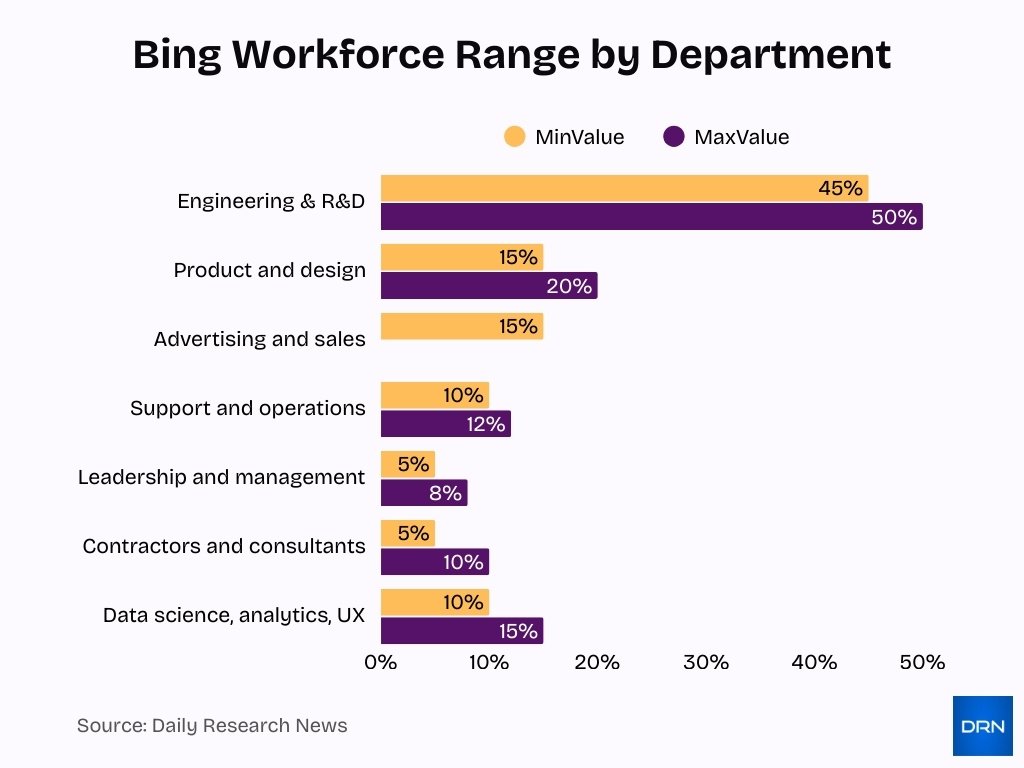
- Around 45–50% of Bing-aligned employees are in engineering & R&D roles focused on search relevance, AI models, and core infrastructure.
- Roughly 15–20% work in product and design, shaping UX across web, mobile, Edge, Copilot in Bing, and other search touchpoints.
- An estimated 15%+ of the Bing ecosystem is tied to advertising and sales, leveraging Microsoft Advertising to reach over 1 billion users across the ad network.
- About 10–12% of headcount sits in support and operations, aligned with datacenter and infrastructure operations that grew nearly 23.9–28.9% in 2024.
- Approximately 5–8% hold leadership and management roles, a layer currently being streamlined as management staffing is trimmed across divisions.
- Close to 5–10% of work is covered by contractors and consultants, reflecting Microsoft’s reliance on external specialists for AI, cloud, and short‑term projects.
- Cross‑division contributors mean that thousands of engineers and researchers from WebXT, Azure AI, and Microsoft Research reinforce Bing search and ads.
- Data science, analytics, and UX specialists likely represent 10–15% of Bing-adjacent teams, supporting continuous experimentation, ranking quality, and UX optimization.
Engineering and R&D staff supporting Bing operations
- Microsoft employs tens of thousands of engineers globally, with a significant share supporting Bing systems.
- Engineering and R&D roles make up roughly 40% to 45% of all Bing-related positions.
- More than 1,000 researchers within Microsoft Research contribute directly to search and language models.
- In 2024 and 2025, hiring increased for AI engineers and applied scientists.
- Software engineer and senior engineer roles remain the most common Bing-related job titles.
- Microsoft invests over $27 billion annually in R&D, supporting Bing innovation.
- Bing teams run thousands of A/B tests each year, requiring dedicated experimentation staff.
- Azure engineers also support Bing indexing and performance optimization.
Advertising and sales teams assigned to Bing
- Thousands of sales, account management, and ad operations professionals support Bing Ads globally.
- Microsoft Advertising generates more than $12 billion in annual revenue, backed by these teams.
- Sales roles cluster in the United States, Ireland, and the United Kingdom.
- Common roles include account executives, sales managers, and advertising strategists.
- In 2024 and 2025, SMB and mid-market ad support teams expanded.
- Programmatic advertising specialists support Microsoft Audience Network integrations.
- Sales enablement teams focus on performance reporting and optimization.
- Advertising policy and trust teams ensure compliance and brand safety.
Product, design, and UX professionals contributing to Bing
- Product and UX roles account for an estimated 10% to 15% of Bing-related staff.
- Hundreds of product managers oversee search features and AI answers.
- UX designers focus on accessibility, mobile experience, and interface testing.
- Microsoft’s design organization includes more than 1,000 designers company-wide.
- In 2025, AI-driven search layouts increased demand for UX research.
- User research teams conduct continuous global usability studies.
- Product operations roles support roadmap planning and execution.
- Localization specialists adapt Bing for international markets.
Support and operations staff managing Bing services
- Bing relies on site reliability engineers, IT operations staff, and support engineers worldwide.
- Thousands of operations professionals across Microsoft support Bing workloads.
- 24/7 availability requires follow-the-sun staffing models.
- Content moderation and quality assurance teams maintain search integrity.
- Operational analytics teams track uptime and latency metrics.
- Customer support teams assist advertisers and partners.
- Infrastructure operations overlap with Azure teams for efficiency.
- Security and incident response teams support trust and safety.
Leadership and management roles related to Bing
- Microsoft employed about 228,000 people globally in 2025, forming the overall leadership pool that Bing-related managers are drawn from.
- If leadership (GMs/VPs/senior directors) is roughly 1%–2% of headcount, this implies about 2,000–4,500 senior leaders potentially covering areas like Bing and AI.
- With management roles estimated at 5%–8% of Bing-aligned headcount, every 100 Bing employees would include about 5–8 managers across levels.
- Bing search serves users in around 238 countries and regions, requiring regional and global leaders to coordinate multi-market execution.
- Microsoft reported about 228,000 employees in 2024 and 2025, so leadership spans a workforce that grew roughly 3.17% from 221,000 in 2023.
- From 2021 to 2022, Microsoft expanded from 181,000 to 221,000 employees (around 22.1% growth), increasing the scale of engineering and product teams that Bing managers coordinate.
- Microsoft’s Responsible AI governance work accelerated in 2024–2025, with leadership aligning initiatives to frameworks like the EU AI Act and NIST AI Risk Management Framework.
- The 2025 Responsible AI Transparency Report highlights a structured AI governance architecture with clearly defined roles and responsibilities across leadership layers.
Full-time versus contract roles within Bing projects
- An estimated 75–85% of Bing project roles are held by full-time Microsoft employees, reflecting the company’s preference for stable, in-house teams.
- Contractors and vendors account for roughly 15–25% of headcount on Bing and adjacent search/AI teams, aligning with Microsoft’s broader vendor mix across operations and support.
- In trust & safety and moderation work, vendor teams can perform over 70% of day‑to‑day review volume, while core policy ownership remains with full‑time staff.
- Localization and support programs often combine dozens of vendor locations with Microsoft employees, enabling training to be delivered in up to 100+ languages at scale.
- During tech workforce adjustments, Microsoft cut about 3–4% of its global staff in 2023–2025, with reductions disproportionately affecting non‑core and vendor‑supported roles.
- Women represent 31.6% of Microsoft’s core workforce in 2024, underscoring diversity efforts among full‑time employees who hold most leadership and R&D roles relevant to Bing.
- Global Microsoft headcount grew from roughly 221,000 in 2023 to 228,000 in 2024, while the company simultaneously streamlined some support and operations functions often involving vendors.
- EU DSA transparency reports for Bing document millions of items of user content assessed yearly, much of the large‑scale data labeling and evaluation handled through vendor teams under strict guidelines.
- Microsoft requires all vendor workers exposed to objectionable Bing content to receive wellness programs and compliance training, standardizing data access and usage controls across contractors.
Geographic distribution of the Bing workforce
- Microsoft employs 228,000 people worldwide as of June 30, 2025, supporting Bing operations.
- About 125,000 employees are based in the United States, the core of Bing’s talent pool.
- Roughly 103,000 employees work internationally across the Americas, Europe, and the Asia-Pacific.
- Nearly 46% of Microsoft’s workforce is located outside the U.S., aiding global Bing localization.
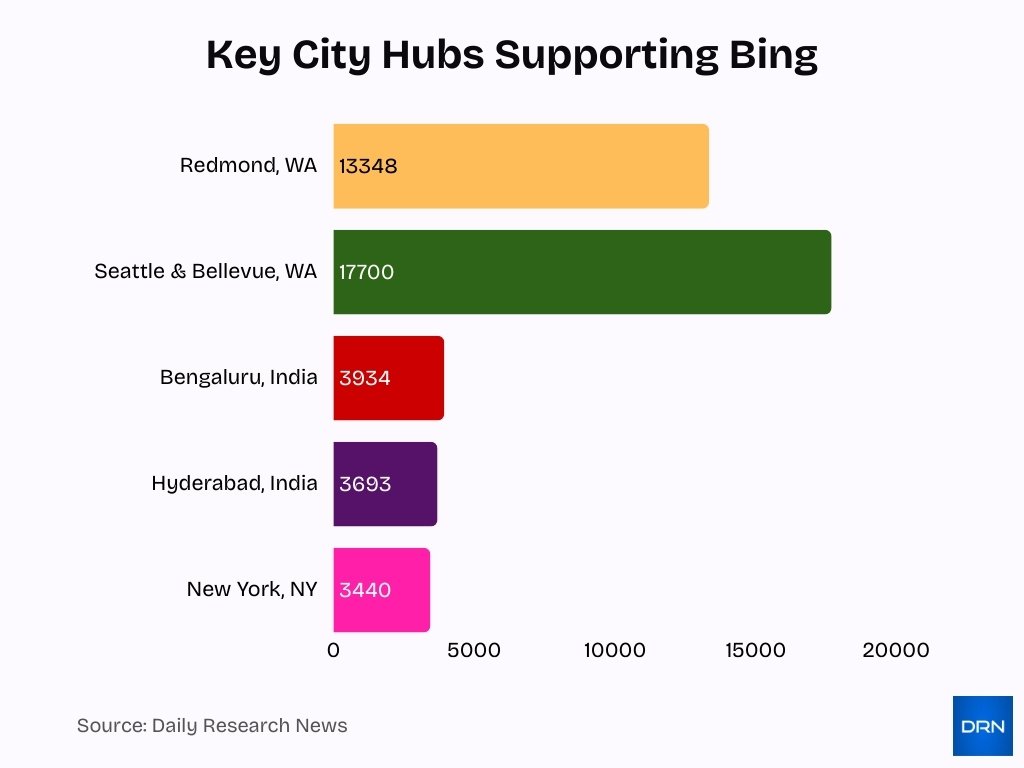
- Redmond, WA, hosts 13,348 employees, Bing’s headquarters hub.
- Seattle and Bellevue, WA, together employ over 17,700 staff, bolstering Pacific Northwest Bing teams.
- Bengaluru, India, has 3,934 Microsoft workers, key to Asia-Pacific Bing support.
- Hyderabad, India, employs 3,693, strengthening regional Bing operations.
- New York, NY, supports 3,440 employees, aligning advertising with U.S. East Coast markets.
- Datacenter roles grew 23.9% globally in 2024, expanding Bing’s cloud workforce beyond Redmond.
Remote versus on-site roles across Bing teams
- Microsoft maintains a hybrid work model across Bing teams.
- More than 50% of Bing employees work in hybrid or remote roles.
- Engineering and data roles show the highest remote adoption.
- On-site roles remain common in security and infrastructure operations.
- Major hubs include Redmond, the San Francisco Bay Area, Dublin, and Hyderabad.
- Remote work expanded access to global engineering talent.
- Collaboration tools support distributed Bing teams.
- Hybrid policies vary by function and region.
United States-based employees involved with Bing
- The U.S. hosts around 125,000 Microsoft employees, including most Bing staff.
- Redmond, Washington, serves as the primary hub for Bing engineering and leadership.
- Additional hubs include the Bay Area, New York, and Austin.
- U.S. teams support Bing’s integration with Windows and Edge.
- National advertising teams serve enterprise Bing Ads clients.
- Remote policies allow nationwide participation in Bing projects.
- Compliance and trust teams are largely U.S.-based.
Europe-based professionals working on Bing
- Bing is reported to have ~69,364 employees globally as of December 2025.
- Microsoft’s total workforce is about 228,000 employees, with 102,000 based outside the U.S. in 2024.
- An updated analysis shows 250,893 Microsoft employees worldwide in August 2025.
- Western Europe comprises over 15,000 Microsoft employees spread across 11 countries.
- Engineering at Microsoft includes about 104,214 employees, making it the largest department.
- Product R&D roles account for about 81,000 employees at Microsoft globally.
- Sales and marketing headcount is roughly 45,000 employees, or about 20% of Microsoft’s workforce.
- Operations and support roles declined slightly from ~89,000 to ~86,000 employees, a 3.37% drop.
Top Bing Search Queries in the United States
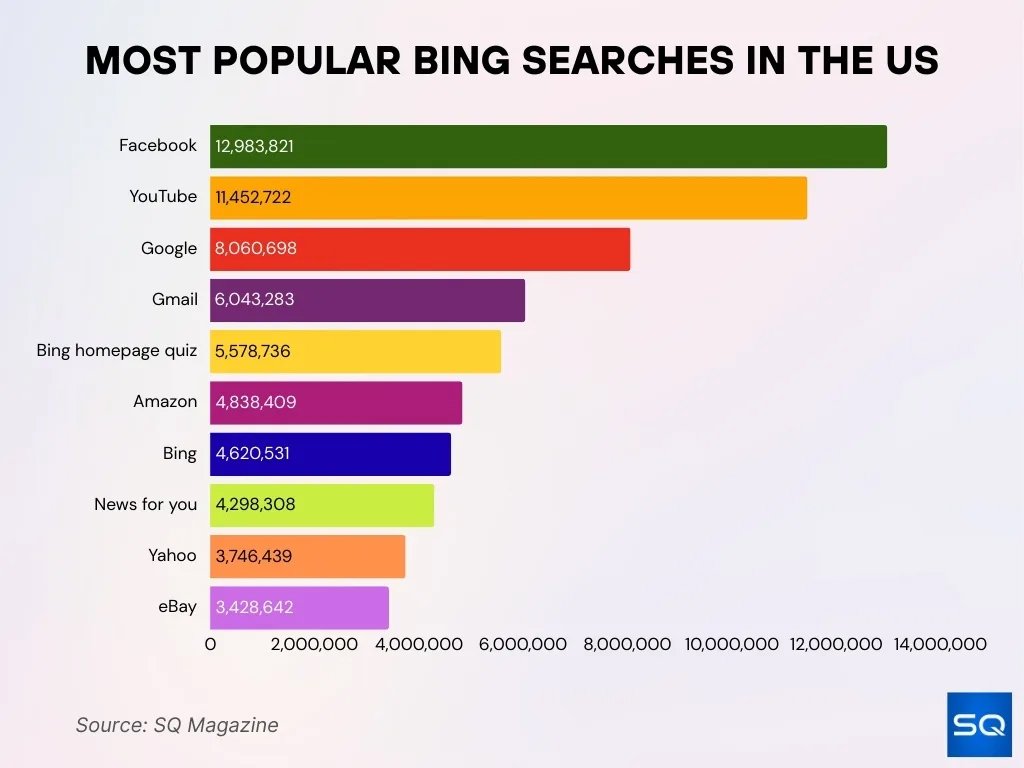
- Facebook leads the rankings with 12.98 million searches, securing its position as the most searched keyword on Bing across the US.
- YouTube comes next with 11.45 million searches, highlighting strong user demand for video-based content on the platform.
- Google unexpectedly takes the third spot with 8.06 million searches, suggesting Bing users frequently look up a rival search engine.
- Gmail attracted 6.04 million searches, underscoring the widespread reliance on Google’s email service among users.
- The Bing homepage quiz accounted for 5.58 million searches, largely driven by daily engagement with Bing’s interactive quiz feature.
- Amazon recorded 4.83 million searches, reflecting strong e-commerce interest from Bing users in the US.
- Bing itself was searched 4.62 million times, likely by users attempting to access, reload, or reset the homepage.
- News for you generated 4.30 million searches, pointing to high demand for personalized and curated news content.
- Yahoo saw 3.75 million searches, indicating continued cross-platform usage among long-time and legacy web users.
- eBay closed the list with 3.43 million searches, maintaining its ongoing relevance in the online retail marketplace.
Asia-Pacific workforce contributing to Bing
- Asia-Pacific hosts around 20,000 Microsoft employees across 20 markets, representing a significant share of the firm’s global headcount.
- Microsoft’s Beijing campus leads Asia Pacific R&D, while new cloud regions such as India South Central (Hyderabad) and Southeast Asia (Singapore) anchor core engineering and operations for Bing and Azure.
- Multiple Azure regions in East Asia, Southeast Asia, China, India, Japan, Korea, and Australia enable low-latency Bing localization for over 1.69 billion workers in Asia’s labor force.
- Microsoft Advertising’s expansion to 11 new APAC markets increased potential reach by 59 million people, generating 780 million searches per month, boosting Bing Ads adoption.
- Azure operates at least 20+ active and announced regions across Asia-Pacific, providing datacenter redundancy that enhances Bing’s global reliability and uptime.
- New APAC regions in Hyderabad, Jakarta, Kuala Lumpur, Auckland, and Taipei add 5 cloud regions, expanding local data processing for Bing queries and AI models.
- Asia-Pacific digital advertising, where search holds 55.3% share, provides fertile ground for regional sales teams to drive Bing Ads campaigns.
- For APAC users, Bing Search API traffic is routed to the nearest Asia-Pacific data center, improving response times and supporting region-specific compliance.
Hiring trends impacting teams working on Bing
- In 2025, Microsoft’s global headcount reached ~228,000 employees, with engineering remaining the largest function at ~104,000 staff, even after cutting ~15,000 roles (~4–6%) across divisions.
- AI‑related positions now account for an estimated 20–25% of new technical openings at Microsoft, with over 75% of frontier firms surveyed planning AI‑specific hiring over the next 12–18 months.
- Hybrid job postings at Microsoft in the U.S. rose from ~15% in Q2 2023 to ~24% in 2024, while fully on‑site roles dropped from 83% to 66%, broadening the Bing and AI talent pool beyond core hubs.
- Women constitute 31.6% of Microsoft’s core workforce in 2024, up from 31.2% in 2023, reflecting gradual diversity gains in engineering, product, and UX roles.
- Microsoft’s total workforce grew from about 221,000 employees in 2023 to roughly 228,000 in 2024, while operations/support roles declined by ~3.37%, indicating a shift toward AI, cloud, and search‑adjacent engineering.
- Across tech, ~55,000 layoffs in the U.S. in 2025 were attributed to AI, yet Microsoft signaled renewed AI‑led hiring, aiming for “smaller, smarter” teams with higher productivity per employee.
- Engineering remains Microsoft’s largest department at roughly 104,214 employees, while Marketing & Product roles represent about 8% of headcount, supporting ad, UX, and programmatic initiatives around Bing.
- In recent workforce reshaping, Microsoft’s LinkedIn unit alone cut 281 roles in California, as up to 30% of Microsoft’s code became AI‑generated, increasing demand for AI‑native engineers and ML specialists.
- Microsoft globally employs about ~250,893 people as of August 2025, with hiring in AI, cloud infrastructure, and R&D prioritized even as departures (7,992) slightly outpaced new hires (7,321).
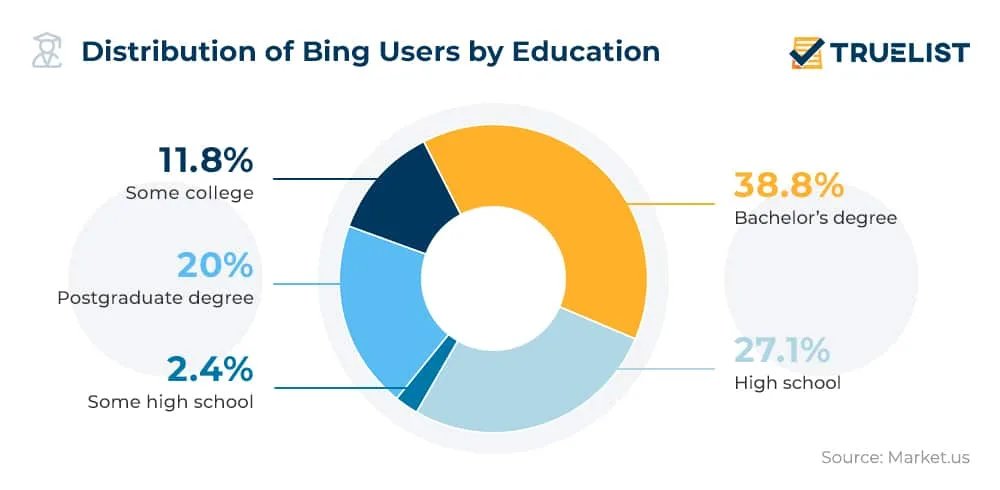
Education Breakdown of Bing’s User Base
- About 38.8% of Bing users possess a Bachelor’s degree, making this group the largest education-based segment on the platform.
- Nearly 27.1% of users have completed only high school, positioning them as the second-largest user group by education level.
- Roughly 20.0% of Bing’s audience holds a Postgraduate degree, highlighting strong adoption among advanced degree holders.
- Approximately 11.8% of users have attended some college, reflecting partial higher education without earning a full degree.
- Just 2.4% of Bing users have completed some high school, making this the smallest education segment on the platform.
Workforce reductions and layoffs within Bing-related units
- Microsoft reduced its workforce by 3%, or roughly 6,000 jobs, across product and engineering in May 2025.
- A later wave in July 2025 affected up to 9,000 employees, or 4% of global staff.
- Total layoffs in 2025 exceeded 15,000 jobs in multiple rounds.
- Software engineers comprised 22% of 305 cuts in June 2025.
- Product managers made up 13% of those 305 impacted roles.
- The sales and marketing division, with 45,000 staff, faced thousands of cuts.
- Layoffs hit gaming/Xbox units hardest among divisions.
- 228,000 total employees as of mid-2025, down from prior growth.
- Reductions spanned the U.S., Europe, and the Asia-Pacific regions.
- Shifts prioritized AI investments over traditional roles.
Search engine workforce comparison, including Bing
- Microsoft’s total workforce stands at 228,000 employees in 2025, dwarfing Bing’s estimated 69,364 dedicated roles.
- Alphabet employs 190,167 staff as of late 2025, enabling Google’s dominant 90%+ search market share.
- Yahoo maintains a lean ~4,500 employees while powering search via Bing tech integration.
- DuckDuckGo operates with just 200 remote workers across 15+ countries.
- Perplexity AI, an AI-first search startup, has grown to ~95 employees in 2025.
- Anthropic‘s AI team reached 1,097 employees by 2024, expanding rapidly into search applications.
- Baidu, China’s top search engine, cut to 35,900 employees amid 9.8% workforce reduction.
- Yandex employs ~28,000 full-time staff, aligning with its 2% global market presence.
- Workforce scales mirror market shares, with Google‘s 190K+ vs Bing‘s subset fueling 90% vs 4% dominance.
Frequently Asked Questions (FAQs)
About 69,364 employees are estimated to be associated with Bing-related work as of early to mid-2025, according to workforce estimates.
Microsoft’s total global workforce is approximately 228,000 employees in 2025.
Roughly 125,000 Microsoft employees are based in the United States as of June 30, 2025.
Microsoft announced layoffs affecting around 3% of its workforce, or roughly 6,000 employees, in mid-2025.
Conclusion
Bing operates at the intersection of traditional search and advanced AI, supported by a diverse workforce embedded within Microsoft’s ~228,000-strong global organization. Estimates indicate that tens of thousands of professionals contribute to Bing across engineering, product, advertising, and operations. The workforce spans the United States, Europe, and Asia-Pacific, reflecting both localization needs and global scale.
Hiring trends continue to prioritize AI and cloud expertise, even as restructuring reshapes certain teams. Compared with competitors, Bing maintains a substantial human capital footprint that underpins its relevance in search and AI through 2025 and beyond.