

Dropbox employs roughly 2,204 people worldwide, reflecting a significant shift in workforce size over recent years. This article breaks down how Dropbox’s employee count has changed, the impact of strategic workforce decisions, and what this means for how the company operates today. Dropbox’s virtual-first work model has reshaped hiring and retention, while workforce reductions have altered the headcount landscape. From industry-wide layoffs to remote work trends, this topic matters for HR leaders, tech workers, and investors alike. Read on to explore the full picture.
Editor’s Choice
- Dropbox’s total employees in 2024: 2,204.
- Employee count declined 18.16% from 2023 to 2024.
- Dropbox had 2,693 employees in 2023.
- Dropbox reduced ~20% of its workforce in 2024 (~528 roles).
- Headcount cut in 2023 was ~16% (~500 positions).
- Virtual First employee satisfaction reportedly improved from 48% to 88%.
- Remote-first policies boosted offer acceptance rates above 80%.
Recent Developments
- In October 2024, Dropbox cut approximately 528 jobs, equal to ~20% of its workforce.
- The layoffs were part of a strategy to streamline operations and improve efficiency.
- This marked the second major reduction after a ~16% cut in April 2023.
- Severance packages offered were estimated at $63 – $68 million in cash costs.
- Workforce reductions were attributed to slowing demand in core products.
- Dropbox’s fiscal results show modest revenue growth but pressure on margins due to restructuring.
- Broader tech layoffs continued in 2025 across the industry, underscoring challenging hiring conditions.
- Dropbox’s revenue per employee rose even as headcount shrank, signaling focus on efficiency.
- Employee sentiment about virtual work improved significantly under the current model.
- Dropbox’s strategy shifts reflect broader tech trends toward AI and digital services.
Employee Count Overview at Dropbox
- 2024 employee count: 2,204, a decline of 18.16% from 2023.
- The 2023 headcount was 2,693, down from 2022.
- 2022 total number of employees reached 3,118 before declines began.
- The 2021 headcount stood at approximately 2,667.
- Headcount has fluctuated considerably since 2017, when it was below 2,000.
- Overall, Dropbox’s workforce peaked in 2022 before the downward trend.
- The latest available data indicates ~2,204 employees in 2025.
- Declines reflect broader strategic and economic factors in the tech sector.
- Despite fewer employees, Dropbox remains within the 1,001–5,000 employee size category on professional networks.
- Headcount changes have coincided with shifts toward automation and AI integration efforts.
Workforce Growth Over Time at Dropbox
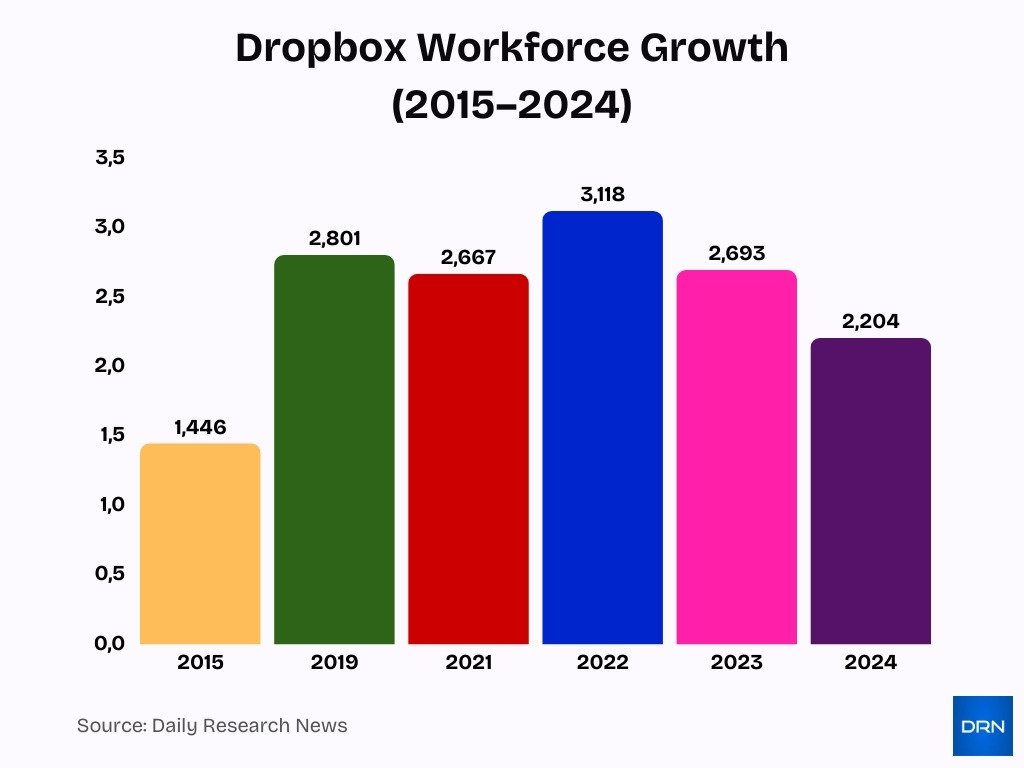
- Dropbox’s headcount rose from 1,446 employees in 2015 to 2,801 in 2019, reflecting a near 94% workforce increase over this early growth period.
- Employee growth peaked in 2022 with 3,118 staff, up 16.9% year-over-year, before the workforce began to contract.
- Workforce expansion slowed in 2021, when headcount dipped 3.4% from 2,760 to 2,667 employees, compared with double‑digit growth in prior years.
- By 2023, Dropbox’s workforce had fallen to 2,693 employees, down 13.6% year-over-year, marking a clear post‑pandemic downward trend.
- As of 2024, Dropbox employed 2,204 people, an 18.2% decline from 2023, underscoring a pivot from aggressive expansion to efficiency-focused operations.
- Layoffs of about 500 employees (16%) in 2023 and 528 employees (20%) in 2024 followed earlier hiring tied to AI and product development priorities.
- Historical data from 2015–2019 shows Dropbox added over 1,350 employees, demonstrating its ability to rapidly scale talent in favorable market conditions.
- Between the 2022 peak (3,118) and 2024 (2,204), net headcount shrank by 914 roles, mirroring broader tech‑sector corrections in hiring and retention.
- The shift from 20.6% growth in 2019 to consecutive declines after 2020 highlights efforts to balance innovation investment with tighter cost control.
- The introduction of a virtual‑first work model in 2021, alongside subsequent multi‑year layoffs, reflects long‑term adjustments in Dropbox’s employment structure.

Annual Headcount Trends at Dropbox
- 2017: ~1,858 employees as growth began.
- 2018–2020: Growth hovered around 2,300–2,800.
- 2021: Slight dip to ~2,667 roles.
- 2022: Peak at 3,118 employees.
- 2023: Drop to 2,693, down ~13.6% from 2022.
- 2024: Further drop to 2,204.
- Year-over-year trends show a significant contraction post-2022.
- Workforce reductions in 2023 and 2024 reflect reorganization priorities.
- The reduction rate from 2022 to 2024 totals over 900 roles cut.
- Forecasts for 2025 indicate a stabilizing headcount near 2,200.
Remote vs On‑Site Roles within Dropbox
- Dropbox operates a Virtual First work model, where remote work is the primary mode for most employees.
- Under this model, employees spend roughly 90% of their time working remotely with occasional in‑person collaboration.
- A company survey found that ~70% of Dropbox employees report higher productivity when working remotely vs traditional office settings.
- Average offer acceptance rates at Dropbox exceed 80%, partly due to remote flexibility.
- Dropbox’s virtual model attracted nearly seven times more applicants per job than before its remote policy implementation.
- Fully on‑site roles at Dropbox are rare and usually tied to specific functions like data center operations or compliance.
- Remote work policies have helped Dropbox tap into talent across the United States, Canada, and Europe without relocation requirements.
- Remote roles have contributed to lower turnover and improved global team collaboration compared to strict on‑site models in other tech firms.
- Dropbox still supports periodic in‑person gatherings or “studios” for team collaboration in cities like San Francisco and New York.
Hybrid and “Virtual First” Model Adopted by Dropbox
- Dropbox formally adopted its Virtual First model in 2020, making remote work the default for employees.
- The company emphasizes flexibility, letting employees work from home while encouraging occasional in‑person meetups.
- Dropbox reports that its virtual strategy has improved employee engagement and retention rates over traditional office work.
- The Virtual First model includes tools and practices aimed at enhancing remote collaboration.
- Dropbox’s leadership frames this model as a strategic asset for recruitment, especially amid broader return‑to‑office trends.
- The model contributes to showcasing Dropbox as a “distributed work lab,” influencing product development.
- Dropbox acknowledges that occasional in‑person work adds value beyond purely virtual communication.
- The Virtual First approach aligns with a broader trend where remote and hybrid roles dominate tech workforce preferences in 2025.
Regional Distribution of Employees at Dropbox
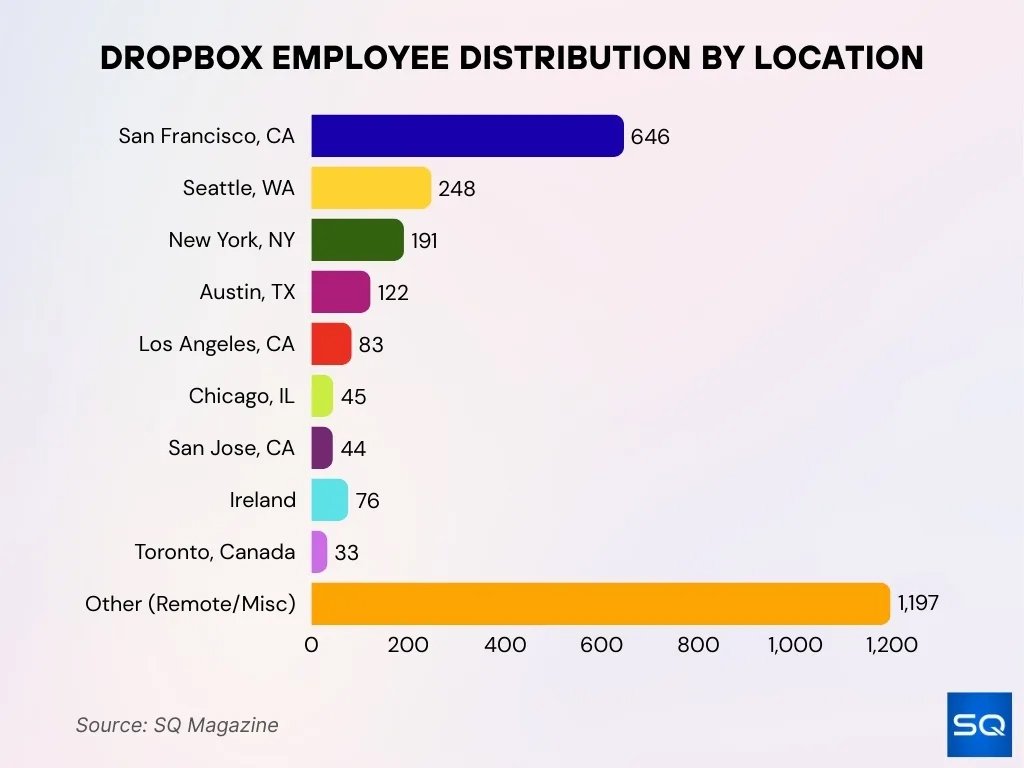
- The largest physical hub is San Francisco, CA, employing approximately ~646 employees, making it the company’s most concentrated office location.
- Seattle, WA, hosts around 248 employees, representing a significant presence on the U.S. West Coast.
- New York, NY, employs approximately 191 employees, reflecting a strong footprint in the eastern United States.
- Austin, TX, has about 122 employees, highlighting its role as a growing regional workforce center.
- Los Angeles, CA, supports roughly ~83 employees, contributing to the company’s Southern California operations.
- Chicago, IL, accounts for approximately ~45 employees, serving as a smaller but notable Midwest location.
- Internationally, Ireland stands out as a key hub with around ~76 employees, marking an important overseas presence.
- Toronto, Canada, accommodates approximately ~33 employees, representing a modest North American international office.
- San Jose, CA, employs close to ~44 employees, adding to the company’s overall Silicon Valley workforce.
- A sizable “Other” category of about ~1,197 employees consists of remote staff, flexible locations, or employees not tied to major office hubs.
Engineering Team Size at Dropbox
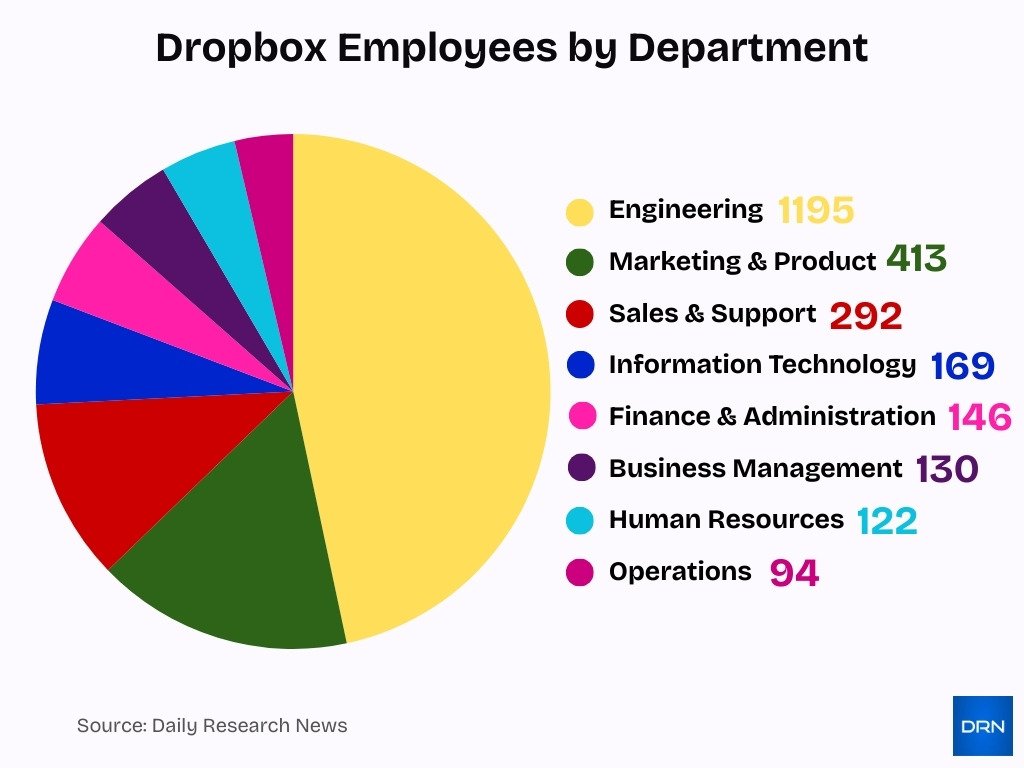
- Dropbox’s engineering org includes roughly 1,195 engineers, representing the single largest functional group at the company.
- Engineering makes up about 45% of Dropbox’s ~2,685‑person global workforce, highlighting a strong product-led operating model.
- Non‑engineering functions collectively account for roughly 55% of staff, spread across 8+ support departments such as IT, Finance, HR, and Legal.
- Marketing and Product functions total about 413 employees, less than 40% of the engineering headcount, underscoring a heavier technical investment.
- Sales and Support teams have around 292 employees, roughly 25% of the engineering group’s size.
- Dropbox reported 2,204–2,685 total employees in recent filings, meaning engineering alone represents ~40–54% of all roles, depending on the reference period.
- Recent workforce reductions of 16% in 2023 and 20% in 2024 targeted underperforming or over‑invested areas while keeping a lean, innovation-focused engineering base.
Sales and Marketing Workforce at Dropbox
- Marketing and Product functions account for 413 employees, representing roughly 15–19% of Dropbox’s global headcount, depending on whether the total staff is 2,204–2,685.
- Sales and Support together total ~292 roles, making up about 11–13% of overall employees at Dropbox.
- Combined Marketing, Product, Sales, and Support functions represent approximately 705 employees, or around 26–32% of the entire Dropbox workforce.
- With Dropbox’s revenue near $2.53 billion, Sales and Marketing-related groups help drive roughly $1.15 million in revenue per employee across the company.
- Marketing and Product headcount at 413 staff is the second‑largest functional cluster after Engineering’s ~1,195 employees, underlining a strong product‑led go‑to‑market model.
- Engineering holds about 45% of headcount, while Sales and Support, plus Marketing and Product, together hold ~26%, highlighting significant but focused customer‑facing investment.
- Recent cuts of ~528 employees (≈20%) in late 2024 mean Sales and Marketing must support acquisition and retention with a leaner overall workforce of ~2,204.
- Dropbox’s total staff decreased by 489 employees (−18.16%) from 2,693 in 2023 to 2,204 in 2024, yet Marketing and Product remain at 413, showing relative stability in growth roles.
- If Sales represents even 60–65% of the 292 Sales and Support employees, dedicated Sales roles likely number around 175–190 staff, aligning closely with third‑party estimates of ~189 sales employees.
Department‑Wise Headcount across Dropbox
- Dropbox’s largest department is Engineering, with about 1,195 employees, nearly half of the workforce.
- Marketing and Product teams total roughly 413 employees.
- Sales and Support functions employ about 292 people.
- Information Technology roles account for 169 employees.
- Finance and Administration teams have around 146 staff members.
- Business Management units include about 130 employees.
- Human Resources has approximately 122 team members.
- Operations roles employ around 94 people across the company.
- Departments like Legal and Other shared services represent smaller portions of the workforce.
Customer Support and Success Staff at Dropbox
- Customer Support & Success staff sit within a Sales & Support group of ~292 employees, representing roughly 11% of Dropbox’s estimated ~2,685-person global workforce.
- These teams help serve more than 18.22 million paying users worldwide, supporting tens of thousands of business teams that rely on Dropbox’s collaboration tools.
- With approximately 2,204–2,693 total employees across recent years, each frontline support and success specialist effectively underpins access for thousands of paying business users.
- Following workforce reductions of ~16% in 2023 and ~20% in 2024, support and success roles became even more critical to maintaining customer satisfaction and preventing churn.
- Dropbox’s Virtual First strategy means nearly 100% of Customer Support & Success staff operate in remote or hybrid models, aligning with the company’s distributed-work culture.
- Internal Virtual First surveys show 83% of employees say offsites are the top driver of belonging, and 86% report that occasional in‑person gatherings improve collaboration, directly benefiting cross‑functional work between support, Engineering, and Product.
- As part of high-satisfaction workplace programs, Dropbox reports strong engagement scores tied to market-aligned pay, with employees citing flexible remote work and personalized perks as key reasons for staying, including among support and success staff.
- Revenue per employee of about $1.15 million in 2024 highlights how each support‑linked role contributes to sustaining high‑value customer relationships and expansion opportunities.
Leadership and Management Team at Dropbox
- Dropbox’s CEO Drew Houston, who co‑founded the company in 2007, now oversees a workforce of about 2,204 employees after recent reductions.
- The core executive committee lists at least 5+ C‑suite leaders (CEO, CFO, CTO, legal, people) covering finance, product/technology, and corporate functions.
- Dropbox’s global headcount fell from 2,693 employees in 2023 to 2,204 in 2024, an 18.2% year‑over‑year decline driven by leadership restructuring decisions.
- Leadership executed workforce reductions of 500 employees in April 2023 and 528 employees in October 2024, together cutting roughly 1,028 roles.
- The October 2024 layoff of 528 employees represented about 20% of Dropbox’s global staff, reflecting a major strategic reset by senior management.
- Dropbox’s Virtual First model, launched in 2021, later showed that over 75% of surveyed employees reported improved work‑life balance under the leadership’s new work design.
- Virtual First makes remote work the default experience for nearly all employees, with offices repurposed primarily for scheduled collaboration and team gatherings.
- As of late 2024, Dropbox’s board includes at least 3+ independent directors (e.g., Lisa Campbell, Don Blair, Sara Mathew) providing governance and growth oversight alongside Houston as chair.
- Culture and leadership sentiment are shaped by repeated large‑scale layoffs, with two cuts in 18 months eliminating over 30% of the workforce between 2022 and 2024.
Personal Cloud Storage Usage Breakdown
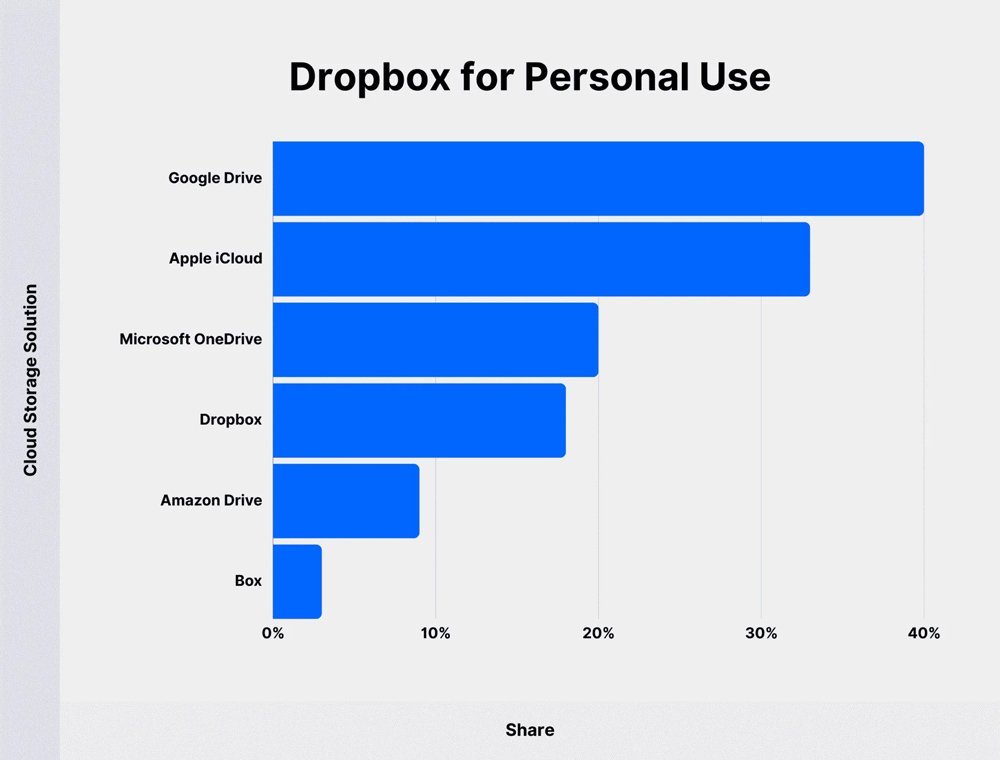
- Google Drive leads the personal cloud storage space with a 40% market share, establishing itself as the top choice among individual users.
- Apple iCloud comes in second at 33%, largely powered by its smooth integration across iOS and Mac devices.
- Microsoft OneDrive secures a solid 20% share, helped significantly by its inclusion with Microsoft 365 subscriptions.
- Dropbox represents 18%, remaining relevant even as competition intensifies from major tech players.
- Amazon Drive holds only 9% of the personal cloud storage market, indicating relatively low consumer adoption.
- Box lags with a 3% share, highlighting its primary focus on business users rather than personal use.
Full‑Time vs Part‑Time Employment at Dropbox
- As of 2025, Dropbox reports around 2,204 full‑time employees, down from 2,693 a year earlier, reflecting an 18.16% headcount drop.
- In 2022, Dropbox disclosed 3,118 full‑time employees, meaning full‑time headcount has fallen by about 29% over three years.
- Public filings list only full‑time workers, so 100% of the officially reported 3,118 employees in 2022 were categorized as full‑time.
- A LinkedIn snapshot showed 53 Dropbox roles tagged as full‑time versus just 1 as part‑time in India, a 98%+ skew toward full‑time openings.
- A 2025 workforce insight estimated 2,685 total employees, with about 650 in engineering, underscoring the focus on full‑time product and engineering roles.
- Corporate responsibility reporting notes that 98% of full‑time employees completed required training in 2024, highlighting benefits and development tied to full‑time status.
- Remote‑job boards list multiple full‑time and contract roles at Dropbox, while part‑time positions appear only as a minor category among all postings.
- A 2024 layoff of ~20% of staff (about 528 people) and a 16% cut in 2023 primarily affected full‑time roles, reshaping but not eliminating the dominant full‑time workforce model.
Permanent vs Contractual Roles at Dropbox
- As of Dec 31, 2024, Dropbox reported 2,204 permanent employees, down 18.16% from 2023, indicating core headcount is tightly managed while contractors remain undisclosed.
- Dropbox cut about 16% of its global workforce in April 2023 (~500 permanent roles), then another 20% or 528 staff in late 2024, showing significant reshaping of full‑time positions.
- Between 2022 and 2023, permanent headcount fell from 3,118 to 2,693 (a drop of 425 roles or ~13.63%), suggesting project‑based work was more likely shifted to flexible or external resourcing.
- Revenue per permanent employee at Dropbox reached about $1.15 million in 2024, implying that a lean full‑time workforce is supported by additional non‑reported contractor capacity.
- In the wider tech sector, platforms such as Gusto report roughly 1 contractor for every 5 employees, illustrating that contractors commonly make up about 20% of the blended workforce for project‑based roles.
- Research on tech labor shows Latinx workers are nearly 2× as likely and Black workers 1.5× as likely to be hired as contractors rather than permanents, underscoring structural reliance on contingent roles.
- Industry analyses describe tech contract workers as a “ghost workforce,” with large firms keeping detailed contractor counts off public filings while reporting only permanent headcount to investors.
- Studies of tech companies find contract workers are frequently segregated from permanent staff in seating and access, reinforcing that full‑time roles receive more cultural and benefit investment.
File Hosting Platform Market Share Breakdown
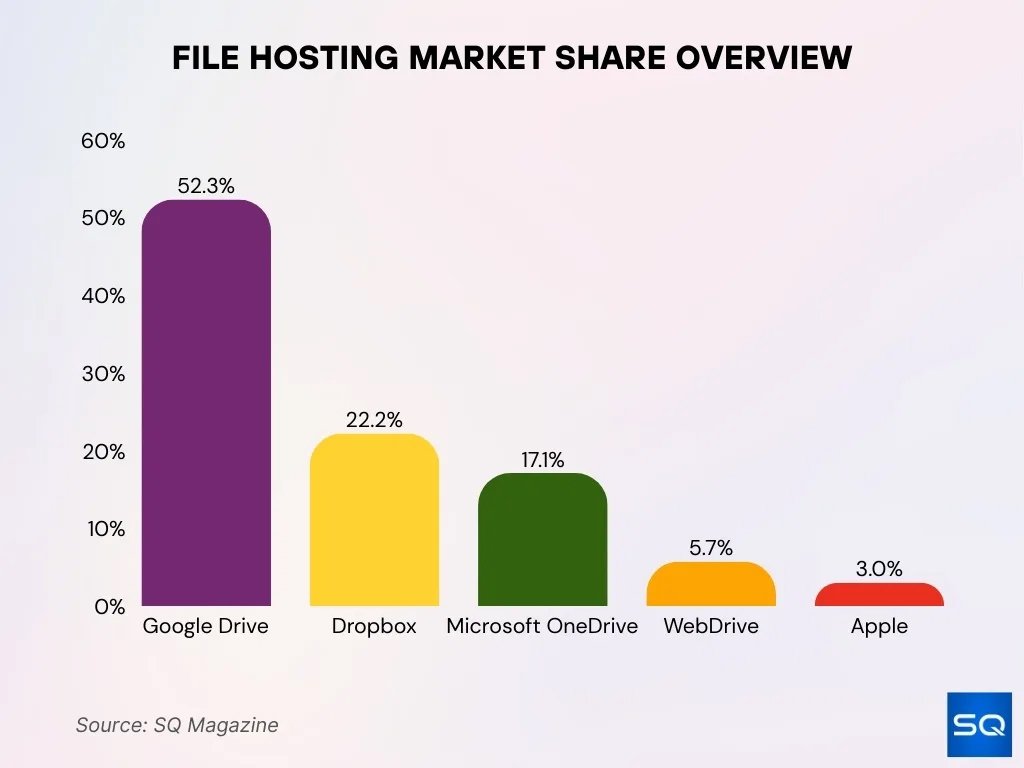
- Google Drive leads the file hosting market with a commanding 52.3% share, establishing itself as the top choice for both individual users and business organizations.
- Dropbox secures the second position with a solid 22.2% market share, demonstrating its continued relevance in secure and user-friendly file hosting solutions.
- Microsoft OneDrive captures 17.1% of the total market, driven by its seamless integration with Office 365 and strong enterprise-focused solutions.
- WebDrive maintains a niche presence with 5.7%, commonly adopted in specialized enterprise environments and for remote server mapping use cases.
- Apple’s iCloud accounts for 3.0% of the market, highlighting its limited role in broader file hosting services outside the Apple ecosystem.
Diversity and Inclusion Metrics at Dropbox
- Women represent 44% of overall employees at Dropbox, up from around 39% in earlier diversity disclosures, reflecting gradual gender balance improvements over time.
- Women hold 54% of non‑tech roles and 43% of manager positions at Dropbox, but only 39% of tech jobs, highlighting ongoing gaps in technical representation.
- In Dropbox leadership, around 28% of roles are held by women, indicating progress from earlier reports where roughly 21% of senior leaders were female in 2015.
- Approximately 37% of Dropbox employees at level L4 and above are women, while only 18.5% of senior tech roles are held by women, underscoring under‑representation in higher‑level technical positions.
- As of 2024, Dropbox employs about 2,204 people globally, down 18.16% year‑over‑year, with diversity initiatives continuing amid a leaner, Virtual First‑oriented workforce.
- After adopting its Virtual First remote model, Dropbox saw a threefold increase in job applicants and a 16% increase in diverse candidates, expanding access to talent across more regions.
- Internal surveys show roughly 70% of Dropbox employees feel more effective working remotely and 76% report more uninterrupted work time, supporting an inclusive, flexibility‑driven culture.
- Around 70% of Dropbox staff have adopted modified work schedules under Virtual First, linking flexible arrangements to better inclusion for employees with varied backgrounds and needs.
- Employee feedback indicates that about 71% of Dropbox workers report stronger team connections after intentional in‑person gatherings, reinforcing belonging within a distributed, diverse workforce.
Attrition and Turnover Rates at Dropbox
- Dropbox’s headcount fell from 3,118 employees in 2022 to 2,693 in 2023, a drop of 425 roles (~13.6% decrease) linked to restructuring.
- April 2023 layoffs cut ~16% of Dropbox’s workforce, eliminating about 500 positions during a major strategy and skills shift.
- In October 2024, Dropbox announced additional layoffs of ~20% of staff (528 employees) as part of further organizational simplification.
- Following the rollout of Virtual First and retreats, Dropbox’s previously record‑high attrition fell to the lowest level in company history, while engagement scores rose 12% from 2020–2022.
- In an internal survey, 78% of Dropbox employees using the asynchronous Virtual First model reported feeling more productive, supporting improved retention outcomes.
- One Dropbox case study reported that 71% of employees felt stronger team connections after in‑person gatherings within the Virtual First framework.
- Broader research indicates that companies that allow remote work can experience up to 25% lower employee turnover rates compared to office-only organizations.
- Large‑scale studies indicate that remote work can reduce job turnover by as much as 35% due to higher job satisfaction.
- Economists have found that increased remote work is associated with lower job turnover, which helps firms reduce hiring and recruiting costs.
- As of 2025, detailed formal attrition percentages for Dropbox are not publicly disclosed, with only headcount and layoff figures available in filings and reports.
Frequently Asked Questions (FAQs)
Dropbox had 2,204 employees worldwide as of December 31, 2024, a decline of 489 from the previous year.
Dropbox’s employee count decreased by 18.16% from 2023 to 2024.
In October 2024, Dropbox cut about 528 employees, which amounted to roughly 20% of its workforce at the time.
Dropbox’s headcount dropped from 3,118 in 2022 to 2,204 in 2024, a reduction of 914 employees over two years.
Conclusion
Dropbox continues to navigate a leaner workforce with roughly 2,204 employees, reflecting strategic shifts in operations, remote work priorities, and organizational realignment. While the emphasis on Virtual First work has reshaped recruiting and retention, structural changes have also brought turnover pressures and evolving roles across departments. Permanent full‑time roles remain the backbone of the company, with support and leadership functions adapting to a broad geographic distribution.
As remote work and flexible models remain central to Dropbox’s identity, diversity data trends and attrition effects warrant ongoing attention from industry watchers and HR leaders alike, highlighting how workforce strategy continues to shape outcomes at this established cloud services provider.