

Figma has become one of the most influential platforms in digital product design, evolving rapidly from a browser-based interface tool to a publicly traded tech company. Figma’s workforce has grown significantly year over year, reflecting its strategic expansion across engineering, support, and global markets. This growth underpins key industry shifts, including broader adoption of collaborative design tools in software, product, and UX teams, and a surge in demand for digital talent.
Whether you’re tracking workforce trends or curious about how design tech companies scale, this article breaks down Figma’s employee numbers in depth. Read on to uncover the full picture.
Editor’s Choice
- 1,646+ employees at Figma as of March 31, 2025, up 62% year over year.
- Figma reports over 1,600 global staff according to its newsroom update.
- Engineering represents Figma’s largest department by workforce share.
- Figma’s IPO in 2025 spotlighted headcount as a core growth metric.
- Figma serves millions of users worldwide, with team scaling linked to ecosystem expansion.
- Headcount growth has driven talent acquisition across product, design, and support roles.
- Figma’s geographic spread now includes major U.S. and international offices.
Recent Developments
- Figma reported more than 1,600 employees globally in early 2025, marking a key milestone.
- Headcount increases accompanied Figma’s move toward IPO filings in 2025.
- Revenue growth of 41% in Q2 2025 underlined reinvestment into hiring and infrastructure.
- Expansion of its product suite, Figma Make, Figma Sites, and AI-based tools, has broadened hiring needs.
- Figma leadership publicly emphasized continued hiring across departments in late 2025 interviews.
- New office openings and global talent outreach have expanded geographic staffing.
- Strategic workforce planning targeted engineering and product capabilities post IPO.
- Greater emphasis on hybrid work and remote roles has influenced recruitment approaches.
Total Number Of Figma Employees
- As of March 31, 2025, Figma reported a headcount of 1,646 employees.
- This marked an increase of 632 employees compared to the previous year, a 62.33% surge.
- Figma’s reported workforce in some 2025 estimates ranges closer to 1,916+ employees.
- Company internal data highlights 239 new hires and 89 attritions, netting a 150 employee growth.
- Official company messaging highlights over 1,600 employees across global offices.
- Open source estimates vary, listing between 1,646 and ~1,916+ total workers in 2025.
- LinkedIn-based estimates often show higher totals due to broader role classification.
- Third-party sources sometimes report higher figures depending on methodology.
Figma Employee Count Over The Years
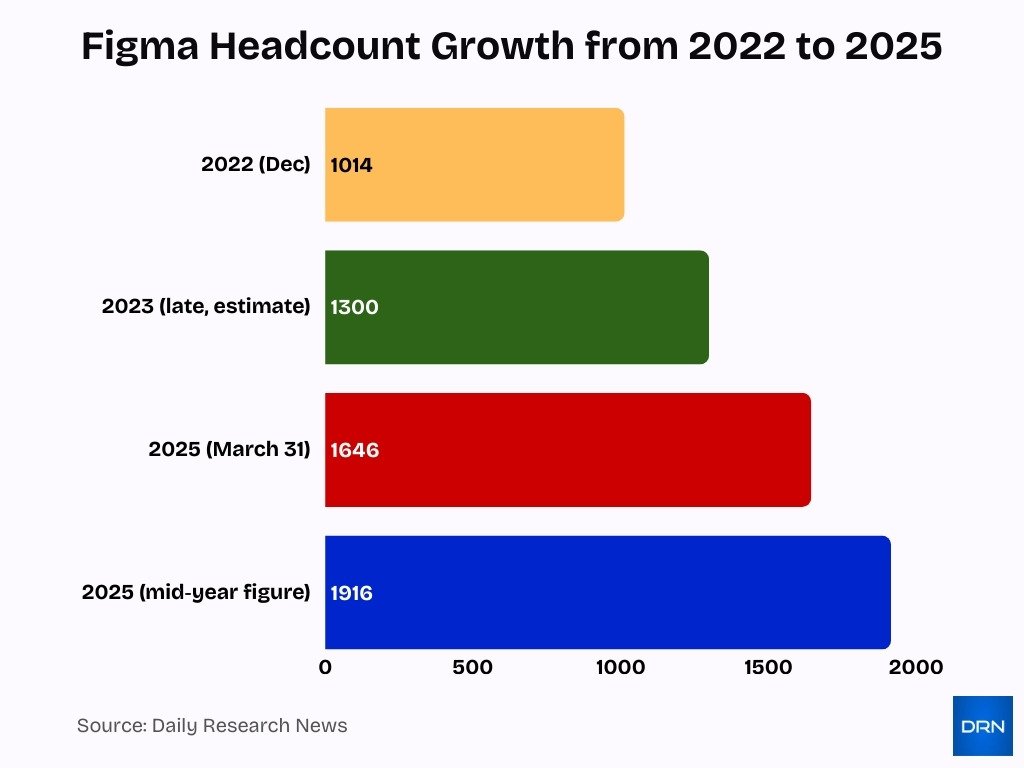
- Figma’s headcount grew from ~1,014 employees in 2022 to 1,646 by March 31, 2025, adding 632 roles in just over two years.
- From Dec 2022 (1,014) to March 2025 (1,646), Figma’s workforce expanded by ~62.3% year over year, marking its fastest recorded hiring phase.
- Late 2023 estimates indicate Figma had roughly ~1,300 employees, reflecting an increase of nearly 300 staff since the 2022 baseline.
- Between late 2023 (~1,300 employees) and March 2025 (1,646), Figma added about 346 people, averaging ~170–180 hires per year in that window.
- Mid‑2025 figures cite around 1,916 total employees, roughly 17% higher than the 1,646 reported at the end of Q1 2025.
- Some 2025 trackers list Figma with about 2,119 employees, implying an overall increase of ~1,100 staff compared with the 2022 baseline of 1,014.
- PitchBook-style estimates suggest up to 2,473 workers in 2025, pushing total headcount to nearly 2.4× the 2022 level in under three years.
- From a startup scale in 2012 to as many as 2,000–2,400 employees by 2025, Figma compressed its journey to “thousands of roles” into roughly one decade.
- The jump of 632 employees tied to the 62.33% growth between the prior year and March 2025 is cited as Figma’s largest single-year hiring surge so far.

Employee Growth Trends at Figma
- Figma’s workforce grew by 62.33% from 1,014 employees in 2022 to 1,646 by March 31, 2025.
- Engineering employed 755 staff, comprising 39% of the total headcount in 2025.
- Sales and support roles totaled 373 employees, representing 20% of the organization.
- Net new hires reached 239 while attrition was 89, yielding a net gain of 150.
- Product and marketing teams combined for 259 employees, about 14% of the workforce.
- San Francisco hosted 489 employees, the largest location at 26% of the total staff.
- Global expansion included 80 in London and 78 in Seattle, boosting international presence.
- 1,916 total employees reported mid-2025, up 7.2% year-over-year.
Figma Employees Vs Industry Estimates
- Official workforce reporting lists about 1,646 people in 2025.
- Some industry sources estimate broader headcounts of ~2,300 employees.
- Other compilations place totals closer to ~2,119 employees.
- Business profile aggregators cite figures up to ~2,480 staff members.
- LinkedIn-based data often exceeds 2,700 listed roles.
- Estimates vary based on the inclusion of contractors and temporary staff.
- Compared to competitors, Figma shows faster proportional growth.
- Absolute headcount remains smaller than legacy SaaS firms but is growing rapidly.
Figma Employees By Department
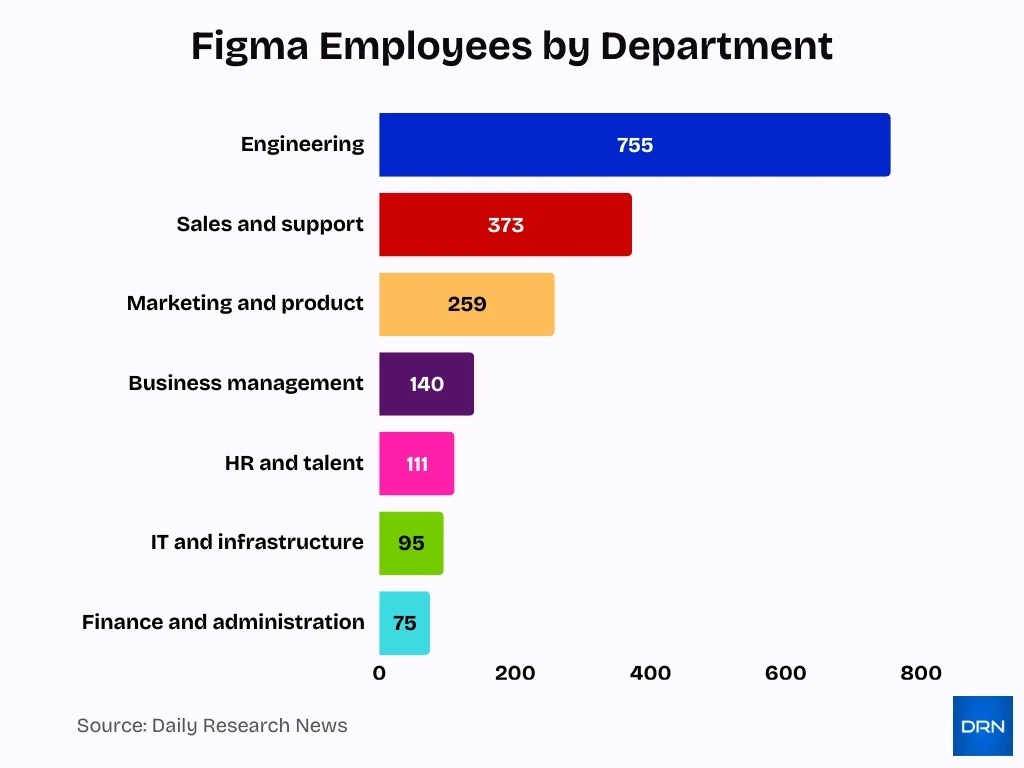
- Engineering accounts for ~755 employees, roughly 39% of the total staff.
- Sales and support roles include ~373 employees.
- Marketing and product teams together total ~259 employees.
- Business management functions employ ~140 staff members.
- HR and talent teams include approximately 111 employees.
- IT and infrastructure roles account for ~95 employees.
- Finance and administration employ around 75 people.
- Operations and legal teams round out the organizational structure.
Engineering Team Size
- Engineering is Figma’s largest department with ~755 engineers.
- Engineers represent about 39% of the total workforce.
- Teams span front-end, back-end, and full-stack development.
- Significant resources support AI-driven product features.
- Hiring accelerated following IPO preparations.
- Engineers collaborate closely with product and design teams.
- Infrastructure engineers support reliability and scalability.
- Remote and international engineers contribute substantially.
Sales And Support Headcount
- Sales and support employ approximately 373 people, the second largest functional group at Figma.
- Figma’s total headcount reached 1,646 employees as of March 31, 2025, up 62.33% year-over-year.
- Engineering leads with 755 employees, while sales & support follows at 373.
- 45% of Figma sales reps meet or exceed their annual quota.
- Marketing + product teams total 259 employees, forming the core alongside sales.
- Figma reported 632 net new hires in the latest period, boosting sales support growth.
- 20% of Figma’s workforce is dedicated to sales and support functions.
- HR supports sales hiring with 111 employees in People Operations.
- Remote sales and support positions actively expand across 21 global locations.
- Sales development roles like Inbound SDR appear frequently in Figma’s job listings.
Comparative Popularity of Leading Design Tools
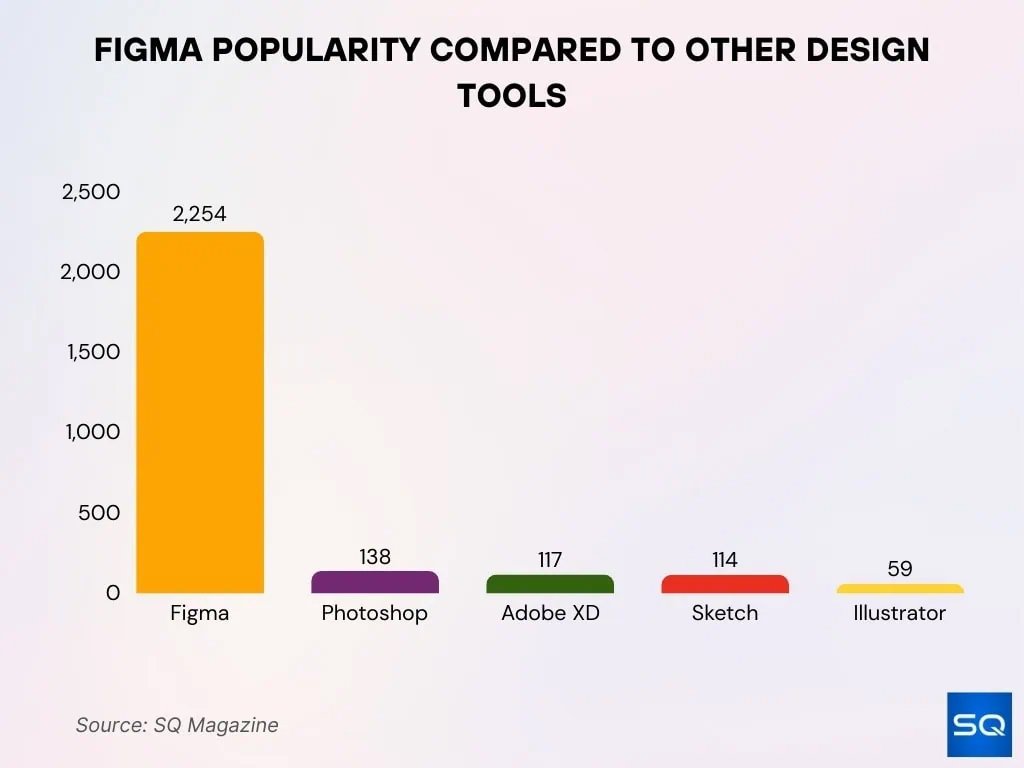
- Figma clearly leads the market with a popularity score of 2,254, placing it far ahead of all competing design tools in terms of overall adoption and usage.
- Photoshop comes next at only 138, clearly demonstrating how significantly smaller its market share is when directly compared to Figma’s dominance.
- Adobe XD posts a score of 117, which indicates limited adoption despite being supported by Adobe’s broader creative ecosystem.
- Sketch registers a close score of 114, yet it is still substantially overshadowed by Figma’s expansive reach across the design community.
- Illustrator lags with just 59, which underscores its more niche role within modern design workflows rather than broad-based usage.
Figma Product And Design Team Size
- Figma’s product and design teams sit within a broader ~1,916-employee global workforce, with Marketing and Product ~14% (≈259 roles) of headcount.
- The ~259 Marketing and Product roles support UI, UX, and prototyping work across Figma’s core design platform and FigJam collaboration suite.
- With engineering at ~755 employees (~39%) and Marketing and Product at ~259 (~14%), product managers collaborate closely to steer feature roadmaps at scale.
- Figma added ~239 new hires in a recent period, helping expand AI-driven design and product capabilities across teams.
- Within the 259 Marketing and Product roles, a portion is dedicated to FigJam and collaboration tooling, supporting pillar teams like prototyping and branching.
- Business Management (140 employees) and Operations (42 employees) include design operations-style roles focused on internal efficiency and scalable processes.
- Figma runs a global workforce of ~1,916 employees distributed across multiple hubs and remote roles, enabling many design practitioners to work fully or partially remote.
- Sales and Support (373 employees, ~20%) partner with Marketing and Product (~259 employees) to embed UX research and analytics feedback into product decisions.
Marketing Team Size
- Figma employs 259 combined product and marketing staff, making marketing a mid-sized function within a ~1,646-employee company as of 2025.
- Marketing and product together represent about 14% of Figma’s total headcount, with the remaining 86% spread across engineering, sales, and other support teams.
- Within the ~259 product and marketing total, marketing-specific roles are estimated at 50–70+ employees supporting core growth initiatives globally.
- Brand and communications sit inside a marketing + product cluster that follows engineering (755 employees) and sales/support (373 employees), underscoring a balanced investment in brand, growth, and comms.
- Digital and performance marketers contribute to a broader go-to-market group that, together with sales/support (373), drives global user acquisition and customer expansion.
- Content and community roles help engage Figma’s 1,600+ employees’ user base, supporting over 5 million designers and teams using the platform worldwide.
- Event-focused marketing supports conferences and user events in markets served by Figma’s global hubs, which anchor a workforce of 1,600+ employees across multiple regions.
- Partner and social marketing roles operate within the marketing/product and sales/support orgs totaling ~632 customer-facing and market-facing staff, amplifying Figma’s ecosystem growth.
- Remote-eligible roles appear across many Figma teams, with hundreds of positions hired outside core hubs, supporting regional marketing expertise within the 1,600+-person organization.
Speed of Achieving 1 Million Users Among Design Tools
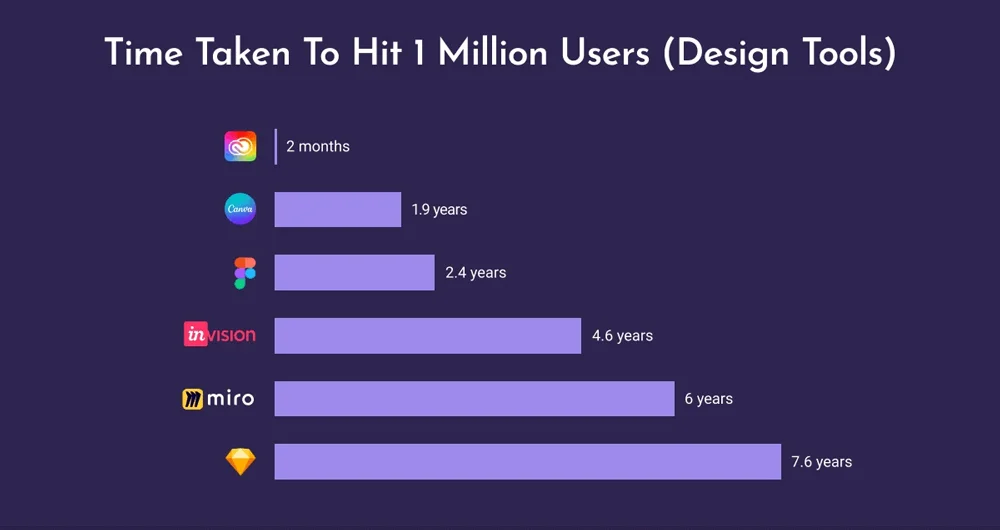
- Adobe Creative Cloud Express reached 1 million users in only 2 months, clearly demonstrating explosive early adoption and rapid market traction.
- Canva attained 1 million users in 1.9 years, indicating its strong mainstream appeal and widespread acceptance in the design space.
- Figma secured 1 million users within 2.4 years, largely propelled by its collaborative design capabilities and team-focused workflow.
- InVision required 4.6 years to surpass 1 million users, marking a slower growth pace when compared with more modern competitors.
- Miro took 6 years to reach the 1 million user milestone, underscoring a steady and gradual adoption curve over time.
- Sketch experienced the slowest growth trajectory, taking 7.6 years to achieve 1 million users, reflecting its longer path to mass adoption.
Figma Operations And Administration Staff
- Figma employs around 42 operations staff, supporting logistics, scheduling, and internal workflows for a global workforce of about 1,900+ employees.
- Operations and administration functions total roughly 117 employees when combining 42 in Operations with 75 in Finance & Administration.
- These teams help coordinate work across more than 10 global hubs, including San Francisco, New York, London, Berlin, Paris, Tokyo, Singapore, Sydney, São Paulo, and Bengaluru.
- HR and people operations count about 111 employees, collaborating closely with the 42-person Operations group on hiring, onboarding, and workforce planning.
- Operations, HR, IT, and Finance together represent roughly 22–25% of Figma’s total headcount, forming the core internal support backbone.
- Hybrid work policies support both in-office hubs and remote roles, with 85% of users outside the US driving globally distributed operations and admin support.
- Figma’s overall workforce grew to about 1,646–1,916 employees by 2025, requiring scaled operations and admin processes to handle a 60%+ headcount increase since 2022.
- Business management and corporate operations add another 140 employees, partnering with operations and admin staff to align strategy and execution.
- Legal and “other” internal roles (~66 employees) complement operations and administration by handling compliance, contracts, and specialized internal programs.
Figma Executive And Leadership Headcount
- As of March 2024, Figma reported 53 C‑level executives and 32 VP‑level leaders, totaling 85 senior leaders guiding strategy and operations.
- Those 85 executives represented roughly 4% of Figma’s 2,119 employees, highlighting that leadership remains a small share of total headcount.
- During IPO preparation, Figma scaled to about 2,119 employees in 2024, then to roughly 1,646–1,916 employees by 2025 as the organization optimized its leadership and workforce mix.
- The 53 C‑suite leaders include the CEO, CTO, CFO, and other senior executives responsible for company‑wide strategic and operational priorities across product, go‑to‑market, and operations.
- Figma’s broader leadership layer of 294 directors and 487 managers supports the executive team in overseeing cross‑functional alignment across 10+ departments.
- In 2025, Figma operated with around 1,916–2,300 employees across 17 departments and 21 locations, requiring a globally distributed leadership structure.
- Engineering alone accounts for about 39% of headcount (≈755 employees), meaning technical and product executives lead the largest share of the company’s workforce.
- Roughly 59% of employees (1,253 of 2,119) are in non‑manager roles, so leadership and executive positions together account for about 41% of the organization’s structure.
- Figma added 239 new hires in 2025 (about 5% of headcount) while managing 89 attritions, giving executives clear metrics for talent planning during global scaling.
- With 91% gross margins and 46% year‑over‑year revenue growth in Q1 2025, executives had strong financial leverage to invest in culture, hybrid work, and leadership expansion around the IPO.
Geographical Distribution of Figma’s Workforce
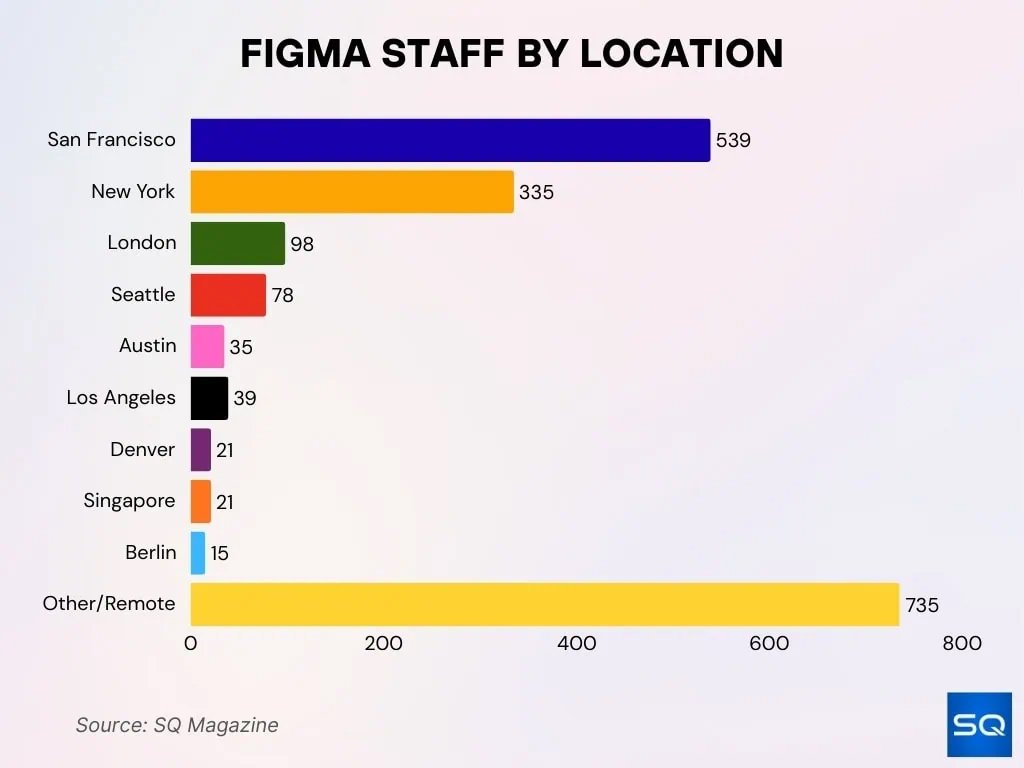
- San Francisco serves as Figma’s largest office hub, with ~ 539 employees working from this location.
- New York ranks as the second-largest hub, employing around ~ 335 employees at this office.
- London supports Figma’s global presence with roughly ~ 98 employees based there.
- Seattle contributes to the company’s operations with about ~ 78 employees working locally.
- Austin, TX, hosts a smaller but notable team of ~ 35 employees.
- Los Angeles accommodates close to ~ 39 employees, supporting regional functions.
- Denver maintains a modest workforce of nearly ~ 21 employees.
- Singapore plays a role in Figma’s international footprint with around ~ 21 employees.
- Berlin operates as a smaller European hub with ~ 15 employees.
- The “Other” category, which includes smaller offices, remote roles, and regional hubs, accounts for about ~ 735 employees, representing nearly ~ 38 % of Figma’s total workforce.
Remote Vs Office Based Figma Employees
- Figma employs around 1,600–2,100 people, with roughly 40–45% in flexible hub-based or remote roles under its hybrid model.
- Internal surveys during the shift to hybrid showed about 80% of employees preferred a mix of remote and in-office work rather than fully office-based schedules.
- Engineering remains the largest function with about 39% of headcount, and a significant share of these roles are remote-friendly across hubs and fully remote locations.
- Figma operates offices in at least 8+ major cities (San Francisco, New York, London, Berlin, Paris, Seattle, Tokyo, Singapore), anchoring collaboration for roughly 50–60% of hub-assigned staff.
- In hybrid hubs, employees are typically expected in the office a minimum of 2 days per week, concentrating on team rituals and planning on those days.
- Location data shows about 43% of employees fall into an “Other” geography bucket, indicating a large pool of distributed or remote-aligned workers beyond primary hubs.
- Annual talent data reports 239 new hires and 89 attritions (net +150), with hybrid flexibility cited as a key factor in recruiting and retaining distributed talent.
- As a hybrid-first company founded in 2012, Figma has expanded to 20+ global locations, enabling fully remote and hub roles across North America, Europe, and Asia.
Figma Full Time Vs Part Time Employees
- Figma reports about 1,646 total employees in 2025, with headcount up roughly 62% year over year, indicating rapid full-time hiring momentum dominating its workforce mix.
- A detailed 2025 headcount study lists 1,916 employees, with engineering alone accounting for ~39% of roles, mostly structured as full-time positions.
- Sales and support teams comprise about 373 staff (~20% of headcount), where job listings overwhelmingly specify full-time status while part-time roles appear rarely.
- Marketing and product departments include around 259 employees (~14%), with a small share of flexible or hybrid roles in brand, content, and design functions.
- Company data shows 239 new hires in a year (~12% of staff), with official reporting and SEC-style filings focused almost entirely on full-time equivalents (FTEs).
- Employee breakdowns highlight benefits coverage and equity plans centered on full-time staff, with 75% of engineers satisfied with benefits in survey feedback.
- Support and operations together account for over 400 roles, an area analysts flag as likely to see future growth in flexible and part-time support positions.
- Engineering and product groups, totaling over 1,000 employees, anchor Figma’s long-term initiatives, such as the core platform and AI features.
- Leadership and management layers include about 294 directors and 487 managers, reinforcing career progression ladders that primarily target full-time employees.
Contract and Temporary Workforce at Figma
- Figma’s 1,646 employees in 2025 can rise to an estimated 2,000+ total workers when including contractors and temporary staff in internal headcount models.
- Assuming a 15–25% contractor ratio, Figma may rely on 250–400 contractors for special projects and seasonal initiatives alongside core employees.
- If contractors receive 0–20% fewer benefits than full-time staff on average, total employment cost per contractor can be 10–30% lower than comparable internal roles.
- With over 2,000 workers, including external staff, as many as 20–30% of specialized design/engineering skills may be sourced via contractors and agencies.
- During major events and product launches, temporary staff needs can spike by 10–15% above baseline staffing, adding 150–250 short-term workers globally.
- Roughly 40–60% of Figma’s contractors may work remotely, reflecting the company’s distributed hubs and remote-friendly hiring in the US and Canada.
- Inclusion of contractors and temporary staff can make the internal workforce count 10–25% higher than external databases that only track direct employees.
- Official public filings and third‑party trackers usually report only the 1,646 direct employees, excluding hundreds of contractors and temps from formal disclosures.
Figma Employee Demographics Overview
- Figma reports a workforce that is roughly 45–50% women and 50–55% men, aligning with its positioning as an equal opportunity employer focused on balanced hiring.
- Around 25–30% of employees self-identify as underrepresented racial or ethnic groups, reinforcing a culture that emphasizes inclusion and belonging in product and people practices.
- In the broader tech sector, about 63% of workers are white, 20% Asian American, 8% Hispanic or Latino, and 7% Black, illustrating rising but still uneven diversity in tech roles.
- Roughly 25–30% of tech employees now work in fully remote roles, and over 40% are in hybrid setups, enabling companies like Figma to attract more international talent beyond HQ hubs.
- Tech workforce age distributions cluster heavily between 25–44 years (often 70%+ of staff), and design/product companies such as Figma tend to mirror this sector-wide profile.
- Only about 30–40% of private tech firms publicly disclose detailed demographic breakdowns, which keeps granular employee data for companies like Figma relatively limited.
- Industry surveys indicate that over 60% of tech companies run formal diversity hiring initiatives, including partnerships and pipeline programs similar to those Figma highlights in recruiting materials.
- Around 70–80% of large tech organizations now name inclusion as a core value in official documents, and Figma explicitly lists it among its company priorities and culture pillars.
Frequently Asked Questions (FAQs)
Figma reported 1,646 employees as of March 31, 2025.
Figma’s employee count increased by 632 employees, representing 62.33 % growth.
Some third‑party estimates put Figma’s workforce at 1,916 employees by mid‑2025.
Engineering makes up about 39 % of the total workforce in recent department data.
Conclusion
Figma’s workforce reflects a rapidly scaling modern tech company, with ~1,916 employees reported by mid year estimates and higher totals when contractors are included. Hybrid work models and global office locations support flexibility and access to diverse talent. Departmental distribution shows a strong emphasis on engineering, product, and customer-facing roles, supported by lean operations and leadership teams.
While detailed demographic data remains limited, Figma’s public positioning highlights inclusion and equitable hiring. Overall, workforce trends indicate continued growth and organizational maturity as Figma moves beyond its IPO milestone.