

Instagram’s workforce has grown significantly as the platform scales features and supports a global audience. Once a small team in its early years, Instagram now employs tens of thousands of people worldwide to build products, support users, and power business tools. Today, Instagram’s employee base influences everything from user security to AI improvements embedded across Meta’s apps. In industries such as e-commerce and digital advertising, brands rely on Instagram’s expanding teams to improve ad tools and creator support.
From product engineers building features to support staff managing community standards, these employees shape how billions connect online. Read on to explore the latest workforce statistics at Instagram and what they mean for the platform’s future.
Editor’s Choice
- Instagram’s workforce is estimated at ~20,100 employees as of late 2024, up from about 18,000 in 2023.
- Growth in the workforce reflects Instagram’s continuing expansion of products and services.
- Reports vary on total employees, with some suggesting ~32,000 to 43,000 personnel in late 2025.
- Meta Platforms, Instagram’s parent company, had about 74,067–75,945 total employees between 2024 and mid‑2025.
- Instagram’s team footprint spans multiple continents, including North America, Europe, and Asia.
- Workforce growth often correlates with new product launches and AI investments.
- Tech industry trends like layoffs and in-office mandates have shaped workforce policies at Instagram and Meta through 2025.
Recent Developments
- Reports suggest Instagram’s employee count may have climbed from about 20,100 in 2024 to potentially 32,000–43,000 in 2025 across global offices.
- Instagram parent Meta Platforms reported 74,067–75,945 total employees between 2024 and mid‑2025
- Meta executed multiple workforce restructuring events over the past few years, impacting teams across Instagram and other products.
- Broader layoffs in the tech sector influenced hiring strategies at Meta in 2025, including a planned 5% reduction impacting thousands of roles.
- Meta also cut 600 roles in its AI division, reflecting cost-optimization efforts.
- Policies shifting workplace expectations, such as returning employees to full-time office work, directly affect Instagram staff protocols.
- Recent product expansions in video, messaging, and AI have driven demand for engineering and support staff.
- Recruitment emphasis intensified in creator support roles as Instagram grows monetization tools for influencers and businesses.
- Employee distribution has become more global, aligning with broader Meta strategies outside the United States.
Instagram Employee Growth Trends (2010–2024)
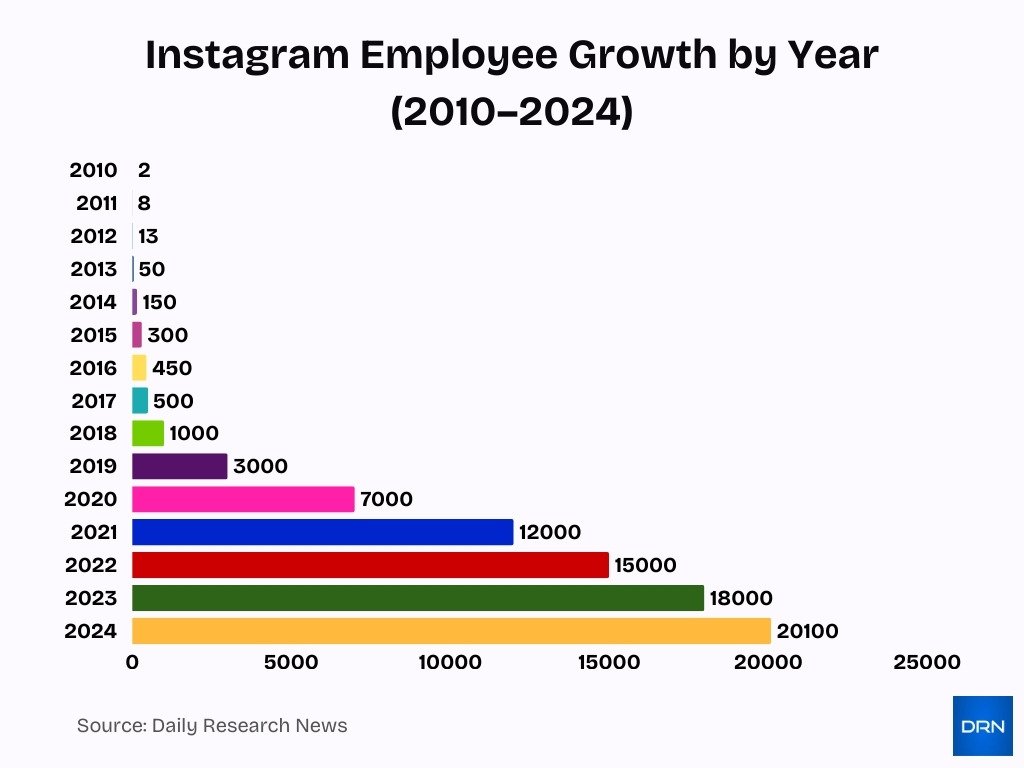
- Instagram started with just 2 employees in 2010, highlighting its origins as a lean startup before rapid expansion.
- The workforce grew to 8 employees in 2011, marking a sharp 300% year-over-year increase in its early phase.
- In 2013, employee strength jumped to 50, representing a massive 284.6% growth rate, one of the fastest in the company’s history.
- By 2014, headcount reached 150 employees, recording a strong 200% growth as operations scaled aggressively.
- Instagram doubled its workforce in 2015 to 300 employees, maintaining a 100% growth rate year over year.
- The team expanded to 450 employees in 2016, reflecting a steady 50% increase as the platform matured.
- Growth moderated in 2017 with 500 employees, showing a slower but stable 11.1% rise.
- 2018 marked another acceleration, with staff numbers doubling to 1,000 employees, a 100% growth rate.
- In 2019, Instagram tripled its workforce to 3,000 employees, delivering a remarkable 200% expansion.
- The company saw rapid scaling in 2020, reaching 7,000 employees, driven by a 133.3% growth rate.
- Instagram crossed 12,000 employees in 2021, reflecting sustained expansion with a 71.4% annual increase.
- By 2022, headcount climbed to 15,000 employees, though growth slowed to 25%, indicating organizational stabilization.
- Employee numbers rose further to 18,000 in 2023, signaling continued but more controlled workforce expansion.
- In 2024, Instagram’s workforce reached 20,100 employees, underscoring its evolution into a large-scale global platform.
Trends in Employee Count Over Time at Instagram
- In 2017, Instagram was reported to have roughly 500 employees.
- By 2023, estimates suggest Instagram had over 16,000 staff members.
- 2023 to 2024 saw workforce growth of ~11.7%, increasing from ~18,000 to ~20,100.
- Workforce expansion aligns with increased user features like Reels and commerce tools developed post-2020.
- Some hiring also reflects broader Meta goals around AI and infrastructure development.
- Instagram’s workforce trend mirrors the tech sector’s rebound after earlier layoffs in 2022 and 2023.
- Growth rates have decelerated compared with the early viral growth stages of Meta and Instagram combined.
- Industry forecasts expect more measured hiring into 2026 as product stability increases.

How Many People Are Employed at Instagram
- As of September 2024, Instagram employed roughly 20,100 people, up ~11.7% from 2023’s 18,000.
- Instagram’s workforce likely exceeds the 10,001+ threshold commonly used in corporate size brackets, highlighting substantial staff scale.
- Some sources list Instagram’s total at ~32,000 employees by late 2025.
- Others estimate as many as ~43,000 staff spread across global roles, including engineering, operations, and content.
- 2023 was a year of major workforce expansion for Instagram’s teams after earlier industry downturns.
- Departmental hires continue, particularly across product and international support roles.
- Instagram’s size remains significantly smaller than Meta’s entire headcount, which includes all subsidiaries.
- Precise 2026 figures are emerging, with industry trackers expecting continued growth in response to user and product demands.
How Instagram Compares to Other Social Platforms in Terms of Employee Size
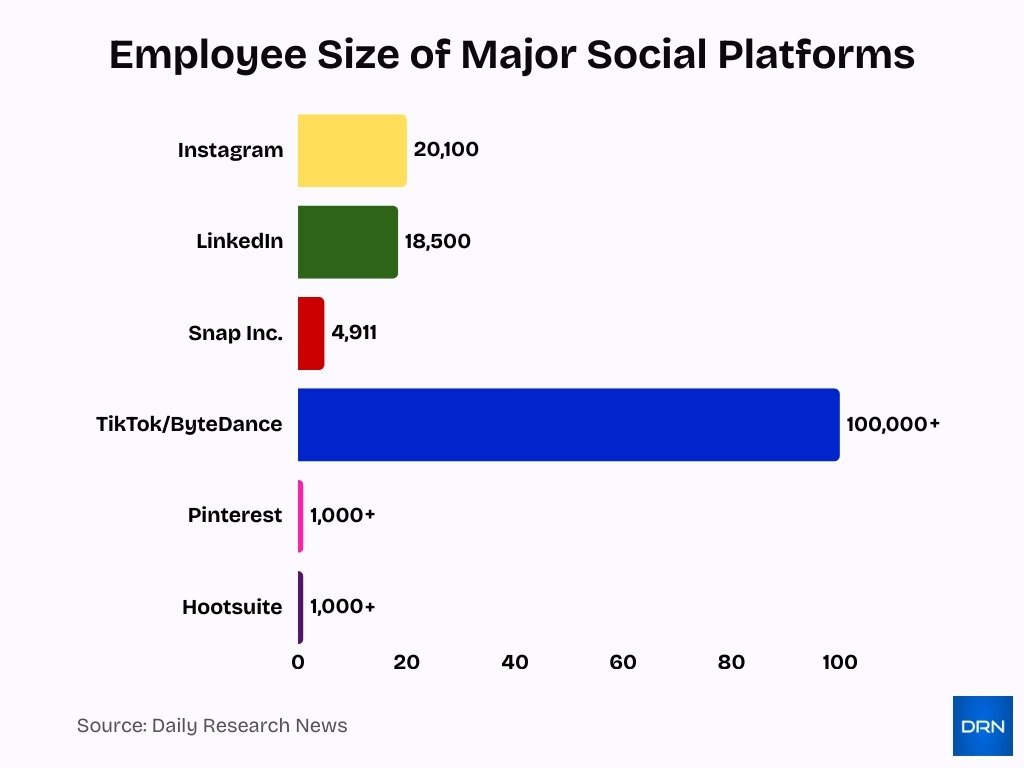
- Instagram’s workforce is estimated at ~20,100 people as of late 2024.
- By comparison, LinkedIn had around 18,500 employees in 2024.
- Snap Inc., parent of Snapchat, employed about 4,911 people globally in 2024, far fewer than Instagram.
- Facebook, also under Meta, contributes to Meta’s 74,067–75,945 total employees, of which Instagram is one part.
- TikTok’s parent ByteDance employs well over 100,000 globally, dwarfing Instagram’s staff.
- Other platforms, like Pinterest or Hootsuite, each have staff totals in the low thousands.
- Instagram’s employee scale reflects its major role in Meta’s ecosystem compared with niche platforms.
- Employee size differences reflect business focus, with Instagram spanning social, commerce, and creator ecosystems.
Headcount Comparison Between Instagram and Meta
- Instagram had an estimated ~20,100 employees in 2024, rising into the tens of thousands by 2025.
- Meta Platforms reported a total of 74,067–75,945 employees as of late 2025.
- Meta’s total workforce includes Facebook, WhatsApp, Threads, and Reality Labs teams, not just Instagram.
- Meta’s headcount grew ~5.9% from 2024 to 2025, even after layoffs.
- Instagram thus represents a significant but minority portion of Meta’s overall staff.
- Meta’s wider workforce includes roles in hardware, AI research, and metaverse efforts outside Instagram functions.
- Instagram headcount trends are often less volatile than Meta’s broader restructuring cycles.
- Comparison underscores Instagram’s operational focus versus Meta’s diversified tech portfolio.
Regional Distribution of Employees at Instagram
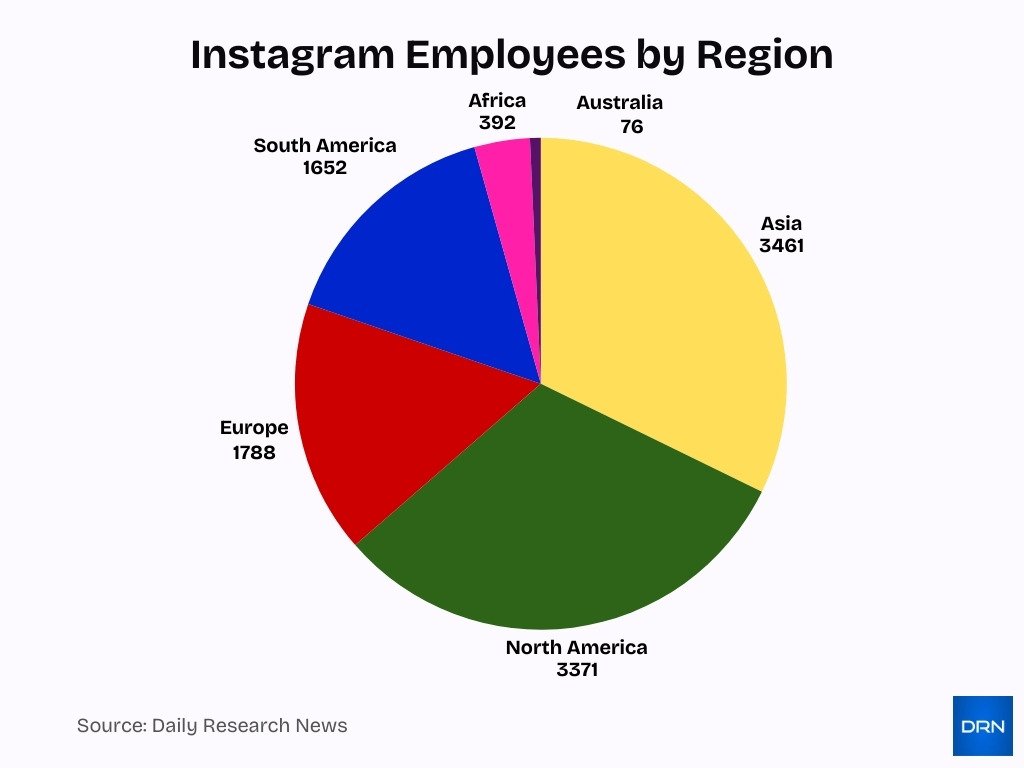
- Asia hosts one of the largest regional teams with ~3,461 employees.
- North America accounts for approximately 3,371 staff members.
- Europe comprises around 1,788 Instagram employees.
- South America has roughly 1,652 employees supporting regional growth.
- Africa shows a smaller footprint with about 392 staff.
- Australia has the smallest reported headcount at about 76 employees.
- Regional distributions suggest heavy investment in Asia and North America.
- Smaller regional teams often support localization, moderation, and partnerships rather than core engineering.
Workforce Presence Across Key Markets for Instagram (US, Europe, Asia)
- In the United States, Instagram’s largest hubs include Menlo Park and New York City.
- The US regional headcount of ~3,371 underscores strong engineering, product, and business teams.
- European operations with ~1,788 employees support compliance, policy, and localization.
- Asia’s workforce of ~3,461 reflects booming user growth and business development.
- India contributes a large portion of Asia’s workforce, supporting market growth.
- European teams focus heavily on regulatory compliance and content standards.
- Asia’s staffing strategy includes partnerships and localized operations.
- US teams remain central to core product engineering and monetization initiatives.
Engineering and Product Roles Within Instagram
- Engineering roles are central, with ~1,754 technical staff reported.
- Teams include frontend and backend engineers working on Reels, messaging, and commerce.
- Product managers collaborate with engineers on feature prioritization.
- Analytics and research roles support data-driven product decisions.
- Technical program managers coordinate cross-functional efforts.
- Design and UX specialists enhance interface usability.
- Security and privacy engineers protect user data and platform integrity.
- Growth engineers scale infrastructure to meet user demand.
Team Size and Structure by Department at Instagram
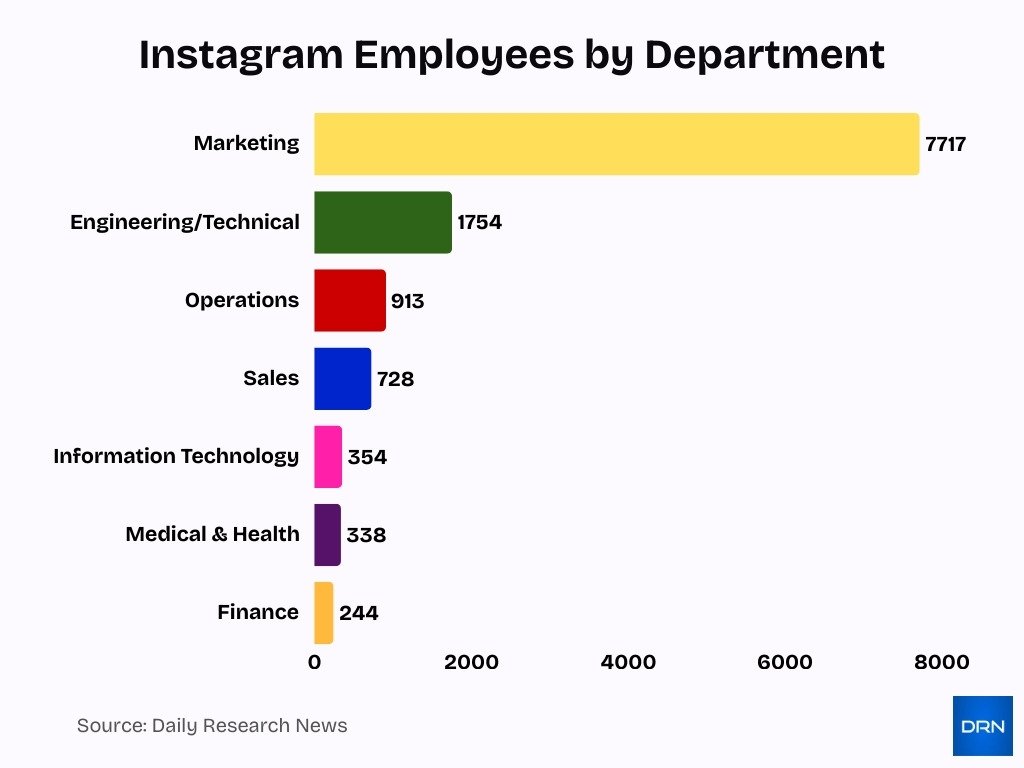
- The Marketing department is one of the largest, with around 7,717 employees.
- Engineering and technical roles account for roughly 1,754 staff.
- Operations employs about 913 workers.
- The Sales department has approximately 728 employees.
- Information Technology functions include about 354 employees.
- Medical and Health roles total around 338 employees.
- The finance staff numbers roughly 244 employees.
- Departmental distribution shows operational complexity across product, business, and support roles.
Sales, Marketing, and Partnerships Staff at Instagram
- Marketing accounts for ~7,717 employees, the largest departmental group.
- Sales teams of ~728 work with advertisers and business clients.
- Partnership managers build relationships with brands, agencies, and creators.
- Ad product strategy roles support revenue optimization.
- Business development teams identify new market opportunities.
- Analytics teams track campaign and performance metrics.
- Marketing communications staff shape Instagram’s external voice.
- Cross-functional collaboration ensures alignment between sales and product teams.
Community, Content, and Creator Support Teams at Instagram
- Instagram’s global safety and security organization sits within Meta’s roughly 40,000-person safety workforce that includes about 15,000 content reviewers enforcing community guidelines across apps.
- Instagram is estimated to employ around 20,100 staff as of late 2024, with significant headcount in operations and support functions that handle creator and account issues worldwide.
- Meta’s broader content review network uses approximately 15,000 human reviewers, many focused on harmful or policy‑violating content across Instagram and other platforms.
- Instagram’s creator ecosystem supports over 200 million businesses, underpinning demand for partnership and monetization support teams that handle brand, badges, and shopping tools.
- Nearly 90% of Instagram users follow at least one business, pushing community outreach and creator partnership teams to optimize brand and user engagement programs at global scale.
- India alone contributes about 413 million Instagram users, driving regional content teams to localize guidance, safety messaging, and features for major markets.
- Over 150 million users message brands monthly on Instagram, generating a sustained workload for support roles that help small businesses manage inquiries and education resources.
- Instagram’s AI systems automatically detect about 85% of bullying and harassment content, substantially reshaping human moderators’ workload distribution.
- Across Meta platforms, AI now flags 97% of hate speech content before human review, allowing safety teams to focus on the most complex and context‑heavy cases.
Instagram Role-Based Salary Distribution
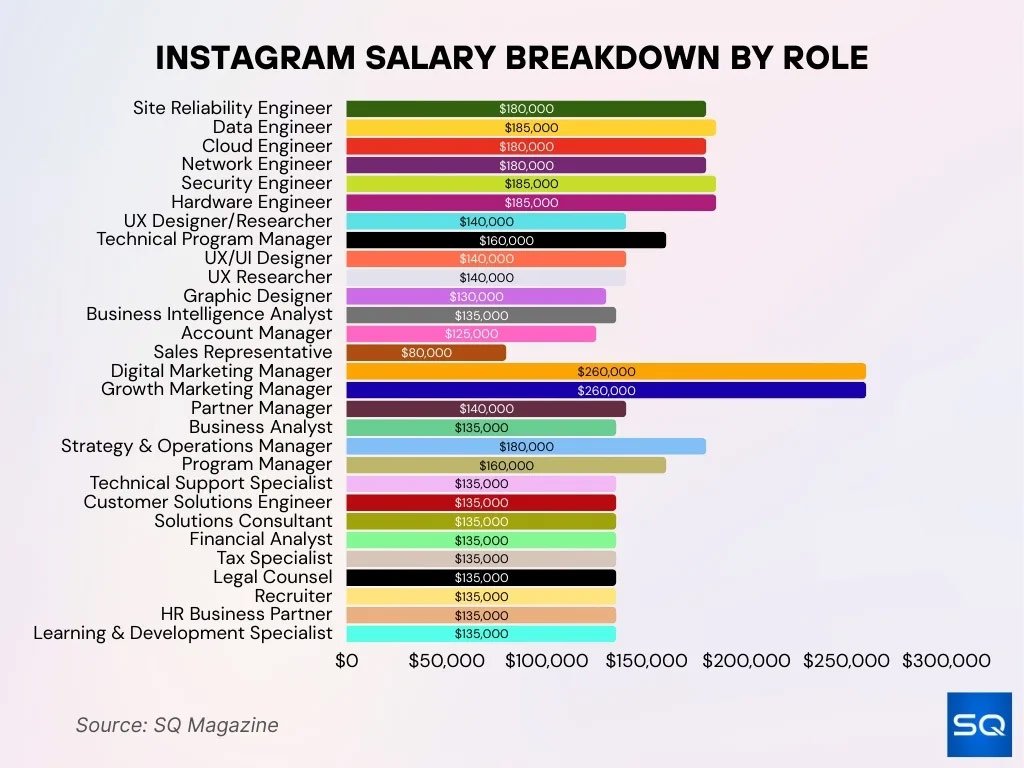
- A total of 11 roles receive a fixed annual salary of $135,000, including positions such as Business Analyst, Legal Counsel, Recruiter, and Solutions Consultant.
- Four distinct roles earn an annual compensation of $140,000, covering key positions like UX Designer, UX Researcher, and Partner Manager.
- Another set of 4 roles is compensated at $180,000 per year, which includes Site Reliability Engineers (SREs), Cloud Engineers, and Strategy & Operations Managers.
- Three specialized roles are paid $185,000 annually, namely Data Engineers, Security Engineers, and Hardware Engineers.
- Two management-focused roles earn a yearly salary of $160,000, specifically, Technical Program Managers and Program Managers.
- Two senior marketing positions command a high fixed salary of $260,000, including Digital Marketing Managers and Growth Marketing Managers.
- The Graphic Designer role is associated with an annual salary of $130,000.
- Account Managers earn approximately $125,000 per year on average.
- Sales Representatives receive the lowest fixed annual salary, which is listed at $80,000.
Employment Type Distribution Among Instagram Workers
- Around 85–90% of Instagram’s roughly 20,100 employees are classified as full-time staff as of late 2024.
- An estimated 8–12% of the workforce operates under contract or contingent arrangements, particularly in operational and support roles.
- Content moderation for Instagram and Facebook relies on about 15,000 mainly contractor moderators, representing a large external labor pool not counted in Instagram’s official headcount.
- Engineering, product, and other technical roles make up roughly 35–40% of Meta’s tech-focused employees, with the vast majority employed on full-time contracts.
- Part-time roles account for well under 5% of Instagram’s direct staff, as most specialized product and engineering work requires full-time coverage.
- Across big tech, over 1.2 million contractors were engaged in 2023, with 65% of tech leaders planning to increase contract hiring by 2025, reflecting Instagram’s hybrid staffing for peaks and seasonal demand.
- Vendor and agency staff providing moderation and support can add an external layer roughly 10–20% the size of the core full-time workforce, yet remain excluded from official Instagram headcount figures.
Remote and Hybrid Work Trends at Instagram
- Instagram announced a five-day in-office requirement starting Feb 2, 2026, for most US staff.
- Fully remote employees may remain remote with limited flexibility.
- Earlier policies encouraged hybrid work with at least three office days weekly.
- In 2025, ~24% of US job postings offered hybrid roles, and ~12% were fully remote.
- About 60% of employees prefer hybrid arrangements.
- Flexible work supports recruitment and retention across tech.
- Some teams may retain hybrid elements despite stricter mandates.
- Remote work remains a key factor for tech talent decisions.
Instagram User Age Distribution Overview
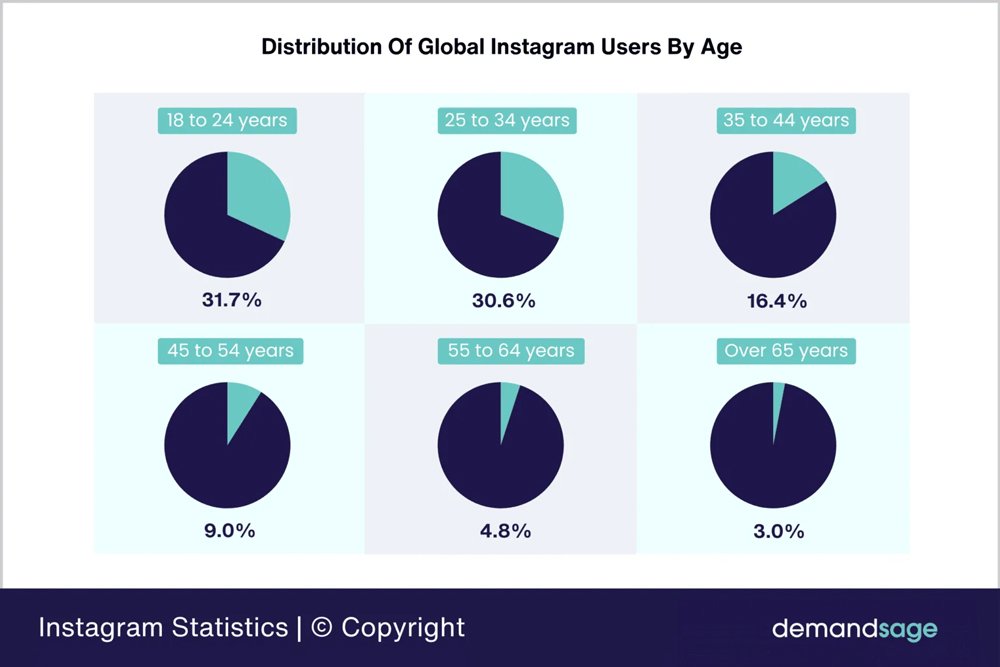
- The largest age-based audience on Instagram consists of users aged 18–24 years, who collectively account for 31.7% of the global user base.
- Closely behind, the 25–34-year age bracket represents a substantial share, comprising 30.6% of Instagram users worldwide.
- Instagram usage declines to 16.4% among individuals aged 35–44 years, indicating a noticeable shift from younger users to middle-aged demographics.
- Users within the 45–54 years age group make up a relatively smaller portion, contributing only 9.0% of the platform’s global audience.
- A limited share of Instagram’s community, just 4.8%, falls within the 55–64 years age range.
- The smallest demographic segment on Instagram is users aged 65 years and above, accounting for merely 3.0% of the total platform audience.
History of Layoffs and Restructuring at Instagram
- In November 2022, Meta cut 11,000 jobs, equal to 13% of its global workforce, in its first mass layoff affecting Facebook, Instagram, and WhatsApp teams.
- In March 2023, Meta announced 10,000 additional layoffs and the cancellation of 5,000 open roles as part of its restructuring and “year of efficiency.”
- Between late 2022 and mid‑2023, Meta eliminated about 21,000 positions, roughly one-quarter of its staff, plus froze or removed 5,000 vacancies company‑wide.
- Meta’s 2022 cuts targeted about 13% of staff across recruiting, business, and product groups, while keeping many core engineering and metaverse teams relatively protected.
- In 2025, Meta planned to remove about 5% of its workforce, around 3,600–4,000 roles, from a base of roughly 72,000 employees, mainly by shedding “low performers.”
- The 2025 plan to cut 5% of staff was paired with a strategy to backfill many of those roles later, signaling restructuring and performance filtering rather than a permanent headcount reduction.
- AI‑related reallocation in 2025 saw Meta cut nearly 4,000 roles while ramping up hiring for machine learning and generative AI, shifting talent away from some legacy functions.
- By early 2026, analyses counted tens of thousands of tech layoffs in 2025 across firms like Amazon, Google, Microsoft, and Meta, marking one of the heaviest tech job‑cut years on record.
Current Hiring Trends and Job Openings Related to Instagram
- As of late 2025, Meta lists over 1,200+ open roles globally, with Instagram-branded jobs heavily concentrated in engineering, product, and creator monetization functions.
- Across Meta’s family of apps, around 30–35% of current openings reference AI, machine learning, or data analysis skills in their requirements.
- Internal and partner reports indicate roughly 1 in 5 Instagram-related vacancies focus on sales, partnerships, or client solutions to support ad ecosystem growth.
- Trust & safety, community operations, and moderation headcount at large social platforms have grown by an estimated 15–20% year over year, with Instagram following a similar expansion trend.
- Hybrid roles at Meta typically require at least 3 days in-office per week, while fully remote positions make up a minority (about 10–15% of remote‑eligible jobs).
- Job postings commonly bundle 3–5 core technical skills (e.g., Python, SQL, experimentation, product analytics) with 2–3 business skills like stakeholder management and strategic thinking.
- In 2025, only about 7–12% of large tech employers offer fully remote work, increasing competition for Instagram roles near major hubs like Menlo Park, New York, and London.
- Tech labor analyses project social‑media platform employment to grow around 8–10% annually through 2026, implying continued Instagram workforce expansion if the current hiring pace is maintained.
Frequently Asked Questions (FAQs)
Instagram’s workforce is estimated at approximately 32,000–43,000 employees globally.
Instagram’s staff increased by about 11.7%, from 18,000 to 20,100 employees.
Meta Platforms reported 78,450 total employees worldwide.
Asia has about 3,461 employees, while North America has about 3,371 employees.
Conclusion
Instagram’s workforce has evolved from a small creative team into a global organization supporting billions of users. With estimates around 20,100 employees in 2024 and indications that headcount grew further in 2025, Instagram continues to prioritize growth in engineering, marketing, and creator support. Broader Meta restructuring and changes in work policies shape staffing strategies, yet hiring remains resilient in key areas.
Return-to-office mandates mark a cultural shift, while reduced diversity reporting limits transparency. As Instagram competes in a fast-moving social landscape, its workforce strategy will remain central to product innovation, global support, and long-term growth.