

Meta (formerly Facebook) stands as one of the world’s largest technology employers. After a period of rapid expansion followed by strategic downsizing, the company’s workforce reflects broader trends in tech hiring, efficiency pushes, and investment in future‑facing divisions like AI. Meta’s employee data helps illustrate how the company balances global growth with structural changes.
Meta’s workforce size impacts tech labor markets, influences regional job ecosystems, and shapes how the company builds and manages platforms used by billions worldwide. Read on to explore the most current headcount figures and trends shaping Meta’s workforce in detail.
Editor’s Choice
- ~78,450 employees at Meta as of late 2025, signaling net growth compared to the prior year.
- ~74,067 workers reported in the fiscal year 2025 official filings.
- The workforce rose roughly 10% year‑over‑year from 2023 to 2024.
- Meta once peaked at 86,482 employees in 2022 before reductions.
- ~600 layoffs in Meta’s Superintelligence Labs were reported in late 2025.
- Meta announced ~5% staff cuts aimed at performance‑based efficiency in 2025.
- Meta’s AI division (Superintelligence Labs) counted ~3,000 staff in 2025.
Recent Developments
- Meta’s global employee count increased to ~78,450 by September 30, 2025, up from earlier in the year.
- In 2025, Meta laid off about 600 workers from its Superintelligence Labs (AI division).
- The company also implemented a ~5% workforce reduction targeted at underperforming staff in early 2025.
- Performance‑based cuts were reported to potentially affect ~3,600 jobs in 2025.
- Meta’s CEO cited a focus on performance management and strategic priorities for reductions.
- Despite layoffs, Meta continued hiring in key areas such as AI and global engineering.
- Meta’s Superintelligence Labs reportedly puts ~600 employees on non‑working notice to reorganize teams.
- Workforce adjustments reflect Meta’s strategic shift to leaner, tech‑focused teams.
Employee Count Overview at Meta
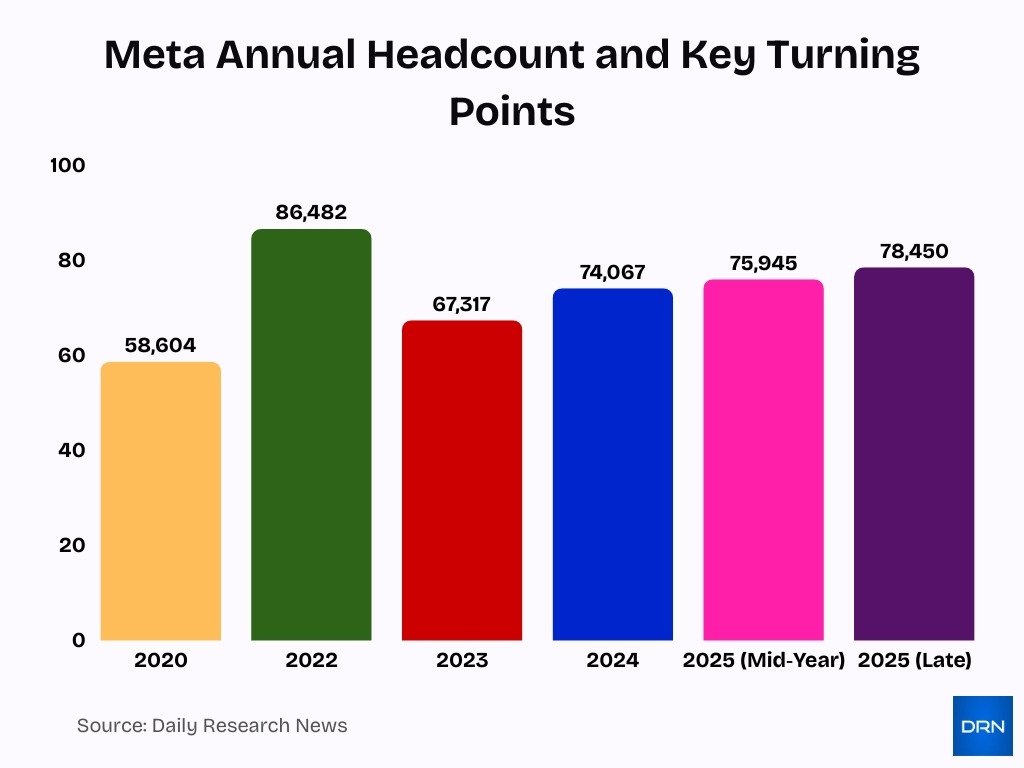
- Meta Platforms reported 67,317 employees at the end of 2023.
- By the end of 2024, the headcount rose to 74,067, a notable recovery.
- As of mid‑2025 (June 30), Meta had 75,945 employees worldwide.
- Late‑2025 data shows ~78,450 total employees, continuing upward momentum.
- Historical peak employment occurred at 86,482 in 2022 before subsequent declines.
- The workforce dipped sharply in 2023 due to mass layoffs.
- Post‑layoff recovery was measurable through 2024 and 2025 hires.
- Meta remains one of the largest tech employers globally.
Annual Headcount by Year at Meta
- 2022: 86,482 employees (peak).
- 2023: 67,317 employees after large layoffs.
- 2024: 74,067 total employees.
- 2025: ~75,945 employees at mid‑year.
- 2025 (late): ~78,450 employees reported.
- The ~10.03% increase from 2023 to 2024 shows adjustment.
- Historical growth from 2020 (~58,604) to 2022 shows rapid expansion before contraction.
- Year‑on‑year figures highlight how Meta oscillated with industry conditions.

Workforce Growth Rate at Meta
- Meta saw a +10% workforce rise from 2023 to 2024.
- From 2024 to 2025, headcount continued to be higher by ~2‑6%, depending on the reporting window.
- Peak growth occurred earlier in 2021‑22 with double‑digit percentage increases.
- Downturn between 2022 and 2023 was a sharp ‑22% decline.
- Recent growth reflects targeted hiring after restructuring.
- Quarterly growth in early 2025 indicates Meta’s renewed expansion focus.
- Workforce growth remains moderate compared with prior pandemic‑era spikes.
- Growth correlates with investment in AI and core business units.
Employee Count Before and After Major Layoffs at Meta
- Meta laid off ~11,000 employees in 2022 (13% of the workforce).
- In 2023, an additional ~10,000 jobs were cut, intensifying the contraction.
- The cumulative layoffs from 2022‑23 totaled ~21,000 jobs.
- The workforce before these layoffs was at a historical peak.
- Post‑layoff tally in 2023 fell to 67,317 employees.
- In early 2025, about 3,600 jobs were targeted in new reduction plans.
- In late 2025, ~600 positions in AI were cut or placed on notice.
- Layoff waves significantly reshaped Meta’s staffing levels and priorities.
Geographic Distribution of Meta Employees and Revenue
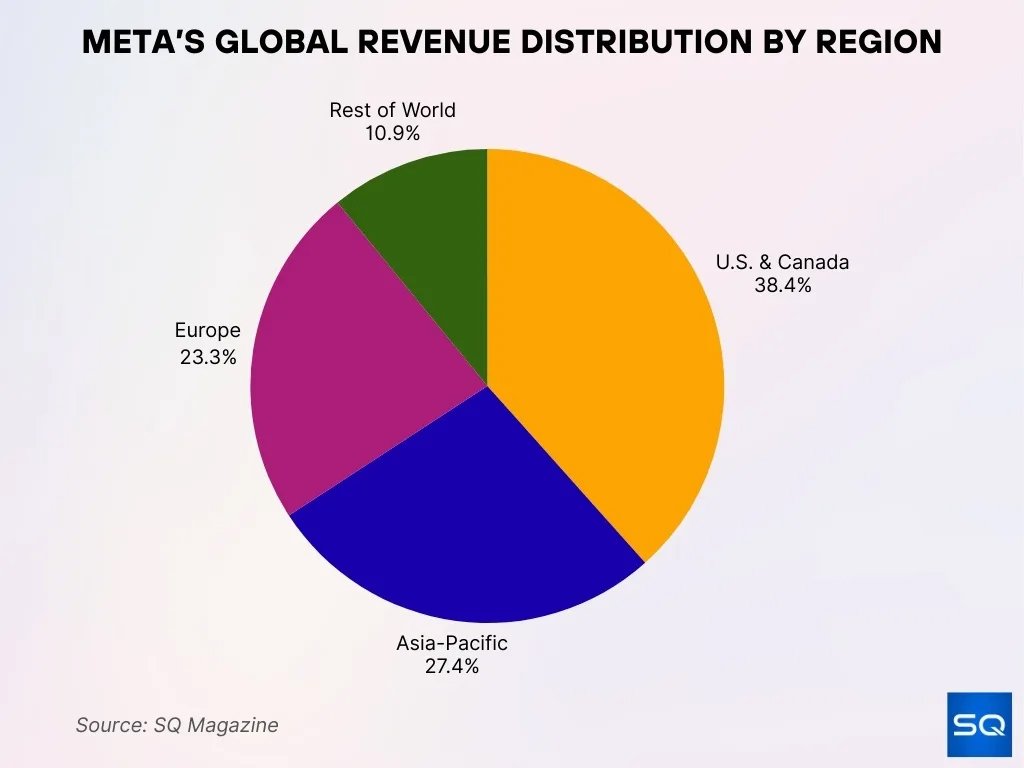
- Meta Platforms’ revenue breakdown highlights that the U.S. & Canada contribute 38.4% of total revenue, followed by Asia-Pacific at 27.4%, Europe at 23.3%, and the Rest of the World at 10.9%.
- Global revenue distribution by region aligns with workforce concentration, as North America houses the largest share of employees, while publicly available data confirms a total global headcount of 75,945 as of June 2025.
- These regional revenue shares imply a comparable employee distribution pattern, with North America leading, followed sequentially by Asia-Pacific, Europe, and finally the Rest of the World.
Workforce Recovery After Layoffs at Meta
- Workforce recovery has been steady since the steep layoffs of 2022 and 2023, with Meta reporting ~75,945 employees by June 2025.
- This figure represents a ~2.5% increase from the end of 2024.
- Meta’s headcount was ~74,067 in 2024, a 10% rise over 2023.
- The incremental gains reflect hiring in priority areas such as AI and engineering teams.
- By September 2025, total headcount was reported at 78,450, up ~5.9% year‑over‑year.
- Meta’s workforce has not yet returned to its peak of 86,482 employees (2022).
- Recovery is uneven across divisions as some units expand while others undergo restructuring.
- Ongoing hiring reflects a refined strategic focus rather than broad expansion.
Full‑Time vs Contract and Part‑Time Roles at Meta
- Meta’s official reporting focuses on full‑time employees; contractor figures are not disclosed publicly.
- Industry sources estimate that contract workers may outnumber direct employees in specific segments such as content moderation and security.
- Contract roles at Meta often include “on‑site” support like security guards, janitors, and food service staff.
- Some estimates suggest contractor counts could exceed 50% of extended workforce layers (employees + contractors).
- Contractors can perform essential but non‑core tasks, offering flexibility amid structural changes.
- Meta’s full‑time headcounts grew in mid‑2025 as direct hiring resumed strategic technical roles.
- Part‑time roles are less common in core tech functions and more typical in campus operations support.
- The contractor workforce fluctuates with project cycles, especially in moderation and operational support.
Meta Employee Ethnicity Insights
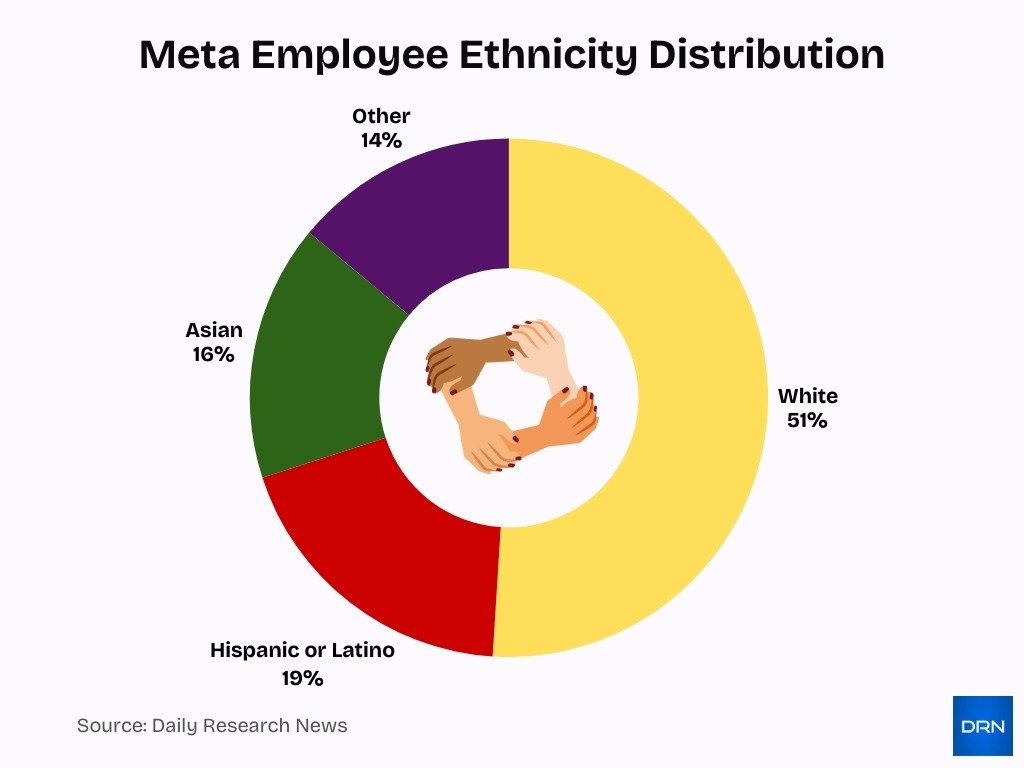
- White employees represent the largest share of the workforce at 51%, accounting for just over half of all employees.
- Hispanic or Latino employees make up 19% of the workforce, highlighting a significant presence among Meta’s diverse talent base.
- Asian employees comprise 16%, reflecting strong representation in technical and professional roles.
- Employees categorized as Other ethnicities account for 14%, underscoring broader multicultural inclusion beyond major demographic groups.
Workforce in the United States at Meta
- As of September 2025, Meta employed 78,450 people globally, with North America hosting the largest share of headcount.
- Meta reported 74,067 employees at year‑end 2024, a 10.03% increase after major U.S.-led efficiency and layoff cycles.
- Revenue from the U.S. & Canada accounted for 38.4% of Meta’s total, aligning workforce concentration in North America with its largest revenue region.
- Meta’s 2023 headcount fell to 67,317, a 22.16% drop from 86,482 in 2022, with performance-focused layoffs heavily impacting U.S. teams first.
- The median Meta employee earned about $379,000 in 2023, placing U.S. workers in the upper salary quartile of the global tech labor market.
- Across functions, Meta’s estimated average annual salary is around $140,602, with the median near $149,718, driven largely by U.S.-based tech and leadership roles.
- Women represent about 36.1% of Meta’s global workforce, while men account for 63.9%, with diversity initiatives particularly targeted at U.S. technical and leadership pipelines.
- In Meta’s U.S. workforce, leadership roles are approximately 57.6% White and 28.6% Asian, illustrating how U.S. leadership composition shapes global HR and promotion policies.
- Overall, Meta’s employee base roughly doubled between 2015 and its 2022 peak of 86,482 staff, reflecting aggressive scaling of U.S.-centric engineering and Reality Labs teams.
Employee Presence in India at Meta
- Exact India employee figures for Meta aren’t disclosed publicly, but India is a key hiring market for Meta and other FAAMNG companies.
- In 2025, big tech, including Met, hired thousands of employees in India despite tighter visa rules.
- Indian operations often focus on software engineering, product support, and business analytics roles.
- India remains an important center for content operations and localized product development.
- Tech talent from India contributes significantly to global development teams.
- Indian headcount growth mirrors broader trends in outsourcing and technical hiring.
- The expansion in India correlates with AI and cloud infrastructure roles.
- Meta’s India presence supports local product markets and international engineering projects.
Family of Apps Workforce at Meta
- As of mid‑2025, Meta employs around 75,945 people worldwide, with the vast majority supporting its Family of Apps rather than Reality Labs.
- Meta’s Family of Apps generated about $162.4 billion (≈98% of $164.5B total revenue) in 2024, underscoring how most headcount is tied to these platforms.
- In 2024, Meta had 74,067 employees, up 10.03% from 67,317 in 2023, driven largely by rebuilding engineering and operations teams for Facebook, Instagram, and WhatsApp.
- Internal diversity data shows roughly 45.9% Asian and 38.5% White employees, reflecting strong engineering and product hiring from tech hubs in the U.S., Europe, and India.
- Women make up about 36.1% of Meta’s workforce, highlighting ongoing efforts to diversify technical and non‑technical roles across its Family of Apps.
- Meta’s Family of Apps captured around 63.8% of global social media ad spend in early 2024, supporting tens of thousands of roles in ad tech, sales engineering, and business operations.
- Daily active users across the Family of Apps surpassed 3.3 billion, requiring large-scale teams in content policy, safety, and reliability engineering to keep services running.
- Advertising on Facebook, Instagram, Messenger, and WhatsApp accounts for about 98.6% of Meta’s total revenue, aligning most workforce allocation with these apps’ engineering and product needs.
Meta’s Technology Talent Role Distribution
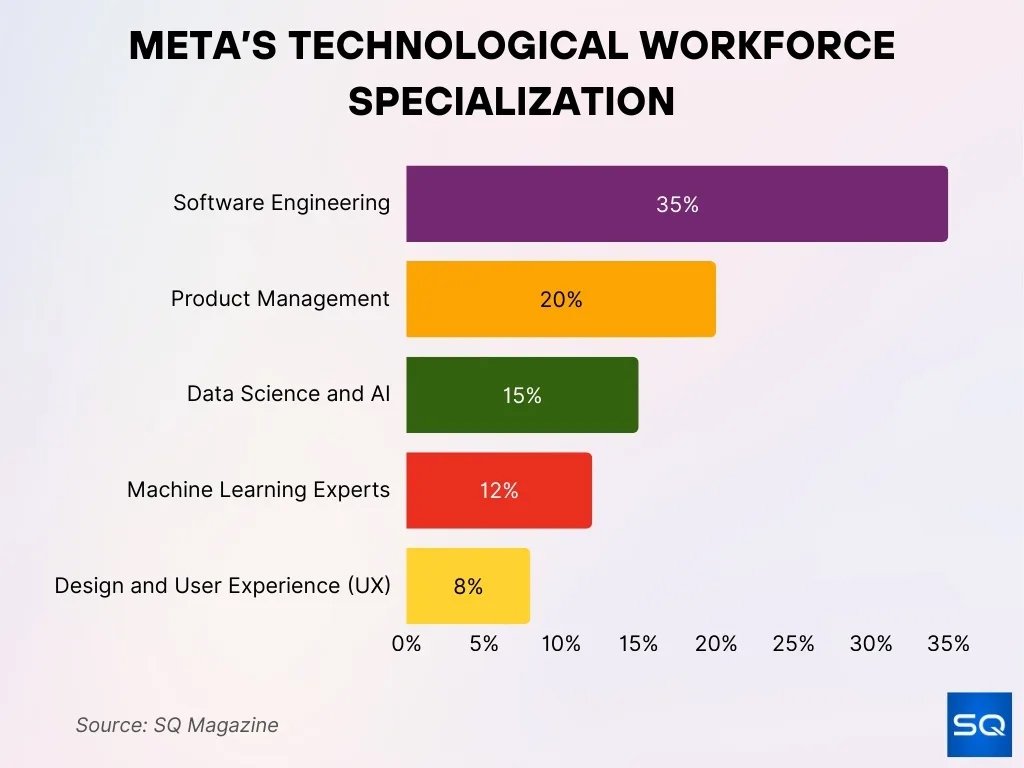
- Software Engineering leads the structure, accounting for 35% of Meta’s technology-focused workforce, highlighting its core role in product development.
- Product Management positions comprise 20%, underscoring their importance in strategic planning and development alignment.
- Data Science and AI specialists represent 15%, playing a key role in analytics, insights, and intelligent systems innovation.
- Machine Learning Experts form 12%, enabling automation, model training, and large-scale deployment.
- Design and User Experience (UX) teams contribute 8%, ensuring intuitive design, usability, and user-centric experiences.
Reality Labs and Metaverse Division at Meta
- Reality Labs achieved Q4 2025 revenue of $1.083 billion, marking its highest quarterly figure amid Quest 3S traction.
- Reality Labs reported a $4.97 billion operating loss in Q4 2024, reflecting intense AR/VR investments.
- Annual 2024 revenue grew to $2.146 billion, a 13% increase from $1.896 billion in 2023.
- Cumulative losses since 2020 surpassed $60 billion by end-2024, exceeding $70 billion by Q3 2025.
- Meta cut over 100 jobs in Reality Labs during April 2025 restructuring at Oculus Studios.
- Q3 2025 revenue jumped 74% year-over-year to $470 million, boosted by Quest and Ray-Ban glasses.
- Reality Labs headcount represents about 20% of Meta’s 74,067 total employees as of Dec 2024.
- 2024 annual losses reached $17.73 billion, up 10% from the previous year, for metaverse development.
- Quest shipped 1.1 million units in Q1 2025, leading the XR market over competitors.
AI and Machine Learning Workforce at Meta
- Meta’s Superintelligence Labs division employed roughly 3,000 people in 2025, even after about 600 AI roles were cut in a restructuring round.
- Following these changes, Meta’s broader headcount reached about 75,945 employees by mid‑2025, with AI units among the fastest‑growing technical teams.
- Meta plans to cut around 3,600 roles (about 5% of staff) to free capacity for new AI talent, while budgeting $60–65 billion in 2025 capex primarily for AI.
- Internal programs aim for at least 75% of employees to actively use AI tools by 2025, up from just over 40% reporting regular AI usage today.
- Meta expects over 60% of its workforce to complete internal AI literacy and training modules as part of its 2025 AI‑first transformation agenda.
- Beginning in 2026, “AI‑driven impact” becomes a core metric in Meta performance reviews, with employees warned that low AI use may lower appraisals.
- Meta’s AI performance assistant and review tools already push staff to log AI‑boosted productivity wins for the 2025 review cycle, ahead of formal scoring in 2026.
- Competitive hiring for top AI researchers has driven some Meta offers into the hundreds of millions of dollars range, raising overall compensation costs in 2025.
- Restructuring across FAIR and AI infrastructure cut around 600 positions but left the combined Superintelligence Labs organization at “just under 3,000” workers.
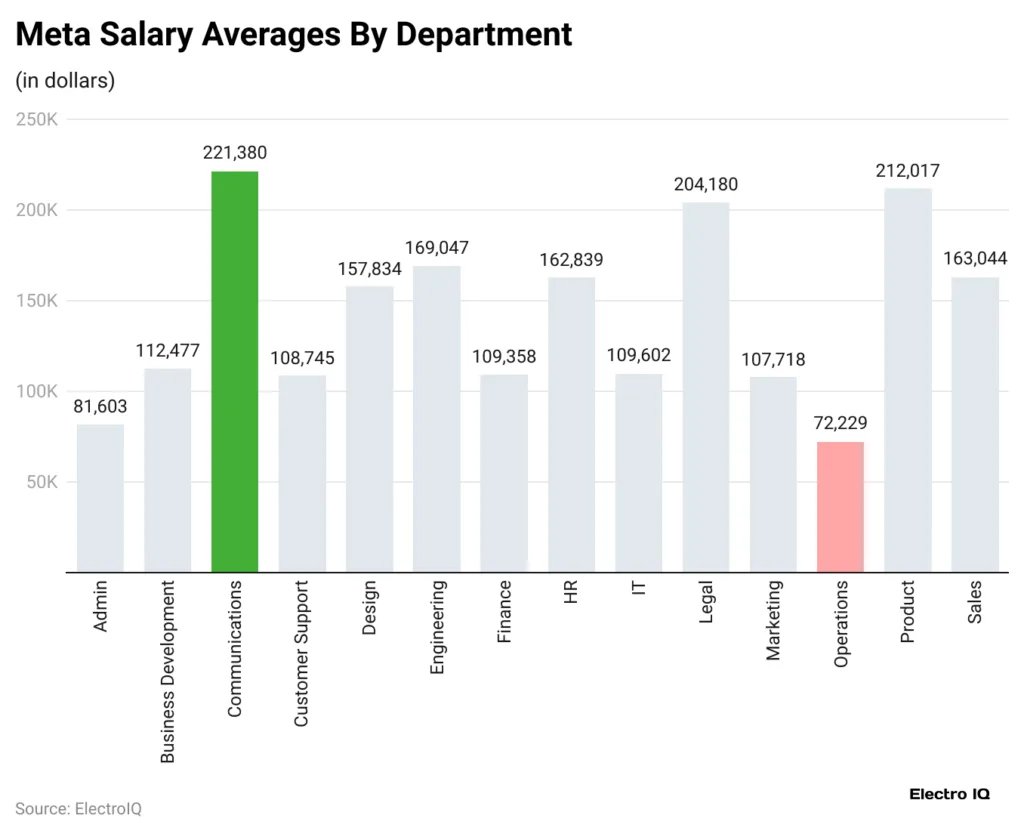
Average Salaries Across Meta Departments
- Communications roles command the highest average salary at $221,380 per year, highlighting the premium placed on corporate messaging and public relations expertise.
- The Product department comes in close behind with an average salary of $212,017, reflecting its critical role in driving platform innovation and growth.
- Legal professionals earn an average of $204,180, underscoring strong demand driven by compliance and regulatory requirements.
- Engineering roles post an average salary of $169,047, slightly above HR ($162,839) and Sales ($163,044), showing continued investment in technical talent.
- Design staff receive an average of $157,834, emphasizing the importance placed on UX/UI expertise and user-centered product development.
- Business Development averages $112,477, while Finance ($109,358) and IT ($109,602) remain closely aligned in compensation levels.
- Customer Support staff earn $108,745, with Marketing close behind at $107,718, reflecting mid-tier compensation among non-technical roles.
- Administrative positions average $81,603, signaling lower compensation compared to specialized technical departments.
- Operations roles are the lowest paid at an average of $72,229, potentially influenced by outsourcing practices or lower specialization requirements.
Gender Diversity Statistics at Meta
- Historically, Meta reported around 36% women and 64% men in its global workforce in prior diversity disclosures.
- Women made up roughly 32% of technical roles in some past reporting.
- Meta’s gender diversity reporting has been paused in 2025, reducing transparency around current figures.
- Industry analysis warns that performance evaluations tied to AI usage may inadvertently disadvantage women if biases are not addressed.
- Efforts historically sought to increase female representation in leadership, technical, and product areas.
- Without recent published data, proportional trends may be aligned with broader tech sector diversity averages (often under 40% women).
- Women contribute across functional areas, including product, marketing, operations, and HR.
- Past reports also highlighted incremental increases in underrepresented gender representation, but varied across regions.
Revenue per Employee at Meta
- Meta’s revenue per employee reached ~$2.42M in Q3 2025 with 78,450 employees.
- Meta’s 2025 cumulative revenue hit $189.5B through Q3, boosting productivity ratios.
- Apple achieved $2.41M revenue per employee in 2025, slightly above Meta.
- Alphabet (Google) generated $1.9M per employee, trailing Meta’s ad-driven efficiency.
- Microsoft reported $1.29M revenue per employee with 228,000 staff in 2025.
- NVIDIA led tech peers at $4.41M revenue per employee amid AI growth.
- Amazon lagged at $410K per employee due to a vast warehouse workforce.
- Headcount dropped to 67,317 by end-2023 before rebounding, inflating per-employee figures.
- Q3 2025 revenue surged 26% YoY to $51.2B, driving high RPE.
- Meta exceeded $160B annual revenue in 2024, setting the 2025 productivity baseline.
Frequently Asked Questions (FAQs)
Meta employs 78,450 people globally as of September 30, 2025.
Meta had 74,067 employees at the end of 2024, marking a 10% year‑over‑year increase from 2023.
Meta’s highest reported employee count was 86,482 in 2022, before workforce reductions.
Meta’s employee count increased by +6,750 (+10.03%) from 67,317 in 2023 to 74,067 in 2024.
Conclusion
Meta’s workforce reflects a balance between strategic expansion and operational refinement. After major layoffs in prior years, its headcount has stabilized and grown with renewed hiring in AI, engineering, and core platforms. Divisions like Reality Labs and Superintelligence Labs represent the company’s long‑term technological vision, even as traditional app teams remain central. Diversity and retention metrics face challenges due to reduced reporting transparency and performance‑centred policies, while productivity remains strong, underscored by high revenue per employee.
Overall, Meta’s employment dynamics offer insight into how leading tech firms adapt to market shifts, invest in critical skills, and reposition for future innovation.