

Nintendo stands as one of the most enduring names in gaming, combining hardware innovation with iconic software franchises. The company continues to balance creative output with strategic global staffing amid industry shifts. In the U.S. and worldwide, Nintendo’s workforce supports game development, hardware engineering, marketing, and distribution, impacting consoles from the Switch 2 to software titles enjoyed by millions.
Whether in software design teams in Kyoto or marketing offices in North America, Nintendo’s staffing trends influence product cycles and market reach. Explore the full article to understand the numbers behind Nintendo’s workforce today.
Editor’s Choice
- 8,205 total employees worldwide reported as of March 31, 2025, up from 7,724 in 2024.
- 5,630 permanent full-time employees globally for the fiscal year ending March 2025.
- Approximately 6.23% year over year workforce growth from 2024 to 2025.
- 455 new full-time hires were reported in the last fiscal year.
- Average employee tenure of ~14.4 years in Japan, the highest regional figure.
- A high annual retention rate of ~98% noted in Japan.
- Male to female full time employee ratio is 3,855 to 1,775 globally.
Recent Developments
- Nintendo’s latest fiscal year saw workforce expansion alongside product launches like the Switch 2.
- Full-time headcount rose with 455 new hires across core studios and administrative functions.
- Nearly 100% performance review adherence in Japan and Australia reflects a talent development focus.
- Career development review rates outside Japan average around 90% in Europe and 87% in the U.S.
- Childcare leave uptake in Japan reached 96.3% for eligible staff.
- Staff taking career leaves remained high across regions, showing strong work-life policies.
- Gender distribution data highlighted opportunities for broader diversity initiatives.
- Turnover and retention metrics varied considerably by region.
Employees by Year
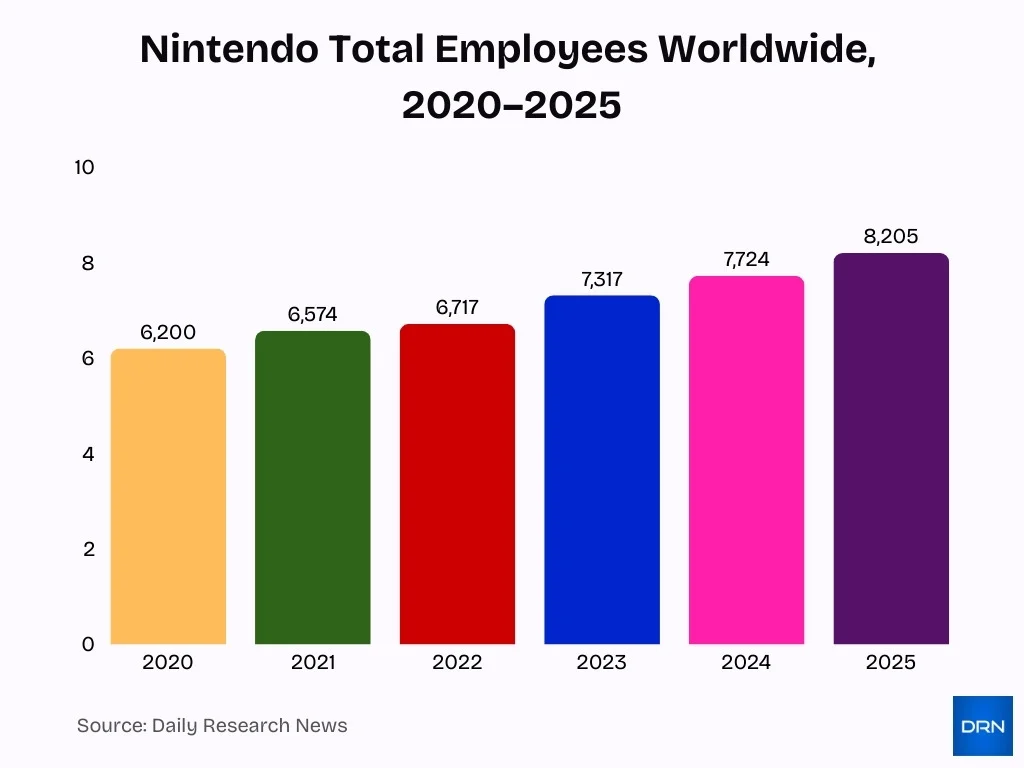
- 2025: 8,205 total employees.
- 2024: 7,724 total employees.
- 2023: 7,317 total employees.
- 2022: 6,717 total employees.
- 2021: 6,574 total employees.
- 2020: 6,200 total employees.
- Year over year growth exceeded 5% annually in recent reporting cycles.
- Steady headcount increases align with new product and market initiatives.
Total Employees Worldwide
- 8,205 total employees across Nintendo’s consolidated global operations as of March 31, 2025.
- This figure rose from 7,724 in March 2024, a 6.23% increase.
- In 2023, Nintendo’s workforce counted 7,317 employees, showing multi-year growth.
- Nintendo’s global staff count includes corporate, development, marketing, and regional offices.
- Subsidiaries contribute significantly to consolidated totals worldwide.
- Japan remains the largest contributor to the total employee pool.
- Roles span software development, hardware engineering, logistics, support, and sales.
- Headcount fluctuations align with product cycles and market expansion strategies.

Permanent vs Total Headcount
- 5,630 permanent full-time employees reported in fiscal 2025.
- Permanent roles form the majority of Nintendo’s workforce.
- Total headcount, including part-time, temporary, and contract workers, exceeds permanent figures.
- Male full-time employees number 3,855, while female full-time employees total 1,775.
- Temporary and contract workers contribute to project-based and operational peaks.
- Permanent headcount growth reflects Nintendo’s long-term workforce planning.
- Headcount composition varies by region and business unit.
- Overall workforce expansion reflects broader strategic investments into global operations.
Workforce Growth Trends
- Nintendo added 455 new full-time employees in the most recent fiscal year.
- Permanent headcount rose steadily compared with the prior year.
- Growth remains measured rather than aggressive, aligning with conservative expansion.
- Nintendo continued hiring while parts of the gaming industry experienced layoffs.
- Japan and the U.S. accounted for the largest share of workforce growth.
- Growth aligns with ongoing software development and hardware support initiatives.
- Workforce size has increased consistently since at least 2020.
- Permanent employment continues to outweigh temporary staffing models.
Nintendo Employee Distribution by Global Regions
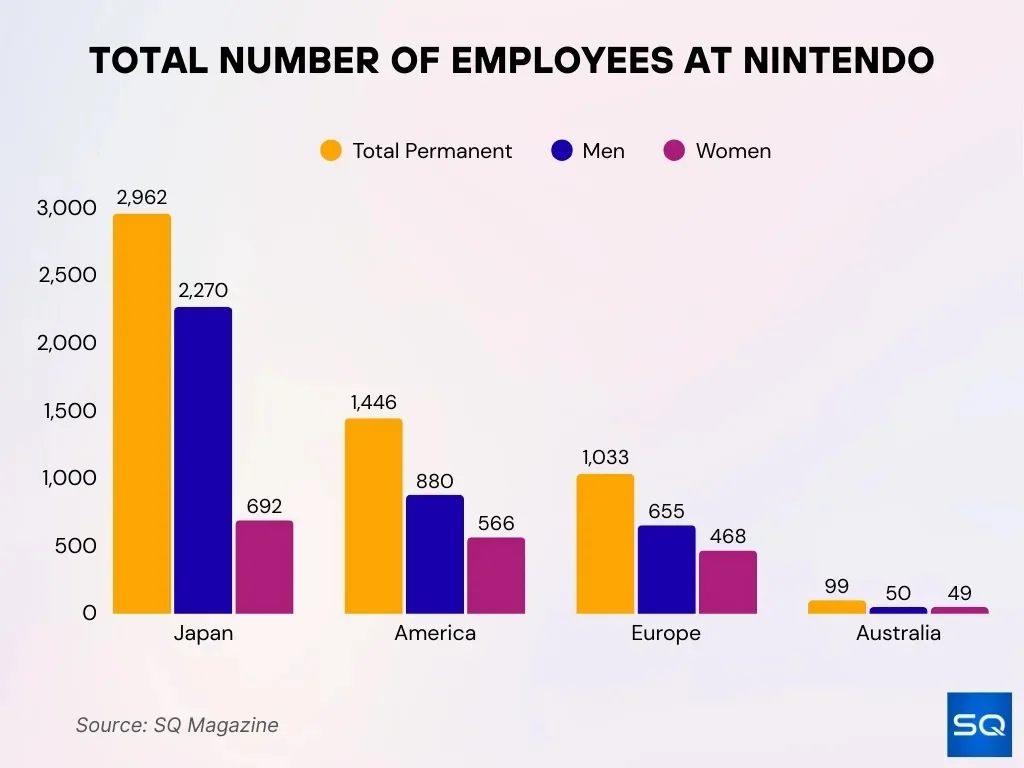
- Japan (Nintendo Co., Ltd.) employs ~ 2,962 permanent employees as of the end of March 2025, consisting of 2,270 men and 692 women, making it the company’s largest workforce base.
- America accounts for ~ 1,446 permanent employees, with a gender split of 880 men and 566 women, reflecting a substantial regional presence.
- Europe maintains ~ 1,033 permanent employees, including 655 men and 468 women, highlighting a strong operational footprint across the region.
- Australia has ~ 99 permanent employees, nearly evenly divided between 50 men and 49 women, indicating a balanced but smaller workforce.
Japan Headquarters Staff
- Kyoto headquarters hosts the largest regional workforce at Nintendo.
- Of the 2,962 permanent employees, about 75% are men and 25% are women.
- Temporary staff in Japan totals fewer than 100 workers.
- Japan reports the highest average tenure at ~14.4 years.
- Turnover in Japan remains very low at ~1.9%.
- Childcare leave participation reaches 96.3% among eligible employees.
- Retention after childcare leave approaches 100%.
- Performance review coverage in Japan stands at 100%.
Nintendo of America Count
- Nintendo of America employs 1,446 permanent employees.
- The U.S. workforce includes 880 men and 566 women.
- Temporary staffing levels in the U.S. remain minimal.
- Average employee tenure in the U.S. is approximately 10 years.
- Turnover rates in the U.S. are around 5.1%.
- Performance and development reviews cover about 87% of staff.
- Dozens of U.S. employees take childcare leave annually.
- Retention following childcare leave exceeds 95%.
Europe and Australia Staff
- Europe employs approximately 1,033 permanent staff members.
- The European workforce includes 655 men and 468 women.
- Temporary employees in Europe total fewer than 100 workers.
- Average tenure in Europe is around 11.1 years.
- European turnover averages ~6.0% annually.
- Career development reviews cover roughly 90% of European staff.
- Australia employs 99 permanent workers, the smallest regional workforce.
- Australia reports an average tenure of ~8.5 years and turnover near 16.7%.
Headcount by Department
- Nintendo’s total headcount stands at 8,205 employees group-wide.
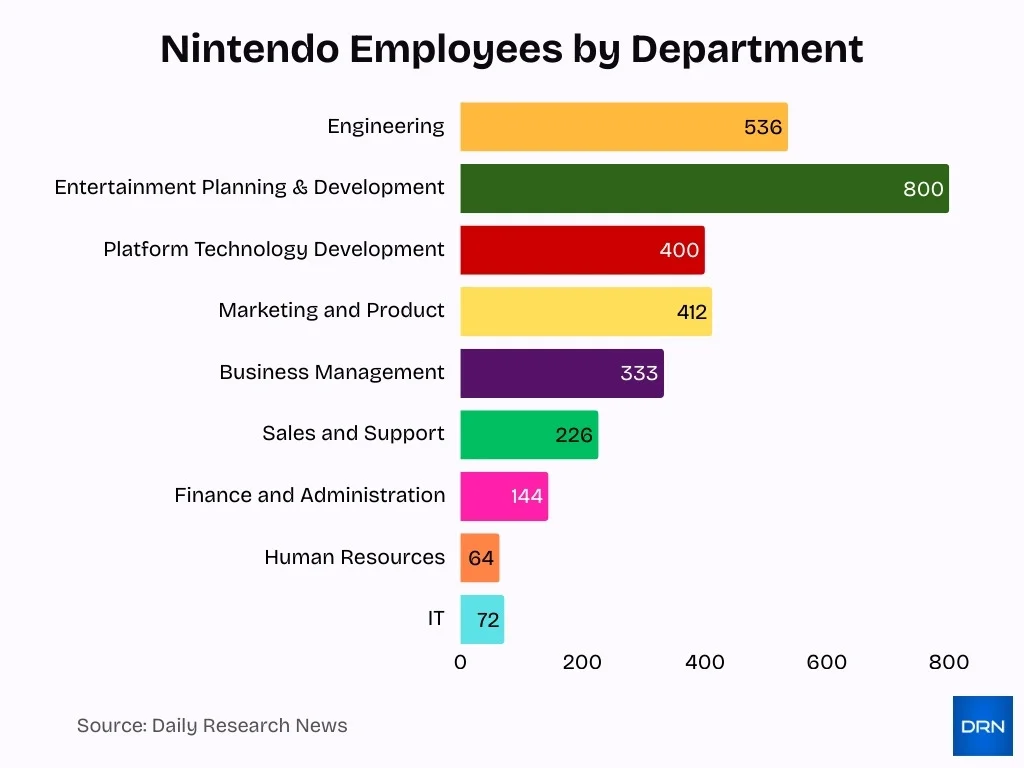
- The engineering department employs 536 staff, representing 25% of the workforce.
- Entertainment Planning & Development (EPD) has approximately 800 creative professionals.
- Platform Technology Development (PTD) supports hardware with over 400 employees.
- The Marketing and Product teams total 412 members focused on branding.
- Business Management oversees operations with 333 staff.
- Sales and Support includes 226 personnel for logistics and customer service.
- Finance and Administration comprises 144 employees handling smaller functions.
- Human Resources and IT teams employ 64 and 72 staff, respectively.
Engineering Team Size
- Nintendo employs 8,205 consolidated employees as of March 2025.
- Engineering roles comprise about 25% of the total workforce, equating to ~536 professionals.
- The EPD division houses roughly 800 staff focused on software and game development.
- Platform Technology Development (PTD) supports hardware with specialized engineering teams.
- Japan-based engineers dominate, with primary hubs in Kyoto and Tokyo facilities.
- Nintendo Technology Development Inc. contributes to hardware OS with a dedicated US staff.
- QA teams at Mario Club Co., Ltd. bolster core development with focused testing.
- Engineering headcount grew steadily, from 6,574 total employees in 2021 to 8,205 in 2025.
- Stability emphasized, with low attrition and 67 new hires amid 45 departures recently.
Marketing and Sales Staff
- Marketing teams include an estimated ~412 employees.
- Sales and support functions include roughly ~226 staff members.
- Teams support global launches and localized campaigns.
- Marketing collaborates closely with creative teams to promote flagship franchises.
- Regional strategies vary based on consumer behavior and market maturity.
- Seasonal hiring increases around major product releases.
- Sales performance aligns with quarterly revenue cycles.
- Digital engagement remains a core marketing focus.
Nintendo Employee Tenure Overview
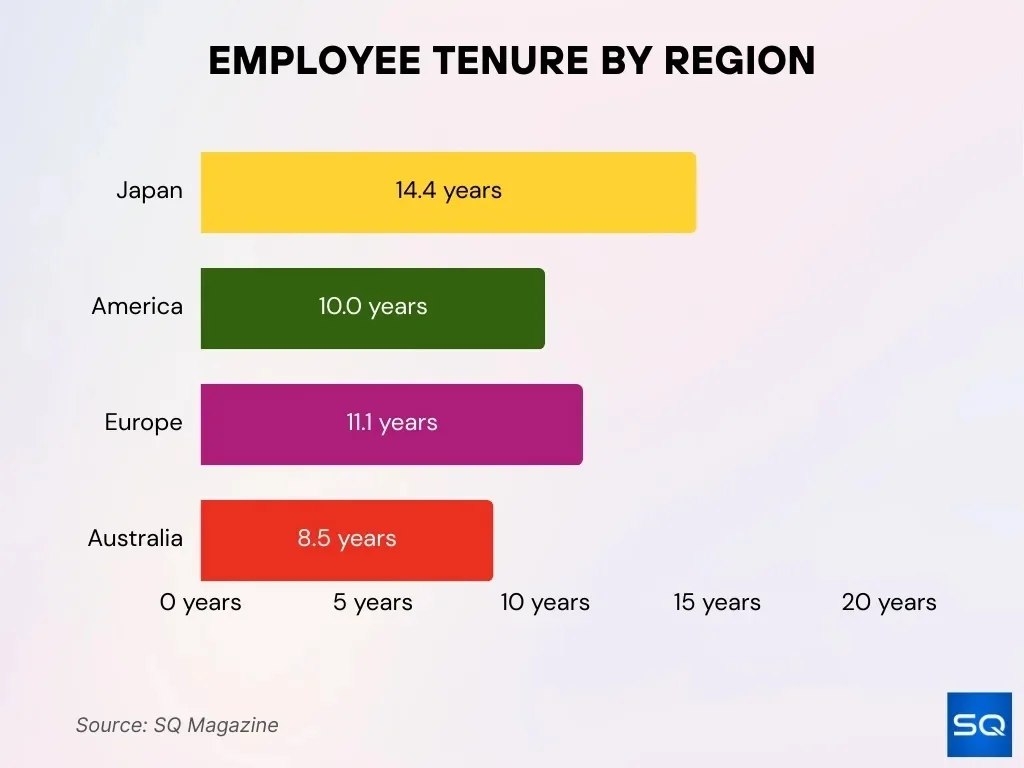
- In Japan, permanent employees remain with the company for an average of 14.4 years, reflecting exceptionally long-term employment.
- In North America (Nintendo of America), the average employee tenure is approximately 10 years, indicating strong workforce stability.
- Across Europe, employees record an average continuous tenure of 11.1 years, positioning the region between Japan and North America.
- Australia reports the shortest average tenure at 8.5 years among all the regions analyzed.
- Male employees generally show slightly longer tenure than female employees in many regions, with the difference most visible in Japan.
- Permanent employees consistently have much longer tenure compared to temporary or contract staff, although public data on non-permanent workers remains limited.
- These long employee tenures directly contribute to low turnover rates across regions, particularly in Japan, where retention is strongest.
Turnover Rates Overview
- Japan reports a turnover rate of ~1.9%.
- U.S. turnover averages ~5.1%.
- Europe experiences a turnover of approximately ~6.0%.
- Australia records the highest turnover at ~16.7%.
- Global retention remains high at ~98%.
- Low turnover offers stability amid industry volatility.
- Regional turnover reflects differing employment conditions.
- Turnover metrics inform recruitment and training strategies.
New Hires Data
- Nintendo added 455 full-time employees in the latest fiscal year.
- Japan accounted for approximately 182 new permanent hires.
- The U.S. added roughly 237 new permanent employees.
- Europe hired around 28 new permanent staff members.
- Australia added approximately 14 new permanent employees.
- Temporary staffing also increased modestly.
- Hiring focused on development and regional market support.
- Growth balances stability with gradual expansion.
Gender Diversity Stats
- The permanent workforce includes 3,855 men and 1,775 women globally.
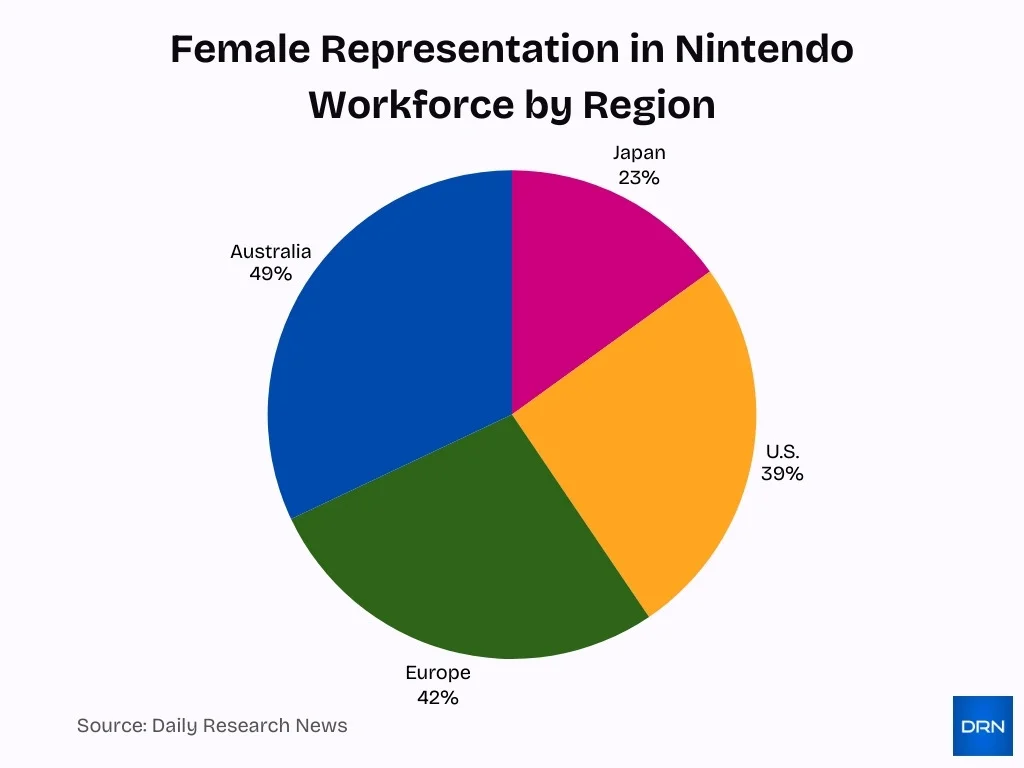
- Women represent about 23% of full-time staff in Japan.
- In the U.S., women account for approximately 39% of employees.
- Europe reports women making up roughly 42% of staff.
- Australia shows near gender parity with 49 women and 50 men.
- Diversity perception scores place Nintendo in the top third of similar companies.
- Corporate policies emphasize inclusion across all regions.
- Long term targets aim to increase female representation to 30% or more.
Comparison With Other Game Companies
- Nintendo boasts a 98% annual retention rate, far exceeding the video game industry’s 22.6% turnover average.
- Average tenure at Nintendo Japan reaches 15 years, surpassing Japan’s national average of 12.5 years.
- Nintendo’s turnover stands at just 1.9% in Japan, compared to new employee 70% retention across Japanese firms.
- Game industry developers average 6.9 years of experience, with less than half reaching their 7th year.
- Nintendo of America employees average 10 years of tenure, against US game sector norms of nearly 4 years.
- Over 45,000 jobs lost in game industry layoffs from 2022–2025, while Nintendo reports near-zero cuts.
- Western studios like EA and Ubisoft face high volatility with thousands laid off recently; Nintendo hires steadily.
- Video game turnover hits 20-22.6%, costing the sector $592 million yearly, dwarfing Nintendo’s stability.
- Nintendo’s workforce grew 6.2% YoY to 8,205 employees in 2025, avoiding industry-wide downsizing.
- Development staff at Nintendo stay longer than peers, where programmers average 18-24 months per studio.
Frequently Asked Questions (FAQs)
Nintendo reported 8,205 total employees worldwide as of March 31, 2025, up around 6.23% from the prior year.
Nintendo has 5,630 permanent full‑time employees globally in its most recent reporting period.
Nintendo Co., Ltd., excluding consolidated subsidiaries, reported 3,078 employees by the end of September 2025.
Nintendo currently shows an employee retention rate of 98%, meaning nearly all staff remain employed annually.
Conclusion
Nintendo’s workforce reflects long tenures, low turnover, and measured growth. With thousands of employees across engineering, marketing, and operations, the company prioritizes stability and continuity over aggressive expansion. Regional differences highlight cultural and market influences, while diversity and inclusion efforts continue to evolve.
As the gaming industry faces ongoing volatility, Nintendo’s people-focused approach positions it as one of the most stable and resilient employers in the global video game market.