


Notion is one of the fastest‑growing productivity platforms in tech today. It blends notes, databases, task boards, and collaboration tools into a single all‑in‑one workspace used by millions of teams worldwide. In industry settings, large enterprises use Notion to replace fragmented tools, while startups leverage it to streamline remote workflows and AI‑driven automation. Tracking Notion’s employee count offers insight into its scale, hiring strategy, and how fast it’s expanding. Below, explore the most recent headcount data and what it reveals about the company’s growth.
Editor’s Choice
- Notion’s current estimated headcount ranges widely from 800 to 4,800 employees, depending on the source.
- Notion’s company size is listed as 501‑1,000 employees, typical for 2025 data.
- The employee total of 4,800 in 2025 may include contractors.
- 1,217 employees, with a 7.2% growth over the past year.
- Some estimates suggest 4,000+ employees as of late 2025.
- Up to 4.7K global team members by Dec 2025.
- Notion has users in over 100 million globally, which influences hiring pace.
Recent Developments
- Released Notion Mail with AI integration in April 2025, likely driving engineering hires.
- Expanded enterprise‑focused security and compliance tools in 2024 and 2025.
- Launched AI‑powered workflow features, enhancing automation across teams.
- Significant international presence grown via community ambassador programs.
- Broadened language support to cater to global users.
- Continued acquisition activities are boosting product stack capabilities.
- Notion’s valuation has remained strong at $10 B, supporting hiring.
- Ongoing integrations with other SaaS tools expand platform reach.
- Customer growth to millions supports large support and sales teams.
How Notion’s Headcount Has Changed Over Time
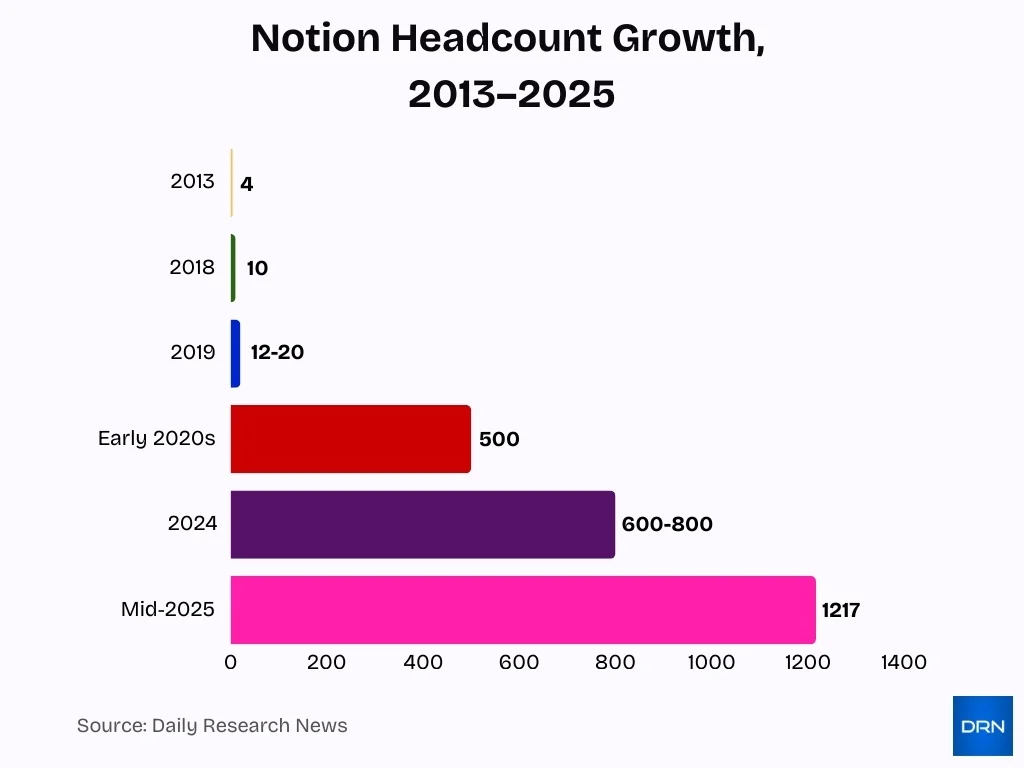
- Notion started with 4 employees at its founding in 2013.
- The company had fewer than 10 employees by 2018.
- Notion employed 12–20 staff around 2019.
- Team size reached 500 employees by the early 2020s.
- In 2024, estimates placed core headcount at 600–800 employees.
- Unify reported 1,217 employees in mid-2025, up 7.2% YoY.
- 218 new hires and 74 departures marked 2025 YTD activity.
- PitchBook lists 4,800 total profiles, including broader listings in 2025.
- The San Francisco office holds 462 employees, the largest hub.
- Engineering comprises 374 employees, about 30% of the workforce.
Notion Employee Count Overview
- Company size listed as 501–1,000 employees as of the latest public data.
- 1,217 employees with modest growth over the last year.
- 4,800 total staff in its 2025 profile.
- Some data platforms list 4,000 employees globally.
- 4.7K employees by year‑end 2025.
- Internal careers portal suggests categories up to 2,000+ employee headcounts if all roles are counted.
- Variance often reflects the inclusion of contractors, affiliates, and remote roles in some estimates.
- Smaller headcount figures likely represent full‑time direct employees only.

Notion Total Workforce In 2025
- 800 employees are estimated for early 2025.
- Approximately 1,217 employees reported in August 2025.
- 4,000+ employee estimates appear on broader data platforms.
- 4,800 total staff is another credible estimate.
- Smaller figures align with industry patterns for focused product teams.
- Higher figures may include contingent or distributed workers globally.
- Growth signals support hiring across engineering, sales, and operations.
- Estimates reflect expansion into international offices beyond the U.S. headquarters.
Post‑Funding Headcount Expansion
- After the $275M Series D in 2021, Notion’s valuation hit $10 B.
- Subsequent funding allowed product and team expansion.
- Growth in AI and automation teams likely followed funding rounds.
- Expansion of global offices corresponds with investment timing.
- Some funding may support contract personnel.
- Broader ecosystem hires help service enterprise customers.
- R&D and security hiring accelerated post‑2023.
- Funding continuity shows confidence in long‑term hiring plans.
Notion Employees By Location
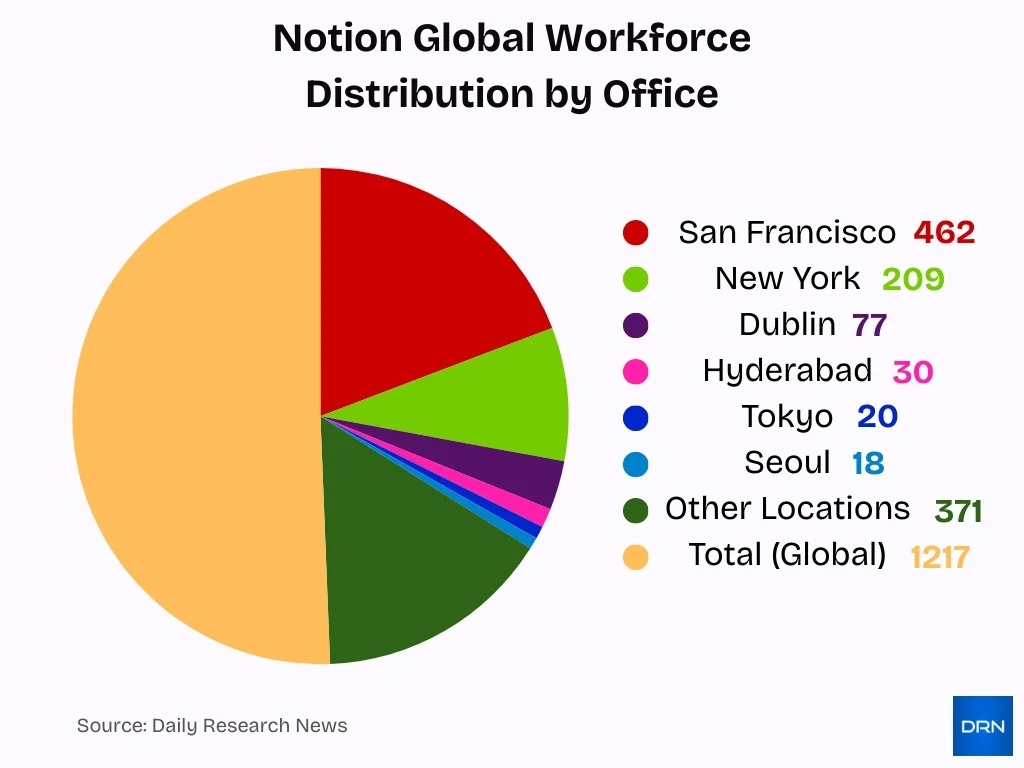
- San Francisco headquarters employs 462 workers, the largest share at 38% of the total.
- The New York office hosts 209 employees, representing 17% of the workforce.
- Dublin serves as the main European hub with 77 staff members.
- Hyderabad, India, has 30 Notion employees supporting regional operations.
- The Tokyo office employs 20 workers focused on Asian markets.The
- The Seoul location includes 18 team members.
- 23 locations worldwide accommodate the full 1,217 employee base.
- 371 employees work from other distributed sites beyond major hubs.
- 462 in San Francisco dwarfs other sites, fostering core team cohesion.
Year‑Over‑Year Employee Growth Rate
- Employee count increased to 1,217 in 2025, up about 7.2% from the prior year.
- There were 218 new hires YTD in 2025, representing 5% of the entire workforce.
- 74 employee departures in the same period indicate moderate turnover.
- Engineering positions grew proportionally, maintaining about 30% of the total team.
- Hiring reflects focus on product and customer support.
- 7% annual growth suggests measured scaling.
- Larger estimates may count contractors differently.
- The hybrid and remote model may influence how hiring affects reported figures.
Department-Wise Employee Distribution
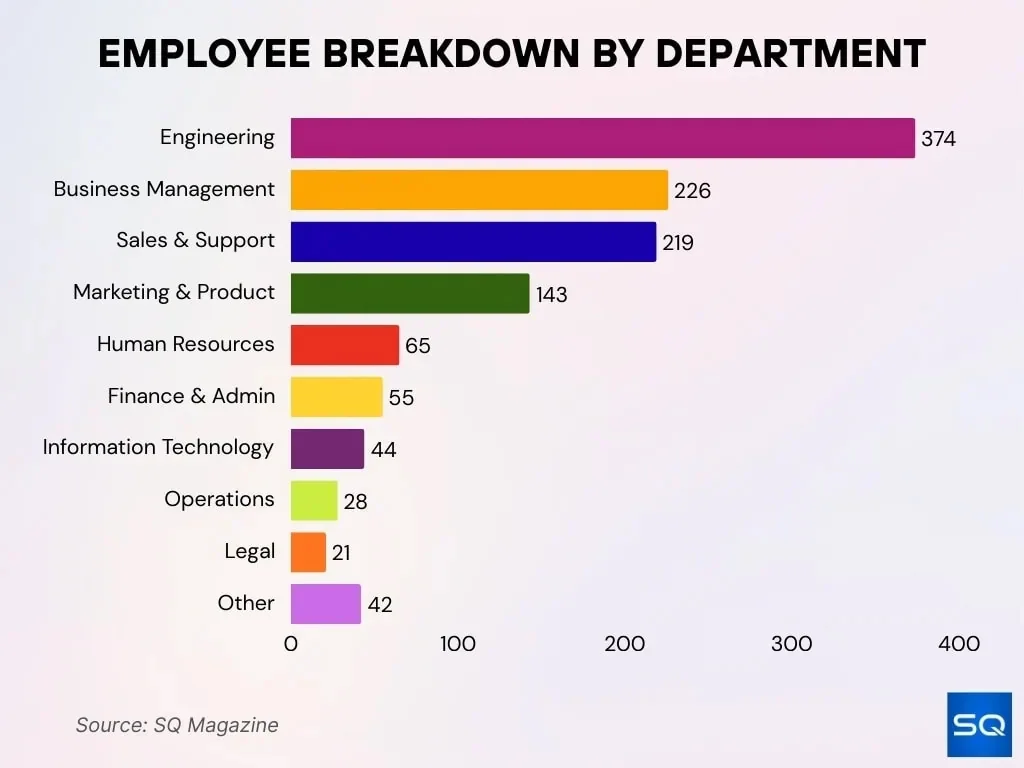
- Engineering employs 374 employees, accounting for ≈ 30% of the total 1,217 workforce.
- Business Management consists of 226 employees, supporting strategic and operational leadership functions.
- Sales & Support teams include 219 employees, focused on revenue generation and customer service.
- Marketing & Product departments together employ 143 employees, driving growth, branding, and product development.
- Human Resources has 65 employees, managing talent acquisition, people operations, and compliance.
- Finance & Administration functions are handled by 55 employees, overseeing financial control and internal processes.
- Information Technology employs 44 employees, maintaining systems, infrastructure, and technical support.
- Operations teams comprise 28 employees, ensuring smooth day-to-day business execution.
- Legal functions are managed by 21 employees, covering compliance, contracts, and regulatory matters.
- Other (miscellaneous functions) account for 42 employees, supporting specialized and cross-functional roles.
Technical vs Non‑Technical Staff At Notion
- Engineering and IT roles form the core technical workforce (418+).
- Technical roles represent roughly one‑third of total staffing.
- Product development, UX, and data science add further technical headcount.
- Non‑technical teams account for the majority of roles (770+).
- Customer‑facing positions like Sales & Support are critical.
- Marketing and Product teams blend both technical and non‑technical skills.
- Growth in non‑technical hires supports enterprise adoption.
- Overall, Notion strikes a balanced workforce mix.
Engineering Team Size At Notion
- Notion employs 374 engineers in its largest department.
- Engineering represents 30% of the 1,217 total headcount.
- Team supports Notion AI, email integrations, and automation features.
- Engineering grew with 7.2% annual company headcount increase.
- 218 new hires joined YTD, strengthening technical roles.
- 74 departures reflect 6% attrition rate among staff.
- The San Francisco base holds 462 employees, including engineers.
- New York supports 209 with key backend and full-stack roles.
- 16 departments exist, with engineering leading technical capabilities.
- Operations span 23 global locations, prioritizing remote positions.
Most In-Demand Features in Project Management Tools
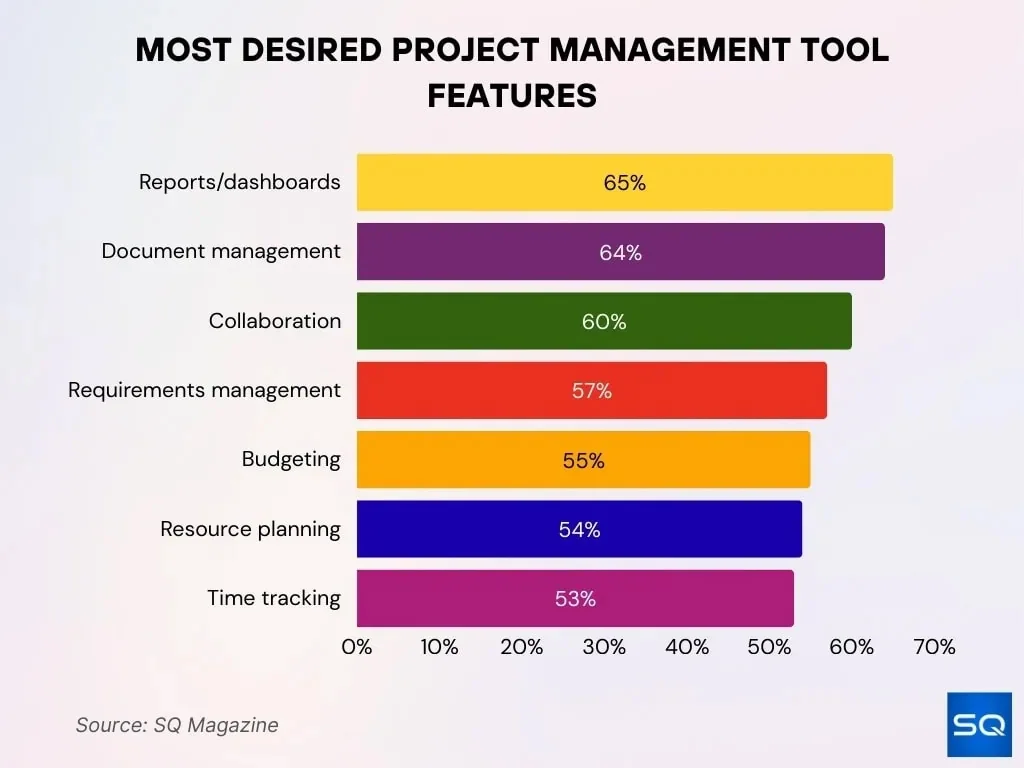
- 65% of users prioritize reports and dashboards, identifying them as the most sought-after feature in project management tools.
- 64% of users consider document management essential for maintaining effective and organized project workflows.
- 60% of respondents highlight the importance of collaboration tools to enhance overall team efficiency and coordination.
- 57% of users look for strong requirements management capabilities to ensure clear scope definition and alignment.
- 55% of users value budgeting features to help control and manage project costs effectively.
- 54% of respondents emphasize the need for resource planning tools to optimize workload distribution and capacity planning.
- 53% of users want built-in time tracking features to better monitor productivity levels and project deadlines.
Sales, Support, And Customer Success Headcount
- Sales & Support employs 219 people.
- Customer Success managers handle enterprise accounts.
- Sales roles span multiple global regions.
- Support specialists handle global technical and billing queries.
- These teams contribute >18% of overall staffing.
- Staff expansion follows user base growth.
- The hybrid model supports cross‑team collaboration.
- Training and onboarding align with product releases.
Product, Design, And Marketing Team Size
- Product and marketing functions total 143 employees.
- Product teams include UX design, research, and product management.
- Marketing teams handle brand, content, and demand generation.
- Design supports interface and experience enhancements.
- Product leadership sets priorities and roadmaps.
- Marketing growth tracks with user base expansion.
- Cross‑functional work accelerates feature launches.
- Teams turn market feedback into product innovation.
Operations, HR, And Administration Staff
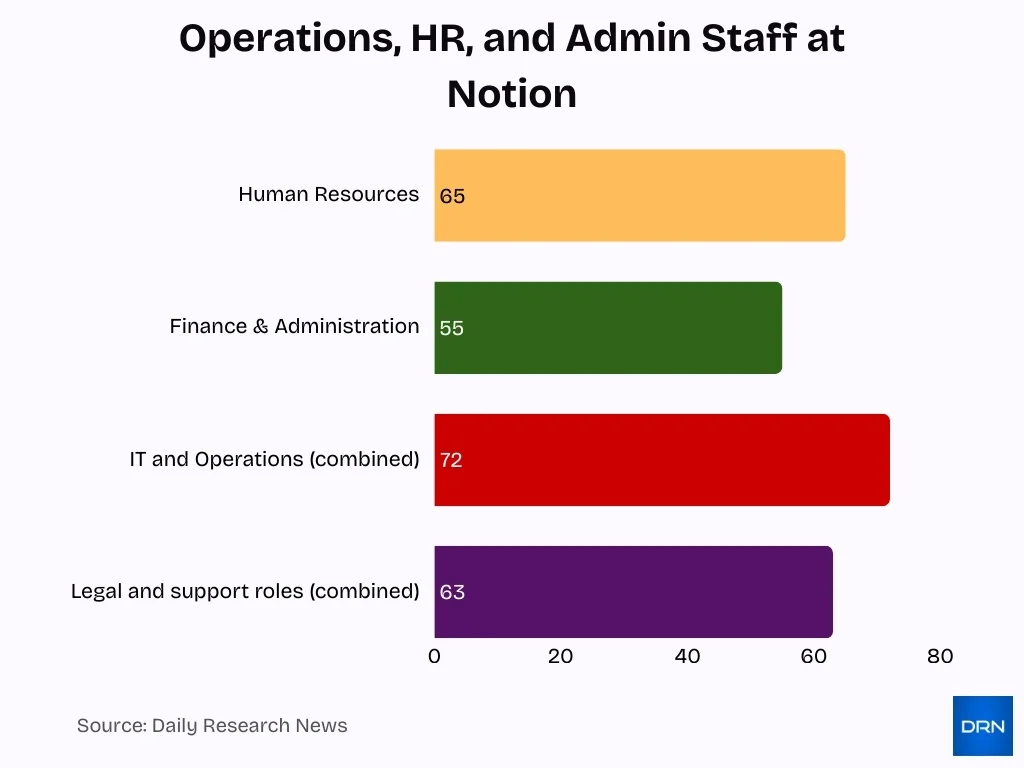
- Operations, HR, and Administration support hiring, compliance, and internal services.
- Human Resources personnel number 65.
- Finance & Administration staff total 55.
- IT and Operations roles are 72.
- Legal and support roles (63) handle contracts and risk.
- HR aligns onboarding and DEI programs.
- Admin expands to support hybrid and global models.
- Operational functions support sustainable growth.
Leadership And Management Team Size
- Leadership includes cofounder & CEO Ivan Zhao and leaders across product, engineering, and growth.
- Team remains small relative to headcount, typical in flat hierarchies.
- Senior roles lead engineering, sales, product, and people ops.
- Team expansion aligns with international growth.
- Advisors and board members come from major tech firms.
- Executive staff typically represent 2–5% of the total workforce.
- Leadership focuses on scaling, innovation, and strategic revenue.
- Strategic guidance balances innovation with expansion.
Remote And Distributed Employees At Notion
- Notion employs around 1,217 total workers across 23 global locations.
- 38% or 462 of employees are based in the San Francisco headquarters.
- 17% or 209 work from the New York office.
- 30% or 371 employees operate from other remote or small-office clusters.
- The company maintains 6 major offices while supporting a distributed workforce.
- The hybrid policy requires 2-3 office days weekly, blending remote flexibility.
- 218 new hires and 74 departures reflect 7.2% YoY growth in the distributed team.
- Remote strategies enable talent access in Hyderabad (30), Tokyo (20), and beyond.
- Workforce spans multiple time zones for continuous development support.
- Remote-first culture is core, despite no official remote headcount being published.
How Notion’s Headcount Compares To Competitors
- Notion reports a headcount of 501-1,000 employees per LinkedIn and ZoomInfo listings.
- Unify tracks Notion at 1,217 employees with 7.2% YoY growth.
- PitchBook estimates Notion’s total team at 4,800 members, possibly including contractors.
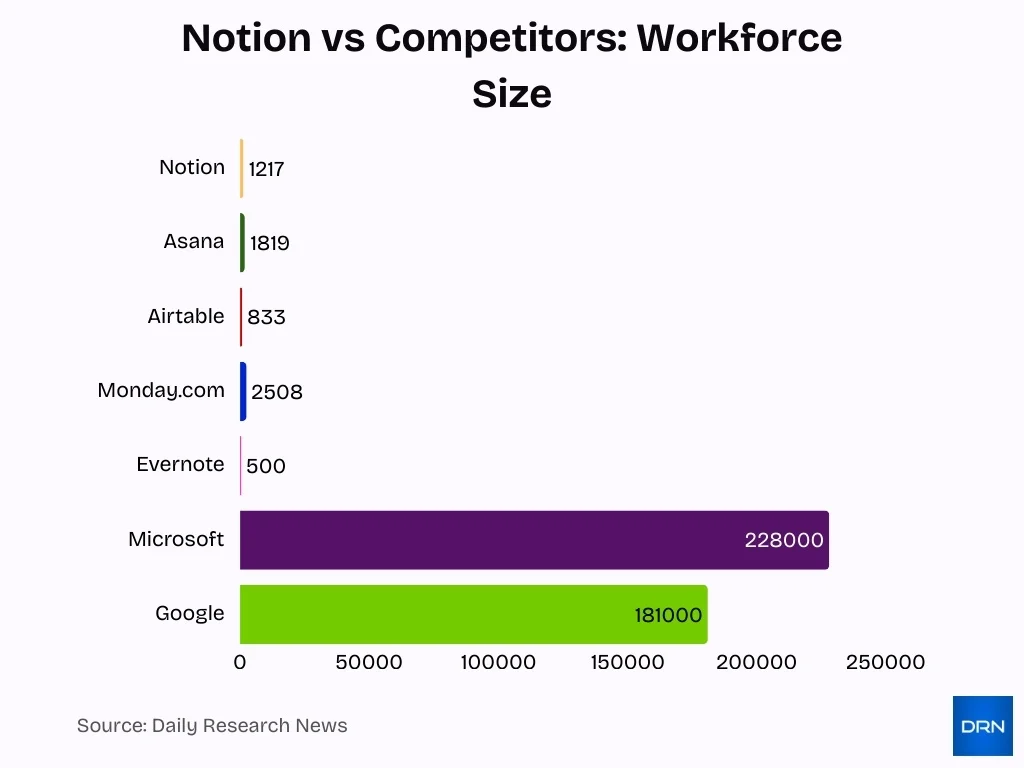
- Asana ended FY2025 with 1,819 employees, down 1.14% YoY.
- Unify lists Asana at 2,372 employees, reflecting recent adjustments.
- Airtable employs 833 staff globally per Unify, up 12.9% YoY.
- Monday.com grew to 2,508 employees by the end of 2024, up 35.28%.
- Evernote maintains 201-500 employees post-layoffs.
- Microsoft employs 228,000 staff, dwarfing Notion’s scale.
- Google has 181,000 employees, highlighting Notion’s lean structure.
Notion Workforce Size vs Revenue And Valuation
- Notion’s valuation is $10 B–$11 B as of 2025.
- The company has 4,000 employees based on the latest estimates.
- Estimated revenue reached $500 M in 2025.
- Revenue per employee approximates $207K.
- Employee data suggests scaling potential tied to revenue growth.
- Competitors may have higher revenue, but also larger teams.
- Notion’s lean headcount signals efficiency focus.
- Workforce and revenue trends show contrasting growth indicators.
Frequently Asked Questions (FAQs)
Notion is reported to have approximately 4,800 employees in 2025, according to PitchBook data.
Unify reported that Notion employs about 1,217 people, showing ongoing organizational growth.
Notion’s LinkedIn company profile lists its company size as 501–1,000 employees.
TrueUp lists 4,000 employees working at Notion.
Conclusion
Notion’s workforce picture reflects a company balancing product innovation with measured hiring. Although figures vary by source, with estimates ranging from 800 to 4,800 employees, most credible data points agree that Notion is scaling both its core teams and global presence. Its hybrid work approach, global offices, and strategic leadership all support growth that aligns with increasing revenue and valuation. As the company continues to refine its AI, collaboration, and enterprise capabilities, workforce trends will remain a key indicator of its long‑term trajectory.