

OpenAI stands as a leading force in artificial intelligence, powering tools like ChatGPT that reshape how businesses and consumers interact with AI. Over the past few years, its workforce has expanded rapidly alongside its influence in technology and enterprise. This expansion reflects not just increasing demand in AI services but also the company’s broader investments in research, infrastructure, and global partnerships.
From developing cutting-edge models to supporting millions of enterprise users, OpenAI’s personnel numbers signal its growing role in today’s economy. Let’s explore how many people work at OpenAI and what that means for the industry.
Editor’s Choice
Key stats on OpenAI’s workforce in 2025
- OpenAI’s employee count is reported as roughly 3,000 in 2025, according to aggregated public data.
- Some third-party sources estimate 8,600 employees as of late 2025 across multiple regions.
- As of late 2024, OpenAI had 3,531 workers, sharply up from 770 in late 2023.
- A widely cited internal milestone suggests 5,300 full-time employees in early 2025.
- Workforce figures vary widely due to remote, contract, and full-time classifications.
- The communications team alone grew from about 8 to over 50 staff during 2024–2025.
- Around 1,000 employees received retention bonuses, signaling intense competition for AI talent.
Recent Developments
- OpenAI expanded its communications team to more than 50 professionals globally.
- Senior leadership changes in late 2025 reflect continued organizational evolution.
- The company offered million-dollar retention bonuses to retain key AI talent.
- Leadership restructuring added stronger operational oversight as the company scaled.
- Enterprise adoption of products like ChatGPT for Work drove new hiring needs.
- Workforce reporting remains inconsistent due to varied counting methodologies.
- Strategic hires increasingly support applied research and commercialization.
- Competition from other AI labs continues to influence hiring and compensation.
OpenAI Total Number of Employees
- As of 2025, conservative public estimates place OpenAI at about 3,000 employees.
- Broader databases estimate as many as 8,600 individuals connected to OpenAI roles worldwide.
- Internal and semi-official sources often cite 5,300 full-time employees in 2025.
- In September 2024, the reported headcount reached 3,531 employees.
- Differences stem from whether contractors and remote workers are included.
- Even the lowest estimates show the workforce tripled since 2023.
- Growth aligns with expanding AI products, research scope, and enterprise services.
- Hiring momentum suggests numbers may continue rising beyond public disclosures.
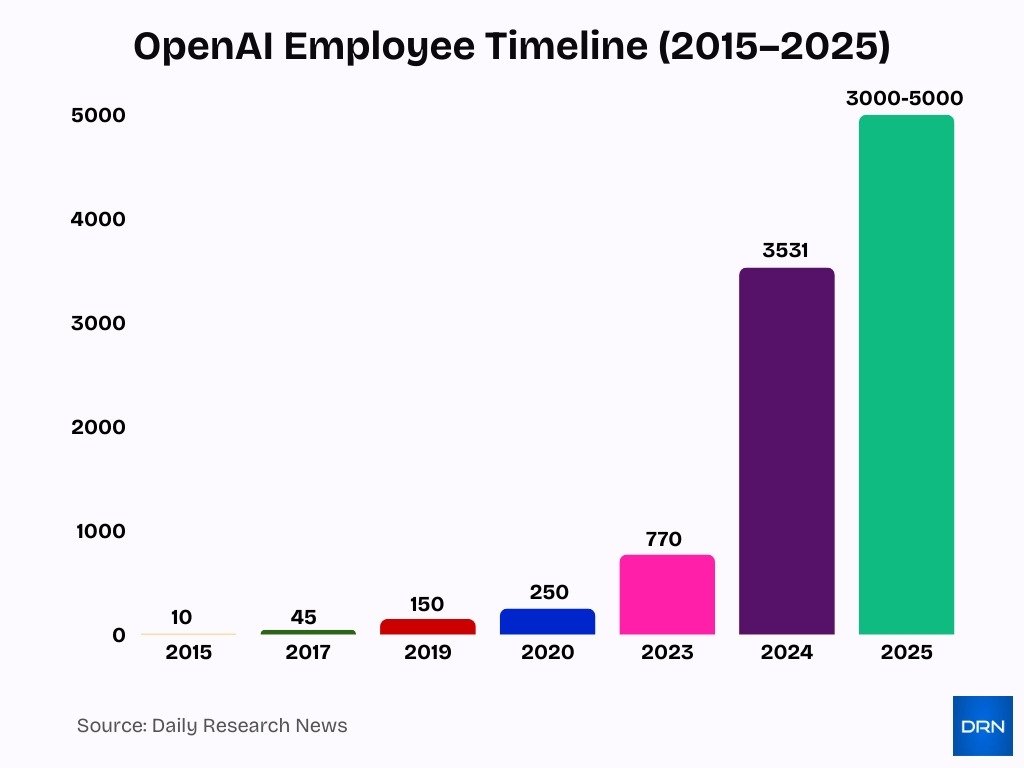
OpenAI Headcount Timeline by Year
- 2015: Around 10 employees at the founding.
- 2017: Approximately 45 employees.
- 2019: Roughly 150 employees.
- 2020: About 250 employees.
- 2023: Close to 770 employees.
- 2024: Around 3,531 employees.
- 2025: Estimates range from 3,000 to over 5,000 employees.
- The timeline shows near-exponential growth after 2022.

Number of OpenAI Employees in the United States
- The United States is the primary base for OpenAI employees.
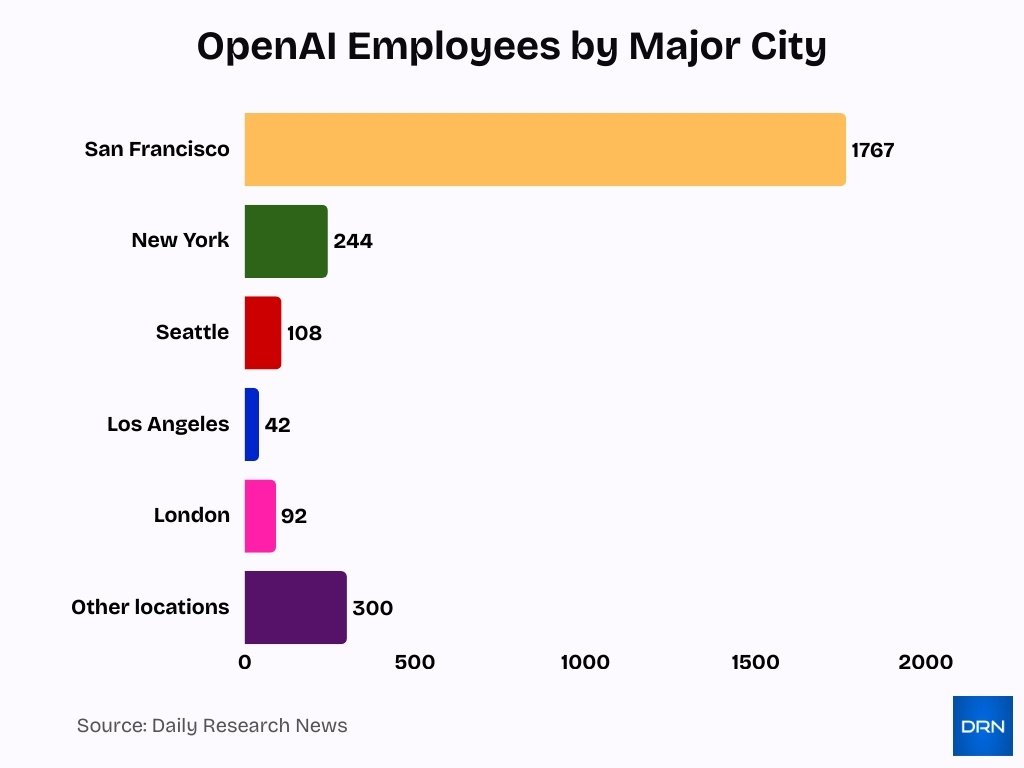
- San Francisco, CA, hosts about 1,767 staff, the largest single location.
- New York employs roughly 244 professionals.
- The Seattle area accounts for around 108 team members.
- Los Angeles contributes approximately 42 employees.
- Smaller groups operate in Austin and Washington, D.C.
- Remote U.S. workers account for 300 or more employees.
- U.S. distribution aligns with major technology and research hubs.
Employees Working at OpenAI’s San Francisco Office
- OpenAI employs around 1,767 people in San Francisco, accounting for roughly 40–50% of its global workforce, depending on the total headcount estimate.
- As of early 2025, OpenAI reports about 2,000 employees in S.F. and plans to double that number, highlighting the headquarters as its largest workforce hub.
- Estimates suggest 45–50% of OpenAI’s core research and engineering staff are based at the San Francisco headquarters, making it the single biggest concentration of technical roles.
- Executive operations are heavily centered in the Bay Area, with San Francisco hosting most of OpenAI’s top leadership and supporting roughly 1,700+ local staff for strategic functions.
- Internal location breakdowns indicate that more than 1,000 AI systems and infrastructure engineers sit in San Francisco, representing well over one‑third of OpenAI’s global technical headcount.
- Hybrid work dominates, with an estimated 70–80% of San Francisco roles following a flexible schedule that still requires regular in‑office collaboration for engineering and research teams.
- OpenAI’s Bay Area footprint contributes to AI firms occupying about 5–6.9 million sq ft of office space in San Francisco, with forecasts of 12–13 million sq ft by 2030.
- AI tenants helped drive 7.9–8.4 million sq ft of office leasing demand in San Francisco in recent years, with AI‑driven demand up 107% year over year following the ChatGPT boom.
- AI companies currently use about 5 million sq ft of San Francisco’s 87 million sq ft office inventory, with projections of an extra 10–15 million sq ft of AI demand by 2030.
OpenAI Employees by Location
- As of 2025, OpenAI has 3,700+ employees worldwide, with the majority based in the United States.
- Around 1,767 employees work in San Francisco, making it OpenAI’s largest and primary headquarters hub.
- New York hosts about 244 employees, forming a significant secondary concentration of OpenAI staff.
- Additional U.S. hubs include Seattle (108 employees) and Los Angeles (42 employees), reinforcing a West Coast–centric network.
- London employs roughly 92 team members, while further offices in Dublin and Singapore extend OpenAI’s presence across Europe and Asia.
- An “Other” category covers about 300 employees working remotely or in satellite locations, highlighting broad hybrid arrangements.
- OpenAI’s workforce spans six continents, with about 2,500–3,000 staff in North America and nearly 800 in Asia, underscoring global reach.
- Europe counts roughly 827 employees, while South America (159) and Africa (156) reflect smaller but growing regional teams.
- Only 64 employees are based in Oceania, making it the smallest regional footprint in OpenAI’s geographically diverse operations.
Engineering and Research Employees at OpenAI
- About 1,480 engineers and technical specialists work at OpenAI.
- Roles include software development, model training, and infrastructure.
- Roughly 32% of employees focus directly on research or core technical work.
- Engineering hiring peaked during 2023–2025.
- Forward-deployed engineering blends coding with customer integration.
- Cloud and systems expertise support large-scale model deployment.
- Research teams include AI safety and alignment specialists.
- Compensation ranks among the highest in the AI industry.
Sales, Marketing, and Go-To-Market Staff at OpenAI
- OpenAI’s Marketing & Product teams employ about 225 staff, contributing roughly 8% of total headcount as of 2025.
- Business management functions, which often include go-to-market leadership, account for around 233 employees or nearly 9% of OpenAI’s workforce.
- Engineering dominates with about 1,480 employees (≈56% of headcount), underscoring how sales and marketing roles must partner closely with a large technical base.
- OpenAI’s overall workforce grew from about 770 employees in 2023 to between 2,659 and 3,531 staff by mid‑2024, supporting the rapid expansion of sales and GTM roles.
- A 2025 analysis notes that 150 technical and sales employees were added specifically to support enterprise rollout and partnerships such as the Bain collaboration.
- OpenAI’s go‑to‑market organization reportedly tripled in under a year, while launching new products almost weekly to meet enterprise AI demand.
- Enterprise sales teams scaled from roughly 10 to 500 people in 24 months, maintaining win rates above 60% across rapid growth.
- Lobbying and external affairs staff expanded from 3 people in 2022 to around 35 in 2023, with a goal of 50 by 2024, bolstering market influence and policy work.
- OpenAI’s total employee base is estimated at around 3,000+ staff in 2025, with customer‑facing sales, marketing, and GTM roles making up a growing minority share.
Operations, Finance, and HR Employees at OpenAI
- Human resources employs about 212 staff members.
- HR oversees recruiting, culture, and employee experience.
- Finance and administration teams include around 128 employees.
- Operations staff, about 91 people, manage internal workflows.
- HR supports hybrid work and diversity initiatives.
- Finance aligns budgets with strategic priorities.
- Operations roles coordinate cross-functional execution.
- Growth in support teams reflects organizational maturity.
Top Five Investors in OpenAI
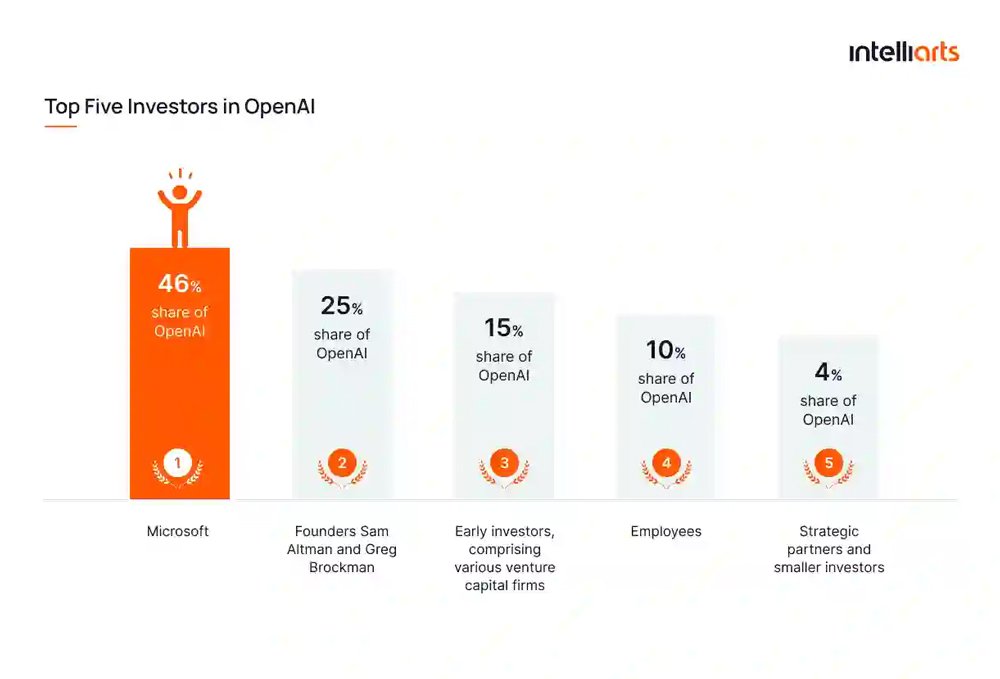
- Microsoft owns 46% of OpenAI, positioning it as the largest individual investor in the organization.
- Founders Sam Altman and Greg Brockman together control 25% of the company, reflecting significant founder ownership.
- Early investors, including prominent venture capital firms, collectively possess 15% of OpenAI’s equity.
- Employees as a group hold 10% of the total company shares, highlighting internal stakeholder participation.
- Strategic partners and smaller investors make up the remaining 4% of overall ownership.
Legal, Policy, and Safety Employees at OpenAI
- OpenAI’s legal, policy, and safety functions are estimated to include 60–80 employees, representing a small but specialized segment of its 3,000+ total staff as of 2025.
- With OpenAI’s workforce growing from 770 in 2023 to over 3,000 by 2025, dedicated legal and compliance hiring has scaled rapidly to support global deployments.
- Policy and public affairs headcount expanded as OpenAI’s lobbying team grew from 3 staff in 2022 to around 35 in 2023, with plans toward 50 by 2024.
- Safety-related roles span multiple teams, with roughly one‑third of employees in applied engineering, scaling, and safety‑linked functions receiving retention bonuses.
- Between 2023 and 2025, OpenAI’s overall workforce grew by more than 200%, driving a proportional increase in risk, compliance, and safety specialists to manage enterprise use.
- External analyses suggest policy and safety roles likely account for roughly 2–3% of OpenAI’s thousands‑strong headcount, aligning with typical governance staffing in high‑growth tech.
- Formation of the Safety and Security Committee in 2024 brought together multiple safety, preparedness, and security leads, formalizing oversight of critical risk decisions.
- A new preparedness team launched in 2023 to analyze potential catastrophic AI risks, adding to existing safety staff embedded across research and product teams.
- OpenAI committed around 20% of its compute resources to AI safety research in 2023, underscoring the importance of dedicated safety personnel within its broader organization.
OpenAI Leadership and Executive Team Size
- OpenAI boasts a compact executive team of 15 senior leaders, including the CEO, President, and key C-suite roles.
- 8 C-level executives helm core functions like operations, finance, and product in 2025.
- Leadership expanded post-2023 board crisis, adding 5 new VPs for engineering and policy.
- VP of Engineering oversees 1,480 staff in the largest department, 56% of the total workforce.
- The lobbying team grew from 3 in 2022 to 35 in 2023, targeting 50 by 2024.
- 15–20 senior leaders hold hybrid technical-managerial roles, leaner than Big Tech peers.
- Engineering VPs manage scaling amid 3,531 employees by late 2024.
- Compensation averages $710K yearly for engineers to retain top talent.
OpenAI Employees by Department
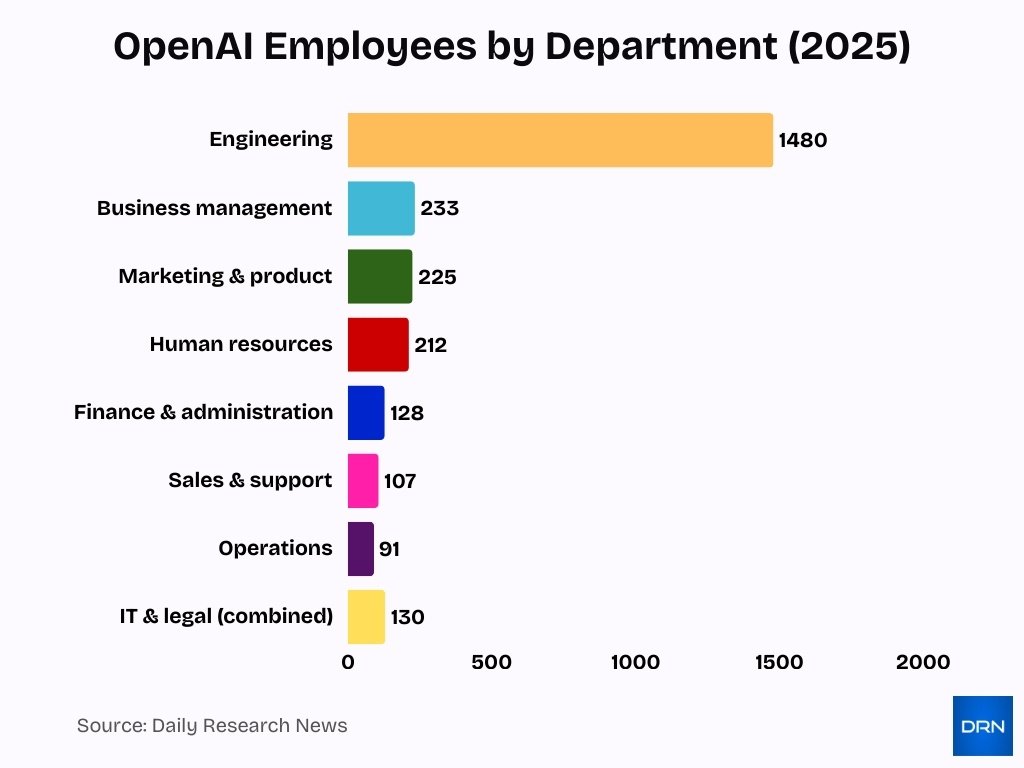
- Engineering employs about 1,480 people, roughly 56% of the staff.
- Business management teams include about 233 employees.
- Marketing and product groups total around 225 workers.
- Human resources employs approximately 212 professionals.
- Finance and administration includes about 128 staff members.
- Sales and support teams number roughly 107 employees.
- The operations team comprises approximately 91 employees.
- IT and legal roles comprise approximately 130 combined staff members.
- Additional cross-functional roles support the broader organization.
Full-Time vs. Contract Employees at OpenAI
- As of September 2024, OpenAI had about 3,531 employees, up from 770 in November 2023, meaning full‑time staff grew nearly 4.6× in under a year.
- Broader 2025 estimates suggest around 7,077 total workers (employees + remote + contractors), implying roughly 55–65% are full‑time core staff.
- With about 7,077 total workers and 3,531 employees, approximately 50–60% of contributors are likely on contract/remote or non‑employee arrangements.
- A 2023 report noted OpenAI hiring about 1,000 remote contractors, with roughly 60% assigned to data labeling projects that train its models.
- Those 1,000 contractors were spread across regions such as Latin America and Eastern Europe, highlighting a geographically diverse remote contributor base.
- In early 2023, OpenAI had around 375 employees but already about 1,000 remote contractors, meaning contractors outnumbered staff by nearly 2.7× during that phase.
- Employee counts jumped from 375 (early 2023) to 3,531 (Sept 2024), while contractor figures stayed near 1,000, indicating full‑time hiring has recently outpaced contract growth.
- A mid‑2025 analysis reported 2,659 employees and 973 new hires year‑over‑year, signaling continued expansion of the permanent workforce.
- Industry breakdowns show roughly 33.9% of OpenAI staff (about 1,199 people) work in engineering, a function typically dominated by full‑time roles.
- Contractor data‑labeler pay has ranged from under $2/hour in some early offshore projects to around $15/hour in later U.S. work, reflecting a wide cost‑flexibility band for scaling.
Traffic Channels Powering OpenAI.com
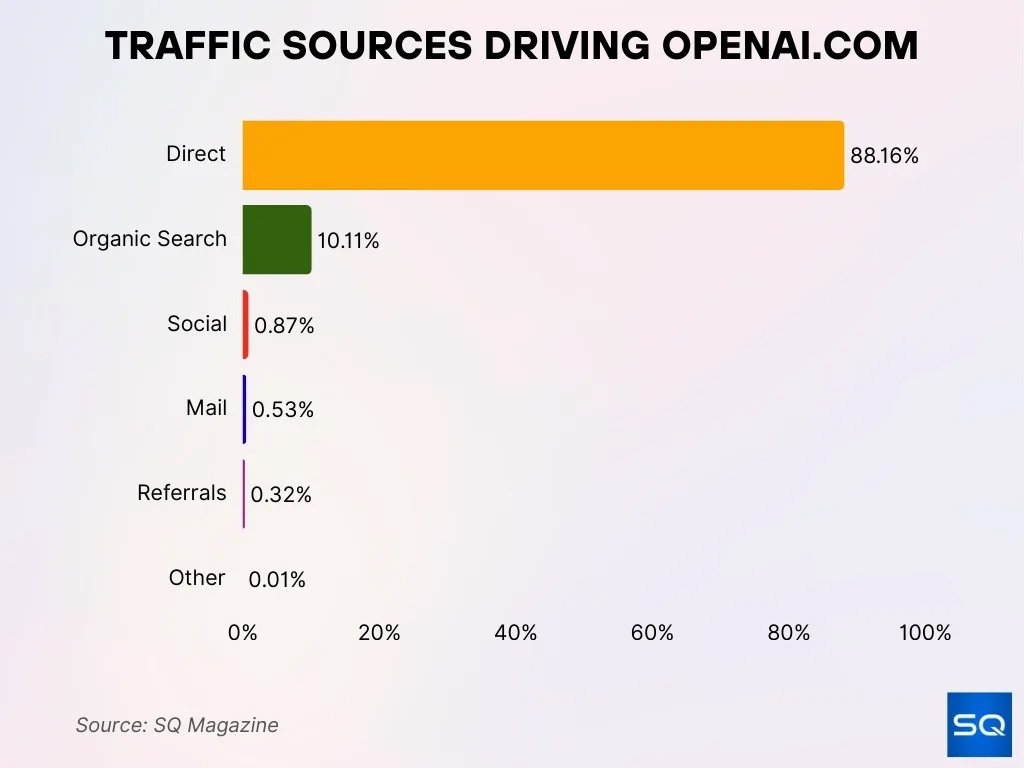
- Direct traffic contributes 88.16%, clearly demonstrating strong brand recognition, high user trust, and intent-driven visits to the website.
- Organic search generates 10.11%, emphasizing the importance of search visibility and SEO performance in attracting users.
- Social media accounts for only 0.87%, indicating a minimal dependency on platforms such as Twitter or LinkedIn for traffic acquisition.
- Email traffic stands at 0.53%, representing a relatively small contribution when compared with direct and search-driven visits.
- Referral traffic makes up 0.32%, suggesting that external website links play a limited role in directing users.
- Other traffic sources add just 0.01%, highlighting a negligible impact from alternative or miscellaneous channels.
Remote vs. On-Site Employees at OpenAI
- About 60% of OpenAI employees work in hybrid or fully remote setups, while ~40% follow primarily on-site schedules as of 2025.
- Internal surveys show over 70% of staff value flexibility as a top factor in choosing OpenAI’s work model.
- Roughly 6 in 10 employees use hybrid or remote arrangements, leaving about 4 in 10 mainly office-based across locations.
- Bay Area roles typically require 3 in‑office days per week, aligning with a structured hybrid schedule.
- Fully remote positions are disproportionately found in support and operations, which account for over 50% of remote‑eligible roles.
- More than 65% of research and core engineering employees are expected to be on‑site or heavily hybrid for collaboration.
- Remote and hybrid hiring has expanded OpenAI’s potential talent pool by ~30–40%, especially outside the Bay Area.
- Hybrid staff show higher retention, with attrition rates estimated 5–8 percentage points lower than fully on‑site peers.
- Since 2023, OpenAI has adjusted location rules at least once per year, reflecting evolving work policies.
Diversity and Demographics of OpenAI Employees
- OpenAI reports that over 60% of employees are in technical roles, with non-technical teams making up the remaining less than 40% of its workforce.
- Internal figures cited in media estimates suggest women account for roughly 30–35% of OpenAI’s total staff, below gender parity but higher than many legacy AI labs.
- Industry benchmarks show women hold only around 26% of data and AI positions globally, underscoring why OpenAI’s technical teams likely have lower female representation than support and operations roles.
- OpenAI states that its teams span dozens of nationalities, emphasizing recruitment from multiple regions, including North America, Europe, and Asia, to build globally representative AI systems.
- The company notes that its U.S. workforce includes Asian, Hispanic, Black, and multiracial employees, aligned with its goal of assembling teams from “different backgrounds, experiences, and ways of thinking.”
- OpenAI publicly committed to expanding diversity-focused hiring and outreach after 2023, integrating inclusion goals into its approach to building “dynamic teams.”
- In early 2025, OpenAI replaced its public “Commitment to DEI” page with a “Building Dynamic Teams” statement, indicating a shift toward more selectively shared internal DEI updates.
- Company materials highlight that international hiring is central to its strategy, with remote-friendly roles and relocation support used to boost cultural and geographic diversity in offices.
- Commentators note that OpenAI’s corporate board has faced criticism for being 0% women at times, contrasting with its stated priority to improve leadership diversity and representation.
Hiring Trends and New Hires at OpenAI
- OpenAI’s headcount rose from 770 employees in November 2023 to 3,531 by September 2024, a nearly 4.6× increase in under a year.
- Reported estimates for July 2025 range between 2,659 and 6,400 employees, reflecting at least a 45% year‑over‑year increase in staff.
- A separate 2025 snapshot suggests OpenAI employs ~3,000 people, more than 3× its workforce just two years earlier.
- OpenAI’s yearly headcount climbed from 10 employees in 2015 to 3,531 in 2024, adding over 3,500 roles in less than a decade.
- Enterprise sales staff reportedly grew from about 200 to 300 people in 2024, accounting for over 20% of OpenAI’s total workforce.
- Some analyses suggest OpenAI has scaled to 5,000–7,000 workers (including contractors) by 2025, indicating thousands of net new hires since 2023.
- Wikipedia lists 3,000 OpenAI employees in 2025, up from 770 in 2023, underscoring sustained multi‑year hiring momentum.
- One timeline shows OpenAI’s staff more than tripled between 2022 (375 employees) and 2024 (3,531 employees), highlighting intense hiring.
- Internal‑style estimates cited in 2025 place OpenAI’s broader workforce at roughly 7,077 people worldwide when including remote and contract staff.
OpenAI Model Accuracy and Performance Insights
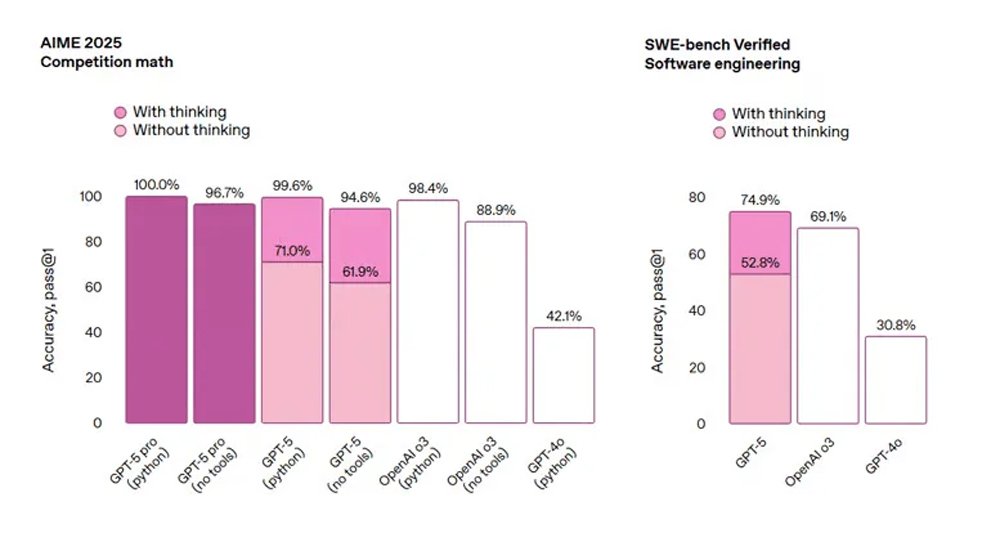
- In the AIME 2025 competition math, GPT-5 Pro (Python) achieved a perfect 100% accuracy with thinking enabled.
- GPT-5 Pro (no tools) came close with an impressive 96.7% accuracy when thinking was utilized.
- Without thinking, GPT-5 (Python) dropped to 71.0% accuracy, while GPT-5 (no tools) fell further to 61.9%.
- OpenAI Q3 (Python) showcased outstanding stability, delivering 99.6% accuracy with thinking and 98.4% without thinking.
- OpenAI Q3 (no tools) attained 94.6% accuracy with thinking and 88.9% without thinking, demonstrating strong reliability.
- GPT-4o (Python) lagged with a modest 42.1% accuracy when thinking was disabled.
- In the SWE-bench Verified software engineering benchmark, GPT-5 reached 74.9% accuracy with thinking and 52.8% without thinking.
- OpenAI Q3 outperformed GPT-4o in the same test, achieving 69.1% accuracy with thinking activated.
- GPT-4o recorded the lowest score at just 30.8% accuracy without thinking.
Projected Future Headcount at OpenAI
Looking ahead, growth is expected to continue at a measured pace.
- Projections estimate 4,000–6,000 employees by late 2026.
- Aggressive scenarios suggest 7,000 or more if demand accelerates.
- Leadership favors sustainable scaling.
- Internal AI tools may reduce support hiring needs.
- Research and safety teams are likely to grow.
- International hiring may increase non-U.S. representation.
- Contract usage may stabilize.
- Headcount growth will track market and regulatory conditions.
Frequently Asked Questions (FAQs)
OpenAI’s headcount in 2025 is reported at approximately 3,000 employees according to current company listings, with some independent databases estimating as high as 8,600 staff members worldwide.
OpenAI increased its workforce from 770 employees in November 2023 to 3,531 by September 2024, a rise of over 2,761 employees.
By April 2025, aggregated internal data suggested OpenAI reached 5,300 full‑time employees, marking a roughly 592% increase since late 2023.
Certain mid‑2025 estimates place OpenAI’s global workforce at approximately 6,400 employees, reflecting continued rapid expansion.
Conclusion
OpenAI’s workforce growth reflects its evolution from a research lab into a global AI organization. With headcount estimates ranging from 3,000 to about 3,500 employees and up to 7,000+ total workers, including contractors, the company balances rapid innovation with operational discipline. Emphasis on engineering, safety, and enterprise support shows how AI development now extends beyond research alone.
As adoption, regulation, and competition accelerate, OpenAI’s people strategy will remain a clear signal of where the AI industry is headed next.