

The global workforce behind TikTok has become a major point of interest as the company navigates rapid growth, regulatory challenges, and shifting hiring trends. Employers, policymakers, and industry analysts alike watch TikTok’s staffing levels to understand its operational priorities and strategic shifts. From content moderation to product development, workforce trends at TikTok reveal broader tech industry dynamics in social media and digital entertainment. In this article, we explore TikTok’s employee numbers and global footprint, with real-world impacts on job markets and international operations.
Editor’s Choice
Here are key numbers that shape the story of TikTok’s workforce in 2025.
- TikTok’s global workforce was estimated at ~77,000 employees as of late 2025.
- As of 2023, TikTok had 38,578 employees worldwide, a commonly cited baseline figure.
- The United States accounts for a large segment of TikTok’s workforce, roughly 7,000 to 11,400 employees.
- TikTok supports millions of U.S. jobs indirectly through business use of the platform.
- Offices span multiple continents, including North America, Europe, and Asia-Pacific.
- Return-to-office policies are changing, with full-time RTO mandates beginning in 2026.
- Trust and safety teams have faced restructuring and layoffs in 2025 as moderation strategies shift.
Recent Developments
- TikTok is preparing a company-wide return-to-office policy, requiring U.S. staff across key departments to work on-site five days a week starting in September 2026.
- The platform’s workforce dynamics are evolving as regulatory pressures mount, particularly in the U.S., affecting job security and strategic planning.
- Trust and safety teams have been reshaped, with layoffs reported in early 2025 across Europe and Asia.
- TikTok’s base offices continue to operate globally despite political and legal uncertainty in major markets.
- Hiring patterns in late 2024 and early 2025 showed increased departures in some regions amid slowed overall growth.
- Independent economic research links TikTok’s business ecosystem to millions of U.S. jobs, highlighting indirect employment effects.
- Workforce planning increasingly balances human moderators and AI automation, influencing headcount decisions.
How Many People Work at TikTok?
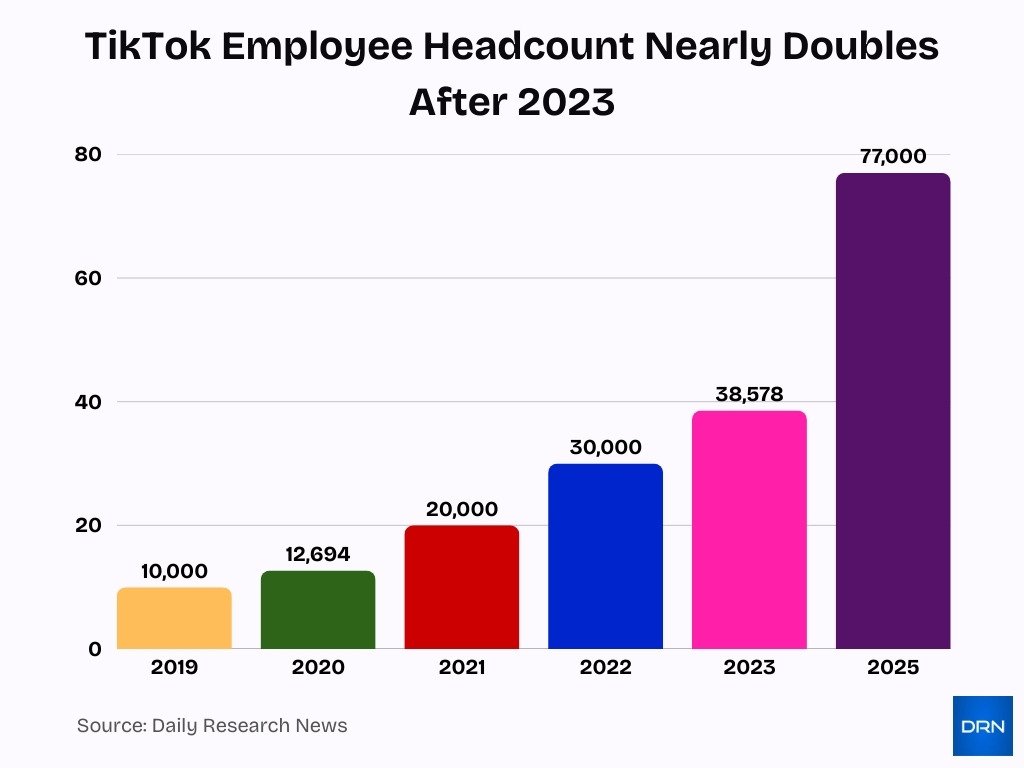
- Multiple sources place TikTok’s global workforce at ~38,578 employees as of 2023.
- More recent estimates suggest TikTok expanded to around 77,000 employees by October 2025.
- As early as 2022, workforce figures exceeded 30,000 employees, signaling rapid expansion.
- TikTok’s headcount nearly doubled between 2021 and 2023 during a phase of aggressive global growth.
- U.S. staff count estimates range from 7,000 to 11,400 employees, depending on the year and methodology.
- Key business units such as TikTok Shop employed over 1,000 workers in the U.S. before restructuring.
- Variations in reported numbers reflect differences in counting contractors, regional staff, and reporting periods.
Global TikTok Workforce Size Over Time
- 2019: Approximately 10,000 or more employees supported early global scaling.
- 2020: Around 12,694 employees, marking early international expansion.
- 2021: Workforce surpassed 20,000 employees alongside user growth.
- 2022: Headcount exceeded 30,000 employees as new markets launched.
- 2023: Workforce reached ~38,578 employees globally.
- 2024: Hiring activity increased early in the year before slowing later.
- 2025: Estimates reached up to ~77,000 employees worldwide, reflecting cumulative growth.
- Year-over-year increases highlight TikTok’s sustained investment in operations and platform support.

TikTok Employees in the United States
- In early 2025, TikTok’s U.S. workforce stood at approximately 7,000 employees, down from about 11,400 in 2023.
- This decline reflects slower hiring and higher attrition compared with prior years.
- Departures among U.S. staff rose 38% in the second half of 2024 versus the same period in 2023.
- U.S. hiring slowed to its lowest pace since late 2020, signaling strategic caution.
- TikTok’s U.S. business ecosystem supports around 4.7 million jobs indirectly.
- Roughly 7.5 million U.S. businesses use TikTok, contributing to indirect employment effects.
- Regulatory uncertainty has influenced workforce planning and retention in the U.S.
- TikTok Shop previously employed over 1,000 U.S. workers before restructuring.
- E-commerce-related layoffs highlight volatility in specific U.S. business units.
Employees in Europe
- TikTok’s London office employed roughly 2,500 workers, covering sales, moderation, and operations.
- Planned layoffs targeted several hundred content moderation roles in the U.K. during restructuring.
- Approximately 300 trust and safety roles in London were affected by redundancy plans.
- Hundreds of U.K. online safety workers reportedly accepted exit agreements.
- In Ireland, about 300 roles, roughly 10% of staff, were flagged as at risk.
- Moderation teams in Berlin also faced restructuring and labor disputes.
- European workforce changes reflect pressure to balance compliance with cost efficiency.
- Some moderation and quality assurance functions are being centralized into fewer hubs.
Employees in the Asia-Pacific
- Asia-Pacific trust and safety teams experienced layoffs similar to those in other regions.
- Singapore operations were included in the global moderation workforce reductions.
- In Malaysia, nearly 500 moderation roles were cut during a shift toward AI tools.
- The region remains critical, with major hubs in Singapore, Seoul, and Tokyo.
- Layoffs in APAC mirror global trends toward automation in moderate work.
- AI integration increasingly shapes staffing decisions across Asia-Pacific markets.
- Regional teams continue to support local languages and market-specific operations.
- Investment in automated moderation tools is expected to expand further in 2025.
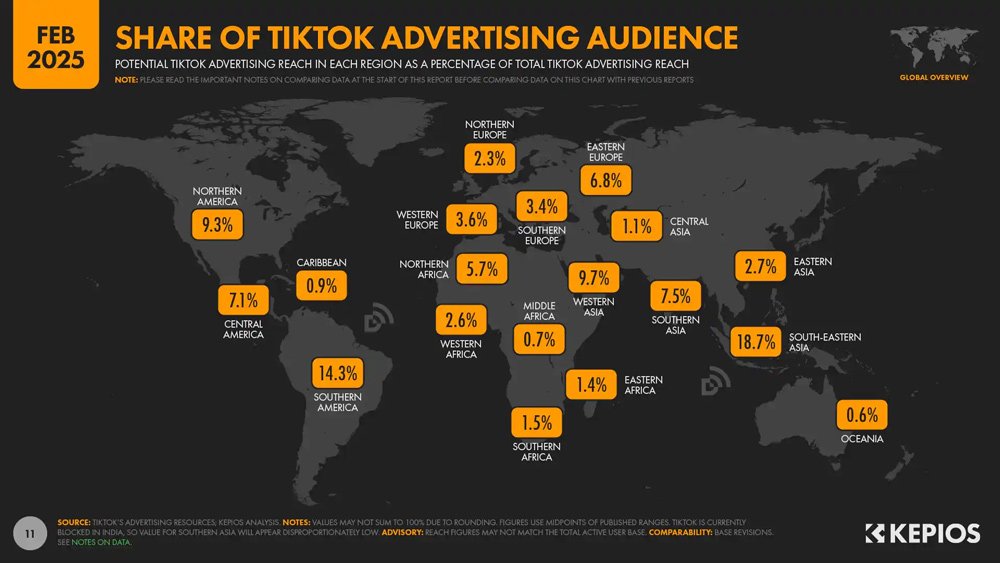
TikTok Advertising Audience Distribution by Global Region
- South-Eastern Asia dominates TikTok’s global advertising reach with 18.7%, making it the largest regional contributor to the platform’s audience share.
- Southern America comes next at 14.3%, reflecting strong TikTok penetration across Latin American markets.
- Western Asia secures 9.7%, highlighting high user engagement in regions such as Turkey and the Middle East.
- North America accounts for 9.3%, encompassing major markets like the United States and Canada.
- Southern Asia represents 7.5%, a reduced share largely influenced by TikTok’s ban in India.
- Central America contributes 7.1%, forming a notable portion of TikTok’s advertising audience.
- Eastern Europe adds 6.8% to TikTok’s total ad reach, showing solid regional adoption.
- Northern Africa holds 5.7%, positioning it ahead of Western Europe in advertising share.
- Western Europe records 3.6%, narrowly surpassing Southern Europe, which stands at 3.4%.
- Eastern Asia, including countries like Japan and South Korea, accounts for 2.7% of TikTok’s reach.
- Western Africa makes up 2.6%, indicating steady and consistent user growth in the region.
- Northern Europe contributes 2.3% to TikTok’s global advertising footprint.
- Southern Africa and Eastern Africa register 1.5% and 1.4% respectively, reflecting smaller but present audiences.
- Central Asia maintains a modest presence with a 1.1% share of the ad audience.
- Caribbean nations together account for 0.9%, forming a minor collective share.
- Middle Africa contributes 0.7% to TikTok’s overall advertising audience.
- Oceania holds the smallest share at just 0.6%, despite high digital adoption in Australia and New Zealand.
Key Office Locations and Headquarters of TikTok
- TikTok’s dual global headquarters in Los Angeles and Singapore anchor a network of 40+ worldwide office locations across multiple continents.
- The Los Angeles headquarters at 5800 Bristol Pkwy, Culver City, positions TikTok within the U.S. entertainment and media hub for content and creator partnerships.
- Singapore’s HQ at 1 Raffles Quay (South Tower) centralizes Southeast Asia operations and coordination for regional growth.
- TikTok lists major U.S. offices in Los Angeles, New York, and Austin, supporting thousands of U.S.-based employees in content, ads, and partnerships roles.
- Key European hubs in London, Dublin, Pari,s and Berlin consolidate management and operations across the U.K. and wider EU region.
- Asia-Pacific expansion is supported by offices in Singapore, Tokyo, Seoul, and Jakarta, enabling localized product and market strategies for the region.
- The Dubai office functions as a strategic base for Middle East operations, aligning regional content, safety, and commercial teams.
- TikTok’s Sydney office extends coverage to Australia and New Zealand, complementing its Asia-Pacific headquarters footprint.
- A regional office in Mexico City underpins Latin American advertising and business operations for Spanish-speaking markets.
- Globally, TikTok’s distributed offices support an estimated 38,500+ employees, reflecting a multi-continental operating model scaled since 2023.
Organizational Breakdown of TikTok’s Workforce by Function
- As of 2023, TikTok employed about 38,578 people globally, with roughly 11,400 staff (≈30%) based in the United States.
- TikTok reports more than 40,000 trust & safety professionals worldwide, making moderation and safety one of its largest functional groups.
- Around 10% of the roughly 3,000 employees at TikTok’s Dublin hub (≈300 roles) were cut in a restructuring affecting trust & safety and support teams.
- TikTok listed about 3,457 open roles in late 2024, with many vacancies in engineering, product, and data functions to scale features and algorithms.
- TikTok planned to invest over $2 billion in trust & safety in 2024, with a significant share allocated to U.S. operations and policy enforcement.
- Global layoffs in 2024–2025 targeted overlapping back-end and moderation roles, with hundreds of staff impacted as the company shifted more content review to AI systems.
- LinkedIn data places TikTok in the 10,001+ employees band, but third‑party estimates put its wider workforce, including regional functions like sales, marketing, and e‑commerce, above 30,000.
- U.S. headcount reportedly fell from about 11,400 in 2023 to roughly 7,000 employees by early 2025, reflecting role consolidation and centralization.
Trust and Safety / Content Moderation Staff
- TikTok’s trust and safety workforce historically numbered tens of thousands globally.
- Around 300 U.K. trust and safety roles were impacted by the 2025 layoffs.
- Hundreds of moderators in the U.K. accepted redundancy agreements by late 2025.
- Moderation teams in London, Berlin, Singapore, and Dublin faced restructuring.
- In Ireland, over 950 moderators participated in assessments tied to redundancy decisions.
- Increased use of AI reduces reliance on human moderators for routine content review.
- Critics argue that automation may limit nuanced judgment on harmful content.
- Moderation of workforce reductions mirrors broader industry trends toward automation.
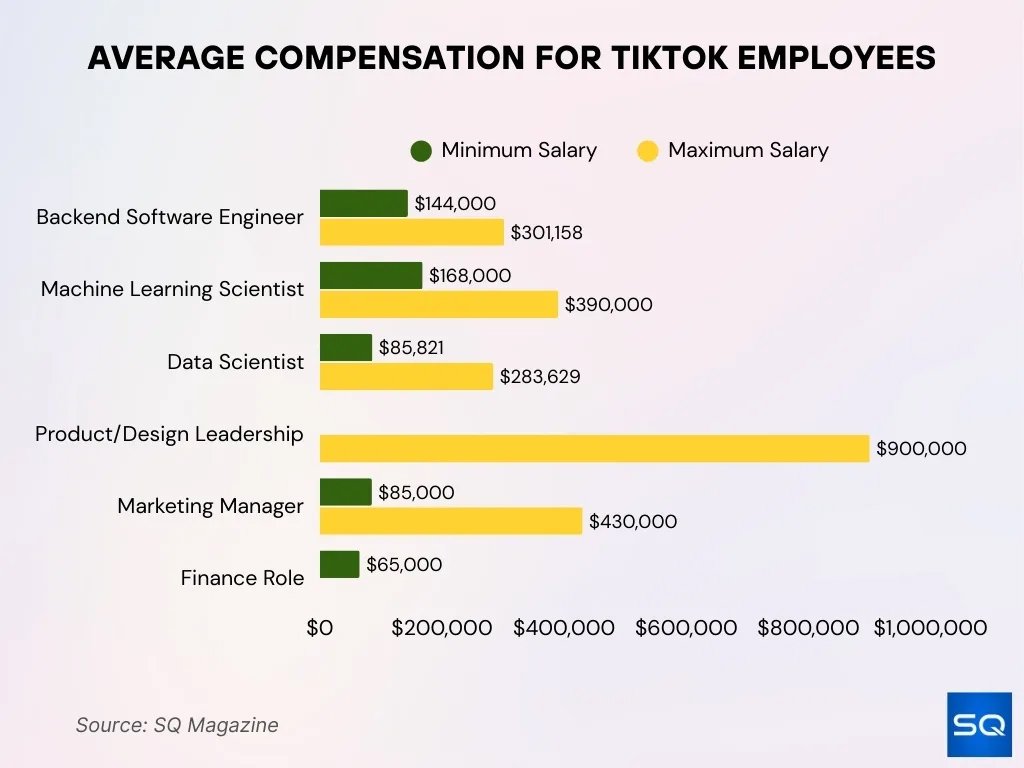
Average Salary and Compensation at TikTok
- The annual pay range for backend software engineers is approximately $144,000 to $301,158, depending on experience, location, and role scope.
- Machine learning scientists can earn between $168,000 and $390,000, reflecting the high demand and specialized expertise required for these positions.
- Data scientists typically receive salaries ranging from $85,821 to $283,629, influenced by seniority, technical depth, and business impact.
- Product and design leadership roles may achieve up to $900,000 in total compensation, combining base salary, bonuses, and equity.
- General marketing managers are offered compensation packages between $85,000 and $430,000, varying by market responsibility and strategic influence.
- Certain finance roles have reported a base pay of around $65,000, particularly in non-senior or support-level positions.
- The highest-paying roles are most commonly found in high-cost-of-living cities or in positions that demand rare and highly specialized skills.
- Overall compensation differs significantly due to the inclusion of bonuses, equity grants, and employee benefits, which can substantially increase total earnings.
Engineering and Product Teams at TikTok
- TikTok’s engineering & technical organization includes about 6,900+ employees globally, supporting core infrastructure and recommendation systems across regions.
- The overall TikTok workforce surpassed 38,500 employees in 2023, with engineering and product functions forming a major share of this global headcount.
- TikTok announced plans to hire about 3,000 new engineers over 3 years, expanding global product development hubs in Europe, Canada, Singapore, and the U.S.
- The company employs around 40,000 trust & safety professionals worldwide, many in specialized technical roles focused on AI-assisted content moderation and platform safety.
- U.S.-based teams account for 11,400+ TikTok employees, including large product, data, and engineering groups aligned with local business and analytics needs.
- TikTok’s ad revenue was projected to reach about 33 billion USD by 2025, underpinning continued investment in scalable engineering and product infrastructure.
- TikTok generated an estimated 9.4 billion USD in revenue in 2022, doubling year-on-year, driving rapid growth in R&D, performance engineering, and reliability roles.
- As of 2023, TikTok had about 1.5 billion monthly active users, pushing cross‑disciplinary squads to ship new features and UX improvements at a massive scale.
Sales, Marketing, and Partnership Teams
- Sales and marketing teams concentrate on advertising revenue and brand enablement.
- These teams support millions of business accounts using TikTok worldwide.
- North American sales groups continue expanding advertising solutions.
- Marketing roles align closely with seasonal campaign cycles.
- Partnership teams manage relationships with major creators and advertisers.
- Roles include strategy, analytics, campaign management, and market development.
- Return-to-office policies will affect many U.S. sales and marketing roles.
- TikTok continues investing in commercial teams despite moderation layoffs.
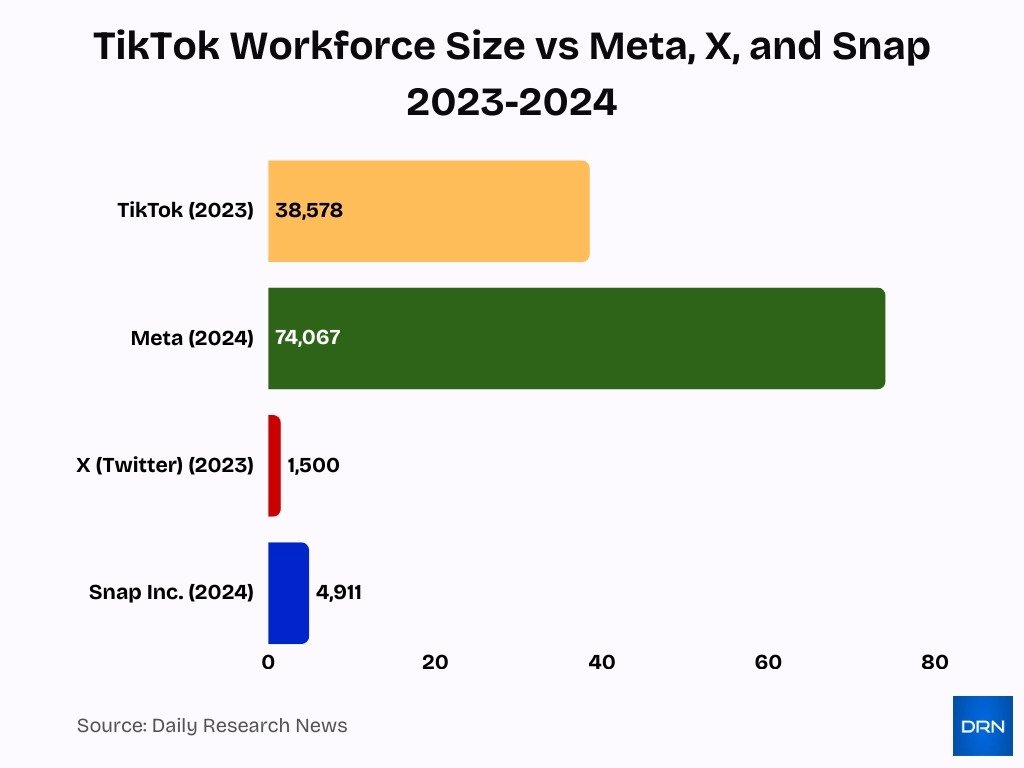
TikTok Employees Compared to Other Social Platforms
- TikTok employs about 38,578 people globally as of 2023, while Meta has roughly 74,067 employees as of 2024, underscoring Meta’s significantly larger headcount across its platforms.
- After deep cuts, X (Twitter) trimmed staff from roughly 7,500 employees in 2022 to nearer 1,500–2,000 by 2023, leaving it with a dramatically leaner workforce than TikTok.
- Snap Inc. reported 4,911 employees at the end of 2024, giving it a workforce around 87% smaller than TikTok’s 38.6k headcount in 2023.
- Meta’s 74,067 employees in 2024 are almost double TikTok’s ~38.6k staff, reflecting Meta’s need to support Facebook, Instagram, WhatsApp, Threads, and other services.
- Snap’s staff shrank by 7.15% year over year in 2024 (‑378 roles), continuing a layoff trend that has kept its headcount well below TikTok’s.
- TikTok’s ~38,578 employees sit between Snap’s 4,911 and Meta’s 74,067, making its workforce large for a single short‑video platform but smaller than big tech conglomerates.
- Major social platforms employ tens of thousands of outsourced moderators and contractors on top of full‑time staff, meaning official employee counts understate the true content‑moderation workforce.
- An estimated 4.7–5 million jobs in the U.S. benefit from TikTok’s ecosystem, far exceeding its ~7,000–11,400 direct U.S. employees, highlighting platform‑driven employment beyond core staff.
TikTok Leadership and Executive Team Size
- TikTok’s core leadership group publicly lists 6–12 key executives globally, reflecting a lean top team overseeing thousands of employees worldwide.
- Companywide headcount is estimated at 70,000+ employees, meaning fewer than 0.02% of staff sit on the top executive leadership bench.
- External datasets often track around 12 named leaders in TikTok’s executive roster, aligning closely with the 8–10 roles highlighted in this leadership lineup.
- With roughly 7,000 U.S. employees but a single CEO role, each C‑level executive indirectly represents oversight of thousands of staff across regions and functions.
- Shou Zi Chew, as Chief Executive Officer, is 1 of only a handful of C‑suite figures formally recognized at the top of TikTok’s global org chart.
- Blake Chandlee’s move from President of Global Business Solutions to an advisory role trims the active front‑line executive layer by at least one major P&L‑owning position.
- Will Liu’s mandate to lead both Global Business Solutions and Monetization Product Technology consolidates at least two prior leadership verticals into a single executive role.
- Adam Presser’s leadership of global Trust & Safety operations centralizes platform safety under one executive, rather than region‑by‑region leadership silos.
- Anuj Bhatia’s grievance and compliance remit places regulatory response and user grievance handling under one specialized leadership seat within the broader sub‑15‑member top team.
- Nicky Raghavan’s global HR leadership means people operations for tens of thousands of employees are coordinated through a single executive‑level HR office.
TikTok Hiring Trends and Job Openings
- By mid-2025, TikTok and ByteDance advertised around 1,800+ open roles in the U.S., with total global openings exceeding 3,400 positions.
- Internal job boards listed over 2,000 U.S. vacancies across a dozen cities, spanning engineering, operations, and business functions.
- AI, data, and engineering roles made up roughly 30–40% of TikTok’s open positions, reflecting heavy investment in machine learning and search infrastructure.
- E-commerce and monetization teams accounted for an estimated 20–25% of postings, including roles in frontend, recommendation, and seller operations.
- Trust & Safety and security openings declined to a low single-digit share of postings, even as TikTok’s global user base surpassed 1.5 billion active users.
- The majority of technical listings are clustered in North America and Asia-Pacific, regions that together host about 65% of TikTok’s global users.
- In North America, the U.S. alone contributes roughly 20–25% of users but features 2,000+ local TikTok job ads, underscoring intense hiring in this hub.
- Asia-Pacific, home to about 45% of TikTok’s audience, remains a key hiring focus, especially for e-commerce, creator operations, and growth roles.
- Employee departures in the U.S. rose by 38% in H2 2024, while new hiring fell to its lowest level since late 2020, signaling more selective recruitment.
- External career portals still show thousands of open TikTok jobs globally, spanning analyst, marketing, engineering, and data science roles.
Layoffs, Restructuring, and Turnover
- TikTok laid off 300 roles in its London content moderation and trust & safety teams in 2025.
- Roughly 300 jobs were cut at TikTok’s Dublin office, impacting 10% of its 3,000 local workforce.
- At least 12 employees in TikTok’s Singapore trust & safety unit lost jobs on Feb 20, 2025.
- TikTok Shop cut 65 e-commerce roles in Washington State, effective July 28, 2025.
- Hundreds of trust & safety staff faced global layoffs in August 2025 due to AI automation.
- TikTok employs 40,000 trust & safety professionals worldwide, with cuts targeting non-frontline roles.
- ByteDance reports median employee tenure at TikTok of about 3 years, signaling high turnover.
- U.S. TikTok workforce dropped to 7,000 in early 2025, down from 11,400 in 2023.
- Multiple 2025 TikTok Shop U.S. layoffs followed failure to meet e-commerce performance goals.
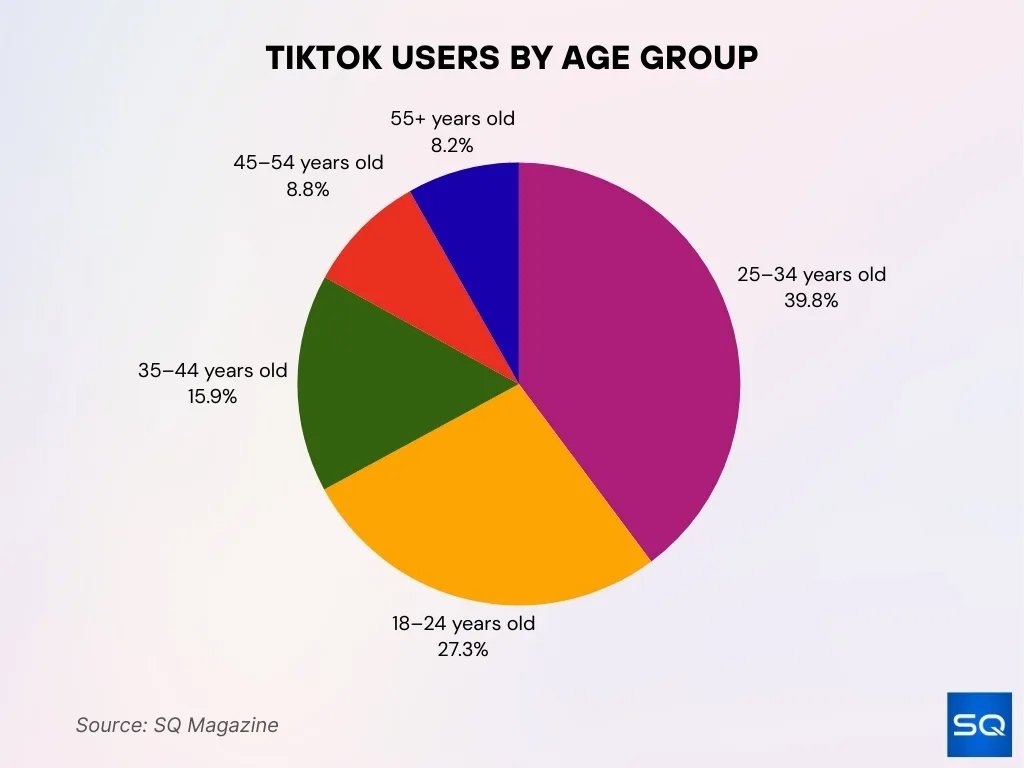
TikTok Audience Distribution by Age Range
- The largest TikTok user segment falls within the 25–34 age range, accounting for 39.8% of the platform’s overall user population.
- Young adults aged 18–24 make up 27.3% of users, highlighting TikTok’s continued dominance among younger demographics.
- Users between 35 and 44 years old represent 15.9%, underscoring the platform’s growing appeal among mid-career professionals.
- Approximately 8.8% of TikTok’s audience is aged 45–54, indicating moderate adoption among older millennials and Generation X.
- An additional 8.2% of users are 55 years or older, signaling TikTok’s expanding reach into senior age groups.
TikTok Employees vs ByteDance Employees
- As of 2023, TikTok had about 38,578 employees globally, all classified under the broader ByteDance group structure.
- ByteDance reports over 150,000 employees across nearly 120 cities worldwide, making TikTok’s headcount roughly one-quarter of the parent company’s workforce.
- ByteDance’s 110,000–150,000+ employees support multiple products (e.g., Douyin, CapCut, Lark) and AI research teams, far beyond TikTok alone.
- With 38,578 TikTok staff versus more than 150,000 ByteDance employees, TikTok workers represent well under 30% of ByteDance’s total global employment.
- In 2024–2025, TikTok cut around 60–500 roles in specific regions, while ByteDance simultaneously maintained a 150,000+ global workforce, signaling uneven reductions across the group.
- ByteDance’s layoffs in its Nuverse gaming division and global operations, affecting hundreds to over 1,000 staff, show parent-level strategic shifts that indirectly shape TikTok hiring and team structures.
- Despite selective TikTok layoffs, ByteDance’s career site continues to advertise hundreds of open roles worldwide, illustrating how parent-company priorities can redirect staffing toward other products or markets.
- TikTok maintains a distinct recruitment pipeline, with U.S. headcount alone moving from about 11,400 in 2023 to roughly 7,000 employees by early 2025, independent of ByteDance’s broader hiring in other regions.
Frequently Asked Questions (FAQs)
TikTok’s global workforce is approximately 38,578 employees as of 2023, according to the latest employment statistics.
TikTok has around 11,400 employees in the U.S. as part of its global employee count.
An Oxford Economics report estimates that 7.5 million U.S. businesses on TikTok support 28 million jobs across the economy.
TikTok’s global employee count grew from 20,000+ in 2021 to 38,578 in 2023, representing nearly a 93% increase over two years.
Conclusion
TikTok’s workforce reflects a balance of rapid historical growth, strategic restructuring, and industry pressure. While the company continues hiring in technology, marketing, and global business roles, moderation and e-commerce teams have faced significant change. Leadership decisions, hiring trends, and layoffs show how social platforms adapt talent strategies amid regulatory scrutiny and automation. Compared with peers, TikTok maintains a sizable yet evolving workforce that mirrors broader shifts in the digital economy.