

Internet addiction is emerging as one of the most pressing behavioral health concerns of the mid-2020s. As billions of people now rely on digital devices for work, school, and social connections, a growing share report losing control over their online use, and this shift is measurable. From rising screen time averages to self-reported dependency, the data shows patterns with real consequences for mental health, sleep, and daily functioning.
In the workplace, productivity losses and burnout are linked to compulsive digital behaviors. In schools, teachers are reporting increased distraction and lower engagement tied to off-task web use. Explore the detailed Internet Addiction Statistics that follow.
Editor’s Choice
- Approximately 17.9% of global internet users are estimated to meet criteria for internet addiction in 2025 studies.
- North America shows an internet addiction prevalence of ~15.2%, above the global average.
- Over 210 million people worldwide are addicted to social media and related internet use.
- An estimated 10% of Americans report clinical signs of social media dependence.
- Average daily screen time is approximately 4 hours 47 minutes on the internet and connected devices.
- Up to 73% of teens aged 13 to 17 are at risk of problematic internet use.
- Studies find 41.84% prevalence of internet addiction among university students globally.
Recent Developments
- Research models now treat internet addiction similarly to behavioral dependencies, focusing on compulsivity and impaired control.
- Large longitudinal studies are isolating addictive patterns separate from sheer screen hours.
- Evidence suggests addictive usage, not just duration, predicts worse outcomes such as sleep loss and mood problems.
- More clinicians classify excessive digital use as impulse control disorders or part of compulsive behavioral spectrums.
- Parental awareness campaigns and digital well-being clinics are expanding globally to combat youth tech dependence.
- Research increasingly distinguishes problematic internet use from productive screen time used for work or learning.
- Advances in diagnostic frameworks are beginning to include more nuanced online behavior criteria.
Global Prevalence of Internet Addiction
- 17.9% of global internet users meet the criteria for addiction in recent estimates.
- Other reports suggest 36.7% of people show signs of internet addiction at varying severity levels.
- The Middle East and Southeast Asia report the highest regional rates, at roughly 31.4% and 29.2%.
- Western Europe shows a lower prevalence, estimated at around 8.7%.
- North America maintains a prevalence rate of approximately 15.2%.
- Adolescents globally show prevalence ranges between 12% and 23%, depending on measurement standards.
- Meta-analyses reveal that prevalence varies widely based on definitions and research methods.
Internet Addiction Rates by Country
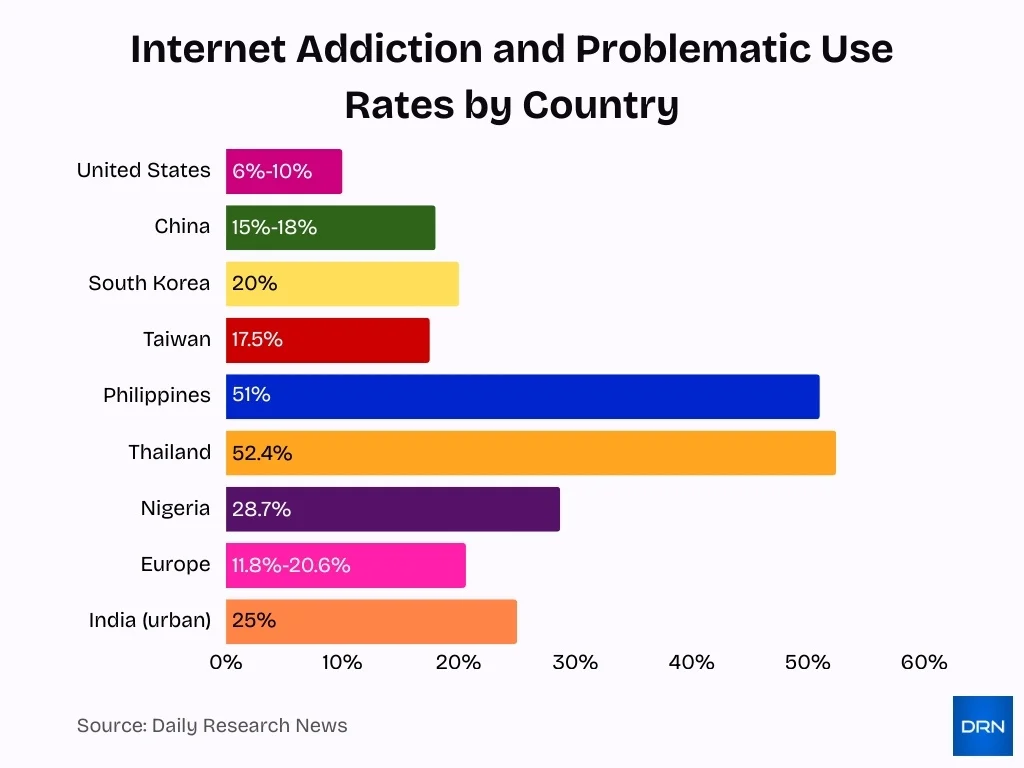
- The United States shows a 6-10% internet addiction rate among young adults.
- Chinese adolescents face a 15-18% pathological internet use.
- South Korea reports 20% of its population is at high addiction risk.
- Taiwanese students exhibit 17.5% internet addiction rate.
- Philippine adolescents have 51% problematic internet use.
- Thailand records 52.4% pathological use in university students.
- Nigeria shows 28.7% internet addiction among secondary students.
- Europe averages 11.8-20.6% adolescent addiction rates.
- Indian urban youth report 25% smartphone addiction tied to the internet.

Gender Differences in Internet Addiction
- Several studies report higher addiction rates among males in gaming and general internet use.
- Gender gaps vary by activity type, with gaming addiction more common among males.
- Social media addiction trends sometimes show higher engagement among females.
- Cultural context significantly influences gender and related addiction patterns.
- Research outcomes vary widely due to inconsistent definitions of addiction.
- Some meta-studies show minimal gender differences when broader criteria are applied.
- Ongoing research continues to explore how gender shapes internet dependency worldwide.
Internet Addiction Among Children and Teens
- Children aged 8 to 12 years spend an estimated 4 to 6 hours per day online, while teens may exceed 9 hours daily.
- Approximately 36% of teens report excessive social media use linked to stress and anxiety.
- 82% of Gen Z adults acknowledge dependency on social platforms, reflecting early addictive patterns.
- More than 11% of adolescents show signs of problematic social media behavior.
- Teens engaging in more than 4 hours of daily screen time exhibit poorer physical health outcomes.
- Children with addictive screen behaviors face a 2 to 3 times higher risk of suicidal ideation.
- Studies show 85% of teens struggle to stop using technology once they start.
- 67% of teens report sleep loss caused by nighttime device use.
- Smartphone addiction among teenagers ranges from 39% to 44% in some countries.
Internet Addiction Statistics by Age Group
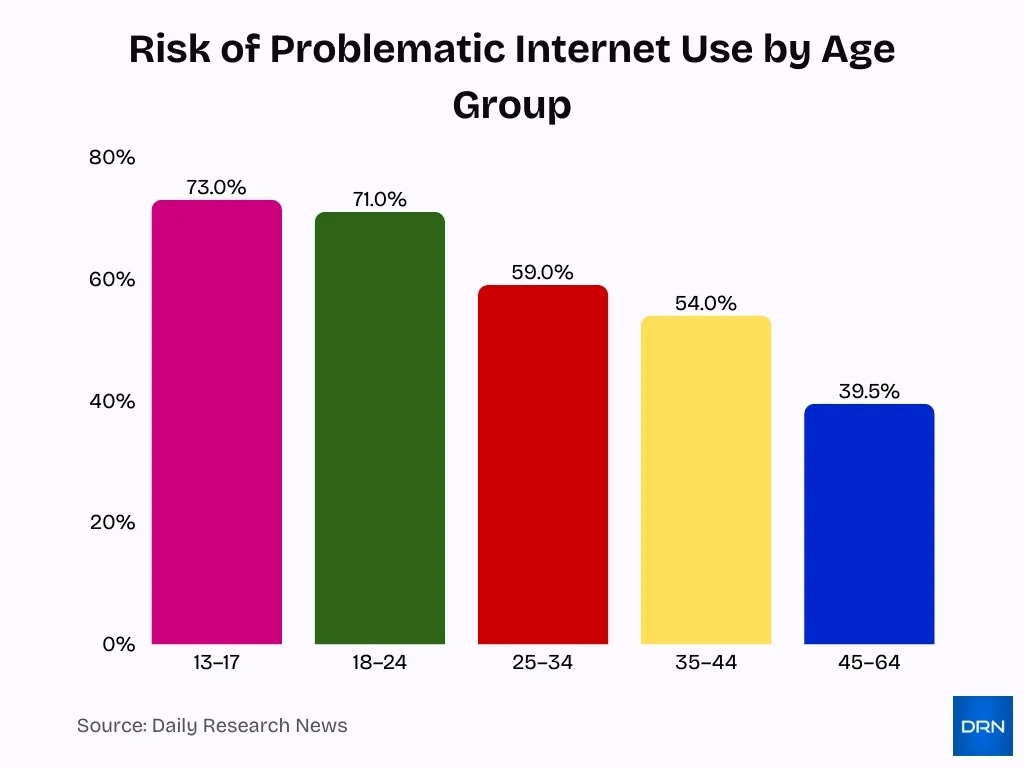
- Individuals aged 13 to 17 represent the highest risk group, with up to 73% at risk.
- Young adults aged 18 to 24 show similarly high vulnerability, at roughly 71%.
- Adults aged 25 to 34 report about 59% risk of digital addiction.
- Ages 35 to 44 show elevated risk levels near 54%.
- Adults aged 45 to 64 still exhibit notable risk levels at approximately 39% to 40%.
- Meta-analyses confirm that young adults consistently demonstrate the highest measured prevalence.
- Excessive screen engagement decreases gradually with age but remains widespread across all cohorts.
Student Internet Addiction Statistics
- Undergraduate populations report internet addiction prevalence as high as 73.3%.
- Nearly 1 in 4 college students shows signs of technology dependency.
- More than 60% of U.S. college students report addiction-level social media use.
- Smartphone, driven internet addiction affects 48.4% of university students in recent studies.
- Addictive digital engagement correlates strongly with depression, anxiety, and stress.
- Excessive online time disrupts sleep routines and concentration.
- Younger students in high-pressure academic programs show higher dependency rates.
- High social media use among students correlates with lower self-esteem.
Internet Addiction in Adults
- 57% of Americans say they feel addicted to their smartphones.
- 44% of U.S. adults experience anxiety when separated from their phones.
- Nearly 53% of Americans check their phones within 10 minutes of waking.
- Smartphone addiction affects approximately 15% of adults aged 18 to 29.
- Around 42% of adults globally report anxiety without smartphone access.
- Digital distraction reduces productivity for over half of U.S. employees.
- Compulsive checking behaviors remain common among working adults.
- Many adults report internet use that interferes with daily routines and relationships.
Average Daily Screen Exposure Among U.S. Adolescents
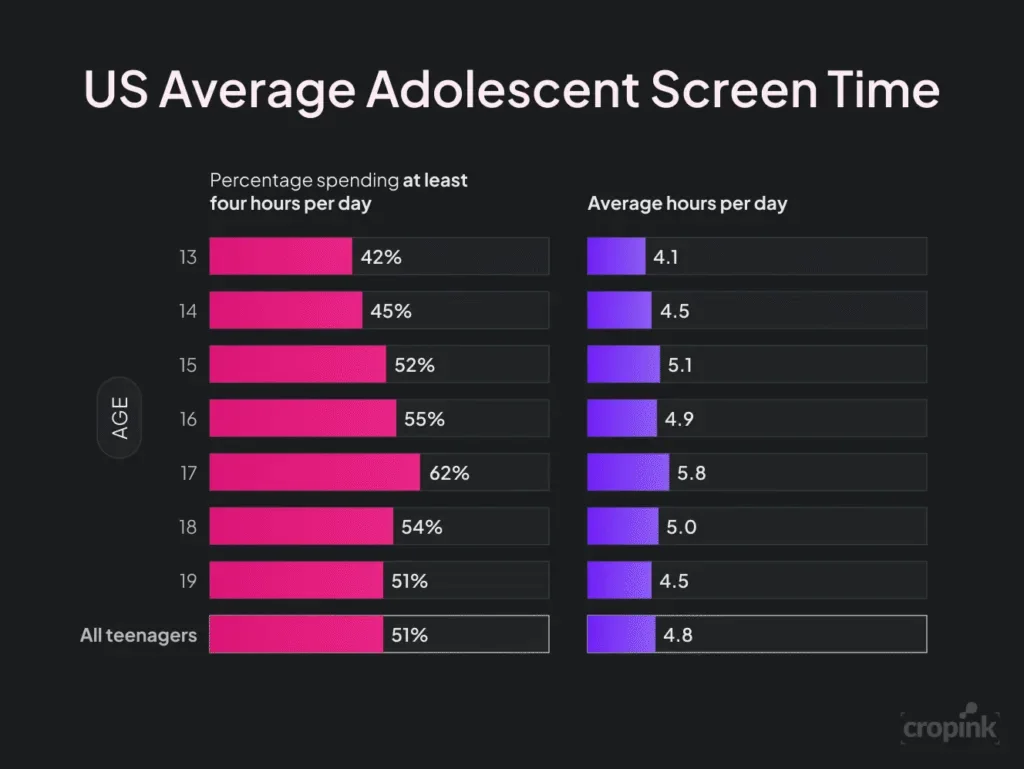
- 51% of all teenagers spend at least four hours per day on screens, with an average daily usage of 4.8 hours.
- 62% of 17-year-olds report the highest screen time, recording an average of 5.8 hours per day.
- At age 15, 52% of teens spend 4+ hours on screens, resulting in an average of 5.1 hours daily.
- 16-year-olds closely follow, with 55% spending 4+ hours, and an average screen time of 4.9 hours per day.
- 18-year-olds log an average of 5.0 hours, with 54% reaching the 4-hour minimum threshold.
- Teens aged 19 and 14 each average 4.5 hours daily, with 51% and 45% spending at least 4 hours, respectively.
- The lowest screen time is observed among 13-year-olds, at 4.1 hours per day, with only 42% spending 4+ hours.
Average Daily Internet Usage Time
- The average individual spends 4 hours 47 minutes per day online.
- Global smartphone users average 4.6 hours of daily use.
- 63% of Gen Z users in the U.S. spend more than 6 hours daily on social platforms.
- Teens often exceed 7 hours of daily screen time, surpassing recommended limits.
- Parents report frequent unsupervised device use among children.
- Americans check their phones more than 140 times per day on average.
- Screen engagement continues to rise year over year.
Symptoms and Signs of Internet Addiction
- Around 36.7% of the global population suffers from internet addiction, struggling to stop online activity despite interference with responsibilities.
- 93.8% of respondents in a study showed signs of internet addiction, including anxiety when unable to access the web.
- 64.2% of those with internet addiction report chronic poor sleep quality from late-night screen use.
- 85.7% of internet addicts experience persistent cravings and unsuccessful attempts to control usage.
- 70.8% of online gamers exhibit reduced interest in offline hobbies due to compulsive internet use.
- Internet addicts face 14 times higher odds of neglecting work, school, or family responsibilities.
- The average person checks their phone 205 times daily, fueling compulsive notification checking in addicts.
- One in ten UK adults (10%) feels irritable and stressed when technology is unavailable.
- 32.7% of adolescents display at least three symptoms of internet addiction, like withdrawal distress.
- 53.6% prevalence of addiction includes restlessness without internet access in over half.
Internet Addiction Severity Levels Among Users
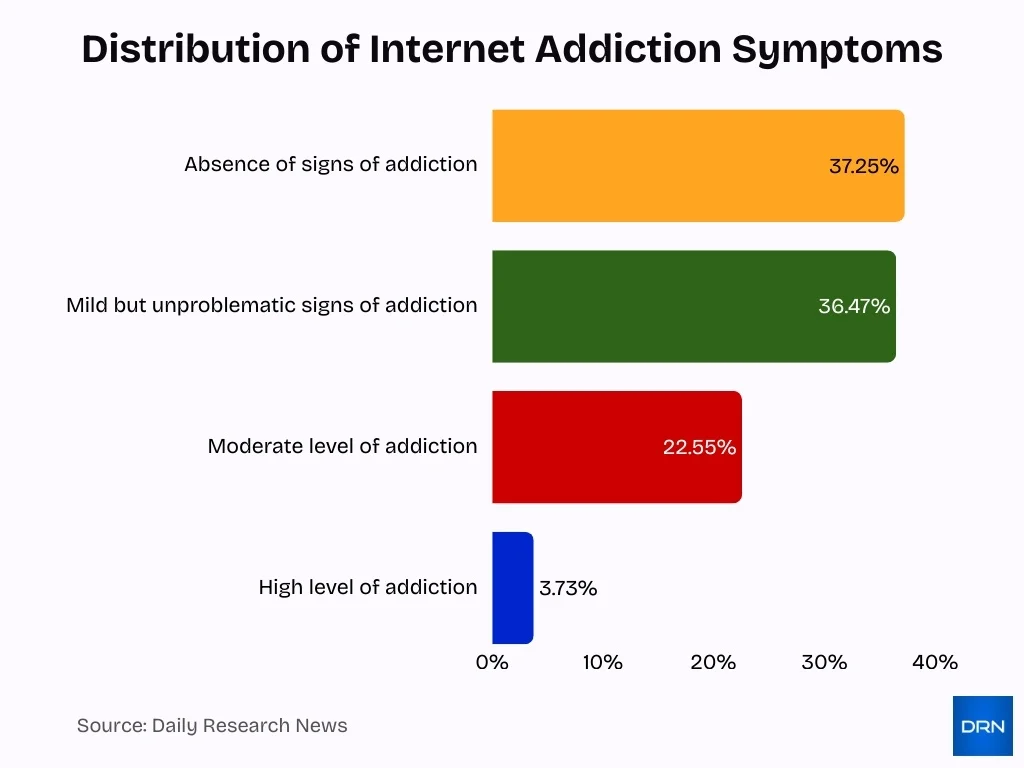
- 37.25% of users show an absence of addiction signs, indicating healthy and controlled internet usage habits.
- 36.47% of individuals display mild but unproblematic addiction symptoms, suggesting early behavioral indicators without serious impact.
- 22.55% of users experience a moderate level of internet addiction, where online usage begins to affect daily routines and responsibilities.
- Only 3.73% of users fall into the high addiction category, representing severe and potentially harmful internet dependency.
Risk Factors for Internet Addiction
- Younger age groups aged 12-18 show 3x higher internet addiction rates than adults.
- Individuals with pre-existing anxiety face a 3.3x greater risk of internet dependency.
- Limited parental supervision triples addiction risk in children under 12.
- Nighttime screen use for over 3 hours worsens sleep quality by 40% in addicts.
- Social media engagement with peer influence boosts dependence by 2.5x.
- Mood regulation via the internet predicts compulsive use in 65% of cases.
- ADHD individuals have 9.3x elevated addiction risk.
- Habitual checking cycles reinforce long-term dependency in 80% of Gen Z.
Post‑Pandemic Rise in Internet Addiction
- Internet and social media addiction increased sharply during and after pandemic lockdowns.
- Studies show significant growth in online engagement compared with pre-pandemic levels.
- Higher addiction levels correlate with increased depression, anxiety, and stress.
- Remote work and learning sustained elevated screen exposure post-pandemic.
- Adolescents and young adults remain the most affected demographics.
- Online coping behaviors for isolation continue to drive dependency.
- Screen exposure remains higher than pre-2020 baselines.
- Experts emphasize the need for long-term digital well-being initiatives.
Emotional Impact of Social Media on Teenagers
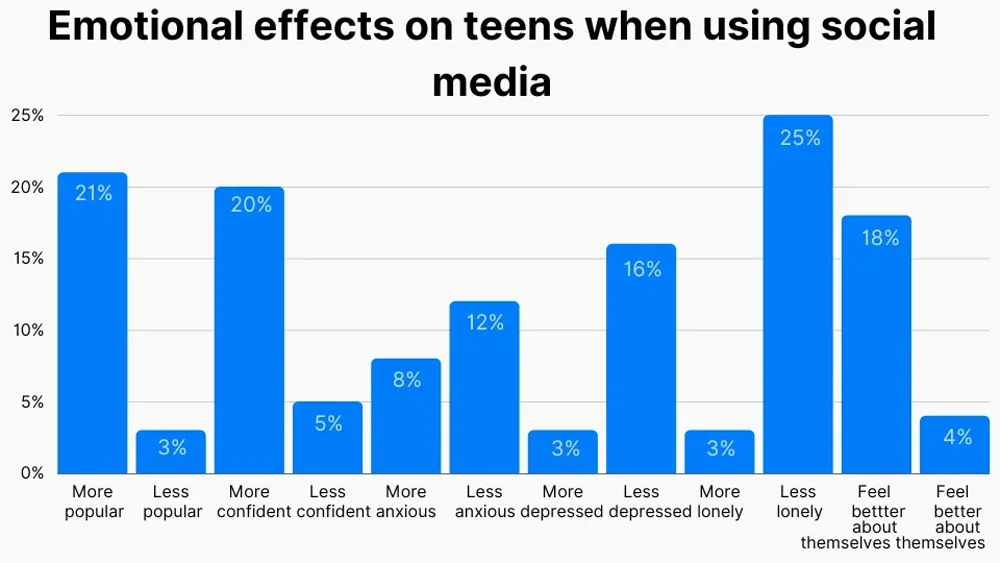
- 25% of teens report that social media makes them feel less lonely, representing the most common positive emotional effect.
- 21% feel more popular when using social media, while only 3% report feeling less popular.
- 20% of teens say social media helps them feel more confident, whereas just 5% feel less confident.
- 18% state that social media helps them feel better about themselves, compared to 4% who say it makes them feel worse.
- 16% of teens feel less depressed due to social media use, while only 3% say it makes them more depressed.
- 12% experience less anxiety after using social media, yet 8% report feeling more anxious.
- Only 3% of teens feel lonelier because of social media, which is significantly lower than those who feel less lonely.
Mental Health Effects of Internet Addiction
- Excessive internet use is linked to higher anxiety and depression rates.
- Internet addiction contributes to emotional dysregulation and chronic stress.
- Persistent dependency worsens social anxiety and self-esteem issues.
- Compulsive use correlates with lower life satisfaction.
- Internet addiction often co-occurs with ADHD and impulse control disorders.
- Post-pandemic data shows sustained mood instability linked to heavy internet use.
- Social comparison on digital platforms increases loneliness.
- Mental health professionals now recognize compulsive digital behavior as a major risk factor.
Physical Health Impacts of Internet Addiction
- Excessive screen time from internet addiction increases overweight/obesity odds by 1.27 times in adolescents.
- Each additional 1 hour/day of internet use raises overweight/obesity odds by 8%.
- 16.7% of adolescents with excessive internet use suffer physical-mental multimorbidity.
- 21% of students show internet addiction linked to neck pain and wrist discomfort.
- Teens using the internet >14 hours/week have elevated blood pressure and are often a higher weight.
- Heavy internet users experience melatonin suppression from blue light, disrupting sleep.
- Evening screen use >2 hours ties to sleep deprivation in 51% of short sleepers.
- Each extra screen hour/day boosts obesity odds by 1.09 and diabetes by 1.17.
- Internet addiction correlates with 22.9% of severe cases reporting physical complaints.
- 75.3% of internet-addicted adolescents show inadequate physical activity.
Smartphone Usage and Addiction Patterns in the UK
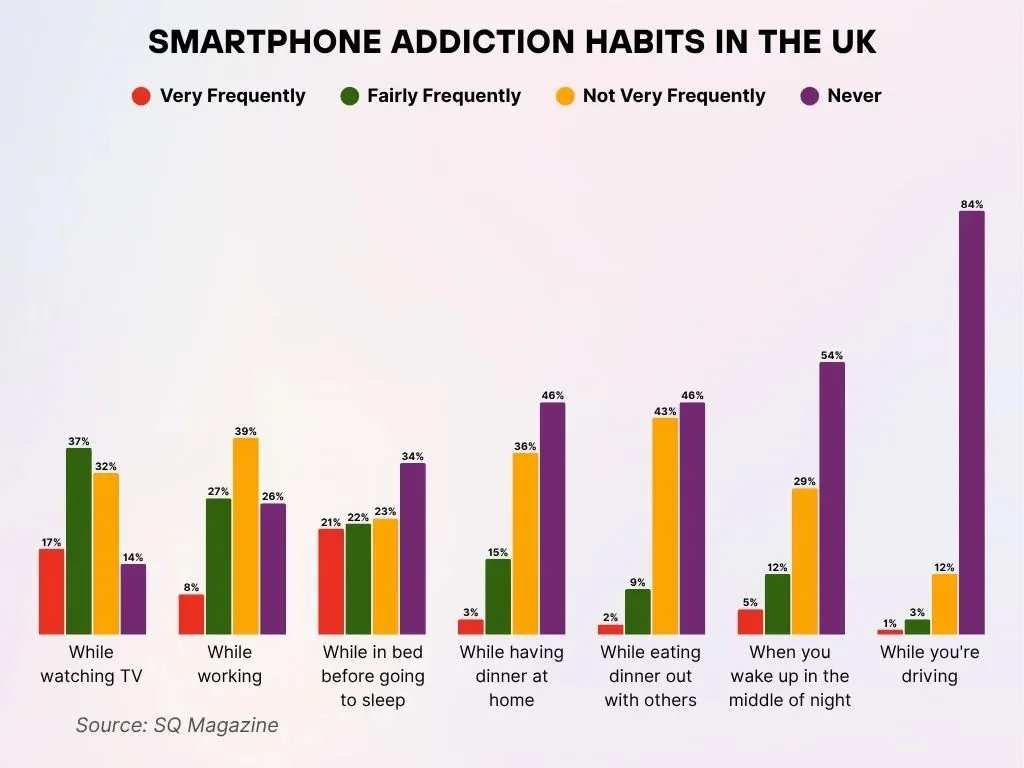
- 54% of UK respondents say they never check their phones when waking up in the middle of the night, but 17% still do so very or fairly frequently.
- 84% of people never use their phones while driving, yet 4% admit to doing it very or fairly frequently, highlighting ongoing safety concerns.
- While watching TV, 54% of users check their phones very or fairly frequently, reflecting a strong dual-screening habit.
- During work hours, 35% of users look at their phones very or fairly frequently, whereas 26% say they do not check them at all.
- 43% of users very or fairly frequently check their phones in bed before sleep, a behavior that may negatively affect sleep quality.
- When having dinner at home, 18% of users check their phones frequently, but nearly half, 46%, report that they never do.
- Only 11% of users check their phones frequently while eating dinner out, while 46% say they completely avoid phone use in this setting.
Social and Relationship Consequences
- 52.5% of regular internet users face addiction risk, straining marital satisfaction and causing communication breakdowns.
- 77.78% of addicted students live in families with unhealthy functioning, highlighting strained family ties.
- 63.8% of participants found face-to-face interactions challenging due to internet overuse.
- Individuals with internet addiction show deficits in empathy processing and social avoidance.
- 70% of teenagers report loneliness from excessive social media use tied to internet habits.
- Teens spending over 5 hours daily on phones are 2x more likely to exhibit depressive symptoms linked to isolation.
- Positive correlation exists between internet addiction and loneliness, forming a vicious cycle.
- Internet addiction displays the highest expected influence (EI=0.71) on workplace dynamics via digital distractions.
Internet Addiction and Sleep Disorders
- Internet addiction raises the risk with a pooled OR of 2.20.
- 69% of young adults show moderate internet addiction, and insomnia is correlated at r=.67.
- Regular nighttime smartphone use doubles sleep latency risk (>30 min, OR 1.98).
- 80.7% bedtime smartphone users link to poor sleep (ORs 1.32-2.12).
- Adolescents with >8 hours daily screen time are poor sleepers in 62.2% cases.
- ≥9 hours of screen time boosts bad sleep odds by 60% (PR 1.60).
- Internet overusers face 5.62 times higher insomnia.
- Internet addiction predicts 45.3% of insomnia variance.
- 52.5% of heavy screen adolescents have poor sleep quality.
- Bedtime screens raise EDS risk 1.3-1.9-fold.
Productivity and Academic Impacts
- Students with severe internet addiction have a mean GPA of 2.41, compared to 3.45 for normal users.
- 21% of students show severe internet addiction, linked to lower academic performance.
- Internet-addicted students: 51% sleep <6 hours/day, and 54% rate their performance as moderate.
- Poor sleep quality affects 31% of students, significantly associated with internet addiction (OR=3.98).
- 13% of heavy internet users report a decline in school performance due to excessive use.
- IAT scores predict 10% of GPA variance, with higher addiction lowering GPAs.
- 84% of students are internet addicted, with 35.6% showing poor academic results.
- Workplace productivity shows a negative correlation with internet addiction, increasing distractions, and errors.
Frequently Asked Questions (FAQs)
Approximately 14% to 18% of the global population meets criteria for internet addiction, depending on the study and measurement methods.
A meta‑analysis found about 41.84% prevalence of internet addiction among university students across 38 countries.
An estimated 210 million people worldwide are addicted to social media and internet use as of 2025.
About 10% of Americans (roughly 33 million people) are reported to be addicted to social media.
Conclusion
Internet addiction remains a multi‑faceted challenge in the digital age. Data shows that compulsive online behaviors, intensified by post-pandemic routines, affect mental well-being, physical health, and daily functioning. Children and young adults face disproportionate risks, including sleep disruption, academic decline, and strained relationships.
Across all age groups, higher dependency aligns with lower productivity, poorer sleep, and reduced quality of life. While the internet remains essential, the evidence highlights the need for informed strategies, education, and balanced digital habits to reduce long-term harm.