

The Internet of Things (IoT) continues to reshape how people live and businesses operate by connecting everyday physical objects to the internet and one another. From smart thermostats in homes to connected industrial machines on factory floors, IoT has moved well beyond early experimentation into mainstream adoption. In the transportation sector, fleet operators use real‑time vehicle tracking to reduce fuel costs, while healthcare providers monitor patient vitals remotely to improve outcomes and cut down hospital visits. As we approach, IoT’s momentum only continues to gather pace. Below are key findings that set the stage for deeper industry insights.
Explore the latest IoT statistics and understand who’s leading, where growth is heading, and what opportunities and risks lie ahead.
Editor’s Choice
- 21.1 billion connected IoT devices active globally by the end of 2025, up ~14% year‑over‑year.
- The global IoT market is estimated at $1.3 trillion in 2026.
- The IoT device market is expected to grow to $293.46 billion in 2026 from $245 billion in 2025.
- The IoT platforms sector is expected to reach $18.23 billion in 2026.
- Cellular IoT links forecast near 4.5 billion connections by the end of 2025.
- The IoT connectivity market is predicted to hit $12.44 billion in 2025.
- Consumer and enterprise revenue is expected to grow steadily through the decade.
Recent Developments
- In 2025, IoT-connected device counts climbed to over 21 billion worldwide, signaling accelerating deployments.
- eSIM adoption, critical for global IoT connectivity, is forecast to rise 30% in 2026 to ~1.5 billion devices, particularly in enterprise use cases.
- Smart cities and infrastructure remain strong growth drivers for IoT spending and integration.
- Industrial IoT market valuation continues climbing, driven by automation and cloud adoption.
- AI and edge integration are increasingly embedded into IoT solutions to process data at endpoints rather than centralized servers.
- IoT development services and frameworks are scaling as enterprises outsource for faster deployment.
- Security approaches are adapting to rising numbers of connected endpoints across sectors.
Global Overview of the Internet of Things
- The total global IoT market is anticipated to grow significantly through the mid‑2030s, with forecasts exceeding $5 trillion by 2035.
- North America retains a leading market share, fueled by enterprise and consumer adoption.
- Asia‑Pacific and China remain key accelerators in global IoT deployment.
- Smart city initiatives and infrastructure planning drive municipal IoT investments worldwide.
- IoT’s economic impact spans manufacturing, healthcare, logistics, and energy.
- Enterprise IoT adoption rates are rising as companies seek operational efficiency gains.
- Consumer IoT (such as smart home devices) continues to be a high‑growth segment globally.
Global Internet of Things Market Size and Growth Forecast
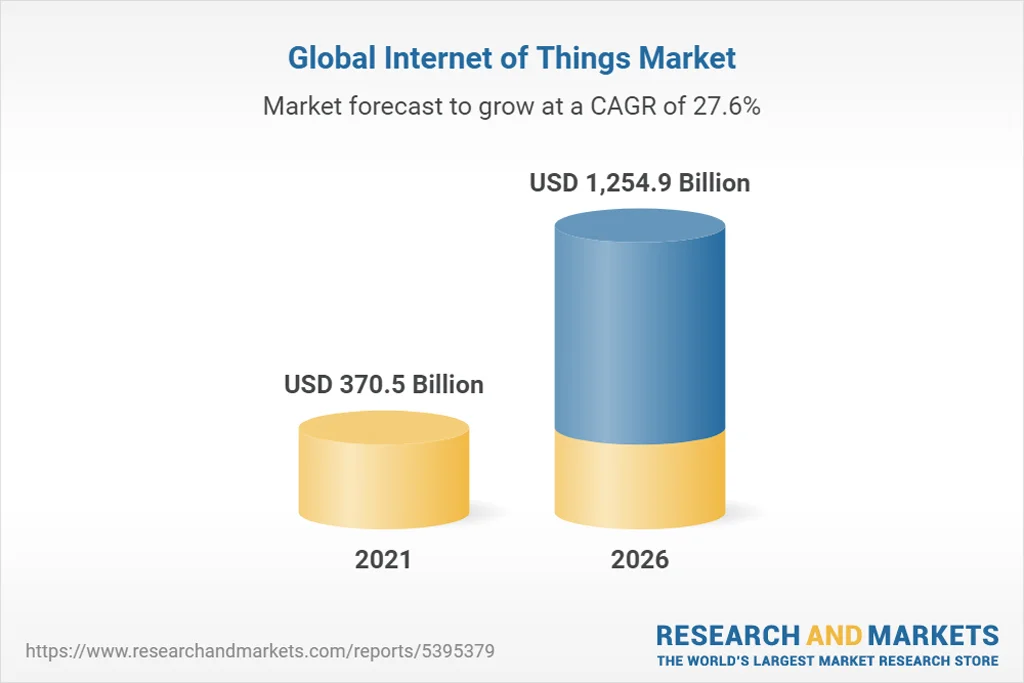
- The Global Internet of Things (IoT) Market was valued at $370.5 billion in 2021, marking a strong baseline for industry expansion.
- The market is projected to surge to $1,254.9 billion by 2026, reflecting massive growth in connected technologies worldwide.
- The industry is expected to grow at a robust 27.6% CAGR during the forecast period.
- Between 2021 and 2026, the IoT market is anticipated to add approximately $884.4 billion in total market value.
- The forecast highlights a more than 3x increase in market size within just five years, underscoring accelerating adoption across industries.

Key Adoption Statistics in the Internet of Things
- IoT adoption is expanding across consumer, enterprise, and industrial IoT sectors.
- Enterprises are increasingly investing in IoT to reduce costs and optimize workflows.
- Adoption rates of connected IoT technologies (~smart sensors, actuators) are rising across logistics and supply chain operations.
- Cellular IoT technologies contribute ~21% of global connections.
- Smart buildings and industrial automation are strong drivers of sector IoT uptake.
- Surveys show a majority of enterprises believe IoT delivers measurable ROI.
- Deployment decisions are increasingly influenced by AI and analytics integration priorities.
Number of Connected Devices in the Internet of Things
- End‑of‑2025 IoT devices worldwide: ~21.1 billion, up ~14% YoY.
- Forecasts suggest device connections could exceed 22 billion by 2026.
- Long‑term models point toward ~40 billion connections by 2034.
- Cellular IoT connections alone are expected to reach 4.5 billion by 2025.
- Greater China remains among the largest single regional pools of IoT devices.
- Europe and North America collectively host multiple billions of connected endpoints.
- Cellular technologies NB‑IoT and Cat‑M are expected to dominate low‑power wide‑area deployments.
Top IoT Categories by Market Share Breakdown
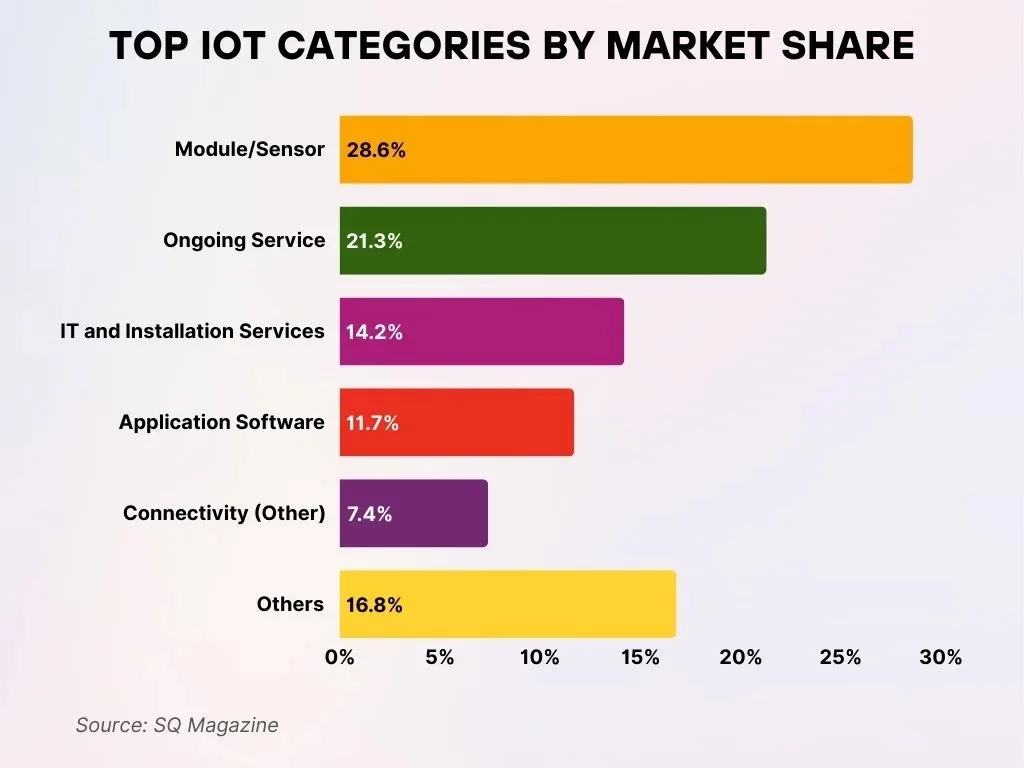
- Module/Sensor dominates the IoT market with a 28.6% share, highlighting its foundational role in device functionality and data collection.
- Ongoing Service accounts for 21.3% of the market, underlining the importance of continuous support and maintenance in IoT ecosystems.
- IT and Installation Services represent 14.2%, showing strong demand for infrastructure setup and deployment.
- Application Software captures 11.7% of the market, crucial for enabling smart functionalities and analytics.
- Connectivity (Other) holds 7.4%, covering various protocols and communication standards within IoT networks.
- Others collectively make up 16.8%, indicating a broad range of additional IoT components and services.
Revenue and Spending Trends in the Internet of Things
- Global IoT annual revenue/spending is estimated at around $800–$900 billion in the mid‑2020s, with projections indicating it will surpass $1 trillion by 2026 and continue growing at roughly 10% CAGR.
- IoT‑related global spending is projected to climb from around $800+ billion in 2023 to more than $1 trillion by 2026, propelled by ongoing enterprise digitization and industry automation.
- Enterprises increasingly allocate budget to connected sensors, analytics, and automation platforms as operational optimization priorities rise.
- Development services remain a key segment: the IoT development services market was valued at ~$527.96 million in 2025 and is forecast to climb sharply to ~$2,956.51 million by 2034.
- Strong YoY revenue growth across the IoT ecosystem is partially fueled by cloud and AI integration, predictive maintenance, and edge analytics spending.
- The IoT security solutions market is growing aggressively, projected to expand by ~25% in one year, followed by an ~18% increase, reflecting rising enterprise demand for protection.
- Investments in custom IoT consulting and integration services are enabling faster deployment cycles and scalability across industries.
- Spending in IoT connectivity (networks and SIM management) is also rising, as cellular and LPWAN technologies expand capacity.
Regional and Country Insights on the Internet of Things
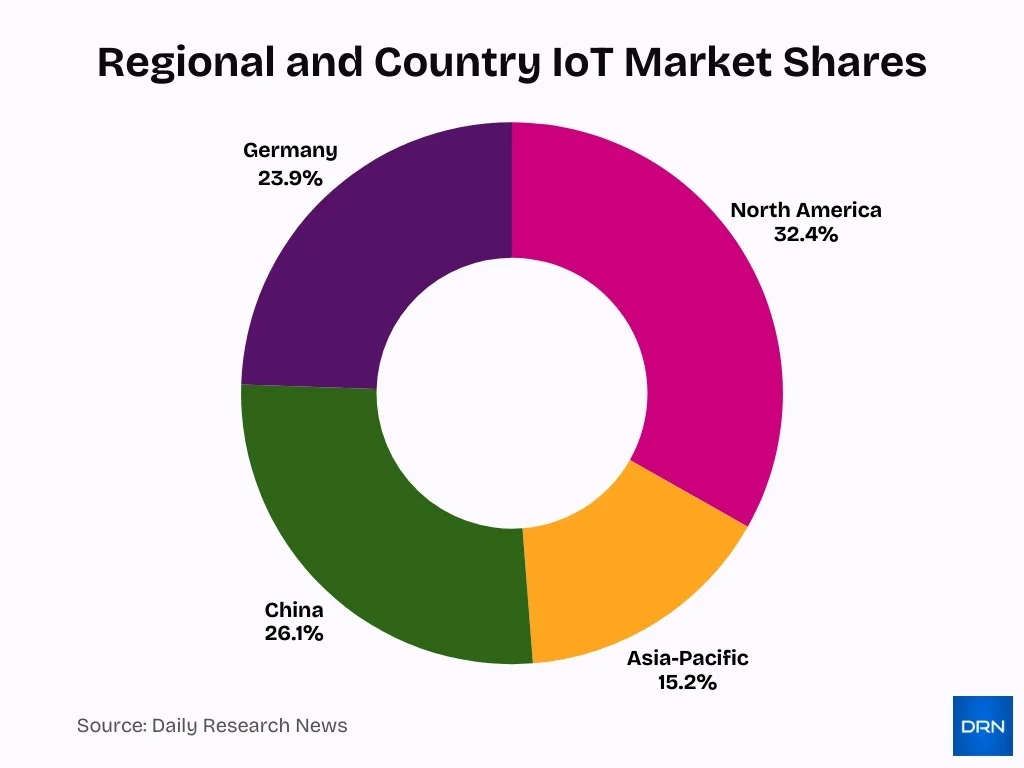
- North America holds a commanding 32.4% of the global IoT market in 2025.
- Asia-Pacific exhibits the highest CAGR of 15.2% through 2030 for IoT growth.
- The US IoT market is valued at $169 billion in 2025, leading enterprise adoption.
- Europe‘s IoT market reached $246.63 billion in 2025.
- China dominated with $300 billion IoT revenue, 26.1% global share in 2025.
- North America generated $279.90 billion in IoT technology spending in 2025.
- Asia-Pacific IoT spending surged to $241 billion, up 12.5% YoY in 2025.
- GCC region IoT market hit $27.96 billion amid smart city initiatives in 2025.
- Germany captured 23.9% of Europe’s IoT market share in recent years.
Consumer vs Enterprise Use of the Internet of Things
- Consumer IoT, including smart home devices and wearables, continues broad adoption, often driving first‑time IoT engagement.
- IoT devices in the smart home segment accounted for ~31% of IoT market revenue in 2025.
- Wearables (fitness bands, smart watches) are among the fastest‑growing categories for consumer IoT.
- Enterprise IoT penetrates manufacturing, logistics, healthcare, utilities, and smart city deployments at scale.
- Enterprise IoT market size (broader than devices alone) was valued at ~$490 billion in 2024, with growth expected through 2033.
- Business usage increasingly prioritizes real‑time analytics, automation, and security over consumer convenience features.
- Consumer IoT often leads in sheer device count, while enterprise IoT tends to command larger per‑device spend and integration complexity.
- The enterprise’s emphasis on cloud integration and managed services distinguishes it from simpler consumer device deployments.
Device Types and Categories in the Internet of Things
- The global smart home devices market is expected to reach $163.30 billion in 2025.
- The IoT wearable devices market is valued at $20.1 billion in 2025, growing at 10.3% CAGR.
- The sensors and actuators market is projected to be $177.93 billion in 2025.
- The industrial sensors market size stands at $25.68 billion in 2025.
- The IoT gateways market is valued at $1.676 billion in 2025.
- The telematics systems market is expected to reach $52.8 billion in 2025.
- The GPS trackers market size is expected to hit $4.4 billion in 2025.
- The IoT medical devices market is expected to reach $65.08 billion in 2025.
- The environmental sensors market is valued at $2.51 billion in 2025.
- The LPWAN segment grows at 14% CAGR from 2025 in IoT platforms.
Connectivity and Network Trends in the Internet of Things
- Cellular IoT connections are expected to reach ~4.5 billion by the end of 2025 and continue growing.
- Broadband 4G/5G connections are expected to make up a major portion of IoT connectivity, supporting higher throughput needs.
- Advances in NB‑IoT and LTE‑M technologies drive scalable, energy‑efficient connectivity for massive device fleets.
- IoT connectivity is increasingly a mix of Wi‑Fi, cellular, LPWAN, and even satellite links for remote coverage.
- The emergence of eSIM and iSIM technologies is streamlining provisioning and large‑scale connectivity for enterprise IoT devices.
- Continued 5G deployment supports low‑latency, high‑capacity IoT networks for industrial and commercial applications.
- Connectivity trends show integration of edge computing to process data closer to endpoints, reducing latency.
- IoT networking growth remains tied to global 5G and LPWAN roll‑outs, which improve coverage and reliability.
Worldwide IoT Market Distribution Across Sub-Sectors
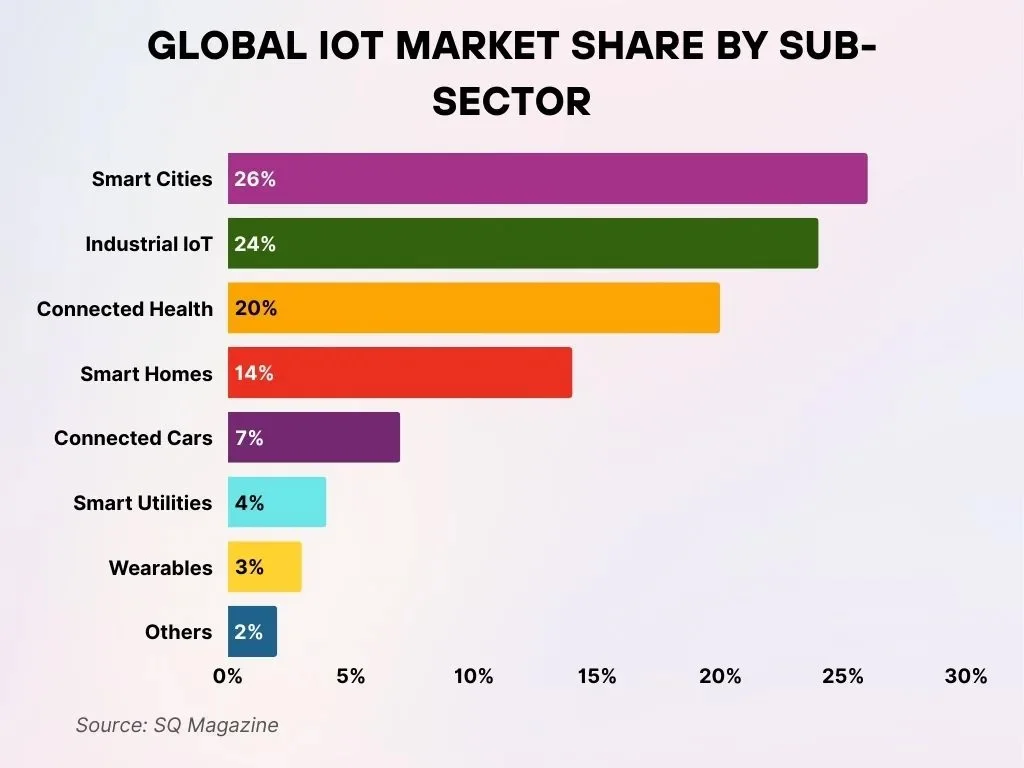
- Smart Cities dominate the global IoT landscape with a 26% share, highlighting accelerated urban integration of connected infrastructure and digital ecosystems.
- Industrial IoT ranks next with 24%, propelled by the expansion of smart manufacturing systems and advanced automation technologies.
- Connected Health secures 20%, underscoring the rising adoption of remote patient monitoring and digital health-tracking solutions.
- Smart Homes contribute 14%, demonstrating strong consumer demand for home automation and intelligent appliance ecosystems.
- Connected Cars account for 7%, reinforcing ongoing progress in autonomous driving and internet-enabled vehicle technologies.
- Smart Utilities represent 4%, encompassing innovations in smart grids and energy-efficient infrastructure systems.
- Wearables capture 3%, covering smartwatches, fitness trackers, and other personal IoT-enabled devices.
- Others comprise the remaining 2%, including specialized or emerging IoT applications across various industries.
Platform and Software Usage in the Internet of Things
- The IoT platform market is forecast to be worth $67.47 billion in 2026, growing toward ~$121.81 billion by 2031 at a ~12.5% CAGR.
- Cloud and software‑as‑a‑service (SaaS) models accounted for over 62% of IoT platform deployments in 2025.
- Application enablement layers made up ~42.5% of platform spending in 2025, driven by analytics and real‑time insights.
- Enterprise IoT platforms increasingly combine edge‑to‑cloud orchestration to balance latency and scalability.
- Hybrid platform configurations are advancing at ~13% CAGR through 2031 to support latency‑sensitive applications.
- Large enterprises held ~55% share of IoT platform usage in 2025, but small and mid‑size firms are catching up.
- North America led global platform adoption in 2025 with ~38% of deployments.
- Asia Pacific is the fastest‑growing region for IoT platform uptake through 2031.
- Platform integration with analytics, ML, and security tooling is a key priority for enterprise IoT adopters.
Manufacturing and Industrial Growth in the Internet of Things
- Global industrial IoT market reaches $514.39 billion in 2025, growing to $2,430.21 billion by 2035 at a 16.8% CAGR.
- Manufacturing holds 28.7% revenue share in the IIoT end-use in 2025.
- IoT in the manufacturing market is valued at $141.18 billion in 2025, projected to hit $1,108.42 billion by 2034 with 26.2% CAGR.
- 62% of manufacturers have adopted IoT in processes for automation and real-time monitoring.
- 35% of maintenance professionals use IIoT sensors extensively for predictive maintenance.
- Predictive maintenance accounts for 30.22% of IoT manufacturing applications in 2026.
- Smart factories require 0.5 connected IoT devices per square meter.
- 29% of global manufacturing firms implement digital twins with IoT integration.
- 62% of manufacturers invest in robotics and automation powered by IIoT.
- Edge computing in IIoT reduces latency by 90% and data costs by 30%.
Leading IoT Device Connectivity Standards and Adoption Trends
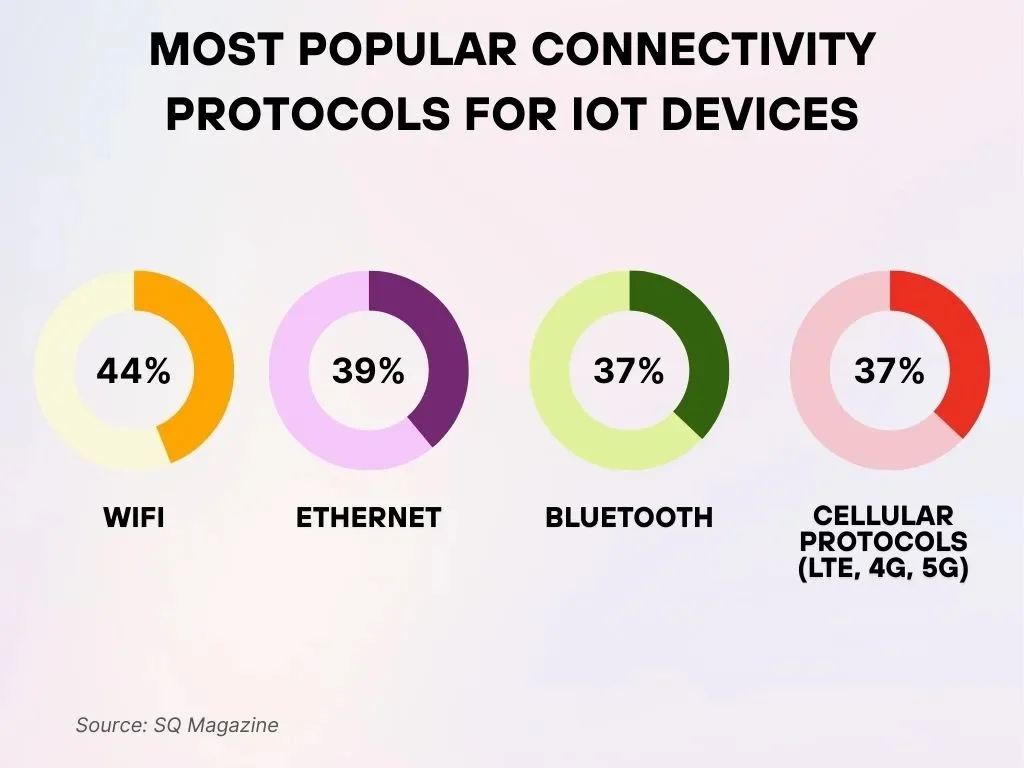
- Wi-Fi stands as the dominant connectivity choice for IoT, powering 44% of deployments thanks to its broad availability and straightforward configuration.
- Ethernet secures the second position at 39%, delivering reliable wired connectivity that is widely favored in industrial environments and fixed-location installations.
- Bluetooth is adopted by 37% of IoT devices, making it well-suited for short-range communication and energy-efficient applications.
- Cellular protocols (including LTE, 4G, and 5G) also account for 37%, enabling mobile and remote IoT use cases where uninterrupted connectivity is essential.
- These statistics underscore the diverse IoT connectivity ecosystem, demonstrating that no single protocol commands complete dominance across all application scenarios.
Healthcare and Medical Use Cases in the Internet of Things
- Global IoT healthcare market reaches $243.40 billion in 2025, growing at 15.3% CAGR to $1 trillion by 2035.
- Patient monitoring holds 28.4% market share in IoT healthcare applications in 2025.
- The wearable medical devices market is valued at $53.73 billion in 2025, expanding to $502.85 billion by 2034 at 25.06% CAGR.
- Hardware components dominate IoT healthcare with 34.2% market share in 2025.
- Remote patient monitoring is expected to cover 30% of the global population by 2025.
- Connected wearable devices are projected to exceed 1.2 billion units by 2025.
- AI-based IoT tools improve medication adherence by 6.7%–32.7% in clinical trials.
- Hospital assets remain unutilized for over 50% of their lifespan without IoT tracking.
- Diagnostic wearables capture 63% revenue share in the wearable medical devices market in 2025.
- Home healthcare applications lead wearable devices with 54% market share in 2025.
Smart Homes and Buildings Powered by the Internet of Things
- The global smart home devices market reached $145.44 billion in 2025, growing at 15.2% CAGR.
- Smart home device shipments hit 1.06 billion units in 2025 worldwide.
- 47% of households in mature markets own at least one smart home device.
- Smart thermostat adoption stands at 16-17% of US internet households.
- Voice assistants in the smart homes market are valued at $25 billion in 2025.
- IoT smart meters installed globally total 1.06 billion units by end-2023.
- Smart buildings with IoT achieve up to 70% energy savings via automation.
- Edge AI in smart devices grows at 30.2% CAGR, reaching $385 billion by 2034.
- Around 87% of older home IoT devices remain vulnerable due to a lack of updates.
Smart Home Device Adoption Growth
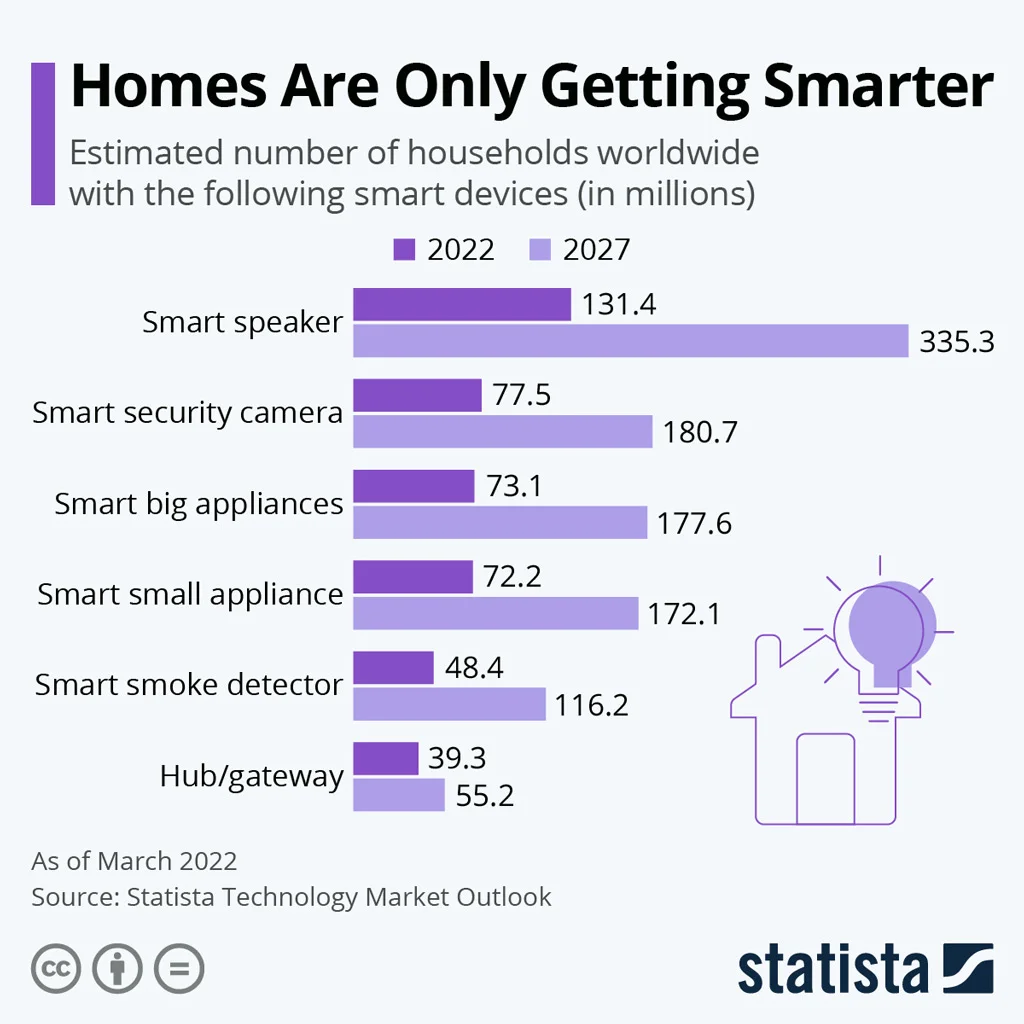
- Smart speakers lead global adoption, increasing from 131.4 million households in 2022 to 335.3 million in 2027, making them the most widely used smart home device worldwide.
- Smart security cameras show strong growth, rising from 77.5 million to 180.7 million households, reflecting the growing focus on home safety and surveillance.
- Smart big appliances are expected to expand from 73.1 million in 2022 to 177.6 million in 2027, highlighting rising demand for connected kitchens and home systems.
- Smart small appliances will grow from 72.2 million households to 172.1 million, driven by increased adoption of everyday smart devices.
- Smart smoke detectors are projected to more than double, climbing from 48.4 million to 116.2 million households, emphasizing rising awareness of home safety technologies.
- Hubs and gateways show steady but slower growth, increasing from 39.3 million in 2022 to 55.2 million in 2027, supporting overall smart home connectivity infrastructure.
Transportation and Automotive Developments in the Internet of Things
- The global connected cars market reached $105.67 billion in 2025, growing at a 14.1% CAGR.
- IoT fleet management solutions reduce operating costs by up to 25% through optimized routing and fuel efficiency.
- Predictive maintenance in IoT-enabled vehicles cuts unplanned downtime by 30%.
- 76% of drivers fear remote cyberattacks on connected cars could endanger lives.
- The Vehicle-to-Infrastructure (V2I) market will grow from $410 million in 2024 to $1,095.61 million by 2030 at 17.8% CAGR.
- Over 192 million connected cars were in service globally by 2023, driving V2X integration.
- Ride-sharing market, powered by IoT tracking, valued at $156.01 billion in 2025 with 21.3% CAGR.
- The automotive IoT market is projected to hit $91.69 billion by 2034 from $37.20 billion in 2026.
- IoT solutions in fleets reduce fuel consumption by 15% and boost vehicle utilization by 20%.
- Edge AI in automotive enables real-time sensor data management for ADAS and predictive features.
Artificial Intelligence Integration in the Internet of Things
- The IoT market is projected to grow from $25.44 billion in 2025 to $81.04 billion by 2030 at a 26.1% CAGR.
- 54% of companies currently use AI, and 51% use IoT in business processes.
- AIoT connections expected to reach 9.1 billion devices by 2033, up from 1.4 billion in 2023.
- Edge AI in IoT reduces latency by processing data locally, enabling real-time insights.
- Predictive maintenance with AI-IoT cuts downtime by 35–45% and maintenance costs by 25–30%.
- 47% reduction in unplanned downtime achieved via AI-driven predictive maintenance solutions.
- Manufacturing holds 26.4% share in AI in the IoT market, leading with smart factory adoption.
- Over 50% of IoT devices have critical vulnerabilities, heightening AI integration security focus.
- North America dominates AI in IoT with 33% revenue share in 2024.
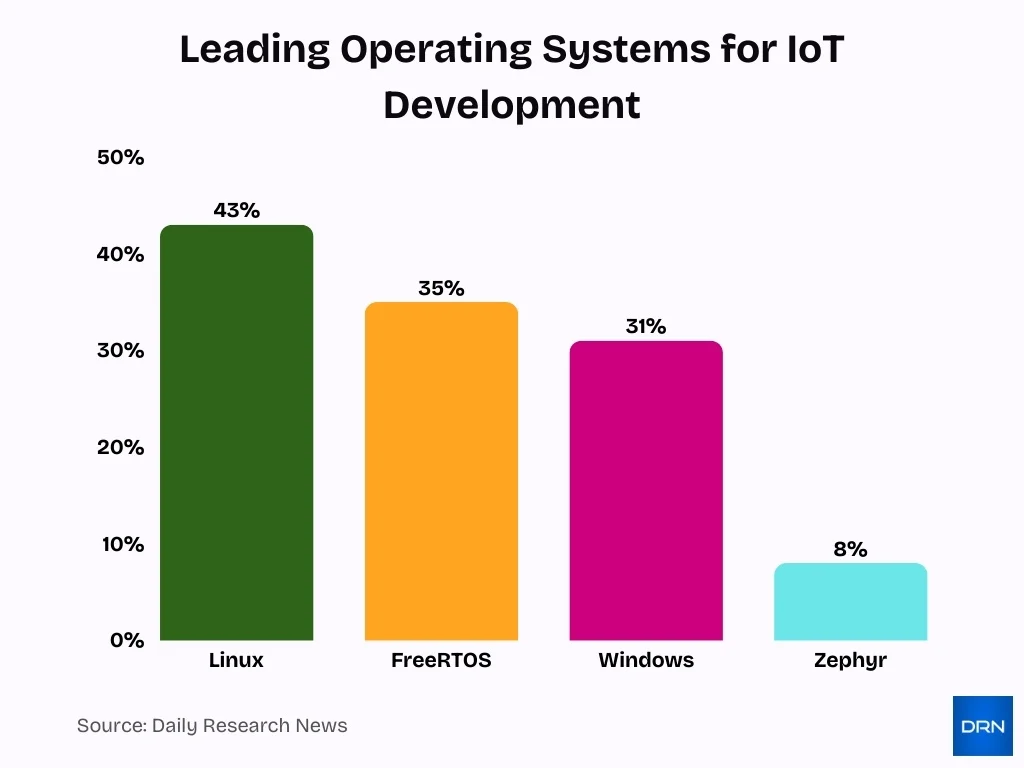
Leading Operating Systems for IoT Development
- Linux dominates IoT development with a 43% usage share, reflecting its flexibility, open-source ecosystem, and strong community support.
- FreeRTOS ranks second with 35% adoption, highlighting its popularity for real-time, lightweight, and embedded IoT applications.
- Windows holds a 31% share, showing its continued relevance in enterprise-grade and industrial IoT environments.
- Zephyr records the lowest adoption at just 8%, indicating limited usage compared to major operating systems.
- The data reveals that open-source and real-time platforms such as Linux and FreeRTOS together account for over 78% usage, making them the preferred choice for most IoT developers.
Security Risks and Vulnerabilities in the Internet of Things
- Nearly 48.2% of IoT connections to IT infrastructure are identified as high‑risk due to insecure devices.
- The global IoT security market is projected to grow from ~$30.8 billion in 2025 to ~$134.96 billion by 2033.
- Security demand is driven by data protection needs in healthcare, energy, and infrastructure.
- Vulnerable IoT endpoints often result from outdated software, weak configuration, or poor segmentation.
- Cyber threats, including AI‑driven attacks and model poisoning, are emerging risks in IoT ecosystems.
- Security solutions must cover network, device, application, and cloud layers for comprehensive protection.
- Regulation and standards for IoT security lag behind adoption, increasing the risk profile.
- Skill gaps in cybersecurity expertise also slow effective IoT risk mitigation.
Challenges and Barriers to Growth in the Internet of Things
- Only 40% of industrial manufacturers achieved high interoperability in IoT ecosystems.
- Nearly 25% of organizations view security as a top barrier to IoT adoption, down from 58% five years ago.
- 820,000 daily hacking attempts target IoT devices in 2025.
- 74% of organizations report a shortage of qualified cybersecurity professionals for cloud and AI.
- 47% of consumers cite privacy risks and security concerns as barriers to IoT device purchases.
- 50% of enterprises identify security and data privacy as major IoT challenges.
- Compliance costs for data protection can exceed $30 million annually in regulated sectors.
- Latency increases by up to 60% in large-scale IoT deployments due to scalability issues.
- Two-thirds of industrial firms face technical challenges from fragmented IoT standards.
Frequently Asked Questions (FAQs)
21.9 billion connected IoT devices, with further growth toward ~30 billion by 2030.
The IoT market is expected to grow to about $1.055 trillion in 2026 from $864.32 billion in 2025.
The IoT market is forecast to expand at a 9.6% CAGR from 2025 to 2030.
Industrial IoT market revenues are projected to rise from $198.2 billion in 2025 to $286.3 billion by 2029 at an 8.1% CAGR.
Conclusion
As it unfolds, the Internet of Things stands at the intersection of connectivity, analytics, and automation. Growth across platforms, manufacturing, smart buildings, healthcare, and transportation underscores the broad impact of IoT on business and daily life. Yet, the journey ahead is not without friction, security risks, and interoperability hurdles; workforce gaps remain significant.
Still, with sustained innovation in AI integration, edge computing, and robust software platforms, IoT’s trajectory continues upward. These statistics present a data‑grounded view of where IoT has been and where it’s heading, empowering organizations to make informed decisions in the connected era.