

Live chat has emerged as a pivotal channel in customer service and digital sales. With customers expecting instant, personalized interactions, businesses are increasingly investing in solutions that respond in seconds rather than hours. In ecommerce, live chat helps close sales and reduce cart abandonment, while in SaaS and tech support, it drives loyalty and long term retention. These trends reflect a broad digital transformation; customers prefer live chat for immediate support, and businesses benefit from measurable lifts in key outcomes like satisfaction and revenue. Explore the insights below to understand how live chat performance and usage are changing.
Editor’s Choice
- 87% of live chat interactions receive a positive customer satisfaction rating.
- 60% of customers are more likely to return to a site that offers live chat support.
- Live chat users are 63% more likely to purchase on websites with live chat features.
- Businesses implementing live chat report an average 20% increase in conversions.
- 44% of online customers say live chat is essential on ecommerce sites.
- When companies reply in 5 to 10 seconds, satisfaction rates can climb above 84%.
- 41% of customers prefer live chat over other support channels like phone and email.
Recent Developments
- Integration of AI into live chat tools has reduced average response times by about 19%.
- Tools using generative AI can accelerate resolution tasks by 90% plus.
- AI solutions now handle up to 70% of basic support contacts, freeing agents for complex queries.
- Hybrid AI human workflows are becoming standard to balance rapid replies with accurate problem-solving.
- Customers still expect human escalation when automation falls short.
- Live chat platforms increasingly include proactive prompts based on user behavior.
- Mobile-first enhancements in chat widgets are increasing usage across devices.
- Real-time analytics inside chat systems help teams track performance trends more efficiently.
What Is Live Chat?
- Live chat is real-time text-based communication between a customer and a support agent or an AI tool.
- It enables users to get instant answers without needing to call or email support.
- Live chat may be powered by human agents, AI chatbots, or a combination of both.
- Chatbots handle simple queries 24 7, while humans take over complex or sensitive cases.
- Integrated chat systems can sync with CRM and help desk tools for support history continuity.
- Many platforms now offer proactive chat triggers based on user behavior.
- Live chat interfaces often include links, images, and file attachments.
- The channel is widely used across retail, travel, finance, and healthcare.
Live Chat Usage by Organization Type
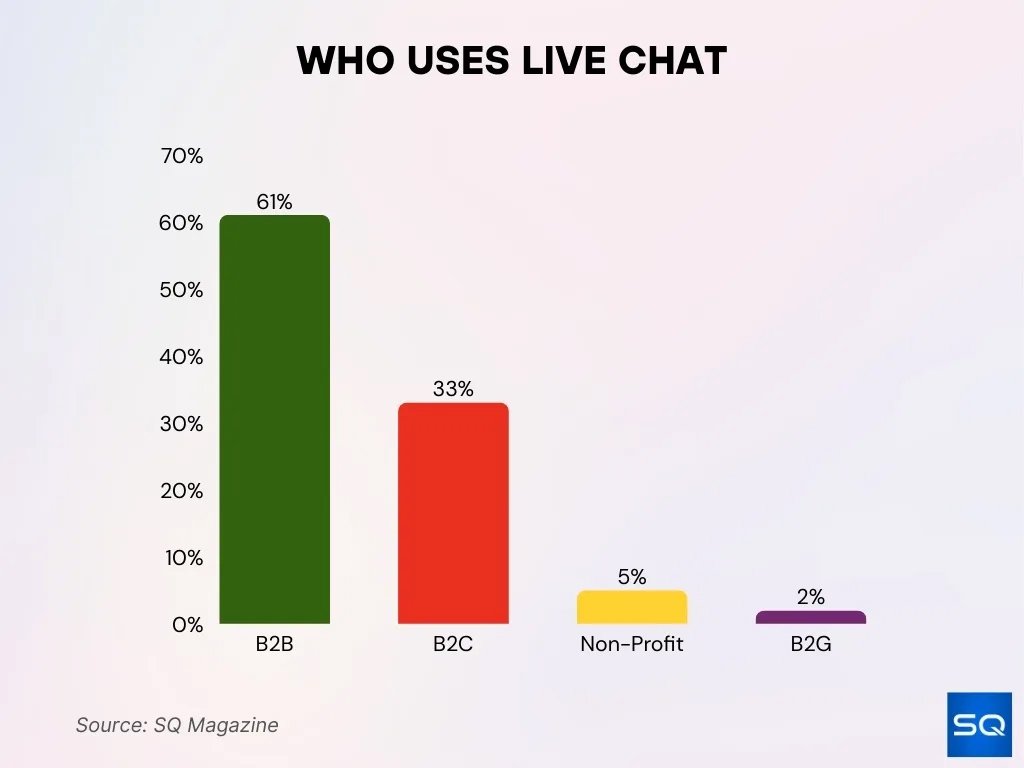
- B2B companies represent 61% of all live chat users, positioning them as the largest segment adopting this communication channel.
- B2C businesses account for 33% of overall live chat adoption, highlighting its strong role in customer-facing interactions.
- Non-profit organizations make up 5% of entities using live chat, indicating a smaller yet notable level of adoption.
- B2G (business-to-government) entities comprise only 2% of total live chat usage, reflecting minimal adoption in this sector.

Key Live Chat Statistics Overview
- 87% of live chat interactions earn positive satisfaction ratings.
- 60% of customers are more likely to return after a positive live chat experience.
- 63% of customers report higher purchase likelihood when live chat is available.
- Businesses using live chat see an average 20% increase in conversions.
- 41% of consumers prefer live chat over other support channels.
- 44% of online shoppers consider live chat essential.
- Response times under 10 seconds significantly boost satisfaction.
- Younger customers aged 18 to 34 show a stronger preference for chat over the phone.
Live Chat Adoption and Usage Statistics
- Over 515,000 websites currently use live chat widgets.
- About 59% of U.S. users have engaged with live chat in the past year.
- 67% of online consumers use live chat during shopping, not only after purchase.
- Retail adoption of live chat has grown from roughly 45% to 53%.
- 52% of companies plan to increase live chat staffing.
- Mobile chat accounts for up to 74% of total chat interactions.
- Mobile live chat usage increased 7% year over year.
- Around 15% of website visitors initiate a chat when a widget appears.
Customer Preference for Live Chat
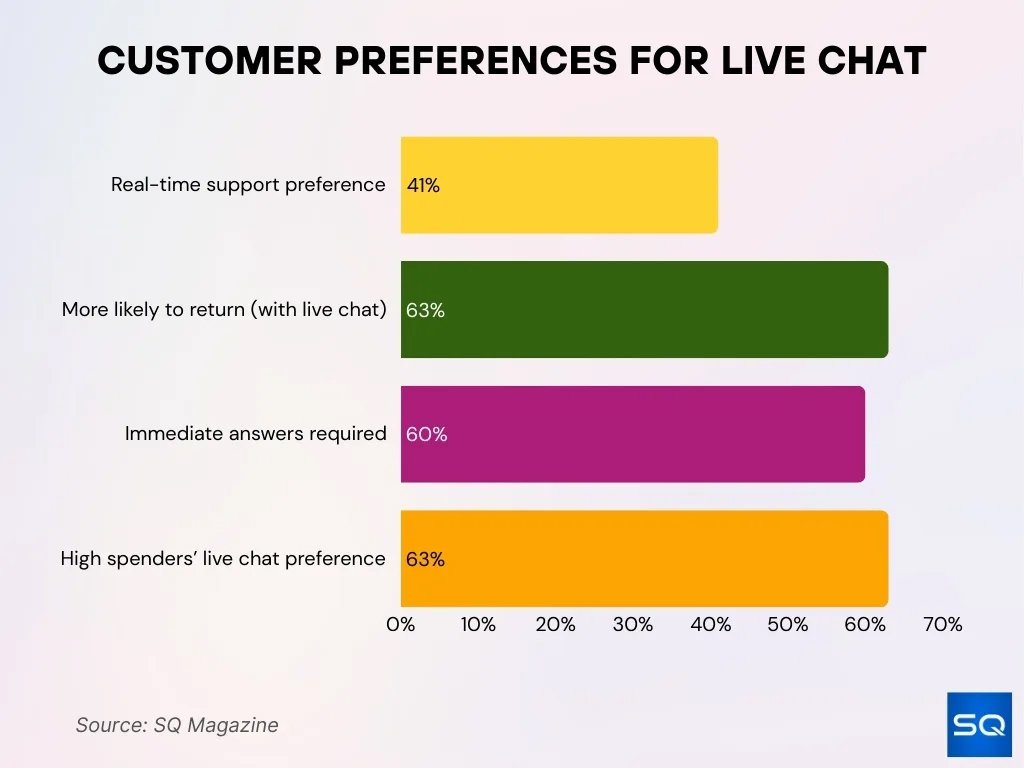
- 41% of customers favor real-time customer service delivered through live chat rather than traditional phone or email channels.
- 63% of consumers are more likely to return to a website that provides live chat support as part of its customer service options.
- Roughly 60% of customers seek immediate answers, and live chat satisfies this expectation far more effectively than email communication.
- Users spending $250–$500/month online demonstrate a 63% preference for brands that actively offer live chat support.
- High-spender segments show a stronger likelihood to purchase from companies that provide live chat as a customer service feature.
- Younger age groups (18–34) display a significantly higher preference for live chat when compared with older demographics.
- Scripted or impersonal responses rank among the top frustrations, even for users who prefer live chat as their primary support channel.
Customer Satisfaction with Live Chat Support
- Live chat earns an average customer satisfaction score of 83.1%.
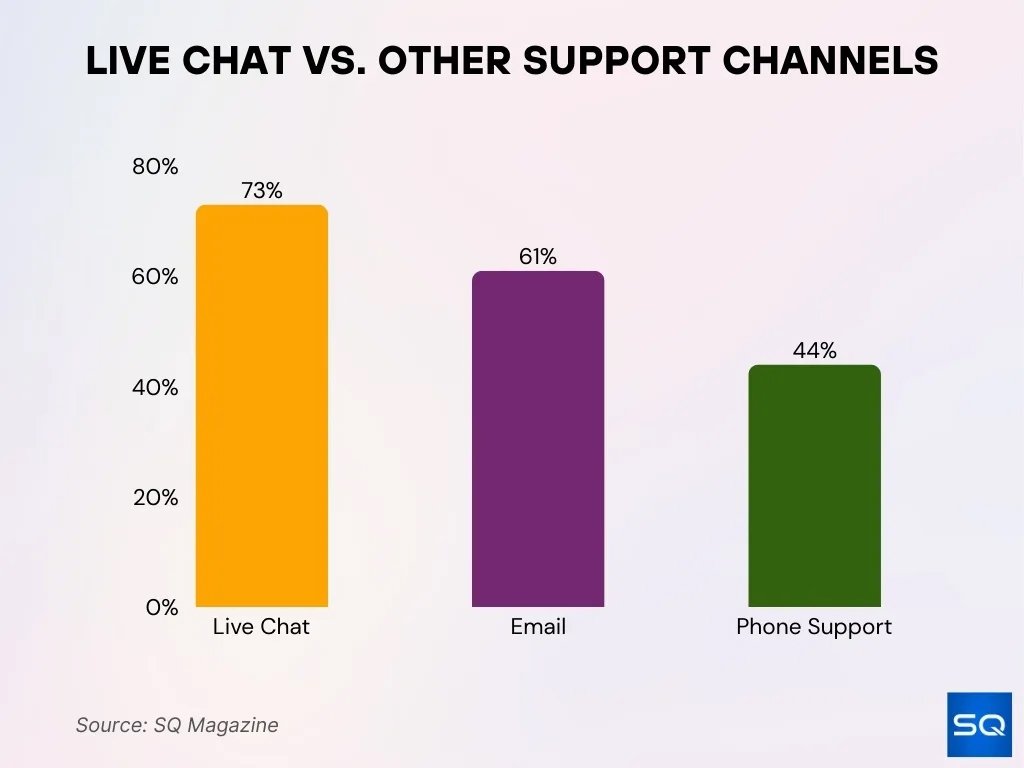
- Satisfaction with live chat exceeds email (61%) and phone (44%) support.
- Response times under 10 seconds push satisfaction above 84%.
- 87% of live chat conversations receive positive ratings.
- 79% of businesses report improved satisfaction after implementing live chat.
- Live chat ranks highest among digital support channels at 85-88% CSAT.
- 73% of customers are satisfied with live chat experiences.
- Average wait time for live chat is 46 seconds.
- 84.7% satisfaction achieved with 5-10 second responses.
- 41% of consumers prefer live chat over other support channels.
Live Chat Response Time and Speed Statistics
- High-performing teams achieve first response times under 2 minutes.
- Many teams maintain replies within 23 to 40 seconds.
- Responses under 10 seconds deliver satisfaction above 84%.
- Nearly 80% of customers expect immediate replies.
- Live chat dramatically outperforms email and ticket systems in speed.
- Delays of over 5 minutes sharply increase abandonment.
- Mobile-optimized chat delivers faster replies than desktop-only tools.
- AI-assisted canned responses improve reply speed for routine questions.
First Contact Resolution and Efficiency Statistics
- Live chat can improve first contact resolution rates by up to 50%.
- Typical live chat FCR benchmarks range from 55% to 65%.
- Faster resolution reduces follow-up interactions and support costs.
- Agents often manage multiple chats simultaneously.
- Live chat resolution is up to 13 times faster than email.
- Higher FCR correlates with stronger customer loyalty.
- Chatbots deflect simple questions, improving human agent efficiency.
- Efficient chat workflows reduce average handling time.
Revenue and Sales Impact of Live Chat
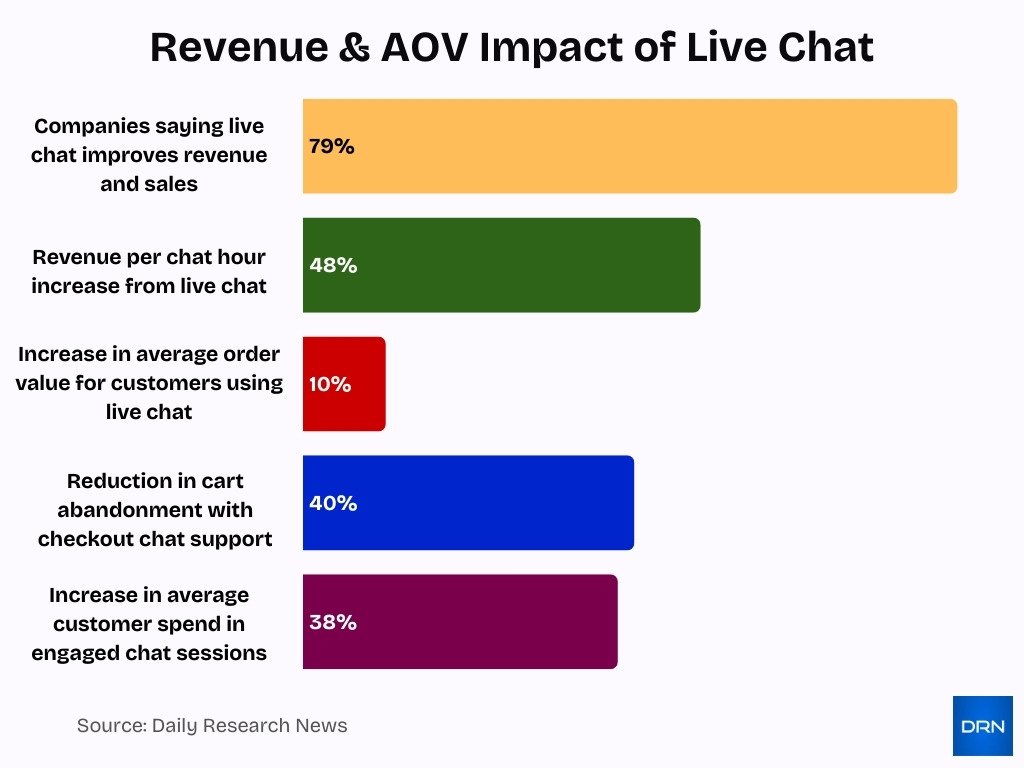
- 79% of companies say live chat improves revenue and sales outcomes.
- Live chat boosts revenue per chat hour by 48%.
- Customers using live chat see a 10% increase in average order value.
- Checkout support via chat reduces cart abandonment by up to 40%.
- Engaged chat sessions raise average customer spend by 38%.
- Revenue gains from live chat are strongest in the retail, travel, and services sectors.
- CRM-integrated chat boosts upsell opportunities by 2.4x annually.
- Positive chat experiences increase lifetime customer value by supporting 25-95% profit growth.
Live Chat Impact on Conversion Rates
- Businesses using live chat report 20% to 40% higher conversion rates.
- Customers engaging with live chat are 2.8 times more likely to make a purchase.
- 38% of customers say live chat directly influenced their buying decision.
- Live chat users spend 60% more per purchase on average.
- Adding live chat boosts overall conversions by 20% typically.
- Proactive live chat increases ecommerce conversions by 3% and revenue by 6%.
- Personalized chat recommendations lift conversion rates by up to 20%.
- Live chat engagement raises revenue per chat hour by 48%.
- 40% increase in conversion rates from effective live chat use.
- Six chat messages boost ecommerce conversion likelihood by 250%.
Impact on Customer Loyalty and Retention
- 60% of customers are more likely to return to sites offering live chat support.
- 63% of customers using live chat are more likely to return to the website.
- 79% of businesses report that live chat positively impacts customer loyalty.
- Businesses using live chat see a 27% increase in customer retention rates.
- 51% of consumers are more likely to stay loyal to companies offering live chat.
- 56% of 18-34 year-olds prefer live chat for stronger retention.
- Brands with live chat achieve higher NPS scores through better satisfaction.
- 73% of 18-49 year-olds find live chat most convenient for loyalty.
- Subscription businesses gain from live chat‘s 63% repeat visit boost.
Live Chat and Customer Experience Metrics
- 41% of consumers prefer live chat over 32% for phone and 23% for email.
- Live chat achieves 85% customer satisfaction, second only to 91% for phone.
- 73% satisfaction rate for live chat, surpassing 61% email and 44% phone.
- Businesses using live chat see 40% higher conversion rates and 48% revenue increase per chat hour.
- Average first response time in live chat is 46 seconds, boosting satisfaction.
- 79% of businesses report live chat increases customer loyalty, revenue, and sales.
- 87% of live chat interactions receive positive CSAT ratings.
- Companies with live chat report higher NPS, averaging 50% promoters over detractors.
- Live chat reduces resolution time 13X faster than email or online forms.
Live Chat vs Phone and Email Support Statistics
- Live chat achieves a 73% satisfaction score, outperforming email at 61% and phone support at 44% in overall customer satisfaction.
- 41% of customers show a clear preference for live chat over other communication channels such as email, phone, or social messaging platforms.
- 52% of consumers favor companies that deliver personalized service, with live chat serving as a critical channel for enabling personalization.
- Phone support usage is steadily declining as customers increasingly opt for faster and more convenient support channels.
- Live chat users frequently bypass the long wait times associated with phone support, as 42% choose live chat over phone specifically to avoid being placed on hold.
- Legacy support channels, including phone and email, trail live chat in response speed, with live chat responses occurring in minutes, while email or social media responses may take hours.
- The cost per interaction for live chat is generally lower, with reports indicating it costs 15–33% less than resolving the same issue through phone support.
Agent Productivity and Workload Statistics
- AI-assisted tools boost agent productivity by 15% on average, measured by issues resolved per hour.
- Chatbots handle 80% of routine questions, slashing agent workload significantly.
- Agents typically manage 2-4 chats simultaneously while maintaining service quality.
- AI suggestions cut average handle time by 16% through real-time assistance.
- Hybrid AI-human models automate 50-60% of calls, reducing agent burnout.
- Conversational AI boosts specialist productivity by 94% and speeds issue resolution by 92%.
- Live chat achieves 88% CSAT rate, outperforming email (61%) and phone (44%).
- Productivity gains from AI correlate with 40%+ CSAT jumps in mid-sized businesses.
- AI access raises issues resolved per hour by 14% overall, up to 35% for novices.
Mobile Live Chat Usage Statistics
- Up to 79% of live chat interactions occur on mobile devices.
- Mobile chat usage increased by 7% in 2023 compared to 2022.
- 62% of customers expect live chat to be available on mobile devices.
- 82% of customers would use live chat on mobile if available.
- Over 75% of live chat sessions happen on mobile devices.
- Millennials are 20% more likely to use mobile live chat.
- Mobile chat users are 6x more likely to convert than non-users.
- Online shoppers using live chat are 513% more likely to buy.
- Mobile-optimized chat boosts ecommerce conversions by 3%.
Live Chat for Ecommerce and Retail Statistics
- Live chat increases ecommerce conversion rates by 20% to 40%.
- Chat-engaged shoppers are 2.8 times more likely to buy.
- Retailers see 48% higher revenue per chat hour.
- Over 60% of shoppers return to sites offering live chat.
- Chat reduces cart abandonment during checkout.
- Chat supports upsell and cross-sell strategies.
- Positive chat interactions increase repeat purchases.
- Live chat helps comparison shoppers make faster decisions.
Key Challenges Users Face When Interacting with Chatbots in the US
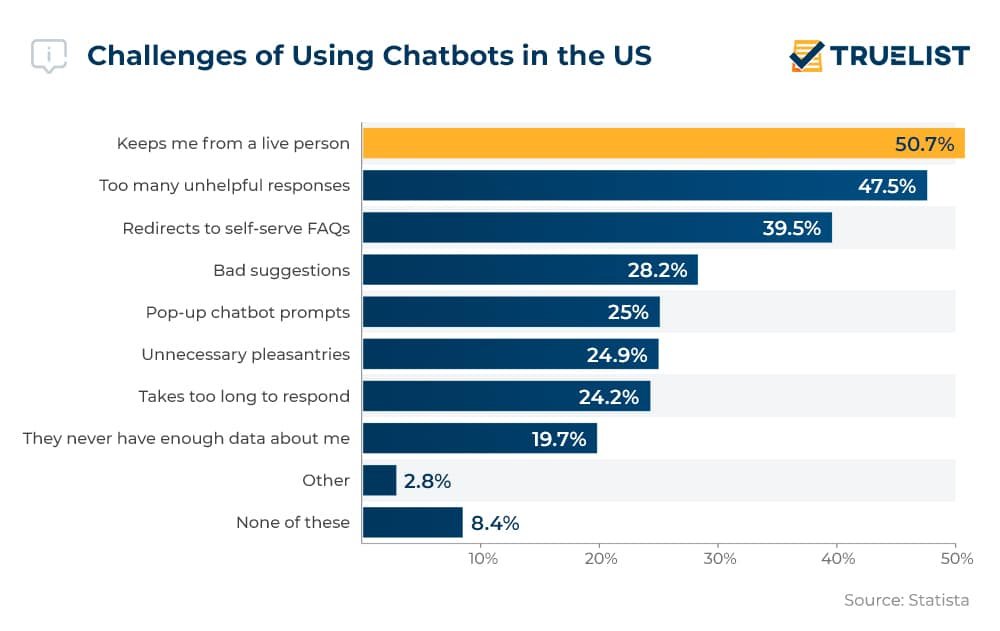
- Lack of access to human support is the most significant concern, with 50.7% of users saying chatbots prevent them from reaching a live person.
- Nearly half of respondents (47.5%) report receiving too many unhelpful responses, indicating shortcomings in chatbot accuracy and relevance.
- 39.5% of users are frustrated when chatbots redirect them to self-service FAQs instead of resolving issues directly.
- Poor recommendation quality remains a notable issue, as 28.2% of users cite bad or irrelevant suggestions.
- Pop-up chatbot prompts are viewed negatively by 25.0% of respondents, suggesting overuse or intrusive deployment.
- Almost one-quarter (24.9%) find unnecessary pleasantries frustrating, preferring concise and task-focused interactions.
- Slow response times continue to impact user satisfaction, with 24.2% stating chatbots take too long to respond.
- Personalization gaps persist, as 19.7% feel chatbots do not have enough data about them to be helpful.
- Only 8.4% of respondents report no issues at all, indicating widespread dissatisfaction.
- A small minority (2.8%) identified other challenges not captured in the main categories.
AI, Chatbots, and Automation in Live Chat Statistics
- 80% of companies use or plan to adopt AI chatbots.
- AI may handle up to 95% of customer interactions.
- 59% of consumers believe AI will change customer interactions.
- 75% of users expect generative AI to reshape customer service.
- Chatbots manage repetitive tasks at scale.
- AI delivers faster responses than manual support.
- Automation enables 24 7 customer service.
- AI-assisted agents deliver more accurate responses.
Future Trends in Live Chat Statistics for 2025 and Beyond
- By 2026, 30% of AI models will utilize multimodal data, enhancing conversational chat experiences.
- AI chatbots provide 24/7 support, meeting 82% of customers’ demands for instant responses.
- Advanced AI agents reduce customer service costs by 25% on average while boosting personalization.
- Predictive chat analytics drive 30-40% higher conversion rates through proactive engagement.
- The voice-enabled chatbots market will reach $99.2 billion by 2030, growing at 18.6% CAGR.
- Mobile live chat usage hit 72% in consumer services, signaling continued design expansion.
- Improved AI context boosts lead conversion by up to 391%, cutting repeat contacts.
- Live chat CRM integrations enable 67% of Fortune 500 firms to adopt AI chatbots by 2025.
Frequently Asked Questions (FAQs)
About 63% of consumers are more likely to return to a website that offers live chat support.
Approximately 87% of live chat conversations receive a positive satisfaction score.
In 2025, 73.8% of live chat interactions were handled by AI tools, up from 62.7% the previous year.
Around 41% of customers prefer live chat compared with phone and email for customer support.
Conclusion
Live chat is no longer a luxury; it is a core component of modern customer engagement. From outperforming phone and email in satisfaction to driving ecommerce conversions and empowering agents through AI, live chat has proven its value across industries. Mobile adoption continues to rise, while automation reshapes both customer expectations and operational efficiency.
As AI capabilities mature, organizations that invest in intelligent, responsive live chat systems will lead in loyalty, retention, and revenue growth.