

Machine learning continues to transform how businesses operate, products evolve, and decisions are automated. From predictive analytics in healthcare to fraud detection in finance, its impact spans industries and borders. Accelerated computing power, richer data streams, and cloud deployment have further solidified machine learning as a core business strategy. Explore how these trends translate into measurable market growth, adoption dynamics, and business outcomes below.
Editor’s Choice
- The global machine learning market is projected to grow sharply from $47.99 B in 2025 to $65.28 B in 2026.
- By 2034, machine learning could represent over $432 B in market value.
- Almost 48% of organizations worldwide report using machine learning.
- The US machine learning market is estimated at over $21 B annually and growing.
- North America currently holds the largest regional share of machine learning spend.
- Nearly 92% of leading businesses say they are investing in machine learning and AI initiatives.
- Automated Machine Learning platforms alone may grow at a 48.4% CAGR through the early 2030s.
Recent Developments
- Machine learning adoption continues to expand even as broader enterprise AI usage shows signs of plateauing in some workplace settings.
- The rise of AI‑capable devices, like PCs and edge systems, is likely to influence machine learning deployment at the edge by 2026.
- New frameworks for population‑normalized AI usage metrics are emerging, helping benchmark global machine learning diffusion.
- Automated Machine Learning tools are moving from niche developer use to mainstream enterprise accessibility.
- Improvements in cloud integration and MLOps are accelerating production‑ready model deployment across industries.
- Privacy and responsible AI frameworks are becoming core parts of machine learning strategy rather than afterthoughts.
- Evidence shows a growing emphasis on explainability and governance in machine learning platforms.
- Machine learning innovations increasingly intersect with adjacent technologies like IoT, edge computing, and federated systems.
Overview of Statistics in Machine Learning
- Global machine learning market volumes are forecast to expand strongly through 2030, with some estimates exceeding $500 B by decade’s end.
- A significant portion of enterprises, around 48% globally, now use machine learning technologies.
- By 2025–2026, the US will lead the global market in machine learning spend and implementation.
- North America holds roughly a 30–32% share of the global machine learning market value.
- Growth rates for machine learning tools and platforms commonly exceed 30% CAGR in major industry reports.
- Almost 92% of leading organizations across sectors report investment in machine learning initiatives.
- Cloud‑based ML services and AutoML tools show some of the fastest adoption curves through 2026.
- Integration with established enterprise workflows, such as ERP and CRM, is a key driver of growth.
Machine Learning Market Size Growth
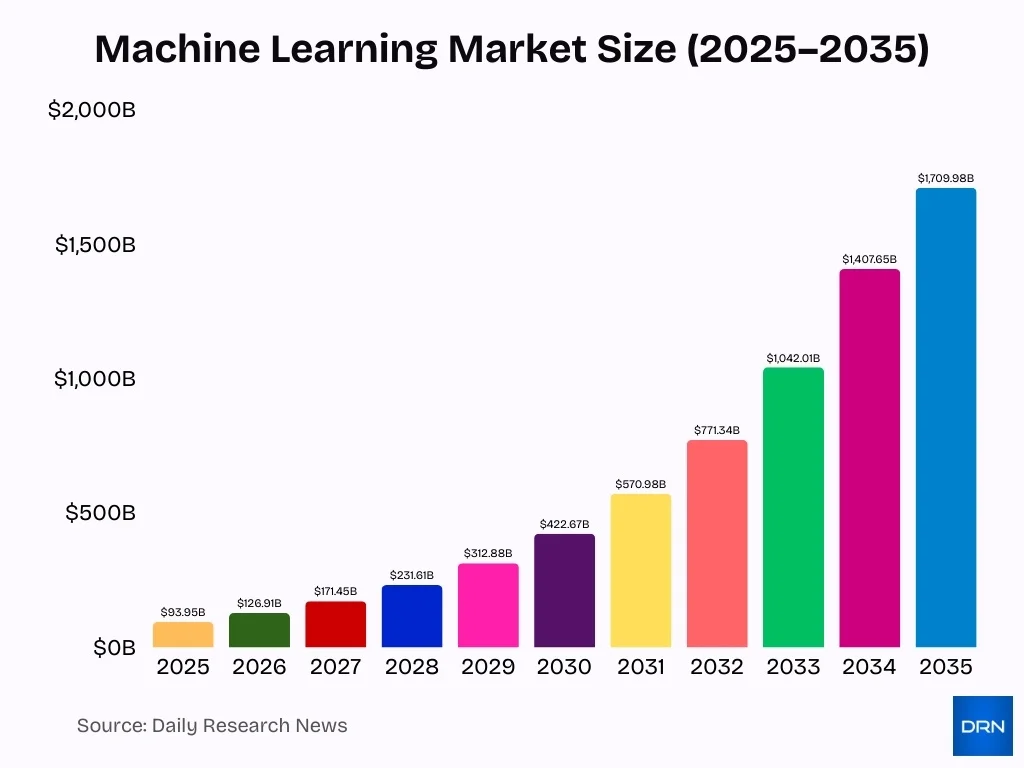
- The global Machine Learning market is projected to grow from $93.95 billion in 2025 to $1,709.98 billion by 2035, reflecting an explosive long-term expansion.
- Market size is expected to cross $300 billion by 2029, reaching $312.88 billion, driven by enterprise-wide AI adoption.
- By 2030, the market is forecast to exceed $422.67 billion, signaling strong acceleration in commercial and industrial use cases.
- The market will surpass $500 billion in 2031, hitting $570.98 billion, as ML becomes core to digital transformation strategies.
- In 2032, Machine Learning revenue is projected to reach $771.34 billion, fueled by cloud-based AI platforms and automation.
- The industry is expected to cross the $1 trillion milestone in 2033, reaching $1,042.01 billion, marking a critical scale inflection point.
- Growth continues sharply in 2034, with market size estimated at $1,407.65 billion, reflecting widespread adoption across sectors.
- By 2035, the Machine Learning market is forecast to peak at $1,709.98 billion, underscoring its role as a foundational global technology.
- Overall, the market demonstrates a steep exponential growth curve from 2025 to 2035, highlighting sustained investment and innovation momentum.

Adoption and Implementation Rates of Machine Learning
- An estimated 48% of businesses globally use machine learning in some capacity.
- Adoption varies by sector, with technology, finance, and telecom leading usage.
- Adoption penetration in IT and telecom reached 38% by 2025.
- A majority of enterprise leaders report at least pilot ML implementations underway.
- Adoption still lags in non‑tech sectors, with uneven deployment beyond pilots.
- Real‑time ML applications, such as fraud detection systems, continue increasing.
- Organizations report widespread training and experimentation even when deployment is limited.
- Adoption is increasingly tied to cloud ML services and scalable platforms.
Investment, Spending, and Budget Trends in Machine Learning
- The global machine learning market is projected to reach $113.10 billion in 2025, projected to hit $503.40 billion by 2030.
- Worldwide AI spending surges to over $500 billion by 2027, prioritizing ML initiatives.
- The automated machine learning market grows from $1.933 billion in 2025 to $11.306 billion by 2030 at 42.37% CAGR.
- 33% of organizations spend over $12 million yearly on public cloud services powering ML scalability.
- Enterprise AI initiatives yield an average ROI of 5.9%, with many struggling to quantify full value.
- AI startups attract $226 billion in 2025 venture funding, comprising 48% of total VC deals.
- Generative AI VC investment hits record $87 billion in 2025, up 65% year-over-year.
- AI/ML claims 20% of digital transformation budgets in 2026 planning.
- Data centers for AI/ML require $5.2 trillion of capex by 2030 to fuel infrastructure growth.
Leading Applications of Machine Learning Across Businesses
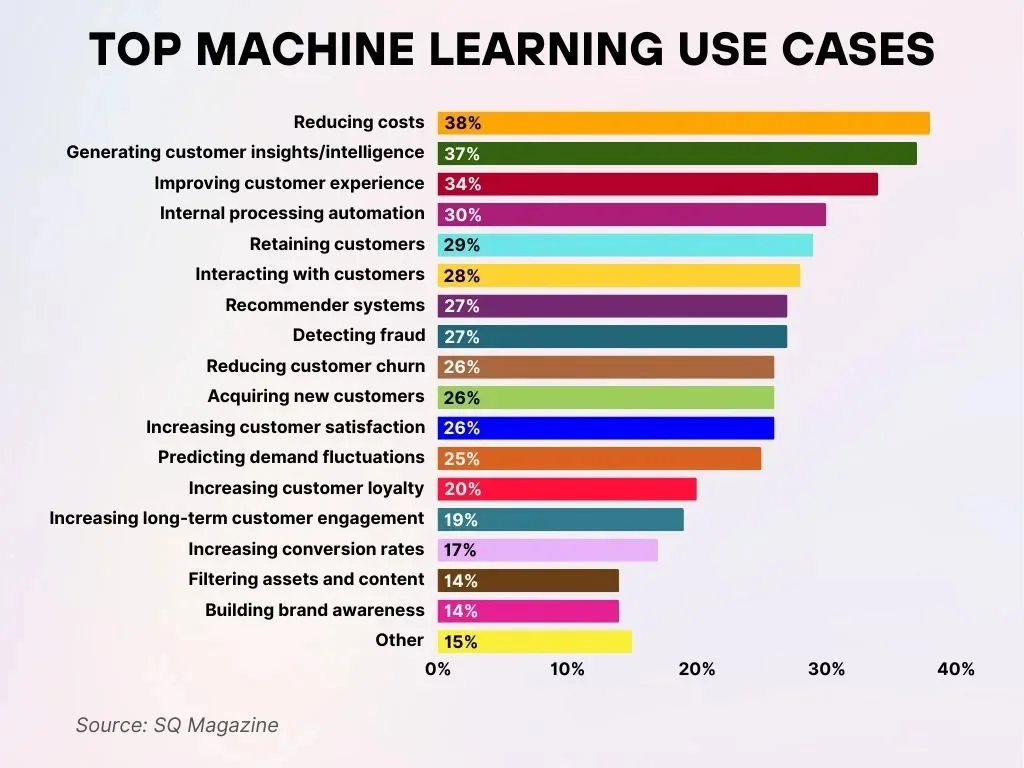
- Cost reduction stands out as the top ML use case, with 38% of respondents identifying it as their primary application focus.
- Customer insights and intelligence generation rank second, cited by 37%, underscoring the importance of data-driven decision-making.
- Enhancing customer experience follows closely at 34%, highlighting ML’s impact on personalization and engagement.
- Internal process automation is leveraged by 30% of businesses, improving operational efficiency and workflow optimization.
- Customer retention is prioritized by 29%, largely supported by predictive analytics and behavioral modeling.
- Customer interaction, including chatbots and support solutions, is powered by ML for 28% of organizations.
- Recommender systems and fraud detection are each adopted by 27%, reflecting balanced use in growth and risk management.
- Reducing customer churn, acquiring new customers, and increasing satisfaction are jointly targeted by 26% of companies.
- Demand forecasting and fluctuation prediction are relevant for 25%, supporting inventory management and logistics planning.
- Customer loyalty programs are enhanced through ML by 20% of businesses to drive repeat engagement.
- Long-term customer engagement is a strategic ML objective for 19%, focusing on lifecycle value growth.
- Conversion rate optimization is pursued by 17%, enabled by predictive modeling and behavioral analysis.
- Content and asset filtering alongside brand awareness building are each cited by 14% as ML-driven initiatives.
- Other innovative ML applications beyond mainstream use cases are reported by 15% of respondents.
ROI, Productivity Impact, and Cost Savings from Machine Learning
- 78% of organizations report machine learning adoption, but fewer achieve full financial impact.
- Full AI adoption could save firms ~$920 B annually in cost reductions.
- Teams using generative AI report productivity gains of around 24.7%.
- AI‑assisted support teams handle 13.8% more interactions per hour.
- Employees estimate AI saves roughly 5 hours per week, or over 260 hours annually.
- Small businesses report an ROI of approximately $3.70 per $1 invested in AI.
- Machine learning reduces customer service costs by 25–30%.
- Combining AI with 81 hours of employee training can yield ~14% weekly productivity gains.
Workforce, Skills, and Talent Gap in Machine Learning
- Machine learning skills appear in ~0.9% of US job postings.
- AI‑skilled workers earn ~56% higher salaries on average.
- In‑demand ML skills include Python, SQL, and data science fundamentals.
- AI and ML skills evolve 66% faster than average job skills.
- 32–38% of executives emphasize training to enable ML adoption.
- Talent shortages slow scaling beyond pilot projects.
- ML engineers command median salaries near six figures.
- Skill gaps extend to explainable AI and responsible deployment.
Machine Learning Economic Impact by Region
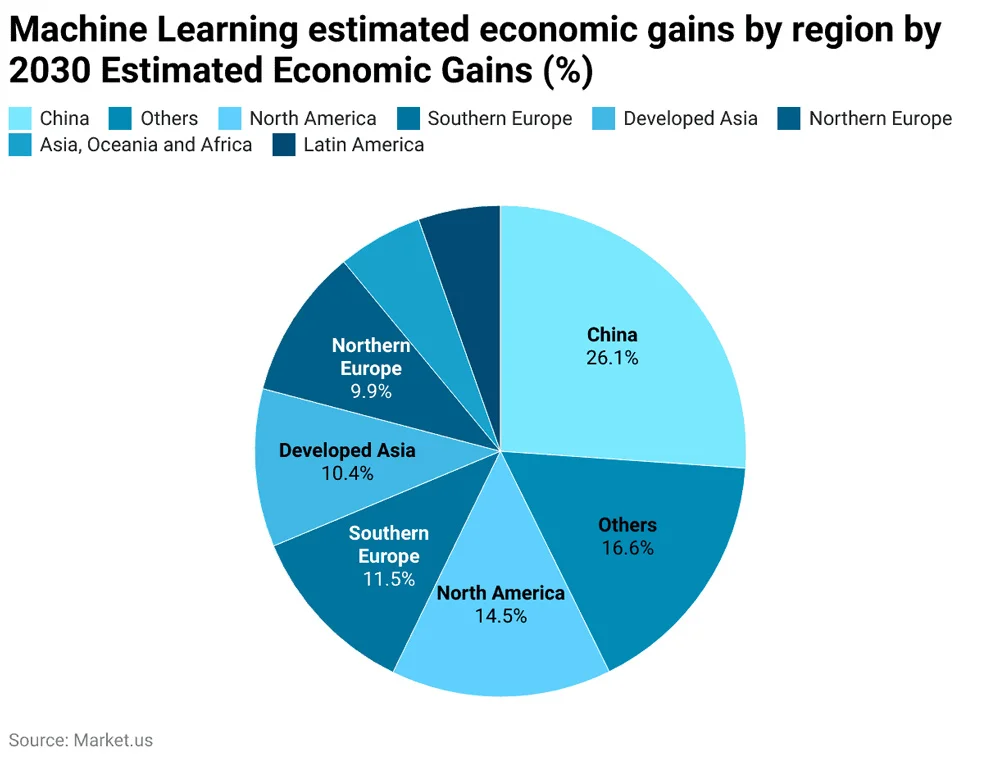
- China leads globally, accounting for 26.1% of total machine learning–driven economic gains, highlighting its aggressive AI investment and large-scale adoption.
- Other regions combined contribute a substantial 16.6%, reflecting broad but fragmented global adoption of machine learning technologies.
- North America captures 14.5% of the projected gains, driven by enterprise AI deployment, cloud infrastructure, and innovation leadership.
- Southern Europe represents 11.5%, showing steady AI-driven productivity growth across manufacturing, services, and public sectors.
- Developed Asia holds 10.4%, underscoring strong adoption in advanced economies with mature digital infrastructure.
- Northern Europe accounts for 9.9%, supported by high digital readiness, automation, and data-driven governance.
- Asia, Oceania, and Africa together generate 6.1%, indicating emerging but accelerating machine learning adoption.
- Latin America contributes 4.9%, reflecting early-stage AI integration with long-term growth potential.
Tools, Platforms, and Framework Usage in Machine Learning
- In 2024, cloud-based ML platforms captured about 65–70% of enterprise deployments, far outpacing on‑premise and hybrid setups.
- AutoML platforms are projected to be the fastest‑growing ML segment, with forecast CAGRs above 35% as they broaden access for non‑experts.
- Around 60–70% of AI‑mature enterprises report using dedicated MLOps tooling to improve reliability, versioning, and scalable deployment of models.
- TensorFlow and PyTorch together account for roughly 70–80% of deep‑learning framework usage, while Scikit‑Learn dominates classic ML in enterprises.
- Over 70% of regulated organizations rank built‑in governance and explainability among their top three criteria when choosing ML platforms.
- More than 75% of real‑time ML pipelines rely on cloud‑native integrations for streaming, monitoring, and analytics across tools like Kafka and Flink.
- About 76% of companies using LLMs now adopt open‑source models alongside proprietary ones, signaling strong confidence in open frameworks.
- End‑to‑end or unified ML platforms are expected to drive a market growing above 30% CAGR by 2030 as enterprises consolidate data, training, and deployment.
Model Performance and Benchmark Statistics in Machine Learning
- Advanced ML models in predictive maintenance reduce costs by 18-25% compared to traditional methods.
- MLPerf Training v5.1 benchmarks show generative AI performance improvements outpacing Moore’s Law trends.
- Classical ML models achieve up to 99.21% accuracy, outperforming some DNNs in malware classification.
- Random Forest and XGBoost models reach 84% accuracy in NLP depression detection tasks.
- ResNet-101 delivers 96.32% recognition rate on metal surfaces, surpassing the classical 86.49%.
- ML model monitoring detects 91% degradation rates over time in production environments.
- Cloud ML endpoints boost CPU utilization to 78%, cutting infrastructure costs by 45-60%.
- Inferentia instances handle 25,000 inferences/second with under 10ms latency.
Leading Machine Learning Software Market Share Breakdown
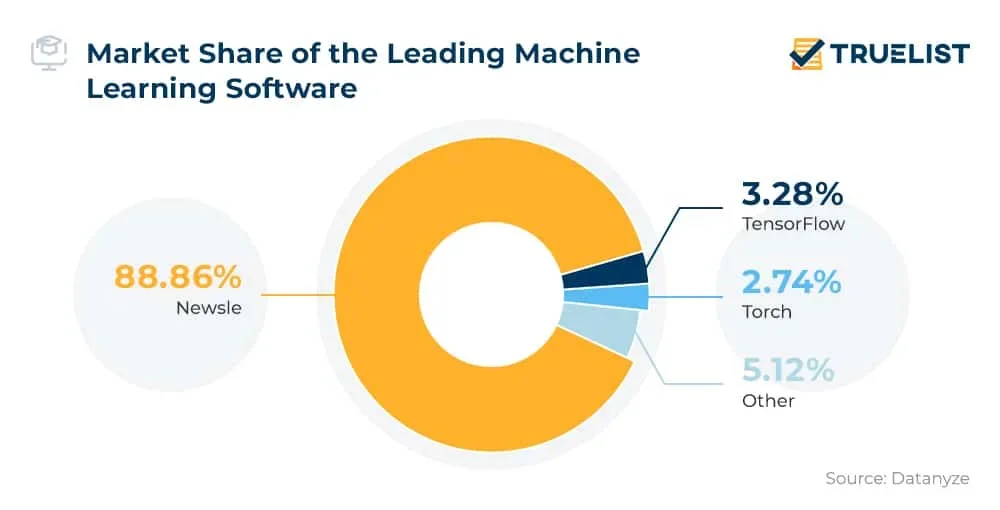
- Newsle overwhelmingly leads the machine learning software market with a dominant 88.86% share, underscoring its near-monopoly position.
- TensorFlow captures a relatively modest 3.28%, despite its strong brand recognition and widespread industry adoption.
- Torch holds 2.74% of the market, indicating a smaller yet meaningful user base within the ecosystem.
- Other software solutions together account for 5.12%, emphasizing the limited overall diversity in current market distribution.
Adoption of Deep Learning and Neural Networks in Machine Learning
- Deep learning market valued at$21 billion in 2025, growing at 32.7% CAGR to $152 billion.
- The neural network market is expected to expand from $45.43 billion in 2025 to $537.81 billion by 2034 at 31.6% CAGR.
- 78% of enterprises actively deploy AI systems, with 71% using generative AI powered by neural networks.
- Deep learning holds the largest share in computer vision at $13.12 billion in 2024.
- The multimodal AI market, driven by deep learning, is expected to reach $42.38 billion by 2034.
- AI/ML jobs surged 54% in August 2025, with deep learning roles leading the growth.
- Transfer learning requires 80-90% less training data and cuts deployment time significantly.
- Deep learning achieves over 95% accuracy in image recognition on ImageNet benchmarks.
- The US deep learning market grows at 30.1% CAGR, adding $5.01 billion by 2029.
- LSTM neural networks are used in 73.5% of deep learning studies for time series forecasting.
Trends in Natural Language Processing and Transformer Models in Machine Learning
- The NLP market may grow from $42.47 B in 2025 to $791.16 B by 2034.
- Multimodal AI markets are forecast to grow from $1.6 B to $27 B by 2034.
- Transformer models dominate modern NLP applications.
- LLMs expand enterprise use in search, compliance, and automation.
- NLP drives real‑time sentiment analysis in CX platforms.
- Transformers deliver 20–40% better performance on complex tasks.
- Speech‑to‑text and NLP integrations grow rapidly.
- NLP increasingly integrates with knowledge graphs.
Global Machine Learning Market Share by Industry
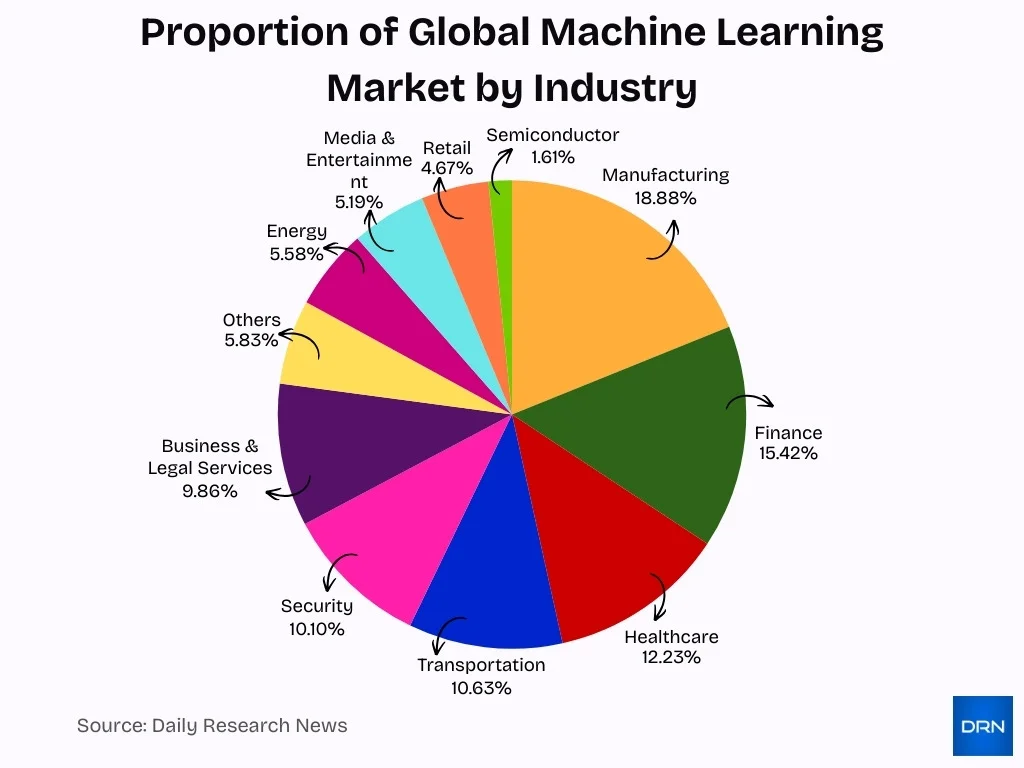
- Manufacturing leads the global machine learning market with a dominant 18.88% share, reflecting widespread adoption in automation, predictive maintenance, and smart factories.
- Finance holds the second-largest share at 15.42%, driven by heavy use of fraud detection, algorithmic trading, and risk analytics.
- Healthcare accounts for 12.23% of the market, highlighting strong demand for diagnostics, medical imaging, and patient data analytics.
- Transportation represents 10.63%, fueled by investments in autonomous vehicles, route optimization, and logistics intelligence.
- Security captures 10.10%, underlining the growing reliance on cybersecurity, threat detection, and surveillance systems.
- Business & Legal Services contribute 9.86%, showcasing increased use of contract analysis, compliance automation, and document intelligence.
- Other industries collectively make up 5.83%, indicating expanding experimentation across niche and emerging use cases.
- Energy holds 5.58%, supported by machine learning applications in energy forecasting, grid optimization, and asset monitoring.
- Media & Entertainment accounts for 5.19%, driven by content recommendation, personalization, and audience analytics.
- Retail represents 4.67%, reflecting adoption in demand forecasting, pricing optimization, and customer behavior analysis.
- Semiconductors have the smallest share at 1.61%, suggesting early-stage but growing use of machine learning in chip design and manufacturing optimization.
Computer Vision and Image Recognition in Machine Learning
- The global computer vision market is projected to reach $58.29 billion by 2030.
- The hardware segment holds over 71% share in 2024.
- AI video analytics is valued at $8.30 billion in 2025.
- Edge AI revenue to hit $157 billion by 2030.
- Deep learning achieves 98.2% accuracy over traditional methods.
- Vision systems reduce manufacturing defects up to 50%.
- The facial recognition market is expected to grow to $30.52 billion by 2034.
- Retail AI vision reaches $12.56 billion by 2033.
- Medical imaging improves detection by 9.4% accuracy.
Integration of Generative AI with Machine Learning
- The generative AI market reached $44.89 B in 2024.
- Investment grew 18.7% year over year.
- 66% of startups use generative AI tools.
- Generative models automate content and code creation.
- AI‑related data violations more than doubled year over year.
- 84% of companies plan to increase generative AI budgets in 2026.
- Product innovation cycles accelerate with generative ML.
- Privacy‑aware generative models gain strategic importance.
Cloud Computing and MLOps in the Context of Machine Learning
- AI in cloud computing reached $121.74 billion in 2025, projected to hit $1,728.40 billion by 2033 at 39.3% CAGR.
- Cloud machine learning market grows by $51.4 billion from 2025 to 2029 at 36.7% CAGR.
- MLOps market valued at $1.4 billion in 2022, expected to reach $37.4 billion by 2032 with 39.3% CAGR.
- 9.7 million developers worldwide deploy AI/ML workloads primarily in cloud environments.
- 87% of enterprises adopted multi-cloud strategies, with 72% using hybrid cloud for ML deployments.
- Cloud/serverless AI reduces deployment preparation time by 63.8% for development teams.
- Centralized cloud AI deployment cuts time to scale ML models by 80-85%.
- 87% of large enterprises implemented AI solutions with MLOps in 2025.
- 76% of organizations use multi-cloud infrastructure for advanced ML operations.
Time Allocation Across Machine Learning Project Tasks
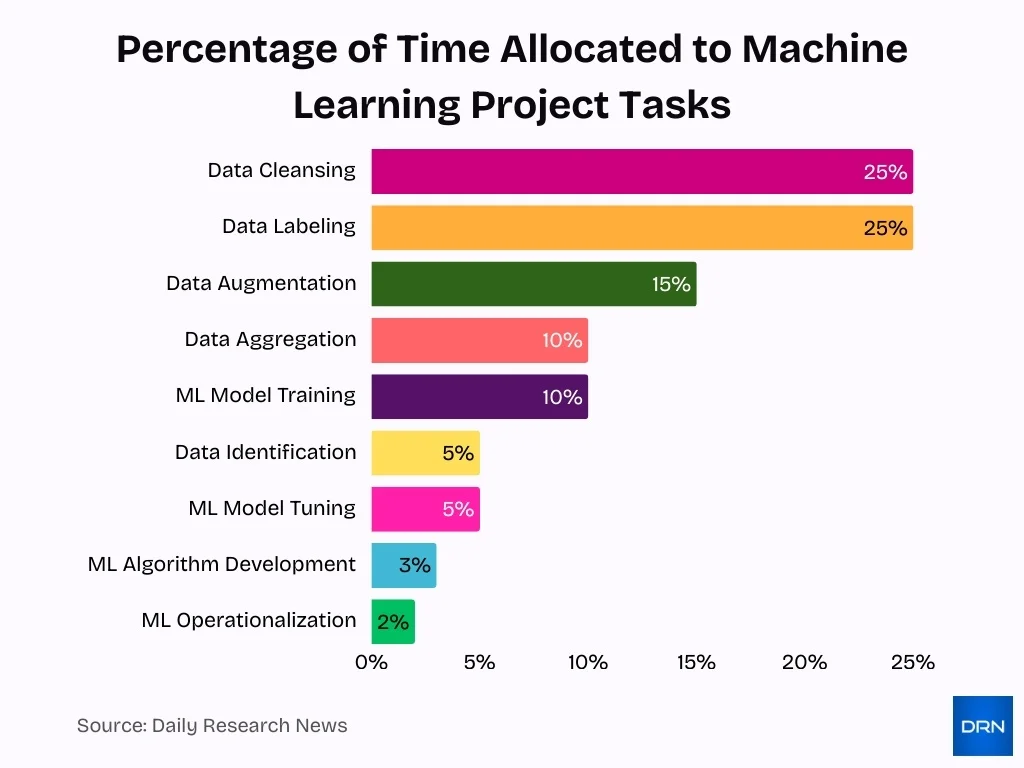
- Data Cleansing and Data Labeling dominate machine learning workflows, each consuming 25% of total project time, highlighting that half of ML effort is spent on preparing training data rather than modeling itself.
- Data Augmentation accounts for 15% of project time, reflecting its growing importance in improving model robustness and handling limited or imbalanced datasets.
- ML Model Training represents only 10% of total time, showing that actual model execution is a relatively small part of the ML lifecycle.
- Data Aggregation also takes 10% of effort, emphasizing the complexity of collecting and consolidating data from multiple sources.
- Data Identification and ML Model Tuning each require 5%, indicating that dataset discovery and performance optimization are necessary but less time-intensive stages.
- ML Algorithm Development consumes just 3% of project time, reinforcing that algorithm selection is far less time-consuming than data preparation.
- ML Operationalization accounts for the smallest share at 2%, suggesting that deployment and production integration are streamlined compared to earlier ML phases.
Federated Learning, Privacy and Security in Machine Learning
- Federated learning keeps raw data on the device, improving privacy.
- It supports regulatory compliance in sensitive data environments.
- 90% of organizations expanded privacy programs due to AI.
- 38% of firms spent over $5 M on privacy initiatives.
- Only ~12% report mature AI governance.
- Data governance shifts from compliance to strategy.
- Federated learning reduces communication costs.
- Security‑aware ML workflows are gaining adoption.
Ethical, Responsible, and Explainable AI in Machine Learning
- The explainable AI market may reach $24.58 B by 2030.
- Regulated industries require ethical ML frameworks.
- Transparency improves trust and reduces bias.
- Bias mitigation tools integrate into ML workflows.
- 96% of companies cite responsible AI as essential.
- Ethical AI includes audits and documentation.
- Public sector adoption mandates explainability.
- Employee training now includes responsible AI practices.
Key Challenges Hindering Machine Learning Adoption
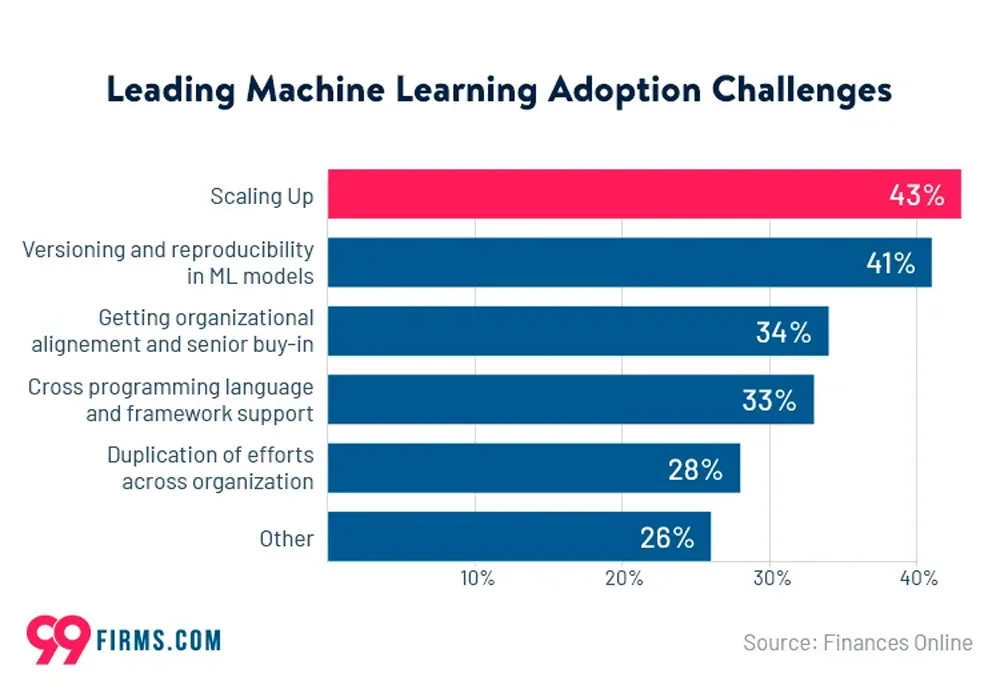
- Scaling up remains the most significant barrier, impacting 43% of organizations as they attempt to expand machine learning solutions across operations.
- Versioning and reproducibility problems are reported by 41%, making ML model consistency and reliable deployment more difficult.
- Organizational alignment and lack of senior management buy-in challenge 34% of companies, slowing overall implementation momentum.
- Cross-programming language and framework support issues are cited by 33%, creating persistent integration challenges within ML environments.
- Duplication of efforts across teams affects 28%, reducing operational efficiency and delaying progress in ML initiatives.
- Other challenges account for 26%, reflecting a wide range of additional obstacles faced during machine learning adoption.
Future Trends and Forecasts for Machine Learning
- Global ML market to hit $282.13B by 2030 at 30.4% CAGR.
- NLP market projected to reach $158.04B by 2032 with 23.2% CAGR.
- Computer vision market expected to grow to $58.29B by 2030 at 19.8% CAGR.
- Edge AI shipments to exceed 9B units by 2030, surpassing 31% penetration.
- Agentic AI market forecasted at $93.20B by 2032 with 44.6% CAGR.
- Multimodal AI market to expand to $4.5B by 2028 at 35.0% CAGR.
- AI-human collaboration market set to reach $55.8B by 2033 via 20.2% CAGR.
- Autonomous systems market projected to surge to $56B by 2030 at 19.1% CAGR.
- AI governance market anticipated at $5.78B by 2029 with 45.3% CAGR.
Frequently Asked Questions (FAQs)
The global machine learning market is expected to grow from $47.99 billion in 2025 to $65.28 billion in 2026, with further expansion forecast through the decade.
The machine learning market is forecast to grow at a CAGR of approximately 26.7% from 2026 to 2034.
The global automated machine learning market is projected to reach $73.66 billion by 2032, up from around $4.65 billion in 2025, with a CAGR of 48.4%.
North America held a 32.5% share of the global machine learning market in 2025, making it the largest regional contributor.
Conclusion
Machine learning stands as a transformative force driving innovation across industries. From natural language processing and computer vision to generative AI, machine learning reshapes automation, analytics, and human‑computer interaction. Cloud‑native ML and advanced MLOps practices enable scalable deployment, while federated learning and privacy frameworks address security concerns.
Ethical AI and explainability are now strategic imperatives. Organizations that invest in talent, governance, and infrastructure will be best positioned to unlock long‑term value from machine learning.