

Since its launch, Microsoft Teams has grown from a niche collaboration tool into a central hub for workplace communication worldwide. Today, it powers conversations, document sharing, and meetings for hundreds of millions of users, from small teams to large enterprises. In sectors such as corporate business and education, Teams plays an essential role; for example, companies rely on it to coordinate remote workflows, while schools and universities use it to deliver hybrid learning. The statistics below show how deeply Teams has embedded itself into global work and study culture.
Editor’s Choice
- 360 million, the approximate number of monthly active users for Teams in 2024,2025.
- 32.29 %, Teams’ share of the global videoconferencing, business communication market.
- Over $8.2 billion, estimated revenue generated by Teams in 2024.
- 77.9 million, the number of worldwide Teams downloads in the first nine months of 2024.
- ~8 million, the number of U.S. companies reportedly using Teams.
- 3 million+ seats on Teams Premium, reflecting uptake of advanced features.
- 93 % of Fortune 100 companies reportedly rely on Teams for enterprise communication.
Recent Developments
- Microsoft Teams reached 360 million monthly active users worldwide as of June 2025.
- Daily active users (DAUs) on Teams crossed the 220 million mark in 2025.
- Virtual meeting minutes on Teams exceeded 7 billion hours per month, an 18% year-over-year increase.
- Teams Premium subscriptions grew by 40% in 2025, reflecting demand for advanced security and collaboration features.
- Microsoft Teams had 77.9 million downloads in the first nine months of 2024.
- Over 20 million users utilized Teams Phone with PSTN capabilities by mid-2025.
- Microsoft Teams maintains a 97% uptime reliability rate globally.
- Hybrid work adoption increased, with 53% of workers on hybrid schedules in 2025, supporting Teams’ role in collaboration.
- Frontline and field worker Teams usage grew by 46% in 2025.
- Microsoft reported $77 billion in revenue in 2024 from productivity and business processes, including Teams and Microsoft 365 integration.
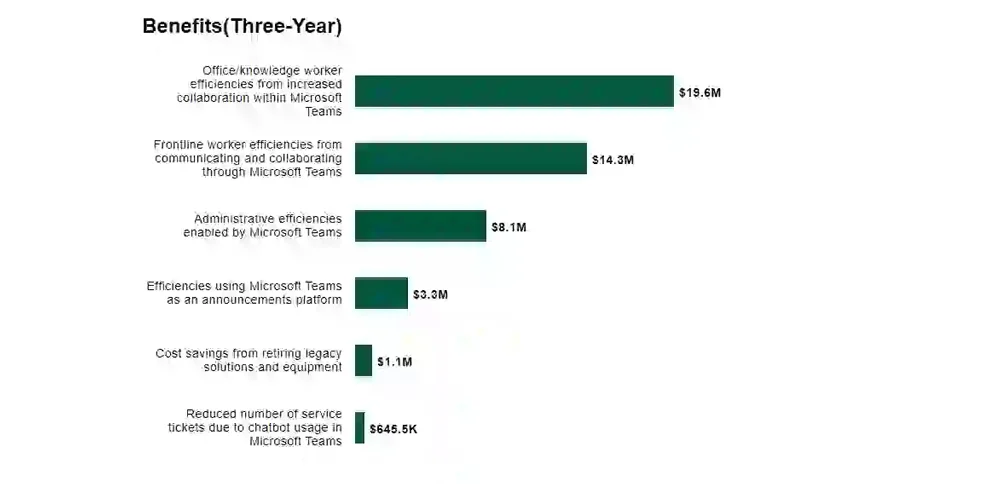
Microsoft Teams 3-Year Benefits Overview
- Microsoft Teams delivered $19.6 million in savings driven by office and knowledge worker efficiencies gained through improved collaboration.
- $14.3 million was saved through frontline worker efficiencies enabled by better communication and enhanced teamwork capabilities in Microsoft Teams.
- $8.1 million resulted from administrative efficiencies supported by Microsoft Teams workflows and seamless integrations.
- $3.3 million in value was generated by leveraging Microsoft Teams as a powerful announcements platform across the organization.
- $1.1 million in cost savings came from retiring legacy systems and outdated equipment.
- $645.5K was saved by reducing IT service tickets through the use of chatbots integrated within Microsoft Teams.
Key Microsoft Teams Statistics
- 360 million monthly active users in 2024,2025 mark a high point for Teams usage globally.
- Market share of 32.29 % among video conferencing, collaboration platforms worldwide.
- The estimated annual revenue of over $8.2 billion in 2024 is tied to the platform’s growth and enterprise traction.
- 77.9 million downloads worldwide in the first 9 months of 2024, a strong sign of continued adoption.
- ~8 million companies in the U.S. reportedly rely on Teams.
- More than 3 million seats on Teams Premium, showing demand for advanced feature tiers.
- Roughly 93 % of Fortune 100 companies use Teams.
- Teams has emerged as the second-largest collaboration platform worldwide.

Microsoft Teams User Growth
- In the early years, Teams was a niche product, but adoption surged in 2020 with the shift to remote work.
- By 2021, Teams reached 145 million daily active users, up from 44 million in early 2020.
- In 2022, Teams reached about 270 million monthly active users.
- From 2022 to 2024, the platform added approximately 50 million new users, reaching 360 million.
- Growth has slowed compared to the pandemic surge, but remains steady as organizations standardize on Teams.
- Post-pandemic, the incremental growth reflects sustained enterprise adoption.
- Teams continues to be a long-term communication backbone for many organizations.
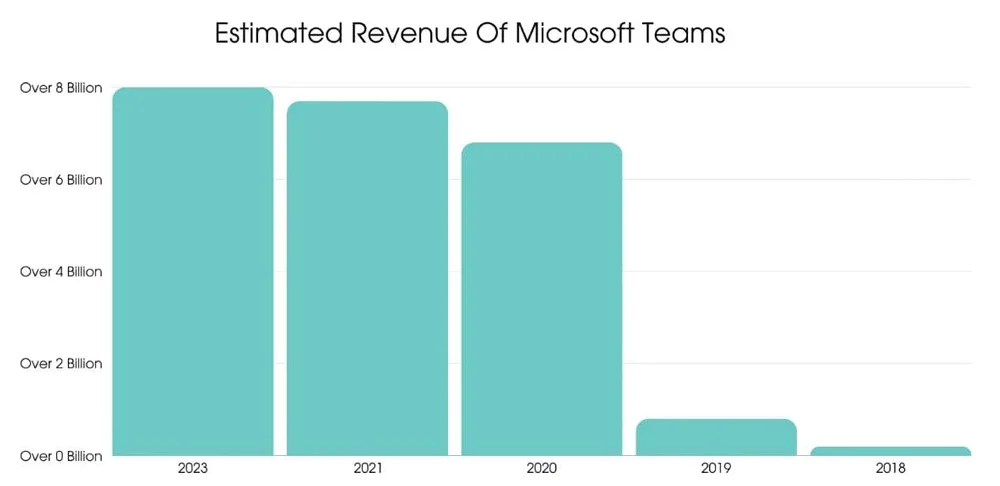
Revenue of Microsoft Teams
- Strong growth in 2023, with revenue reaching over $8 billion, marking the highest point in the chart.
- 2021 also shows impressive performance, with revenue climbing to over $7.5 billion, highlighting sustained momentum during the remote-work boom.
- 2020 revenue surpasses $6 billion, reflecting the platform’s rapid rise as organizations adopted digital collaboration tools.
- A sharp drop appears in 2019, with revenue at roughly $1 billion, showing how early Microsoft Teams was in its adoption curve before the pandemic.
- 2018 records the lowest revenue, well under $1 billion, demonstrating its initial stage before mainstream usage accelerated.
- The chart clearly illustrates significant year-over-year growth, especially between 2019 and 2020, where revenue increased more than 6×.
- Overall, Microsoft Teams shows a massive upward trajectory, driven by remote work, enterprise adoption, and integration across Microsoft 365 services.
Microsoft Teams Market Share
- Microsoft Teams holds a 32.29% share of the global videoconferencing market in 2025.
- Over 360 million monthly active users were recorded on Microsoft Teams in 2024.
- Microsoft Teams generated more than $8.2 billion in revenue in 2023.
- Teams ranks second globally in the video conferencing software market, behind the leader.
- Bundling with Microsoft 365 gives Teams a strong structural adoption advantage in enterprises.
- Enterprise adoption of Teams grew from 50,000 organizations in 2017 to over 200,000 in 2020.
- Adoption surged during the pandemic, with daily active users increasing from 44 million in March 2020 to 115 million in October 2020.
- Teams is particularly strong in large enterprises, with a market share of 55.4% in collaboration tools.
- The global video conferencing market is projected to be worth $33.3 billion in 2025, where Teams leads a substantial share.
- Teams’ integration with Microsoft 365 and compliance features drives adoption in regulated enterprise environments.
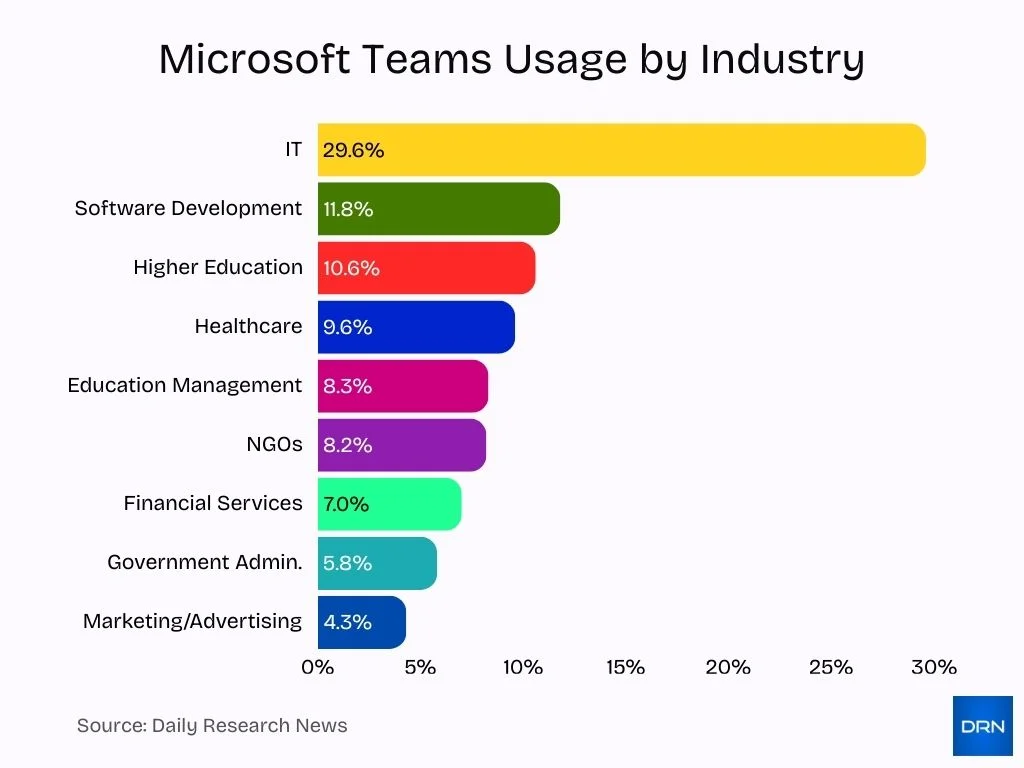
Microsoft Teams Adoption by Industry
- In 2025, large enterprises make up 32% of Teams usage.
- Medium-sized businesses represent around 47% of usage.
- Small businesses account for 21% of usage.
- Information Technology (IT) leads industry adoption with 29.6% usage share.
- Software development follows at 11.8%.
- Higher education represents 10.6% of usage.
- Healthcare accounts for 9.6%.
- Education management makes up 8.3%.
- NGOs account for 8.2%.
- Financial services represent 7.0%.
- Government administration accounts for 5.8%.
- Marketing and advertising represent about 4.3%.
User Demographics
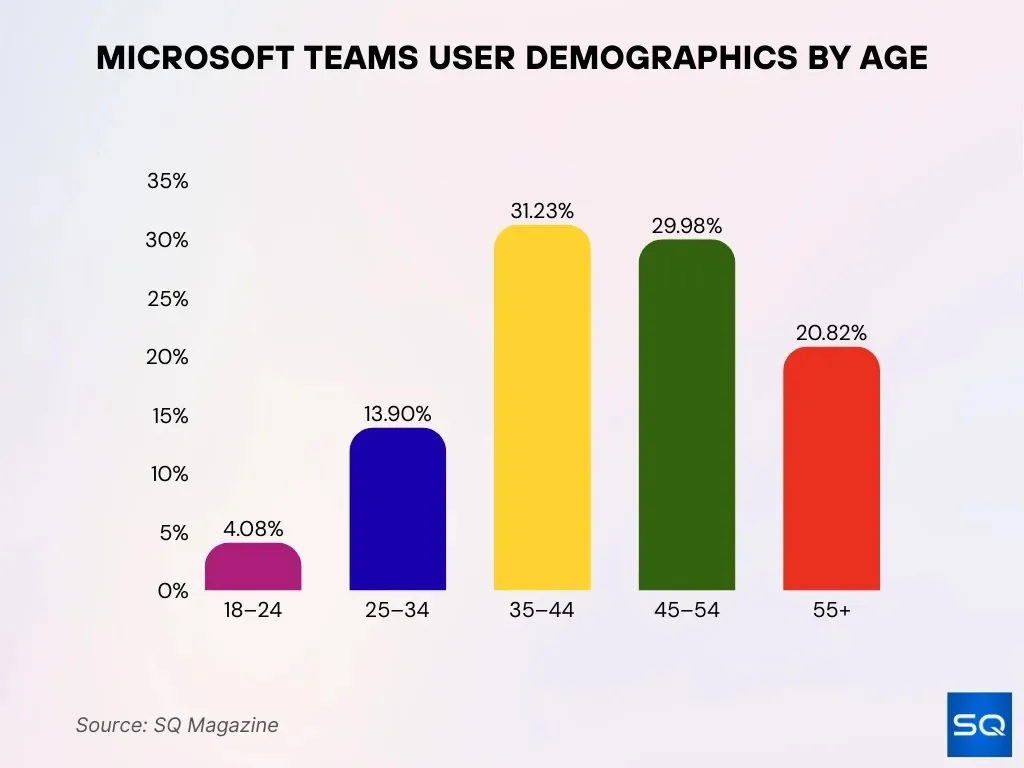
- Users aged 35-44 constitute approximately ~31.23% of the Teams user base, maintaining a strong presence within the platform.
- Individuals within the 45-54 age range follow closely, representing about ~29.98% of overall Users.
- Users 55 and older make up roughly ~20.82%, forming a significant portion of the demographic distribution.
- The youngest group (18-24) remains the smallest segment, totaling around ~4.08% of all Users.
- Those aged 25-34 contribute an estimated ~13.90%, rounding out the overall User Demographics.
Microsoft Teams Meeting Statistics
- Microsoft Teams has over 360 million monthly active users globally as of early 2024.
- Virtual meeting minutes on Teams exceed 7 billion hours per month, growing about 18% year-over-year.
- Teams holds approximately 32.29% of the global video conferencing market share.
- More than 200 million participants join Teams meetings daily.
- Teams Phone has around 80 million users, with over 20 million using PSTN-based calling.
- File sharing on Teams grew by about 76%, reflecting increased collaboration.
- Daily active users on mobile for Teams have surpassed 75 million.
- Teams Premium seats have grown by roughly 40% in recent years.
- Nearly one-third of meetings now span multiple time zones, up about 35% since 2021.
- Large meetings with 65+ attendees show the fastest growth among meeting types.
Microsoft Teams Feature Adoption
- Teams supports chat, video, files, and Microsoft 365 integrations widely.
- Approximately 80 million users rely on Teams Phone.
- Real-time caption and translation usage reaches 42% of meetings.
- Enterprise security and compliance features are heavily adopted.
- Teams’ shared workspace supports real-time document collaboration.
- Third-party integrations expand Teams into a workflow hub.
- Compliance-focused industries increasingly adopt advanced Teams tiers.
Adoption by Country
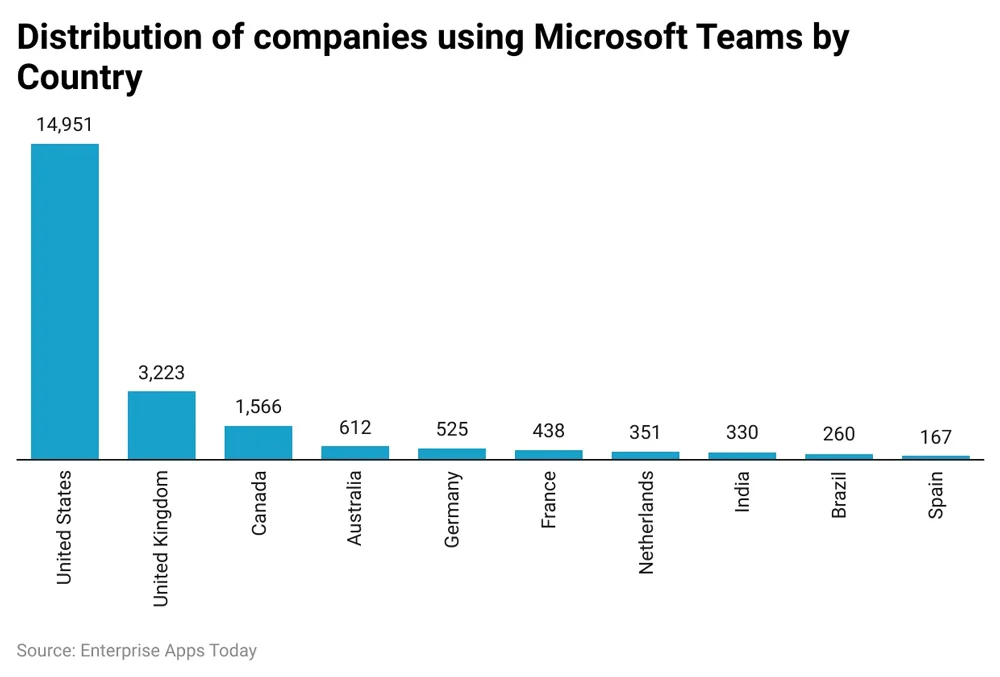
- The United States strongly dominates usage, with 14,951 companies relying on Microsoft Teams.
- The United Kingdom closely follows with 3,223 companies, showing strong adoption across UK enterprises.
- Canada ranks third with 1,566 companies using Teams for collaboration and communication.
- Australia reports 612 companies actively leveraging Microsoft Teams in business operations.
- Germany accounts for 525 companies, reflecting solid adoption in Europe’s largest economy.
- France has 438 companies utilizing the platform across various industries.
- In the Netherlands, 351 companies have successfully implemented Microsoft Teams.
- India contributes with 330 companies, highlighting growing usage in emerging markets.
- Brazil sees 260 companies using Teams across its corporate landscape.
- Spain rounds out the list with 167 companies adopting the platform.
Microsoft Teams in the Education Sector
- 10.6% of Microsoft Teams users are from higher education institutions.
- Schools and education management account for 8.3% of Teams usage.
- Over 150 million students and educators use Teams for classes, collaboration, and administration globally.
- Post-pandemic, 61% of educators expect hybrid learning environments using Teams.
- File sharing in Teams is widely used to support academic workflows in virtual classrooms.
- Integration with Microsoft 365 enhances productivity for educators and students on Teams.
- Discounted education licensing has accelerated Teams adoption in educational institutions.
- Teams usage in education surged by 30 million students from September 2020 to early 2021.
- Schools standardizing on Teams have reported increased student engagement and collaboration.
- Microsoft Teams Education features support up to 49 participants for interactive learning sessions.
Microsoft Teams Device and Platform Usage
- Microsoft Teams reached 360 million monthly active users globally by June 2025.
- Over 90% of Fortune 100 companies use Microsoft Teams.
- Desktop usage accounts for around 70% of total Teams sessions, with Windows dominating the share.
- Microsoft Teams Rooms hardware supports meeting rooms with over 1 million certified Teams Rooms devices deployed.
- Teams-certified peripherals like USB headsets, webcams, and speakerphones continue expanding steadily.
- Windows holds over 75% global desktop OS market share, boosting Teams desktop client usage.
- Mobile daily active users of Teams exceed 75 million, supporting remote and frontline workers.
- Teams Admin Center offers device usage analytics with data retrievable over 7, 30, 90, and 180-day periods.
- About 25% of Teams users utilize Teams Phone, with 80 million Teams Phone users reported by mid-2025.
- Certified Teams Rooms hardware supports Windows, Android, and Surface Hub devices with AI-enabled features.
Role of Microsoft Teams in Enterprise Workflows
- 90% of Fortune 100 companies use Teams.
- 32% of Teams usage comes from large enterprises.
- 47% comes from medium-sized businesses.
- 21% comes from small businesses.
- 80 million Teams Phone users exist globally, with 20 million PSTN-enabled users.
- Enterprises increasingly replace legacy telephony with Teams Phone.
- Teams Rooms adoption shows enterprises standardize on unified communications.
Global Downloads of the Microsoft Teams Mobile App
- Teams saw 77.9 million mobile downloads in the first three quarters of 2024.
- Mobile daily active users exceed 75 million.
- EMEA regions show strong mobile Teams adoption.
- Mobile usage supports frontline and hybrid workforce connectivity.
- Mobile complements desktop and room-based enterprise environments.
Engagement and User Behavior
- Teams handles 7 billion meeting hours per month, up 18% year over year.
- Daily active users exceeded 220 million in 2025.
- Caption and live translation features are used in 42% of meetings.
- File sharing usage increased by ~76%.
- Teams serves as a hub for chat, files, and calls.
- Distributed and hybrid teams drive increased engagement.
Productivity Benefits of Microsoft Teams
- Microsoft Teams reached 360million monthly active users in early 2024.
- Daily active users grew from 270 million in 2022 to 360million in 2023.
- Over 5 billion meeting minutes are generated daily on Microsoft Teams.
- Microsoft Teams Phone is used by 20 million users for enterprise voice.
- The platform supports over 1,400 third-party app integrations, improving workflow.
- Average daily active users surpassed 145 million in 2024, showing reliance on Teams for daily work.
- Microsoft Teams centralizes communications, reducing time spent toggling between apps by up to 20%.
- Teams supports multi-device usage, allowing users to join meetings simultaneously on multiple devices without disruption.
- The consolidation of tools in Teams improves productivity scores across communication and collaboration by up to 40%.
- Centralized file sharing and real-time collaboration cut email reliance, with files shared inside Teams increasing by 50% year over year.
AI Integration in Microsoft Teams
- Microsoft Teams had 360 million monthly active users in June 2025, with widespread device integration supporting AI features.
- Channel Agents launched in 2025 help with task automation like summarization and deadline tracking across Teams channels.
- About 25% of Teams active users utilize Teams Phone functionality for communication as of mid-2025.
- Microsoft Teams Rooms hardware integrates AI features such as smarter framing and noise suppression to enhance meeting quality.
- AI-powered live captions are available in over 30 spoken languages, boosting accessibility and inclusivity in meetings.
- AI-generated live caption translations in Teams reach an accuracy rate of 85–90%, facilitating multilingual communication.
- Teams holds around 32.29% of the global video conferencing market share by 2025, driven by AI-enhanced collaboration tools.
- By 2025, Microsoft will have over 34,000 engineers working on Teams with extensive AI feature deployment and security integrations.
- Teams integrates AI-driven workflows like Copilot and Agent Builder to automate routine tasks and improve team productivity.
- Microsoft Teams Rooms market was valued at approximately USD 2.18 billion in 2024, with rapid growth driven by AI-enabled hardware.
Competitor Analysis of Microsoft Teams
- Microsoft Teams holds about 32.29% of the global collaboration market share as of 2025.
- Teams has 360 million monthly active users, with over 80 million using Teams Phone features.
- Teams Phone System subscriptions exceed 20 million, including PSTN telephony users.
- Teams Premium tier surpassed 3 million users, attracting enterprises with advanced collaboration features.
- Hybrid work trends have boosted Teams usage with 42% more chats after hours, and meetings growing 2.5 times in duration globally.
- AI capabilities in Teams support accurate note-taking, task automation, and enhanced meeting engagement.
- Over 8 million US companies have adopted Teams, dominating enterprise collaboration adoption.
- Teams telephony integration delivers financial benefits with up to 345% ROI over three years through improved call center efficiency.
- Teams room system integration tracks meeting occupancy to optimize workspace usage effectively.
- Competitors like Zoom hold 40-55% share in SMB segments but cannot match Teams’ enterprise integration and compliance depth.
Frequently Asked Questions (FAQs)
Microsoft Teams has over 360 million users worldwide.
Microsoft Teams holds about 32.29% of the global video conferencing / business-communication market.
The platform recorded approximately 77.9 million downloads in the first nine months of 2024.
90% of Fortune 100 companies reportedly rely on Microsoft Teams for enterprise communication.
Conclusion
Microsoft Teams has evolved far beyond a simple chat or meeting platform; it is now a multi-device, enterprise-grade collaboration hub, deeply integrated into daily workflows across organizations of all sizes. With hundreds of millions of active users, widespread mobile and desktop adoption, strong enterprise penetration, and growing AI capabilities, Teams supports modern hybrid and remote work models with flexibility and depth.
As companies continue to seek unified, scalable, and efficient communication tools, Teams stands out for combining video, chat, voice, file collaboration, and AI-powered features under one roof. For anyone exploring collaboration platforms, these statistics offer a clear snapshot of why Teams remains a top choice and why its relevance is likely to grow in the years ahead.