

Mobile phones have become nearly universal tools for communication, work, commerce, and entertainment. Global mobile phone adoption and usage hit record highs, shaping how people connect, businesses operate, and services evolve. From rising smartphone penetration to surging mobile data demand, the trends show far-reaching effects across economies and industries. In this article, we explore the latest mobile phone usage statistics and their implications.
Editor’s Choice
- An estimated 5.81 billion people worldwide are unique mobile subscribers in 2025.
- Global mobile subscriptions reached 8.66 billion by the end of 2024, with a forecast of 8.8 billion by the end of 2025.
- Around 7.13 billion smartphone subscriptions existed in 2024, rising to roughly 7.3 billion by late 2025.
- As of 2024, about 4.25–4.3 billion people globally owned a smartphone, approximately 50% of the world’s population.
- The average person spends 4 hours 37 minutes per day on their phone, over one day per week.
- Mobile technologies and services now contribute roughly 5.8% of global GDP, equating to about $6.5 trillion annually.
- Mobile-only internet users and mobile-driven web traffic continue to push the global online economy forward.
Recent Developments
- In 2025, unique mobile subscribers globally rose by 2.0% year over year, adding 116 million new users.
- Smartphone subscriptions grew modestly in 2025, reflecting continued device upgrades and expansion of cellular networks.
- The dominance of smartphones over feature phones becomes clearer as global smartphone subscriptions near 7.3 billion in 2025.
- The global share of smartphones in total mobile connections has climbed, highlighting rising dependence on smart devices.
- Mobile technologies are increasingly generating economic value, with mobile contributing about 5.8% of global GDP in 2025.
- Expansion of mobile infrastructure and the spread of 4G and 5G networks support broader mobile adoption globally.
- More regions report rising mobile internet penetration and increased mobile data subscriptions.
- Mobile phones serve as a primary gateway to the internet for a growing share of the global population.
Mobile Data Traffic Increase Across the Years
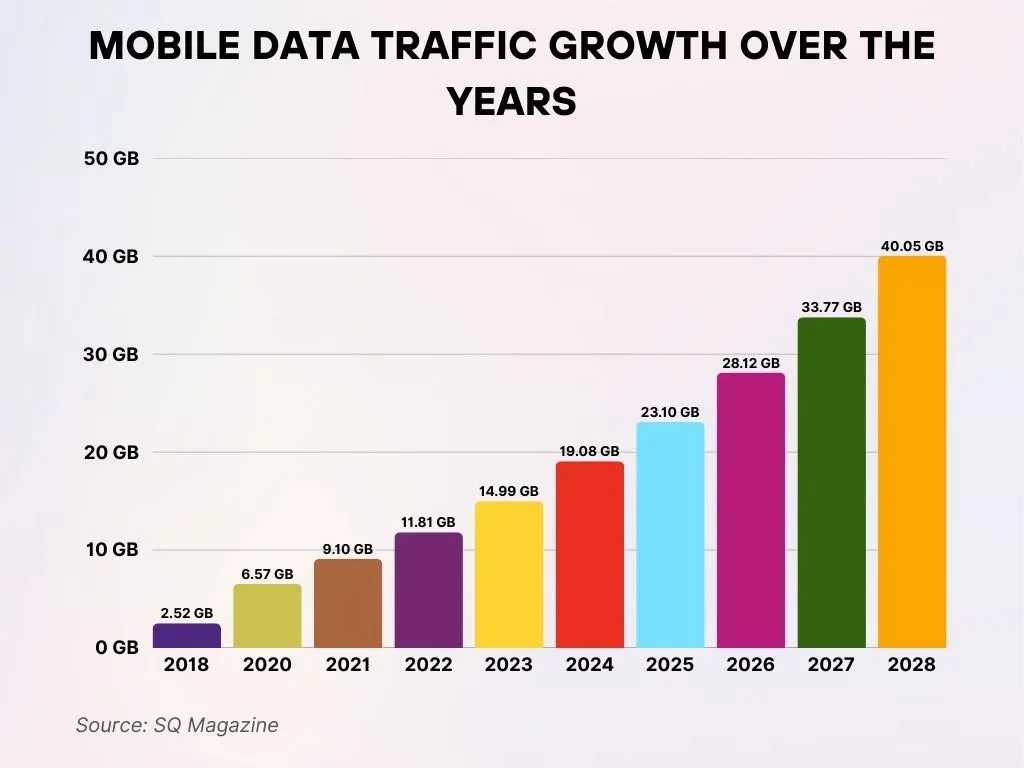
- In 2018, the average monthly mobile data traffic per smartphone was 2.52 GB, indicating the early phase of growing mobile internet reliance.
- By 2020, it had increased to 6.57 GB, showing a notable shift as more users consumed streaming and online services.
- In 2021, usage jumped to 9.10 GB, reflecting growing dependency on mobile apps and remote work tools.
- The year 2022 saw data usage rise to 11.81 GB, driven by video content, gaming, and social media.
- In 2023, average data traffic climbed to 14.99 GB, continuing the trend of heavy mobile internet consumption.
- 2024 projected traffic reached 19.08 GB, fueled by higher-resolution content and always-on connectivity.
- By 2025, monthly usage is expected to hit 23.10 GB, showcasing how central smartphones are to digital lifestyles.
- 2026 forecasts push the average to 28.12 GB, highlighting increasing bandwidth demands.
- For 2027, the estimate is 33.77 GB, pointing to even more immersive mobile experiences like AR/VR.
- In 2028, average usage is projected to reach 40.05 GB, reflecting the culmination of 5G, smart apps, and cloud-based services.
Global Mobile Phone Usage
- As of 2025, roughly 70–71% of the world’s population is mobile phone users.
- The number of unique mobile subscribers stands at around 5.8 billion globally.
- Total mobile subscriptions reached 8.66 billion in 2024, with growth expected to reach about 8.8 billion by the end of 2025.
- The gap between subscriptions and unique users shows how many people own multiple SIMs or devices.
- By 2025, smartphone subscriptions are estimated at 7.3 billion, showing a strong global preference for smart devices.
- In many regions, mobile connectivity exceeds desktop and fixed-line internet usage.
- Mobile technology contributes an estimated $6.5 trillion in economic value worldwide.
- Mobile usage is growing in both developed and developing regions, highlighting the universality of mobile phones.

Unique Mobile Subscribers
- 5.8–5.9 billion unique mobile phone users worldwide represent 70–71% of the global population.
- Unique mobile subscribers reached 5.9 billion by 2025, equating to a 71% penetration rate.
- Global unique mobile subscribers are expected to grow to 6.5 billion by 2030 from 2025 levels.
- 108 million new unique mobile users were added worldwide over the past 12 months to October 2025.
- Unique mobile users grow at 1.9% annually, fueling continued connectivity expansion.
- 5G subscriptions hit almost 2.8 billion in Q3 2025, one-third of all mobile subscriptions.
- 86% of global adults own a mobile phone in 2025, with 68% owning smartphones.
- Smartphone owners totaled 4.69 billion in 2025, rising from 4.25 billion in 2024.
- 91% of US adults own smartphones, up significantly from 70% ownership in 2016.
Smartphone vs Feature Phone Share
- By the end of 2025, smartphone subscriptions will represent about 7.3 billion of the estimated 8.8 billion total mobile subscriptions.
- Feature phones and basic devices make up the remaining share, approximately 1.5 billion subscriptions, or 17–20%.
- In 2024, roughly 4.25–4.3 billion people owned a smartphone, representing 50% of the world’s population.
- Smartphone ownership continues rising while basic phone usage declines.
- Smartphones dominate both subscriptions and active use, serving as primary communication and internet devices.
- The shift highlights widespread adoption of devices supporting apps, data, and digital services.
- Regions historically reliant on feature phones are adopting smartphones rapidly.
- Rising smartphone subscriptions support increased mobile data usage and digital service adoption.
Smartphone User Growth Trends
- An estimated 4.69 billion people owned a smartphone in 2025, an increase of 440 million over the prior year.
- Over the past three years, smartphone ownership increased approximately 38.4%, adding 1.3 billion new users.
- Other reports estimate ~5.78 billion smartphone users in 2025.
- Smartphone subscriptions reached 7.13 billion in 2024, rising from 6.93 billion in 2023.
- Forecasts show subscriptions may reach 7.3 billion by the end of 2025.
- In Q2 2025, smartphone shipments rose 1.0% year over year, totaling 295.2 million units.
- Despite economic pressures, smartphone adoption continues to expand across global markets.
- The growth trend highlights increasing reliance on mobile devices for daily communication and internet access.
Mobile Phone Usage by Region
- Europe boasts the highest mobile penetration at 140% of the population in 2024.
- Greater China and Europe lead with 89% unique mobile subscriber penetration in 2024.
- Africa records 92% mobile penetration, trailing the global average of 109%.
- Latin America shows strong growth in unique mobile penetration to 76% by 2030.
- Asia achieves 85% Android dominance, reflecting high mobile usage.
- Hong Kong tops with 293% mobile phone penetration as a percentage of the population.
- North America holds a 124% mobile penetration rate by the end of 2024.
- Sub-Saharan Africa lags at 33% smartphone ownership among adults.
- South Asia averages 32 GB/mo mobile data usage per user in 2024.
Mobile Phone Usage by Age Group
- 97.1% of individuals aged 15–29 in major markets report mobile phone use in the past three months.
- 73.4% of individuals aged 15–29 own a mobile phone globally.
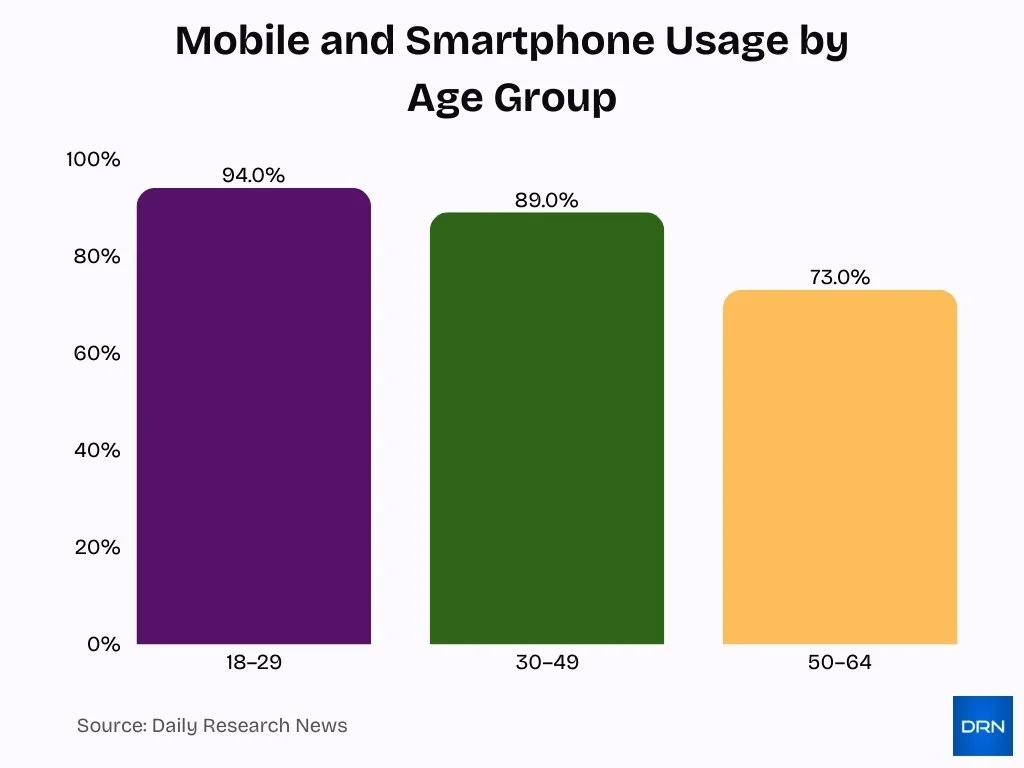
- 94% of 18–29-year-olds own smartphones in the US.
- 89% of 30–49-year-olds own smartphones, followed by 73% of 50–64-year-olds.
- 95% of Americans aged 18–29 and 30–49 rely on smartphones.
- 92% of 50–64-year-olds in the US own and use smartphones.
- 94.2% of global internet users aged 16+ access via smartphones in 2025.
- 96.8% of rural 15–29-year-olds in India used mobile phones in the last three months.
Mobile Phone Usage by Income Level
- High-income economies report mobile ownership exceeding 95% among individuals aged 10+.
- Upper-middle-income economies exceed 90% ownership.
- Low-income economies average around 53% ownership.
- Economic status remains a strong determinant of device access.
- Many low-income regions show gaps between phone ownership and internet usage.
- Higher income groups are more likely to own smartphones instead of feature phones.
- Increased income correlates with owning multiple mobile connections.
- Economic inequality affects both access and connectivity quality.
Time Spent on Mobile Phones Daily
- The average global user spends 4 hours and 37 minutes per day on their smartphone.
- This equals roughly 70 days per year of phone time.
- People check their phones 58 times per day, with over half occurring during work hours.
- Weekday usage tends to exceed weekend usage slightly.
- In the US, 91% of adults own a smartphone and use them between 4.5 to 5.2 hours daily.
- Frequent checking underscores how integrated phones are in daily life.
- Smartphones anchor communication, browsing, media consumption, and social interaction.
Generations Most Dependent on Their Mobile Phones
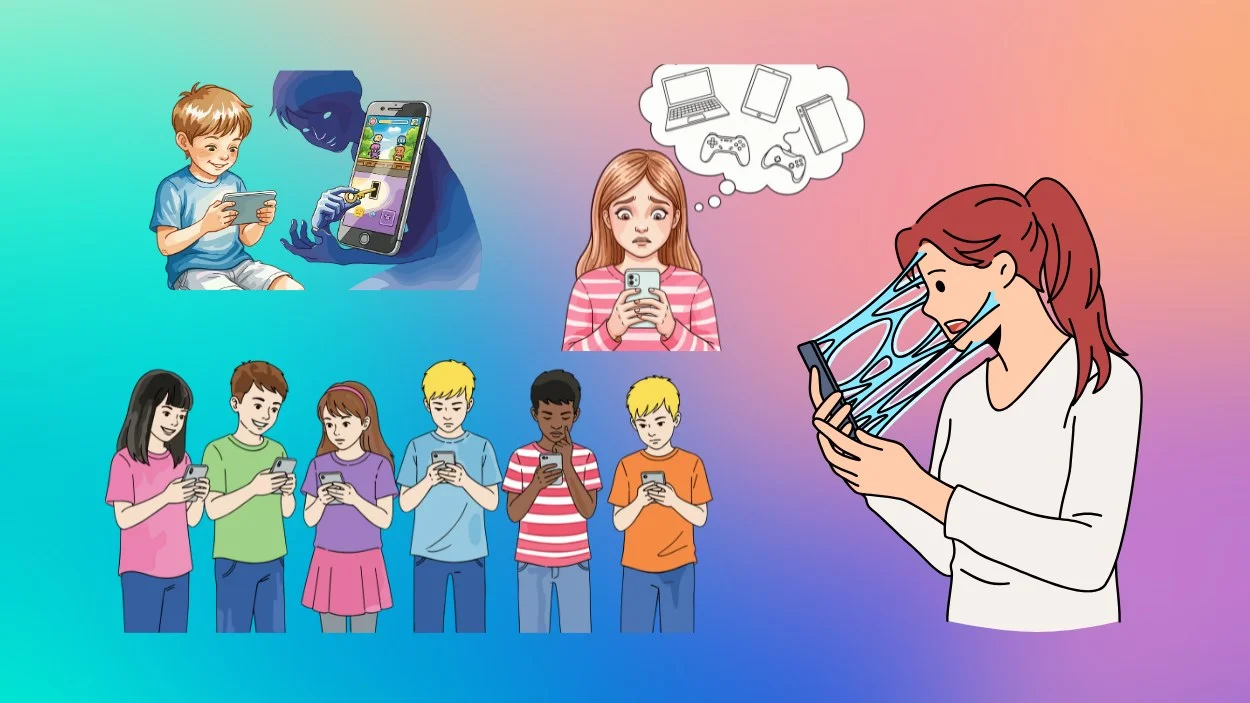
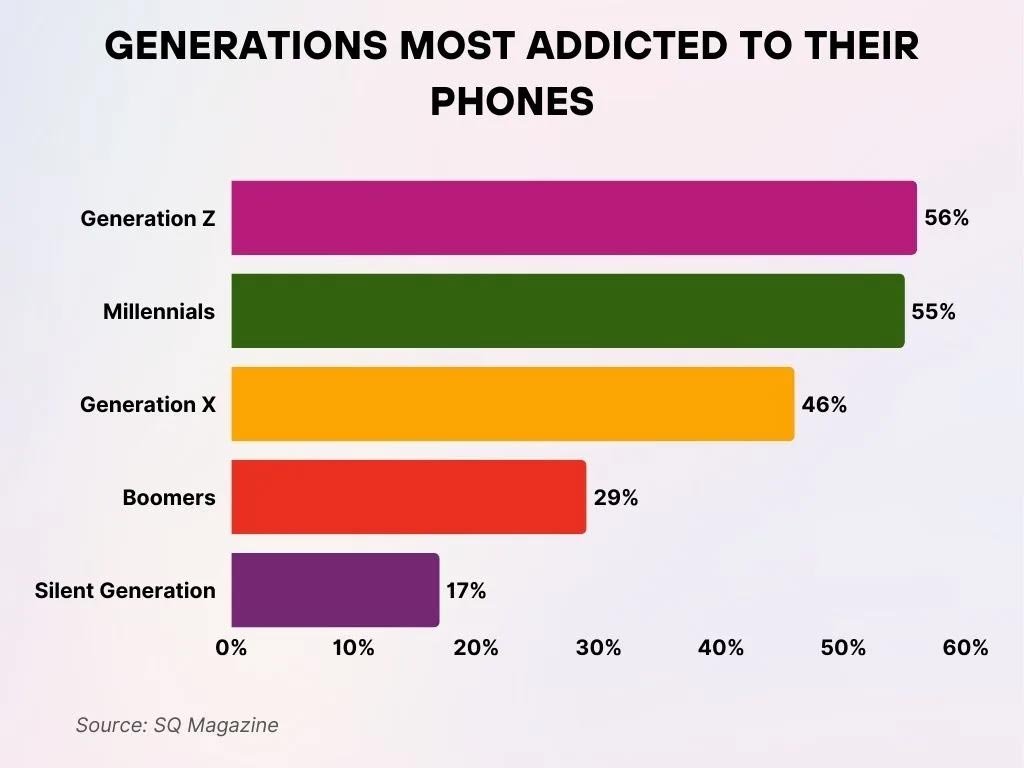
- 56% of Generation Z acknowledge being addicted to their phones, positioning them as the age group with the strongest attachment to mobile usage.
- 55% of Millennials confess to phone addiction, placing them just behind Gen Z in terms of mobile dependency.
- 46% of Generation X state they experience phone addiction, indicating a moderate level of digital attachment.
- Only 29% of Boomers report feeling addicted to their phones, reflecting their lower digital engagement.
- The Silent Generation records the lowest rate, with merely 17% expressing feelings of mobile phone addiction.
Mobile Only Internet Users
- Around 62–64% of global internet traffic originates from mobile devices in 2025.
- 76.1% of internet traffic in Africa comes from mobile users.
- 71.2% mobile share dominates internet traffic in Asia.
- 15% of US adults access the internet exclusively via mobile phones.
- 4.32 billion active mobile internet users worldwide in 2025.
- 96.3% of internet users access the web using a mobile phone.
- In India, 79.9% of internet traffic is mobile-only.
- 69.13% of Africa’s internet traffic stems from mobile devices.
Share of Web Traffic from Mobile
- Mobile devices account for 64.35% of global website traffic in 2025.
- Smartphones generated 60% of global web traffic in Q2 2025, excluding tablets.
- Mobile traffic reached 60.5% of global web share as of July 2025.
- Africa leads with 69.13% of internet traffic from mobile devices.
- Desktop share fell to 39.5% globally, while mobile hit 60.5% in 2025.
- Mobile overtook desktop in October 2016 at 50.77% web traffic.
- In 2009, desktops dominated with 99.3% versus mobile‘s 0.7%.
- US mobile traffic stands at 56.75%, with desktop at 43.25%.
- Mobile traffic surged from 6.1% in 2011 to 64.35% in 2025.
Mobile App Usage Statistics
- Global app downloads are projected to reach 299 billion in 2025.
- About 137.8 billion apps and games were downloaded in 2024.
- Users spend 3 hours 10 minutes per day on their phones, with 2 hours 51 minutes spent inside apps.
- The mobile app market is worth about $289 billion in 2025.
- Asia Pacific leads with 33% of the mobile app market share.
- In the US, apps account for nearly 70% of digital media time.
- About 49% of users open an app 11 times daily.
- Roughly 55% of consumers use apps as their primary interaction channel with brands.
Mobile Social Media Usage
- Active social media identities reached 5.24 billion in 2025.
- Social media adoption grew 4.1% over the previous year.
- Users spend about 2 hours 21 minutes per day on social platforms.
- Around 35% of mobile time is spent on social apps.
- Users interact with nearly 7 platforms monthly.
- YouTube, WhatsApp, Facebook, Instagram, and TikTok remain dominant.
- Social media usage continues to rise globally.
Gender Breakdown of iPhone vs Android Users Worldwide
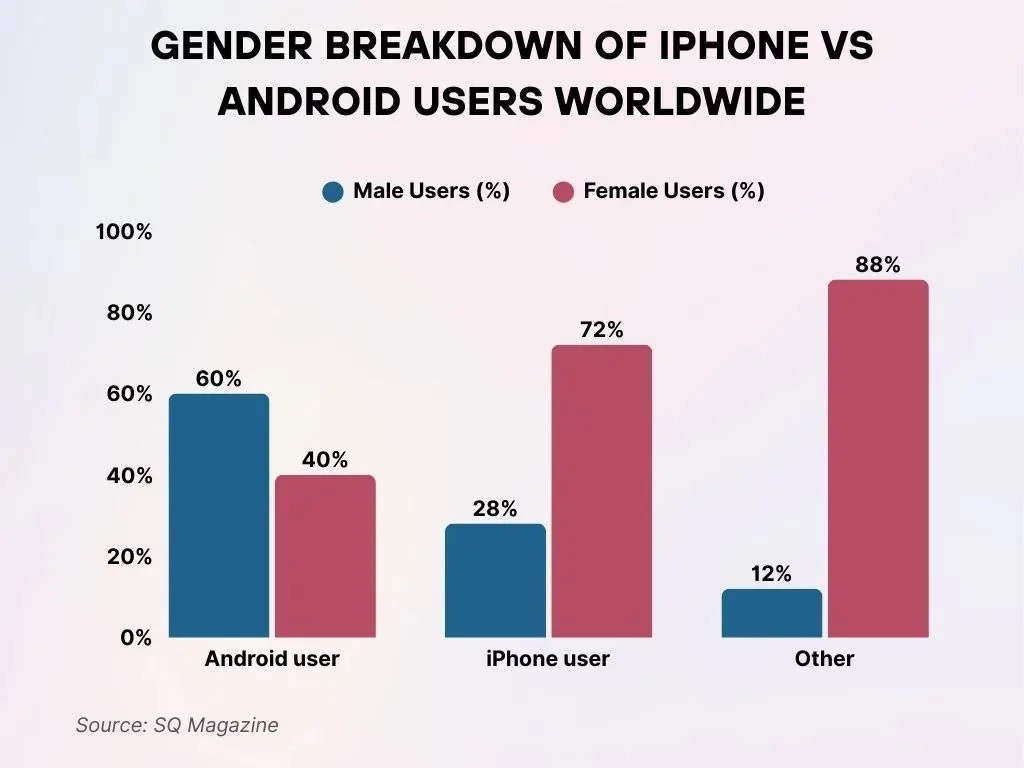
- Worldwide, 60% of Android users are male, whereas 54% of Android users are female, highlighting a modest male predominance in the platform’s user base.
- Among overall smartphone owners, 28% of males choose iPhones, in contrast to 31% of females who prefer Apple devices, emphasizing a slightly stronger inclination toward Apple among women.
- A total of 12% of males and 15% of females are classified in the Other category, signifying their usage of brands that are neither Android nor iPhone.
Mobile Phone Usage and Mental Health
- 65.7% of participants with excessive smartphone screen time near bedtime reported poor sleep quality.
- Smartphone users with high-severe usage had average depression scores of 17.8, compared to 12.1 for low-moderate use.
- 70% of medical students with smartphone overuse before bed experienced sleep problems.
- Adolescents with mental health conditions spent more time on social media and reported lower happiness with online friends.
- 77.5% of students showed sleep issues linked to prolonged mobile phone use.
- Frequent smartphone users reported a 19% rate of fair or poor health, versus 12% the least frequent.
- Adolescents using devices for over 5 hours daily were 70% more likely to have suicidal thoughts.
- Young adults getting smartphones before age 13 had poorer mental health scores, declining further for earlier ages.
Mobile Payments and Digital Wallet Usage
- Global digital wallet users reach 4.4 billion in 2025, projected to grow 35% to over 5.8 billion by 2029.
- Mobile wallet transaction values surge from $10 trillion in 2024 to $17 trillion by 2029, a 73% increase.
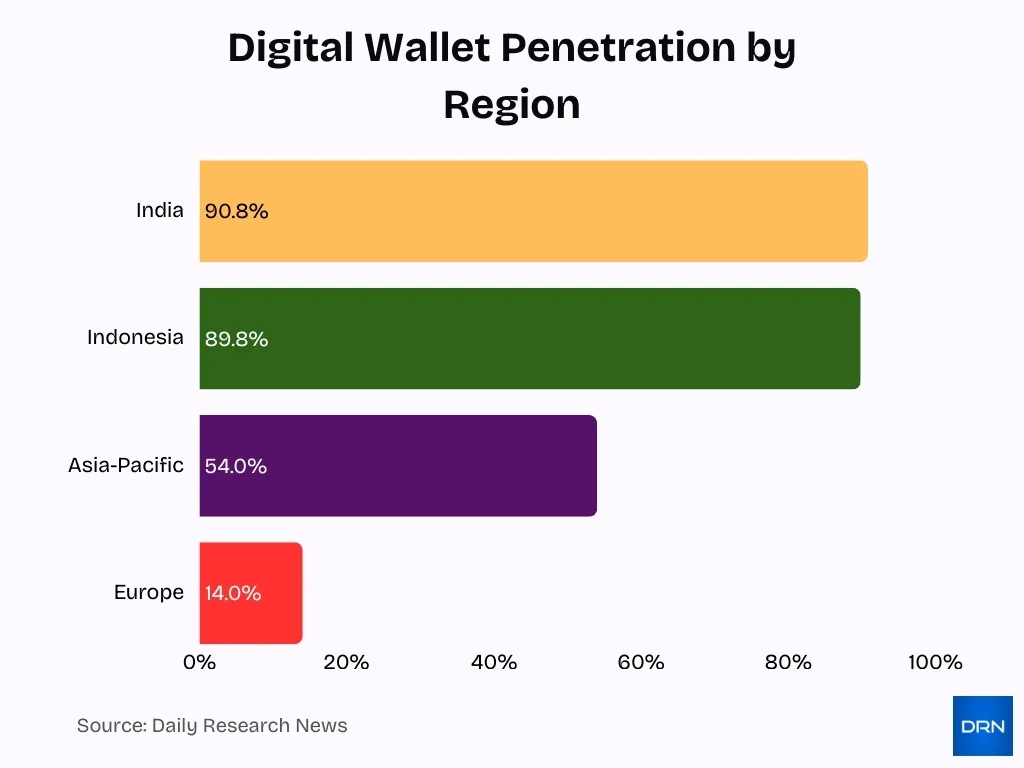
- India leads with 90.8% digital wallet penetration, followed by Indonesia at 89.8%.
- Australians made $160 billion in mobile wallet payments last year via over 4 billion transactions.
- Asia-Pacific dominates with 54% digital wallet penetration, outpacing Europe‘s 14%.
- Global mobile payment transactions hit $4.97 trillion in 2025, driven by smartphone adoption.
- 53% of Americans prefer digital wallets over cash or physical cards for payments.
- UPI transactions in India grow 75% in 2024, powering 80% of total digital payments.
- Mobile wallets comprise 51.7% of global e-commerce payments by 2024.
Forecasts for Mobile Phone Usage
- Mobile app market poised to surpass $1.1 trillion by 2033.
- Global smartphone data usage forecast to hit 42.38 GB/month by 2029.
- 5G networks will handle 80% of global mobile traffic by 2030.
- The mobile payments market is expected to reach $21.79 trillion by 2030.
- Mobile devices will generate 60% of global web traffic in 2025.
- Mobile data traffic projected to surge 2.3x to 280 EB/month by 2030.
- App downloads worldwide forecast at 299 billion in 2025.
- Mobile commerce is expected to account for 59% of e-commerce sales by 2025.
Frequently Asked Questions (FAQs)
About 70–71% of the world’s population uses a mobile phone as of 2025.
Roughly 4.69 billion people globally owned a smartphone in 2025.
In 2025, mobile devices account for about 64.35% of all global web traffic.
Mobile technologies and services contribute approximately $6.5 trillion, equal to ~5.8% of global GDP, as of 2025.
Conclusion
The data highlights how mobile phones have become central to global life, not just as communication devices, but as primary tools for internet access, apps, payments, and social connection. Rising mobile data consumption, app downloads, and mobile web traffic show that smartphones now anchor digital behavior worldwide. As adoption deepens, particularly in developing economies, mobile-first design, digital inclusion policies, and responsible usage practices will matter more than ever.
Looking ahead, the growth in mobile payments, app markets, and data demand suggests that mobile devices will continue to reshape how we live, work, and connect.