

Technology shapes much of daily life today, from work and school to leisure and social connections. Yet, as digital devices and platforms multiply, new data reveal rising costs: mental strain, sleep problems, and physical discomfort. In workplaces and schools, these effects reduce productivity and well-being; in households, they challenge healthy family routines and rest. Read on to explore key statistics behind these trends.
Editor’s Choice
- 73% of Americans say they feel more distracted now than five years ago due to digital devices.
- 1 in 3 teens report anxiety symptoms they link directly to excessive smartphone use.
- 60% of remote workers report burnout related to always-on communication platforms.
- On average, people globally now spend about 6 hours and 38 minutes per day on screen time connected to the internet.
- An estimated 36.7% of the global population shows signs of internet addiction, 33.9% moderate addiction, and 2.8% severe addiction.
- 61.7% of young adults who report high screen usage also report poor sleep quality.
- More than 1 in 10 adolescents (11%) display problematic social media usage, exhibiting difficulty controlling use and facing negative consequences.
Recent Developments
- A 2025 meta-analysis revealed 25.5% of adolescents exceeded 2 hours daily screen time, linking to 17.36% depression prevalence.
- Young adults in the highest smartphone bracket report poor sleep 70% of the time, with 15% excessive daytime sleepiness.
- The 2025 study shows smartphone addiction raises poor sleep risk by 184% (OR 2.84) among university students.
- 48% of teens view social media’s impact on peers as mostly negative, up from 32% in 2022.
- Excessive social media ties to higher self-harm exposure, with 50% of reviews targeting mental health outcomes in youth.
- 69% of remote employees experience burnout symptoms from “always on” digital work demands.
- 76% of remote workers report workplace stress harming mental health, fueling digital fatigue.
- U.S. users face 46 daily notifications, taking 23 minutes to refocus and doubling error rates.
- 3 weeks of screen time reduction yields small-to-medium gains in well-being, depression, and sleep quality.
- Digital detoxes halve screen time to 2.5 hours, boosting positive emotions and cutting anxiety symptoms.
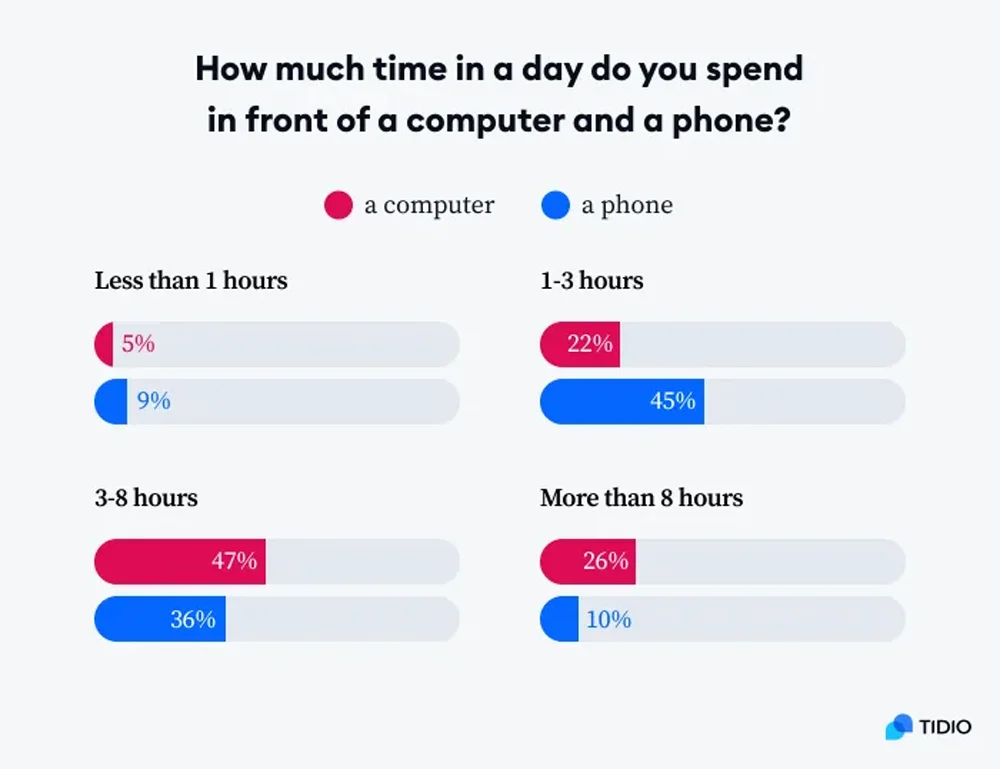
Daily Duration Spent on Computers vs. Phones
- Only 5% of individuals spend less than 1 hour on a computer, whereas 9% report the same amount of time on a phone.
- 22% of people use a computer for 1–3 hours each day, in contrast to a significantly higher 45% who use their phone for that duration.
- The largest portion, 47%, spend 3–8 hours per day on a computer, while 36% spend this same time range on their phone.
- About 26% of individuals use a computer for more than 8 hours daily, whereas only 10% reach this usage level on a phone.
Mental Health Impact
- Among adolescents who spend more than 4–6 hours/day on digital media, studies show significantly higher rates of depression, anxiety, low self-esteem, and sleep problems, in a clear dose-response pattern.
- A 2025 study linked excessive digital engagement in adults to a 40% higher risk of depression relative to lower engagement.
- Adolescents with heavy screen use, 7+ hours/day, are twice as likely to report anxiety disorders compared with lower use.
- Research in 2025 shows that daily screen use of four or more hours among children/adolescents is associated with higher odds of anxiety, depression, and behavioral or conduct problems.
- Problematic social media behavior affects 11% of adolescents, with girls reporting higher rates than boys.
- Nearly 1 in 3 teens report anxiety or mental health symptoms they directly connect with excessive smartphone or social media use.
- Reviews of multiple studies in 2025 flag a consistent pattern: screen time increases correlate with lower overall life satisfaction, greater self-harm risk, and poorer emotional well-being among youth.
- Excessive social media use appears to impair social connectedness and self-esteem, especially when combined with online harassment or social comparison.

Sleep Disruption
- Among university students, the average screen time of around 6.4 hours/day corresponded with 61.7% reporting poor sleep quality and 48.1% reporting excessive daytime sleepiness.
- In the high usage group, 70% had poor sleep, while only 37.5% of low usage individuals did.
- A 2025 study found that adding just one hour of screen use after bedtime increased the odds of insomnia symptoms by 59%, and reduced total sleep duration by about 24 minutes.
- Young adults with longer screen time had significantly higher scores on the Pittsburgh Sleep Quality Index, indicating widespread poor sleep quality.
- Sleep latency emerged as the most affected component among frequent screen users.
- Multiple studies link nighttime device use with daytime sleepiness, mood changes, and impaired daytime functioning.
- Among people who identify as having “smartphone addiction,” roughly 70% report poor sleep quality.
- Sleep disruption appears as a mediating factor between screen time and adverse mental health outcomes, amplifying digital harm.
Physical Health Symptoms
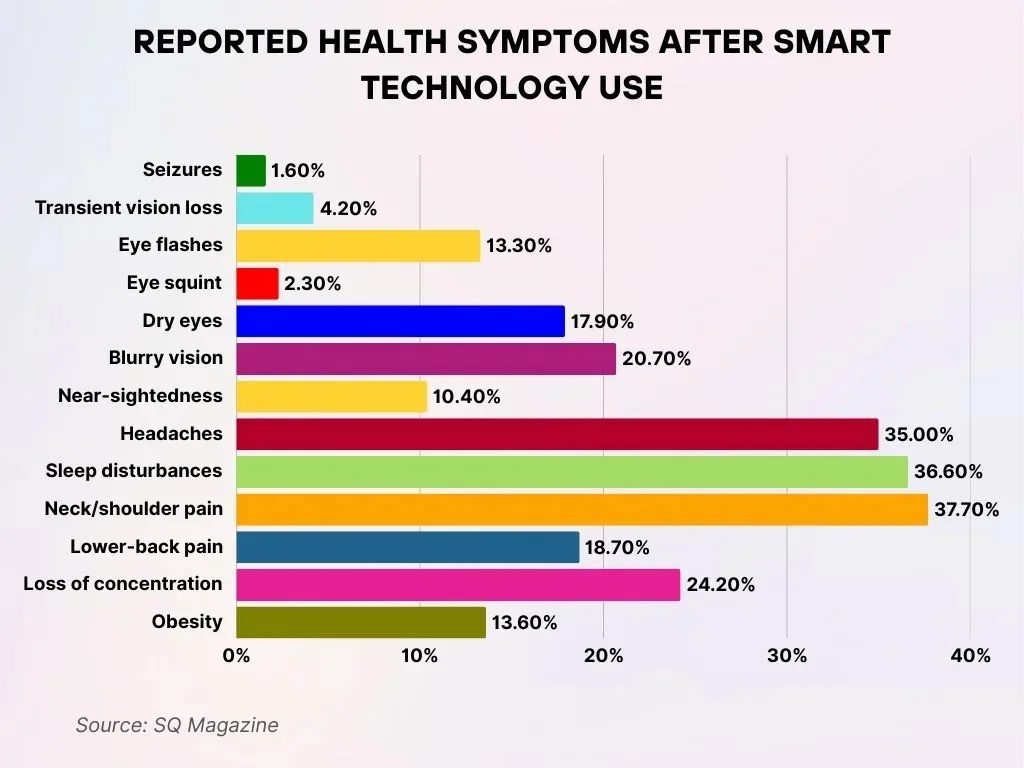
- Neck/shoulder pain emerged as the most frequently reported issue, affecting 37.7% of users after ST use.
- Sleep disturbances impacted 36.6% of users, making it the second most common health concern.
- Headaches were reported by 35% of users, underscoring a notable neurological impact.
- Loss of concentration affected 24.2% of respondents, indicating significant cognitive side effects.
- Blurry vision was noted by 20.7%, signaling possible visual strain.
- Lower-back pain was experienced by 18.7% of users following ST use, suggesting substantial musculoskeletal stress.
- Dry eyes were reported by 17.9%, likely tied to prolonged screen exposure or ocular strain.
- Obesity was identified in 13.6% of users, hinting at a potential connection to sedentary habits.
- Eye flashes were experienced by 13.3%, possibly reflecting visual fatigue or ocular stress.
- Near-sightedness was reported by 10.4%, suggesting potential long-term vision impairment.
- Transient vision loss affected 4.2%, and though less common, it represents a serious concern.
- Eye squint was reported by 2.3%, potentially caused by close-range screen focus.
- Seizures were the least reported symptom, appearing in 1.6% of cases.
Social Isolation
- Young adults using social media ≥121 minutes/day have double the odds of increased perceived social isolation.
- 71% of heavy social media users report feelings of loneliness, up from 53% a year prior.
- 50% of remote workers feel more isolated and lonely when working from home.
- 20.9% of 13-17-year-olds experience loneliness, the highest rate globally.
- Adolescents rate in-person social interaction skills significantly higher than those on social media.
- Face-to-face socializing among teenagers fell by more than 45% from 2003-2022.
- Individuals in the top 25% for social media frequency are more than twice as likely to feel lonely.
- Global social isolation prevalence rose 13.4% from 19.2% in 2009 to 21.8% in 2024.
Technology Addiction
- An estimated 36.7% of the global population shows signs of internet addiction.
- Nearly 48% of Americans report being “addicted or somewhat addicted” to digital devices.
- About 10% of Americans suffer from social media addiction.
- 40% of Americans aged 18–22 report feeling somewhat addicted to social media.
- 37% of people aged 23–38 admit to problematic social media use.
- Over 70% of smartphone users report “phantom vibrations,” indicating compulsive checking behavior.
- More than half of adults say they spend more time on devices than they realize.
- Technology addiction correlates with reduced social skills, procrastination, and poor emotional regulation.
Cyberbullying Rates
- More than 1 in 10 adolescents (11%) show problematic social media use linked to cyberbullying.
- Up to 60% of teens believe they have faced cyberbullying online.
- 44% of U.S. internet users have experienced some form of online harassment.
- Cyberbullying incidents increased by 17% in 2024 compared with 2023.
- Youth-oriented platforms show high vulnerability to online harassment.
- Cyberbullying contributes to anxiety, depression, and reduced self-esteem.
- Victims often feel unsafe even when alone because online harassment is constant.
Data Privacy Concerns
- 73% of consumers are more concerned about data privacy than in previous years.
- 64% feel their personal data is less secure today.
- 79% believe organizations collect personal data without their knowledge.
- 59% say they have little understanding of how their data is used.
- 38% use social media less because of privacy concerns, and 36% have deleted an account.
- 94% of enterprises say customers won’t buy from companies they don’t trust with personal data.
- Over 70% of businesses report benefits from privacy investments.
- Many companies now adopt privacy by design frameworks.
Workplace Distractions
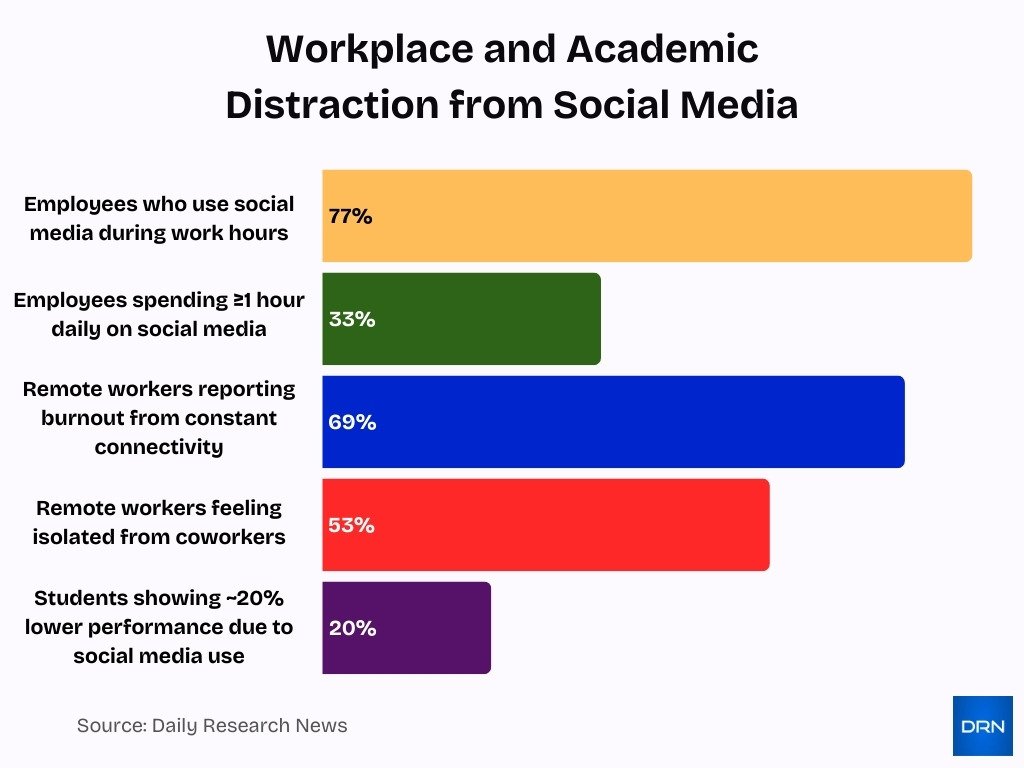
- 77% of employees admit to using social media during work hours.
- Companies lose an estimated $650 billion annually due to social media distractions.
- Workers may lose 23 minutes before regaining focus after a digital interruption.
- 33% of employees spend at least one hour per workday on social media.
- Students who check social media during study show about 20% lower performance.
- 69% of remote workers experience burnout from constant connectivity.
- Over 53% of remote workers feel more isolated from coworkers.
- Many employees report that digital distraction harms job satisfaction and relationships.
Educational Impacts
- Each additional hour of screen time at age two linked to 7% decrease in class participation and 6% drop in math proficiency by fourth grade.
- Children with >3 hours daily screen time averaged 62.1% grades, versus 88.4% for non-users.
- 84.5% of students spend >4 hours daily on social media, with 39.4% reporting harm to assignment completion.
- 1-hour increase in TV at age two correlates with reduced class participation and math proficiency years later.
- >3 hours daily screen exposure in children aged 3-12 showed significantly worse cognitive assessments.
- Every hour of screen time reduces students’ academic performance by 9-10%.
- 1-year-olds with >4 hours daily screen time exhibited developmental delays in communication and problem-solving.
- Excessive screen time predicts poorer academic performance, higher anxiety, and behavioral issues in school children.
- Media multitasking is linked to poorer inhibitory control and lower standardized test scores.
Environmental Effects
- Global e-waste reached 62 million tonnes in 2022, rising five times faster than recycling rates.
- Projected e-waste generation hits 82 million tonnes by 2030.
- The electronics industry accounts for over 4% of global GHG emissions.
- E-waste GHG emissions surged 53% from 2014 to 2020, reaching 580 million metric tons CO2 in 2020.
- Data centers consumed 240-340 TWh in 2022, or 1-1.3% of global electricity demand.
- Rare earth mining produces wastewater with >150 mg/L ammonium and >5000 mg/L sulfate, plus heavy metals.
- Improper e-waste disposal elevates soil lead levels up to 100 times safe limits near recycling sites.
- Only 22.3% of 62 million tonnes of e-waste was formally recycled in 2022.
- Asia generates nearly half of global e-waste at 30 million tonnes annually.
Children and Teens
- A 2025 study of 50,231 U.S. children found that≥4 hours daily screen time raises anxiety odds by 45% (aOR 1.45).
- Physical inactivity and irregular bedtime partly explain screen time and ADHD, as well as mental health issues in children.
- 70.05% of children experience excessive screen time, correlating with emotional symptoms and conduct problems.
- Among 245 toddlers, 39.6% had language delay, with 66% of delayed cases exceeding 2 hours/day screen exposure.
- Adolescents with ≥9 hours/day screen time face 60% higher odds of poor sleep quality and 32.4 minutes less sleep.
- High screen time (≥2 hours/day) links to 32% higher overweight/obesity risk (RR 1.32) in children.
- 57% of school-age children with >2 hours/day screen time show impaired executive function and cognitive issues.
- 47% of parents cite privacy/safety concerns as their top fear from children’s screen time.
- 63% of parents believe online time negatively impacts children’s overall health.
Internet Addiction Risk by Age Group
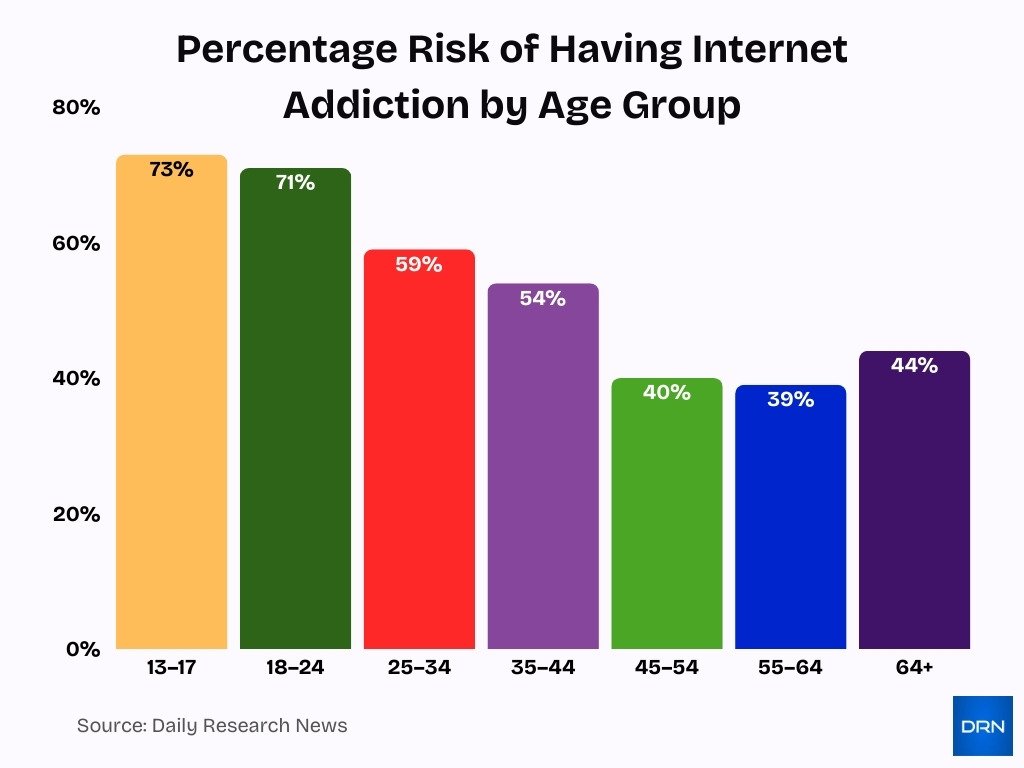
- The highest risk of internet addiction is seen among teens aged 13–17, with a striking 73% reporting vulnerability.
- Young adults 18–24 follow closely behind at 71%, indicating that youth and early adulthood are the most impacted stages.
- Individuals aged 25–34 show a 59% risk, marking a noticeable decline but still representing a major at-risk demographic.
- The risk continues to drop among 35–44-year-olds, reaching 54%, yet remaining over half of the population in this group.
- A significant decrease appears in the 45–54 group, with risk falling to 40%, suggesting mid-life adults may have more balanced internet use.
- 55–64-year-olds report the lowest risk at 39%, showing a trend of reduced dependence with age.
- Interestingly, the 64+ group shows an uptick to 44%, indicating that older adults may still face notable challenges with internet overuse.
Social Media Worries
- 62% of teens report feeling anxious or depressed due to social media pressure.
- Around 38% of heavy users show signs of poor emotional well-being.
- 71% of young adults admit that social media reduces face-to-face conversations.
- Nearly 1 in 3 teenagers experience cyberbullying on social platforms.
- 68% of adolescent girls link Instagram use to body dissatisfaction.
- 79% of users with high screen time report poor sleep quality.
- Average users spend 2 hours and 31 minutes daily on compulsive scrolling.
- 42% of parents notice their children’s real-world social skills declining.
- Only 27% of schools provide digital wellness education programs.
- 56% of users feel social media reduces their overall life satisfaction.
Generational Concerns About Social Media
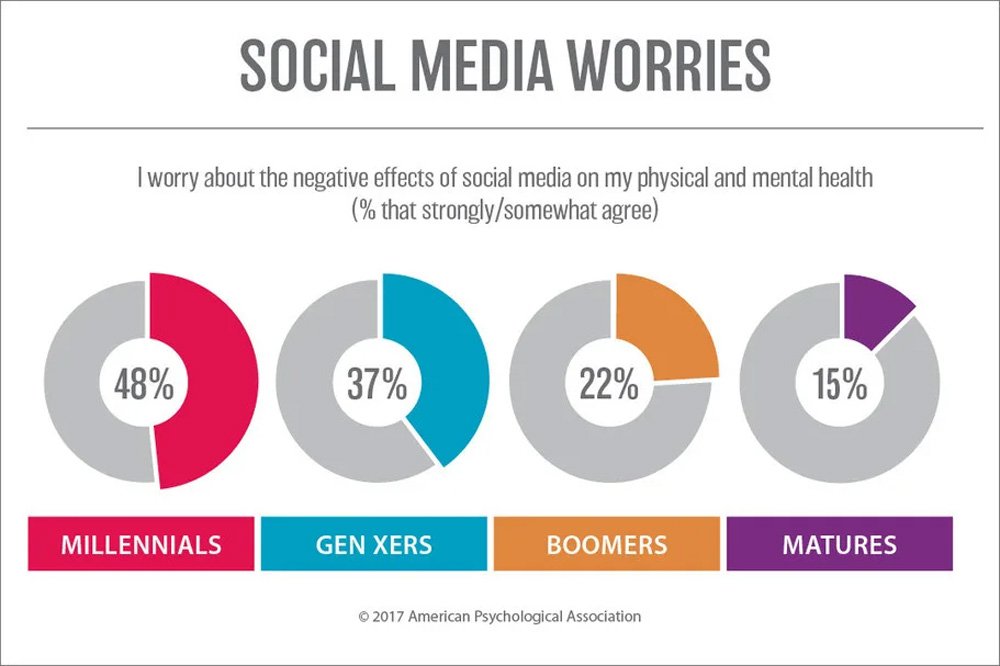
- 48% of Millennials are worried that social media negatively influences their physical and mental health, representing the highest level of concern among all age groups.
- 37% of Gen Xers likewise voice concern regarding the harmful impact of social media on their overall well-being.
- Only 22% of Boomers indicate comparable worries, highlighting their relatively lower sensitivity to social media’s health effects.
- Just 15% of Matures feel concerned about the impact of social media, marking them as the least worried demographic in this survey.
Physical Inactivity
- Over 50% of U.S. teens aged 12–17 report 4+ hours of daily screen time.
- 50.4% of teens have 4+ hours daily screen time, and higher rates of infrequent physical activity at 45.6%.
- Screen time >4 hours/day raises overweight/obesity in adolescents.
- 68.8% of children with >7 hours weekday screen time report no physical activity.
- 37% of children spend <30 minutes/day on outdoor play after school.
- 31% of adults worldwide fail to meet physical activity guidelines, risking chronic diseases.
- 89% of children are exposed to screens during meals, linking to unhealthy diets.
- 65.1% of adolescents report musculoskeletal pain tied to screen time.
- 43% of children exceed 2+ hours/day on screen activities like TV/games.
Safety and Security Risks
- 59% of teens report being bullied or harassed online, according to Pew Research.
- Over 70% of social media apps collect minors’ personal data for advertising purposes.
- Adolescents spending 5+ hours daily on screens are 2.5x more likely to experience depression or anxiety.
- About 40% of youth cannot identify fake news or scams, showing low digital literacy.
- 68% of teens say nighttime phone use disrupts their sleep regularly.
- 1 in 3 children admits to checking devices every few minutes, fueling stress and distraction.
- Nearly 45% of minors have shared private details online without understanding privacy risks.
- Cybercrime involving minors rose by 144% between 2019 and 2023, driven by social media exploitation.
- 62% of parents fear their child’s data privacy is at risk from online tracking.
- Teenagers active online after midnight report 30% higher anxiety and lower self-esteem scores.
Frequently Asked Questions (FAQs)
About 36.7% of the global population shows signs of internet addiction.
On average, people spend 2 hours and 24 minutes per day on social media.
Daily screen time ≥ 4 hours is associated with an adjusted odds ratio (aOR) of 1.65 for depression.
45% of teens reported that they spend too much time on social media in 2025.
Conclusion
As we navigate deeper into the statistical picture, the negative effects grow clearer. From reduced academic performance and impaired development in children to rising rates of physical inactivity, mental health issues, and environmental harm, the data underscore a growing public health and social challenge.
Digital tools offer real value, but when usage tilts toward excess, without guidance or balance, the risks multiply. It becomes critical for parents, educators, policymakers, and individuals to treat digital wellness as a priority.