

Nintendo continues to shape the gaming landscape with impressive sales milestones and evolving consumer engagement. The company’s hybrid console strategy, anchored by the enduring success of the original Nintendo Switch and the breakout launch of the Nintendo Switch 2, illustrates not just longevity but adaptability in a competitive market. From blockbuster hardware launches to robust software ecosystems, Nintendo’s performance influences both the broader gaming industry and adjacent sectors like media franchises and digital entertainment. Explore the data below to understand Nintendo’s current trajectory and where it stands in the global gaming world.
Editor’s Choice
- Nintendo Switch lifetime hardware sales surpassed 153 million units as of mid‑2025, keeping it among the top three best‑selling consoles ever.
- Nintendo Switch 2 sold over 10 million units within months of its June 2025 launch, marking it as Nintendo’s fastest‑selling console.
- Software shipments for the Switch family exceeded 1.4 billion units, with a 9.2 attach rate (games per console).
- Digital game sales accounted for over 60 % of total software purchases in 2025.
- Nintendo raised its fiscal year 2025 revenue forecast to JPY 2.25 trillion ($14.6 billion) based on strong hardware performance.
- Switch 2’s performance in the U.S. eclipsed PS4’s early sales pace within the same timeframe.
- Hardware sales declined year‑over‑year for the original Switch, reflecting market saturation and lifecycle maturity.
Recent Developments
- Nintendo launched the Nintendo Switch 2 on June 5, 2025, introducing improved specs and broader market appeal.
- Within four days of release, Switch 2 shipped over 3.5 million units globally, setting a new company record.
- By September 30, 2025, the Switch 2 had shipped 10.36 million units worldwide.
- Switch 2 software sales reached 20.62 million units in the same period.
- Japan remained a strong regional market for Switch 2, with nearly 1 million units sold in its first four days there.
- Analysts noted that Switch 2 sales outpaced PlayStation 5 in early comparative quarters.
- Nintendo increased its sales forecast for Switch 2 to 19 million units by March 2026, up from 15 million previously predicted.
- Early revenue reports showed Nintendo’s financial outlook improving significantly due to strong hardware and software demand.
Company Overview of Nintendo
- Nintendo Co., Ltd. was founded in 1889 in Kyoto, Japan, and evolved from playing cards to global gaming leadership.
- The company’s portfolio spans consoles, software, mobile titles, and IP licensing.
- Nintendo’s mission emphasizes accessible and innovative gaming experiences across demographics.
- The Switch ecosystem has become central to its strategy, bridging traditional console and handheld play.
- Recent corporate moves include strategic studio investments to bolster first‑party development.
- Nintendo’s iconic franchises (e.g., Mario, Zelda, Pokémon) underpin long‑term brand traction.
- The company continues to balance hardware innovation with ecosystem monetization.
- Nintendo’s licensing partnerships extend into theme parks, film, and consumer products.
Revenue Breakdown by Region and Platform for Nintendo
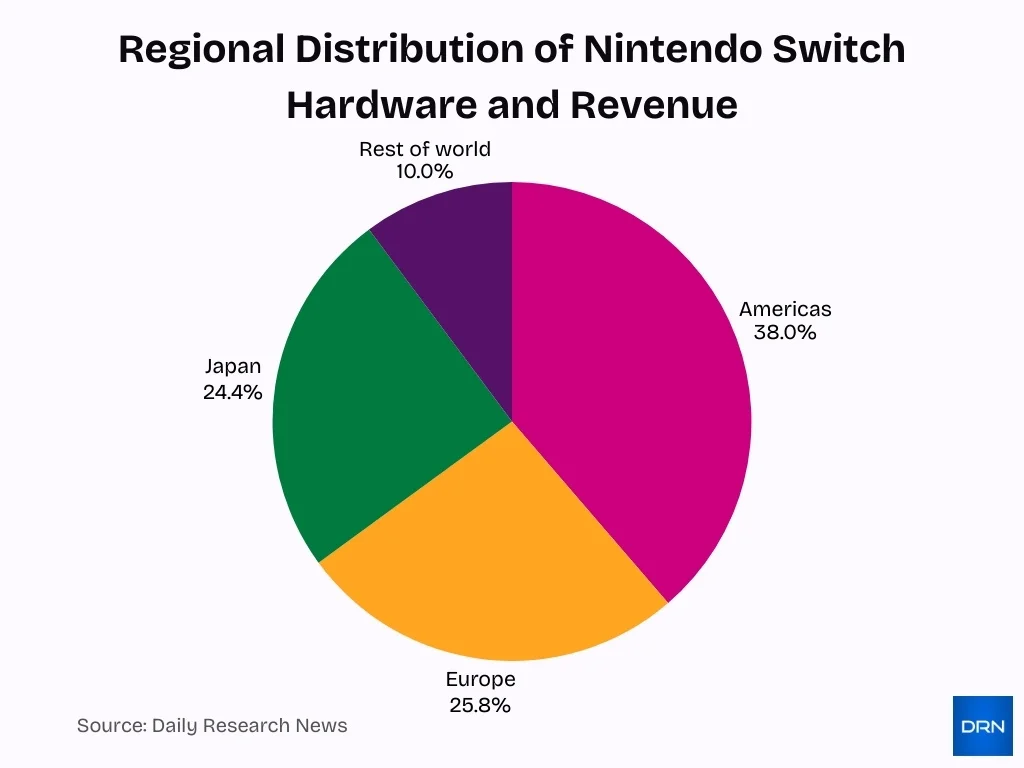
- The Americas accounted for roughly 38% of Nintendo Switch hardware sales historically.
- Europe’s share was about 25.8%, highlighting strong EMEA engagement.
- Japan contributed around 24.4% of lifetime Switch unit sales.
- The rest of the world regions have grown their presence, now exceeding 10% of total sales.
- Digital software revenue outpaced physical sales in recent years, reflecting consumer preference shifts.
- Switch 2 early software results showed strong regional performance across markets.
- Revenue outside Japan typically represented 76% of total net sales for Nintendo.
- Continued hardware diversification supports revenue stability across platforms.

Financial Performance Data for Nintendo
- Nintendo raised its full‑year 2025 revenue target to approximately JPY 2.25 trillion ($14.6 billion).
- Operating profit forecasts climbed accordingly, with estimates near JPY 370 billion.
- Recent quarterly reports indicated double‑digit percentage revenue growth year‑over‑year, driven by Switch 2.
- Profitability metrics improved markedly compared with the prior fiscal period.
- Hardware, software, and licensing contributed to diversified revenue streams.
- The digital game segment saw robust growth, supporting higher margins.
- Revenue from outside Japan accounted for more than three‑quarters of total sales in recent reporting periods.
- Nintendo’s strategic pricing and tariff considerations impacted revenue forecasts.
Global Market Share of Nintendo in the Gaming Industry
- Nintendo holds a 28.4% share of the global console gaming market as of Q1 2025.
- Switch family lifetime sales reached 153.10 million units worldwide by early 2025.
- Nintendo commands 52% market share of consoles in the Americas through September 2025.
- Switch 2 sold over 10 million units globally by the end of September 2025.
- Switch 2 achieved 4.4 million units in the US in the first seven months, leading hardware sales.
- Digital sales comprised 63% of Nintendo software purchases in 2025.
- Nintendo software shipments hit 1.416 billion units for Switch with a 9.2 attach rate as of June 2025.
- The US contributes 42% of Nintendo’s total annual revenue, its largest market.
- Nintendo enjoys 78% market share in Japan.
- In Black Friday 2025, Switch 2 captured 24% of US console sales.
Global Gaming Console Market Share Breakdown
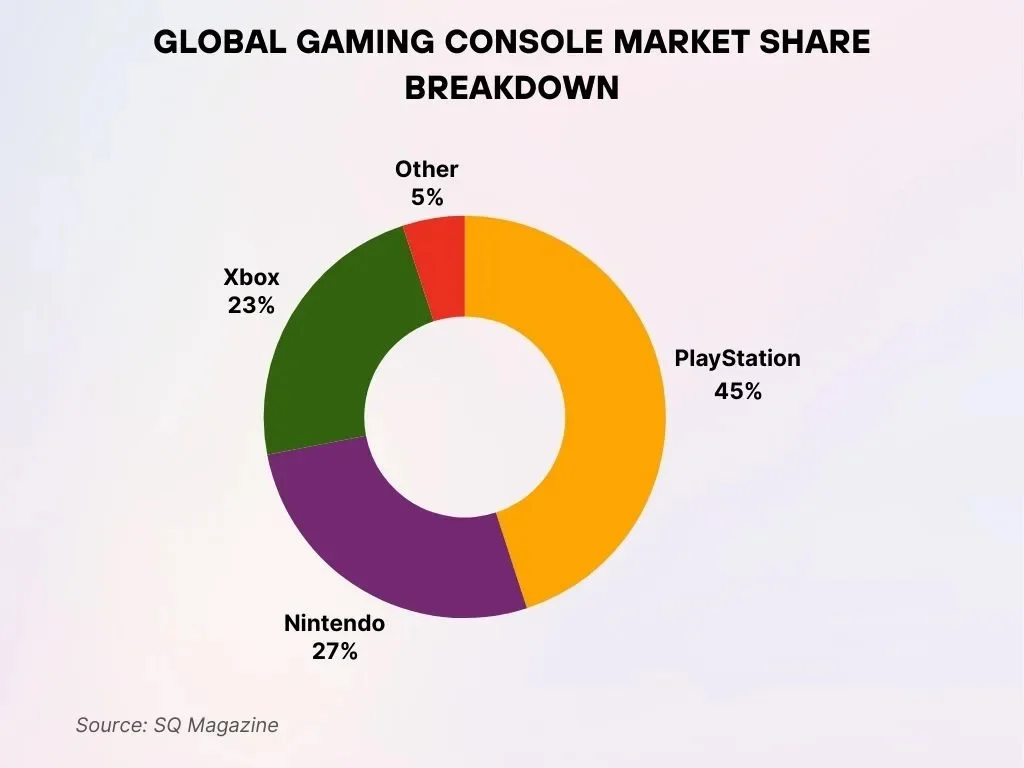
- PlayStation dominates the global gaming console market with a commanding 45% market share, firmly positioning itself as the leading brand worldwide.
- Nintendo captures the second-largest position with a strong 27% market share, highlighting its robust performance and highly loyal fan base.
- Xbox maintains a competitive stance by holding a 23% market share, ensuring a solid presence within the global gaming ecosystem.
- Other console brands collectively represent only 5% of the global market, signaling minimal competition beyond the top three players.
Key Statistics on the Nintendo Switch
- Nintendo’s official figures list the Switch family with 154.01 million total hardware units shipped as of late 2025.
- The Switch platform reached 1,452.79 million software units shipped lifetime.
- The Switch remained one of the top‑selling consoles in 2025, despite the launch of its successor.
- Year‑to‑date hardware figures show the original Switch’s sales are slower than Switch 2, with a notable decline in annual unit sales.
- Cumulative Switch sales made it one of the best‑selling consoles historically, outpacing many legacy systems.
- Switch console sales contributed significantly to Nintendo’s revenue in emerging markets.
- In the Americas, the Switch family held 52% market share within dedicated console segments through 2025.
- Switch’s success helped Nintendo dominate the hybrid console niche worldwide.
Hardware Sales Figures for the Nintendo Switch
- Nintendo reported 154.01 million Switch units shipped by September 2025.
- Year‑to‑date data shows the original Switch sold 4.07 million units while Switch 2 reached 12.49 million in the same period.
- Annual comparisons indicate the original Switch is in a decline phase in unit shipments as the model ages.
- Switch hardware still sells steadily, especially with discounts and in international markets.
- In Europe, Switch 2 has outpaced Switch 1 launch sales by notable margins in matching launch month comparisons.
- Nintendo hardware sales show strong peaks around major holiday windows, sustaining relevance.
- Overall, lifetime Switch sales contribute a significant share of Nintendo’s total console hardware revenue.
- Despite the Switch entering late lifecycle, its cumulative sales remain a key revenue pillar.
Nintendo Website Traffic Distribution by Age Group
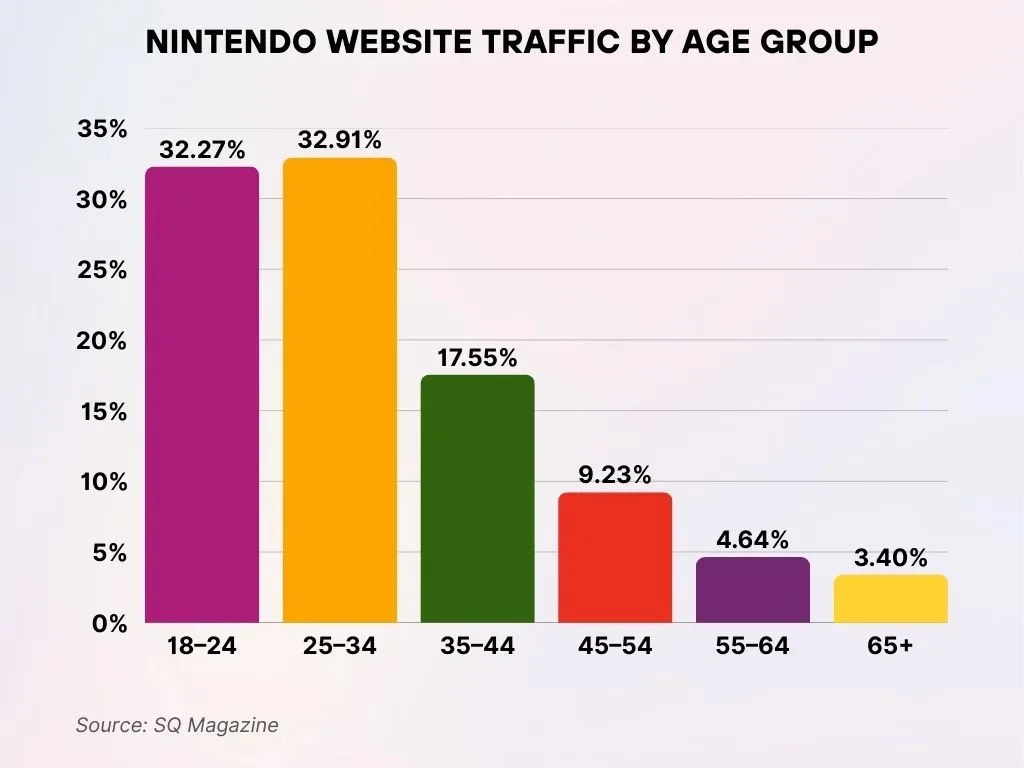
- The largest share of website traffic comes from users aged 25–34, accounting for 32.91% of the total audience, making this the most dominant demographic segment.
- Visitors in the 18–24 age group follow closely behind, contributing 32.27% of overall site traffic and highlighting strong interest from younger users.
- The 35–44 age group makes up 17.55% of traffic, indicating solid engagement levels among older millennials.
- Users aged 45–54 contribute 9.23% of visits, while the 55–64 demographic accounts for an additional 4.64% of total traffic.
- The 65+ age group represents the smallest audience segment, generating just 3.40% of overall website traffic.
Hardware Model Performance of the Nintendo Switch
- The original Switch console remains the dominant model, forming the bulk of the 154 million+ hardware base.
- Switch OLED units account for a meaningful share of total lifetime Switch sales.
- The Switch Lite model holds a notable share as a lower‑cost portable alternative.
- Switch 2 has rapidly overtaken prior generation models in early sales metrics.
- In comparisons across similar launch months, Switch 2 sales have outpaced older models in Europe and North America.
- Performance variances indicate consumer preference for the newest hardware iteration.
- Regional demand for specific models shifts with pricing strategies and availability.
- The mix of SKU performance shows the ongoing relevance of multiple Switch configurations globally.
Annual Sales Trajectory for the Nintendo Switch
- VGChartz reports Switch 2 at 12.49 million YTD vs the original Switch‘s 4.07 million.
- Original Switch reached 153.10 million lifetime units by mid-2025.
- Switch family added 1.89 million original units in H1 2025.
- Switch FY2025 sales hit 10.80 million units, down 31.2% YoY.
- Switch 2 sold 10.36 million units by September 2025.
- Nintendo projects 19 million+ Switch 2 units for FY2026.
- Switch 2 launch: 5.82 million in 26 days vs the original’s 2.7 million.
- FY2021 peak: Switch sold 28.83 million units, up 37.1% YoY.
- Combined Switch sales drove ¥1,099.5 billion H1 FY2026 net revenue.
Most-Watched Gaming Livestream Events by Audience Size
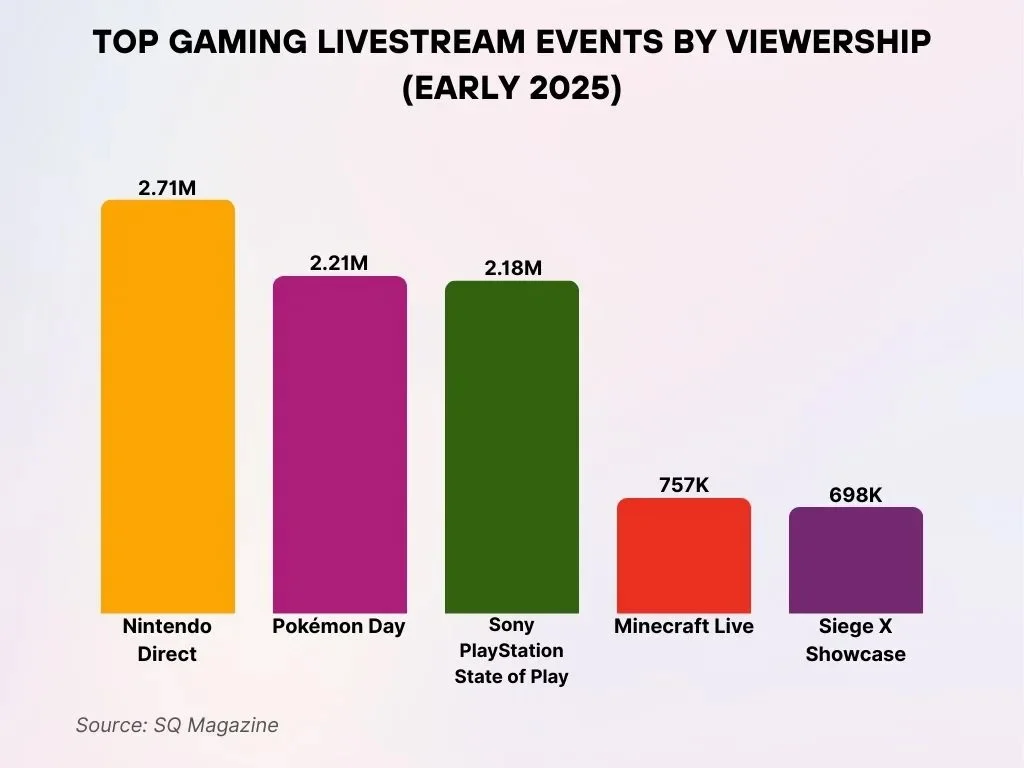
- Nintendo Direct drew the largest audience with 2.71 million peak viewers, firmly leading all major gaming showcases during early 2025 in terms of live viewership.
- Pokémon Day secured second place with 2.21 million peak viewers, demonstrating strong franchise loyalty and exceptionally high fan engagement levels.
- Sony PlayStation State of Play followed closely with 2.18 million viewers, underscoring continued interest in Sony’s gaming ecosystem and upcoming titles.
- Minecraft Live recorded 757,000 peak viewers, emphasizing its consistent global popularity and enduring appeal among diverse gaming audiences.
- Siege X Showcase completed the top five with 698,000 peak viewers, signaling niche yet passionate interest in the Rainbow Six franchise.
Market Share Analysis of the Nintendo Switch
- Nintendo Switch family captured 52% market share in the Americas through September 2025.
- Switch 2 topped global console sales with 1.37 million units in October 2025.
- Switch 2 led US hardware sales in December 2025 by units and revenue.
- Switch lineup claims 38.3% of lifetime sales in North America at 57.83 million units.
- Europe represents 25.8% of Switch’s total sales, totaling 39 million units.
- Nintendo secured 27% global market share in 2025, trailing PlayStation‘s 45%.
- Switch 2 outsold PS5 4.24 million units in the first 6 aligned months to November 2025.
- Switch 2 hit 4.4 million US units in 7 months, 35% ahead of PS4 pace.
- PS5 dominated UK Black Friday 2025 with 62% market share vs Switch 2‘s 23%.
Best‑Selling Games on the Nintendo Switch
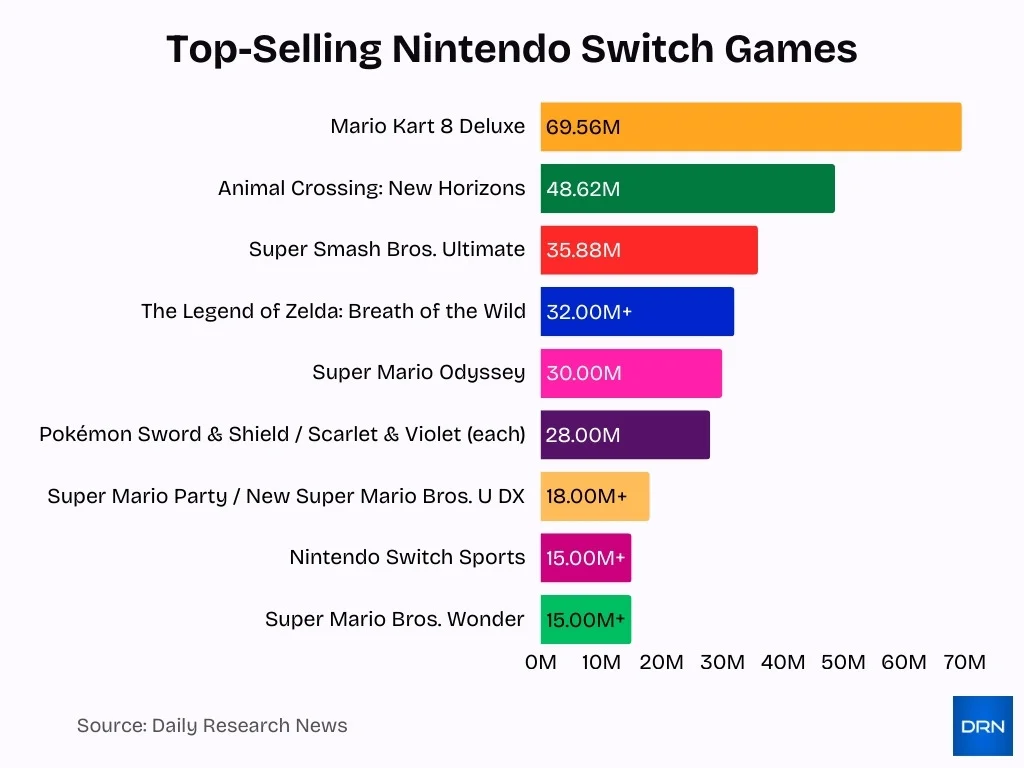
- Mario Kart 8 Deluxe remains the top‑selling Switch title, with around 69.56 million units sold as of late 2025.
- Animal Crossing: New Horizons has sold 48.62 million units, making it one of Nintendo’s most enduring first‑party hits as of late 2025.
- Super Smash Bros. Ultimate has reached 35.88 million in lifetime sales on Switch.
- The Legend of Zelda: Breath of the Wild logged over 32 million sales across Switch platforms by late 2025.
- Super Mario Odyssey has sold nearly 30 million units worldwide, maintaining strong long‑term performance.
- Pokémon franchise titles such as Sword & Shield and Scarlet & Violet each sold 26‑28 million copies on Switch.
- Super Mario Party and New Super Mario Bros. U Deluxe exceeded 18 million sales.
- Nintendo Switch Sports and Super Mario Bros. Wonder both surpassed 15 million units, demonstrating diverse genre appeal.
- Super Mario Bros. Wonder became one of the best‑selling late‑generation Switch titles with over 11 million copies sold by early 2025.
Software Sales Metrics for the Nintendo Switch
- Total software shipments for the Switch platforms surpassed 1.416 billion units as of mid‑2025.
- The software attach rate stood at 9.2 games per console, indicating strong ongoing engagement.
- Digital sales accounted for 63% of total game purchases in 2025, up from 57% in 2024.
- The eShop’s global revenue expanded 8.1% year‑over‑year to roughly $5.9 billion in 2024.
- North America led digital game purchases with over 70% of sales occurring digitally.
- Japan remained comparatively strong in physical game purchases, with physical still accounting for 52% of sales in 2025.
- Software sales for the Switch family help drive recurring engagement over multiple years, with many titles still adding millions of units annually.
Online Subscriber Trends for the Nintendo Switch
- Nintendo Switch Online reached 42 million global subscribers by Q1 2025, marking a significant 23.5% increase from late 2024.
- The Expansion Pack tier (which offers N64 and GBA game libraries) represented about 35% of subscribers.
- Historical figures show the service passed 34 million subscribers in late 2024 before growing further in 2025.
- Surveys indicate a majority of Switch owners (78%) hold an active NSO membership, with 60% of those on the Expansion tier.
- Cloud saving and classic library access continue to be cited as key subscription drivers.
- Increased engagement from online features correlates with ongoing multiplayer and seasonal events across major Nintendo titles.
- Weekly online play averages multiple hours among active subscribers, reflecting the sustained utility of the service.
Digital vs. Physical Game Sales Distribution
- Digital game purchases comprised 63% of total Nintendo game sales in 2025.
- This digital share increased from 57% in 2024 and far exceeds the 43% level seen in 2020, showing a clear long‑term trend.
- North America is especially dominant in digital purchases, while Japan retains a stronger physical market.
- Third‑party titles on Nintendo platforms sometimes buck this trend, for example, Cyberpunk 2077 on Switch 2 sold 75% of its units physically, highlighting niche collector demand.
- Physical media remains relevant for many Switch users, particularly for collector editions and retail markets.
- Industry data show that global console markets have generally shifted toward digital in the past decade, with physical game sales shrinking proportionally across platforms.
- Bundles and special editions often combine digital and physical elements, bridging preferences for both formats.
Most Popular Franchises by Units Sold on Nintendo Platforms
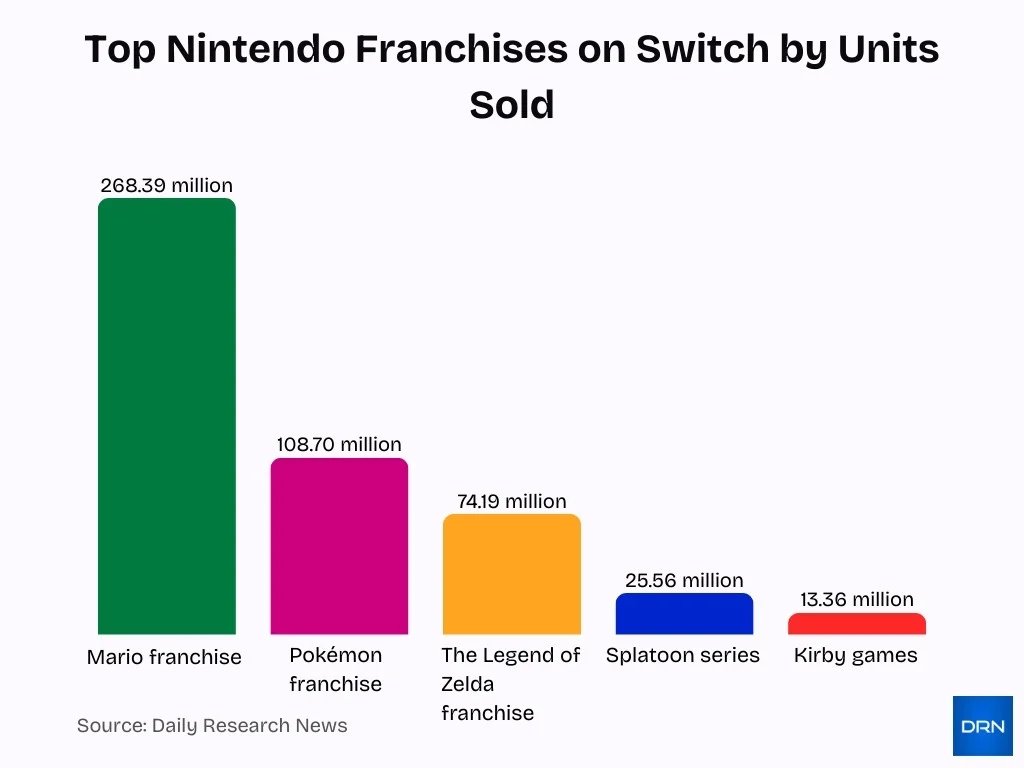
- The Mario franchise has sold 268.39 million units on Nintendo Switch platforms.
- Pokémon titles have achieved 108.70 million units on Switch.
- The Legend of Zelda franchise totals 74.19 million units across Switch games.
- The Splatoon series has sold 25.56 million units on Switch platforms.
- Kirby games reached 13.36 million units on Nintendo Switch.
- Animal Crossing: New Horizons sold 48.62 million units, boosting franchise visibility.
- Super Smash Bros. Ultimate delivered 36.93 million units for the fighting franchise.
- Super Mario Odyssey contributed 29.84 million units to the Mario lineup on Switch.
- Mario Kart 8 Deluxe alone sold 69.56 million units, leading kart racing sales.
Mobile Gaming Revenue Generated by Nintendo
- Nintendo’s mobile business has generated nearly $2.2 billion in revenue across nine mobile titles to date.
- Fire Emblem Heroes alone contributed over $1.19 billion of that total, making it one of Nintendo’s most successful mobile properties.
- Mario Kart Tour and Super Mario Run have hundreds of millions of downloads, broadening Nintendo’s global reach beyond consoles.
- The U.S. accounts for over 20% of all Nintendo mobile installs, making it a key strategic market.
- Japan remains the largest revenue generator for Nintendo mobile titles, with 46% of the revenue share.
- Although recent mobile releases have seen slower starts, legacy titles continue to provide recurring revenue.
- Future mobile gaming initiatives remain part of Nintendo’s growth strategy, though at a measured pace compared with console efforts.
Frequently Asked Questions (FAQs)
As of September 30, 2025, the original Nintendo Switch has shipped 154.01 million units, and the Nintendo Switch 2 has shipped 10.36 million units, totaling 164.37 million units combined.
Nintendo raised its Switch 2 sales forecast to 19 million units for the fiscal year ending March 2026.
In Nintendo’s second quarter of FY2025, the company reported ¥527.202 billion ($3.44 billion) in revenue, representing a 90.56% increase year‑over‑year.
According to Circana data, the Switch 2 sold approximately 4.4 million units in the U.S. within its first seven months on the market, making it the fastest‑selling console in U.S. tracked history.
Conclusion
The data confirm that Nintendo’s hybrid console strategy, anchored by both long‑lived Switch platforms and the new Switch 2, continues to deliver strong engagement and commercial success. First‑party titles like Mario Kart 8 Deluxe and Animal Crossing remain perennial best‑sellers, while digital sales and online subscriptions grow rapidly. Physical media still holds relevance among specific audiences, even as digital formats lead overall game purchases.
Additionally, Nintendo’s mobile segment adds a meaningful revenue stream, underscoring the company’s multi‑platform reach. As Nintendo accelerates its next hardware cycle and expands its game library, these statistics offer a clear picture of both legacy strength and future potential in a rapidly evolving gaming market.