

Online gaming has become a cornerstone of global entertainment and digital culture, blending social connection with immersive play. From casual mobile titles to competitive esports arenas, the sector attracts billions of active players and generates hundreds of billions in revenue. Its influence spans industries, boosting streaming platforms’ viewership and supporting careers from professional gamers to indie developers.
In education, game‑based learning tools leverage online gaming mechanics to increase engagement, while in advertising, brands use in‑game placements to reach highly engaged audiences. Explore what the latest data reveals about this industry’s scale and momentum.
Editor’s Choice
- 3.58 billion people worldwide are expected to play video games in 2025, representing more than 60% of global internet users.
- The global online gaming market is projected to reach roughly $225 billion in 2025.
- Mobile gaming accounts for up to 83% of all gamers globally.
- Console gaming remains a key revenue driver, with growth outpacing mobile in certain markets.
- Revenue across the broader video game market is expected to approach $188.8 billion in 2025.
- North America continues as a top market, with the U.S. generating tens of billions annually.
- Creator payouts for top titles like Fortnite and Roblox could exceed $1.5 billion in 2025.
Recent Developments
- In 2025, generative AI emerged as a key topic in game development, influencing dialogue, assets, and NPC behavior but sparking debate over quality and ethics.
- Streaming culture continues to grow: YouTube’s IShowSpeed led with 64.1 million hours viewed in gaming content in 2025.
- Global policy shifts are underway, such as India’s Online Gaming Bill proposing a ban on real‑money play to regulate fraud and money laundering.
- Major industry M&A could reshape studios, and a $55 billion go‑private deal for Electronic Arts signals new investment dynamics.
- Xbox reported a 10% year‑over‑year increase in gaming revenue driven by content and subscription growth.
- User‑generated content economies for Fortnite and Roblox are expected to pay out more than $1.5 billion in 2025.
- South Korea’s shift to embrace gaming as a cultural and economic asset reflects broader global industry acceptance.
- Hardware innovation and cloud gaming adoption are accelerating cross‑platform engagement and accessibility.
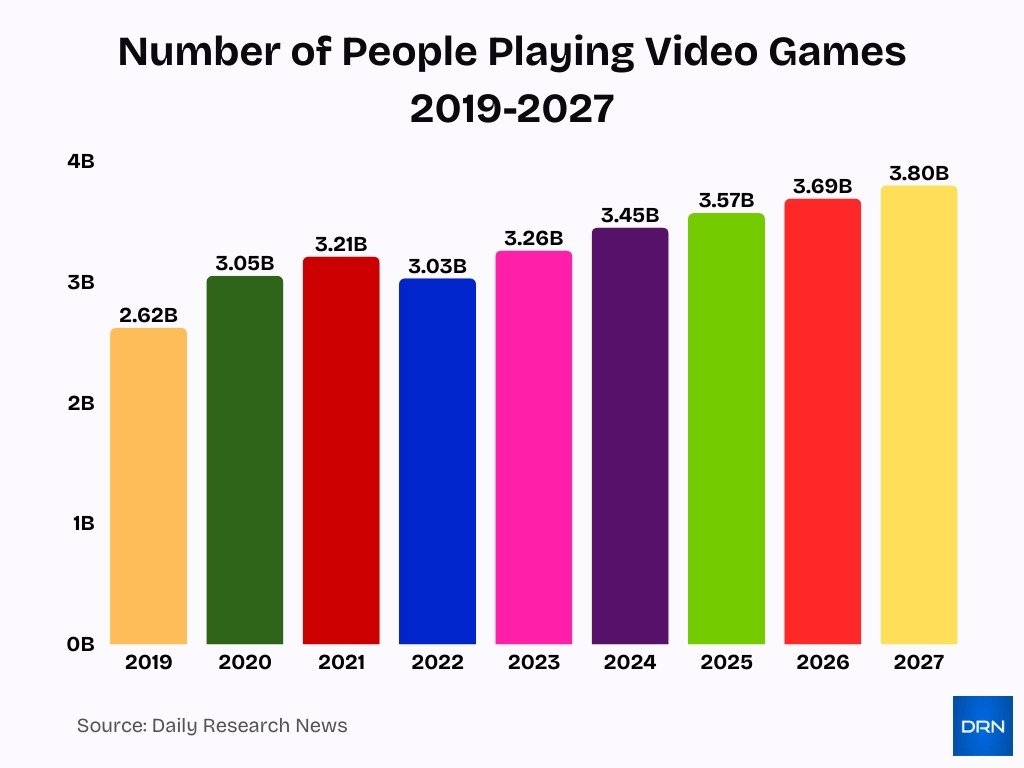
Global Video Gaming Audience Growth (2019–2027)
- The global number of people playing video games stood at 2.62 billion in 2019, highlighting a strong baseline before accelerated digital adoption.
- In 2020, the gaming population jumped to 3.05 billion, reflecting a sharp rise in engagement during global lockdowns.
- The upward momentum continued in 2021, with total gamers reaching 3.21 billion worldwide.
- A slight dip was recorded in 2022, as the number of players declined marginally to 3.03 billion.
- The gaming audience rebounded in 2023, climbing to 3.26 billion players as normal activity and new game releases boosted participation.
- Growth strengthened further in 2024, with the global gamer base expanding to 3.45 billion.
- By 2025, the number of people playing video games is projected to reach 3.57 billion, signaling steady long-term growth.
- The global gaming population is expected to rise to 3.69 billion in 2026, driven by mobile gaming and emerging markets.
- By 2027, the worldwide gaming audience is forecast to hit 3.80 billion players, marking a significant expansion over the decade.
Online Gaming Market Revenue
- The global online gaming market is estimated to be around $225 billion in 2025.
- Broader video game market revenue is expected to be $188.8 billion in 2025, up from 2024.
- Mobile games generated approximately $92 billion in 2024, a large share of the total.
- Digital in‑game spending accounts for a major portion of overall market revenue.
- The U.S. market constitutes tens of billions annually, remaining one of the top revenue sources.
- Console titles contribute strongly to revenue, especially with new releases and subscriptions.
- Asia‑Pacific holds a majority share of global gaming revenue.
- Emerging markets like Latin America and the Middle East/Africa show accelerated revenue gains.

Gaming Industry Growth Rate
- The online gaming sector is projected to grow at a 9.5% CAGR through 2032.
- Alternative estimates show the market could expand around 7.97% CAGR from 2025 to 34.
- Broader video game market growth forecasts indicate CAGR up to 12.2% through 2030.
- Year‑on‑year gamer population increases remain in the 4‑5% range.
- Growth is driven by mobile penetration and digital distribution expansion.
- Cloud gaming adoption contributes to future‑oriented growth.
- Esports and live content monetization add incremental industry growth vectors.
- Software and platform revenues are expected to outpace hardware sales.
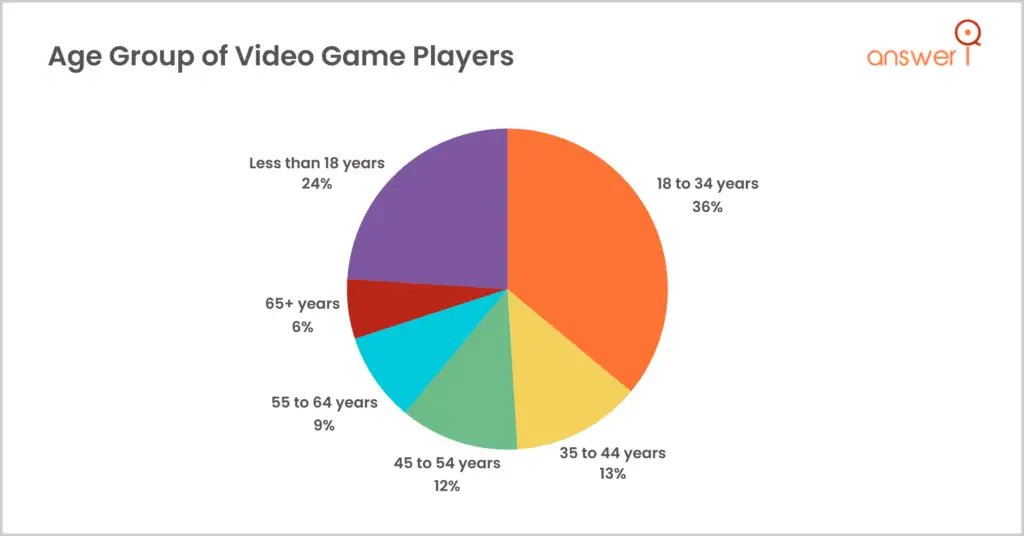
Age Distribution of Video Game Players
- The 18 to 34-year segment represents the largest gamer demographic, accounting for 36% of all video game players worldwide.
- Players under 18 years comprise 24% of the total audience, reflecting strong early adoption among younger gamers.
- Gamers aged 35 to 44 years make up 13% of the player base, highlighting the rising popularity of gaming among older millennials.
- The 45 to 54 years age group contributes 12% of total gamers, demonstrating steady engagement among middle-aged players.
- Individuals between 55 to 64 years account for 9% of gamers, indicating gradual adoption among older adults.
- Players aged 65 years and above represent 6%, showing that video gaming spans all generations.
Gamer Demographics by Gender
- In the U.S., 53% of gamers identify as male, and 46% as female, signaling near parity.
- Mobile gaming specifically mirrors this split, with approximately 53.6% male and 46.4% female players.
- Broader global data suggests a slight male majority overall, but narrowing each year.
- Some mobile audiences show female participation equal to or exceeding male in engagement.
- The growth of casual titles and social features has helped increase female representation.
- A small percentage of gamers now identify outside binary gender categories in surveys.
- Competitive genres like shooters still skew more male, whereas mobile and social games see balanced or female‑leaning audiences.
- Overall, gender balance in gaming continues to improve as barriers to access decline.
Geographic Distribution of Gamers
- Asia Pacific commands over 50% of global gamers, totaling around 1.48 billion players, with dominant mobile adoption.
- India boasts 488 million online gamers in 2024, surging to 517 million by 2025 amid 90% mobile preference.
- China sustains 683 million gamers in 2025, fueling $49.8 billion in domestic gaming revenue.
- Latin America mobile gaming revenue hits $7.25 billion in 2024, expanding at 10.6% CAGR through 2030.
- U.S. hosts over 205 million gamers, with 28% aged 50+ driving broad demographic play.
- Europe counts 128.3 million players in 2024, where 54% of those aged 6-64 engage regularly.
- Africa and the Middle East markets grow 12.3% yearly, propelled by surging mobile penetration rates.
- MENA gaming market surges 19% to exceed $5 billion by 2025, led by high smartphone ownership.
Most Popular Gaming Platforms Among Game Developers
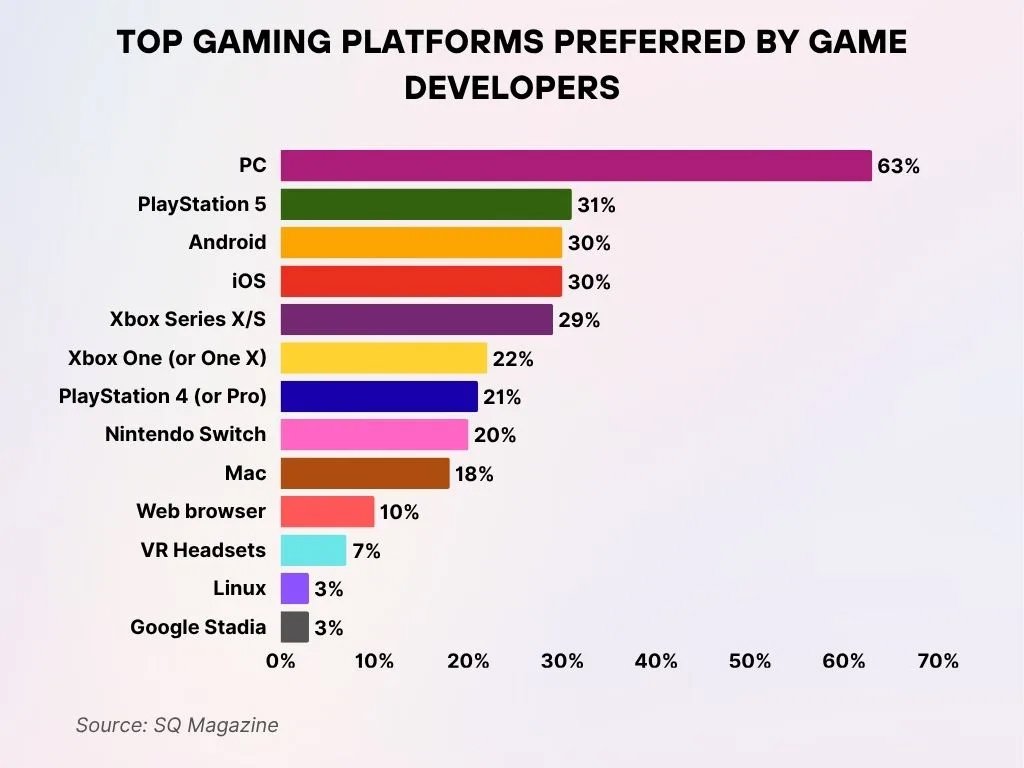
- PC dominates all platforms, with 63% of game developers selecting it as their primary development platform.
- PlayStation 5 secures the second position, as 31% of developers focus on building games for the next-generation Sony console.
- Android and iOS remain equally popular, with 30% of developers preferring each platform for mobile game development.
- Xbox Series X/S closely trails competitors, drawing interest from 29% of console-focused developers.
- About 22% of developers continue to develop games for the older Xbox One (or One X) platforms.
- PlayStation 4 (or Pro) continues to stay relevant, maintaining 21% developer support despite newer consoles.
- Nintendo Switch is targeted by 20% of developers, even with its well-known hardware limitations.
- Mac attracts 18% of game creators, primarily for casual and indie game titles.
- Just 10% of developers build games for web browsers, highlighting its status as a niche segment.
- VR headsets appeal to 7% of developers, signaling slow but consistent adoption in the gaming industry.
- Linux and Google Stadia rank lowest, with only 3% developer interest each among all platforms.
Mobile Gaming Dominance
- Mobile games represent nearly half the global gaming revenue in some reports.
- There are 3.2 billion active mobile gamers worldwide in 2025, with growth continuing.
- The majority of mobile gamers play for several hours daily, especially in markets like Indonesia and Brazil.
- Smartphones serve as the primary gaming device across Asia, Latin America, and Africa.
- Mobile gaming’s accessibility has broadened participation across ages and genders.
- Gen Z players show high mobile usage, often preferring it as their first platform.
- In‑app purchases and free‑to‑play models drive substantial mobile revenue.
- Mobile gaming accounts for a significant majority of daily play sessions worldwide.
PC Gaming Statistics
- Around 1.86 billion PC gamers exist worldwide in 2024, projected to reach 1.9 billion by early 2025.
- Steam boasts 147 million monthly active users in Q1 2025, with 40 million peak concurrent users in February.
- PC gaming revenue hits $43 billion in 2025, growing 10.4% year-over-year amid a premium content surge.
- 72% of global gamers play across two or more platforms, including PC, console, and mobile.
- North America commands 29.4% of the global gaming PC market share, with 35% of U.S. households owning gaming PCs.
- Steam revenue soared to $10.8 billion in 2024, up 24%, powering the PC gaming ecosystem.
- PC esports draws from a 641 million viewer audience in 2025, with 320 million core fans engaged.
- Cloud gaming reaches $5.32 billion in 2025, with 71% of users accessing via PC or laptop.
Game Genre Download Trends in India
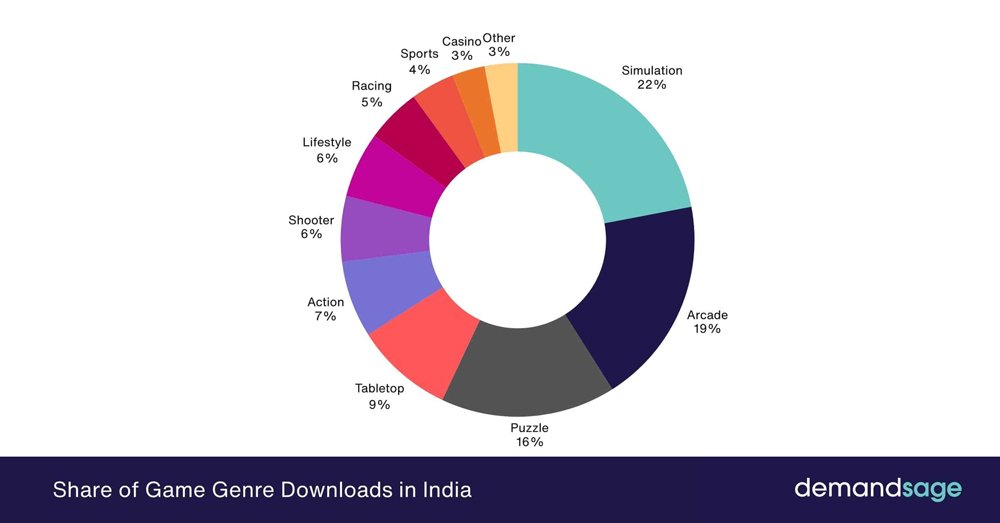
- Simulation games lead the market, accounting for 22% of total game downloads in India, highlighting strong user interest in real-world and immersive experiences.
- Arcade games rank second with 19%, showing their continued appeal due to simple gameplay and quick engagement.
- Puzzle games capture 16% of downloads, reflecting high demand for brain-training and casual gaming content.
- Tabletop games hold a 9% share, indicating the steady popularity of digital board and card games.
- Action games represent 7% of downloads, driven by players seeking fast-paced and competitive gameplay.
- Shooter games account for 6%, showing moderate but consistent interest in combat-focused titles.
- Lifestyle games also make up 6%, highlighting user engagement with simulation-based daily life and social games.
- Racing games contribute 5%, appealing to fans of speed-based and driving experiences.
- Sports games register 4%, reflecting a niche yet loyal player base interested in sports simulations.
- Casino games account for 3%, indicating limited but notable engagement in chance-based gaming.
- The Other category also represents 3%, covering emerging or less common game genres in the Indian market.
Console Gaming Trends
- Console software revenue reached $45 billion globally in 2025, up 4.2% year-over-year.
- PlayStation 5 commands 71% ninth-generation console market share vs Xbox’s 29%.
- The global games market hit $197 billion in 2025, with consoles at $45 billion (28% share).
- Console gaming grows at +4.7% CAGR 2025–2028, outpacingthe overall market.
- Xbox Game Pass surpassed 35 million subscribers by mid-2025.
- 83% of console games were sold digitally in 2023, dominating physical sales.
- Console microtransactions generated over $19.5 billion in 2025.
- Cloud gaming market to grow at 39.9% CAGR through 2033.
- Nintendo Switch shipped 153.10 million units by June 2025.
- PC/console gamers average higher spending per session than mobile users.
Average Gaming Time Spent
- Average gamers globally spend around 7.6 hours per week playing games in 2025.
- Many mobile players exceed 10–12 hours weekly, reflecting the casual play model.
- Hardcore gamers on PC/console often log more than 15 hours per week on average.
- In the U.S., teenagers and young adults spend 8+ hours per week gaming on average.
- Weekend play spikes contribute significantly to these averages across regions.
- Social and multiplayer games show higher weekly engagement due to community interaction.
- Peak periods like holidays and game launches temporarily increase average playtime.
- Esports participants and spectators often invest in excess of 20+ hours weekly between practice and viewing.
How Gamers Find New Games and Gaming News
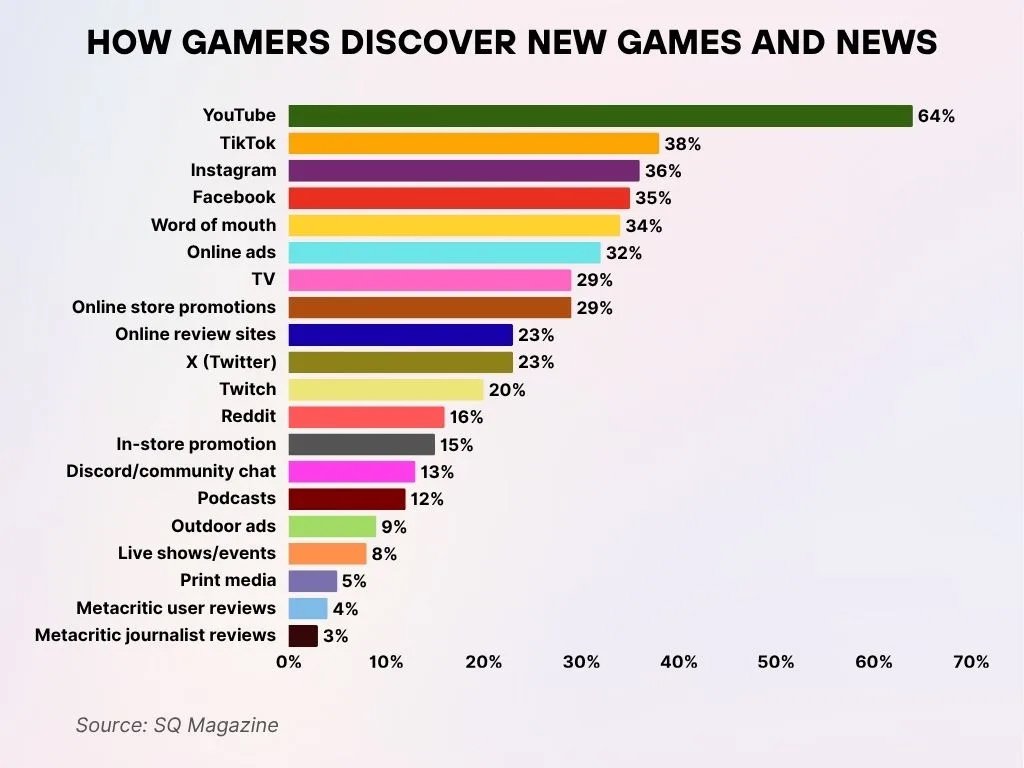
- YouTube stands out as the leading discovery platform, with 64% of gamers using it to discover new games and stay updated on gaming news.
- TikTok is rapidly increasing its impact, as 38% of gamers now rely on it for game discovery.
- Instagram plays a key role in gaming updates, with 36% of gamers using the platform to follow game news and new releases.
- Facebook remains relevant, as 35% of gamers depend on it for gaming updates and related news.
- Word of mouth continues to be influential, with 34% of respondents citing it as a trusted source for discovering new games.
- Online advertisements shape discovery decisions for 32% of gamers when exploring new titles.
- TV ads and online store promotions are equally impactful, being used by 29% of players for game discovery.
- Online review sites and X (Twitter) are consulted by 23% of gamers for new game information.
- Twitch attracts 20% of gamers, highlighting its importance in livestreamed previews and game showcases.
- Reddit serves as a discussion and discovery hub for 16% of gamers seeking game insights.
- In-store promotions continue to draw attention from 15% of gamers, despite the strong shift toward digital platforms.
- Discord and community chat platforms are used by 13% of gamers to stay informed about games.
- Podcasts help 12% of players remain updated on gaming news and trends.
- Outdoor advertising influences 9% of gamers, while live shows and gaming events attract 8%.
- Print media has a limited impact, influencing only 5% of gamers today.
- Metacritic user reviews are checked by 4% of gamers, while journalist reviews influence just 3%.
Peak Gaming Hours
- Global mobile gamers peak between 7 p.m. and 9 p.m., with the highest engagement at 8 p.m. local time.
- Asia-Pacific users play 7.2–10% more during 7 p.m. peak hours than other regions.
- Cloud gaming sees daily peaks from 7 p.m. to 11 p.m., with higher spikes on holidays.
- North America shows 40% more late-night gaming from midnight to 2 a.m. vs. global averages.
- Holiday gaming time surges 50–75%, reaching 2.5–3.5 hours daily from weekday 1.3 hours.
- Gaming traffic during peak hours rose 75% year-over-year for cloud services.
- APAC gamers average 11.3 hours weekly, topping the global 8.9-hour average.
- Steam games like PUBG hit 3.2 million peak concurrent users in the evenings.
Esports Market Revenue
- The global esports market revenue in 2025 is projected to be near $4.78 billion, up about 11% year‑over‑year.
- By 2029, analysts expect competitive gaming revenue to approach $5.93 billion.
- Sponsorships and media rights represent a growing share of esports income.
- Corporate investment and streaming deals add significant financial support.
- Prize money pools like the 2025 Esports World Cup’s $70 million+ total show monetization expansion.
- Event ticket sales contribute to overall revenue, especially in APAC and North America.
- Consumer merchandise adds incremental earnings for major esports franchises.
- Revenues from digital advertising around esports content continue to scale.
Most Popular Android Games in the US by Daily Active Users
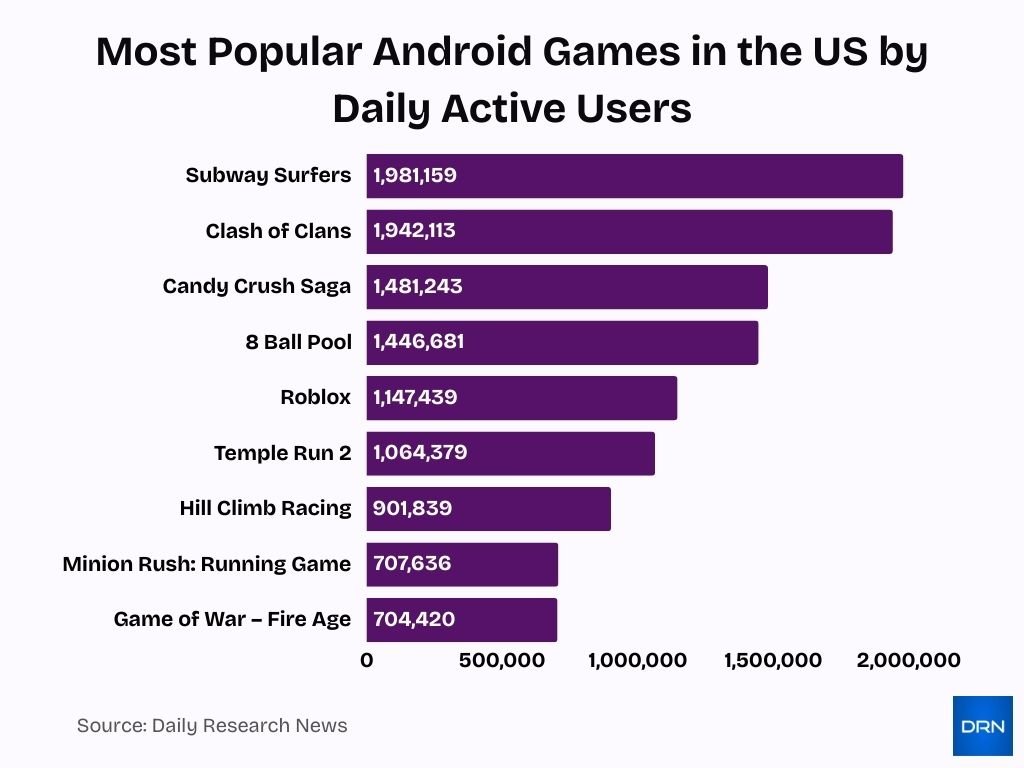
- Subway Surfers leads the US Android gaming market with an impressive 1,981,159 daily active users, making it the most-played Android game in the country.
- Clash of Clans closely follows, attracting 1,942,113 daily active users, highlighting its long-term player loyalty and strong community engagement.
- Candy Crush Saga maintains its massive casual gaming appeal, recording 1,481,243 daily active users across the US.
- 8 Ball Pool remains a consistent favorite among mobile gamers, drawing 1,446,681 daily active users through competitive and social gameplay.
- Roblox continues to dominate user-generated gaming experiences, reaching 1,147,439 daily active users on Android devices in the US.
- Temple Run 2 shows enduring popularity in the endless-runner genre with 1,064,379 daily active users.
- Hill Climb Racing secures a strong position with 901,839 daily active users, driven by its simple mechanics and broad appeal.
- Minion Rush: Running Game attracts 707,636 daily active users, benefiting from its globally recognized franchise.
- Game of War – Fire Age rounds out the list with 704,420 daily active users, reflecting continued interest in mobile strategy games.
In‑Game Purchases Revenue
- In-game purchases generated $200 billion globally in 2024, led by mobile gaming.
- Mobile in-app purchases hit $80.9 billion in 2024, up 4% year-over-year.
- PC microtransactions accounted for $24.4 billion in 2024, or 58% of PC gaming revenue.
- Console microtransactions reached $13.9 billion in 2024, comprising 32% of console revenue.
- Loot boxes generated over $15 billion in 2020, projected to exceed $20 billion by 2025.
- In-game purchases represent 63.4% of the global gaming market share in 2024.
- 52% of players make in-game purchases at least monthly, averaging $147 annually per gamer.
- Esports in-game item sales totaled $33 million in 2023 for select titles like Valorant.
- Cosmetics and battle passes drive 58% of Fortnite’s revenue through V-Bucks spending.
- In-app purchases comprise 55% of mobile gaming revenue, versus 38% from ads.
Emerging Gaming Technologies
- Cloud gaming market valued at $2.7 billion in 2024, projected to reach $77.7 billion by 2033 at 39.9% CAGR.
- AI in the gaming market hits $1.5 billion in 2024, expected to grow to $9.8 billion by 2034 with 20.8% CAGR.
- VR gaming market forecasted to increase by $34.94 billion from 2024 to 2029 at 32.5% CAGR.
- Cross-platform games boost player retention by 25-45% over single-platform titles.
- NFT gaming market estimated at $0.54 trillion in 2025, reaching $1.08 trillion by 2030 at 14.84% CAGR.
- Ray tracing adoption reaches 80% among RTX users in 2025, supporting over 870 games.
- Metaverse gaming attracts 38% of gamers aged 10-20 in key markets.
- Edge computing reduces gaming latency via nearby servers, minimizing lag on home networks.
- AI tools are used by 84% of gaming executives for content creation in 2025.
Frequently Asked Questions (FAQs)
There are approximately 3.32 billion active gamers globally in 2025.
The online gaming industry revenue is expected to be about $188.8 billion in 2025.
Mobile gaming accounted for 49% of total gaming market revenue in 2024.
The number of active mobile gamers is projected to reach 3.5 billion by the end of 2025.
Conclusion
Online gaming continues to diversify in both participation and economic influence. Console and mobile ecosystems are thriving alongside expanding esports markets, while players worldwide spend increasing hours engaging in digital play. Monetization through in‑game purchases and competitive scenes fuels growth, and emerging tech like cloud streaming, AI, and immersive platforms promise further innovation.
These trends highlight an industry evolving fast yet deeply rooted in player engagement and community dynamics.