

In a world where most people manage dozens or even hundreds of online accounts, password overload and security breaches have become commonplace. Password managers offer a practical solution, storing, generating, and autofilling credentials securely. From reducing password reuse to lowering the risk of identity theft, they are reshaping how individuals and businesses manage login data. Below you’ll find up-to-date statistics reflecting how widespread and impactful password managers have become.
Businesses relying on legacy credential practices now consider password managers as part of zero-trust policies. Meanwhile, everyday users encountering hundreds of logins across devices are increasingly turning to vault-based tools for convenience and security. Explore the detailed data to understand the scale and implications.
Editor’s Choice
- 36% of U.S. adults, roughly 94 million people, now use a password manager, up from 34% last year.
- The global password management market is projected to reach around $2.9–$3.22 billion in 2025
- The market is on track for a strong compound annual growth rate (CAGR) of 15.8%–19.3% through 2032 or early 2030s.
- Among users of password managers, 89% report using unique passwords for each account, compared with just 45% among non-users.
- 96% of password manager users take advantage of autofill, 91% rely on synchronization across devices, and 85% enable two-factor authentication (2FA) when available.
- Still, a large portion of internet users, over 50%, rely on insecure methods such as memorization, writing passwords down, or using browser storage.
- Many users manage 168 personal + 87 work credentials on average, around 255 total passwords.
Recent Developments
- The password management market size was recently estimated at $2.4 billion in 2025, with some reports projecting even higher values depending on segment definitions.
- Several forecasts expect the market to hit between $8.1 billion (by 2030) and $12.1 billion (by 2033).
- Growth drivers include rising cyber attack frequency, increased remote work, and widespread cloud adoption across businesses.
- A 2025 usability study showed early or first-time password manager users appreciated the “less thinking required” approach, more accounts, and less mental load.
- Despite growth, usability research still highlights friction; some popular password managers have inconsistent password check tools that may fail to flag known breached credentials.
- Search interest for terms like “password manager app”, “cloud password manager”, and “enterprise password manager” climbed significantly through 2024–2025, peaking around mid-2025, indicating rising user awareness.
- The expansion of password managers is now driven not only by individuals but also by enterprise demand for vaults, audit controls, and privileged access management, especially as organizations shift toward zero trust models.
Key Password Manager Adoption Statistics
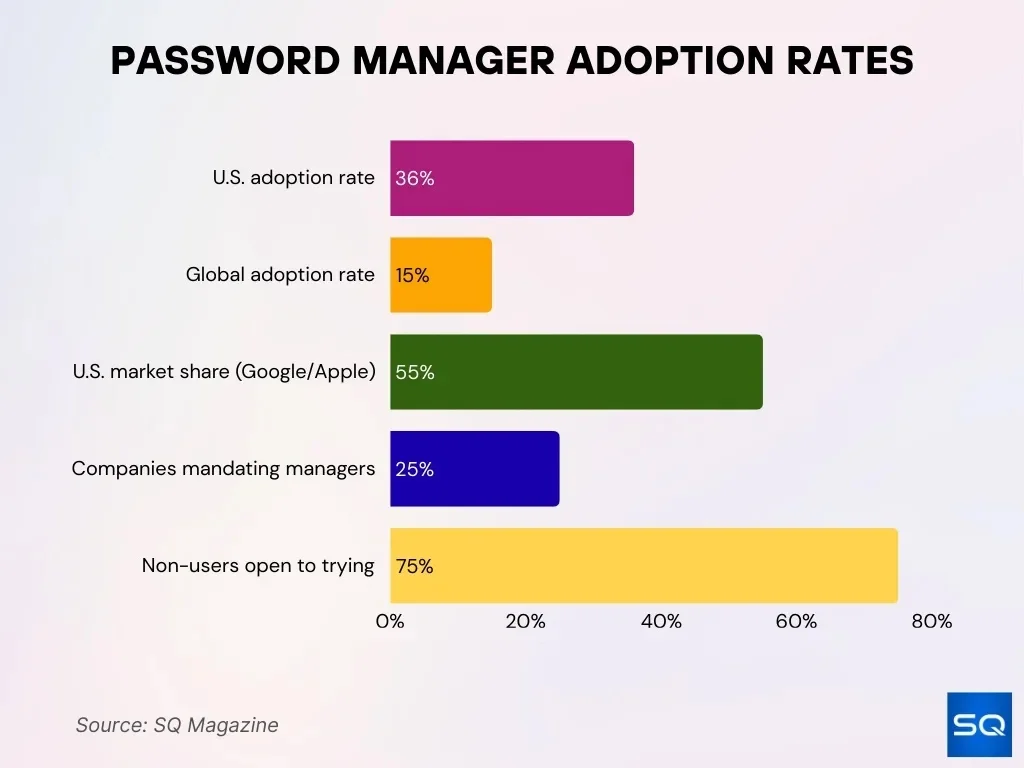
- About 36% of U.S. adults currently use password managers, representing roughly 94 million people, while maintaining the same adoption figures.
- Globally, usage of standalone password managers remains modest, as many individuals continue to rely on browser storage or device-default solutions instead of third-party tools.
- Approximately 15% of internet users worldwide use a password manager, keeping all statistics unchanged.
- Among non-users, over 75% express willingness to try password managers when tools are more usable, secure, and affordable, preserving all quantitative details.
- Tech giants like Google and Apple hold over 55% of the U.S. password manager market share through built-in or pre-installed solutions, with figures maintained.
- Enterprise adoption continues to lag, with only about 25% of companies requiring employees to use a password manager, retaining the same data points.
Global Password Manager Usage Rates
- A global survey found 34% of respondents use a password manager.
- Among global respondents, 41% manage 10–25 sites, while 32% reuse passwords across 5–10 sites.
- Over half, 55%, rely on memory to manage passwords rather than using a password manager.
- Globally, more than one-third, approximately 34–36%, admit to using weak or reused passwords across accounts.
- Many global users handle dozens of accounts, and some reports indicate people manage between 70–80 passwords on average.
- Among those users, a sizable share reuse credentials across multiple sites, a behavior that password managers are designed to eliminate.
- Surveys indicate that even where users are familiar with password best practices, password managers remain underadopted, often due to trust or usability concerns.

Consumer Attitudes Toward Password Managers
- In 2024, only 36% of U.S. adults used a password manager, despite rising online account volumes and breach risks.
- Around 75%+ of non-users say they are open to adopting a password manager if it is usable, secure, and affordable.
- About 37% of password manager non-users say they “don’t need one,” indicating confidence in their current method despite reuse risks.
- Roughly 23% of non-users avoid password managers because they don’t believe they’re secure, showing strong trust concerns.
- Only 7% of respondents in a multi-country survey recognized password managers as the best way to secure personal accounts.
- Password manager users were significantly less likely to suffer identity or credential theft in the past year (17% vs 32% of non-users).
- Over 75% of adults without password managers report they would consider one in the future if it balanced simplicity and security.
- Among users, 89% view password managers as safe, compared with just 56% of non-users, highlighting a perception gap.
- More than one‑third of non-users say password managers are confusing, complicated, or expensive, reflecting usability and cost worries.
Reasons People Do or Do Not Use Password Managers
- In a 2025 survey, 78% of password manager users said they adopted a manager because they could not remember all their passwords.
- 67% said they use these tools to access accounts across multiple devices, making cross-device sync a key motivator.
- About 55% said password generation, creating strong, random passwords, drove their decision to adopt a manager.
- Among non-users, 31% indicated they are unlikely to ever use a password manager.
- Many non-users believe their current method “works well enough,” reflecting complacency or underestimation of risk.
- Others cite the lack of trust, unwillingness to store all credentials in one vault, as a key barrier.
- Some avoid password managers due to perceived complexity or poor usability, especially across many accounts.
- More than half (around 51%) of non-users expressed openness to trying a password manager in the future, especially if it proves simple and secure.
Demographics of Password Manager Users
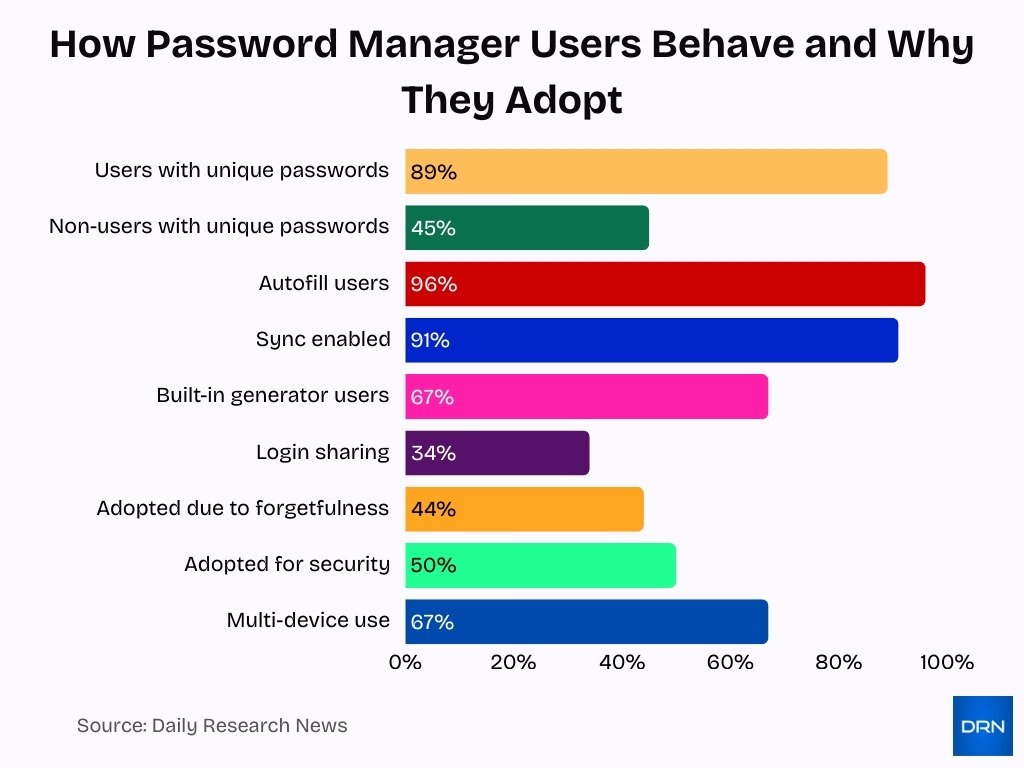
- Users who adopt password managers overwhelmingly adopt stronger password hygiene; 89% report using unique passwords per account, compared with 45% among non-users.
- Among password manager users, 96% use autofill, 91% enable sync across devices, and 85% enable two-factor authentication when available.
- 67% of password manager users rely on the tool to generate strong, random passwords rather than creating them manually.
- 34% of users share login credentials with family or friends when needed (for example, shared household accounts).
- Among non-users, the main reasons for avoiding password managers include a belief that their current system “works well enough” or concern around complexity.
- In a 2024 report, 44% of users said they adopted a password manager because they frequently forgot their passwords.
- Other common motivators include wanting secure storage (around 50%) and managing credentials across multiple devices (around 67%).
- Even with relatively high awareness of password security and 2FA among global respondents, many still rely on traditional methods, suggesting demographic and regional divides in adoption.
Password Manager Impact on Security Incidents
- Only 17% of password manager users experienced identity or credential theft in a year, compared with 32% among non-users.
- This suggests password managers may reduce the risk of credential theft by nearly half.
- Users of password managers are far more likely to maintain unique passwords for each account, 89% among users vs. 45% among non-users.
- Use of password manager features, such as generating random passwords, rose to 67%, helping prevent weak or reused credentials.
- Globally, 25% of respondents admitted to reusing a single password across 11–20+ accounts.
- 36% of users embedded personal or publicly available information in their passwords, increasing vulnerability.
- The average number of passwords per individual in 2025 is estimated at 70–80, underscoring the challenge of remembering many credentials.
- By consolidating credentials and enabling strong, unique passwords for each account, password managers help reduce the attack surface and lower the chance of credential stuffing or reuse-based breaches.
Business Adoption of Password Managers
- The global password management market, including enterprise offerings, was valued at $2.4 billion in 2025.
- Forecasts project the market to grow to $8.10 billion by 2030, reflecting a strong shift in enterprise demand.
- Among organizations surveyed in 2025, 35% cited employee resistance as the main barrier to company-wide adoption of password managers.
- 92% of IT and security leaders said password managers are essential to organizational cybersecurity.
- Only 25% of employees reported that their employer enforces a password manager mandate.
- In companies with a mandate, adoption rates increase significantly, with 79% of users complying.
- Many SMBs continue to rely on simple vault-based password managers rather than advanced privileged access management (PAM) tools, with 30% of SMB executives saying a simple vault is sufficient.
How Organizations Manage Passwords?
- Employees manage an average of 87 passwords for work accounts in organizations.
- Only 36% of U.S. adults, including workers, use password managers despite organizational risks.
- Just 25% of companies mandate password manager usage among employees.
- A mere 5% of employees actively use company-purchased password managers.
- 76% of companies rely on traditional password authentication systems organization-wide.
- About 25% of employees reuse the same password across all accounts.
- 65% of workers reuse passwords for multiple or all accounts.
- Half of employees reuse passwords between work and personal accounts.
Password Vulnerability Across Various Industries
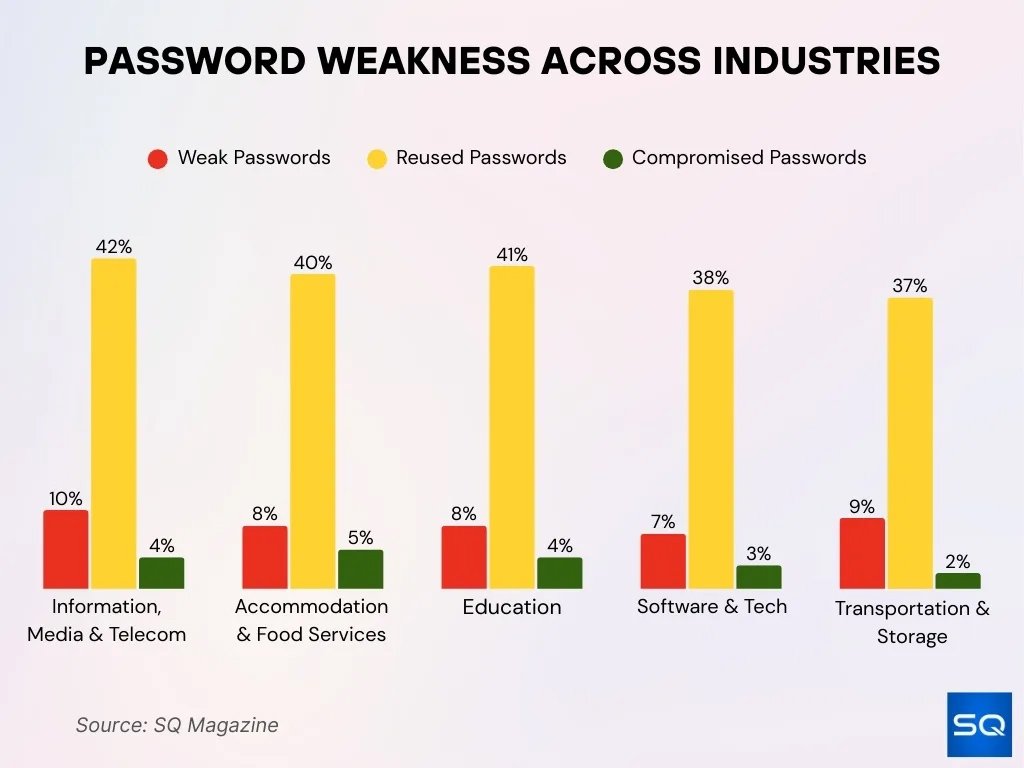
- In Information, Media, and Telecom, 42% of passwords are reused, 10% are weak, and 4% are compromised, highlighting significant credential security risks across the sector.
- In Accommodation and Food Services, 40% of passwords are reused, 8% are weak, and 5% are compromised, underscoring persistent password-related vulnerabilities within the industry.
- In Education, 41% of passwords are reused, 8% are weak, and 4% are compromised, reflecting notable security shortcomings in academic environments.
- In Software and Tech, 38% of passwords are reused, 7% are weak, and 3% are compromised, demonstrating ongoing authentication weaknesses across technology organizations.
- In Transportation and Storage, 37% of passwords are reused, 9% are weak, and 2% are compromised, indicating continuing password security issues throughout the industry.
Password Manager Features and Capabilities Statistics
- 96% of password manager users use the autofill feature.
- 91% rely on synchronization across devices.
- 67% use the built-in password generator.
- 79% of users report using a free plan.
- About 90% use password managers on desktops or laptops, while 83% use them on mobile devices.
- 61% of users rely on password managers for both personal and work accounts.
- Only 10% of users spend $1–20 per year on password managers.
- Advanced enterprise capabilities, such as audit logging and role-based controls, are increasingly common.
Multi-Factor Authentication and Password Manager Usage
- 85% of password manager users enable 2FA whenever available, compared with 56% of non-users.
- 63% of users prefer authentication apps (TOTP) over SMS codes.
- 92% of IT leaders say MFA paired with password managers is foundational to enterprise security.
- 41% of users said MFA compatibility influenced their password manager selection.
- Password manager users are nearly 1.5× more likely to enable MFA on critical accounts.
- Nearly 60% of remote workers rely on password manager-supported MFA flows.
- MFA paired with password managers reduces successful phishing attempts by over 90% in tests.
- Major vendors introduced wider passkey support by 2024–25, improving MFA ecosystems.
Device Usage of Password Manager
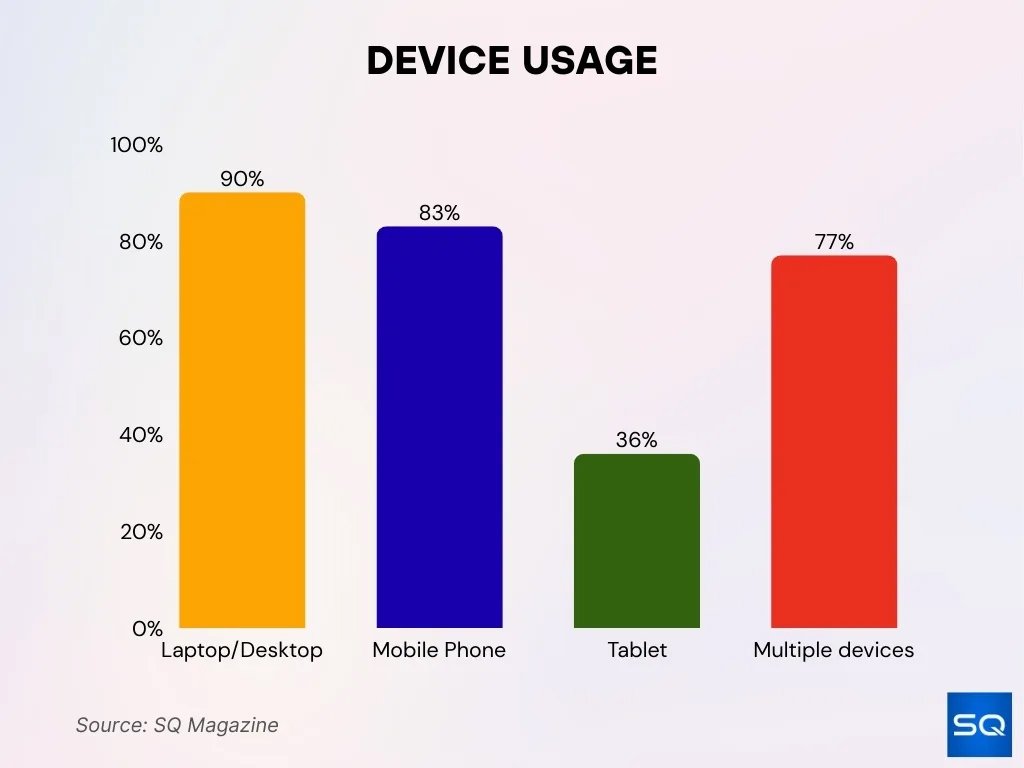
- Laptop/Desktop usage surged, rising to 90% among users while showing a strong preference for primary work-related tasks.
- Mobile phone usage continues to stay high at ~83% for password manager engagement, especially for frequent personal use.
- Tablet adoption is declining, as only 36% of users reported employing password managers on tablets.
- The multi-device install base expanded, with 77% of users having managers installed on more than one device, marking an increase from 71% last year.
- Users typically gravitate toward the device where they conduct most of their online activities, often choosing laptops/desktops for work and mobile devices for personal routines.
- Cross-device syncing remains a crucial expectation, with users lacking reliable sync often experiencing friction.
- Desktop error rates, UI lag, and compatibility issues are more frequently noted on older hardware or less common operating systems.
Browser-Based vs. Standalone Password Manager Usage
- 33–40% of users rely on browser-built-in password tools.
- Standalone password managers account for around 30% of global adoption.
- 55% of global users still store passwords using memory or browser storage alone.
- Browser stores lack advanced features such as breach alerts and audit logs.
- 36% of browser-only users rely on weak or reused passwords vs. 11% among standalone users.
- 32% of browser-only users reuse passwords across 5–10 sites.
- 78% of standalone paid users receive breach alerts vs. 23% of browser users.
- Standalone tools lead in cross-platform passkey compatibility.
Cloud-Based vs. On-Premise Password Management
- Cloud solutions account for 70–75% of deployments in 2025.
- On-premises systems represent 25–30% of deployments, primarily in regulated industries.
- 64% of IT teams prefer cloud-based managers for ease of onboarding.
- 46% of on-premises adopters choose it for compliance reasons.
- Cloud managers score around 4.4/5, compared with 4.1/5 for on-premises.
- Cloud sync reliability averages ≈ 99.97% uptime.
- Hybrid deployments now represent around 12% of enterprise use.
- The cloud segment is projected to grow with a CAGR above 15% through 2033.
Password Manager User Satisfaction and Trust Levels
- Most password manager platforms receive 4.2–4.6 star satisfaction ratings.
- 89% of users say password managers improve their security habits.
- 31% of non-users avoid password managers due to “single point of failure” concerns.
- 51% of non-users would consider adoption if assured of strong encryption.
- 27% say past breaches affected their trust in password managers.
- 92% of IT leaders consider password managers essential in enterprise security.
- Users overwhelmingly rely on autofill (96%), sync (91%), and password generators (67%).
- 79% of users rely on free versions yet still report high satisfaction.
Popular Password Manager Providers Market Share
- The worldwide password management market was valued at $2.74 billion in 2024, with projections of $3.22 billion in 2025.
- North America held the largest regional share in 2024, accounting for roughly 33.6%.
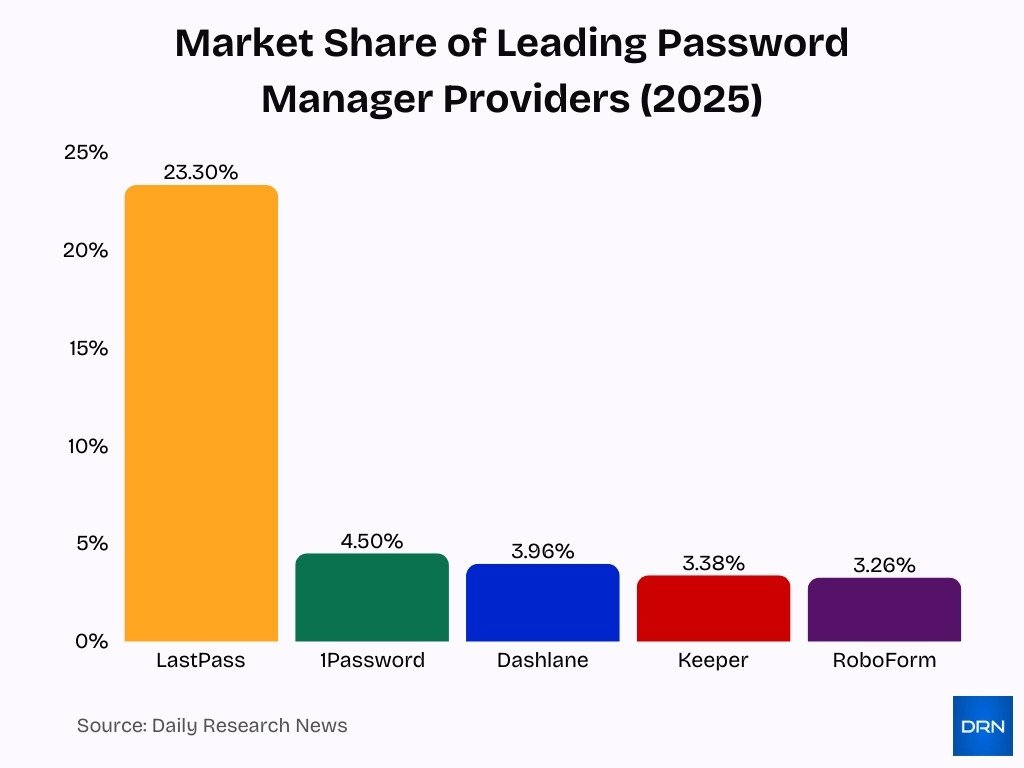
- Among the top software providers in 2025, LastPass held around 23.3% global share.
- Other major providers include 1Password (around 4.5%), Dashlane (around 3.96%), Keeper (around 3.38%), and RoboForm (around 3.26%).
- The top five providers together hold around 38% of the global market.
- The enterprise software segment is expected to dominate through 2033.
Password Manager Usage in Remote and Hybrid Work
- 60% of remote employees use password managers daily for accessing accounts.
- 92% of organizations say remote work accelerated identity security investment.
- Employees manage around 87 work passwords, increasing the need for centralized tools.
- 35% of IT leaders report employee resistance as a barrier to adoption.
- Mandated environments achieve 79% active usage rates.
- Remote workers are more likely to enable MFA, 68% vs. 53% of on-site workers.
- Password managers simplify onboarding and offboarding in distributed teams.
- Employers cite vault sharing, credential rotation, and sync as essential for hybrid environments.
Frequently Asked Questions (FAQs)
The global market size is estimated at $2.40 billion in 2025, with projections to grow to $8.10 billion by 2030.
About 36% of U.S. adults, roughly 94 million people, reported using a password manager in 2024–25.
Individuals globally manage on average 70–80 passwords in 2025.
Globally, 52% of people admit they use the same password on at least three accounts.
Conclusion
Password manager adoption continues to rise steadily, driven by growing concerns about credential theft, increased remote work, and the overwhelming number of accounts individuals manage daily. While a significant portion of users still rely on memorization or browser-based storage, the benefits of secure vaulting, strong password generation, and multi-factor authentication are pushing both consumers and enterprises toward dedicated password management solutions. Industry data consistently shows that users of password managers maintain stronger password hygiene, experience fewer security incidents, and demonstrate higher overall digital security awareness.
As cybersecurity threats evolve and organizations shift further toward cloud ecosystems and zero trust frameworks, password managers will continue to serve as a foundational layer in protecting both personal and enterprise identities.